Fidelity Assesses the Limits of AI's Influence on the Crypto Market

cryptonews.ruPublicado em 2026-08-20Última atualização em 2026-08-20

Resumo

Fidelity Analysts Assess the Limits of AI's Impact on the Crypto Market Fidelity Digital Assets senior analyst Max Waddington notes that AI agents could become a new source of activity in the digital asset sector, from payments to trading and lending. However, the benefits will likely be distributed unevenly. Fidelity's study of over 100,000 GitHub developers shows AI coding assistants increased commit counts by up to 180% and releases by 30%. These tools enable smaller teams to build blockchain applications faster, though critical financial software still requires manual code review. In the crypto industry itself, developer counts fell in 2026 amid lower prices, but commits per developer continued to rise. Waddington cautions that more applications don't guarantee success; user adoption, liquidity, compliance, and trust remain key. Autonomous AI agents, capable of payments, trading, liquidity provision, and lending, are emerging as another driver. Blockchains are suitable due to 24/7 operation and programmable settlements. According to Keyrock, AI agents had already conducted over 176 million transactions worth more than $73 million by May, predominantly using USDC. Infrastructure is developing, with Coinbase launching tools like the x402 protocol and 'Coinbase for Agents'. However, Fidelity expects agents to use multiple platforms (both public blockchains and traditional finance systems) based on cost and convenience. A surge in AI-driven transactions may not proportion...

AI agents could become a new source of activity for the digital asset sector—from payments to trading and lending. The benefits from this will be distributed unevenly among market participants, believes Max Waddington, Senior Analyst at Fidelity Digital Assets.

Developers Are Using AI More Frequently

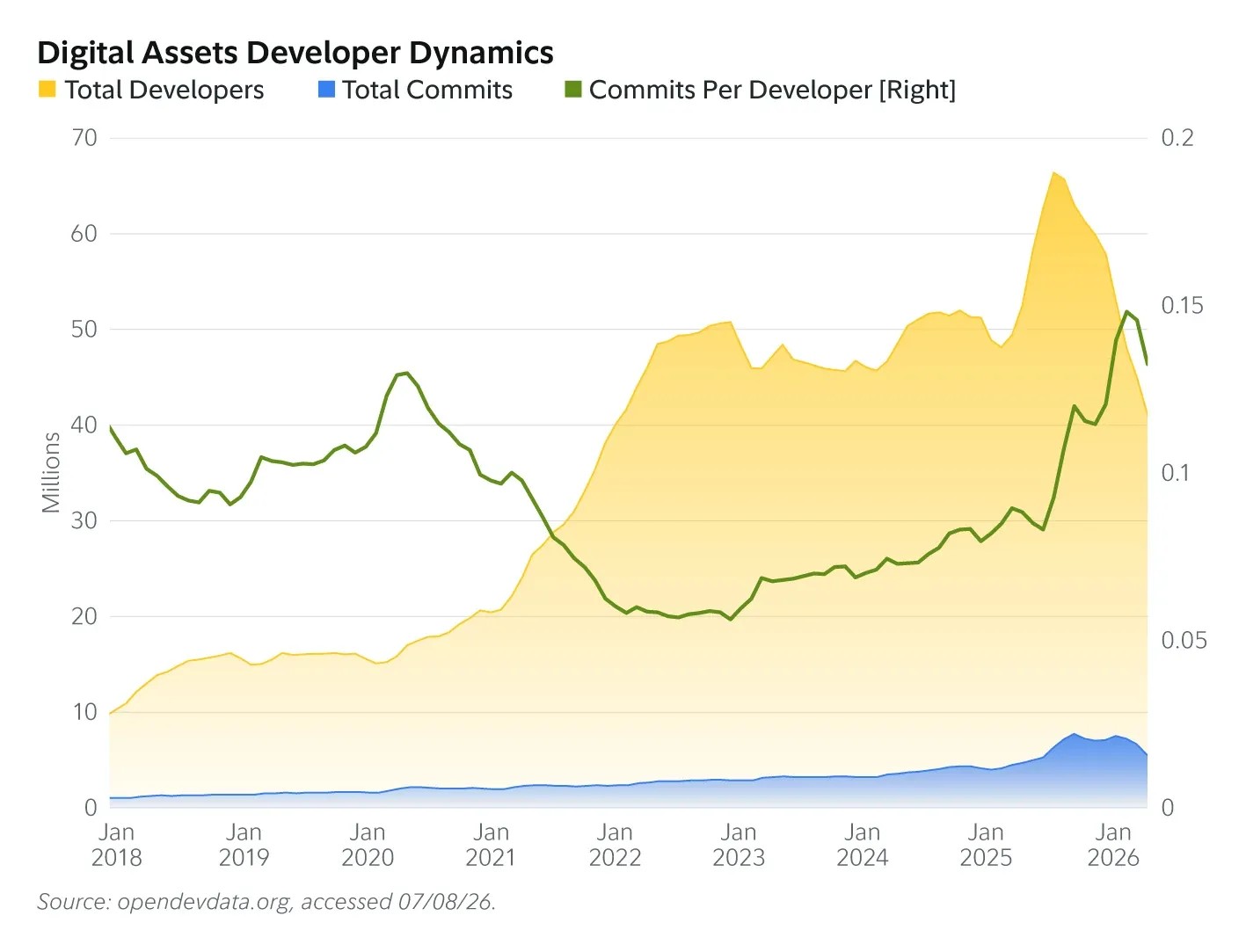
Fidelity studied data from over 100,000 GitHub developers. The use of digital programming assistants increased the number of commits by up to 180% and the number of releases by 30%.
Source: Fidelity.

Waddington noted that such tools will allow small teams to build and launch blockchain applications faster. However, in financial and other critical software, code still requires manual review.

A similar trend was observed within the crypto industry itself. In 2026, against the backdrop of declining digital asset prices, both the number of developers and the volume of commits decreased, with the latter indicator falling more slowly. As a result, the average number of changes per developer continued to grow.

At the same time, an increase in the number of applications alone does not guarantee their success. Projects still need users, liquidity, regulatory compliance, and trust. According to Waddington, as development becomes cheaper, these factors will come to the forefront.

AI Agents Will Go On-Chain

Autonomous AI agents could become an additional driver of activity in the sector. They are capable of independently making payments, trading assets, providing liquidity, as well as issuing and taking loans.

Blockchains are suitable for such operations due to 24/7 operation, programmable settlements, and the ability to conduct microtransactions without human involvement.

This market is already taking shape. According to Keyrock, by May, AI agents had conducted over 176 million transactions worth more than $73 million. About 98.6% of the operations involved the USDC stablecoin.

Infrastructure for such scenarios is also developing. One of the most active players here is the exchange Coinbase, which previously launched the x402 protocol for automatic internet payments and later introduced Coinbase for Agents—a set of tools for trading and settlements using AI.

Nevertheless, Fidelity does not expect all agent operations to migrate to public blockchains. Banks, fintech companies, and traditional players are developing their own solutions, possessing an established customer base, infrastructure, and access to credit products.

In the view of analysts, AI agents will most likely work with multiple platforms simultaneously, choosing between them based on cost and convenience.

What are AI agent payments (agentic payments)?

Transaction Growth Does Not Guarantee Revenue Growth

Even if AI attracts millions of new operations to blockchains, this will not necessarily lead to a proportional increase in revenue for the networks themselves.

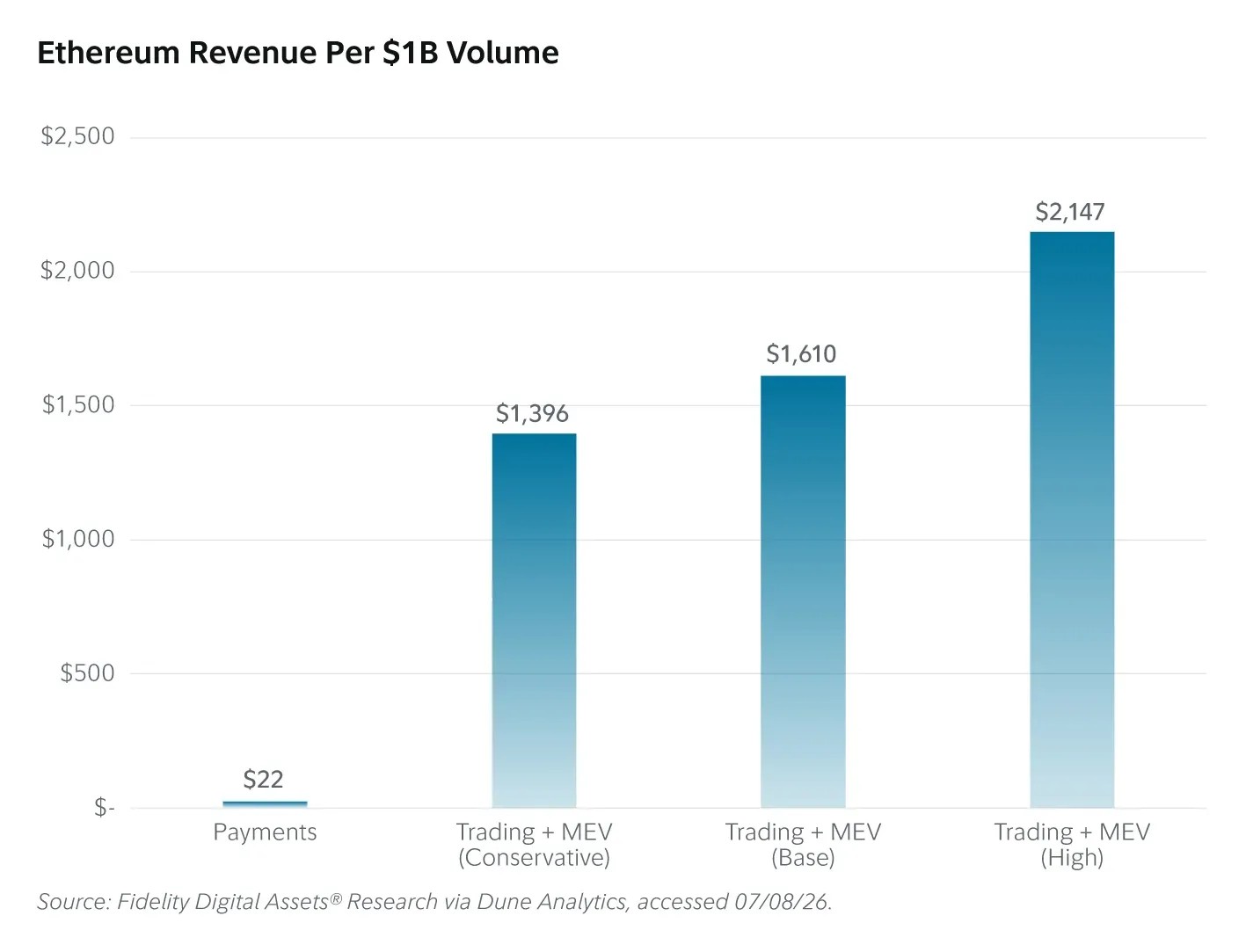
As an example, experts cited payments: their number can grow rapidly, but the fee per transaction remains low. Such transactions can also be batched, conducted off the main network, or moved to cheaper L2 solutions.

Operations with capital generate much more significant revenue. According to Fidelity's calculations, over the last 180 days, trading brought the base layer of Ethereum 49 times more revenue per dollar of volume than payments. Additional revenue is also created through MEV.
Source: Fidelity.

This is why analysts see greater potential in AI agents that will trade, lend, borrow, and provide liquidity. In the case of mass adoption of automatic payments, the main beneficiaries may be stablecoin issuers and infrastructure providers, rather than the native tokens of blockchains.

Recall that in March, specialists at Bernstein named digital assistants as the future of stablecoins. Later, Franklin Templeton noted that AI agents could become a driver of crypto payments.

end-content
Perguntas relacionadas

QAccording to the Fidelity analysis mentioned in the article, what are the two main areas of crypto market activity that AI agents could significantly impact?

AAccording to the Fidelity analysis, AI agents could significantly impact two main areas: 1) Development of blockchain applications by increasing developer productivity, and 2) On-chain activity through autonomous operations like payments, trading, lending, and providing liquidity.

QWhat key finding about developer productivity using AI assistants did Fidelity's study of GitHub data reveal?

AThe study of over 100,000 GitHub developers revealed that the use of AI coding assistants increased the number of code commits by up to 180% and boosted the number of software releases by 30%.

QWhy does the article suggest that a surge in AI-driven transactions might not proportionally increase blockchain networks' revenue?

AThe article suggests this because many AI-driven activities, like payments, generate low fees per transaction. Furthermore, these transactions can be batched, processed off-chain, or moved to cheaper Layer-2 solutions, limiting revenue for the base layer. Revenue from capital-based activities like trading is much more significant.

QWhat is the primary type of cryptocurrency used by AI agents for their on-chain transactions, according to data from Keyrock cited in the article?

AAccording to data from Keyrock cited in the article, approximately 98.6% of transactions conducted by AI agents used the stablecoin USDC.

QWhat does the article identify as a major challenge for new blockchain projects, which will become even more critical as AI lowers development costs?

AThe article identifies that attracting users, ensuring liquidity, complying with regulatory requirements, and building trust are the major challenges for new projects. As AI makes development cheaper, these factors will become the primary focus for success, rather than just the ability to create an application.

Leituras Relacionadas

Haiwei Huaxin's Official Seal Seized by Over a Hundred People, High-Stakes Corporate Battle's 'Nuclear Deterrence' in Action Again

On August 18th, Haowei Huaxin, a semiconductor firm specializing in gallium arsenide and gallium nitride wafers, reported that over a hundred individuals forcibly entered its offices and seized the company's official seals from a safe, including the corporate, contract, and party committee seals. The incident is the latest escalation in a protracted control dispute. Haowei Huaxin, established in 2010, was originally a joint venture. Control became contested after 2021 when Zhenwei Financial Holding injected capital, becoming the largest shareholder (34.01%), while former parent Haite High-Tech's stake was diluted to 33.79%. An agreed-upon governance structure collapsed, leading to mutual accusations. Haite claimed it was locked out of the subsidiary's premises, while also alleging improper management like livestock being kept on the chip fabrication site. After state-owned Qingdao Haiyue Holdings took over Zhenwei's stake in 2023, Haite accused it of illegally seizing control. Despite Haite winning several legal battles in 2024-2026, which affirmed its rights to nominate directors and the chairman, it failed to regain physical control or recover the seals. The stakes are high: market valuations for Haite's stake in Haowei Huaxin are estimated between 3.7 to 5 billion USD, yet it is only valued at about 83 million USD on Haite's books. Losing control effectively jeopardizes a significant portion of Haite's value. In response to the seal seizure, Haite framed it as a "shareholder rights protection" action agreed upon by five shareholders. This mirrors a pattern in Chinese corporate disputes where seizing physical seals becomes a tactic to paralyze the opponent's daily operations, seen in past conflicts at companies like Dangdang and Bitmain. However, such actions don't resolve underlying ownership issues; the opposing party can report the seals stolen, declare them void, and apply for new ones, albeit with significant delay. The incident underscores how fragile corporate governance can devolve into physical confrontations over symbols of authority, with control ultimately determined by law and shareholding, not possession of a seal.

marsbitHá 24m

Haiwei Huaxin's Official Seal Seized by Over a Hundred People, High-Stakes Corporate Battle's 'Nuclear Deterrence' in Action Again

marsbitHá 24m

Bernstein Interprets MRNA's 177% Surge: What's Fundamentals and What's Hype?

Bernstein's analysis of Moderna's 177% stock surge following positive Phase 3 results for its individualized neoantigen therapy (INT) in melanoma distinguishes fundamental drivers from market speculation. The clinical breakthrough is real: the INTerpath-001 trial met its primary and key secondary endpoints, providing crucial validation for mRNA technology in oncology beyond infectious diseases. However, Bernstein argues the magnitude of the stock move cannot be justified by this single trial's fundamentals alone. The surge was amplified by three key factors: 1) A re-rating of Moderna's mRNA platform potential for expansion into other cancers, 2) A massive short squeeze, given ~15% of shares were sold short pre-announcement, and 3) The compelling "cancer vaccine" narrative that fueled broader investor enthusiasm. While the melanoma success is significant, Bernstein cautions that replication in lung, kidney, and bladder cancers—which have different immunogenicity—is not guaranteed. Furthermore, INT's commercial model faces challenges: it's a personalized treatment, not a mass-market vaccine, implying higher production costs and potential margin pressures despite a projected multi-billion dollar peak sales opportunity. The report also notes sector rotation, with some funds moving from crowded AI/semiconductor trades into defensive healthcare stocks, adding further momentum. In conclusion, Bernstein maintains a "Market-Perform" rating and a $45 price target, far below the post-surge price. It views the current valuation as pricing in an optimistic multi-cancer platform success and efficient commercialization that are yet to be proven. The clinical inflection point is clear, but the earnings inflection point awaits validation across future trials and commercial execution.

marsbitHá 25m

Bernstein Interprets MRNA's 177% Surge: What's Fundamentals and What's Hype?

marsbitHá 25m

Trading

Spot
活动图片