Mining Scale Skyrockets: Why Can't Bitdeer Hold onto Its Bitcoin?

Foresight NewsPublicado em 2026-06-22Última atualização em 2026-06-22

Resumo

Bitdeer's May 2026 operational data reveals a stark contrast: while its Bitcoin mining output surged to 921 BTC, a 370% year-over-year increase, its end-of-month holdings plummeted to just 171 BTC. This significant disparity highlights that the company, amidst a strategic pivot towards AI cloud infrastructure, continues to rely heavily on selling newly mined Bitcoin to fund operations and expansion, despite reporting a steady $69 million in annualized recurring AI revenue. The trend is consistent with Q1 2026 figures, where mining output reached 2,033 BTC but holdings were a mere 31 BTC, with $206.8 million from digital asset disposals. While the AI business, showing 90% GPU utilization, offers a potential future cash flow buffer to reduce dependency on Bitcoin sales, its current contribution to actual confirmed revenue remains limited. The transformation introduces new risks related to client acquisition, capital-intensive data center projects like Tydal, and delivery timelines. The core question raised is whether the AI venture will successfully generate sufficient stable cash flow to allow Bitdeer to retain more of its mining proceeds as Bitcoin treasury assets, or if the shift merely changes the form of financial pressure while Bitcoin reserves continue to dwindle.


Written by: Liam Akiba Wright

Compiled by: Chopper, Foresight News


TL;DR


  • Bitdeer mined 921 bitcoins in May 2026, but held only 171 bitcoins by month-end.
  • Behind this data discrepancy, Bitdeer is simultaneously developing its AI cloud business, which in theory could reduce the need to sell bitcoin for liquidity.
  • However, May's operational data shows that Bitdeer's bitcoin holdings remain low. Whether AI business revenue can support corporate expansion and reduce bitcoin selling remains uncertain.


The latest operational data from Bitdeer reveals the realistic contradiction behind the collective pivot of bitcoin mining companies to the AI track: while mining output has soared, the total bitcoin holdings at month-end have shrunk significantly compared to the same period last year.


Bitdeer disclosed that it mined a cumulative 921 bitcoins in May 2026, a 370% year-on-year surge; yet its month-end bitcoin holdings were only 171. In contrast, the company's financial report for May 2025 showed mining output of 196 bitcoins and holdings as high as 1,351.


The stark contrast between output and holdings points directly to the selling pressure in the context of mining companies' transition to AI. The valuation logic Bitdeer conveys to investors is that a complete business map will be formed by its computing power mining farms, self-developed mining machines, power sites, AI cloud computing resources, and future data center colocation revenue. However, the bitcoin holding data on the balance sheet indicates that this transformation strategy still heavily relies on selling newly mined bitcoins to maintain operational cash flow.


The current situation presents both encouraging and concerning aspects. In theory, AI business revenue could create a cash buffer, alleviating the pressure for companies to sell tokens during downturns in the mining industry. A combined look at May and Q1 disclosure data shows: Bitdeer's mining output continues to rise, but its book bitcoin inventory has plummeted; simultaneously, the newly developing AI infrastructure business introduces a new dimension of risk.


The Discrepancy Between Bitcoin Production and Holdings is the Clearest Signal


Comparing the May data from the two years, the two core metrics show completely opposite trends. Mining output increased from 196 to 921 bitcoins, while bitcoin holdings plunged from 1,351 to 171.


Supplementary note: The May 2026 mining statistics include both proprietary and pooled mining output, while the May 2025 period only counted proprietary mining. Even after adjusting for this statistical difference, the vast disparity in holding size remains highly pronounced.
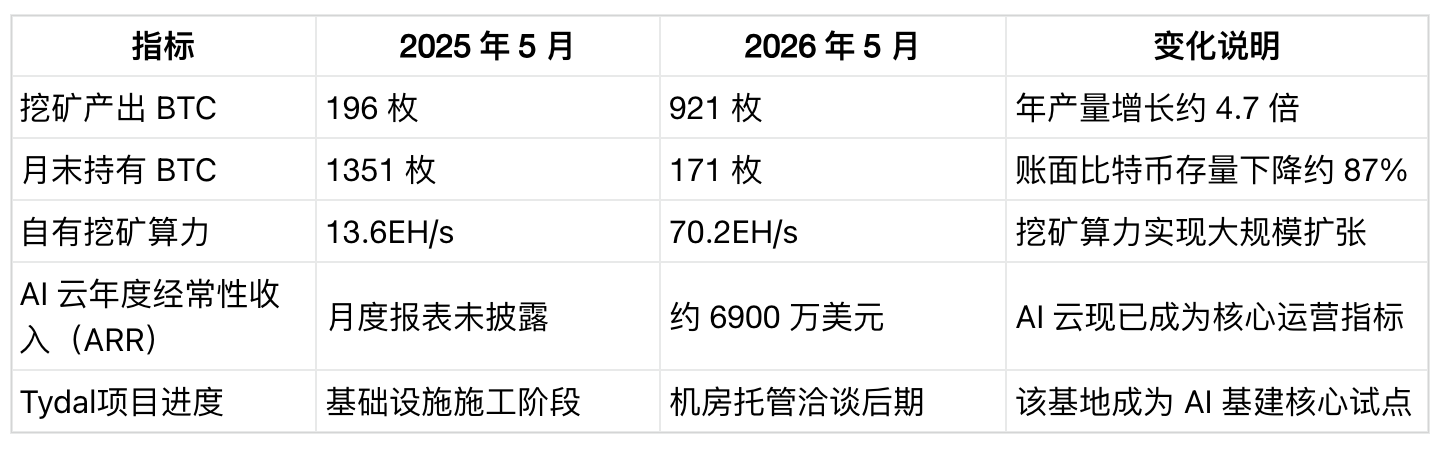


A rough estimate based on Bitcoin's price range of approximately $62,700 to $62,900 on June 19th: the total value of Bitdeer's May mining output was about $57.9 million, while the market value of its month-end bitcoin holdings was only $10.7 million.


This is merely an estimation based on spot prices and not official financial data disclosed by the company, yet it sufficiently illustrates the scale difference. While the monthly mining output volume is substantial, the retained bitcoin size on the books is severely mismatched with the company's overall operational scale.


Monthly holdings are a static point-in-time data point, unable to fully depict the entire flow of funds or precisely calculate how much of the month's output was sold, pledged, retained, or used for other purposes. However, this data is enough to prove that expanding computing power and increasing mining output have not translated into bitcoin treasury reserves for the company.


For a bitcoin miner transitioning to AI infrastructure, this data gap alters the investment logic: new AI revenue should either help the company retain more bitcoin or be used to fund capital-intensive infrastructure expansion.


Bitdeer's Q1 2026 financial report further confirms the trend seen in the May data. In Q1, Bitdeer mined 2,033 BTC, compared to only 350 BTC in the same period of 2025; quarter-end bitcoin holdings were a mere 31 BTC, compared to 1,156 BTC a year earlier. The company also disclosed the disposal of digital assets, realizing a total of $206.8 million.


As mining farm scale expands, Bitdeer's mining revenue has grown significantly, while bitcoin holdings on the balance sheet continue to decline, indicating the company is consistently converting mined bitcoins into funds needed for operations and expansion.


The company reported a net cash outflow of $346.9 million from operating activities in Q1; capital expenditures were $93.7 million, used for data center infrastructure, GPU procurement, tariff payments, and mining machine deployment; total corporate liabilities reached $1.9 billion. Total Q1 revenue was $188.9 million, with adjusted EBITDA at $14.4 million, and cash, cash equivalents, and restricted cash combined amounted to $297.7 million.


The company is progressing with a large-scale capital investment plan, where bitcoin reserves, debt financing, and infrastructure investment are interlinked, forming a unified development strategy.


Can AI Business Cash Flow Alleviate Bitcoin Selling Pressure?


Bitdeer's AI cloud business data is the core argument supporting market optimism. In May, the company disclosed that its AI Cloud Annual Recurring Revenue (ARR) remained stable at $69 million, with GPU utilization at 90%. It had deployed 4,248 GPUs, with an additional 3,305 GPUs under external lease agreements; two Nvidia GB300 NVL72 computing clusters were launched, and its Model Studio had been adapted for the Nvidia Nemotron 3 large language model.


AI cloud revenue had seen rapid growth prior to May. March monthly data showed ARR at about $43 million, rising to $69 million in April and maintaining that level in May. The growth rhythm shifted from high-speed expansion to steady operation, testing the business's sustainability.


Annual Recurring Revenue is merely an annualized projection metric. In Q1, the company's recognized AI cloud revenue booked into the income statement was only $3.7 million. There is a clear gap between the two: annualized revenue represents potential future revenue space, while recognized revenue is actual cash flow recorded in the profit and loss statement. A $69 million ARR figure might seem to reduce reliance on bitcoin sales, but the cash flow must still cover electricity costs, interest, capital expenditures, and costs associated with the cyclical volatility of the mining industry.


This monthly data from Bitdeer also raises an industry-wide debate about miners transitioning to AI. As CryptoSlate previously reported, even though most AI computing facilities are not yet operational, Wall Street is willing to assign higher valuations to bitcoin miners laying out AI and High-Performance Computing (HPC) plans. Bitdeer's May operational report localizes this industry question onto a single company: when AI business scale has reached a level warranting separate disclosure, yet the company's bitcoin treasury remains meager, how should this be interpreted?


The benefits for bitcoin miners venturing into AI cloud and data center colocation are apparent: long-term computing power lease contracts can smooth cash flow, reduce the need to sell bitcoin during market downturns, and allow proprietary power resources to generate additional value beyond the simple pricing system of mining.


However, the transition path also presents challenges: building AI infrastructure requires substantial capital, stable clients, mature delivery capabilities, and sufficient time. During this transition period, the bitcoin treasury likely serves more as a liquidity reserve rather than a long-term value asset.


The Tydal Project: Hidden Implementation Risks


The Tydal data center is the most tangible project illustrating Bitdeer's business model transformation. In March, the company disclosed that its Tydal data center subsidiary had partnered with a third-party institution to convert the campus into a 180-megawatt AI computing center, primarily to host Nvidia Vera Rubin equipment in a colocation model, with the project expected to be completed as early as December 2026.


The latest update in May indicated that the Tydal site had entered advanced negotiations with potential colocation clients. This project also serves as the company's core evidence: power sites originally serving bitcoin mining can be transformed to host client computing power leases, generating long-term contract revenue, no longer relying solely on bitcoin mining profits.


The bitcoin mining business exposes Bitdeer to risks related to computing power unit price, mining difficulty, transaction fees, energy costs, mining machine performance, and bitcoin price. The AI data center colocation business, however, introduces new risks: client creditworthiness, delivery milestones, GPU supply, construction timelines, power allocation, contract terms, and financing costs. Overall risk volatility might be reduced, but the sources of risk have shifted.


Therefore, Bitdeer's May operational report is less of a stellar report card and more akin to an ongoing stress test of its operations. CryptoSlate's report in February about Bitdeer's large-scale reduction in bitcoin reserves also addressed the market's core question: even as miners continuously produce bitcoin, they will still sell tokens to raise funds to support operational expansion.


Currently, Bitdeer's mining computing power continues to expand, bitcoin holdings saw a slight recovery after the March low, AI ARR stabilized at $69 million, and the AI data center colocation business continues to advance. However, the critical gap remains unfilled: AI annualized revenue cannot stably translate into sustained cash flow, and mining output hasn't accumulated as corporate bitcoin reserves.


If this profitability link is successfully established in the future, the AI business will become a safety cushion buffering the company's routine bitcoin selling operations. If this link fails to materialize, the transformation merely changes the form of risk: book bitcoin continues to dwindle, the company becomes highly dependent on computing power leasing business, while simultaneously bearing pressure from power parks, client development, and capital markets.


This is precisely the core question Bitdeer's May operational data leaves for the market: while mining 921 BTC in a month is certainly noteworthy, the mere 171 BTC held by month-end is the number that warrants deeper reflection.


Criptomoedas em alta

Perguntas relacionadas

QAccording to Bitdeer's May 2026 operational data, what was the significant discrepancy between its Bitcoin mining output and its end-of-month Bitcoin holdings?

AIn May 2026, Bitdeer mined 921 BTC, but its end-of-month holdings were only 171 BTC, showing a large disparity between production and retained inventory.

QWhat is the core argument presented in the article regarding why Bitdeer cannot retain more of its mined Bitcoin despite its AI cloud business?

AThe article argues that while Bitdeer's AI cloud business theoretically provides a cash buffer, its operational data shows the company is still largely dependent on selling newly mined Bitcoin to fund its capital-intensive expansion plans and cover operational expenses.

QWhat is the key metric Bitdeer disclosed for its AI cloud business in May, and what caveat does the article mention about this figure?

ABitdeer disclosed an Annual Recurring Revenue (ARR) of $69 million for its AI cloud business in May. The article cautions that ARR is a forward-looking, annualized projection, distinct from the actual $3.7 million in AI cloud revenue recognized on the income statement for Q1.

QWhat is the Tydal data center project, and what new business risks does it introduce for Bitdeer according to the article?

AThe Tydal project involves converting a 180MW site into an AI computing center for client hosting. It introduces new risks like client qualification, project delivery timelines, GPU supply, construction schedules, and contract terms, shifting the company's risk profile away from pure Bitcoin mining volatility.

QWhat does the article conclude is the 'core question' left by Bitdeer's May operational data?

AThe article concludes that the core question is not the impressive mining output of 921 BTC, but the meaning behind the company holding only 171 BTC at month-end, highlighting the ongoing challenge of transforming its business model to rely less on Bitcoin sales for cash flow.

Leituras Relacionadas

Uniswap v4 Hook Analysis: Architecture Design, Common Vulnerabilities, and Protection Practices

Uniswap v4's Hook mechanism is a major innovation, enabling custom logic injection into liquidity pool lifecycle events like swaps and liquidity provisioning. This transforms the AMM into programmable infrastructure, shifting the security model from protocol-level to pool-level, as each pool's safety now depends on its bound Hook contract. The core architecture revolves around the singleton PoolManager contract, which manages all pools via a flash accounting system. State changes are tracked in transient storage and must be settled by the end of a transaction. Hook contracts are permanently bound to pools via a PoolKey, with their permissions encoded directly into their address via specific low-order bits. This design introduces unique security considerations and challenges for future upgrades. Key vulnerabilities and best practices identified include: - **Access Control Gaps:** Early versions of the BaseHook abstract contract only protect `unlockCallback()`, leaving other lifecycle functions (`beforeSwap`, `afterSwap`, etc.) exposed unless explicitly secured by developers. - **Unrestricted Pool Binding:** The `initialize()` function does not validate if a Hook "consents" to a new pool. Hooks must implement their own whitelisting in `beforeInitialize` to prevent unauthorized pool creation. - **Async/Custom Curve Hooks:** These high-risk Hooks can completely replace Uniswap's swap logic. Their security depends entirely on their own implementation, as they operate outside the native protocol's pricing safeguards. - **Delta Accounting Risks:** The system ensures final balance (NonzeroDeltaCount == 0) but cannot guarantee the *correctness* of intermediate delta states, which attackers could manipulate. - **Token Confusion:** Protocols must implement semantic validation for tokens in user-created markets, not just interface checks, to prevent cross-market confusion attacks. The article emphasizes that Hook auditing requires a "sub-protocol" approach due to extended interaction chains, highlighting a significant shift in security methodology for the v4 ecosystem.

marsbitHá 52m

Uniswap v4 Hook Analysis: Architecture Design, Common Vulnerabilities, and Protection Practices

marsbitHá 52m

Chips, Open-Source Models, and $50 Trillion: Joe Tsai Reassesses Alibaba Once Again

Alibaba Executive Chairman Joe Tsai recently outlined the company's comprehensive AI strategy in a public discussion. He believes AI represents a massive opportunity, estimating its potential economic impact at up to $50 trillion, stemming from the automation of human intelligence and productivity. Tsai detailed Alibaba's four-layer investment approach across the AI stack: starting from the chip level, moving to cloud infrastructure (Alibaba Cloud), then the model layer with its open-source Qwen model, and finally applications within its vast digital ecosystem (e-commerce, logistics, etc.). The company avoids the energy layer due to China's efficient infrastructure. This broad strategy is designed to ensure Alibaba captures value regardless of where it ultimately concentrates in the AI value chain. He dismissed concerns about an AI investment bubble, pointing to the enormous $50 trillion opportunity. While acknowledging U.S. cloud giants' higher capital expenditure, he argued Chinese firms, including Alibaba (funded by its cash-generative e-commerce core), need to invest more in AI infrastructure. A key theme was technological sovereignty. Tsai positioned open-source models like Qwen as a solution for companies, especially in Europe, seeking independence from proprietary U.S. models and greater data privacy control. He contrasted this with the trend of U.S. giants keeping their models closed-source. Tsai highlighted Alibaba's collaborations with European manufacturers like Bosch and Siemens, using AI for design and quality control. He concluded with an optimistic vision of AI agents enhancing productivity, ultimately freeing up human time for leisure, family, and experiences like live entertainment.

marsbitHá 1h

Chips, Open-Source Models, and $50 Trillion: Joe Tsai Reassesses Alibaba Once Again

marsbitHá 1h

Trading

Spot
Futuros

Artigos em Destaque

O que é BITCOIN

Compreender o HarryPotterObamaSonic10Inu (ERC-20) e a Sua Posição no Espaço Cripto Nos últimos anos, o mercado de criptomoedas assistiu a um aumento na popularidade das moedas meme, cativando não apenas os traders, mas também aqueles que procuram envolvimento comunitário e valor de entretenimento. Entre estes tokens únicos está o HarryPotterObamaSonic10Inu (ERC-20), um projeto intrigante que mistura referências culturais no tecido das criptomoedas. Este artigo explora os principais aspetos do HarryPotterObamaSonic10Inu, examinando os seus mecanismos, a sua ética orientada pela comunidade e o seu envolvimento com o vasto panorama cripto. O que é o HarryPotterObamaSonic10Inu (ERC-20)? Como o nome sugere, o HarryPotterObamaSonic10Inu é uma moeda meme construída na blockchain Ethereum, classificada sob o padrão ERC-20. Ao contrário das criptomoedas tradicionais, que podem enfatizar a utilidade prática ou o potencial de investimento, este token prospera no valor de entretenimento e na força da sua comunidade. O projeto visa promover um ambiente onde utilizadores envolvidos possam reunir-se, partilhar ideias e participar em atividades inspiradas por diversos fenómenos culturais. Uma característica notável do HarryPotterObamaSonic10Inu é a zero taxa sobre transações. Este elemento atraente visa encorajar a negociação e o envolvimento da comunidade, isento de encargos adicionais que podem desencorajar os traders de pequena escala. A oferta total da moeda está fixada em mil milhões de tokens, uma cifra que marca a sua intenção de manter uma circulação substancial dentro da comunidade. Criador do HarryPotterObamaSonic10Inu (ERC-20) As origens do HarryPotterObamaSonic10Inu estão um pouco envoltas em mistério; os detalhes sobre o criador permanecem desconhecidos. O desenvolvimento deste token carece de uma equipa identificável ou de um plano explícito, o que não é raro no setor das moedas meme. Em vez disso, o projeto surgiu de forma orgânica, com o seu progresso a depender fortemente do entusiasmo e da participação da sua comunidade. Investidores do HarryPotterObamaSonic10Inu (ERC-20) No que diz respeito a investimentos externos e apoios, o HarryPotterObamaSonic10Inu também permanece ambíguo. O token não lista quaisquer fundações de investimento conhecidas ou apoio organizacional significativo. Em vez disso, o “sangue vital” do projeto é a sua comunidade de base, que informa o seu crescimento e sustentabilidade através da ação coletiva e do envolvimento no espaço cripto. Como Funciona o HarryPotterObamaSonic10Inu (ERC-20)? Como uma moeda meme, o HarryPotterObamaSonic10Inu opera principalmente fora dos quadros tradicionais que muitas vezes governam o valor dos ativos. Existem vários aspetos distintivos que definem como o projeto funciona: Transações Sem Taxas: Sem taxas sobre transações, os utilizadores podem comprar e vender o token livremente, sem a preocupação de custos ocultos. Envolvimento da Comunidade: O projeto prospera na interação da comunidade, aproveitando plataformas de redes sociais para criar entusiasmo e facilitar a participação. Discussões, partilha de conteúdo e envolvimento são elementos cruciais que ajudam a expandir o seu alcance e a fomentar a lealdade entre os apoiantes. Sem Utilidade Prática: Deve ser notado que o HarryPotterObamaSonic10Inu não oferece utilidade concreta dentro do ecossistema financeiro. Em vez disso, é classificado como um token principalmente para entretenimento e atividades comunitárias. Referência Cultural: O token incorpora de forma inteligente elementos da cultura popular para atrair interesse, conectando-se tanto com entusiastas de memes como com seguidores de criptomoedas. HarryPotterObamaSonic10Inu exemplifica como as moedas meme operam de forma diferente de projetos de criptomoedas mais tradicionais, entrando no mercado como construções sociais inovadoras em vez de ativos utilitários. Linha do Tempo do HarryPotterObamaSonic10Inu (ERC-20) A história do HarryPotterObamaSonic10Inu é marcada por vários marcos notáveis: Criação: O token surgiu de um meme viral, capturando a imaginação de muitos entusiastas de criptomoedas. Datas específicas de criação não estão disponíveis, sublinhando a sua ascensão orgânica. Listagem em Exchanges: O HarryPotterObamaSonic10Inu conseguiu entrar em várias exchanges, permitindo um acesso e negociação mais fáceis pela comunidade. Iniciativas de Envolvimento da Comunidade: Atividades contínuas direcionadas a melhorar a interação comunitária, incluindo concursos, campanhas em redes sociais e geração de conteúdo por fãs e defensores. Planos de Expansão Futura: O roteiro do projeto inclui o lançamento de uma coleção de NFTs, mercadorias e um site de eCommerce relacionado aos seus temas culturais, envolvendo ainda mais a comunidade e tentando adicionar mais dimensões ao seu ecossistema. Pontos-Chave sobre o HarryPotterObamaSonic10Inu (ERC-20) Natureza Orientada pela Comunidade: O projeto prioriza a contribuição coletiva e a criatividade, assegurando que o envolvimento dos utilizadores está na vanguarda do seu desenvolvimento. Classificação como Moeda Meme: Representa o epítome da criptomoeda baseada em entretenimento, destacando-se dos veículos de investimento tradicionais. Sem Afiliação Direta com o Bitcoin: Apesar da semelhança no nome do ticker, o HarryPotterObamaSonic10Inu é distinto e não tem qualquer relação com o Bitcoin ou outras criptomoedas estabelecidas. Foco na Colaboração: O HarryPotterObamaSonic10Inu é projetado para criar um espaço de colaboração e partilha de histórias entre os seus detentores, proporcionando uma via para a criatividade e o fortalecimento da comunidade. Perspectivas Futuras: A ambição de expandir além da sua premissa inicial para NFTs e mercadorias delineia um caminho para o projeto potencialmente entrar em avenidas mais mainstream dentro da cultura digital. À medida que as moedas meme continuam a capturar a imaginação da comunidade cripto, HarryPotterObamaSonic10Inu (ERC-20) destaca-se devido aos seus laços culturais e abordagem centrada na comunidade. Embora possa não se encaixar no molde típico de um token orientado para utilidade, a sua essência reside na alegria e camaradagem fomentadas entre os seus apoiantes, destacando a natureza em evolução das criptomoedas em uma era cada vez mais digital. À medida que o projeto continua a desenvolver-se, será importante observar como as dinâmicas comunitárias influenciam a sua trajetória no panorama em constante mudança da tecnologia blockchain.

1.7k Visualizações TotaisPublicado em {updateTime}Atualizado em 2024.12.03

O que é BITCOIN

Como comprar BTC

Bem-vindo à HTX.com!Tornámos a compra de Bitcoin (BTC) simples e conveniente.Segue o nosso guia passo a passo para iniciar a tua jornada no mundo das criptos.Passo 1: cria a tua conta HTXUtiliza o teu e-mail ou número de telefone para te inscreveres numa conta gratuita na HTX.Desfruta de um processo de inscrição sem complicações e desbloqueia todas as funcionalidades.Obter a minha contaPasso 2: vai para Comprar Cripto e escolhe o teu método de pagamentoCartão de crédito/débito: usa o teu visa ou mastercard para comprar Bitcoin (BTC) instantaneamente.Saldo: usa os fundos da tua conta HTX para transacionar sem problemas.Terceiros: adicionamos métodos de pagamento populares, como Google Pay e Apple Pay, para aumentar a conveniência.P2P: transaciona diretamente com outros utilizadores na HTX.Mercado de balcão (OTC): oferecemos serviços personalizados e taxas de câmbio competitivas para os traders.Passo 3: armazena teu Bitcoin (BTC)Depois de comprar o teu Bitcoin (BTC), armazena-o na tua conta HTX.Alternativamente, podes enviá-lo para outro lugar através de transferência blockchain ou usá-lo para transacionar outras criptomoedas.Passo 4: transaciona Bitcoin (BTC)Transaciona facilmente Bitcoin (BTC) no mercado à vista da HTX.Acede simplesmente à tua conta, seleciona o teu par de trading, executa as tuas transações e monitoriza em tempo real.Oferecemos uma experiência de fácil utilização tanto para principiantes como para traders experientes.

4.2k Visualizações TotaisPublicado em {updateTime}Atualizado em 2026.06.02

Como comprar BTC

O que é $BITCOIN

OURO DIGITAL ($BITCOIN): Uma Análise Abrangente Introdução ao OURO DIGITAL ($BITCOIN) OURO DIGITAL ($BITCOIN) é um projeto baseado em blockchain que opera na rede Solana, com o objetivo de combinar as características dos metais preciosos tradicionais com a inovação das tecnologias descentralizadas. Embora partilhe um nome com o Bitcoin, frequentemente referido como “ouro digital” devido à sua percepção como uma reserva de valor, o OURO DIGITAL é um token separado projetado para criar um ecossistema único dentro da paisagem Web3. O seu objetivo é posicionar-se como um ativo digital alternativo viável, embora os detalhes sobre as suas aplicações e funcionalidades ainda estejam em desenvolvimento. O que é o OURO DIGITAL ($BITCOIN)? OURO DIGITAL ($BITCOIN) é um token de criptomoeda explicitamente projetado para uso na blockchain Solana. Em contraste com o Bitcoin, que fornece um papel amplamente reconhecido como armazenamento de valor, este token parece focar em aplicações e características mais amplas. Aspectos notáveis incluem: Infraestrutura Blockchain: O token é construído na blockchain Solana, conhecida pela sua capacidade de lidar com transações de alta velocidade e baixo custo. Dinâmicas de Oferta: O OURO DIGITAL tem um fornecimento máximo limitado a 100 quatrilhões de tokens (100P $BITCOIN), embora os detalhes sobre o seu fornecimento circulante ainda não tenham sido divulgados. Utilidade: Embora as funcionalidades precisas não estejam explicitamente delineadas, existem indicações de que o token poderia ser utilizado para várias aplicações, potencialmente envolvendo aplicações descentralizadas (dApps) ou estratégias de tokenização de ativos. Quem é o Criador do OURO DIGITAL ($BITCOIN)? Neste momento, a identidade dos criadores e da equipa de desenvolvimento por trás do OURO DIGITAL ($BITCOIN) permanece desconhecida. Esta situação é típica entre muitos projetos inovadores no espaço da blockchain, particularmente aqueles alinhados com finanças descentralizadas e fenómenos de moedas meme. Embora tal anonimato possa fomentar uma cultura orientada pela comunidade, intensifica as preocupações sobre governança e responsabilidade. Quem são os Investidores do OURO DIGITAL ($BITCOIN)? As informações disponíveis indicam que o OURO DIGITAL ($BITCOIN) não tem apoiantes institucionais conhecidos ou investimentos proeminentes de capital de risco. O projeto parece operar num modelo peer-to-peer focado no apoio e adoção da comunidade, em vez de rotas de financiamento tradicionais. A sua atividade e liquidez estão principalmente situadas em exchanges descentralizadas (DEXs), como a PumpSwap, em vez de plataformas de negociação centralizadas estabelecidas, destacando ainda mais a sua abordagem de base. Como Funciona o OURO DIGITAL ($BITCOIN) A mecânica operacional do OURO DIGITAL ($BITCOIN) pode ser elaborada com base no seu design de blockchain e nas características da rede: Mecanismo de Consenso: Ao aproveitar o exclusivo proof-of-history (PoH) da Solana combinado com um modelo de proof-of-stake (PoS), o projeto assegura uma validação eficiente das transações, contribuindo para o alto desempenho da rede. Tokenomics: Embora mecanismos deflacionários específicos não tenham sido extensivamente detalhados, o vasto fornecimento máximo de tokens implica que pode atender a microtransações ou casos de uso de nicho que ainda estão por definir. Interoperabilidade: Existe o potencial para integração com o ecossistema mais amplo da Solana, incluindo várias plataformas de finanças descentralizadas (DeFi). No entanto, os detalhes sobre integrações específicas permanecem não especificados. Cronologia de Eventos Chave Aqui está uma cronologia que destaca marcos significativos relacionados ao OURO DIGITAL ($BITCOIN): 2023: O lançamento inicial do token ocorre na blockchain Solana, marcado pelo seu endereço de contrato. 2024: O OURO DIGITAL ganha visibilidade ao tornar-se disponível para negociação em exchanges descentralizadas como a PumpSwap, permitindo que os utilizadores o negociem contra SOL. 2025: O projeto testemunha atividade de negociação esporádica e potencial interesse em envolvimentos liderados pela comunidade, embora não tenham sido documentadas parcerias ou avanços técnicos notáveis até ao momento. Análise Crítica Forças Escalabilidade: A infraestrutura subjacente da Solana suporta altos volumes de transações, o que pode aumentar a utilidade do $BITCOIN em vários cenários de transação. Acessibilidade: O potencial preço de negociação baixo por token pode atrair investidores de retalho, facilitando uma participação mais ampla devido a oportunidades de propriedade fracionada. Riscos Falta de Transparência: A ausência de apoiantes, desenvolvedores ou um processo de auditoria publicamente conhecidos pode gerar ceticismo em relação à sustentabilidade e confiabilidade do projeto. Volatilidade do Mercado: A atividade de negociação depende fortemente do comportamento especulativo, o que pode resultar em volatilidade significativa dos preços e incerteza para os investidores. Conclusão O OURO DIGITAL ($BITCOIN) surge como um projeto intrigante, mas ambíguo, dentro do ecossistema em rápida evolução da Solana. Embora tente aproveitar a narrativa do “ouro digital”, a sua divergência do papel estabelecido do Bitcoin como reserva de valor sublinha a necessidade de uma diferenciação mais clara da sua utilidade pretendida e estrutura de governança. A aceitação e adoção futuras dependerão provavelmente da abordagem da atual opacidade e da definição mais explícita das suas estratégias operacionais e económicas. Nota: Este relatório abrange informações sintetizadas disponíveis até outubro de 2023, e desenvolvimentos podem ter ocorrido além do período de pesquisa.

97 Visualizações TotaisPublicado em {updateTime}Atualizado em 2025.05.13

O que é $BITCOIN

Discussões

Bem-vindo à Comunidade HTX. Aqui, pode manter-se informado sobre os mais recentes desenvolvimentos da plataforma e obter acesso a análises profissionais de mercado. As opiniões dos utilizadores sobre o preço de BTC (BTC) são apresentadas abaixo.

活动图片