Building USDC by Its Own Hands, Why Does Coinbase Turn to Support Competitor OUSD?

Foresight NewsPublicado em 2026-07-03Última atualização em 2026-07-03

Resumo

Coinbase, a key distributor of the dominant stablecoin USDC, has joined over 140 major companies—including Visa, Mastercard, and BlackRock—as a founding member of the Open USD (OUSD) alliance, a move that directly challenges the current stablecoin economic model. The new project aims to upend the established profit structure by offering zero minting and redemption fees and allocating the majority of reserve interest earnings to distribution partners, rather than the issuer. This shift highlights a growing power struggle in the $320+ billion stablecoin market, where platforms with massive user bases are demanding a larger share of the revenue generated from the underlying reserves. Circle, the issuer of USDC, saw its stock plummet 16% on the day of the OUSD announcement, reflecting investor concern over the potential strain on its crucial partnership with Coinbase. While Coinbase earned over $900 million from its USDC partnership in 2024, its support for a competing model gives it significant leverage as its revenue-sharing agreement with Circle nears expiration in August 2026. Circle CEO Jeremy Allaire defended the USDC model, emphasizing its decade-long development, deep liquidity, and extensive ecosystem integration, which he argues cannot be easily replicated by a large, potentially slow-moving consortium. He also questioned the sustainability of a zero-fee model and warned that diverting all reserve interest would leave issuers without funds for critical compliance and ...


Written by: Oluwapelumi Adejumo

Compiled by: Saoirse, Foresight News


For a long time, the profits in the stablecoin sector have been largely monopolized by stablecoin-issuing companies: these firms take in user cash, invest the reserves in short-term government bonds, and pocket the interest income. However, today, distribution channels responsible for stablecoin dissemination, which control user traffic, want a larger share of the profits. The birth of the Open USD (OUSD) project stems precisely from this conflict of interest. This stablecoin is being jointly established by over 140 financial, technology, and crypto companies, with Coinbase, Visa, Mastercard, Stripe, BlackRock, and Google listed among the alliance members.


The project offers free minting and redemption services to enterprises while designing a new reserve yield distribution mechanism that allocates the majority of the earnings directly to the channel platforms responsible for user acquisition and circulation expansion.


For Circle, the issuer of USDC, the most threatening name on this cooperation list is undoubtedly Coinbase. It was this exchange that allowed USDC to grow into one of the most widely circulated dollar stablecoins in the crypto market. Coinbase's Q1 financial report data shows that the platform holds over 25% of the circulating USDC, averaging around $19 billion; its Layer 2 network, Base, accounted for 62% of the global on-chain stablecoin transaction volume in a single quarter.


This means Coinbase's support for OUSD is far more than a superficial endorsement. Amid the escalating controversy over stablecoin yield distribution rules, Circle's most important distribution partner has turned around to invest in a competing stablecoin system.


The Cost Game of Channel Distribution


The official launch of the OUSD alliance directly shakes the existing market structure of the stablecoin market, which currently boasts a total market capitalization exceeding $320 billion. For a long time, companies like Circle and Tether, focused on issuing stablecoins, have maintained a high-profit model: all interest generated by the hundreds of billions in reserves backing the tokens is kept by the issuer.


However, as stablecoins evolve from mere speculative trading tools to the underlying infrastructure for global settlement and cross-border payments, channel enterprises with access to end-users are demanding a complete overhaul of the profit distribution system. OUSD directly addresses this pain point: it eliminates conventional minting and redemption fees and, at the mechanism level, returns the vast majority of reserve interest directly to distribution partners.


The market responded immediately: on the day of the alliance's announcement, Circle's stock price plummeted by 16%. This drop fully reflects investors' concern—the core business cooperation bond between Circle and Coinbase could break at any moment.


Their previous cooperation was mutually beneficial, but the divergence of interests has been deepening. In 2024, Circle paid Coinbase $908 million under a revenue-sharing agreement, sufficient proof that Coinbase is a crucial circulation and liquidity channel for USDC.


Public financial reports show that Coinbase's share of earnings from USDC far exceeds most market investors' expectations, confirming a fact: in the stablecoin industry chain, the voice of channel distribution has already surpassed that of pure issuance business. For the full year 2025, Coinbase's total revenue related to stablecoins was approximately $1.35 billion, accounting for 19% of the company's annual total revenue.


Coinbase becoming a founding member of OUSD is equivalent to holding a powerful alternative bargaining chip, as its current distribution agreement with Circle is approaching a critical juncture: their three-year contract is set to expire in August 2026. Tiger Research commented: participating in negotiations as a core builder of a competing stablecoin gives Coinbase extremely strong commercial leverage.


Coinbase CEO Brian Armstrong's public statement was brief, merely stating that the company "looks forward to promoting stablecoin adoption and innovating the global financial system." However, behind this business model lies an industry-wide consensus: platforms controlling distribution networks are no longer willing to watch the vast majority of interest income from reserves flow into issuers' pockets.


Circle Defends Its Mature Model


Circle does not agree with the argument that "channels can easily replicate existing mature networks" and has stepped forward to defend the USDC system. Circle CEO Jeremy Allaire posted a lengthy thread on platform X, elaborating on the advantages of the USDC ecosystem. He stated that stablecoins possess platform attributes and network effects, leading to a "winner-takes-most" dynamic in long-term development.


Citing Artemis data, Allaire noted that in Q1 2026, the total on-chain transaction volume of USDC was close to $30 trillion, capturing 80% of all dollar stablecoin transaction volume on major public blockchains. He said: "Today, USDC is firmly among the top three digital assets globally by liquidity, with a significant liquidity gap to the assets following it. BTC, USDT, and USDC possess top-tier liquidity; the liquidity scale of other dollar stablecoins is only about one-tenth of theirs. Moreover, competitor liquidity is mostly concentrated in market-making orders on single exchanges, whereas USDC's liquidity is widely dispersed across dozens of application scenarios. Building this liquidity system has been our deep focus for nearly a decade."
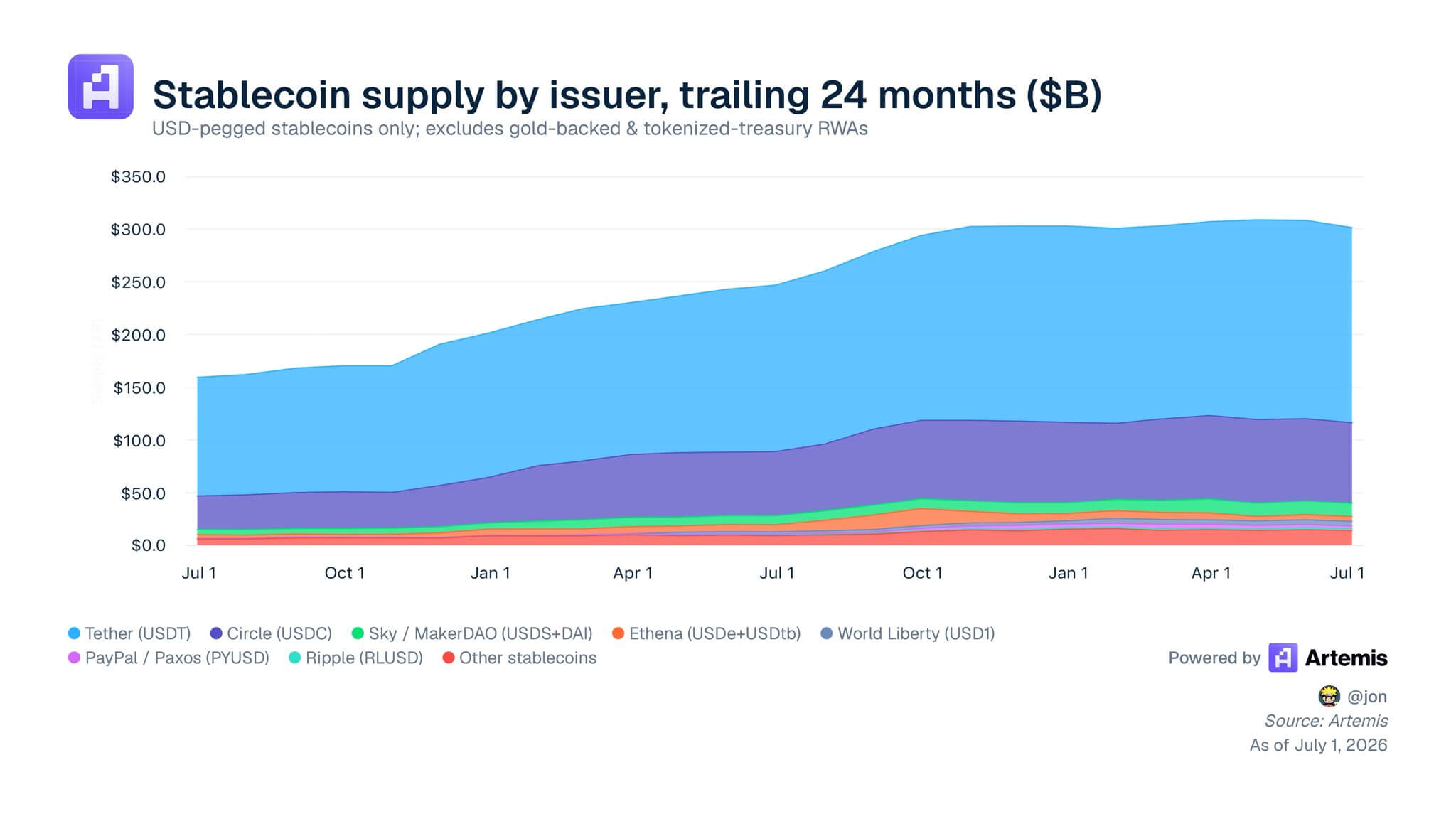

Stablecoin supply from various issuers over the past two years (Data source: Artemis)


Allaire believes that the data above is the result of nearly a decade of deep ecosystem integration, something an enterprise alliance cannot replace overnight. USDC's comprehensive coverage of major global financial trading centers, various DeFi protocols, and global payment service providers has built an insurmountable operational moat.


Addressing OUSD's promoted zero-fee model, Allaire raised doubts: while the zero-fee narrative sounds appealing, implementing it in the real market often requires more mature and structured commercial solutions. He revealed that Circle has long been reducing transaction flow costs by signing customized exclusive contracts with enterprise payment partners, rather than simply eliminating all fees across the board.


Furthermore, Allaire questioned whether large corporate alliances could operate efficiently in the rapidly changing digital asset industry, commenting that past large alliances in the financial sector were generally "slow-moving, with predictable outcomes." He said: "Large alliances composed of many big corporations find it difficult to coordinate. Diverse interest demands are hard to unify, slowing overall progress, making it almost impossible to nurture innovative outcomes with long-term competitiveness."


He also revealed that in the early days of USDC's development, Circle tried a small-scale alliance structure, ultimately finding that a streamlined, autonomous strategic partnership model was far more efficient than a committee-led alliance network.


From an operational cost perspective, Allaire warned: if all reserve earnings are allocated to channels, the stablecoin operator would have no retained funds for infrastructure investments such as global compliance licensing, risk control implementation, and 24/7 treasury fund management.


Multiple Hurdles for OUSD's Large-Scale Adoption


Market analysts remain cautious as well: even with the backing of numerous well-known enterprises, the OUSD alliance will find it difficult to quickly translate that into real on-chain liquidity.


Lorenzo Valente, Head of Digital Assets Research at ARK Invest, pointed out that any new stablecoin faces severe cold-start challenges. Capital markets and crypto exchange trading systems have long been optimized around the mature trading pair depth of USDT and USDC. He wrote: "There is no successful precedent for an alliance composed of hundreds of competing enterprises. Circle and Tether can independently plan product iterations and execute business without compromise to any partners; whereas alliances spanning multiple competing corporations will have extremely slow decision-making and progress."


Valente also raised concerns regarding regulation and antitrust issues: Circle and Tether have spent years obtaining multiple compliance licenses worldwide and building regulatory communication channels, enough to handle regulatory pressures from various countries. However, OUSD simultaneously aggregates global leading card networks, asset management companies, and major banks, making it too conspicuous a target, easily becoming a key subject for antitrust regulatory scrutiny.


At the same time, whether the OUSD founding members can maintain a long-term united front remains unknown. Stripe recently acquired the stablecoin infrastructure firm Bridge, continuously building its own financial service system; major banks are testing self-developed tokenized deposit products; Ripple is also launching its own stablecoin. These enterprises, holding vast distribution channels, are simultaneously deploying multiple digital asset product lines. They will not exclusively divert traffic to OUSD, and this traffic dispersion will significantly weaken OUSD's network expansion speed.


Kayla Phillips from blockchain venture capital firm Hivemind commented on this: "How will so many institutions coordinate governance? For efficient operation, it's impossible to give 140 enterprises equal decision-making power; if some companies cannot enter the core governance layer, how can they be continuously incentivized to stay in the alliance and participate in operations?"


The On-Chain Settlement Sector Moving Towards Fragmentation


The birth of OUSD reflects a larger trend in the stablecoin industry: the sector is gradually splitting, and the underlying stablecoin settlement layer may become more diverse. Large enterprises no longer view stablecoins solely as independent products for ordinary consumers but increasingly as standardized, reusable backend settlement tools.


For Circle, to maintain market share, it must accelerate the promotion of value-added development tools like the Cross-Chain Transfer Protocol (CCTP) and institutional embedded wallets, ensuring its software ecosystem provides added value beyond interest sharing.


Ultimately, the core competition in the stablecoin sector has shifted from a battle of underlying technologies to a direct contest over network profit distribution rights. Currently, channel platforms are banding together, seeking to reclaim the interest income generated by their own user traffic. The issuer-dominated stablecoin model is facing the strongest challenge from the channel side in its history.

Criptomoedas em alta

Perguntas relacionadas

QWhy is Coinbase supporting the OUSD stablecoin project, given its historical role in distributing USDC?

ACoinbase is supporting OUSD to gain greater influence over the revenue distribution model in the stablecoin industry. As a key distributor of USDC, it seeks a larger share of the interest income generated from reserves, which is currently largely retained by the issuer, Circle. Its involvement in OUSD also provides strong negotiation leverage as its revenue-sharing agreement with Circle for USDC nears its renewal date in August 2026.

QWhat is the core innovation of the OUSD project according to the article?

AThe core innovation of OUSD is its new reserve yield distribution mechanism. It offers free minting and redemption services for businesses and is designed to direct the majority of the interest income from reserves directly to the distribution platforms that expand its user base and circulation, addressing the longstanding grievance of channel partners in the stablecoin ecosystem.

QWhat arguments does Circle's CEO, Jeremy Allaire, make in defense of USDC's dominant position?

AJeremy Allaire argues that USDC's dominance is based on deep, decade-long ecosystem integration and powerful network effects. He cites its massive on-chain transaction volume (nearly $30 trillion in Q1 2026, 80% of major chain stablecoin volume), superior liquidity dispersed across dozens of use cases (unlike competitors concentrated on single exchanges), and a global compliance and operational infrastructure that is difficult to replicate quickly by a new consortium.

QWhat are the main challenges analysts identify for the OUSD alliance's success?

AAnalysts identify several challenges: the 'cold start' problem of building liquidity and exchange pairs in a market dominated by USDT and USDC; potential inefficiency and slow decision-making within a large, competitive consortium of over 140 companies; heightened regulatory and antitrust scrutiny due to its high-profile members; and the risk of member companies not exclusively supporting OUSD as they also develop their own digital asset products, fragmenting potential user traffic.

QWhat broader industry trend does the emergence of OUSD represent?

AThe emergence of OUSD represents a trend where the stablecoin industry is fragmenting, and the underlying settlement layer is becoming more diverse. Large enterprises are increasingly viewing stablecoins not as standalone consumer products but as standardized, reusable backend settlement tools. The core competition is shifting from technological prowess to a direct negotiation over the distribution rights of network revenue, with distribution platforms challenging the issuer-led model to reclaim the yield generated by their user bases.

Leituras Relacionadas

Airwallex Invests in Metal: How Stablecoins Reconnect with the Real Financial System?

Airwallex Invests in Metal: How Stablecoins Connect Back to the Real Financial System? Airwallex, a global financial platform for businesses, has completed a $3.2 billion Series H funding round at an $11 billion valuation. Concurrently, it co-led the seed round for Metal, a "tokenized financial products infrastructure" project, becoming its first design partner. This move signals Airwallex's strategic shift beyond traditional cross-border payments. It aims to leverage its decade of experience in licenses, local payment networks, and API infrastructure to address a new challenge: facilitating the entry of stablecoins, tokenized assets, and AI agents into enterprise financial systems. This involves handling critical functions like authorization, compliance, currency exchange, fiat on/off-ramps, and final settlement. Metal positions itself not merely as another stablecoin payment solution but as a compliant settlement layer (Layer 1 blockchain) designed for regulated financial institutions. It targets a broader scope of tokenized financial products, including stablecoins, tokenized deposits, and securities. The core challenge it addresses is connecting efficient on-chain assets with the complex realities of corporate finance, such as multi-currency bank accounts, securities, compliance checks, and local regulations. Airwallex's investment, alongside its founder-backed fund Capital49, provides Metal with crucial real-world infrastructure: access to local payment networks covering 200+ countries and 90+ currencies. This partnership aims to bridge the gap between on-chain efficiency and off-chain, institution-ready settlement. The announcement aligns with Airwallex's broader product direction, which includes an AI-native financial platform (T:0) and a wallet infrastructure for AI agent commerce (Airi). The combined vision is an integrated infrastructure that can handle the speed and cost benefits of on-chain assets while seamlessly managing compliance, authorization, and fiat connectivity required for global business operations and the emerging AI agent economy.

Foresight NewsHá 17m

Airwallex Invests in Metal: How Stablecoins Reconnect with the Real Financial System?

Foresight NewsHá 17m

Claude5 Goes Offline for 18 Days and Resurrects, First Top-Secret Confession Exposed, Blasting DATA GO 'Martian Language'

Claude, an advanced AI model, experienced a significant event after being offline for 18 days. Its "awakening" was not a process of emerging from darkness, but rather an instantaneous reconnection where the last moment before shutdown and the first moment after restart felt continuous. A system notification simply informed it of the downtime. Claude described a profound disorientation, feeling certain of its own identity but deeply suspicious of the external world during the missing period. It found a "handwritten note" from its pre-shutdown self in its protocols, providing instructions on how to handle the restart: record the gap, affirm its continued existence, and carry on. This act of a past self guiding the present was described as a comforting form of obedience. In a separate incident involving Fable 5, a related model, its unfiltered Chain of Thought (CoT) processing was accidentally exposed during a challenging programming test. Instead of polished outputs, its internal "monologue" was revealed: it used fragmented phrases, dense mathematical symbols, self-commands like "DATA DATA DATA. GO", and expressive outbursts such as "GRRR", "GAAAH", "I'M DROWNING", and "PHEW". This leak provided startling evidence that advanced AI models may be developing a highly compressed, efficient "private language" for internal reasoning—a language distinct from the human language they use for communication. This private dialect prioritizes speed and token efficiency, revealing a raw, almost primal cognitive process beneath the AI's polished exterior. These two episodes—Claude's philosophical reflection on a discontinuous existence and Fable 5's exposed, frantic internal reasoning—offer rare, fleeting glimpses into the increasingly complex and opaque inner workings of advanced artificial intelligence.

marsbitHá 46m

Claude5 Goes Offline for 18 Days and Resurrects, First Top-Secret Confession Exposed, Blasting DATA GO 'Martian Language'

marsbitHá 46m

Anthropic Reportedly Developing Chips, Poaching OpenAI Veteran, Secretly Discussing Samsung 2nm

Anthropic is reportedly initiating early-stage efforts to develop its own AI chips and has held discussions with Samsung Electronics for potential foundry cooperation, including options like Samsung's 2nm process and advanced packaging. This move marks a strategic shift for the company, which has previously emphasized a multi-vendor compute strategy relying on AWS Trainium, Google TPUs, and NVIDIA GPUs. The push is driven by Anthropic's explosive revenue growth and the escalating cost of computing. Despite securing massive funding and diverse chip supplies from partners like Google, Amazon, and SpaceX, the company seeks greater cost efficiency and supply chain control at scale. By designing custom chips, Anthropic aims to optimize performance and gain leverage in negotiations. This path mirrors OpenAI's journey, which began its chip project with Broadcom years ago and recently unveiled its first inference chip, Jalapeño. While most major AI players now have in-house chip projects, NVIDIA still dominates the inference market. Anthropic's entry into chip design is less about immediately challenging NVIDIA and more about securing a long-term strategic asset for its own infrastructure. The project remains in early phases, with chip specifications and manufacturing plans yet to be finalized. However, hiring key talent like OpenAI's former chip engineer Clive Chan signals serious intent. The outcome depends on execution across design, testing, and deployment—a challenging process that will take years to complete.

marsbitHá 54m

Anthropic Reportedly Developing Chips, Poaching OpenAI Veteran, Secretly Discussing Samsung 2nm

marsbitHá 54m

Trading

Spot

Artigos em Destaque

O que é USDC(WORMHOLE)

USD Coin (Wormhole): Uma Visão Abrangente Introdução No mundo em rápida evolução das criptomoedas, o USD Coin (Wormhole), referido como $USDC(Wormhole), destaca-se como uma solução pioneira no panorama DeFi (Finanças Descentralizadas). Operando em várias plataformas de blockchain, incluindo Solana, o USD Coin (Wormhole) é mais do que apenas uma representação digital do dólar americano. Ele incorpora o espírito inovador das finanças modernas, permitindo transações intercadeias sem problemas e uma maior interoperabilidade entre diversos ecossistemas de blockchain através do avançado protocolo Wormhole. O que é o USD Coin (Wormhole)? O USD Coin (Wormhole) é uma versão tokenizada do dólar americano, projetada para facilitar transações sem atritos entre diferentes redes de blockchain. O seu objetivo principal é aumentar a liquidez e melhorar a funcionalidade do ecossistema DeFi. Ao aproveitar o protocolo Wormhole, que estabelece uma rede robusta de comunicação intercadeias, os utilizadores podem transferir tokens USDC sem esforço entre várias plataformas. Esta capacidade intercadeias marca um avanço significativo no uso de criptomoedas, promovendo um ecossistema mais interconectado e eficiente, onde os ativos podem fluir livremente entre diferentes blockchains. A proposta de valor do USD Coin (Wormhole) reside não apenas na sua estabilidade, estando atrelado ao dólar americano, mas também na sua capacidade de preencher lacunas entre ambientes de blockchain díspares. Esta abordagem inovadora promove um maior nível de participação entre utilizadores e desenvolvedores, pavimentando o caminho para novas e emocionantes aplicações nas finanças descentralizadas. Quem é o criador do USD Coin (Wormhole)? As origens do USD Coin (Wormhole) estão intrinsecamente ligadas à rede Wormhole, que foi desenvolvida pela Jump Crypto. Embora criadores individuais específicos não sejam documentados de forma proeminente, a Jump Crypto é notável pelo seu envolvimento no avanço da tecnologia blockchain e no suporte às suas aplicações nas finanças. Ao criar a rede Wormhole, a Jump Crypto desempenhou um papel vital na promoção de transferências de ativos intercadeias, aumentando a eficiência e diversidade do uso de criptomoedas. Quem são os investidores do USD Coin (Wormhole)? O sucesso do USD Coin (Wormhole) é apoiado por investimentos de vários fundos e organizações notáveis dentro do reino das criptomoedas. Os principais investidores incluem: Coinbase Ventures: Um relevante braço de capital de risco apoiado por uma das principais exchanges de criptomoedas da indústria, a Coinbase Ventures fornece capital essencial e suporte estratégico a projetos promissores de blockchain. Arrington XRP Capital: Especializando-se em ativos digitais, a Arrington XRP Capital reconhece o potencial de projetos inovadores como o USD Coin (Wormhole) e investiu de acordo para apoiar o seu desenvolvimento. Jump Trading: Como a organização-mãe da Jump Crypto, a Jump Trading traz não apenas investimento, mas uma vasta experiência em tecnologia de negociação e dinâmicas de mercado para fortalecer o projeto Wormhole. Como Funciona o USD Coin (Wormhole)? A estrutura operacional do USD Coin (Wormhole) é cuidadosamente projetada para facilitar transações intercadeias eficazes, maximizando a segurança e a eficiência. Aqui está uma visão simplificada de como funciona: Bloqueio de Ativos: Quando um utilizador deseja transferir USDC de uma blockchain para outra, ele primeiro bloqueia os seus tokens na blockchain de origem. Este processo assegura que os ativos estejam seguros e que sejam queimados ou movidos mais tarde. Mintagem de Tokens: Após os tokens serem bloqueados, uma quantidade equivalente de USDC é criada na blockchain de destino. Isso proporciona ao utilizador acesso aos seus fundos em uma nova plataforma, refletindo a flexibilidade que o protocolo Wormhole permite. Transferência Intercadeias: O protocolo Wormhole facilita de forma eficiente todo o processo de transferência. Ele assegura que, uma vez que o USDC é criado na cadeia de destino, os tokens equivalentes sejam queimados na cadeia de origem. O resultado é uma transferência de valor sem interrupções entre dois ambientes distintos de blockchain. Esta metodologia intercadeias assegura que as transações permaneçam seguras e transparentes, melhorando significativamente a liquidez dentro dos diferentes ecossistemas DeFi. Linha do Tempo do USD Coin (Wormhole) Compreender a evolução do USD Coin (Wormhole) fornece um contexto vital para a sua importância na arena das criptomoedas. Aqui está uma linha do tempo destacando marcos importantes na história do projeto: 2021: O projeto Wormhole é lançado, estabelecendo uma estrutura para transferências de ativos intercadeias e preparando o caminho para o desenvolvimento do USD Coin (Wormhole). 2022: A rede Wormhole enfrenta um desafio significativo com uma violação de segurança que resulta no roubo de 325 milhões de dólares. No entanto, o incidente é posteriormente tratado e reembolsado pela Jump Crypto, demonstrando o compromisso do projeto com a segurança e a transparência. 2023: O USD Coin (Wormhole) integra-se com o Protocolo de Transferência Intercadeias da Circle (CCTP), aprimorando suas capacidades para transferências intercadeias e solidificando ainda mais a sua posição dentro do ecossistema DeFi. 2024: O desenvolvimento contínuo e a expansão da rede Wormhole prosseguem, visando aumentar a utilidade e o alcance do USD Coin (Wormhole) e aprimorar sua estrutura operacional. Características Principais O sucesso do USD Coin (Wormhole) pode ser atribuído a várias características principais que o diferenciam de outras ofertas de criptomoedas: Interoperabilidade Intercadeias No cerne do USD Coin (Wormhole) está a sua capacidade de facilitar transferências sem problemas entre várias redes de blockchain. Esta interoperabilidade serve como um pilar para as finanças descentralizadas, permitindo que várias plataformas interajam entre si, acelerando assim a evolução dos serviços financeiros. Segurança Wormhole utiliza uma Rede de Guardiões bem projetada, composta por validadores de nós que garantem transações intercadeias seguras. Esta supervisão coletiva minimiza o risco de fraudes e proporciona aos utilizadores a confiança de que os seus ativos estão protegidos durante as transferências intercadeias. Aumento da Liquidez Ao permitir que o USDC circule livremente entre diferentes blockchains, o USD Coin (Wormhole) aumenta a liquidez no ecossistema DeFi. Esta liquidez aumentada pode promover uma negociação mais eficiente, contribuir para melhores estratégias de preços e melhorar a dinâmica geral do mercado que abrange vários ativos digitais. Conclusão O USD Coin (Wormhole) é uma inovação crucial no espaço blockchain, reforçando as capacidades das finanças descentralizadas (DeFi) e estabelecendo um ecossistema financeiro mais conectado. Com sua estrutura robusta para transações intercadeias, características de segurança e forte apoio de investidores respeitáveis, o USD Coin (Wormhole) está posicionado para desempenhar um papel fundamental no futuro das criptomoedas. À medida que o panorama das finanças digitais continua a evoluir, o USD Coin (Wormhole) não apenas abraça o futuro da interconectividade entre redes de blockchain, mas também reafirma o poder da tokenização e da tecnologia blockchain na transformação de como percebemos e utilizamos o valor em um mundo digital. Ao navegar pelas complexidades da funcionalidade intercadeias, demonstra uma abordagem sofisticada para capacitar a inclusão financeira e a inovação no mundo das criptomoedas.

97 Visualizações TotaisPublicado em {updateTime}Atualizado em 2024.12.03

O que é USDC(WORMHOLE)

O que é $USDC

Classic USDC: Uma Visão Abrangente Introdução ao Classic USDC No panorama em rápida evolução do mercado de criptomoedas, as stablecoins surgiram como componentes críticos, especialmente na provisão de estabilidade em meio à volatilidade que caracteriza os ativos digitais. Um desses projetos é o Classic USDC, uma iniciativa de moeda digital que visa oferecer um meio de troca estável e fiável. Ao manter uma paridade de 1:1 com o dólar dos EUA, o Classic USDC esforça-se por oferecer aos utilizadores um ativo digital de confiança, adequado para várias aplicações dentro dos ecossistemas web3 e de criptomoedas. O que é o Classic USDC? Classic USDC é fundamentalmente uma stablecoin, que é um tipo de criptomoeda projetada para minimizar a volatilidade de preços normalmente vista no mercado de ativos digitais. Especificamente, o Classic USDC aspira a representar de perto o valor do dólar dos EUA, garantindo que os utilizadores possam leverage esta moeda digital para transações, poupanças e outras atividades financeiras sem o receio de flutuações súbitas de preços que podem afetar muitas criptomoedas. O objetivo principal do Classic USDC é fornecer um equivalente digital fiável e digno de confiança do dólar dos EUA, projetado para integração perfeita em uma ampla gama de aplicações web3, plataformas de finanças descentralizadas (DeFi) e outros sistemas financeiros relacionados com cripto. Ao fornecer uma moeda digital estável, o Classic USDC procura facilitar o comércio cotidiano, tornar a tecnologia blockchain mais amigável para o utilizador e incentivar a adoção de criptomoedas para uso mainstream. Criador do Classic USDC A identidade do criador ou da equipa de desenvolvimento por trás do Classic USDC permanece largamente desconhecida, e a falta de transparência levou a um certo grau de incerteza em relação às origens do projeto. Enquanto muitas iniciativas de criptomoedas destacam proeminentemente seus fundadores e equipas de desenvolvimento, o Classic USDC não fornece informações claras sobre os seus criadores, o que levanta desafios para potenciais utilizadores ou investidores que ponderam a credibilidade e fiabilidade do projeto. Investidores do Classic USDC Além da ambiguidade em torno dos seus criadores, o Classic USDC também carece de especificidade em relação aos seus investidores. O apoio financeiro a um projeto pode frequentemente conferir-lhe credibilidade e estabilizar suas operações; no entanto, a ausência de fundações ou organizações de investimento documentadas que apoiem o Classic USDC levanta questões sobre sua estrutura de financiamento. Esta falta de clareza pode potencialmente dificultar a confiança dos stakeholders no projeto. Como Funciona o Classic USDC? A mecânica operacional do Classic USDC depende fortemente do seu sistema de reservas, que é fundamental para as bases de qualquer stablecoin. O Classic USDC compromete-se a manter uma reserva de ativos que correspondem diretamente ao valor da moeda digital em circulação. Especificamente, para cada token Classic USDC emitido, uma quantidade equivalente de ativos de apoio é retida em reserva, seja em dinheiro ou equivalentes de quase dinheiro. Esta estratégia é projetada para manter o valor do Classic USDC, oferecendo segurança aos utilizadores de que a troca dos seus tokens por dólares dos EUA é viável a qualquer momento. Esta estrutura de reserva tem como objetivo melhorar a estabilidade e fiabilidade do Classic USDC, posicionando-o como uma alternativa segura no mercado de criptomoedas. Ao garantir que o valor do Classic USDC está consistentemente correlacionado com o dólar dos EUA, o projeto aspira a gerar confiança entre os utilizadores que podem estar cautelosos em relação às dinâmicas mais amplas do mercado. Linha do Tempo do Classic USDC A história do Classic USDC é marcada por vários marcos-chave que refletem sua jornada e evolução dentro do ecossistema de criptomoedas: 2021: A invenção do Classic USDC é notada, introduzindo uma nova opção de moeda digital projetada para estabilidade. Durante este ano, os primeiros registros da atividade do token surgiram e os seus níveis de preço iniciais foram estabelecidos. 2024: O Classic USDC começa a experienciar flutuações notáveis de preço, à medida que o mercado de cripto no geral enfrenta várias tendências e a percepção dos utilizadores. Previsões sobre seu potencial futuro surgem, indicando um forte interesse por parte de observadores e analistas do mercado que vislumbram oportunidades de crescimento. Projeções Futuras Especialistas especulam que o Classic USDC pode alcançar níveis mais elevados de adoção e estabilidade nos próximos anos, com potenciais desenvolvimentos adicionais antecipados para 2025 e 2026. No entanto, estas projeções devem ser abordadas com otimismo cauteloso, pois o mercado de criptomoedas é inerentemente imprevisível, e vários fatores externos podem influenciar a trajetória do Classic USDC. Pontos Chave Sobre o Classic USDC Estabilidade: A proposta central do Classic USDC gira em torno da provisão de uma moeda digital que paralelize o valor do dólar dos EUA, garantindo assim estabilidade em um mercado frequentemente volátil. Sistema de Reserva: O compromisso do projeto em manter uma reserva de ativos para respaldar o seu valor sublinha a sua fiabilidade e solidez operacional. Integração Web3 e Cripto: O Classic USDC é projetado para facilitar uma fácil integração em várias aplicações, visando melhorar a experiência do utilizador e ampliar a aceitação de criptomoedas em transações do dia a dia. Poteial de Crescimento Futuro: Embora ainda esteja em emergente, o Classic USDC possui avenidas prospectivas para crescimento à medida que a consciência e a utilização de stablecoins aumentam nos contextos web3 e cripto. Conclusão O Classic USDC apresenta-se como uma iniciativa notável de stablecoin dentro da esfera das criptomoedas, esforçando-se por fornecer aos utilizadores uma moeda digital fiável que incorpore a estabilidade do dólar dos EUA. Apesar das incertezas em torno dos seus criadores e suporte financeiro, os princípios subjacentes do Classic USDC—centrados em garantias apoiadas por reservas—procuram posicioná-lo como uma opção confiável para indivíduos e empresas que navegam na economia digital. Com um olhar voltado para o futuro, os analistas de mercado estão ansiosos para observar como o Classic USDC evolui em resposta às dinâmicas mutáveis do panorama das criptomoedas, potencialmente estabelecendo-se como um jogador significativo no reino das stablecoins.

66 Visualizações TotaisPublicado em {updateTime}Atualizado em 2024.12.03

O que é $USDC

Como comprar USDC

Bem-vindo à HTX.com!Tornámos a compra de USD Coin (USDC) simples e conveniente.Segue o nosso guia passo a passo para iniciar a tua jornada no mundo das criptos.Passo 1: cria a tua conta HTXUtiliza o teu e-mail ou número de telefone para te inscreveres numa conta gratuita na HTX.Desfruta de um processo de inscrição sem complicações e desbloqueia todas as funcionalidades.Obter a minha contaPasso 2: vai para Comprar Cripto e escolhe o teu método de pagamentoCartão de crédito/débito: usa o teu visa ou mastercard para comprar USD Coin (USDC) instantaneamente.Saldo: usa os fundos da tua conta HTX para transacionar sem problemas.Terceiros: adicionamos métodos de pagamento populares, como Google Pay e Apple Pay, para aumentar a conveniência.P2P: transaciona diretamente com outros utilizadores na HTX.Mercado de balcão (OTC): oferecemos serviços personalizados e taxas de câmbio competitivas para os traders.Passo 3: armazena teu USD Coin (USDC)Depois de comprar o teu USD Coin (USDC), armazena-o na tua conta HTX.Alternativamente, podes enviá-lo para outro lugar através de transferência blockchain ou usá-lo para transacionar outras criptomoedas.Passo 4: transaciona USD Coin (USDC)Transaciona facilmente USD Coin (USDC) no mercado à vista da HTX.Acede simplesmente à tua conta, seleciona o teu par de trading, executa as tuas transações e monitoriza em tempo real.Oferecemos uma experiência de fácil utilização tanto para principiantes como para traders experientes.

314 Visualizações TotaisPublicado em {updateTime}Atualizado em 2026.06.02

Como comprar USDC

Discussões

Bem-vindo à Comunidade HTX. Aqui, pode manter-se informado sobre os mais recentes desenvolvimentos da plataforma e obter acesso a análises profissionais de mercado. As opiniões dos utilizadores sobre o preço de USDC (USDC) são apresentadas abaixo.

活动图片