Trump's Financial Disclosure Teaches You the Most Underrated Tax Optimization Strategy

Foresight NewsPublicado em 2026-07-03Última atualização em 2026-07-03

Resumo

Forbes article analyzes tax optimization strategies based on Trump's recent financial disclosures, highlighting his crypto holdings. Key insights reveal that holding appreciated assets like his $50M+ Bitcoin and multi-million dollar Ethereum allows indefinite deferral of capital gains taxes under U.S. law. Taxable events only occur upon disposal (sale, trade, spend). Conversely, certain activities create immediate tax liability. Trump reported ~$510,808 in staking rewards and ~$45,932 in USDC interest, both treated as ordinary income taxed in the year received. The IRS views staking rewards as income at fair market value upon receipt. Other reported income includes $635M in memecoin royalties, NFT licensing fees (ordinary income), and $236.25M from token/equity sales (capital gains). Long-term holdings qualify for lower capital gains rates. The article concludes that the simplest, most overlooked tax strategy is straightforward: hold assets without selling to defer taxes on unrealized gains indefinitely. This principle applies to all crypto investors regardless of portfolio size.


Author: Forbes

Translated by: AididiaoJP, Foresight News


The U.S. federal government recently released Donald Trump's financial disclosure documents, detailing how one of America's top cryptocurrency holders holds tens of millions of dollars in digital assets without facing immediate massive tax bills. The core principle of this strategy applies to every crypto investor, regardless of portfolio size: unless sold, taxes are typically not owed.


Holding Appreciating Assets Indefinitely Defers Capital Gains Tax


The disclosure shows Trump holds a cold wallet Bitcoin position worth over $50 million, with no reported income associated with it. This substantial appreciation falls under the IRS definition of 'unrealized gains'—paper value increases not yet realized through sale. Under current U.S. tax law, a taxable event is triggered only upon 'disposition' of the asset (such as sale, trade, or spending). Simply holding an asset, even if its value surges by millions, does not create a tax liability. This deferral can continue indefinitely until the asset is sold or otherwise disposed of.


Similarly, his Ethereum (ETH) holdings, valued between $5 million and $25 million, are also stored in a cold wallet; additionally, there are 15.75 billion WLFI governance tokens worth over $50 million. These positions were not accompanied by income reports. The asset value appears on the balance sheet, but as long as it's not sold, there's no taxable event and thus no tax bill.


Staking Rewards and Interest Income Must Be Reported and Taxed in the Year Received


Not all holdings enjoy deferral. Trump reported $510,808 in income from Coinbase validator rewards, compensation earned by helping validate transactions on the Ethereum network through staking. The IRS treats staking rewards as ordinary income, taxed in the year received at the fair market value of the tokens when they are credited, regardless of whether the tokens are later sold.


Currently, there is controversy among some investors regarding the treatment of staking rewards: an aggressive approach is to wait until sale to report gains, rather than counting the full value as income upon receipt. The IRS has not issued definitive guidance for all scenarios, but its 2023 Revenue Ruling 2023-14 regarding Proof-of-Stake (PoS) mining rewards leans towards recognition upon receipt. Most tax professionals adopt this conservative reporting approach. The disclosure document does not specify which method was used here.


Furthermore, the disclosure shows Trump holds USDC (a U.S. dollar-pegged stablecoin) valued between $5 million and $25 million, earning $45,932 in interest. Stablecoin prices typically hover near $1, rarely generating capital gains or losses, but interest income is ordinary income, treated the same as bank interest, and is fully taxable in the year received.


Royalties, Token Sales, and Licensing Fees Taxed as Ordinary Income


The disclosure also includes two entries beyond passive holding. CIC Digital LLC reported $635 million in royalties from 'Celebration Coins' (Trump meme coins) and licensing fees related to NFTs. This income is classified as ordinary income under tax law, taxed at the same rates as wages, not the preferential long-term capital gains rates available for assets held over a year. Income is recognized and taxed upon receipt.


The crypto project World Liberty Financial, associated with Trump, shows $236.25 million in token sale proceeds and $65.625 million in equity sale proceeds. Selling tokens is a taxable event, similar to selling stock. Gains or losses are calculated as the difference between the sale price and the cost basis (the original purchase or investment amount). Depending on the holding period, short-term or long-term capital gains tax rates may apply.


The Simplest Yet Most Overlooked Crypto Tax Optimization Strategy


Ultimately, what this disclosure reveals is not complex offshore structures or aggressive tax avoidance schemes, but the sole reason the largest positions in the portfolio incur no current tax: they have not been sold.


Every crypto investor can use this same deferral mechanism. Whether assets are held in a wallet or on an exchange, as long as they appreciate in value without being sold, no taxable event is triggered.

Perguntas relacionadas

QAccording to the article, what is the core principle for crypto investors to defer capital gains tax, as illustrated by Trump's financial disclosures?

AThe core principle is that holding an appreciating asset without selling it allows for indefinite deferral of capital gains tax. Under U.S. tax law, a taxable event is only triggered upon 'disposition' (like selling, trading, or spending), not from unrealized gains.

QWhat types of crypto-related income does the article state are treated as ordinary income and taxed in the year they are received, similar to wages?

AThe article states that staking rewards (like Trump's Coinbase validator rewards), interest income (like from stablecoin holdings), royalties, licensing fees from NFT projects, and revenue from token sales are all generally treated as ordinary income and taxed in the year they are received.

QWhat is the key difference, according to the article, in how the IRS treats the holding of a Bitcoin wallet versus receiving staking rewards?

AHolding a Bitcoin wallet with unrealized gains does not trigger a tax event until the asset is sold. In contrast, staking rewards are considered ordinary income and are taxed based on their fair market value at the time they are received, regardless of whether the tokens are later sold.

QBased on the financial disclosure discussed, what simple tax optimization strategy does the article conclude is most underutilized by crypto investors?

AThe article concludes that the simplest and most underutilized tax optimization strategy is the intentional deferral of taxes by simply not selling appreciating crypto assets. This allows investors to avoid triggering a taxable event and defer capital gains taxes indefinitely.

QHow are proceeds from the sale of a token, like those reported by World Liberty Financial, taxed according to the article?

AProceeds from the sale of a token are a taxable event. The capital gain or loss is calculated as the difference between the sale price and the cost basis (the original purchase/investment amount). The tax rate applied depends on whether it's a short-term or long-term capital gain, based on the holding period.

Leituras Relacionadas

“Economic Outcast”: US Treasury Takes Aim at Iran's Cryptocurrency, Technology, and Gold

On August 24, 2026, the U.S. Treasury Department, under Secretary Scott Bessent, launched "Operation Economic Outcast," a major campaign targeting the financial networks of the Islamic Republic of Iran and its affiliates. The primary goal is to cut off revenue streams supporting the Iranian regime, with a specific focus on denying funding to the Islamic Revolutionary Guard Corps (IRGC). The Office of Foreign Assets Control (OFAC) activated authorities to sanction any entities, regardless of location, operating in or servicing five key Iranian economic sectors: digital assets (cryptocurrency), technology, gold, aviation, and shipping. OFAC noted Iran's increasing use of cryptocurrency to evade sanctions, including for operations linked to the IRGC and government officials. Initial measures targeted nearly 60 organizations, individuals, and vessels across multiple jurisdictions involved in procuring nuclear/missile technology, conducting cyber operations, and facilitating illicit oil sales. The U.S. State Department joined the campaign, announcing additional sanctions against Iranian military officials, intelligence entities targeting U.S. forces, and networks moving Iranian oil. Treasury warned foreign partners that they have a specific deadline to halt identified Iran-related activities, or face unilateral U.S. action. Entities facilitating sanctions evasion risk being cut off from the U.S. financial system and the dollar economy. The operation consolidates sanctions against Iran's crypto, tech, and commodity financing into a unified campaign with clear deadlines. It expands OFAC's reach to crypto brokers and payment networks handling Iranian oil. Analysis suggests crypto tools are already embedded in Iran's trade practices, as seen with capital flight from the Nobitex exchange and discussions of Bitcoin payments for Strait of Hormuz transit, indicating new OFAC powers target existing, not hypothetical, evasion channels.

cryptonews.ruHá 14m

“Economic Outcast”: US Treasury Takes Aim at Iran's Cryptocurrency, Technology, and Gold

cryptonews.ruHá 14m

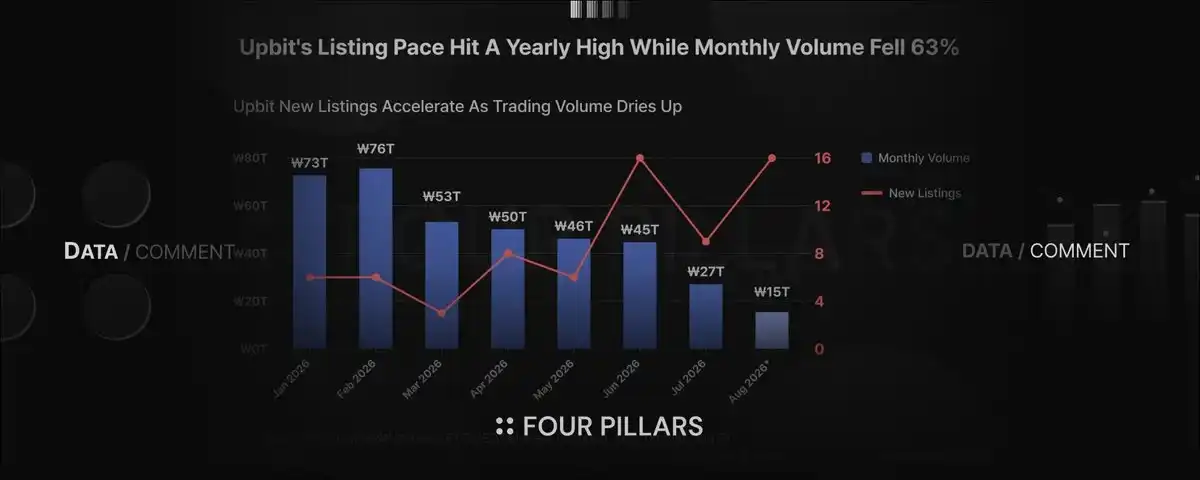
Upbit Accelerates Token Listings: Total Trading Volume Halved, New Tokens Support Nearly 30% Share

In the second half of 2026, Upbit significantly accelerated its pace of listing new cryptocurrencies, even as the overall Korean won-denominated trading market cooled rapidly. Monthly trading volume on Upbit plunged 63%, from KRW 72.7 trillion in January to KRW 27.1 trillion in July, with Bitcoin prices also falling. Contrary to the conventional logic of listing more during bull markets, Upbit intensified new listings during this downturn. New listings have become a crucial lever for Upbit to sustain trading activity in a bear market. By August, 61 new tokens listed in 2026 were collectively contributing nearly 30% of Upbit's total won trading volume, up from just 5% in January. This means roughly a quarter of the platform's fee revenue now comes from these newly listed assets. Standout performers like CHIP, RE, SLX, and CAP achieved significant individual market share shortly after listing, while new stablecoin listings contributed negligible volume. This strategy highlights a shift: the "Upbit listing premium," once a sought-after event to attract new capital, is increasingly used as a defensive tool to stabilize fee income amid shrinking overall volume. While the premium effect persists, indicating remaining genuine demand, its frequent use risks diluting the long-term strategic value and scarcity of Korean won liquidity access. Upbit's approach reflects a broader challenge for Asian centralized exchanges: relying on short-term listing tools to maintain operations during macro weakness, potentially at the cost of eroding long-term competitive foundations.

marsbitHá 34m

Upbit Accelerates Token Listings: Total Trading Volume Halved, New Tokens Support Nearly 30% Share

marsbitHá 34m

Trading

Spot
活动图片