The Ethereum Community Is in an Uproar! Who Stands to Lose with EIP-8363?

marsbitPublicado em 2026-08-05Última atualização em 2026-08-05

Resumo

The Ethereum community is deeply divided over the controversial EIP-8363 proposal, which aims to introduce a "tapered issuance burn" to curb the growth of ETH staking. Authored by researchers including Jérôme de Tychey and Justin Drake, the proposal would gradually reduce and eventually eliminate the consensus-layer issuance rewards for validators when the total staked ETH approaches 50% of the total supply (approximately 60.25 million ETH). This is intended to discourage excessive staking concentration among large institutional providers and reduce the dilution pressure on non-staking ETH holders, potentially strengthening native ETH as a neutral asset. Currently, even at 100% staking, validators have a theoretical minimum reward of about 1.5%. EIP-8363 would implement a burn mechanism based on the staking ratio, making net consensus rewards approach zero at the 50% threshold, though execution-layer rewards (priority fees, MEV) remain unaffected. At the current ~33% staking ratio, annual consensus yield would drop from ~2.6% to ~1.2%. An 18-month transition period is proposed to soften the impact. The community reaction has been largely negative. Critics, including Aave founder Stani Kulechov and ether.fi CEO Mike Silagadze, argue it undermines predictable cash flows for institutional investors, hurts solo stakers by making their operations less viable against fixed costs, and could destabilize the DeFi ecosystem built around Liquid Staking Tokens (LSTs). They also fear it...

Original author: KarenZ, Foresight News

Intuitively, the more ETH staked, the higher the economic cost to attack the network.

However, an increase in the staking scale does not necessarily bring an equivalent gain in security; if the new stakes primarily flow to a few large service providers, the validator ecosystem might instead become more centralized.

On August 4th, Jérôme de Tychey, founder of EthCC, Justin Drake from the Ethereum Foundation, and four other researchers jointly submitted the "Tapered Issuance Burn" proposal. It attempts to install a "revenue downslope" for the continuously growing staking ratio, and when the staked amount approaches 50% of the total ETH supply, the consensus-layer issuance rewards obtained by validators will be completely offset.

This proposal was initially released with the number EIP-8361, but as that number had already been assigned to another proposal, it was subsequently changed to EIP-8363. Although it is still in the early draft stage, it has rapidly become one of the most contentious topics in the Ethereum community.

What is this proposal actually trying to do?

Currently, Ethereum consensus-layer rewards decrease as the total amount staked increases. However, even if all ETH were staked, there still exists a theoretical lower bound of approximately 1.5% for the nominal consensus yield of an individual validator.

The authors of EIP-8363 argue that this means the protocol always provides positive incentives for more staking, without a real "stop button," which could drive ETH towards concentration among large custodians, exchanges, and staking derivatives.

Additionally, unstaked ETH is continuously diluted by new issuance. Liquid Staking Tokens (LSTs), because they come with yield, can more easily replace native ETH as collateral in DeFi and savings assets. The proposal authors hope to reduce this dilution pressure, allowing native ETH to become a more competitive neutral asset again.

The solution given by the proposal is not to prohibit new validators from entering, nor to rigidly lock the staking ratio at 50%, but to deduct and burn a portion of the validator's calculated reward after its normal calculation. The burn proportion depends on the total effective staked balance: calculated as "the ratio of the total effective staked balance to 60.25 million ETH raised to the power of 1.5," with an upper limit of 100%, i.e.:
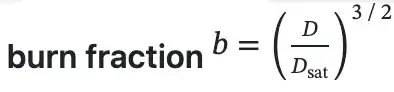
60.25 million ETH is approximately half of the current total ETH supply. As the staked amount approaches this value, the validator's net consensus-layer profit gradually approaches zero; upon reaching or exceeding this value, the consensus-layer issuance rewards earned by normally, fully performing validators will be completely offset by the new burn deductions. It should be added that 60.25 million ETH is a fixed value proposed to be written into the protocol at the hard fork.

There are two points easily misunderstood here:

First, 50% is not a staking cap, nor a target staking ratio. Validators can still continue to join; the proposal merely hopes the market will stop growing on its own before the reward is insufficient to cover liquidity, operational, slashing, and regulatory risks.

Second, the so-called "reward reaching zero" refers only to the net consensus-layer issuance reward. Execution-layer income such as priority fees and MEV is not affected by this proposal.
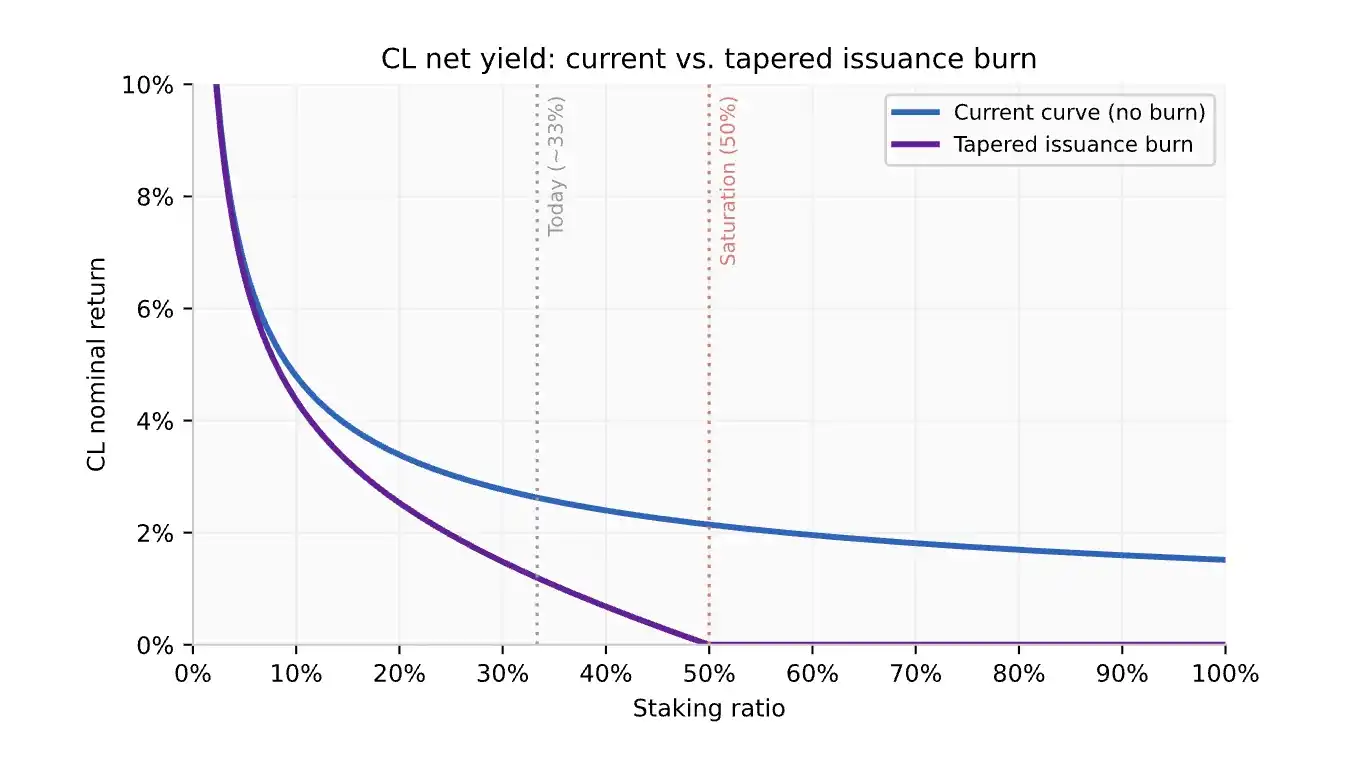
Net consensus-layer profit under the current issuance curve and the EIP-8363 curve

According to the proposal's curve, the annual consensus-layer issuance would peak near a staking ratio of about 19.8%, then decline as the staking ratio increases. Estimating with the current staking ratio of about 33%, if this curve were fully implemented at the fork, the consensus-layer yield would decrease from about 2.6% to about 1.2%.
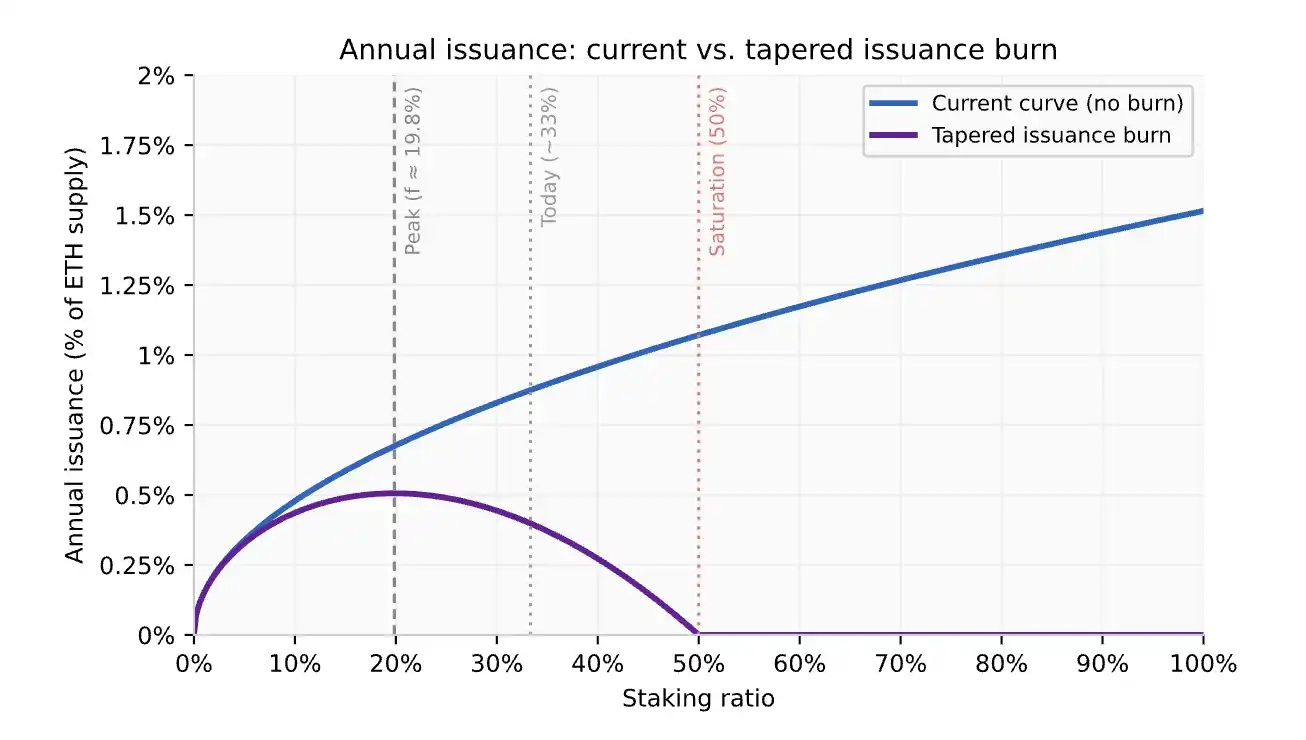
Annual issuance under the current issuance curve and the EIP-8363 curve

To avoid a sudden halving of rewards, the proposal designs an 18-month transition period: upon activation, the base reward factor will be temporarily increased from 64 to 128, then gradually reduced back to 64 over 65 steps, with each step lasting approximately 8.6 days. Therefore, the initial net profit upon activation would be close to current levels, then gradually decline. However, the rule of "providing no consensus-layer issuance incentive after 50%" takes effect from the first day of activation; it does not wait for 18 months.

Currently, this proposal is still an unmerged Core EIP draft, in the editing review and consensus assessment stage. The authors have separately submitted PR #12087, hoping to have it listed as Proposed for Inclusion for the Hegotá upgrade. This PR is also not yet merged; the current formal Hegotá Meta EIP does not include it.

Ethereum core developers plan to discuss Hegotá proposal cut-off items at the 184th ACDC meeting on August 6th. Even if it enters Proposed for Inclusion, it does not guarantee implementation; it would still need to go through subsequent stages of developer assessment, client implementation, testing, and Scheduled for Inclusion.

Community reaction is clearly negative

Jérôme de Tychey, one of the EIP-8363 authors, believes this is a "minimalist, market-driven" change. He also stated in a forum response that the issuance debate started back in 2023, and this proposal merely opens a formal feedback window; it does not equate to being confirmed for inclusion.

He also warned that if validator entries remain continuously full and exits are few, the staked amount could exceed 70 million ETH by early 2028, accounting for over 55% of the supply; reversing course then could lead to larger exit volumes and market disruptions.

The side supporting reduced issuance mainly cites three reasons:

  • Ethereum may be paying too high a cost for economic security that is already sufficiently abundant;
  • Unstaked holders are continuously diluted, forced to choose between "bearing dilution" and "undertaking staking risk";
  • LSTs, ETFs, and custodial services continuously lower staking friction, potentially ultimately allowing a few intermediaries to simultaneously control large amounts of ETH and validation rights.

However, opposition voices are more concentrated in the current public reaction.

Aave founder Stani Kulechov believes that consensus-layer staking rewards varying with the staking ratio and ultimately approaching zero would undermine the cash flow predictability valued by institutions when allocating ETH, and compress positive interest rate strategies like ETH lending and LST loop staking.

Obol co-founder Oisín Kyne points out that Ethereum's true security depends not only on how much ETH is staked, but also on whether the validation power is sufficiently decentralized. If rewards drop to extremely low levels, large institutions with low capital costs and low sensitivity to yield might have the ability to stay in the game long-term and squeeze out high-cost independent operators.

ether.fi CEO Mike Silagadze criticized the proposal for being submitted just before the Hegotá deadline, leaving insufficient lead time for ecosystem developers to discuss it; he worries that low yields will impact staking-related protocols and reduce institutional confidence in Ethereum's governance stability.

Ethereum community member Ryan Berckmans summarized that opponents at least include those worried about who will run validators under zero rewards, those unwilling to reduce staking yields, those opposed to modifying ETH monetary policy again, and those hoping to avoid escalating controversy disrupting ecosystem growth. He personally supports moderately reducing issuance but opposes letting rewards trend all the way to zero, also believing the current proposal is too divisive for the community.

A relatively neutral view comes from ARK Invest research director Lorenzo Valente. He frames this debate from the perspective of ETH's asset positioning. If one emphasizes ETH's "internet bond" attributes more, weakening staking yield indeed damages the lending market and yield curve; if one emphasizes ETH as a neutral currency and store of value more, then the base yield obtained through loop staking mainly comes from protocol issuance, at the cost of unstaked holders being diluted. Reducing issuance means reducing this transfer of yield from unstaked holders to stakers and their leverage strategies.

Who Benefits and Who Bears the Pressure?

If this proposal passes, Solo Stakers would be affected first.

The 18-month transition period spreads out the reward decline but does not reduce fixed costs like hardware, electricity, and operation/maintenance. The proposal maintains the current offline penalty intensity while lowering net rewards, so it would take longer for a single fault to be compensated by subsequent rewards. The proposal itself estimates that at the current ~33% staking ratio, the time needed to compensate for downtime losses could increase to about 3.8 times the current duration.

For large operators with backup power, disaster recovery, and 24/7 operations, such changes are relatively easier to absorb; for home validators, a few internet outages or device failures could significantly erode annual returns.

Tax treatment could also amplify this disparity. The EIP-8363 proposal notes that in some jurisdictions, it's currently unclear whether tax authorities would recognize income based on the pre-deduction reward. If the burned portion can only be recognized as a capital loss, a solo staker's post-tax earnings could be lower than the apparent net reward.

The impact would further transmit to LSTs. The base yield for products like stETH and rETH comes from the underlying validators; when consensus-layer issuance decreases, the yield gap between LSTs and native ETH would also narrow. Whether users are still willing to bear smart contract, governance, custody, and de-pegging risks for one or two percentage points of yield would become a new pricing question.

Loop strategies relying on LST yield would feel pressure sooner. The common approach is to borrow ETH, buy or mint LSTs, then use the LSTs as collateral to borrow more ETH. As staking yield gradually approaches borrowing costs, the positive interest rate spread of such trades would gradually disappear, and leveraged positions might contract voluntarily. Aave, Morpho, Pendle, and products built around LST yield might consequently face decreased ETH borrowing demand, capital utilization rates, and liquidity.

The impact would ultimately affect the entire DeFi interest rate system. Staking yield is an important base rate for ETH-denominated markets; LST lending, fixed income, yield splitting, and loop leverage are all priced around this benchmark.

Of course, LSTs would not lose all their utility because of this. What might truly change is LSTs' advantage relative to native ETH.

Looking further upstream, the staking income of ETFs, exchanges, custodians, and ETH treasury companies would also decline. For institutions relying on staking yield to enhance asset returns, ETH's predictable cash flow would weaken, potentially affecting their willingness for new allocations. Aave founder Stani Kulechov therefore believes this proposal would make it harder for institutions to evaluate ETH's yield and weaken ETH's competitiveness relative to other yield-bearing assets.

The actual impact on institutions may not be uniform. When base yields fall, high-cost participants might exit first, while the largest institutions least dependent on staking yield might instead be more capable of staying. This is precisely the reason opponents fear further validator centralization.

For ordinary ETH holders, the direction of impact is relatively clear. The burned issuance does not go to a specific protocol or fund but benefits all ETH holders collectively by reducing dilution.

However, reduced issuance does not mean ETH will necessarily become deflationary, nor can one deduce that the price will necessarily rise. The final supply change still depends on EIP-1559 fee burns, network usage, validator issuance, and market conditions. If lower yields simultaneously weaken institutional allocation, LST demand, and on-chain lending activity, demand-side changes could also offset some of the supply-side benefits.


Criptomoedas em alta

Perguntas relacionadas

QWhat is the main objective of the EIP-8363 proposal, and what specific issue does it aim to address?

AThe main objective of EIP-8363, the 'Tapered Issuance Burn' proposal, is to install a "downward slope" for staking rewards as the total amount of staked ETH increases. It aims to address the concern that the protocol currently provides positive incentives for more staking indefinitely, potentially leading to excessive concentration of ETH and validator power among a few large custodians, exchanges, and staking derivatives (LSTs). It seeks to reduce the dilution pressure on non-staked ETH and make native ETH a more competitive neutral asset.

QHow does the EIP-8363 proposal technically achieve the reduction in consensus layer rewards for validators?

AThe proposal calculates validator rewards normally but then deducts and burns a portion of them. The burn ratio depends on the total effective staked balance relative to 60.25 million ETH (approximately half of the current supply). The formula uses the 1.5th power of this ratio, capped at 100%. As the staked amount approaches 60.25 million ETH, validators' net consensus layer rewards trend towards zero. At or above this threshold, the newly added burn would completely offset the consensus layer issuance rewards for fully performing validators. Execution layer income like priority fees and MEV remains unaffected.

QWhat are some of the key arguments raised by opponents of the EIP-8363 proposal?

AOpponents argue that: 1) It weakens the predictability of cash flows from staking, which is valued by institutions when allocating ETH. 2) Extremely low rewards could disproportionately squeeze out high-cost solo stakers, leaving capital-rich, yield-insensitive large entities in control, potentially increasing centralization. 3) It could negatively impact protocols built around staking yields (e.g., LSTs, lending markets, leverage strategies). 4) The proposal was submitted close to the Hegotá upgrade deadline, leaving insufficient time for community discussion. 5) It represents another contentious change to ETH's monetary policy that could disrupt ecosystem growth.

QAccording to the article, how might the EIP-8363 proposal disproportionately impact solo stakers compared to large institutional operators?

ASolo stakers (home validators) would be more severely impacted because the proposal lowers net rewards without reducing fixed costs like hardware, electricity, and maintenance. The offline penalty severity remains the same, so recovering from a downtime incident would take longer with lower subsequent rewards. Large operators with backup power, disaster recovery systems, and 24/7 operations can more easily absorb these changes. Furthermore, potential unfavorable tax treatments in some jurisdictions, where the burned portion might only be recognized as a capital loss, could further reduce solo stakers' after-tax income.

QWhat is the potential impact of EIP-8363 on Liquid Staking Tokens (LSTs) and the broader DeFi ecosystem?

AThe yield gap between LSTs and native ETH would narrow as the underlying consensus layer rewards decline. This could reduce the attractiveness of LSTs, as users may be less willing to take on smart contract, governance, and de-peg risks for a smaller yield premium. Strategies relying on LST yield, such as looping (borrowing ETH to buy/mint LST and re-collateralizing), would see their positive carry diminish and potentially unwind. This could lead to decreased ETH borrowing demand, lower utilization rates, and reduced liquidity in protocols like Aave, Morpho, and Pendle, ultimately affecting the entire ETH-denominated DeFi interest rate system.

Leituras Relacionadas

Trading

Spot

Artigos em Destaque

O que é ETH 2.0

ETH 2.0: Uma Nova Era para o Ethereum Introdução ETH 2.0, amplamente conhecido como Ethereum 2.0, marca uma atualização monumental à blockchain do Ethereum. Esta transição não é meramente uma mudança estética; visa melhorar fundamentalmente a escalabilidade, segurança e sustentabilidade da rede. Com uma mudança do mecanismo de consenso em Proof of Work (PoW), intensivo em energia, para um Proof of Stake (PoS) mais eficiente, o ETH 2.0 promete uma abordagem transformadora ao ecossistema blockchain. O que é ETH 2.0? ETH 2.0 é um conjunto de atualizações distintas e interconectadas focadas na otimização das capacidades e desempenho do Ethereum. Esta reformulação foi projetada para abordar desafios críticos que o mecanismo atual do Ethereum enfrentou, particularmente em relação à velocidade das transações e à congestão da rede. Objetivos do ETH 2.0 Os principais objetivos do ETH 2.0 giram em torno da melhoria de três aspectos centrais: Escalabilidade: Com o objetivo de melhorar significativamente o número de transações que a rede pode manejar por segundo, o ETH 2.0 procura ultrapassar a limitação atual de aproximadamente 15 transações por segundo, alcançando potencialmente milhares. Segurança: Medidas de segurança melhoradas são integrais ao ETH 2.0, especialmente através da resistência aprimorada contra ciberataques e da preservação do ethos descentralizado do Ethereum. Sustentabilidade: O novo mecanismo PoS foi projetado não apenas para melhorar a eficiência, mas também para reduzir drasticamente o consumo de energia, alinhando a estrutura operacional do Ethereum com considerações ambientais. Quem é o Criador do ETH 2.0? A criação do ETH 2.0 pode ser atribuída à Ethereum Foundation. Esta organização sem fins lucrativos, que desempenha um papel crucial no apoio ao desenvolvimento do Ethereum, é liderada pelo co-fundador notável Vitalik Buterin. A sua visão de um Ethereum mais escalável e sustentável tem sido a força motriz por trás desta atualização, envolvendo contribuições de uma comunidade global de desenvolvedores e entusiastas dedicados a melhorar o protocolo. Quem são os Investidores do ETH 2.0? Embora os detalhes sobre os investidores do ETH 2.0 não tenham sido tornados públicos, é sabido que a Ethereum Foundation recebe apoio de várias organizações e indivíduos no espaço da blockchain e tecnologia. Esses parceiros incluem firmas de capital de risco, empresas de tecnologia e organizações filantrópicas que compartilham um interesse mútuo em apoiar o desenvolvimento de tecnologias descentralizadas e infraestrutura de blockchain. Como Funciona o ETH 2.0? ETH 2.0 é notável por introduzir uma série de características chave que o diferenciam do seu predecessor. Proof of Stake (PoS) A transição para um mecanismo de consenso PoS é uma das mudanças de destaque do ETH 2.0. Ao contrário do PoW, que depende da mineração intensiva em energia para a verificação de transações, o PoS permite que os utilizadores validem transações e criem novos blocos de acordo com a quantidade de ETH que apostam na rede. Isso leva a uma maior eficiência energética, reduzindo o consumo em aproximadamente 99,95%, tornando o Ethereum 2.0 uma alternativa consideravelmente mais ecológica. Shard Chains As shard chains são outra inovação crítica do ETH 2.0. Estas cadeias menores operam em paralelo com a cadeia principal do Ethereum, permitindo que várias transações sejam processadas simultaneamente. Esta abordagem melhora a capacidade geral da rede, abordando preocupações de escalabilidade que têm atormentado o Ethereum. Beacon Chain No coração do ETH 2.0 está a Beacon Chain, que coordena a rede e gere o protocolo PoS. Ela atua como uma espécie de organizador: supervisiona os validadores, garante que as shards permaneçam conectadas à rede e monitora a saúde geral do ecossistema blockchain. Linha do Tempo do ETH 2.0 A jornada do ETH 2.0 tem sido marcada por vários marcos chave que traçam a evolução desta atualização significativa: Dezembro de 2020: O lançamento da Beacon Chain marcou a introdução do PoS, preparando o caminho para a migração para o ETH 2.0. Setembro de 2022: A conclusão de “The Merge” representa um momento crucial em que a rede Ethereum fez a transição com sucesso de um quadro PoW para um PoS, anunciando uma nova era para o Ethereum. 2023: O lançamento esperado das shard chains visa melhorar ainda mais a escalabilidade da rede Ethereum, solidificando o ETH 2.0 como uma plataforma robusta para aplicações e serviços descentralizados. Características Chave e Benefícios Escalabilidade Melhorada Uma das vantagens mais significativas do ETH 2.0 é a sua escalabilidade melhorada. A combinação de PoS e shard chains permite que a rede expanda a sua capacidade, permitindo que acomode um volume de transações muito maior em comparação com o sistema legado. Eficiência Energética A implementação do PoS representa um enorme passo em direção à eficiência energética na tecnologia blockchain. Ao reduzir drasticamente o consumo de energia, o ETH 2.0 não só reduz os custos operacionais, mas também se alinha mais estreitamente com os objetivos globais de sustentabilidade. Segurança Aprimorada Os mecanismos atualizados do ETH 2.0 contribuem para uma segurança melhorada em toda a rede. O uso do PoS, juntamente com medidas de controle inovadoras estabelecidas através das shard chains e da Beacon Chain, assegura um maior grau de proteção contra potenciais ameaças. Custos Mais Baixos para os Utilizadores À medida que a escalabilidade melhora, os efeitos sobre os custos de transação também serão evidentes. Aumentada a capacidade e reduzida a congestão, espera-se que isso se traduza em taxas mais baixas para os utilizadores, tornando o Ethereum mais acessível para transações do dia a dia. Conclusão ETH 2.0 marca uma evolução significativa no ecossistema da blockchain do Ethereum. Ao abordar questões fundamentais como a escalabilidade, o consumo de energia, a eficiência das transações e a segurança geral, a importância desta atualização não pode ser subestimada. A transição para o Proof of Stake, a introdução das shard chains e o trabalho fundamental da Beacon Chain são indicativos de um futuro em que o Ethereum pode atender à crescente demanda do mercado descentralizado. Em uma indústria movida pela inovação e progresso, o ETH 2.0 representa um testemunho das capacidades da tecnologia blockchain em pavimentar o caminho para uma economia digital mais sustentável e eficiente.

220 Visualizações TotaisPublicado em {updateTime}Atualizado em 2024.12.03

O que é ETH 2.0

O que é ETH 3.0

ETH3.0 e $eth 3.0: Uma Análise Profunda do Futuro do Ethereum Introdução No ambiente em rápida evolução da criptomoeda e da tecnologia blockchain, o ETH3.0, frequentemente denotado como $eth 3.0, emergiu como um tema de considerável interesse e especulação. O termo abrange dois conceitos principais que merecem esclarecimento: Ethereum 3.0: Esta representa uma potencial atualização futura destinada a aumentar as capacidades da atual blockchain do Ethereum, focando especialmente na melhoria da escalabilidade e desempenho. ETH3.0 Meme Token: Este distinto projeto de criptomoeda procura aproveitar a blockchain do Ethereum na criação de um ecossistema centrado em memes, promovendo o envolvimento na comunidade de criptomoedas. Compreender esses aspectos do ETH3.0 é essencial não apenas para entusiastas de criptomoedas, mas também para aqueles que observam as tendências tecnológicas mais amplas no espaço digital. O que é ETH3.0? Ethereum 3.0 Ethereum 3.0 é promovido como uma atualização proposta para a rede Ethereum já estabelecida, que tem sido a espinha dorsal de muitas aplicações descentralizadas (dApps) e contratos inteligentes desde a sua criação. As melhorias vislumbradas concentram-se principalmente na escalabilidade—integrando tecnologias avançadas como sharding e provas de conhecimento zero (zk-proofs). Essas inovações tecnológicas visam facilitar um número sem precedentes de transações por segundo (TPS), potencialmente alcançando milhões, abordando assim uma das limitações mais significativas enfrentadas pela tecnologia blockchain atual. A melhoria não é meramente técnica, mas também estratégica; visa preparar a rede Ethereum para uma adoção generalizada e utilidade em um futuro marcado por uma maior demanda por soluções descentralizadas. ETH3.0 Meme Token Em contraste com o Ethereum 3.0, o ETH3.0 Meme Token aventura-se por um domínio mais leve e divertido, combinando a cultura dos memes da internet com a dinâmica das criptomoedas. Este projeto permite que os usuários comprem, vendam e negociem memes na blockchain do Ethereum, proporcionando uma plataforma que fomenta o envolvimento da comunidade através da criatividade e interesses compartilhados. O ETH3.0 Meme Token visa demonstrar como a tecnologia blockchain pode interseccionar com a cultura digital, criando casos de uso que são tanto divertidos quanto financeiramente viáveis. Quem é o Criador do ETH3.0? Ethereum 3.0 A iniciativa em direção ao Ethereum 3.0 é impulsionada principalmente por um consórcio de desenvolvedores e pesquisadores dentro da comunidade Ethereum, notavelmente incluindo Justin Drake. Conhecido por suas percepções e contribuições para a evolução do Ethereum, Drake tem sido uma figura proeminente nas discussões sobre a transição do Ethereum para uma nova camada de consenso, referida como “Beam Chain”. Esta abordagem colaborativa ao desenvolvimento significa que o Ethereum 3.0 não é fruto de um único criador, mas sim uma manifestação da engenhosidade coletiva focada no avanço da tecnologia blockchain. ETH3.0 Meme Token Os detalhes sobre o criador do ETH3.0 Meme Token são atualmente indetectáveis. A natureza dos tokens de meme frequentemente leva a uma estrutura mais descentralizada e impulsionada pela comunidade, o que poderia explicar a falta de atribuição específica. Isso alinha-se com a ethos da comunidade de criptomoedas mais ampla, onde a inovação geralmente surge de esforços colaborativos em vez de esforços individuais. Quem são os Investidores do ETH3.0? Ethereum 3.0 O apoio ao Ethereum 3.0 provém principalmente da Fundação Ethereum, juntamente com uma comunidade entusiástica de desenvolvedores e investidores. Esta associação fundacional proporciona um grau significativo de legitimidade e melhora as perspectivas de uma implementação bem-sucedida, uma vez que aproveita a confiança e credibilidade construída ao longo de anos de operações de rede. Em um clima em rápida mudança no mundo das criptomoedas, o apoio da comunidade desempenha um papel crucial no impulso ao desenvolvimento e adoção, posicionando o Ethereum 3.0 como um sério candidato a futuros avanços na blockchain. ETH3.0 Meme Token Embora as fontes atualmente disponíveis não forneçam informações explícitas sobre as fundações ou organizações de investimento que apoiam o ETH3.0 Meme Token, é indicativo do modelo típico de financiamento para tokens de meme, que frequentemente depende de apoio base e engajamento da comunidade. Os investidores em tais projetos costumam consistir em indivíduos motivados pelo potencial de inovação impulsionada pela comunidade e pelo espírito de cooperação encontrado dentro da comunidade cripto. Como Funciona o ETH3.0? Ethereum 3.0 As características distintivas do Ethereum 3.0 residem em sua proposta de implementação de sharding e tecnologia zk-proof. Sharding é um método de partição da blockchain em partes menores e gerenciáveis ou “shards”, que podem processar transações simultaneamente em vez de sequencialmente. Esta descentralização do processamento ajuda a prevenir congestionamentos e garante que a rede permaneça responsiva mesmo sob carga pesada. A tecnologia de prova de conhecimento zero (zk-proof) contribui com outra camada de sofisticação ao permitir a validação de transações sem revelar os dados subjacentes envolvidos. Este aspecto não apenas melhora a privacidade, mas também aumenta a eficiência geral da rede. Há também conversas sobre a incorporação de uma Máquina Virtual Ethereum de conhecimento zero (zkEVM) nesta atualização, amplificando ainda mais as capacidades e utilidade da rede. ETH3.0 Meme Token O ETH3.0 Meme Token distingue-se ao capitalizar sobre a popularidade da cultura dos memes. Estabelece um mercado para que os usuários participem da negociação de memes, não apenas para entretenimento, mas também para potencial ganho econômico. Ao integrar recursos como staking, provisão de liquidez e mecanismos de governança, o projeto fomenta um ambiente que incentiva a interação e participação da comunidade. Ao oferecer uma mistura única de entretenimento e oportunidade econômica, o ETH3.0 Meme Token visa atrair um público diversificado, variando de entusiastas de criptomoedas a conhecedores casuais de memes. Cronologia do ETH3.0 Ethereum 3.0 11 de novembro de 2024: Justin Drake sugere a próxima atualização do ETH 3.0, centrada nas melhorias de escalabilidade. Este anúncio sinaliza o início de discussões formais sobre a futura arquitetura do Ethereum. 12 de novembro de 2024: A proposta antecipada para Ethereum 3.0 deve ser revelada no Devcon em Bangkok, preparando o cenário para um feedback mais amplo da comunidade e potenciais próximos passos no desenvolvimento. ETH3.0 Meme Token 21 de março de 2024: O ETH3.0 Meme Token é oficialmente listado no CoinMarketCap, marcando sua entrada no domínio público das criptomoedas e aumentando a visibilidade de seu ecossistema baseado em memes. Pontos Chave Em conclusão, Ethereum 3.0 representa uma evolução significativa dentro da rede Ethereum, focando em superar limitações quanto à escalabilidade e desempenho através de tecnologias avançadas. As atualizações propostas refletem uma abordagem proativa às futuras demandas e usabilidade. Por outro lado, o ETH3.0 Meme Token encapsula a essência da cultura impulsionada pela comunidade no espaço das criptomoedas, aproveitando a cultura dos memes para criar plataformas envolventes que incentivam a criatividade e participação dos usuários. Compreender os distintos propósitos e funcionalidades do ETH3.0 e $eth 3.0 é fundamental para qualquer pessoa interessada nos desenvolvimentos contínuos dentro do espaço cripto. Com ambas as iniciativas a pavimentar caminhos únicos, elas sublinham coletivamente a natureza dinâmica e multifacetada da inovação em blockchain.

221 Visualizações TotaisPublicado em {updateTime}Atualizado em 2024.12.03

O que é ETH 3.0

Como comprar ETH

Bem-vindo à HTX.com!Tornámos a compra de Ethereum (ETH) simples e conveniente.Segue o nosso guia passo a passo para iniciar a tua jornada no mundo das criptos.Passo 1: cria a tua conta HTXUtiliza o teu e-mail ou número de telefone para te inscreveres numa conta gratuita na HTX.Desfruta de um processo de inscrição sem complicações e desbloqueia todas as funcionalidades.Obter a minha contaPasso 2: vai para Comprar Cripto e escolhe o teu método de pagamentoCartão de crédito/débito: usa o teu visa ou mastercard para comprar Ethereum (ETH) instantaneamente.Saldo: usa os fundos da tua conta HTX para transacionar sem problemas.Terceiros: adicionamos métodos de pagamento populares, como Google Pay e Apple Pay, para aumentar a conveniência.P2P: transaciona diretamente com outros utilizadores na HTX.Mercado de balcão (OTC): oferecemos serviços personalizados e taxas de câmbio competitivas para os traders.Passo 3: armazena teu Ethereum (ETH)Depois de comprar o teu Ethereum (ETH), armazena-o na tua conta HTX.Alternativamente, podes enviá-lo para outro lugar através de transferência blockchain ou usá-lo para transacionar outras criptomoedas.Passo 4: transaciona Ethereum (ETH)Transaciona facilmente Ethereum (ETH) no mercado à vista da HTX.Acede simplesmente à tua conta, seleciona o teu par de trading, executa as tuas transações e monitoriza em tempo real.Oferecemos uma experiência de fácil utilização tanto para principiantes como para traders experientes.

3.6k Visualizações TotaisPublicado em {updateTime}Atualizado em 2026.06.02

Como comprar ETH

Discussões

Bem-vindo à Comunidade HTX. Aqui, pode manter-se informado sobre os mais recentes desenvolvimentos da plataforma e obter acesso a análises profissionais de mercado. As opiniões dos utilizadores sobre o preço de ETH (ETH) são apresentadas abaixo.

活动图片