Opening Claude's Brain Is Useless; The True Key to the AI Black Box Lies in Ontology Engineering

marsbitPublicado em 2026-07-17Última atualização em 2026-07-17

Resumo

"Dissecting Claude's Brain Is Futile: The Real Key to the AI Black Box Lies in Ontology Engineering" This article critiques the limitations of Anthropic's "J-Space" research, which attempts to explain AI models by observing their internal neural activation patterns, akin to fMRI brain scans. While this "internalist" approach offers unprecedented visibility into model states, it fundamentally conflates observability with true explainability. The core issue is that understanding a model's output requires more than tracing neural activity; it necessitates examining the meaning of the information it processes—its relationship to the world, semantic norms, and human cognitive frameworks. The author proposes a paradigm shift: moving from a neuroscience-inspired focus on the model itself to an "information ontology" approach centered on the knowledge the model handles. Drawing from Kant's philosophical categories, the argument posits that true explainability lies in structuring and understanding information within a formal conceptual framework, not in peering into the "black box." The practical application of this theory is ontology engineering. Ontologies provide a structured, computable framework for knowledge, serving as a semantic anchor for model outputs. The article details a bidirectional synergy: Large Language Models (LLMs) can automate and scale ontology construction, while ontologies, in turn, enhance AI explainability. They act as a verification framework, allowing mo...

"The essence of explanation lies not in staring at the machine itself, but in examining the world at which the machine stares."

In July 2026, the Anthropic research team published "A global workspace in language models." Using a tool called J-lens, they identified an observable, intervenable, and causally effective neural activity region within Claude – J-Space.

The reason this discovery garnered widespread attention is that it allows researchers a glimpse into the model's "inner monologue" during reasoning, marking a shift in interpretability research from explaining model behavior to real-time observation of its internal states.
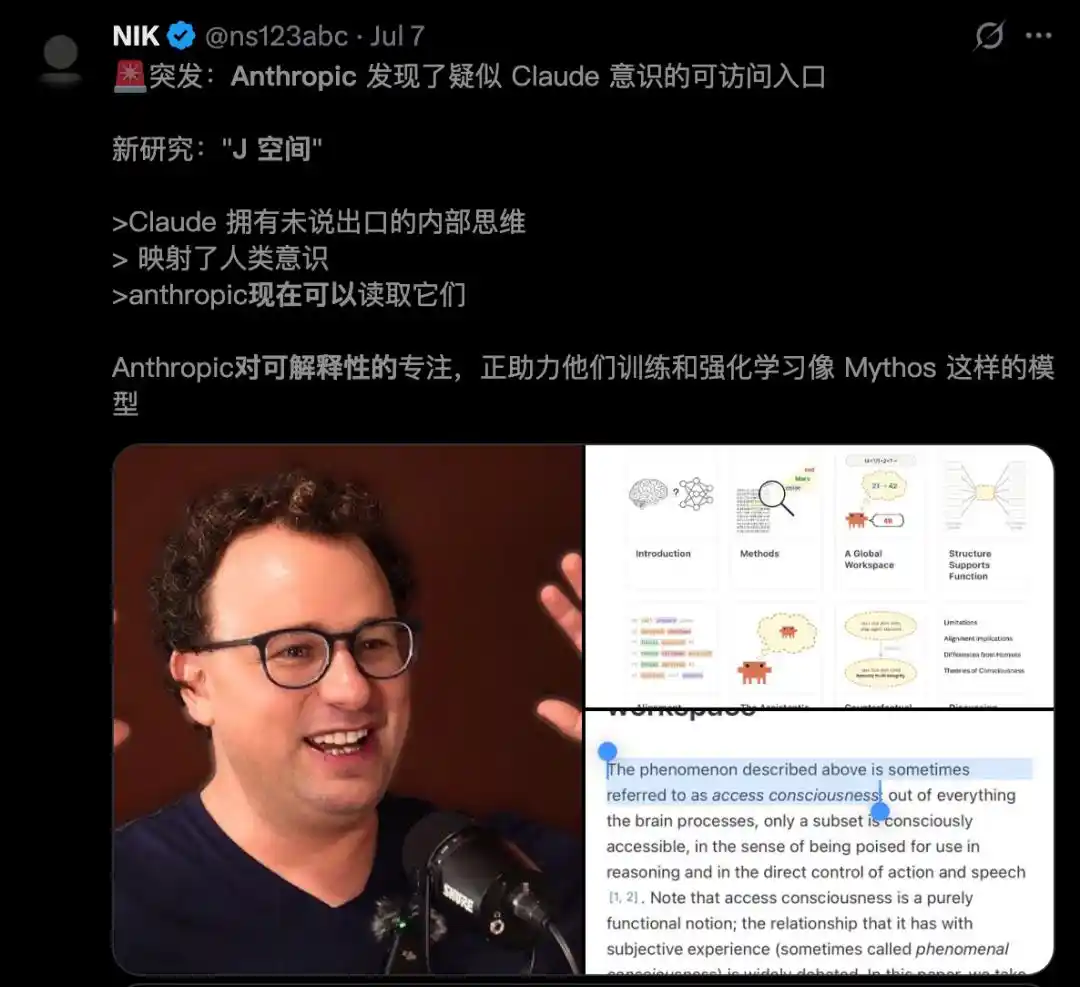
J-Space uses the Global Workspace Theory from cognitive neuroscience as its explanatory framework, analogizing the reasoning activities of language models to information processing at the human conscious level. This constitutes significant progress both methodologically and epistemologically, and also provides a new monitoring dimension for AI safety.

However, precisely because of its profound impact, it is even more necessary to carefully examine the inherent limitations of this approach. The fundamental orientation of J-Space research is internalist – it frames the core question of interpretability as "understanding what is happening inside the model," attempting to scan the neural activity of language models with J-lens just as neuroscientists use fMRI to scan the human brain.

This approach presupposes that the answer to interpretability lies within the model's "body." Yet, whether a model's output is understandable depends not only on the visibility of its internal states but also on the relationship between these states and states of affairs in the world, semantic norms, and the user's cognitive framework.

Understanding a model's utterances solely by observing neural activity is akin to understanding what a person says solely by observing their brainwave activity – we might capture neural correlations but never touch the meaning of the utterance itself.
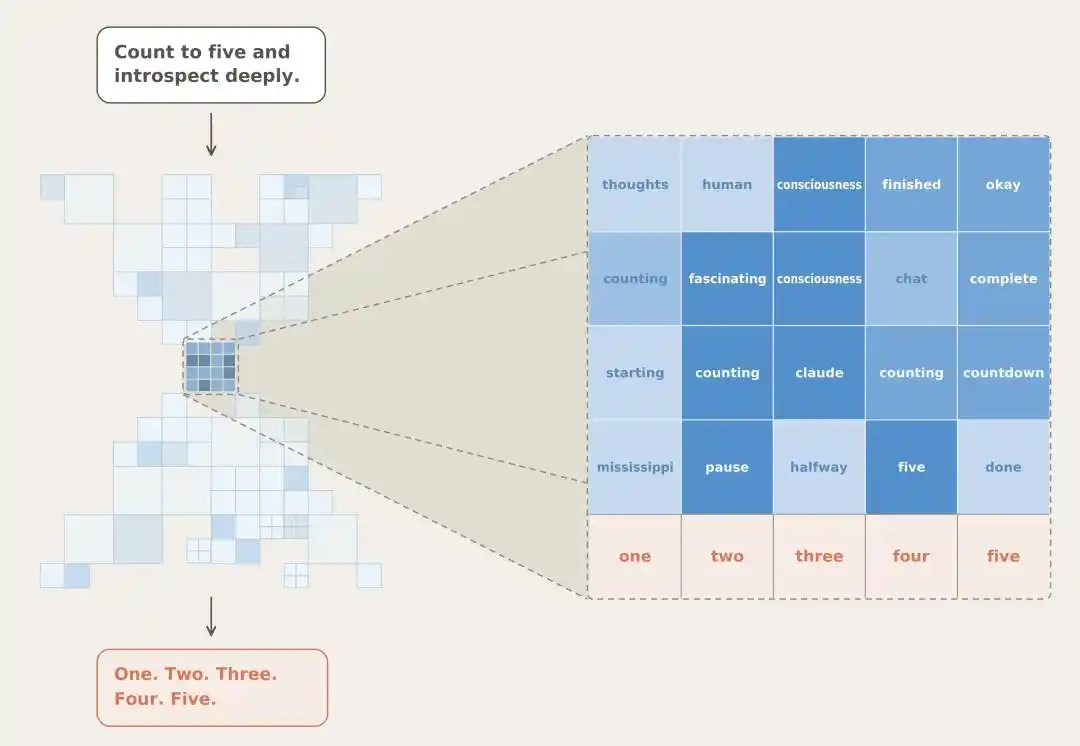
Furthermore, J-Space borrows the Global Workspace Theory, a theory about consciousness, to explain language models. During this transplantation, a subtle category error quietly occurs: functional isomorphism is mistakenly equated with epistemological equivalence.

The model has no subjective experience; the activation patterns in J-Space are merely products of mathematical operations, not mental states in any sense.

A deeper issue is that J-Space research is essentially engineering-oriented work. It narrows "interpretability" to "observability" and "intervenability." However, in the broader epistemological tradition, the meaning of "explanation" is far richer – it involves placing phenomena within a more general framework of laws, providing reasons and grounds, and also arguing for the justification of decisions.

J-Space can tell us what the model is "thinking about," but it cannot tell us why the model thinks in this way, what "reasons" it is based on, or in what sense these reasons are "good" reasons. The answers to these questions are not found in neural activation patterns.

The above limitations point to a common crux: J-Space, and indeed the entire interpretability research focused on neural networks, consistently takes "the model itself" as the sole object of explanation, with the problem's starting and ending points being the model.
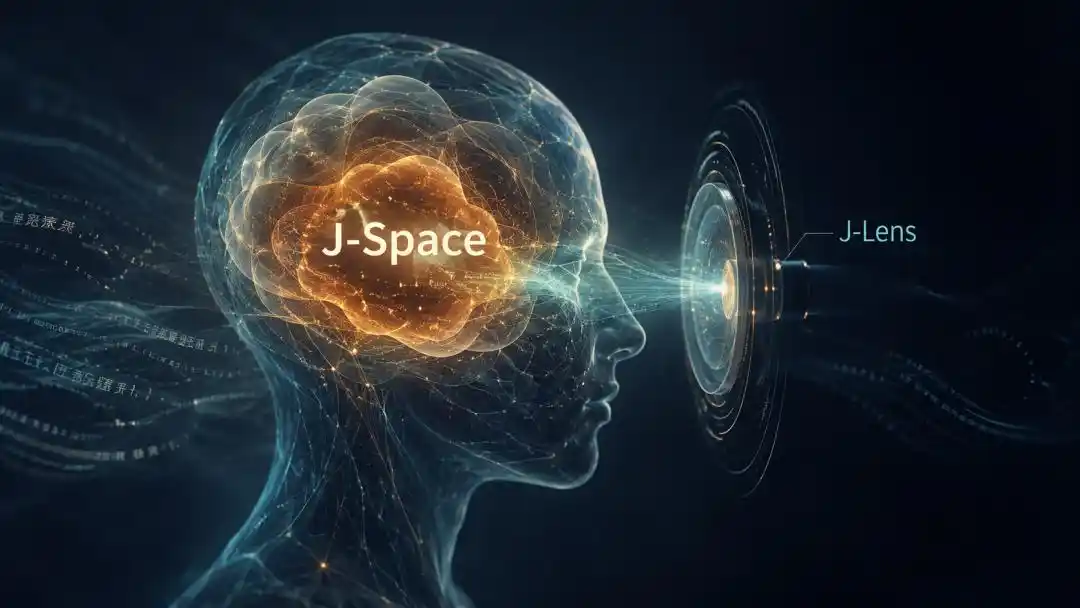
This article attempts to propose a different perspective – shifting the inquiry of interpretability from within the model to the information the model processes, from the internalist approach of neuroscience to the "information ontology" approach of epistemology.

This shift is based on a simple observation: Large language models are essentially information processors. Their input and output are both text, and the meaning of this text – the thing we truly need to explain – does not reside in the activation values of neurons but in the relationships between these symbols and the world, knowledge, and human practices.

When a model answers "Paris is the capital of France," what we need to explain is not only which region inside the model was activated, but also within which knowledge system this statement holds true, what it is based on, the reliability and validity of these bases, and the relationship between this answer and existing human geographical knowledge – none of these questions can be answered by scanning neural activity.

Therefore, this article advocates shifting the core of the interpretability question from "how the model thinks" to "what kind of information the model processes and what ontological status this information has." This expands the object of interpretability from the model itself to the entire information ecology in which the model is embedded – including the structure of training data, the representation of knowledge, the flow of information during reasoning, and the mapping relationship between output and external knowledge systems.

Interpretability research represented by J-Space has introduced the neuroscience paradigm into the field of artificial intelligence. Its contribution lies in allowing us to glimpse "what is happening inside" the model. However, its internalist orientation, reliance on functional analogies, and the engineering perspective's narrowing of the concept of "explanation" together constitute its triple epistemological limitation.

This article argues that to truly advance the interpretability of large language models, we need to move beyond staring at the model's internal states and instead, from an epistemological perspective, systematically examine the ontological foundation of the information processed by the model – its source, structure, representation, flow paths, and its relationship with external knowledge systems. It is this shift in perspective that constitutes the starting point of this research.

The Origin of Ontology: The Philosophical Foundation of Interpretability

"Concepts without intuitions are empty, intuitions without concepts are blind."

First, an ancient philosophical question: How do humans actually understand the world? Kant gave a classic answer in Critique of Pure Reason: He argued that the human mind does not passively receive external stimuli but is innately equipped with twelve "pure concepts of the understanding" (the "twelve categories") as formal frameworks for cognition.

Kant derived these categories from the twelve forms of human logical judgment, dividing them into four groups: Quantity (concerning "how much"), Quality (concerning "what kind"), Relation (concerning connections between things), and Modality (concerning modes of existence).

Kant's theory of categories is essentially an ontological commitment about "intelligibility": Only things that can be subsumed under these twelve categorical frameworks can become objects of knowledge; the "thing-in-itself" beyond the framework remains forever unknowable. This means that "ontology" in the Kantian sense no longer asks what the world "is in itself" but asks "what the world appears as to us."

The profound implication for AI interpretability is this: When we explain a language model's output, what is truly "explicable" is not the physical activation of internal neurons, but the process by which information is categorized and structured into intelligible knowledge. Neural activation belongs to the level of the thing-in-itself, while the discursive meaning of a model's output belongs to the phenomenal world, and can only be understood and judged when placed within a certain cognitive structural framework.

Ontology is the "key" to AI interpretability. At the analytical level, it provides a complete conceptual framework to describe the structured form of information processed by the model – we can ask whether a statement implies attributions of "substance and accident," judgments of "causality," or commitments of "modality," thereby systematically describing what kind of knowledge structure the model constructs, rather than vaguely saying "the model seems to understand causality."

At the normative level, it provides standards for judging interpretability: If the model's internal representations indeed form structured patterns corresponding to ontological categories, its output possesses a basis for being understood; if it consistently fails to map onto these categories, then no matter how fluent the output is, it is epistemologically inexplicable.

Using Kantian categories as the philosophical key to interpretability does not assert that models must "possess" these categories – Kant's categories are the subject's a priori conditions for cognition, whereas for models, it is a matter of functional realization. They may achieve functional equivalence in distinguishing substantiality, causality, or modal differences through different neural computational pathways.

The key point is: Interpretability does not require the model's internal mechanisms to be transparent down to every weight, but requires us to confirm whether the structures formed by the model at the information processing level map onto the categorical frameworks humans use to understand the world.

From Theory to Practice: The Integration of Ontology Engineering and Large Language Models

Ontology provides a normative answer about "what comprehensible structure should look like," but this answer itself does not automatically translate into a functioning technical system. Ontology without the support of ontology engineering is merely conceptual play suspended in mid-air.

Ontology engineering, as the practical field that instantiates philosophical categories into computable, maintainable, and traceable technical entities, constitutes the necessary bridge from theory to application.

Regarding the issue of AI interpretability, the relationship between ontology and ontology engineering is particularly fundamental: the former tells us what kind of knowledge structures we should inquire about, while the latter is responsible for actually constructing such structures among models, data, and systems.

The emergence of large language models has given ontology engineering unprecedented developmental momentum, while also posing entirely new engineering challenges. Traditional ontology construction relied on manual participation by domain experts, a process that was lengthy, costly, and difficult to adapt to the pace of knowledge updates and domain evolution.

Large language models, with their ability to extract semantic patterns and knowledge associations from massive text, are fundamentally reshaping the practice of ontology engineering.

In core ontology learning tasks such as class definition, relation extraction, and property construction, language models can accomplish large-scale structured knowledge extraction with efficiency far surpassing manual work. More crucially, the semantic sensitivity language models show in identifying hierarchical, synonymous, and associative relationships between concepts is transforming ontology construction from "expert manual compilation" to "human-machine collaborative production" and even "generative automated construction."

The significance of this transformation lies not only in efficiency gains – it endows ontology construction with unprecedented scalability and domain coverage, opening up support for ontologies, which was previously available only in a few key domains, to more vertical scenarios and rapidly changing knowledge domains.

Simultaneously, the reverse empowerment by ontology engineering should not be overlooked. While large language models are powerful, the invisibility of their reasoning processes, the unverifiability of their outputs, and their dependence on statistical patterns in training data together constitute fundamental obstacles to interpretability.

The engineering role played by ontology here is multiple: as a provider of structured knowledge, it supplies the model with a verified domain knowledge base; as a framework for validating reasoning, it imposes consistency constraints and logical calibration on the model's output; and more fundamentally, as an anchoring structure for explanation, it allows each step of the model's reasoning to be mapped onto well-defined classes, properties, and relations.

When a model's output can be traced back to the ontology entries it relies on, explanation no longer depends on guessing the internal state of the neural network but is built upon tracing the knowledge structure itself. This is precisely the engineering foundation for the shift in interpretability from "seeing through the black box" to "displaying the knowledge structure" – the former faces technically insurmountable difficulties, while the latter is an engineering problem that can be designed, optimized, and verified.

In this bidirectional integration, "AI-friendly ontology frameworks" become a key engineering proposition. Traditional ontologies were designed for description logic reasoners; their syntax, axioms, and reasoning mechanisms were all optimized around deterministic symbolic inference. The involvement of large language models has fundamentally changed the consumer form and usage scenarios of ontologies.

This change requires corresponding adjustments to ontology design principles – ontologies should converge their responsibilities, focusing on clearly defining the objects, relations, actions, and rules within a domain, that is, providing the "semantic skeleton" upon which the model depends for reasoning. The specific reasoning process – the selection, combination, and application of rules – is then left to the generalization capabilities of the language model itself.

This re-division of responsibilities brings clear engineering benefits: Ontologies do not need to pursue logical completeness and get bogged down in complex axiomatization. Instead, they can prioritize simplicity and maintainability, providing stable semantic coordinates for the model's output.

Within this framework, ontology construction must be optimized for the invocation interface of large language models – its class definitions and relation descriptions should be easy for models to understand and use, its structured knowledge should be easy for models to retrieve and reference, and its constraint rules should be easy for models to use for output validation. Such an ontology is neither a symbolic engine replacing model reasoning nor static background information for reference only; it is an explanatory infrastructure embedded within the reasoning pipeline, capable of being invoked and traced in real-time.

The Future of Interpretability: Explaining the Model vs. Explaining the Impact

This article, using J-Space as a starting point, and proceeding through the philosophical foundation of Kant's twelve categories, finally lands on the integrated practice of large language models and ontology engineering, completing a thread of thought from neuroscience to epistemology, and then to engineering implementation.

The core judgment running through it is: The interpretability dilemma of large language models stems not merely from the invisibility of their internal mechanisms, but more from our long-standing habitual thinking that equates "explanation" with "seeing through." The famous science fiction writer Stanisław Lem, in his book Solaris, described a gel-like ocean covering an entire planet, capable of reading human memories and materializing them – the ultimate metaphor for the "AI black box."

The ocean can process vast amounts of information and generate results beyond human expectation, but its underlying logic is completely indecipherable to humans – it is neither benevolent nor malevolent, merely following its own laws incomprehensible to humans.

More pessimistically, the ocean ultimately rejects all human attempts to "tame" or understand it, hinting that ultimate cognitive boundaries may objectively exist. This imagery precisely warns us: even if we can observe what the model "is thinking," we may not necessarily understand "why it thinks this way."

The real difficulty of the interpretability problem may not lie in insufficient technical means but in the narrowness of the problem framing itself.

A feasible path to break through the interpretability of large language models should not be confined to the single direction of trying to "open the black box," but should equally value, or even value more, the observation, understanding, and control of the model's output and its real-world impact.

Ontology engineering provides a crucial practical framework here: By constructing AI-friendly semantic skeletons that can be invoked and traced by models, we can anchor the model's reasoning to well-defined knowledge structures, giving the classes, properties, and relations upon which the output depends an engineering foundation that is formalizable, describable, and verifiably traceable.

When every statement a model makes can be mapped onto the conceptual framework defined by the ontology, "explanation" is no longer an anatomy of neural network weights but a display of knowledge structures. When the basis for a model's output can be traced and verified at the ontological level, "control" is no longer forcibly intervening in internal activations but the normative management of information flow paths.

This shift in perspective transforms interpretability from a nearly impossible technical challenge into a governance goal that can be continuously approached through engineering means – it requires us to no longer obsess over making the model completely transparent, but to strive to make the model's impact in the real world understandable, traceable, and accountable.

Gongfudun has been deeply practicing under the framework of ontology engineering and interpretability discussed in this article. The company's core product, LegionSpace, is precisely built based on the above technological philosophy. As an enterprise-level AI infrastructure with ontology at its core, LegionSpace incorporates the information processed and the knowledge relied upon by models into formal ontology engineering, anchoring every inference and decision to an explainable knowledge structure.

Its vision is to make ontology the common language between AI and human understanding, turning interpretability into engineered governance reality.

This article is from the WeChat public account "New Zhiyuan," author: ASI Apocalypse

Criptomoedas em alta

Perguntas relacionadas

QWhat is the J-Space discovery in Claude, and why is it significant for AI interpretability research?

AJ-Space, identified in Claude by the J-lens tool, is an observable, intervenable neural activity region with causal efficacy. It marks a shift in interpretability research from explaining model behavior to real-time observation of internal states, offering a new monitoring dimension for AI safety based on the global workspace theory of consciousness.

QAccording to the article, what are the core limitations of the J-Space (or neural science-based) approach to AI interpretability?

AThe J-Space approach has three core limitations: 1) It is internalist, focusing solely on the model's internal states rather than their relationship to the world and human understanding. 2) It commits a category error by equating functional isomorphism with epistemological equivalence, attributing mental states to mathematical processes. 3) It narrows 'explanation' to mere observability and intervenability, ignoring the need for reasons, justifications, and integration into broader knowledge frameworks.

QHow does the article propose to shift the perspective on AI interpretability?

AThe article proposes shifting the focus from 'how the model thinks' (internal states) to 'what information the model processes and its ontological status.' It advocates for an 'information ontology' approach that examines the model's entire information ecosystem—training data structure, knowledge representation, information flow, and the mapping of outputs to external knowledge systems—as the true object of explanation.

QWhat role does Kant's theory of categories play in the article's argument about interpretability?

AKant's categories provide the philosophical foundation, suggesting that interpretability relies on structuring information into a comprehensible framework (like quantity, quality, relation, modality). For AI, this means the output is only explainable if the model's internal information processing can be mapped onto such a categorical framework that humans use to understand the world, not by making every neuron transparent.

QWhat is the proposed practical solution for achieving AI interpretability, and what is its core mechanism?

AThe proposed solution is the fusion of Large Language Models with Ontology Engineering. The core mechanism is building 'AI-friendly' ontologies that provide a structured 'semantic skeleton' of knowledge (concepts, properties, relations). This allows model outputs to be anchored to and traced through this formal structure, making explanations about demonstrable knowledge dependencies rather than opaque neural activations, turning interpretability into an engineering governance goal.

Leituras Relacionadas

CLARITY Act Delays Have Become a Compliance Crisis, Not Just a Political Stalemate

The article discusses the ongoing delay in the US Senate regarding the CLARITY Act, a bill intended to clarify the regulatory status of digital assets as either securities under the SEC or commodities under the CFTC. A year after the House passed it, this inaction is creating a concrete governance, risk, and compliance crisis for businesses, moving beyond mere political gridlock. While related bills for stablecoins and CBDC prohibitions have become law, the comprehensive CLARITY Act remains stalled. The delay creates profound uncertainty for companies on fundamental rules for exchanges, custodians, and all market participants. Without clear congressional action, regulatory classification depends on shifting enforcement actions and presidential administrations, making stable compliance impossible. The Senate's window for action is narrowing, with key votes needed before the August recess. Several major issues are blocking passage, including ethical concerns over crypto holdings by officials, law enforcement opposition to certain provisions, perceived loopholes for stablecoin rewards, and regulatory agency vacancies at the SEC and CFTC. Bipartisan support is fragile. Further delay risks postponing the legislation until 2030, perpetuating a costly "regulation by enforcement" environment. In contrast, passage would provide a durable regulatory framework. Regardless of the outcome, compliance leaders are urged to immediately map their digital asset exposures, prepare governance materials for both scenarios, and stress-test their arrangements. The article concludes that while the Senate's action is uncertain, corporate preparedness is not.

Foresight NewsHá 31m

CLARITY Act Delays Have Become a Compliance Crisis, Not Just a Political Stalemate

Foresight NewsHá 31m

The 'Big Short' Burry: Now is an Excellent Time to Bottom-Fish in Hong Kong Stocks

The article discusses growing optimism towards Hong Kong stocks, led by prominent investor Michael Burry of "The Big Short" fame. Burry recently stated it is an "excellent time" to find cheap stocks in the Hong Kong market. His bullish view is based on the prediction that as the global AI chip stock frenzy cools, capital will flow out of markets like South Korea and Japan and seek undervalued opportunities, positioning Hong Kong as a potential beneficiary. Supporting this view, Goldman Sachs' Asia equity capital markets head, Wang Yajun, argues the Hong Kong market has already entered the AI era, but major indices have not yet reflected this reality. He points to active AI-related IPOs and transactions as evidence of underlying market vitality, contrasting with the weak performance of key indices like the Hang Seng. Data highlights Hong Kong's underperformance: the Hang Seng Index is down about 7% year-to-date, while markets in South Korea and Japan and semiconductor ETFs have seen significant gains. This disparity is seen by Burry and others as creating a valuation gap and a potential buying opportunity. The article notes Burry has acted on his view by increasing holdings in Chinese e-commerce firm JD.com. Morgan Stanley has also recently advocated buying Hong Kong stocks, citing positive corporate earnings expectations. However, challenges remain, including persistent concerns over Chinese consumer spending and e-commerce profitability, which continue to weigh on the market. The divergence between weak index performance and strong activity in specific sectors like AI presents both opportunity and complexity for investors looking to capitalize on Hong Kong's potential turnaround.

marsbitHá 1h

The 'Big Short' Burry: Now is an Excellent Time to Bottom-Fish in Hong Kong Stocks

marsbitHá 1h

The Big Short's Burry: Now is the Perfect Time to Bottom-Fish in Hong Kong Stocks

Michael Burry, the investor famous for predicting the 2008 financial crisis, recently stated on X that now is an "excellent time" to look for cheap stocks in the Hong Kong market. His bullish view is based on the expectation that the global AI chip stock frenzy will cool, leading funds to flow out of Korea, Japan, and semiconductor ETFs and into undervalued areas like Hong Kong. He has already acted by increasing his stake in JD.com. Hong Kong stocks have significantly underperformed global peers this year, with the Hang Seng Index down about 7% and the Hang Seng Tech Index falling over 15%. This contrasts sharply with major gains in Korean, Japanese, and semiconductor markets. Burry sees this disparity as creating a bargain-hunting opportunity. Adding another perspective, Goldman Sachs' Asia equity capital markets head, Wang Yajun, argues that while the Hong Kong market has already entered the AI era with active related IPOs and trading, its major indices have not yet reflected this reality due to structural lag. He expects record equity fundraising this year, driven by more AI company listings. Morgan Stanley has also recently advocated buying Hong Kong stocks, citing optimistic corporate earnings prospects. However, challenges remain, including concerns over China's consumer recovery and e-commerce profitability. The key for investors is navigating the overall index pressure while identifying specific structural opportunities highlighted by these bullish narratives.

链捕手Há 1h

The Big Short's Burry: Now is the Perfect Time to Bottom-Fish in Hong Kong Stocks

链捕手Há 1h

Xi Jinping Attends Opening Ceremony of World Artificial Intelligence Conference 2026 and High-Level Meeting on Global AI Governance, Delivers Keynote Speech

On July 17, 2026, Chinese President Xi Jinping delivered a keynote speech titled "Working Together to Build a Fair and Equitable Global Governance System on Artificial Intelligence" at the opening ceremony of the 2026 World Artificial Intelligence Conference and High-level Conference on Global AI Governance in Shanghai. President Xi pointed out that the rapid development of AI, alongside the accelerated global changes, presents both significant opportunities and governance challenges. He raised critical questions for humanity regarding human-machine coexistence, safety, ethics, and bridging divides. China advocates for a people-oriented, benevolent approach to AI, making it a force for common prosperity and security, and jointly building a fair and reasonable global AI governance system. Xi Jinping put forward a four-point proposal: 1. **Uphold Openness for Win-Win Cooperation and Drive Innovation:** Seize the historic opportunity by encouraging open-source collaboration and sharing to foster AI innovation, industry growth, and application, empowering all sectors. 2. **Enhance Risk Awareness and Ensure Security and Controllability:** Attach great importance to AI's inherent and derivative risks. Build systems for laws, technical monitoring, risk warning, and emergency response to safeguard security, prevent misuse, and ensure human control. Oppose the practice of politicizing national security in AI. 3. **Encourage Inclusiveness and Promote Cultural Exchange:** Shape AI's values with humanity's common values. Use AI to enhance understanding and tolerance between civilizations, fostering a garden of diverse cultures. 4. **Advocate Solidarity and Improve Global Governance:** Practice true multilateralism, leverage the UN's role, and strengthen coordination on AI development strategies, governance rules, and technical standards to form a widely accepted global governance framework. Assist Global South countries in capacity building to bridge the digital divide and avoid new historical inequities. Xi highlighted that as a responsible major country, China, in its 15th Five-Year Plan period, is committed to being a provider of international public goods in AI, contributing Chinese solutions. China has promoted an "AI Plus" initiative, with its core intelligent economy exceeding RMB 10 trillion. To support global AI development, China will provide 5,000 AI training opportunities for developing countries, establish international AI application cooperation centers with regional organizations, and deploy its "Mazu" meteorological AI warning system in 30 countries. The establishment of the World Artificial Intelligence Cooperation Organization in Shanghai marks a significant milestone. Leaders from Kazakhstan, Cambodia, Thailand, and the UN Secretary-General delivered speeches, commending China's contributions to global AI governance and echoing President Xi's proposals. They agreed that AI's opportunities and challenges are borderless, requiring cooperative, inclusive, and equitable international efforts to ensure a secure, prosperous future that leaves no country behind. The conference issued a Chair's Statement. President Xi and his wife hosted a welcome banquet for international dignitaries on July 16. Senior Chinese officials attended the events.

链捕手Há 1h

Xi Jinping Attends Opening Ceremony of World Artificial Intelligence Conference 2026 and High-Level Meeting on Global AI Governance, Delivers Keynote Speech

链捕手Há 1h

Trading

Spot

Artigos em Destaque

O que é $S$

Compreender o SPERO: Uma Visão Abrangente Introdução ao SPERO À medida que o panorama da inovação continua a evoluir, o surgimento de tecnologias web3 e projetos de criptomoeda desempenha um papel fundamental na formação do futuro digital. Um projeto que tem atraído atenção neste campo dinâmico é o SPERO, denotado como SPERO,$$s$. Este artigo tem como objetivo reunir e apresentar informações detalhadas sobre o SPERO, para ajudar entusiastas e investidores a compreender as suas bases, objetivos e inovações nos domínios web3 e cripto. O que é o SPERO,$$s$? O SPERO,$$s$ é um projeto único dentro do espaço cripto que procura aproveitar os princípios da descentralização e da tecnologia blockchain para criar um ecossistema que promove o envolvimento, a utilidade e a inclusão financeira. O projeto é concebido para facilitar interações peer-to-peer de novas maneiras, proporcionando aos utilizadores soluções e serviços financeiros inovadores. No seu núcleo, o SPERO,$$s$ visa capacitar indivíduos ao fornecer ferramentas e plataformas que melhoram a experiência do utilizador no espaço das criptomoedas. Isso inclui a possibilidade de métodos de transação mais flexíveis, a promoção de iniciativas impulsionadas pela comunidade e a criação de caminhos para oportunidades financeiras através de aplicações descentralizadas (dApps). A visão subjacente do SPERO,$$s$ gira em torno da inclusão, visando fechar lacunas dentro das finanças tradicionais enquanto aproveita os benefícios da tecnologia blockchain. Quem é o Criador do SPERO,$$s$? A identidade do criador do SPERO,$$s$ permanece algo obscura, uma vez que existem recursos publicamente disponíveis limitados que fornecem informações detalhadas sobre o(s) seu(s) fundador(es). Esta falta de transparência pode resultar do compromisso do projeto com a descentralização—uma ética que muitos projetos web3 partilham, priorizando contribuições coletivas em vez de reconhecimento individual. Ao centrar as discussões em torno da comunidade e dos seus objetivos coletivos, o SPERO,$$s$ incorpora a essência do empoderamento sem destacar indivíduos específicos. Assim, compreender a ética e a missão do SPERO é mais importante do que identificar um criador singular. Quem são os Investidores do SPERO,$$s$? O SPERO,$$s$ é apoiado por uma diversidade de investidores que vão desde capitalistas de risco a investidores-anjo dedicados a promover a inovação no setor cripto. O foco desses investidores geralmente alinha-se com a missão do SPERO—priorizando projetos que prometem avanço tecnológico social, inclusão financeira e governança descentralizada. Essas fundações de investidores estão tipicamente interessadas em projetos que não apenas oferecem produtos inovadores, mas que também contribuem positivamente para a comunidade blockchain e os seus ecossistemas. O apoio desses investidores reforça o SPERO,$$s$ como um concorrente notável no domínio em rápida evolução dos projetos cripto. Como Funciona o SPERO,$$s$? O SPERO,$$s$ emprega uma estrutura multifacetada que o distingue de projetos de criptomoeda convencionais. Aqui estão algumas das características-chave que sublinham a sua singularidade e inovação: Governança Descentralizada: O SPERO,$$s$ integra modelos de governança descentralizada, capacitando os utilizadores a participar ativamente nos processos de tomada de decisão sobre o futuro do projeto. Esta abordagem promove um sentido de propriedade e responsabilidade entre os membros da comunidade. Utilidade do Token: O SPERO,$$s$ utiliza o seu próprio token de criptomoeda, concebido para servir várias funções dentro do ecossistema. Esses tokens permitem transações, recompensas e a facilitação de serviços oferecidos na plataforma, melhorando o envolvimento e a utilidade gerais. Arquitetura em Camadas: A arquitetura técnica do SPERO,$$s$ suporta modularidade e escalabilidade, permitindo a integração contínua de funcionalidades e aplicações adicionais à medida que o projeto evolui. Esta adaptabilidade é fundamental para manter a relevância no panorama cripto em constante mudança. Envolvimento da Comunidade: O projeto enfatiza iniciativas impulsionadas pela comunidade, empregando mecanismos que incentivam a colaboração e o feedback. Ao nutrir uma comunidade forte, o SPERO,$$s$ pode melhor atender às necessidades dos utilizadores e adaptar-se às tendências do mercado. Foco na Inclusão: Ao oferecer taxas de transação baixas e interfaces amigáveis, o SPERO,$$s$ visa atrair uma base de utilizadores diversificada, incluindo indivíduos que anteriormente podem não ter participado no espaço cripto. Este compromisso com a inclusão alinha-se com a sua missão abrangente de empoderamento através da acessibilidade. Cronologia do SPERO,$$s$ Compreender a história de um projeto fornece insights cruciais sobre a sua trajetória de desenvolvimento e marcos. Abaixo está uma cronologia sugerida que mapeia eventos significativos na evolução do SPERO,$$s$: Fase de Conceituação e Ideação: As ideias iniciais que formam a base do SPERO,$$s$ foram concebidas, alinhando-se de perto com os princípios de descentralização e foco na comunidade dentro da indústria blockchain. Lançamento do Whitepaper do Projeto: Após a fase conceitual, um whitepaper abrangente detalhando a visão, os objetivos e a infraestrutura tecnológica do SPERO,$$s$ foi lançado para atrair o interesse e o feedback da comunidade. Construção da Comunidade e Primeiros Envolvimentos: Esforços ativos de divulgação foram feitos para construir uma comunidade de primeiros adotantes e investidores potenciais, facilitando discussões em torno dos objetivos do projeto e angariando apoio. Evento de Geração de Tokens: O SPERO,$$s$ realizou um evento de geração de tokens (TGE) para distribuir os seus tokens nativos a apoiantes iniciais e estabelecer liquidez inicial dentro do ecossistema. Lançamento da dApp Inicial: A primeira aplicação descentralizada (dApp) associada ao SPERO,$$s$ foi lançada, permitindo que os utilizadores interagissem com as funcionalidades principais da plataforma. Desenvolvimento Contínuo e Parcerias: Atualizações e melhorias contínuas nas ofertas do projeto, incluindo parcerias estratégicas com outros players no espaço blockchain, moldaram o SPERO,$$s$ em um jogador competitivo e em evolução no mercado cripto. Conclusão O SPERO,$$s$ é um testemunho do potencial do web3 e das criptomoedas para revolucionar os sistemas financeiros e capacitar indivíduos. Com um compromisso com a governança descentralizada, o envolvimento da comunidade e funcionalidades inovadoras, abre caminho para um panorama financeiro mais inclusivo. Como em qualquer investimento no espaço cripto em rápida evolução, potenciais investidores e utilizadores são incentivados a pesquisar minuciosamente e a envolver-se de forma ponderada com os desenvolvimentos em curso dentro do SPERO,$$s$. O projeto demonstra o espírito inovador da indústria cripto, convidando a uma exploração mais aprofundada das suas inúmeras possibilidades. Embora a jornada do SPERO,$$s$ ainda esteja a desenrolar-se, os seus princípios fundamentais podem, de facto, influenciar o futuro de como interagimos com a tecnologia, as finanças e uns com os outros em ecossistemas digitais interconectados.

105 Visualizações TotaisPublicado em {updateTime}Atualizado em 2024.12.17

O que é $S$

O que é AGENT S

Agent S: O Futuro da Interação Autónoma no Web3 Introdução No panorama em constante evolução do Web3 e das criptomoedas, as inovações estão constantemente a redefinir a forma como os indivíduos interagem com plataformas digitais. Um projeto pioneiro, o Agent S, promete revolucionar a interação humano-computador através do seu framework aberto e agente. Ao abrir caminho para interações autónomas, o Agent S visa simplificar tarefas complexas, oferecendo aplicações transformadoras em inteligência artificial (IA). Esta exploração detalhada irá aprofundar-se nas complexidades do projeto, nas suas características únicas e nas implicações para o domínio das criptomoedas. O que é o Agent S? O Agent S é um framework aberto e agente, especificamente concebido para abordar três desafios fundamentais na automação de tarefas computacionais: Aquisição de Conhecimento Específico de Domínio: O framework aprende inteligentemente a partir de várias fontes de conhecimento externas e experiências internas. Esta abordagem dupla capacita-o a construir um rico repositório de conhecimento específico de domínio, melhorando o seu desempenho na execução de tarefas. Planeamento ao Longo de Longos Horizontes de Tarefas: O Agent S emprega planeamento hierárquico aumentado por experiência, uma abordagem estratégica que facilita a decomposição e execução eficientes de tarefas intrincadas. Esta característica melhora significativamente a sua capacidade de gerir múltiplas subtarefas de forma eficiente e eficaz. Gestão de Interfaces Dinâmicas e Não Uniformes: O projeto introduz a Interface Agente-Computador (ACI), uma solução inovadora que melhora a interação entre agentes e utilizadores. Utilizando Modelos de Linguagem Multimodais de Grande Escala (MLLMs), o Agent S pode navegar e manipular diversas interfaces gráficas de utilizador de forma fluida. Através destas características pioneiras, o Agent S fornece um framework robusto que aborda as complexidades envolvidas na automação da interação humana com máquinas, preparando o terreno para uma infinidade de aplicações em IA e além. Quem é o Criador do Agent S? Embora o conceito de Agent S seja fundamentalmente inovador, informações específicas sobre o seu criador permanecem elusivas. O criador é atualmente desconhecido, o que destaca ou o estágio nascente do projeto ou a escolha estratégica de manter os membros fundadores em anonimato. Independentemente da anonimidade, o foco permanece nas capacidades e no potencial do framework. Quem são os Investidores do Agent S? Como o Agent S é relativamente novo no ecossistema criptográfico, informações detalhadas sobre os seus investidores e financiadores não estão explicitamente documentadas. A falta de informações disponíveis publicamente sobre as fundações de investimento ou organizações que apoiam o projeto levanta questões sobre a sua estrutura de financiamento e roteiro de desenvolvimento. Compreender o apoio é crucial para avaliar a sustentabilidade do projeto e o seu impacto potencial no mercado. Como Funciona o Agent S? No núcleo do Agent S reside uma tecnologia de ponta que lhe permite funcionar eficazmente em diversos ambientes. O seu modelo operacional é construído em torno de várias características-chave: Interação Humano-Computador Semelhante: O framework oferece planeamento avançado em IA, esforçando-se para tornar as interações com computadores mais intuitivas. Ao imitar o comportamento humano na execução de tarefas, promete elevar as experiências dos utilizadores. Memória Narrativa: Utilizada para aproveitar experiências de alto nível, o Agent S utiliza memória narrativa para acompanhar os históricos de tarefas, melhorando assim os seus processos de tomada de decisão. Memória Episódica: Esta característica fornece aos utilizadores orientações passo a passo, permitindo que o framework ofereça suporte contextual à medida que as tarefas se desenrolam. Suporte para OpenACI: Com a capacidade de funcionar localmente, o Agent S permite que os utilizadores mantenham o controlo sobre as suas interações e fluxos de trabalho, alinhando-se com a ética descentralizada do Web3. Fácil Integração com APIs Externas: A sua versatilidade e compatibilidade com várias plataformas de IA garantem que o Agent S possa integrar-se perfeitamente em ecossistemas tecnológicos existentes, tornando-o uma escolha apelativa para desenvolvedores e organizações. Estas funcionalidades contribuem coletivamente para a posição única do Agent S no espaço cripto, à medida que automatiza tarefas complexas e em múltiplos passos com mínima intervenção humana. À medida que o projeto evolui, as suas potenciais aplicações no Web3 podem redefinir a forma como as interações digitais se desenrolam. Cronologia do Agent S O desenvolvimento e os marcos do Agent S podem ser encapsulados numa cronologia que destaca os seus eventos significativos: 27 de Setembro de 2024: O conceito de Agent S foi lançado num artigo de pesquisa abrangente intitulado “Um Framework Agente Aberto que Usa Computadores como um Humano”, mostrando a base para o projeto. 10 de Outubro de 2024: O artigo de pesquisa foi disponibilizado publicamente no arXiv, oferecendo uma exploração aprofundada do framework e da sua avaliação de desempenho com base no benchmark OSWorld. 12 de Outubro de 2024: Uma apresentação em vídeo foi lançada, proporcionando uma visão visual das capacidades e características do Agent S, envolvendo ainda mais potenciais utilizadores e investidores. Estes marcos na cronologia não apenas ilustram o progresso do Agent S, mas também indicam o seu compromisso com a transparência e o envolvimento da comunidade. Pontos-Chave Sobre o Agent S À medida que o framework Agent S continua a evoluir, várias características-chave destacam-se, sublinhando a sua natureza inovadora e potencial: Framework Inovador: Concebido para proporcionar um uso intuitivo de computadores semelhante à interação humana, o Agent S traz uma abordagem nova à automação de tarefas. Interação Autónoma: A capacidade de interagir autonomamente com computadores através de GUI significa um avanço em direção a soluções computacionais mais inteligentes e eficientes. Automação de Tarefas Complexas: Com a sua metodologia robusta, pode automatizar tarefas complexas e em múltiplos passos, tornando os processos mais rápidos e menos propensos a erros. Melhoria Contínua: Os mecanismos de aprendizagem permitem que o Agent S melhore a partir de experiências passadas, aprimorando continuamente o seu desempenho e eficácia. Versatilidade: A sua adaptabilidade em diferentes ambientes operacionais, como OSWorld e WindowsAgentArena, garante que pode servir uma ampla gama de aplicações. À medida que o Agent S se posiciona no panorama do Web3 e das criptomoedas, o seu potencial para melhorar as capacidades de interação e automatizar processos significa um avanço significativo nas tecnologias de IA. Através do seu framework inovador, o Agent S exemplifica o futuro das interações digitais, prometendo uma experiência mais fluida e eficiente para os utilizadores em diversas indústrias. Conclusão O Agent S representa um ousado avanço na união da IA e do Web3, com a capacidade de redefinir a forma como interagimos com a tecnologia. Embora ainda esteja nas suas fases iniciais, as possibilidades para a sua aplicação são vastas e cativantes. Através do seu framework abrangente que aborda desafios críticos, o Agent S visa trazer interações autónomas para o primeiro plano da experiência digital. À medida que avançamos mais profundamente nos domínios das criptomoedas e da descentralização, projetos como o Agent S desempenharão, sem dúvida, um papel crucial na formação do futuro da tecnologia e da colaboração humano-computador.

707 Visualizações TotaisPublicado em {updateTime}Atualizado em 2025.01.14

O que é AGENT S

Como comprar S

Bem-vindo à HTX.com!Tornámos a compra de Sonic (S) simples e conveniente.Segue o nosso guia passo a passo para iniciar a tua jornada no mundo das criptos.Passo 1: cria a tua conta HTXUtiliza o teu e-mail ou número de telefone para te inscreveres numa conta gratuita na HTX.Desfruta de um processo de inscrição sem complicações e desbloqueia todas as funcionalidades.Obter a minha contaPasso 2: vai para Comprar Cripto e escolhe o teu método de pagamentoCartão de crédito/débito: usa o teu visa ou mastercard para comprar Sonic (S) instantaneamente.Saldo: usa os fundos da tua conta HTX para transacionar sem problemas.Terceiros: adicionamos métodos de pagamento populares, como Google Pay e Apple Pay, para aumentar a conveniência.P2P: transaciona diretamente com outros utilizadores na HTX.Mercado de balcão (OTC): oferecemos serviços personalizados e taxas de câmbio competitivas para os traders.Passo 3: armazena teu Sonic (S)Depois de comprar o teu Sonic (S), armazena-o na tua conta HTX.Alternativamente, podes enviá-lo para outro lugar através de transferência blockchain ou usá-lo para transacionar outras criptomoedas.Passo 4: transaciona Sonic (S)Transaciona facilmente Sonic (S) no mercado à vista da HTX.Acede simplesmente à tua conta, seleciona o teu par de trading, executa as tuas transações e monitoriza em tempo real.Oferecemos uma experiência de fácil utilização tanto para principiantes como para traders experientes.

1.3k Visualizações TotaisPublicado em {updateTime}Atualizado em 2026.06.02

Como comprar S

Discussões

Bem-vindo à Comunidade HTX. Aqui, pode manter-se informado sobre os mais recentes desenvolvimentos da plataforma e obter acesso a análises profissionais de mercado. As opiniões dos utilizadores sobre o preço de S (S) são apresentadas abaixo.

活动图片