How to spot a crypto scam or a rug pull?

ambcryptoPublicado em 2026-07-21Última atualização em 2026-07-21

Resumo

Rug pulls typically begin with seemingly legitimate projects exhibiting rising prices and active communities, but end with developers withdrawing liquidity. These scams often involve manufacturing trust through locked liquidity and renounced contracts, then creating hype on social media. The process from hype to exit can occur in 48-72 hours. There are "hard" rug pulls involving immediate liquidity drainage and "soft" ones that gradually erode value through insider selling or abandoned development. Key warning signs include high wallet concentration (e.g., top 5-10 holders controlling over 30% of supply), lack of vesting for developer allocations, and quickly expiring liquidity locks. Smart contract risks stem from unverified code, hidden mint functions, upgradeable contracts, and sell restrictions. Market behavior red flags are rapid price surges driven by influencer promotion, low organic trading volume, and slowing holder growth before large developer withdrawals. Common exploit types are honeypots (trapping investors by blocking sells, accounting for ~98k scam tokens), hidden mint functions (~61k cases allowing post-launch supply inflation), and fake ownership renunciations (~49k cases). Ultimately, genuine decentralization is determined by developers relinquishing control through transparent vesting, verified code, and third-party audits.

Imagine discovering a promising new token with thousands of holders, rising prices, and an active community. Everything appears legitimate until the liquidity suddenly disappears. That is how a rug pull begins.

Rather than simply siphoning off your money, developers first manufacture trust through locked liquidity and renounced contracts. Later on, they create a buzz around their token via active social media platforms and coordinated hype.

The stronger the community grows, the easier it becomes to attract fresh capital and deepen investor confidence. The entire process often unfolds within 48-72 hours, from hype-creation to exit.

Hard rug pulls drain liquidity in one move through developer wallet dumps or pool withdrawals, while soft rugs quietly erode value through insider selling, token unlocks, or abandoned roadmaps.

Eventually, the developer withdraws the proceeds, and the TVL begins to collapse, revealing what the hype concealed all along. As a result, this leaves the token on-chain but with little practical market value or investor confidence.

The patterns behind most rug pulls

Not every token is as decentralized as it first appears. A project can attract thousands of holders and still leave most of the control in a few developer wallets. That is where the real risk begins.

Historical rug pull cases reveal that warning signs rarely emerge in isolation. Instead, multiple indicators tend to appear together long before liquidity is removed.

The smart contract then determines whether that risk becomes reality. Hidden mint functions, retained ownership, upgradeable contracts, or sell restrictions can quietly give developers more control than investors expect.

On-chain data consistently associates high wallet concentration, where the top 5 to 10 holders control more than 30% of supply, with increased manipulation risk. Furthermore, that exposure grows when developer allocations lack meaningful vesting or liquidity locks expire quickly after the launch of the project.

Contract architecture adds another layer of concern. Unverified source code, active mint functions, upgradeable proxies, and adjustable sell restrictions allow developers to retain control after deployment.

Market behavior often reinforces these structural risks. This happens through rapid price appreciation supported by influencer-driven promotion. This is in addition to low organic volume and decreasing holder growth rates that occur prior to large developer wallet transfers and declining liquidity pools.

For instance, cases such as SQUID and LIBRA followed similar trajectories despite different narratives. Collectively, these patterns suggest rug pulls are better identified through converging on-chain, contract, and behavioral signals rather than any single metric alone.

That being said, not all projects follow that trajectory. The use of transparent vesting, verified code, and third-party audit processes makes manipulation extremely difficult. Ultimately, decentralization is determined by how much control developers are willing to relinquish.

The exploits that trap investors

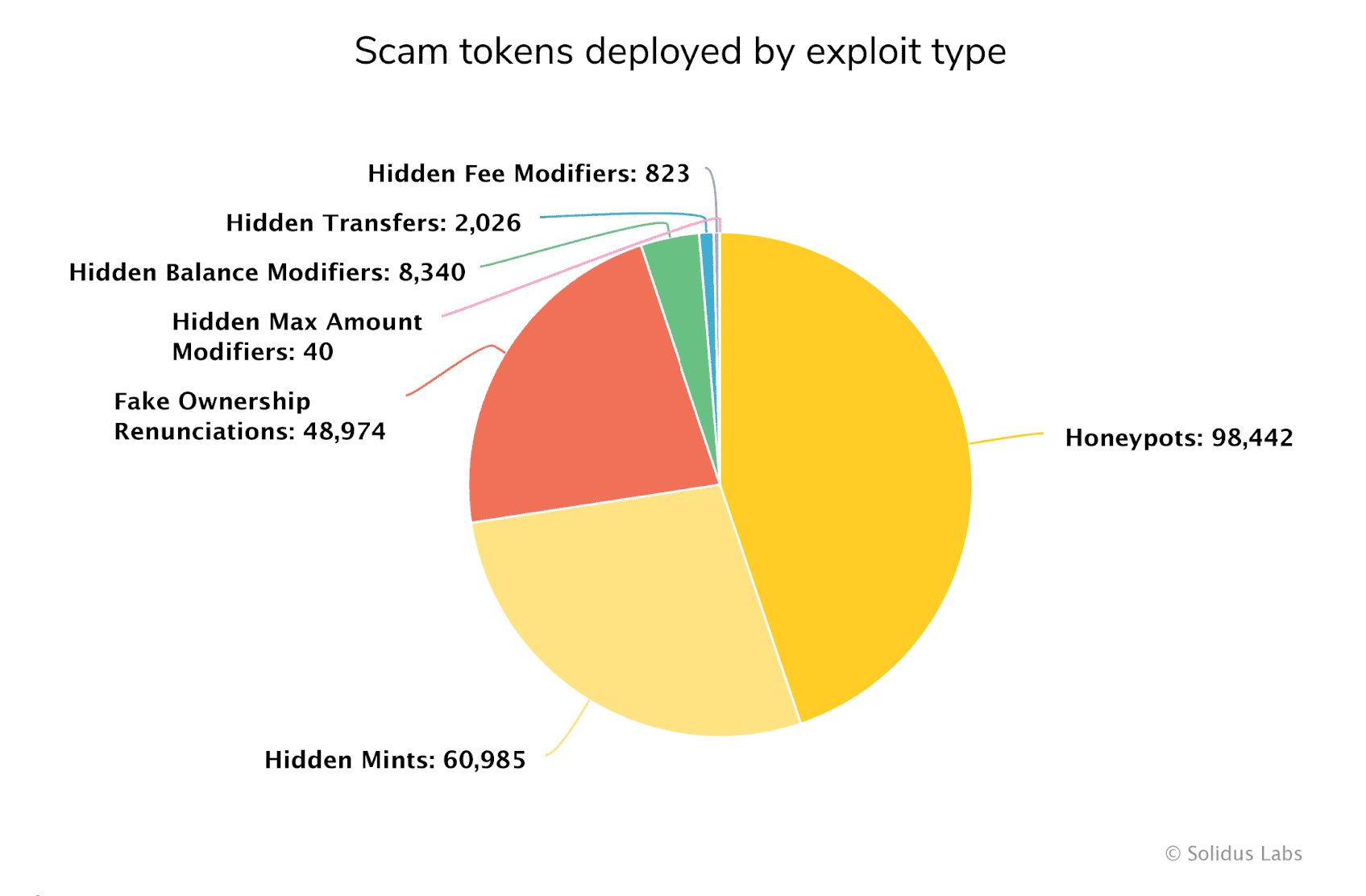
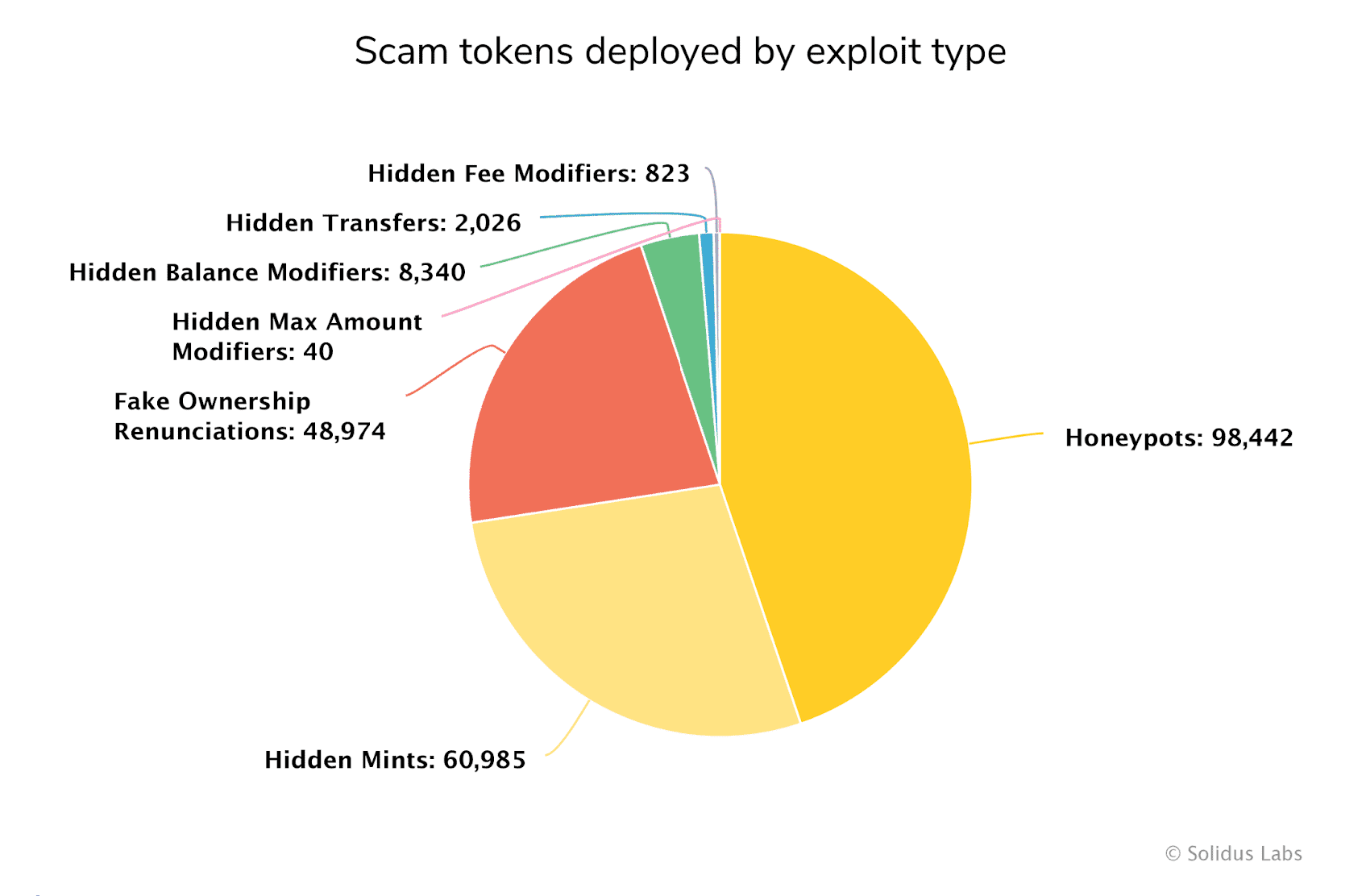
That control often reveals itself through the type of exploit developers choose. Honeypots remain the most common, accounting for 98,442 scam tokens. These contracts let investors buy normally but prevent or heavily restrict selling, effectively trapping funds once enough liquidity enters.
Source: Solidus Labs

Hidden mint functions follow with 60,985 cases, allowing developers to inflate the supply after launch and dilute existing holders. Fake ownership renunciations appear in another 48,974 tokens, reinforcing how control can remain hidden despite claims of decentralization.

That said, the growing variety of exploits suggests scammers are adapting faster, making smart contract scrutiny as important as price action before investing.


Final Summary

Perguntas relacionadas

QWhat are the two main types of rug pulls described in the article?

AThe article describes hard rug pulls and soft rug pulls. Hard rug pulls drain liquidity in one move through developer wallet dumps or pool withdrawals, while soft rugs quietly erode value through insider selling, token unlocks, or abandoned roadmaps.

QAccording to the article, what on-chain data pattern is consistently associated with increased manipulation risk?

AThe article states that on-chain data consistently associates high wallet concentration, where the top 5 to 10 holders control more than 30% of the token supply, with increased manipulation risk.

QWhat are the most common types of scam token exploits mentioned, and which one is the most prevalent?

AThe most common types of scam token exploits mentioned are honeypots, hidden mint functions, and fake ownership renunciations. Honeypots are the most prevalent, accounting for 98,442 scam tokens.

QWhat timeframe does the article suggest the typical rug pull process often unfolds within?

AThe article suggests that the entire rug pull process, from hype-creation to the developer's exit, often unfolds within 48 to 72 hours.

QWhat contract features can give developers more control than investors expect, according to the article?

AAccording to the article, hidden mint functions, retained ownership, upgradeable contracts, or sell restrictions within the smart contract can quietly give developers more control than investors expect.

Leituras Relacionadas

9.42 Million Retail Investors Compete for Changxin Technology, Who Got Allotted?

Evergreen Technology's IPO subscription results are now available. On July 20, the domestic memory chip giant announced the offline preliminary allotment results and online lottery results for its IPO. A total of approximately 9.43 million retail investors participated in the online subscription, generating 770,000 winning lots with a final winning rate of about 0.4714%, setting a record for new shares on the STAR Market. After triggering a clawback mechanism from institutional to retail investors, the online retail allocation was significantly increased to 3.851 billion shares. Simultaneously, 285 institutional investors participated in the offline subscription, ultimately receiving 2.173 billion shares at an allotment rate of approximately 0.1756%. Leading insurers and public funds were among the major recipients. Notably, Liang Wenfeng, founder of the major AI model company DeepSeek, through his quantitative investment firms Ningbo Huanfang Quantitative and Zhejiang Jiuzhang Asset, secured the largest share among private funds, with a total allotment worth approximately 175 million yuan. Estimates suggest potential profits could reach 730 million yuan if Evergreen Technology's market capitalization reaches 3 trillion yuan post-listing. The company is expected to list on July 27 and could become the highest-valued tech stock on the A-share market, with various brokerages providing valuations ranging from 1 trillion to over 4 trillion yuan. However, recent significant corrections in global tech stocks may impact its post-listing performance. (Character count: 1,196)

marsbitHá 40m

9.42 Million Retail Investors Compete for Changxin Technology, Who Got Allotted?

marsbitHá 40m

L2 'Recalibration': When L1 Becomes Its Own Rollup, What Is Ethereum's Endgame?

The article discusses the evolving relationship between Ethereum's Layer 1 (L1) and Layer 2 (L2) solutions, moving beyond the initial "L2 for scaling" model. As Ethereum L1 itself scales (increasing Gas Limit, statelessness, zkEVM), the unique value proposition of L2s shifts from merely providing cheap execution to offering differentiated features like application-specific optimization, privacy, and flexible governance. The piece explores three key themes: 1. **L2's New Role:** L2s are transitioning from a pure scaling technology to a spectrum of execution environments with varying degrees of security inheritance from Ethereum L1. 2. **Interoperability as State Trust:** Solving L2 fragmentation is less about cross-chain bridges and more about enabling faster, trust-minimized state verification between environments. This involves initiatives like faster L1 finality, intent-based architectures (Open Intents Framework), and native account abstraction. 3. **Blurring Layers:** With the potential integration of zk-proofs into L1 validation (making L1 akin to its own "Rollup") and the concept of "Native Rollups," the rigid boundary between L1 and L2 may fade. The future could be a unified system with multiple execution domains (for DeFi, gaming, privacy, etc.) sharing a common security, settlement, and state framework. In conclusion, Ethereum's goal is not to abandon L2s or re-centralize everything on L1, but to re-integrate the fragmented user experience—liquidity, accounts, applications—while preserving the scaling benefits of a multi-environment ecosystem. The endgame is a cohesive "one chain" feeling for users, powered by diverse but securely interconnected execution layers.

marsbitHá 1h

L2 'Recalibration': When L1 Becomes Its Own Rollup, What Is Ethereum's Endgame?

marsbitHá 1h

Trading

Spot
活动图片