Just Now, Lin Junyang Officially Announces the Startup Company Pragmatik Labs

marsbitPublicado em 2026-08-11Última atualização em 2026-08-11

Resumo

Justin Lin, former technical lead of Alibaba's Qwen large language model, has officially announced the launch of his AI startup, Pragmatik Labs (also known as p7k), based in Shanghai. The company is focused on developing next-generation agents that operate across both digital and physical worlds. The startup's research is divided into two main areas: Digital Agents for knowledge work and business operations, and Physical Agents for embodied intelligence capable of performing long-term tasks in the real world. Pragmatik Labs also emphasizes translating research into products and pursuing long-term exploratory projects. The company has secured significant funding, reportedly raising hundreds of millions of USD in a round co-led by Gaorong Capital and Sequoia Capital China, with additional support from Tencent and the Shanghai Future Industry Fund. The post-money valuation is estimated to be around $2 billion. Lin, who left Alibaba in March, has a background in linguistics and computational linguistics. He played a key role in developing the open-source Qwen model series. In a previous article, he argued that the next phase of AI will shift from training models to training agents and multi-agent systems. The company's name, "Pragmatik," reflects both a connection to linguistics (pragmatics) and a pragmatic approach to achieving AGI. His move signals a growing focus among top AI researchers on building agents that can not only reason but also execute complete tasks, moving be...

Just now, Lin Junyang, the former technical lead of Alibaba's Tongyi Qianwen, announced his new entrepreneurial move: he has founded a new AI company in Shanghai called Pragmatik Labs, abbreviated as p7k. The direction was also officially revealed for the first time: to research the next generation of Agents spanning the digital and physical worlds.
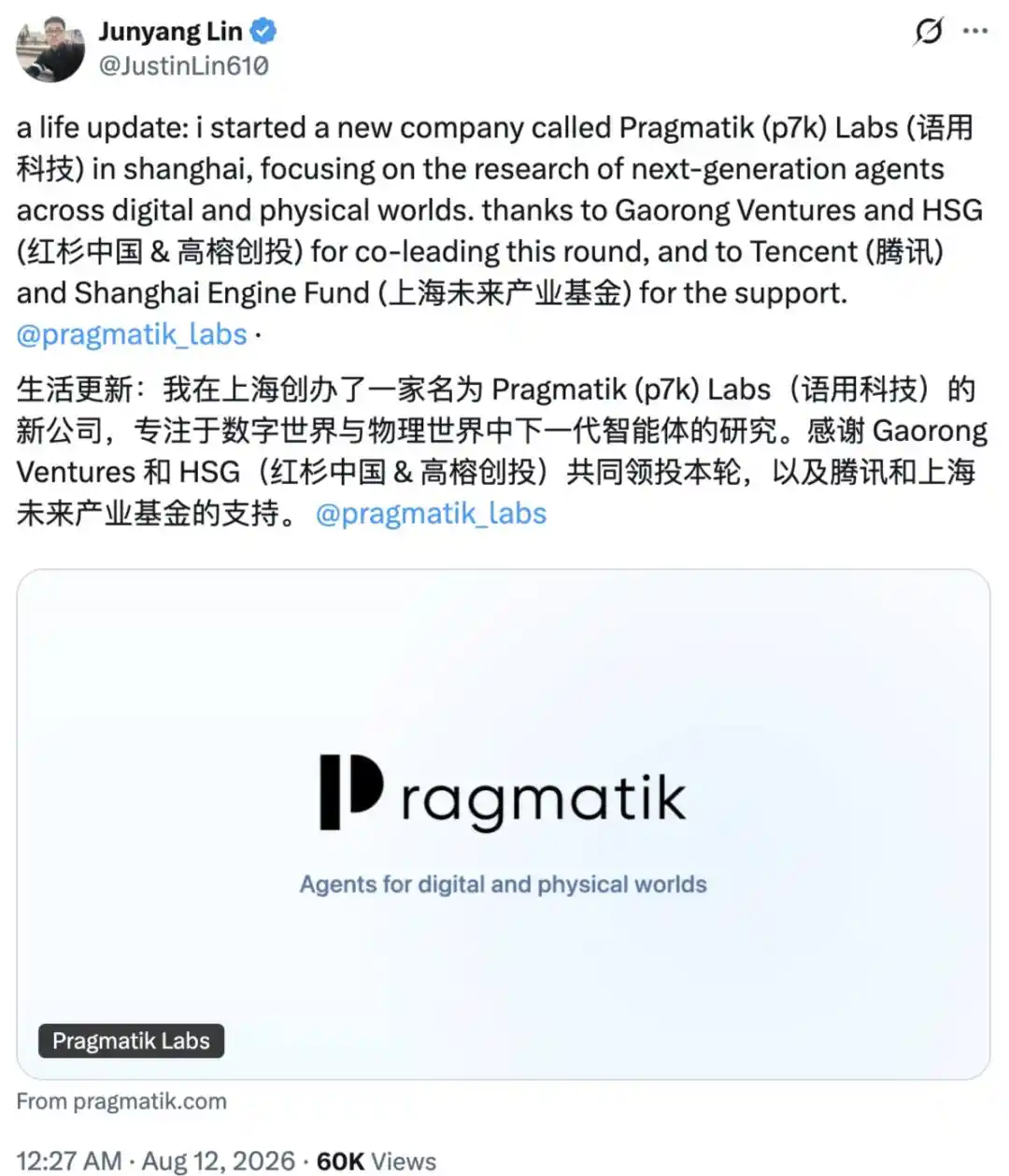

At the same time, Pragmatik Labs's investor lineup also surfaced. Lin Junyang revealed that Gaorong Capital and HSG (Sequoia Capital China) co-led this round of financing, with Tencent and the Shanghai Future Industry Fund providing support.

There were previously reports indicating that Pragmatik Labs's financing round reached several hundred million US dollars, with Gaorong Capital and HSG each investing approximately $100 million, Tencent investing about $20 million, and the company's post-money valuation reaching about $2 billion.

This also means that even before its official debut, Pragmatik Labs's valuation has already entered the tens of billions of RMB range.

Thus, the speculation surrounding Lin Junyang's whereabouts, which lasted nearly half a year from his departure from Tongyi Qianwen in March this year, to rumors of entrepreneurship in May and financing progress in June, has finally been answered.

The technical lead who once drove Qwen into the global top tier of large models did not stay at a large tech company, nor did he simply limit his new company's goal to foundational models.

He has placed his next bet on Agents.

Currently, the new company's official website has also surfaced, but the disclosed information is very limited, with no model parameters announced nor specific products released. However, the company's technical blueprint is already quite clear.

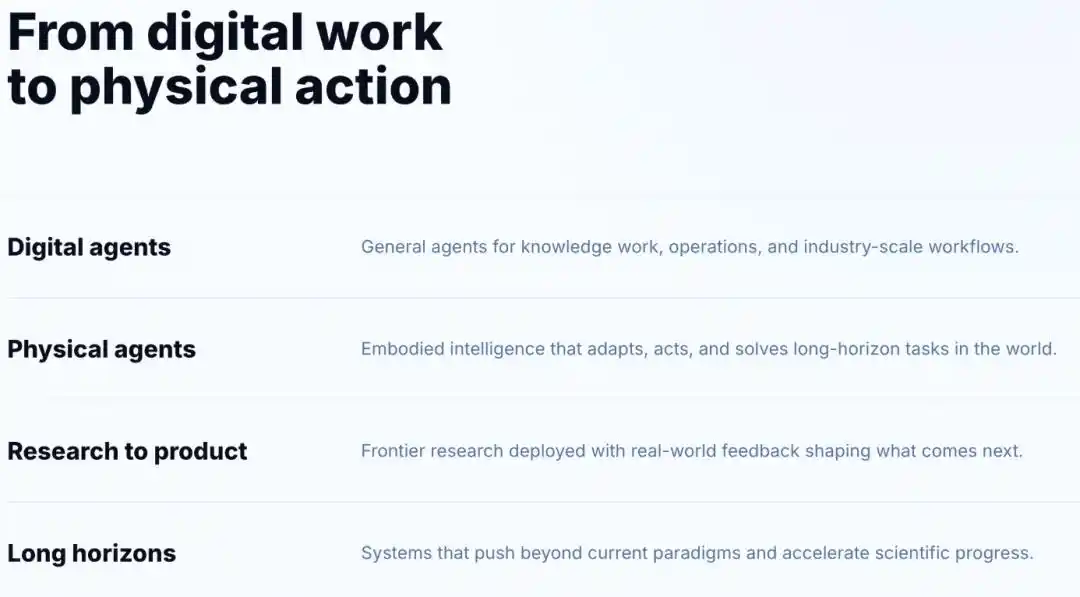
Pragmatik has clearly divided its research direction into two areas: Digital Agents + Physical Agents. Based on this, it is refined into four parts:

Digital Agents: General-purpose agents for knowledge work, business operations, and industry-level workflows.

Physical Agents: Embodied intelligence capable of adapting to environments, taking actions, and completing long-horizon tasks in the real world.

From Research to Product: Transforming cutting-edge research into real products and continuously shaping the next research directions through real-world feedback.

Long-term Exploration: Building systems that break through existing paradigms to accelerate scientific progress.

In fact, this choice of technical direction was not without warning. As early as March this year, Lin Junyang published an article titled "From 'Reasoning' Thinking to 'Agentic' Thinking," proposing that the focus of the next stage of AI will further shift from 'training models' to 'training agents, and even training systems composed of multiple agents.'
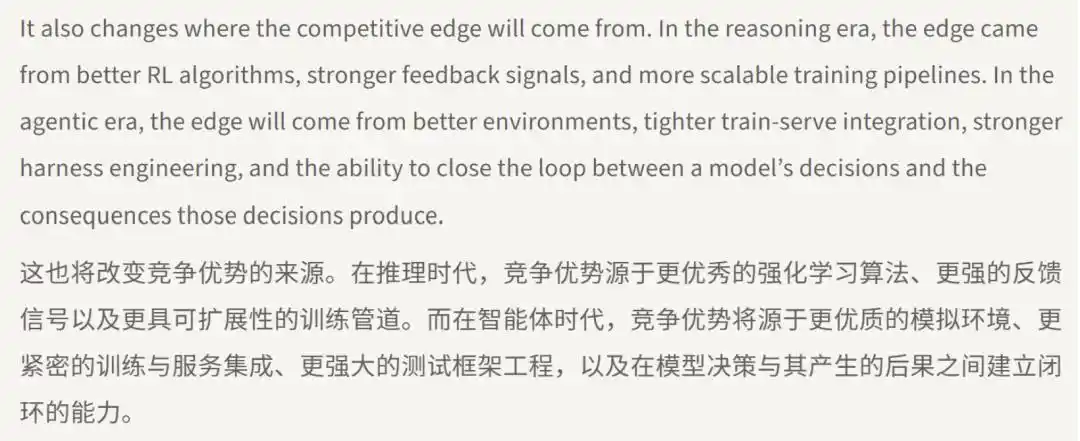
Article link: https://justinlin610.github.io/blog/from-reasoning-to-agentic-thinking/

Lin Junyang's definition of 'Agent' goes a step further.

In his vision, what truly needs to be trained in the Agent era is the complete system composed of 'model + environment,' including the Harness, training environment, evaluators, and even the collaboration methods between multiple Agents.

This might be what Pragmatik Labs refers to as the "next generation of Agents."

When discussing the new company's name, Lin Junyang explained: "I originally studied linguistics because a friend recommended pragmatics to me. Later, I turned to computational linguistics and natural language processing (NLP).

This name, on one hand, means returning to where everything truly happens; on the other hand, it also points to pragmaticism — we believe this is the direction AGI should pursue."

Speaking of this, we cannot help but review Lin Junyang's impressive resume once more.

Lin Junyang was born in 1993. He completed his undergraduate studies in the English Department at the University of International Relations, concurrently studying Japanese, Russian, German, and French. He pursued a master's degree in Foreign Linguistics and Applied Linguistics at Peking University. His deep linguistic background laid the foundation for his future understanding of the underlying logic of large language models, giving him deeper insights and accumulation in the direction of machines understanding human language and intent.

Information shows that during university, Lin Junyang conducted tests using an English-German vocabulary database containing over 3 million samples. He found that the accuracy rate of normal machine translation was only about 23%, while an early version of Transformer could achieve 27%. This seemingly minor data comparison allowed him to keenly capture the future explosive potential of large models.

After graduating with a master's degree in 2019, Lin Junyang joined the Alibaba DAMO Academy Intelligent Computing Lab as a senior algorithm engineer, researching natural language processing, officially entering the frontier field of AI.

Afterwards, in just over 6 years, he embarked on a fast-track promotion path......

At the end of 2022, Alibaba merged the AI teams for language, vision, etc., from DAMO Academy into Alibaba Cloud, establishing the Tongyi Lab. Lin Junyang officially took over the Tongyi Qianwen series of large models, shouldering the banner of technical lead.

Under his leadership, Alibaba launched the Qwen series of open-source models covering various parameter scales, truly pushing Alibaba's AI technology more widely into the industry ecosystem.

In August 2024, after the former head of Tongyi Qianwen, Zhou Chang, left to join ByteDance, Alibaba conducted a general salary adjustment for core department employees, and Lin Junyang was promoted to P9 as a result.

In May 2025, based on the outstanding achievements led by his team, Lin Junyang jumped to P10, becoming the youngest P10-level technical lead at Alibaba.

In October 2025, Lin Junyang personally formed a robotics and embodied intelligence group within Qwen, seen by the outside world as one of Alibaba's most explicit strategic explorations into physical AI systems. At that time, he stated in an X post that he was attempting to let models step out of the virtual screen, to truly understand space and learn to operate with hands, pushing intelligence into the real physical world.

Then, in early March this year, Lin Junyang posted a tweet announcing his departure from the Qwen team.

And just now, Lin Junyang officially announced his new entrepreneurial direction — Pragmatik Labs, choosing to bet on "the next generation of Agents spanning the digital and physical worlds."

Lin Junyang once participated in building one of China's most globally influential large model systems. Now, choosing to include both the digital and physical worlds in the company's research objectives at the very first moment of announcing the new company's name is itself a noteworthy industry signal.

The "war" of foundational models is far from over, but more and more top researchers are already asking the next-level question: The models can already think, so how do we make them actually get things done next?

Perhaps this is precisely the question Pragmatik Labs aims to answer.

Reference Links:

https://x.com/JustinLin610/status/2087214239643730227

https://pragmatik.com/

This article is from the WeChat public account "Almost Human" (ID: almosthuman2014), author: Almost Human focusing on Agents, editors: Youli, Shan Hui


Perguntas relacionadas

QWho is the founder of Pragmatik Labs, and what was his previous role at Alibaba?

AThe founder is Lin Junyang, who was previously the technical leader for the Alibaba Tongyi Qianwen (Qwen) large language model series.

QWhat is the core research direction of Pragmatik Labs?

APragmatik Labs focuses on developing the next-generation Agent technology that spans across the digital world and the physical world, encompassing Digital Agents for knowledge work and Physical Agents for embodied intelligence.

QWhich investment firms are the lead investors in Pragmatik Labs' current funding round?

AGaorong Capital (高榕创投) and HSG (HongShan China, 红杉中国) are the co-lead investors of this funding round.

QAccording to Lin Junyang's vision, what is the key shift needed for the Agent era?

AHe believes the key shift is from just training models to training the complete system consisting of 'model + environment', including harnesses, training environments, evaluators, and the collaboration methods between multiple Agents.

QWhat was Lin Junyang's educational background that influenced his approach to AI?

AHe holds a master's degree in Foreign Linguistics and Applied Linguistics from Peking University, and his deep background in linguistics provided him with a foundational understanding of the underlying logic of large language models and how machines comprehend human language and intent.

Leituras Relacionadas

The Last Mile of Stablecoins: MoneyGram Connects Crypto Wallets to Cash Outlets in Over 170 Countries

Stablecoins have revolutionized cross-border payments with speed and low cost, but a fundamental barrier remains: converting digital money into physical cash in most parts of the world. On August 11th, global remittance giant MoneyGram announced its "MoneyGram Ramps" crypto-cash service is now live on the Solana blockchain. This allows developers, via a simple API, to connect their applications to MoneyGram's network of nearly 500,000 cash agent locations across over 170 countries. Users can now walk into a local MoneyGram agent to convert their USDC into local currency cash or use cash to purchase USDC for their wallets. Solana wallet Rift is the first to integrate the service. MoneyGram, founded in 1940 and historically second only to Western Union in global remittance volume, was privatized in 2023. Since then, it has accelerated its shift into a fintech platform, opening its compliance capabilities, cash network, and settlement infrastructure as services for developers. Its involvement with crypto is not new, having previously partnered with Ripple, Stellar, and Circle, and even issuing its own stablecoin, MGUSD, on Stellar in 2026. The Ramps API solves a critical physical obstacle to stablecoin adoption. While a USDC transfer from New York to Lagos takes seconds and costs cents on-chain, the recipient often lacks a bank account to access the funds. MoneyGram's extensive physical agent network, prevalent in regions like Sub-Saharan Africa, Southeast Asia, and Latin America, bridges this gap, connecting on-chain dollars to the offline cash-based economy. No crypto-native company could replicate this network quickly. MoneyGram chose Solana for its multi-chain expansion due to its extremely low transaction fees (often less than a cent) and fast confirmation times, making it ideal for small-value, frequent remittances. Solana's developer ecosystem is also geared toward consumer-facing applications. This partnership represents a pragmatic path for stablecoins in everyday remittances. Users don't need to understand blockchain or have a bank account; they simply visit a trusted local agent. The underlying settlement shifts from SWIFT to Solana, but the user experience remains familiar. The true path to stablecoin adoption is being paved by an 85-year-old remittance company, using its physical network to solve the "last mile" problem for crypto.

marsbitHá 13m

The Last Mile of Stablecoins: MoneyGram Connects Crypto Wallets to Cash Outlets in Over 170 Countries

marsbitHá 13m

How to Adapt to Frequent Miraculous Comebacks After the New Patch When Trading in Polymarket's LOL Section?

After recent League of Legends (LoL) game updates, major comebacks and unpredictable outcomes have become more frequent, making trading on Polymarket's LoL prediction markets challenging. This article analyzes the causes and offers adaptation strategies. The author, a longtime LoL fan turned Polymarket trader, notes that post-update, a large early-game gold lead no longer guarantees victory. The current meta reduces the decisive weight of economy, emphasizing instead "advantage conversion, resource trading, team composition strength, and teamfight execution." Key systemic changes aiding comebacks include: Bounty/Kill Gold Compensation, Strategic Objective Bounties, and reduced Baron Nashor rewards. Furthermore, the prevalence of mage picks in the bot lane, instead of traditional marksmen (ADC), can lower sustained damage and teamfight reliability in the late game, contributing to throws. For more successful trading, the article suggests: 1. **Choosing the Right Region:** Prioritize major regions (LPL, LCK, LEC, LCS) where matches matter for World Championship qualification or player contracts, leading to more serious play. Avoid or be extremely cautious with regions like CBLOL (Brazil), TCL (Turkey), and North American Challengers, citing high volatility and potential for unreliable outcomes. 2. **Trading Strategies:** * **Placing Orders:** Use limit orders below market price for strong favorites. In close matchups, consider placing equal low-ball bids (e.g., 25-40 cents) on both sides of a match; if both fill for a total under $1, you secure profit regardless of the winner. Exploit team "power spikes" by buying low before their composition peaks and selling high. * **Timely Selling:** The most crucial lesson is to take profits. If you buy the early-leading team at a low price (e.g., 50-60 cents), sell most of your position (e.g., 75%) at 85-90 cents to lock in gains and avoid a potential comeback zeroing your position. * **Position Sizing:** Practice strict risk management. Do not exceed 5-10% of your capital per match and avoid "tilting" or chasing losses after a few bad trades. In summary, adapting to the new meta requires understanding that early advantages are less stable. Success depends on analyzing team compositions, player form, and regional contexts, combined with disciplined order placement, profit-taking, and capital preservation. The next patch in August is expected to revive traditional ADCs, potentially shifting the dynamics again.

Odaily星球日报Há 25m

How to Adapt to Frequent Miraculous Comebacks After the New Patch When Trading in Polymarket's LOL Section?

Odaily星球日报Há 25m

Strategy CEO Announces Plan to Resume Bitcoin Purchases This Year, With Buying Volume 25 Times Selling Volume

Strategy CEO Announces Resumption of Bitcoin Purchases This Year, Buy-to-Sell Ratio at 25x In a FOX Business interview, Phong Le, CEO of Strategy (formerly MicroStrategy), stated the company plans to resume its Bitcoin acquisition strategy within the current year. This ends a pause in buying that began in May. Le revealed that since the start of the year, Strategy has purchased approximately 175,000 bitcoins while selling around 7,000, making its buy volume about 25 times its sell volume. The company remains the world's largest corporate holder of Bitcoin, with 840,447 BTC, representing roughly 4% of the circulating supply. Le explained that recent sales were used to fulfill capital obligations under a newly approved framework, including paying preferred stock dividends, funding share buybacks, and bolstering the company's US dollar reserves, which now stand at about $4.7 billion. This move marks a shift from the firm's previous "never sell" mantra, which had contributed to its market premium. The change in strategy and the associated financial pressures led to a significant drop in its stock price (MSTR) and a rating downgrade from JPMorgan. The CEO framed the company's role as the "JPMorgan of the crypto economy," emphasizing its long-term goal of increasing the amount of Bitcoin per MSTR share. The announcement signals the return of a major institutional buyer to the Bitcoin market, which could provide price support. It is also viewed as a micro-indicator of recovering institutional confidence, suggesting the company believes the most acute phase of liquidity pressure has passed.

marsbitHá 47m

Strategy CEO Announces Plan to Resume Bitcoin Purchases This Year, With Buying Volume 25 Times Selling Volume

marsbitHá 47m

ArthurHayes新文:押注日元升值,ENA未来几月或涨5至10倍

Arthur Hayes argues that the Japanese Yen is significantly undervalued and posits that its appreciation against the US Dollar is imminent. He outlines three potential mechanisms for this shift, dismissing the first two—the Bank of Japan raising interest rates and domestic institutions selling foreign assets—as politically or economically unfeasible. He identifies the third and preferred method: the Japanese Ministry of Finance (MOF) using its holdings of US Treasuries as collateral in the Fed's FIMA repo facility to borrow US dollars, then selling those dollars to buy Yen in the forex market. Hayes believes US Treasury Secretary Bessant has signaled support for this approach, which requires the Fed's Foreign Currency Subcommittee, led by Chairman Walsh, to remove lending limits on the FIMA tool. Hayes asserts that implementing this "Scheme 3" would lead to a significant expansion of US dollar liquidity. He predicts this surge in liquidity will act as a catalyst, driving up the prices of assets like Bitcoin and physical gold. Within the crypto space, he views Ethereum (ETH) as undervalued and singles out Ethena's ENA token as a speculative play with potential for 5-10x gains in the coming months, contingent on a recovery in Bitcoin basis trades that would boost demand for its USDe stablecoin. He concludes that investors should watch for the Fed's rule change as the key trigger for these market movements.

marsbitHá 59m

ArthurHayes新文:押注日元升值,ENA未来几月或涨5至10倍

marsbitHá 59m

Trading

Spot
活动图片