A Year Later, 'Lean Ethereum' Moves Forward: What Is Ethereum Aiming to Achieve?

marsbitPublicado em 2026-07-15Última atualização em 2026-07-15

Resumo

A year after its initial proposal, "Lean Ethereum" is resurfacing as a core focus, signaling a potential fundamental shift in Ethereum's development narrative. While recent years prioritized scalability (e.g., Rollups, blobs), current discussions center on long-term sustainability and decentralization. This shift is evident on multiple fronts. Organizationally, the Ethereum Foundation (EF) is becoming "leaner and more focused," while key responsibilities like R&D (Ethlabs) and institutional outreach (Ethereum Institution) are being distributed to independent organizations. This aims to reduce systemic reliance on a single entity. Technologically, "Lean Ethereum," described by Vitalik Buterin as Ethereum's "third major iteration," outlines a 3-4 year roadmap. Its goals extend beyond raw throughput to emphasize protocol properties for a "long-term trust infrastructure." Key directions include: protocol simplification via "light verification" (using recursive STARKs instead of heavy re-execution); prioritizing quantum resistance; integrating privacy as a first-class protocol goal; and consensus-layer improvements for faster finality and reduced validator burden. Complementing this, the proposed 0x02 compounding validators feature seeks to make staking rewards more sustainable and equitable for smaller participants by allowing native reinvestment, improving capital efficiency and reducing network overhead. Together, these changes represent a move towards "subtraction": reduci...

By: imToken

Over the past few years, most of Ethereum's upgrades could be explained by a relatively clear goal: scaling.

From Rollup, Blob, and data availability to the continuous increase in the Gas Limit, the discussions have all been about how to enable Ethereum to handle more transactions and reduce costs. Therefore, even if ordinary users don't understand every EIP, they can intuitively grasp that these upgrades ultimately aim to make the chain faster and cheaper.

However, recently, Ethereum has begun to frequently discuss issues that are less easily priced by the market. Especially on July 4th, Vitalik Buterin, based on the updated long-term roadmap for Ethereum, re-summarized the core directions of Lean Ethereum, calling it the "third major iteration" of Ethereum after The Merge.

At the same time, another piece of research on 0x02 compounding validators provided a supplementary clue from the perspective of staking rewards. For smaller-scale stakers, a native compounding mechanism could bring about a 5% relative increase in the consensus layer APR.

On the surface, these are different topics, but when placed together, one might find that Ethereum is undergoing a deeper narrative reconstruction: it is starting to reconsider, how to support its operation over the next decade or even longer through a more decentralized organizational structure, a protocol base that is easier to verify, and a more sustainable revenue model.
I. From 'One Foundation' to Multiple Responsibility Nodes

For a long time in the past, the outside world has been accustomed to equating the Ethereum Foundation (EF) with Ethereum itself.

Whether it's protocol upgrades, research directions, ecosystem funding, or external communication, many questions ultimately boil down to one phrase: What does EF plan to do?

But as is well known, the Ethereum Foundation is not an ordinary company. It does not have traditional shareholders, does not use market share and quarterly profits as its goals, and does not "actually own" the Ethereum network. This has also left EF facing an inherent tension.

On one hand, Ethereum needs long-term commitment to protocol R&D, organizing upgrades, and public goods construction. On the other hand, if research, funding, talent, and decision-making become increasingly concentrated within the foundation, then EF itself would become Ethereum's biggest centralization risk source.

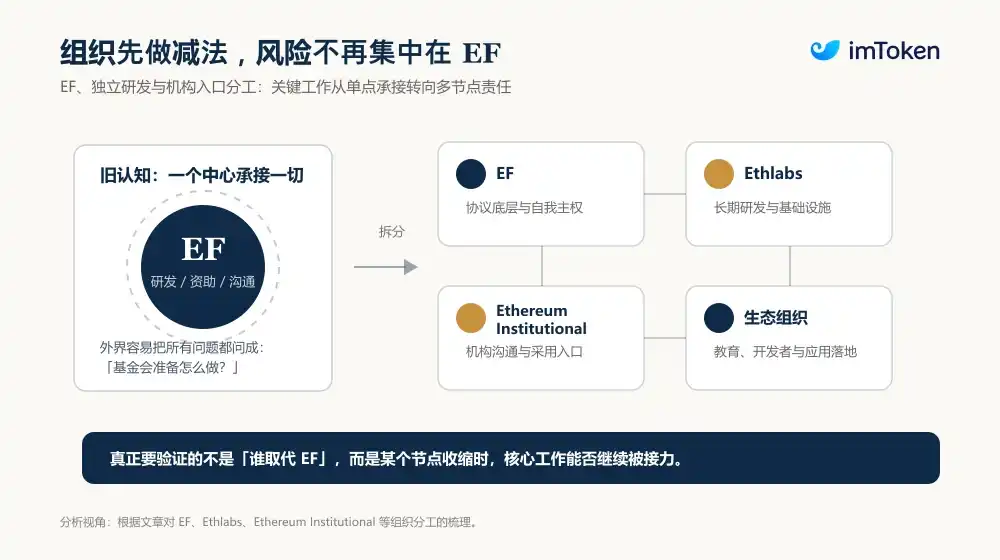
But recent organizational changes are intentionally breaking this perception. In the latest round of adjustments, EF reduced its personnel by approximately 20% on one hand, while refocusing internal work on different levels such as protocol, users, and institutions. According to EF's self-description, it is to become "leaner and more focused," prioritizing core tasks that only the foundation can and must undertake.

Meanwhile, some capabilities previously concentrated within EF are starting to shift to external independent organizations, as discussed in the previous article (extended reading: 'From "One Foundation" to "Multi-Node Governance": Is Ethereum Undergoing a Silent Power Restructuring?'):

  • On June 22nd, five former core researchers from the Ethereum Foundation announced the establishment of Ethlabs, an independently operated non-profit R&D lab, taking on protocol research, infrastructure, and institutional-level technical needs;
  • On July 1st, another independent non-profit organization, Ethereum Institutional, officially launched, taking over the institutional cooperation work previously handled by EF's business development team, becoming an independent contact window for traditional financial institutions entering the Ethereum ecosystem;

These two respectively correspond to technical R&D and institutional adoption, forming a new specialization division of labor. It also marks that Ethereum is attempting to split the research, ecosystem, and market functions previously concentrated in one organization among multiple relatively independent responsibility nodes—with EF focusing more on the protocol base and self-sovereignty, Ethlabs driving long-term R&D, Ethereum Institutional handling institutional communication, and other organizations continuing to undertake education, developer support, and application deployment.
From an organizational structure perspective, this model will undoubtedly increase coordination costs. After all, different organizations have different funding sources, priorities, and execution rhythms, and future disagreements on roadmaps or even resource competition may arise.

But on the other hand, if a decentralized protocol relies long-term on a single foundation to handle almost all key work, that in itself is a structural risk.

Therefore, the changes at the Ethereum organizational level are not truly answering "who will replace EF," but rather whether Ethereum can establish a collaborative structure where, even if one organization scales down, pivots, or disappears, core work can still be taken over by other nodes.

This "organizational subtraction" also sets the stage for the upcoming protocol shift.

II. The Turn in Technical Narrative: What Exactly Is Lean Ethereum Trying to Do?

Strictly speaking, Lean Ethereum is not a concept that first appeared last week.

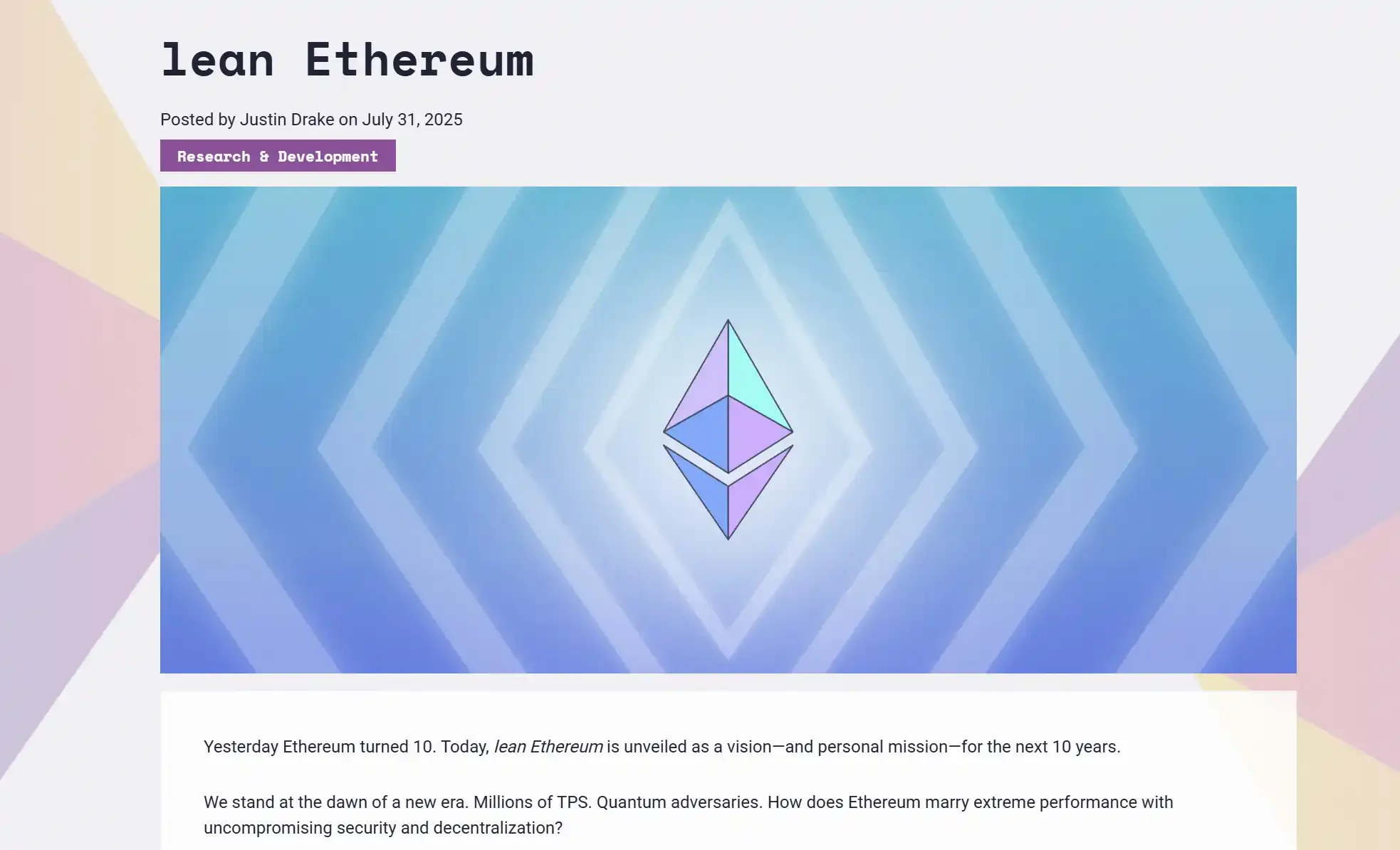
As early as July 2025, EF researcher Justin Drake released a vision for "lean Ethereum" development over the next decade, proposing directions such as Lean Consensus, Lean Execution, and Lean Data. The main goals included scaling the base layer TPS to 10,000 transactions per second, L2 networks to 10 million, while maintaining decentralization and 100% uptime.

It was already clear then that Ethereum would undergo major upgrades in the consensus layer, data layer, and execution layer, including upgrading the beacon chain to version 2.0, introducing post-quantum era blobs 2.0, and potentially an EVM 2.0 based on the open-source RISC-V instruction set; in terms of cryptography, the system would fully rely on hash-based signatures, hash-root data commitments, and a native hash-based zero-knowledge virtual machine to achieve quantum-resistant capabilities.
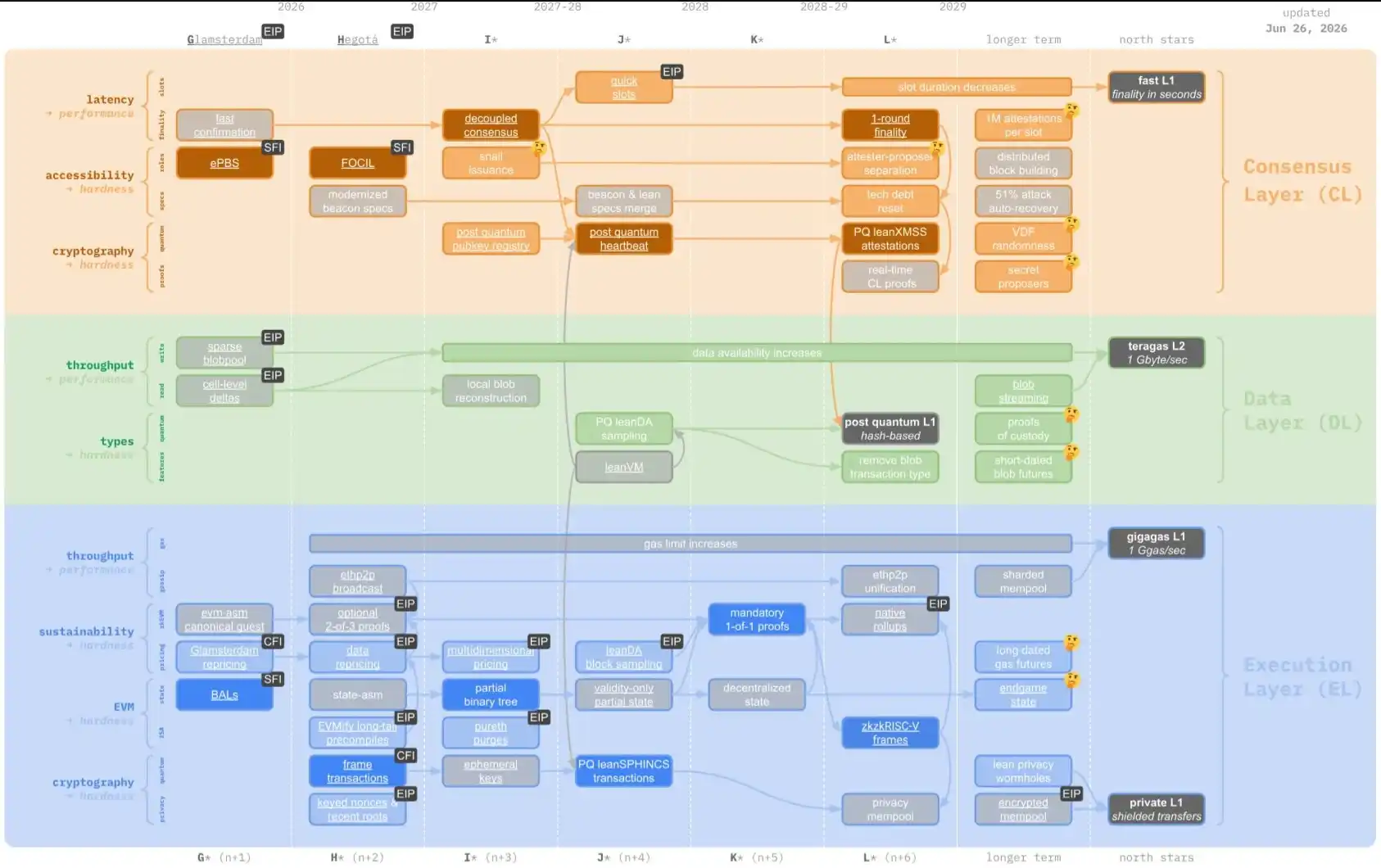
Therefore, the truly important change this week is that Vitalik, based on the latest strawmap, elevated these scattered research directions to a more defined position—Lean Ethereum is not a single hard fork, but a series of transformations gradually rolled out over the next three to four years, and what he defines as Ethereum's "third major iteration."

According to Vitalik's summary, Lean Ethereum touches almost all core parts of the protocol, reflected in several directions:

  • Protocol Simplification, shifting from "Heavy Execution" to "Light Verification": Using recursive STARKs as a core, native component, replacing direct transaction re-execution with proof verification. Client architecture, state model, and Gas multi-dimensionality will be adjusted accordingly. The goal is to make the protocol itself leaner and more formally verifiable;
  • Quantum-Resistance Priority: Quantum safety has been significantly advanced from a "long-term consideration." Existing cryptographic components vulnerable to quantum computing threats will gradually be replaced with quantum-resistant schemes, and the quantum-safe design of blobs has also been listed as an urgent matter;
  • Privacy is no longer seen as a function requiring additional application-layer supplements, but becomes a first-class goal in protocol design: No longer an afterthought patch, but a native protocol capability. New Frames, mempool, and state tree designs will support quantum-safe, intermediary-free private transactions;
  • The Consensus layer will attempt to decouple block availability from finality: Aiming to achieve second-level finality (1–2 rounds of voting), while significantly reducing the burden on validators and light clients through state redesign (dynamic state coexisting with new scalable state types);
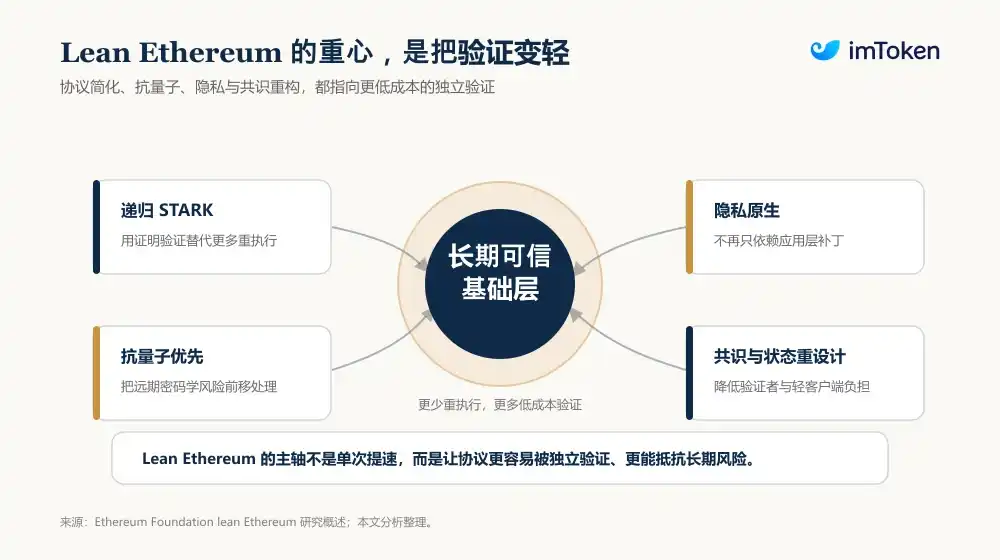
These directions may seem very complex, but they share a common logic: concentrating computation and complexity on a few nodes responsible for generating proofs, allowing more participants to verify results at a lower cost.

Ultimately, Ethereum is no longer treating "short-term TPS" or "L2 compatibility" as its only narrative axis, but is re-emphasizing the underlying attributes of the protocol as "long-term trusted infrastructure." This naturally includes verifiability, censorship resistance, quantum resistance, privacy friendliness, and lightweight verification. This is also the massive shift over the next decade for Ethereum, moving from "engineering iteration" back to "principles."

Against this backdrop, 0x02 compounding validators also embodies a similar long-term perspective.

In the past, discussions about ETH Staking mainly revolved around APR and DeFi composite yields. However, under the traditional 0x01 mode, each validator's effective balance cap is 32 ETH. Consensus layer rewards exceeding 32 ETH are periodically withdrawn and no longer continue to participate in staking.

Thus, for small stakers with only one or a few validators, they need to wait for rewards to accumulate back to 32 ETH to activate a new validator and start earning staking rewards again, which naturally places them at a disadvantage in compounding efficiency; whereas large service providers can aggregate rewards from many validators to quickly activate new nodes.
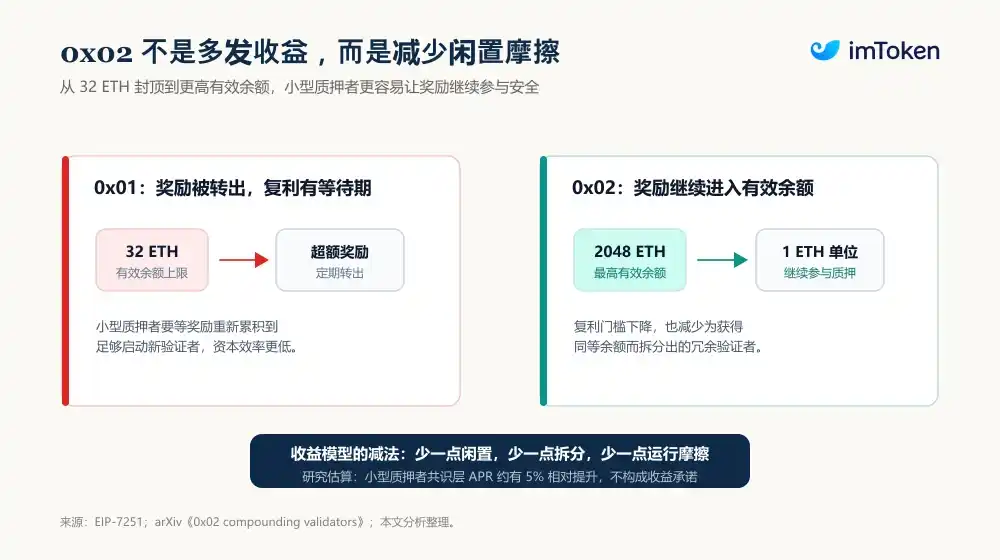
Therefore, Pectra introduces the 0x02 mode, raising the maximum effective balance for a single validator to 2048 ETH and allowing rewards to continue participating in staking in units of 1 ETH. This lowers the threshold for small stakers to achieve compounding, narrowing the capital efficiency gap between participants of different scales while reducing redundant validators and network operational burden.

Of course, it cannot simply be equated to "validator count becoming more dispersed." More accurately, 0x02 improves the operational efficiency of the validator set at the protocol level on one hand, and on the other, enhances the capital efficiency and relative position of small stakers, allowing participants of different scales to obtain protocol-native yields with lower friction.

This is not disconnected from the direction of Lean Ethereum. What they both emphasize is the same thing—maintaining an Ethereum that can operate long-term with less redundancy and friction.

III. The Next Decade: What Kind of Ethereum Should We Expect?

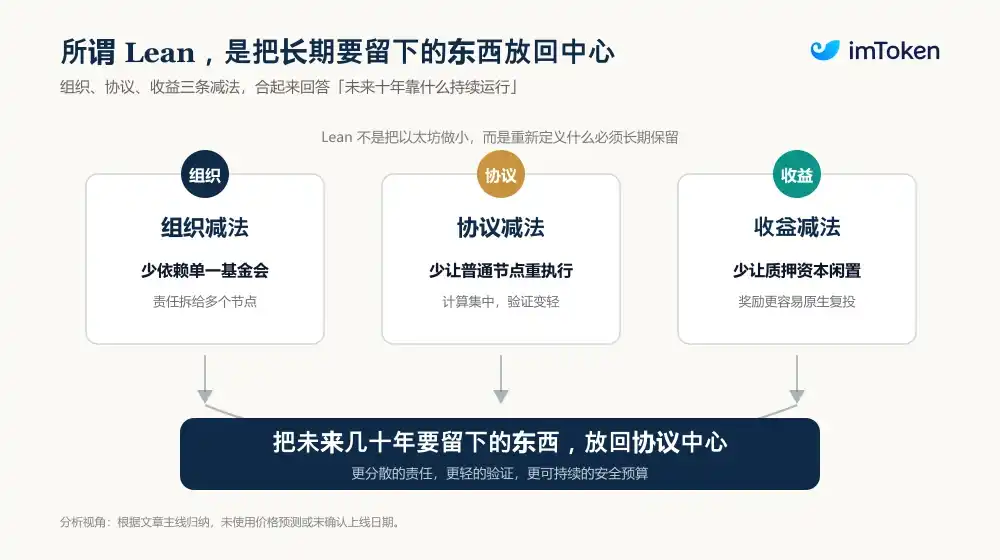
From EF scaling down, to the emergence of independent organizations like Ethlabs and Ethereum Institutional; from prioritizing scaling, to Lean Ethereum re-emphasizing protocol simplification, quantum resistance, privacy, and light verification; to 0x02 validators gradually transforming staking rewards from periodic withdrawals into a sustainable, natively reinvested income—these changes are not isolated from each other.

They are all doing similar subtraction: for example, reducing Ethereum's dependence on a single organization, reducing the cost ordinary participants need to bear to verify the protocol, and reducing the idle and redundant overhead of staking capital during operation.

Correspondingly, what Ethereum hopes to achieve is a more decentralized responsibility system, a protocol base that is easier to independently verify, and a revenue structure more suitable for long-term holders and network security participants.

These changes are difficult to become an immediately effective price catalyst.
After all, Lean Ethereum will take three to four years or even longer to be gradually implemented; the new organizational structure needs to prove that multi-node collaboration does not lead to directional fragmentation; the compounding advantages of 0x02 validators also need to go through a full cycle to fully manifest.

But what Ethereum truly needs to prove in its next phase is perhaps not just how many more upgrades it can complete.

More importantly, as the value borne by the protocol increases and the external environment becomes more complex, can it become less dependent on any single organization, easier to verify by ordinary devices, and provide more stable, sustainable long-term returns for capital participating in network security?

What Lean means is not making Ethereum smaller, but putting back at the center of the protocol what will truly be needed for the next several decades.

Criptomoedas em alta

Perguntas relacionadas

QWhat is the 'third major iteration' of Ethereum according to Vitalik Buterin, as mentioned in the article?

AAccording to Vitalik Buterin's updated long-term roadmap, the 'third major iteration' of Ethereum is 'Lean Ethereum,' which is a series of protocol improvements to be rolled out over the next three to four years.

QHow is the Ethereum Foundation (EF) changing its organizational structure, and what are the goals of this change?

AThe Ethereum Foundation is reducing its staff by about 20% and refocusing its work on core tasks like the protocol layer. Simultaneously, some of its former responsibilities are being transferred to independent organizations like Ethlabs and Ethereum Institutional. The goal is to become 'leaner and more focused' and to create a more decentralized governance and operational structure that reduces reliance on a single entity.

QWhat are the key technical directions or goals of the 'Lean Ethereum' vision as outlined by Vitalik Buterin?

AThe key technical directions of 'Lean Ethereum' include: protocol simplification through 'light verification' using recursive STARKs; quantum resistance as a priority, replacing vulnerable cryptography; making privacy a first-class, protocol-native goal; and decoupling block availability from finality for faster finality while reducing validator and client burdens.

QWhat problem does the proposed '0x02 compounding validators' (Pectra) upgrade aim to solve for smaller-scale stakers?

AThe '0x02 compounding validators' upgrade aims to solve the capital efficiency disadvantage for small-scale stakers. In the traditional 0x01 mode, rewards above 32 ETH per validator are periodically withdrawn, not restaked. The new mode raises the effective balance limit to 2048 ETH and allows rewards in 1 ETH increments to be restaked, enabling native compounding and reducing the friction for small stakers to achieve efficient returns.

QWhat overarching narrative shift does the article suggest Ethereum is undergoing?

AThe article suggests Ethereum is undergoing a deeper narrative shift from a primary focus on short-term scalability (like TPS and L2 compatibility) to re-emphasizing its foundational attributes as a 'long-term credible infrastructure.' This includes priorities like verifiability, censorship resistance, quantum resistance, privacy, and light verification to support the network's operation for the next decade or more.

Leituras Relacionadas

Nobel Laureate Hassabis Shocks with Statement: AGI Impact Will Be 10 Times That of the Industrial Revolution

Nobel laureate and DeepMind CEO Demis Hassabis declares that Artificial General Intelligence (AGI), matching human cognitive abilities, is likely just a few years away. He states its impact could be ten times greater than the Industrial Revolution and unfold ten times faster, heralding an age of unprecedented abundance where resource scarcity may end. AGI promises transformative benefits, accelerating breakthroughs in medicine, clean energy, and advanced materials. However, its rapid development, driven by intense commercial and geopolitical competition, outpaces our understanding and increases risks in cybersecurity, bio-threats, and controlling autonomous, self-improving systems. To manage this, Hassabis proposes a U.S.-led framework: a new "Frontier AI Standards Body," modeled after organizations like FINRA. It would define "frontier-class" models through dynamic benchmarks. Labs creating such models would voluntarily submit them for a 30-day pre-release review, later formalized into mandatory assessments. This body would conduct rigorous evaluations on security and safety, update tests regularly, and, if necessary, coordinate a global slowdown in development. While technical challenges are surmountable, Hassabis emphasizes that profound economic and philosophical questions about post-scarcity societies, human values, and purpose remain. He concludes that responsibly navigating AGI's arrival is our defining task, offering a chance to shape a future of immense scientific progress and human flourishing.

marsbitHá 20m

Nobel Laureate Hassabis Shocks with Statement: AGI Impact Will Be 10 Times That of the Industrial Revolution

marsbitHá 20m

GPT-5.6 Sol Suddenly Gets Dumber Overnight? Thinking Budget Slashed from 960 to 128, No More Fixed-Intelligence Models?

The article discusses widespread user reports that OpenAI's GPT-5.6 Sol model, specifically its "Max" reasoning tier, has become less capable at complex, deep reasoning tasks. Users noted faster but shallower responses. Community investigation revealed an unpublicized internal parameter called "juice value," representing computational budget for reasoning. Observations indicated this value for the Max tier dropped dramatically from 960 to 128. In response, OpenAI's Thibault Sottiaux stated there was no intentional reduction in model capability ("nerf"). He explained the changes were part of an experiment to investigate unexpected high token usage following GPT-5.6's launch, which introduced features like longer reasoning and larger context windows. The experiment temporarily adjusted the "juice" parameter and rolled back the context window from 372k to 272k tokens to diagnose the usage spike. Sottiaux asserted these settings have been reverted and highlighted ongoing optimizations. The controversy highlights a tension between AI as a reliable, fixed-capability tool and its reality as a cloud service where providers can adjust performance parameters. The article argues that for AI to be trusted enterprise infrastructure, providers need clearer, transparent guarantees about the specific performance boundaries associated with service tiers.

marsbitHá 25m

GPT-5.6 Sol Suddenly Gets Dumber Overnight? Thinking Budget Slashed from 960 to 128, No More Fixed-Intelligence Models?

marsbitHá 25m

Trading

Spot

Artigos em Destaque

O que é ETH 2.0

ETH 2.0: Uma Nova Era para o Ethereum Introdução ETH 2.0, amplamente conhecido como Ethereum 2.0, marca uma atualização monumental à blockchain do Ethereum. Esta transição não é meramente uma mudança estética; visa melhorar fundamentalmente a escalabilidade, segurança e sustentabilidade da rede. Com uma mudança do mecanismo de consenso em Proof of Work (PoW), intensivo em energia, para um Proof of Stake (PoS) mais eficiente, o ETH 2.0 promete uma abordagem transformadora ao ecossistema blockchain. O que é ETH 2.0? ETH 2.0 é um conjunto de atualizações distintas e interconectadas focadas na otimização das capacidades e desempenho do Ethereum. Esta reformulação foi projetada para abordar desafios críticos que o mecanismo atual do Ethereum enfrentou, particularmente em relação à velocidade das transações e à congestão da rede. Objetivos do ETH 2.0 Os principais objetivos do ETH 2.0 giram em torno da melhoria de três aspectos centrais: Escalabilidade: Com o objetivo de melhorar significativamente o número de transações que a rede pode manejar por segundo, o ETH 2.0 procura ultrapassar a limitação atual de aproximadamente 15 transações por segundo, alcançando potencialmente milhares. Segurança: Medidas de segurança melhoradas são integrais ao ETH 2.0, especialmente através da resistência aprimorada contra ciberataques e da preservação do ethos descentralizado do Ethereum. Sustentabilidade: O novo mecanismo PoS foi projetado não apenas para melhorar a eficiência, mas também para reduzir drasticamente o consumo de energia, alinhando a estrutura operacional do Ethereum com considerações ambientais. Quem é o Criador do ETH 2.0? A criação do ETH 2.0 pode ser atribuída à Ethereum Foundation. Esta organização sem fins lucrativos, que desempenha um papel crucial no apoio ao desenvolvimento do Ethereum, é liderada pelo co-fundador notável Vitalik Buterin. A sua visão de um Ethereum mais escalável e sustentável tem sido a força motriz por trás desta atualização, envolvendo contribuições de uma comunidade global de desenvolvedores e entusiastas dedicados a melhorar o protocolo. Quem são os Investidores do ETH 2.0? Embora os detalhes sobre os investidores do ETH 2.0 não tenham sido tornados públicos, é sabido que a Ethereum Foundation recebe apoio de várias organizações e indivíduos no espaço da blockchain e tecnologia. Esses parceiros incluem firmas de capital de risco, empresas de tecnologia e organizações filantrópicas que compartilham um interesse mútuo em apoiar o desenvolvimento de tecnologias descentralizadas e infraestrutura de blockchain. Como Funciona o ETH 2.0? ETH 2.0 é notável por introduzir uma série de características chave que o diferenciam do seu predecessor. Proof of Stake (PoS) A transição para um mecanismo de consenso PoS é uma das mudanças de destaque do ETH 2.0. Ao contrário do PoW, que depende da mineração intensiva em energia para a verificação de transações, o PoS permite que os utilizadores validem transações e criem novos blocos de acordo com a quantidade de ETH que apostam na rede. Isso leva a uma maior eficiência energética, reduzindo o consumo em aproximadamente 99,95%, tornando o Ethereum 2.0 uma alternativa consideravelmente mais ecológica. Shard Chains As shard chains são outra inovação crítica do ETH 2.0. Estas cadeias menores operam em paralelo com a cadeia principal do Ethereum, permitindo que várias transações sejam processadas simultaneamente. Esta abordagem melhora a capacidade geral da rede, abordando preocupações de escalabilidade que têm atormentado o Ethereum. Beacon Chain No coração do ETH 2.0 está a Beacon Chain, que coordena a rede e gere o protocolo PoS. Ela atua como uma espécie de organizador: supervisiona os validadores, garante que as shards permaneçam conectadas à rede e monitora a saúde geral do ecossistema blockchain. Linha do Tempo do ETH 2.0 A jornada do ETH 2.0 tem sido marcada por vários marcos chave que traçam a evolução desta atualização significativa: Dezembro de 2020: O lançamento da Beacon Chain marcou a introdução do PoS, preparando o caminho para a migração para o ETH 2.0. Setembro de 2022: A conclusão de “The Merge” representa um momento crucial em que a rede Ethereum fez a transição com sucesso de um quadro PoW para um PoS, anunciando uma nova era para o Ethereum. 2023: O lançamento esperado das shard chains visa melhorar ainda mais a escalabilidade da rede Ethereum, solidificando o ETH 2.0 como uma plataforma robusta para aplicações e serviços descentralizados. Características Chave e Benefícios Escalabilidade Melhorada Uma das vantagens mais significativas do ETH 2.0 é a sua escalabilidade melhorada. A combinação de PoS e shard chains permite que a rede expanda a sua capacidade, permitindo que acomode um volume de transações muito maior em comparação com o sistema legado. Eficiência Energética A implementação do PoS representa um enorme passo em direção à eficiência energética na tecnologia blockchain. Ao reduzir drasticamente o consumo de energia, o ETH 2.0 não só reduz os custos operacionais, mas também se alinha mais estreitamente com os objetivos globais de sustentabilidade. Segurança Aprimorada Os mecanismos atualizados do ETH 2.0 contribuem para uma segurança melhorada em toda a rede. O uso do PoS, juntamente com medidas de controle inovadoras estabelecidas através das shard chains e da Beacon Chain, assegura um maior grau de proteção contra potenciais ameaças. Custos Mais Baixos para os Utilizadores À medida que a escalabilidade melhora, os efeitos sobre os custos de transação também serão evidentes. Aumentada a capacidade e reduzida a congestão, espera-se que isso se traduza em taxas mais baixas para os utilizadores, tornando o Ethereum mais acessível para transações do dia a dia. Conclusão ETH 2.0 marca uma evolução significativa no ecossistema da blockchain do Ethereum. Ao abordar questões fundamentais como a escalabilidade, o consumo de energia, a eficiência das transações e a segurança geral, a importância desta atualização não pode ser subestimada. A transição para o Proof of Stake, a introdução das shard chains e o trabalho fundamental da Beacon Chain são indicativos de um futuro em que o Ethereum pode atender à crescente demanda do mercado descentralizado. Em uma indústria movida pela inovação e progresso, o ETH 2.0 representa um testemunho das capacidades da tecnologia blockchain em pavimentar o caminho para uma economia digital mais sustentável e eficiente.

123 Visualizações TotaisPublicado em {updateTime}Atualizado em 2024.12.03

O que é ETH 2.0

O que é ETH 3.0

ETH3.0 e $eth 3.0: Uma Análise Profunda do Futuro do Ethereum Introdução No ambiente em rápida evolução da criptomoeda e da tecnologia blockchain, o ETH3.0, frequentemente denotado como $eth 3.0, emergiu como um tema de considerável interesse e especulação. O termo abrange dois conceitos principais que merecem esclarecimento: Ethereum 3.0: Esta representa uma potencial atualização futura destinada a aumentar as capacidades da atual blockchain do Ethereum, focando especialmente na melhoria da escalabilidade e desempenho. ETH3.0 Meme Token: Este distinto projeto de criptomoeda procura aproveitar a blockchain do Ethereum na criação de um ecossistema centrado em memes, promovendo o envolvimento na comunidade de criptomoedas. Compreender esses aspectos do ETH3.0 é essencial não apenas para entusiastas de criptomoedas, mas também para aqueles que observam as tendências tecnológicas mais amplas no espaço digital. O que é ETH3.0? Ethereum 3.0 Ethereum 3.0 é promovido como uma atualização proposta para a rede Ethereum já estabelecida, que tem sido a espinha dorsal de muitas aplicações descentralizadas (dApps) e contratos inteligentes desde a sua criação. As melhorias vislumbradas concentram-se principalmente na escalabilidade—integrando tecnologias avançadas como sharding e provas de conhecimento zero (zk-proofs). Essas inovações tecnológicas visam facilitar um número sem precedentes de transações por segundo (TPS), potencialmente alcançando milhões, abordando assim uma das limitações mais significativas enfrentadas pela tecnologia blockchain atual. A melhoria não é meramente técnica, mas também estratégica; visa preparar a rede Ethereum para uma adoção generalizada e utilidade em um futuro marcado por uma maior demanda por soluções descentralizadas. ETH3.0 Meme Token Em contraste com o Ethereum 3.0, o ETH3.0 Meme Token aventura-se por um domínio mais leve e divertido, combinando a cultura dos memes da internet com a dinâmica das criptomoedas. Este projeto permite que os usuários comprem, vendam e negociem memes na blockchain do Ethereum, proporcionando uma plataforma que fomenta o envolvimento da comunidade através da criatividade e interesses compartilhados. O ETH3.0 Meme Token visa demonstrar como a tecnologia blockchain pode interseccionar com a cultura digital, criando casos de uso que são tanto divertidos quanto financeiramente viáveis. Quem é o Criador do ETH3.0? Ethereum 3.0 A iniciativa em direção ao Ethereum 3.0 é impulsionada principalmente por um consórcio de desenvolvedores e pesquisadores dentro da comunidade Ethereum, notavelmente incluindo Justin Drake. Conhecido por suas percepções e contribuições para a evolução do Ethereum, Drake tem sido uma figura proeminente nas discussões sobre a transição do Ethereum para uma nova camada de consenso, referida como “Beam Chain”. Esta abordagem colaborativa ao desenvolvimento significa que o Ethereum 3.0 não é fruto de um único criador, mas sim uma manifestação da engenhosidade coletiva focada no avanço da tecnologia blockchain. ETH3.0 Meme Token Os detalhes sobre o criador do ETH3.0 Meme Token são atualmente indetectáveis. A natureza dos tokens de meme frequentemente leva a uma estrutura mais descentralizada e impulsionada pela comunidade, o que poderia explicar a falta de atribuição específica. Isso alinha-se com a ethos da comunidade de criptomoedas mais ampla, onde a inovação geralmente surge de esforços colaborativos em vez de esforços individuais. Quem são os Investidores do ETH3.0? Ethereum 3.0 O apoio ao Ethereum 3.0 provém principalmente da Fundação Ethereum, juntamente com uma comunidade entusiástica de desenvolvedores e investidores. Esta associação fundacional proporciona um grau significativo de legitimidade e melhora as perspectivas de uma implementação bem-sucedida, uma vez que aproveita a confiança e credibilidade construída ao longo de anos de operações de rede. Em um clima em rápida mudança no mundo das criptomoedas, o apoio da comunidade desempenha um papel crucial no impulso ao desenvolvimento e adoção, posicionando o Ethereum 3.0 como um sério candidato a futuros avanços na blockchain. ETH3.0 Meme Token Embora as fontes atualmente disponíveis não forneçam informações explícitas sobre as fundações ou organizações de investimento que apoiam o ETH3.0 Meme Token, é indicativo do modelo típico de financiamento para tokens de meme, que frequentemente depende de apoio base e engajamento da comunidade. Os investidores em tais projetos costumam consistir em indivíduos motivados pelo potencial de inovação impulsionada pela comunidade e pelo espírito de cooperação encontrado dentro da comunidade cripto. Como Funciona o ETH3.0? Ethereum 3.0 As características distintivas do Ethereum 3.0 residem em sua proposta de implementação de sharding e tecnologia zk-proof. Sharding é um método de partição da blockchain em partes menores e gerenciáveis ou “shards”, que podem processar transações simultaneamente em vez de sequencialmente. Esta descentralização do processamento ajuda a prevenir congestionamentos e garante que a rede permaneça responsiva mesmo sob carga pesada. A tecnologia de prova de conhecimento zero (zk-proof) contribui com outra camada de sofisticação ao permitir a validação de transações sem revelar os dados subjacentes envolvidos. Este aspecto não apenas melhora a privacidade, mas também aumenta a eficiência geral da rede. Há também conversas sobre a incorporação de uma Máquina Virtual Ethereum de conhecimento zero (zkEVM) nesta atualização, amplificando ainda mais as capacidades e utilidade da rede. ETH3.0 Meme Token O ETH3.0 Meme Token distingue-se ao capitalizar sobre a popularidade da cultura dos memes. Estabelece um mercado para que os usuários participem da negociação de memes, não apenas para entretenimento, mas também para potencial ganho econômico. Ao integrar recursos como staking, provisão de liquidez e mecanismos de governança, o projeto fomenta um ambiente que incentiva a interação e participação da comunidade. Ao oferecer uma mistura única de entretenimento e oportunidade econômica, o ETH3.0 Meme Token visa atrair um público diversificado, variando de entusiastas de criptomoedas a conhecedores casuais de memes. Cronologia do ETH3.0 Ethereum 3.0 11 de novembro de 2024: Justin Drake sugere a próxima atualização do ETH 3.0, centrada nas melhorias de escalabilidade. Este anúncio sinaliza o início de discussões formais sobre a futura arquitetura do Ethereum. 12 de novembro de 2024: A proposta antecipada para Ethereum 3.0 deve ser revelada no Devcon em Bangkok, preparando o cenário para um feedback mais amplo da comunidade e potenciais próximos passos no desenvolvimento. ETH3.0 Meme Token 21 de março de 2024: O ETH3.0 Meme Token é oficialmente listado no CoinMarketCap, marcando sua entrada no domínio público das criptomoedas e aumentando a visibilidade de seu ecossistema baseado em memes. Pontos Chave Em conclusão, Ethereum 3.0 representa uma evolução significativa dentro da rede Ethereum, focando em superar limitações quanto à escalabilidade e desempenho através de tecnologias avançadas. As atualizações propostas refletem uma abordagem proativa às futuras demandas e usabilidade. Por outro lado, o ETH3.0 Meme Token encapsula a essência da cultura impulsionada pela comunidade no espaço das criptomoedas, aproveitando a cultura dos memes para criar plataformas envolventes que incentivam a criatividade e participação dos usuários. Compreender os distintos propósitos e funcionalidades do ETH3.0 e $eth 3.0 é fundamental para qualquer pessoa interessada nos desenvolvimentos contínuos dentro do espaço cripto. Com ambas as iniciativas a pavimentar caminhos únicos, elas sublinham coletivamente a natureza dinâmica e multifacetada da inovação em blockchain.

127 Visualizações TotaisPublicado em {updateTime}Atualizado em 2024.12.03

O que é ETH 3.0

Como comprar ETH

Bem-vindo à HTX.com!Tornámos a compra de Ethereum (ETH) simples e conveniente.Segue o nosso guia passo a passo para iniciar a tua jornada no mundo das criptos.Passo 1: cria a tua conta HTXUtiliza o teu e-mail ou número de telefone para te inscreveres numa conta gratuita na HTX.Desfruta de um processo de inscrição sem complicações e desbloqueia todas as funcionalidades.Obter a minha contaPasso 2: vai para Comprar Cripto e escolhe o teu método de pagamentoCartão de crédito/débito: usa o teu visa ou mastercard para comprar Ethereum (ETH) instantaneamente.Saldo: usa os fundos da tua conta HTX para transacionar sem problemas.Terceiros: adicionamos métodos de pagamento populares, como Google Pay e Apple Pay, para aumentar a conveniência.P2P: transaciona diretamente com outros utilizadores na HTX.Mercado de balcão (OTC): oferecemos serviços personalizados e taxas de câmbio competitivas para os traders.Passo 3: armazena teu Ethereum (ETH)Depois de comprar o teu Ethereum (ETH), armazena-o na tua conta HTX.Alternativamente, podes enviá-lo para outro lugar através de transferência blockchain ou usá-lo para transacionar outras criptomoedas.Passo 4: transaciona Ethereum (ETH)Transaciona facilmente Ethereum (ETH) no mercado à vista da HTX.Acede simplesmente à tua conta, seleciona o teu par de trading, executa as tuas transações e monitoriza em tempo real.Oferecemos uma experiência de fácil utilização tanto para principiantes como para traders experientes.

3.3k Visualizações TotaisPublicado em {updateTime}Atualizado em 2026.06.02

Como comprar ETH

Discussões

Bem-vindo à Comunidade HTX. Aqui, pode manter-se informado sobre os mais recentes desenvolvimentos da plataforma e obter acesso a análises profissionais de mercado. As opiniões dos utilizadores sobre o preço de ETH (ETH) são apresentadas abaixo.

活动图片