Bitcoin Erases May Gains in 2 Days, Ending 6-Week ETF Inflow Streak: A Washout or Turning Signal?

marsbitPublicado em 2026-05-19Última atualização em 2026-05-19

Resumo

Bitcoin plummeted below $77,000, erasing all gains made since the beginning of May within 48 hours. The sell-off was triggered by a combination of factors: soaring U.S. PPI data, which reduced rate cut expectations, and a shift in institutional flows. U.S. spot Bitcoin ETFs saw over $1 billion in net outflows for the week, ending a six-week inflow streak, contributing to a market-wide liquidation of $657 million, predominantly from long positions. Amidst the panic, notable institutional moves signaled a strategic consolidation. Michael Saylor's Strategy (formerly MicroStrategy) doubled down, purchasing nearly 25,000 BTC for approximately $2 billion. Meanwhile, Goldman Sachs's Q1 13F filing revealed a clear pivot towards Bitcoin, completely exiting its XRP and Solana ETF holdings, drastically reducing its Ethereum exposure by ~70%, and maintaining its ~$700 million Bitcoin ETF position. The actions highlight a growing institutional dichotomy: either avoiding crypto entirely or concentrating exposure solely on Bitcoin.

Author: Claude, Deep Chao TechFlow

Deep Chao Insight: Bitcoin fell below $77,000 on Monday, retreating to its opening level from May 1st, wiping out half a month's gains within 48 hours. The triggers overlapped densely: U.S. April PPI surged 6% year-over-year, hitting a three-year high; Bitcoin spot ETFs recorded a weekly net outflow exceeding $1 billion, ending six consecutive weeks of inflows; the crypto market saw $657 million in liquidations within 24 hours. While retail investors fled in panic, Strategy Group bucked the trend, spending $2 billion to add nearly 25,000 BTC. Meanwhile, Goldman Sachs liquidated all its XRP and Solana ETF holdings in Q1, slashed its Ethereum exposure by 70%, and retained only $700 million in Bitcoin ETFs. Institutional choices are becoming increasingly clear: either avoid crypto entirely, or only touch Bitcoin.

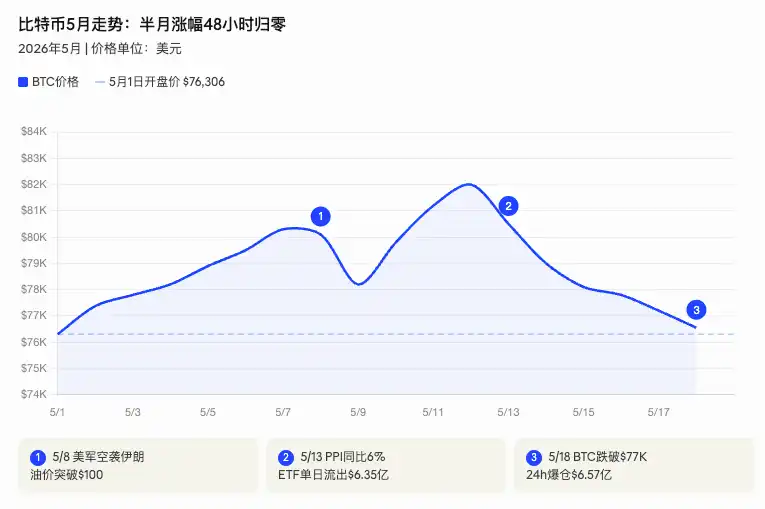
Bitcoin briefly dropped to $76,551 during Monday's Asian trading session, its lowest level since May 1st. According to a Bloomberg report on May 18th, widespread risk aversion triggered by Middle East tensions prompted traders to slash positions significantly, with the crypto market seeing nearly $500 million in liquidations within 15 minutes.

What does this price signify? On May 1st, Bitcoin opened around $76,306. Over the following two weeks, it climbed to above $82,000, then declined for four consecutive trading days, erasing all of May's gains. For traders who chased the rally mid-month, turning from floating profits to floating losses within 48 hours happened too fast to react.
PPI Soars 6% Year-Over-Year, Hitting Three-Year High, Rate Hike Probability Rises to 39%

The fuse that ignited this round of selling was the U.S. April Producer Price Index (PPI) released on May 13th. According to data from the U.S. Bureau of Labor Statistics, PPI rose 1.4% month-over-month, the largest monthly increase since March 2022; it surged 6% year-over-year, the highest level since December 2022, far exceeding market expectations of 4.9%.

Energy prices were the main driver. Gasoline prices jumped 15.6% month-over-month in April, diesel prices rose 12.6%, and the impact of the Iran conflict on the energy complex is transmitting down the supply chain. Even excluding food and energy, the core PPI still rose 1% month-over-month and reached 5.2% year-over-year, indicating price pressure is no longer confined to the pump.

High Frequency Economics Chief Economist Carl Weinberg warned after the PPI report that the data would sound alarms at both the Federal Reserve and financial markets. The CME FedWatch tool shows the market's pricing for a 25 basis point rate hike this year has risen to about 39%, with expectations for a rate cut this year largely eliminated.

Just one day before the PPI data, April CPI rose to 3.8% year-over-year, the highest since May 2023. According to CNN, several economists raised their forecasts for May CPI after the PPI release, expecting it to exceed 4%. The transmission of wholesale prices to the consumer end is accelerating.

ETF Six-Week Inflow Streak Ends, Weekly Net Outflow Exceeds $1 Billion

Macro pressures quickly transmitted to the institutional capital level. According to SoSoValue data, for the week ending May 15th, U.S. Bitcoin spot ETFs recorded a net outflow of approximately $1 billion, ending six consecutive weeks of net inflows. A CoinShares report on May 18th showed digital asset investment products overall saw a net outflow of $1.07 billion, the third-largest weekly outflow of 2026.

James Butterfill, Head of Research at CoinShares, stated this shift "may reflect geopolitical risk aversion triggered by developments related to Iran."

The total net inflow over the previous six weeks was about $3.4 billion, averaging about $568 million per week, with April alone seeing inflows of $1.97 billion, the strongest monthly performance of 2026. This accumulation was reversed intensively this week. May 13th saw a single-day net outflow of $635 million, the largest daily decline of the week; on May 15th, none of the 11 Bitcoin ETFs recorded positive inflows, with another $290 million outflow.

Ethereum spot ETFs also suffered five consecutive days of outflows, with a weekly net outflow of $255 million. By the weekend, Bitcoin ETF cumulative net inflows still stood at $58.34 billion, with total assets under management around $104.29 billion.

$657 Million in Liquidations, 89% Long Positions

As ETF capital fled, the derivatives market experienced a brutal long squeeze. According to Coinglass data, total crypto market liquidations within 24 hours reached $657 million, with long positions accounting for about 89%. According to bitcoin.com, $584 million came from long positions. The Fear & Greed Index plummeted from a neutral 50 a few days earlier to 29, entering the fear zone.

The domino effect of leveraged liquidations accelerated the decline. Bitcoin triggered a large number of stop-loss and forced liquidation orders after breaking below key support, forming a "liquidation → selling → more liquidation" spiral. LMAX crypto strategist Joel Kruger described this process as "forced position closures and position washouts" pushing Bitcoin below key technical support.

Bitcoin is currently hovering in the $76,000 to $76,800 range, with the 50-day moving average around $76,716 providing short-term support, and the 200-day moving average around $83,513 acting as resistance above.

Strategy Group Adds 20,000 BTC Against the Trend, Saylor Not Reading the Same Sentiment Report

While retail investors were liquidated and ETFs bled, Strategy Group (formerly MicroStrategy) operated in the opposite direction during the same period.

According to an 8-K filing with the SEC on May 18th, the company purchased 24,869 Bitcoin for approximately $2.01 billion between May 11th and 17th, at an average price of $80,985. This transaction brought Strategy's total holdings to 843,738 BTC, with a total cost of about $63.87 billion and an average price of around $75,700. This purchase was primarily funded through the sale of STRC preferred stock.

Strategy also disclosed that its "BTC yield" for the year-to-date 2026 (a metric measuring Bitcoin holdings relative to diluted share count growth) reached 12.6%.

This isn't the first time Saylor has added during market panic. Throughout 2026, Strategy has maintained a near-weekly or bi-weekly purchase rhythm, regardless of market ups and downs. From January to May, the company increased its holdings from about 560,000 BTC to over 840,000, adding nearly 60,000 new BTC per month on average. In the same week everyone was watching PPI data and ETF outflow data, he spent another $2 billion buying.

Goldman Sachs Liquidates XRP and Solana ETFs in Q1, Keeps Only Bitcoin

If Strategy's actions represent the "Bitcoin maximalist" stance, Goldman Sachs' Q1 13F holdings report presents a more representative institutional choice.

According to Goldman's latest Q1 2026 13F report, the bank completely liquidated all its XRP and Solana ETF holdings in the first quarter. At the end of the previous quarter, Goldman held about $154 million in XRP-related ETFs (distributed across issuers like Bitwise, Franklin Templeton, Grayscale, and 21Shares), and over $100 million in Solana-related ETFs. Now both positions are zero.

Ethereum ETF exposure was cut by about 70%, reduced from previous levels to around $114 million. The Bitcoin ETF position remained largely unchanged at around $700-720 million, with only a slight reduction of about 10%.
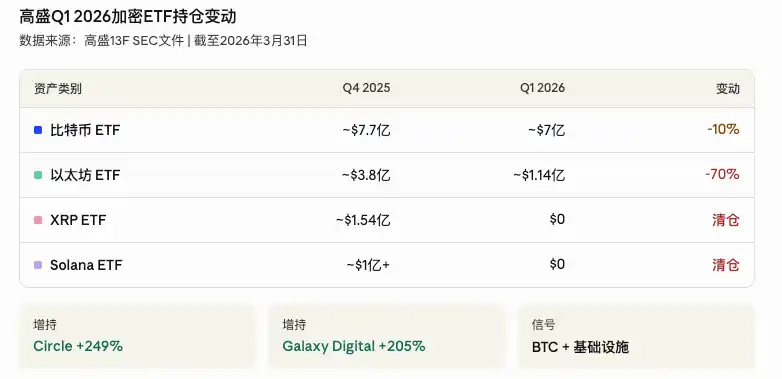
At the same time, Goldman increased its holdings in crypto infrastructure stocks: Circle holdings increased 249%, Galaxy Digital holdings increased 205%, and Coinbase also saw an increase. The signal from this set of actions is clear: Goldman hasn't exited crypto, but is narrowing its bets—shifting from "casting a wide net" back to "BTC-only."

According to a CCN report, the Harvard University Endowment also reduced its Bitcoin ETF holdings by 43% during the same period and completely exited Ethereum ETFs. Institutions are synchronizing a concentration of their crypto exposure by asset type.


Perguntas relacionadas

QWhat are the main factors cited as triggers for the recent sharp decline in Bitcoin's price?

AThe main triggers are the higher-than-expected US Producer Price Index (PPI) report showing a 6% year-over-year increase, leading to heightened expectations of potential Federal Reserve rate hikes. This macroeconomic pressure coincided with a shift in institutional fund flows, marked by US spot Bitcoin ETFs seeing their first net outflow in six weeks, exceeding $1 billion. Additionally, significant liquidations in the derivatives market, with $657 million in positions forcibly closed, accelerated the downward price movement.

QHow did the investment behavior of Strategy (formerly MicroStrategy) contrast with the general market trend during the sell-off?

AStrategy engaged in significant contrarian buying during the market sell-off. According to its SEC filing, the company purchased 24,869 BTC for approximately $2.01 billion between May 11 and May 17, at an average price of $80,985 per Bitcoin. This increased its total holdings to 843,738 BTC. This action demonstrates a consistent strategy of accumulating Bitcoin regardless of short-term price volatility, directly opposing the trend of retail panic selling and ETF outflows.

QWhat significant change did Goldman Sachs make to its cryptocurrency portfolio in Q1 2026, according to its 13F report?

AAccording to its Q1 2026 13F report, Goldman Sachs made a significant shift towards concentrating its crypto exposure primarily on Bitcoin. The bank completely liquidated its entire holdings of XRP and Solana ETFs. It also reduced its Ethereum ETF exposure by approximately 70%. Meanwhile, it largely maintained its Bitcoin ETF holdings at around $700-$720 million, making only a minor ~10% reduction. The report indicates a strategic move from a diversified crypto portfolio to a more focused 'BTC-only' stance among cryptocurrency investments.

QWhat was the impact of the recent market downturn on leveraged traders in the cryptocurrency market?

AThe market downturn led to massive liquidations for leveraged traders. Within 24 hours, total liquidations across the crypto market reached $657 million. A vast majority of these, approximately 89% or $584 million, were long positions that were forcibly closed. This created a cascading effect where initial liquidations triggered further selling, leading to more stop-losses and liquidations, which accelerated the price decline and pushed the market fear and greed index from a neutral 50 into the 'fear' territory at 29.

QWhat does the article suggest is the emerging institutional consensus regarding cryptocurrency investment, based on the actions of firms like Goldman Sachs?

AThe article suggests an emerging institutional consensus of strategic concentration on Bitcoin. The actions of Goldman Sachs—exiting other major altcoins like XRP and Solana while maintaining core Bitcoin exposure—are presented as a representative example. The trend indicates that major institutions are moving away from a 'broad exposure' approach to a more selective one. The implied consensus is: if institutions are to engage with crypto assets at all, they are increasingly choosing to focus their bets primarily or exclusively on Bitcoin, viewing it as the core, foundational asset in the space.

Leituras Relacionadas

When Hyperliquid Steals Solana's 'Internet Capital Markets' Playbook

The article discusses how Solana's grand vision of becoming an "Internet Capital Markets" platform is facing significant challenges in 2026, primarily from the unexpected rise of Hyperliquid. Solana's performance has weakened, with its token SOL experiencing the largest price decline among major cryptocurrencies. Its core narrative of building a global, chain-based marketplace for all assets is under pressure both internally and externally. Hyperliquid, originally a perpetual futures exchange, has evolved into a dedicated Layer 1 financial infrastructure network. Its focused, trading-centric approach is attracting capital and challenging the assumption that a "general-purpose" ecosystem like Solana is necessary for a capital market. Hyperliquid's success suggests that for high-frequency trading, superior performance, liquidity, and user experience may be more critical than a broad application ecosystem. Internally, Solana's strategy suffered a blow from a major hack on the Drift Protocol in April, resulting in over $200 million in losses. In response, Solana founder Anatoly Yakovenko has heavily promoted Phoenix as a new decentralized perpetual futures platform on Solana. While this boosted Phoenix's visibility, its trading volume remains far behind leading platforms. Solana's community has launched a rhetorical attack against Hyperliquid, questioning its decentralization due to its limited validator set and closed-source code. Critics, however, point out Solana's own decreasing validator count and increasing centralization of stake. This focus on "decentralization metrics" has also caused internal friction, with other Solana ecosystem developers expressing discontent over the foundation's perceived favoritism towards Phoenix. The article concludes that the rise of Hyperliquid represents a challenge to the "general-purpose blockchain" narrative, proving that an efficient trading engine might be more central to a capital market than a vast ecosystem. If Solana cannot regain dominance in the derivatives space, it risks remaining a "meme coin paradise" rather than achieving its ambition of hosting global assets.

链捕手Há 4m

When Hyperliquid Steals Solana's 'Internet Capital Markets' Playbook

链捕手Há 4m

Samsung Bets on Mobile HBM: AI Moves from Cloud to Palm, a New Frontier in Semiconductor Investment?

Samsung is betting on bringing high-bandwidth memory (HBM) technology from servers to mobile devices, aiming to enable powerful on-device AI features in smartphones and tablets. This move is driven by the booming AI market, where HBM demand from data centers has fueled Samsung's record profits, with HBM4 already in mass production. By integrating mobile HBM, Samsung seeks to transform user AI experiences—making tasks like image generation and real-time translation faster, seamless, and more private by processing data locally. Strategically, this allows Samsung to leverage its vertical integration in memory, advanced packaging, and Exynos processors to differentiate its Galaxy devices against competitors like Apple and Qualcomm. It also opens a new consumer growth avenue, reducing reliance on volatile server HBM demand alone. The initiative is expected to benefit the broader supply chain, boosting demand for advanced packaging materials, thermal solutions, and other components. While promising, risks include potential delays in mobile HBM mass production beyond 2027, high initial costs, and the cyclical nature of the memory market. Nonetheless, Samsung's push signals a broader industry shift toward hybrid cloud-edge AI computing, positioning it as a key player in defining the future of AI-powered devices and presenting a potential long-term investment theme in semiconductors.

marsbitHá 15m

Samsung Bets on Mobile HBM: AI Moves from Cloud to Palm, a New Frontier in Semiconductor Investment?

marsbitHá 15m

Trillion-Dollar Banking Giant Adjusts Portfolio: Buys XRP Heavily, Clears Out Solana

In a significant portfolio rebalancing move, Italian banking giant Intesa Sanpaolo, with $1.1 trillion in assets, has made a notable shift in its cryptocurrency holdings. According to disclosures from Q4 2025 to Q1 2026, the bank's total crypto exposure surged from $100 million to approximately $235 million. The most striking action was its first-time establishment of an XRP position, investing around $18 million through the Grayscale XRP Trust. This marks a milestone as one of the first major European banks to adopt XRP via a regulated investment vehicle. This move is part of a broader, systematic digital asset strategy. The bank also substantially increased its Bitcoin exposure via ETFs and initiated its first Ethereum investment through a staking trust. In a contrasting strategic pivot, Intesa Sanpaolo drastically reduced its Solana holdings by over 99%, nearly exiting its position in a Bitwise Solana staking ETF. This shift is interpreted as reflecting a institutional preference for assets perceived with lower regulatory and operational risk, especially following Solana's network stability issues and improved clarity for XRP after its legal settlements. The bank's actions highlight key drivers for institutional adoption: clearer regulations, the availability of compliant ETF products, and the search for portfolio diversification. This trend signifies crypto's evolving status from a niche experiment to a recognized component of mainstream asset allocation, with institutions favoring gradual, regulated entry points over direct token ownership.

marsbitHá 1h

Trillion-Dollar Banking Giant Adjusts Portfolio: Buys XRP Heavily, Clears Out Solana

marsbitHá 1h

Base Native Leveraged Prediction Market OmenX Officially Launches on Mainnet

Base-native leveraged prediction market platform OmenX has officially launched on mainnet. It currently supports up to 5x leverage, with plans to increase to 10x based on platform liquidity and market conditions. Unlike traditional prediction markets where users fully collateralize YES/NO positions and wait for settlement, OmenX aims to create a trading platform-like experience. Users can open leveraged positions on event outcomes, and actively trade, adjust, or hedge these positions before the event concludes for greater capital efficiency. Alongside the mainnet launch, OmenX introduced a "Hedge-to-Earn" campaign targeting existing users of other prediction markets (initially Polymarket). This initiative allows users to claim incentives or hedging benefits on OmenX based on their existing positions, aiming to introduce them to leveraged trading and active risk management. OmenX positions itself as a derivatives trading platform for prediction market assets. The team believes that as platforms like Polymarket mainstream prediction markets, event outcomes are becoming a new tradable asset class. The next phase of demand will focus on leverage, liquidity, and advanced trading tools. Post-launch, OmenX plans to expand supported market types, optimize liquidity, and develop APIs and additional trading tools. The team is also in discussions with investors and partners to secure resources for further development.

链捕手Há 1h

Base Native Leveraged Prediction Market OmenX Officially Launches on Mainnet

链捕手Há 1h

Trading

Spot
Futuros

Artigos em Destaque

O que é BITCOIN

Compreender o HarryPotterObamaSonic10Inu (ERC-20) e a Sua Posição no Espaço Cripto Nos últimos anos, o mercado de criptomoedas assistiu a um aumento na popularidade das moedas meme, cativando não apenas os traders, mas também aqueles que procuram envolvimento comunitário e valor de entretenimento. Entre estes tokens únicos está o HarryPotterObamaSonic10Inu (ERC-20), um projeto intrigante que mistura referências culturais no tecido das criptomoedas. Este artigo explora os principais aspetos do HarryPotterObamaSonic10Inu, examinando os seus mecanismos, a sua ética orientada pela comunidade e o seu envolvimento com o vasto panorama cripto. O que é o HarryPotterObamaSonic10Inu (ERC-20)? Como o nome sugere, o HarryPotterObamaSonic10Inu é uma moeda meme construída na blockchain Ethereum, classificada sob o padrão ERC-20. Ao contrário das criptomoedas tradicionais, que podem enfatizar a utilidade prática ou o potencial de investimento, este token prospera no valor de entretenimento e na força da sua comunidade. O projeto visa promover um ambiente onde utilizadores envolvidos possam reunir-se, partilhar ideias e participar em atividades inspiradas por diversos fenómenos culturais. Uma característica notável do HarryPotterObamaSonic10Inu é a zero taxa sobre transações. Este elemento atraente visa encorajar a negociação e o envolvimento da comunidade, isento de encargos adicionais que podem desencorajar os traders de pequena escala. A oferta total da moeda está fixada em mil milhões de tokens, uma cifra que marca a sua intenção de manter uma circulação substancial dentro da comunidade. Criador do HarryPotterObamaSonic10Inu (ERC-20) As origens do HarryPotterObamaSonic10Inu estão um pouco envoltas em mistério; os detalhes sobre o criador permanecem desconhecidos. O desenvolvimento deste token carece de uma equipa identificável ou de um plano explícito, o que não é raro no setor das moedas meme. Em vez disso, o projeto surgiu de forma orgânica, com o seu progresso a depender fortemente do entusiasmo e da participação da sua comunidade. Investidores do HarryPotterObamaSonic10Inu (ERC-20) No que diz respeito a investimentos externos e apoios, o HarryPotterObamaSonic10Inu também permanece ambíguo. O token não lista quaisquer fundações de investimento conhecidas ou apoio organizacional significativo. Em vez disso, o “sangue vital” do projeto é a sua comunidade de base, que informa o seu crescimento e sustentabilidade através da ação coletiva e do envolvimento no espaço cripto. Como Funciona o HarryPotterObamaSonic10Inu (ERC-20)? Como uma moeda meme, o HarryPotterObamaSonic10Inu opera principalmente fora dos quadros tradicionais que muitas vezes governam o valor dos ativos. Existem vários aspetos distintivos que definem como o projeto funciona: Transações Sem Taxas: Sem taxas sobre transações, os utilizadores podem comprar e vender o token livremente, sem a preocupação de custos ocultos. Envolvimento da Comunidade: O projeto prospera na interação da comunidade, aproveitando plataformas de redes sociais para criar entusiasmo e facilitar a participação. Discussões, partilha de conteúdo e envolvimento são elementos cruciais que ajudam a expandir o seu alcance e a fomentar a lealdade entre os apoiantes. Sem Utilidade Prática: Deve ser notado que o HarryPotterObamaSonic10Inu não oferece utilidade concreta dentro do ecossistema financeiro. Em vez disso, é classificado como um token principalmente para entretenimento e atividades comunitárias. Referência Cultural: O token incorpora de forma inteligente elementos da cultura popular para atrair interesse, conectando-se tanto com entusiastas de memes como com seguidores de criptomoedas. HarryPotterObamaSonic10Inu exemplifica como as moedas meme operam de forma diferente de projetos de criptomoedas mais tradicionais, entrando no mercado como construções sociais inovadoras em vez de ativos utilitários. Linha do Tempo do HarryPotterObamaSonic10Inu (ERC-20) A história do HarryPotterObamaSonic10Inu é marcada por vários marcos notáveis: Criação: O token surgiu de um meme viral, capturando a imaginação de muitos entusiastas de criptomoedas. Datas específicas de criação não estão disponíveis, sublinhando a sua ascensão orgânica. Listagem em Exchanges: O HarryPotterObamaSonic10Inu conseguiu entrar em várias exchanges, permitindo um acesso e negociação mais fáceis pela comunidade. Iniciativas de Envolvimento da Comunidade: Atividades contínuas direcionadas a melhorar a interação comunitária, incluindo concursos, campanhas em redes sociais e geração de conteúdo por fãs e defensores. Planos de Expansão Futura: O roteiro do projeto inclui o lançamento de uma coleção de NFTs, mercadorias e um site de eCommerce relacionado aos seus temas culturais, envolvendo ainda mais a comunidade e tentando adicionar mais dimensões ao seu ecossistema. Pontos-Chave sobre o HarryPotterObamaSonic10Inu (ERC-20) Natureza Orientada pela Comunidade: O projeto prioriza a contribuição coletiva e a criatividade, assegurando que o envolvimento dos utilizadores está na vanguarda do seu desenvolvimento. Classificação como Moeda Meme: Representa o epítome da criptomoeda baseada em entretenimento, destacando-se dos veículos de investimento tradicionais. Sem Afiliação Direta com o Bitcoin: Apesar da semelhança no nome do ticker, o HarryPotterObamaSonic10Inu é distinto e não tem qualquer relação com o Bitcoin ou outras criptomoedas estabelecidas. Foco na Colaboração: O HarryPotterObamaSonic10Inu é projetado para criar um espaço de colaboração e partilha de histórias entre os seus detentores, proporcionando uma via para a criatividade e o fortalecimento da comunidade. Perspectivas Futuras: A ambição de expandir além da sua premissa inicial para NFTs e mercadorias delineia um caminho para o projeto potencialmente entrar em avenidas mais mainstream dentro da cultura digital. À medida que as moedas meme continuam a capturar a imaginação da comunidade cripto, HarryPotterObamaSonic10Inu (ERC-20) destaca-se devido aos seus laços culturais e abordagem centrada na comunidade. Embora possa não se encaixar no molde típico de um token orientado para utilidade, a sua essência reside na alegria e camaradagem fomentadas entre os seus apoiantes, destacando a natureza em evolução das criptomoedas em uma era cada vez mais digital. À medida que o projeto continua a desenvolver-se, será importante observar como as dinâmicas comunitárias influenciam a sua trajetória no panorama em constante mudança da tecnologia blockchain.

1.5k Visualizações TotaisPublicado em {updateTime}Atualizado em 2024.12.03

O que é BITCOIN

Como comprar BTC

Bem-vindo à HTX.com!Tornámos a compra de Bitcoin (BTC) simples e conveniente.Segue o nosso guia passo a passo para iniciar a tua jornada no mundo das criptos.Passo 1: cria a tua conta HTXUtiliza o teu e-mail ou número de telefone para te inscreveres numa conta gratuita na HTX.Desfruta de um processo de inscrição sem complicações e desbloqueia todas as funcionalidades.Obter a minha contaPasso 2: vai para Comprar Cripto e escolhe o teu método de pagamentoCartão de crédito/débito: usa o teu visa ou mastercard para comprar Bitcoin (BTC) instantaneamente.Saldo: usa os fundos da tua conta HTX para transacionar sem problemas.Terceiros: adicionamos métodos de pagamento populares, como Google Pay e Apple Pay, para aumentar a conveniência.P2P: transaciona diretamente com outros utilizadores na HTX.Mercado de balcão (OTC): oferecemos serviços personalizados e taxas de câmbio competitivas para os traders.Passo 3: armazena teu Bitcoin (BTC)Depois de comprar o teu Bitcoin (BTC), armazena-o na tua conta HTX.Alternativamente, podes enviá-lo para outro lugar através de transferência blockchain ou usá-lo para transacionar outras criptomoedas.Passo 4: transaciona Bitcoin (BTC)Transaciona facilmente Bitcoin (BTC) no mercado à vista da HTX.Acede simplesmente à tua conta, seleciona o teu par de trading, executa as tuas transações e monitoriza em tempo real.Oferecemos uma experiência de fácil utilização tanto para principiantes como para traders experientes.

4.0k Visualizações TotaisPublicado em {updateTime}Atualizado em 2025.03.21

Como comprar BTC

O que é $BITCOIN

OURO DIGITAL ($BITCOIN): Uma Análise Abrangente Introdução ao OURO DIGITAL ($BITCOIN) OURO DIGITAL ($BITCOIN) é um projeto baseado em blockchain que opera na rede Solana, com o objetivo de combinar as características dos metais preciosos tradicionais com a inovação das tecnologias descentralizadas. Embora partilhe um nome com o Bitcoin, frequentemente referido como “ouro digital” devido à sua percepção como uma reserva de valor, o OURO DIGITAL é um token separado projetado para criar um ecossistema único dentro da paisagem Web3. O seu objetivo é posicionar-se como um ativo digital alternativo viável, embora os detalhes sobre as suas aplicações e funcionalidades ainda estejam em desenvolvimento. O que é o OURO DIGITAL ($BITCOIN)? OURO DIGITAL ($BITCOIN) é um token de criptomoeda explicitamente projetado para uso na blockchain Solana. Em contraste com o Bitcoin, que fornece um papel amplamente reconhecido como armazenamento de valor, este token parece focar em aplicações e características mais amplas. Aspectos notáveis incluem: Infraestrutura Blockchain: O token é construído na blockchain Solana, conhecida pela sua capacidade de lidar com transações de alta velocidade e baixo custo. Dinâmicas de Oferta: O OURO DIGITAL tem um fornecimento máximo limitado a 100 quatrilhões de tokens (100P $BITCOIN), embora os detalhes sobre o seu fornecimento circulante ainda não tenham sido divulgados. Utilidade: Embora as funcionalidades precisas não estejam explicitamente delineadas, existem indicações de que o token poderia ser utilizado para várias aplicações, potencialmente envolvendo aplicações descentralizadas (dApps) ou estratégias de tokenização de ativos. Quem é o Criador do OURO DIGITAL ($BITCOIN)? Neste momento, a identidade dos criadores e da equipa de desenvolvimento por trás do OURO DIGITAL ($BITCOIN) permanece desconhecida. Esta situação é típica entre muitos projetos inovadores no espaço da blockchain, particularmente aqueles alinhados com finanças descentralizadas e fenómenos de moedas meme. Embora tal anonimato possa fomentar uma cultura orientada pela comunidade, intensifica as preocupações sobre governança e responsabilidade. Quem são os Investidores do OURO DIGITAL ($BITCOIN)? As informações disponíveis indicam que o OURO DIGITAL ($BITCOIN) não tem apoiantes institucionais conhecidos ou investimentos proeminentes de capital de risco. O projeto parece operar num modelo peer-to-peer focado no apoio e adoção da comunidade, em vez de rotas de financiamento tradicionais. A sua atividade e liquidez estão principalmente situadas em exchanges descentralizadas (DEXs), como a PumpSwap, em vez de plataformas de negociação centralizadas estabelecidas, destacando ainda mais a sua abordagem de base. Como Funciona o OURO DIGITAL ($BITCOIN) A mecânica operacional do OURO DIGITAL ($BITCOIN) pode ser elaborada com base no seu design de blockchain e nas características da rede: Mecanismo de Consenso: Ao aproveitar o exclusivo proof-of-history (PoH) da Solana combinado com um modelo de proof-of-stake (PoS), o projeto assegura uma validação eficiente das transações, contribuindo para o alto desempenho da rede. Tokenomics: Embora mecanismos deflacionários específicos não tenham sido extensivamente detalhados, o vasto fornecimento máximo de tokens implica que pode atender a microtransações ou casos de uso de nicho que ainda estão por definir. Interoperabilidade: Existe o potencial para integração com o ecossistema mais amplo da Solana, incluindo várias plataformas de finanças descentralizadas (DeFi). No entanto, os detalhes sobre integrações específicas permanecem não especificados. Cronologia de Eventos Chave Aqui está uma cronologia que destaca marcos significativos relacionados ao OURO DIGITAL ($BITCOIN): 2023: O lançamento inicial do token ocorre na blockchain Solana, marcado pelo seu endereço de contrato. 2024: O OURO DIGITAL ganha visibilidade ao tornar-se disponível para negociação em exchanges descentralizadas como a PumpSwap, permitindo que os utilizadores o negociem contra SOL. 2025: O projeto testemunha atividade de negociação esporádica e potencial interesse em envolvimentos liderados pela comunidade, embora não tenham sido documentadas parcerias ou avanços técnicos notáveis até ao momento. Análise Crítica Forças Escalabilidade: A infraestrutura subjacente da Solana suporta altos volumes de transações, o que pode aumentar a utilidade do $BITCOIN em vários cenários de transação. Acessibilidade: O potencial preço de negociação baixo por token pode atrair investidores de retalho, facilitando uma participação mais ampla devido a oportunidades de propriedade fracionada. Riscos Falta de Transparência: A ausência de apoiantes, desenvolvedores ou um processo de auditoria publicamente conhecidos pode gerar ceticismo em relação à sustentabilidade e confiabilidade do projeto. Volatilidade do Mercado: A atividade de negociação depende fortemente do comportamento especulativo, o que pode resultar em volatilidade significativa dos preços e incerteza para os investidores. Conclusão O OURO DIGITAL ($BITCOIN) surge como um projeto intrigante, mas ambíguo, dentro do ecossistema em rápida evolução da Solana. Embora tente aproveitar a narrativa do “ouro digital”, a sua divergência do papel estabelecido do Bitcoin como reserva de valor sublinha a necessidade de uma diferenciação mais clara da sua utilidade pretendida e estrutura de governança. A aceitação e adoção futuras dependerão provavelmente da abordagem da atual opacidade e da definição mais explícita das suas estratégias operacionais e económicas. Nota: Este relatório abrange informações sintetizadas disponíveis até outubro de 2023, e desenvolvimentos podem ter ocorrido além do período de pesquisa.

92 Visualizações TotaisPublicado em {updateTime}Atualizado em 2025.05.13

O que é $BITCOIN

Discussões

Bem-vindo à Comunidade HTX. Aqui, pode manter-se informado sobre os mais recentes desenvolvimentos da plataforma e obter acesso a análises profissionais de mercado. As opiniões dos utilizadores sobre o preço de BTC (BTC) são apresentadas abaixo.

活动图片