Robinhood, the First Stock in the Predictive Market Concept

marsbitPublicado em 2026-06-16Última atualização em 2026-06-16

Resumo

The online brokerage Robinhood, which previously partnered with prediction market platform Kalshi to offer event contract trading to its users, is now becoming a direct competitor. This shift began after Robinhood, through a joint venture, acquired and rebranded a CFTC-regulated exchange (now Rothera Exchange). Robinhood's motivation stems from the rapid growth of prediction markets on its platform, which significantly boosted its "other transaction revenue." Recognizing that its vast retail user base is the most critical asset, Robinhood aims to capture more value by routing orders to its own exchange instead of sharing fees with Kalshi. It strategically launched its Rothera platform during the high-traffic 2026 FIFA World Cup, successfully processing tens of millions of contracts in its initial days. This move signals a pivotal power shift in the prediction market industry: control over user distribution and access is emerging as a more decisive advantage than the underlying market infrastructure itself. The future competition may increasingly revolve around which platforms control the major user gateways.

Author: Azuma, Odaily Planet Daily

The battle of the World Cup has begun, and the total trading volume of the predictive market continues to hit new highs. However, as the industry leader, Kalshi might not be in the best mood right now.

The reason is not due to fluctuations in Kalshi's own business data, but because Kalshi now "suddenly" faces another formidable rival besides Polymarket, and this opponent was once its most important ally.
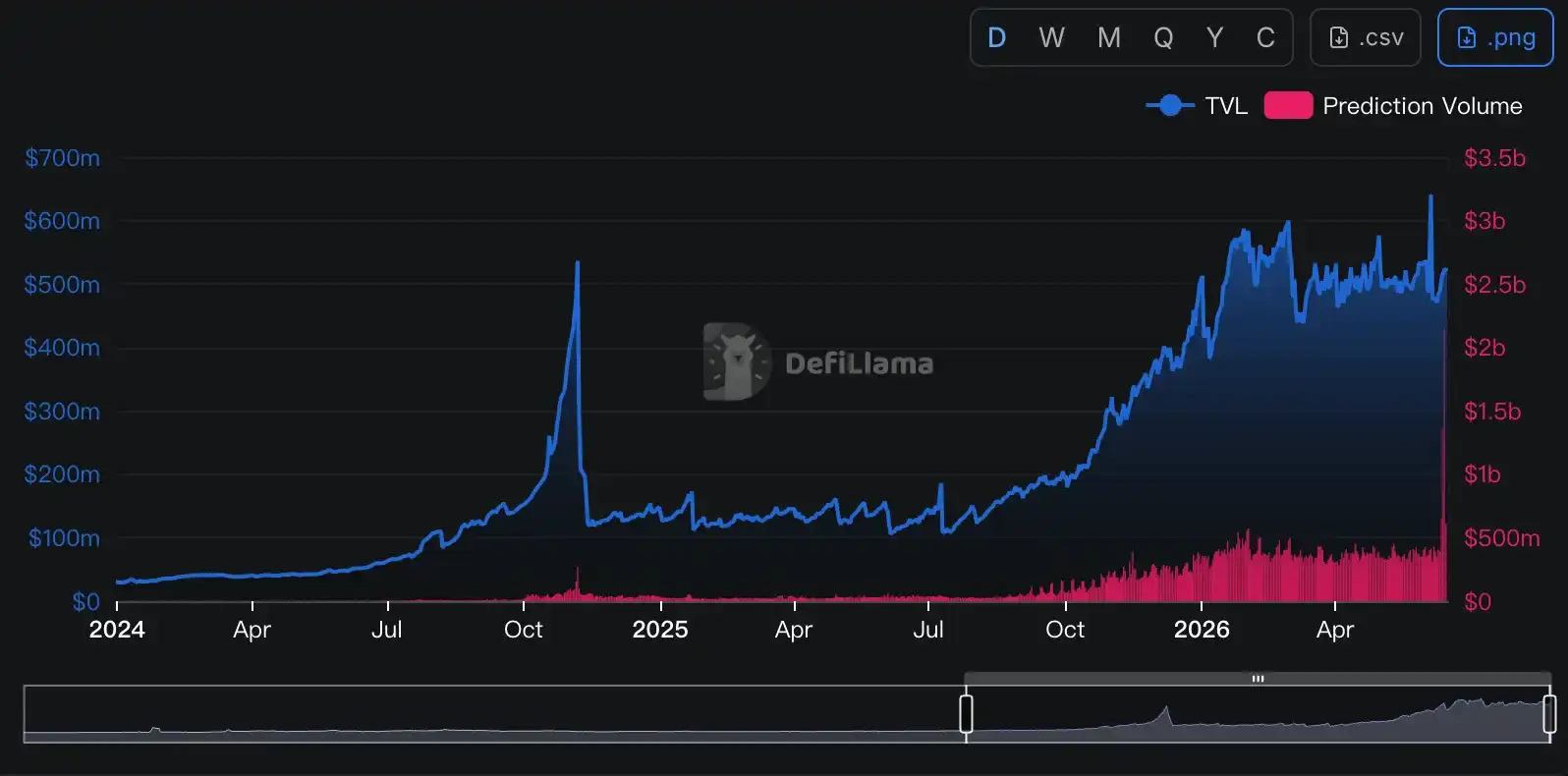
  • Odaily Note: Data sourced from Defillama.

Kalshi's Most Important Traffic Channel — Robinhood

Rewind to March 2025. At that time, Kalshi announced a partnership with the US online broker Robinhood, where the latter would use Kalshi's services to offer its users predictive market trading, allowing them to place bets on events like politics, economics, and sports.

From a business model perspective, this was a typical case of "mutual benefit" — Robinhood, responsible for user access and transaction distribution, could directly use Kalshi's mature product; Kalshi, responsible for the underlying market, matching, clearing, and regulatory compliance systems, could reach Robinhood's massive retail user pool.

The subsequent story proved the "win-win" outcome of this partnership. Through Robinhood's channel distribution, Kalshi indirectly gained massive users and transaction volume. Piper Sandler analysts once estimated that "trading volume completed through Robinhood's channel accounted for about 25%-35% of Kalshi's total trading volume." These orders ultimately translated into revenue for both parties — Robinhood would independently charge for all Kalshi event contracts traded through its channel, a fixed fee of $0.01 per contract per direction, and then share the revenue with Kalshi (the specific proportion was not disclosed).
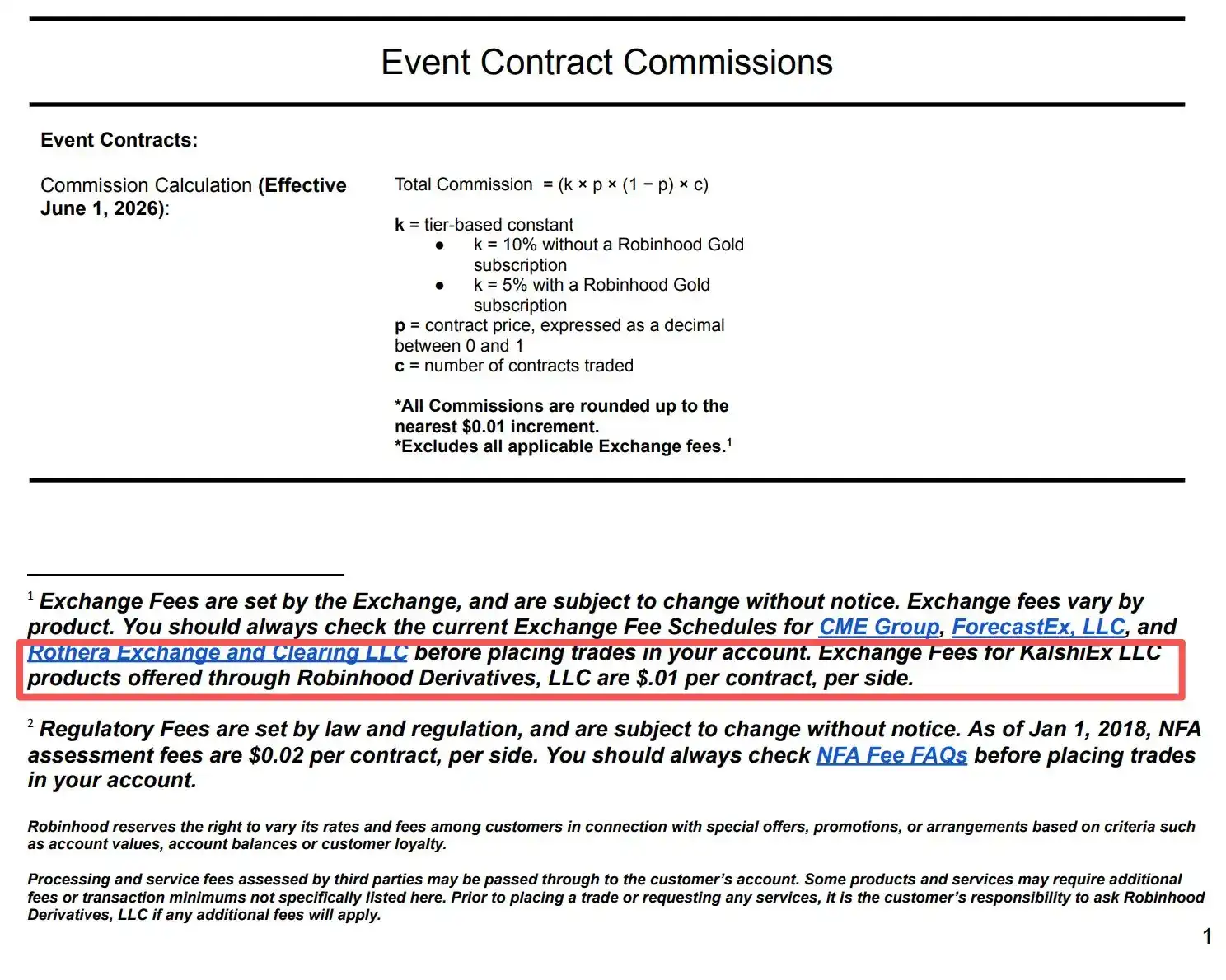
The Q1 financial report disclosed at the end of April showed that Robinhood facilitated the trading of 8.8 billion event contracts in Q1, driving "other trading revenue" to grow by 320% year-on-year, reaching $147 million. The predictive market has become the brightest new growth engine in Robinhood's product line.

However, recently, this relationship has undergone some subtle changes.

Robinhood's Ambition: Taking Back the Cake Shared with Kalshi

As internet history has proven countless times, when a channel gains enough leverage, it is no longer content with being just a channel. Robinhood is no exception.

Although the partnership with Kalshi also brought substantial revenue to Robinhood, as the predictive market became one of the fastest-growing new businesses on the platform, Robinhood was no longer satisfied with the current revenue-sharing arrangement.

In their cooperation model, Kalshi was responsible for providing the market and infrastructure, while Robinhood was responsible for providing users and order flow. However, as the partnership deepened, Robinhood gradually realized that what is truly scarce might not be the market itself, but the user access it firmly controls. After all, for most Robinhood users, they don't care whether their orders are ultimately executed on Kalshi or another platform — users only see a trading entry within the Robinhood app, not the underlying infrastructure provider.

In other words, Robinhood always held one of the most critical resources for the predictive market — distribution power. If the users belong to Robinhood, why should the order flow go to someone else?

In fact, just as Robinhood was quickly validating the demand for predictive markets through Kalshi, a Plan B was quietly launched shortly thereafter.

In November 2025, Robinhood announced the formation of a joint venture with Wall Street quantitative trading giant Susquehanna and planned to acquire the CFTC-regulated derivatives exchange MIAXdx. According to the official statement, this joint venture would operate an independent futures and derivatives exchange and clearing organization in the future, with predictive markets being one of its key focus areas. At the time, the outside world largely viewed it as an infrastructure investment. However, as more information was disclosed later, people gradually realized Robinhood's goal was far beyond just finding a new partner for predictive markets.

In January 2026, the transaction was completed. Robinhood and Susquehanna gained 90% control of MIAXdx, simultaneously acquiring a complete CFTC regulatory framework, including Designated Contract Market (DCM) and Derivatives Clearing Organization (DCO) licenses. Subsequently, MIAXdx was renamed Rothera Exchange, and its clearing organization was renamed Rothera Clearing.

At this point, Robinhood possessed the core elements needed to independently operate a predictive market, lacking only a mature product comparable to Kalshi. However, for Robinhood, with its rich experience in internet product development, this was evidently not a difficult task.

Rothera's Opportunity: The World Cup

In June 2026, after about half a year of accelerated development, the Rothera product gradually took shape, and Robinhood finally made the move that was almost destined to happen — gradually shifting the orders that originally flowed to Kalshi into its own controlled system.

Robinhood specifically chose an ideal launch battleground for Rothera — the World Cup. For predictive markets, the World Cup is undoubtedly one of the most high-traffic trading themes. Whether it's match outcomes, advancement results, or champion predictions, related markets can attract a large number of new users to trade in a short period. For the newly launched Rothera platform, there is no better scenario for a cold start than the World Cup.

According to Robinhood's official disclosure, during this World Cup with a total of 104 matches, some event contracts will be directed to Rothera for matching and clearing, including markets for single World Cup match results, the ultimate World Cup champion, total goals in a single match, and others. Compared to the previous model that relied entirely on Kalshi, this marks the first time Robinhood has introduced predictive market orders into its own trading system on a large scale.
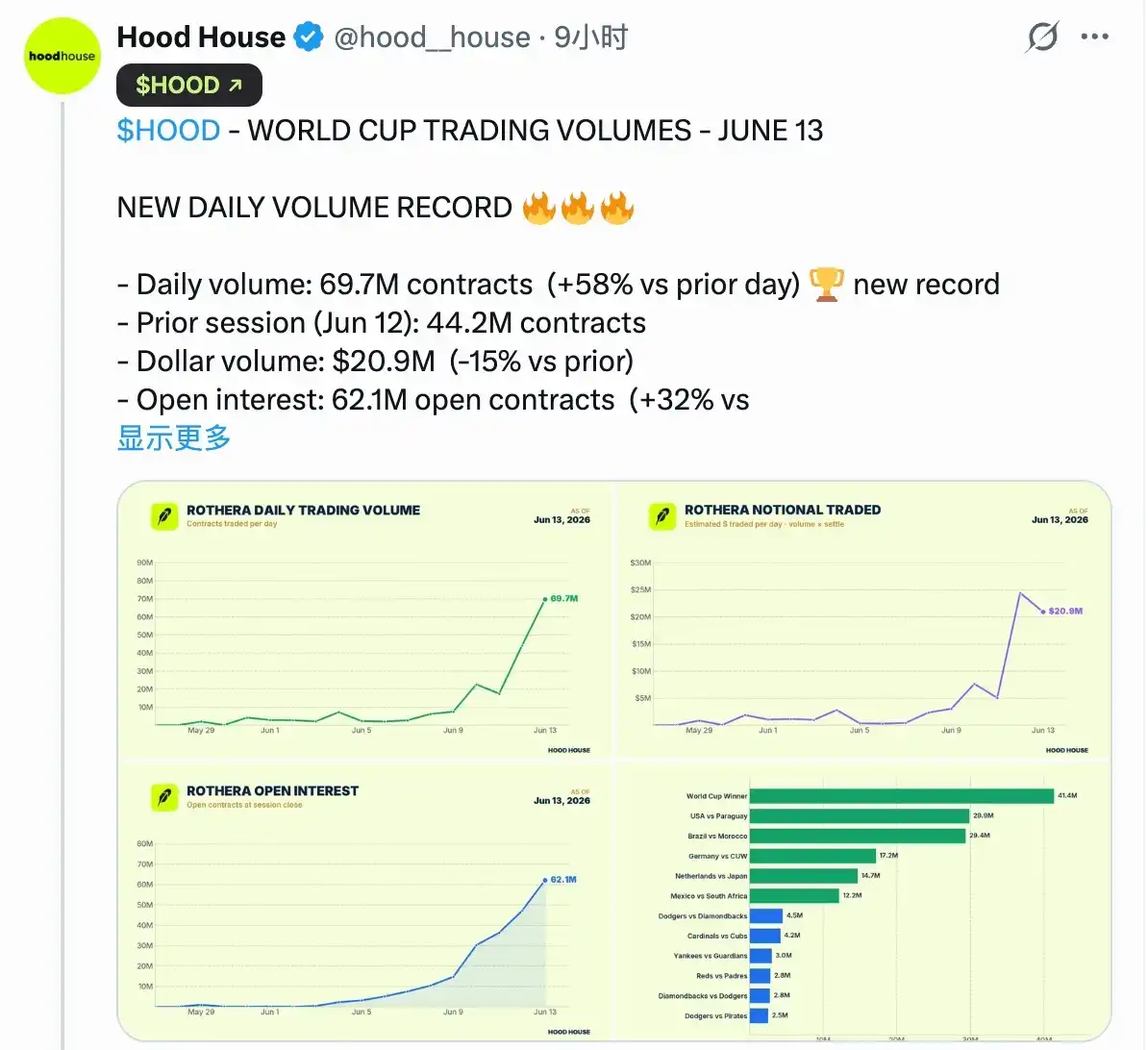
Judging by the results, Rothera clearly seized this opportunity. According to data disclosed by Hood House, an investment research media tracking Robinhood's activities, on June 12, Rothera completed 44.2 million contract trades, corresponding to a dollar trading volume of approximately $24.4 million; on June 13, Rothera completed 69.7 million contract trades, corresponding to a dollar trading volume of approximately $20.9 million... Although these figures still lag behind Kalshi's popular markets, which often involve hundreds of millions of dollars, considering that Rothera has literally just launched a few days ago, this performance is sufficiently successful.

For both Robinhood and Kalshi, this signifies that the balance of their cooperation has begun to tilt. From Robinhood's perspective, the transaction fee revenue that previously had to be shared with Kalshi can now be kept more within its own ecosystem. From Kalshi's perspective, this means that one of its most important growth engines has begun to show signs of weakening.

And the World Cup is clearly just the beginning of Rothera's encroachment on Kalshi. Looking further into the future, Robinhood will inevitably expand Rothera's coverage to more sporting events, as well as economic and political themes. Those orders that originally flowed to Kalshi will be intercepted one by one by Rothera.

Since Robinhood and Kalshi have never publicly disclosed their revenue-sharing ratio (some reports say 50%:50%, but no official information is available), we cannot know the exact monetary value of this interception. However, considering that Robinhood alone generated $147 million in predictive market-related revenue in Q1, and the Q2 World Cup and the more distant mid-term elections will likely bring even larger-scale trading activities, calculated on an annual basis, the value of this interception could reach several billion dollars.

Who Controls Distribution, Controls Everything

The drama of Robinhood and Kalshi moving from allies to opponents once again illustrates a logic repeatedly proven in the internet market — products are easy to build, but traffic is hard to find; whoever controls distribution controls everything.

Over the past few years, the market generally believed that Kalshi's core moat came from regulatory licenses, exchange qualifications, and clearing capabilities. Therefore, whether it was brokers like Robinhood or various media, communities, and traffic platforms, they were essentially just Kalshi's channel partners and traffic inlets. However, the emergence of Rothera proves one thing: in today's landscape of severe product homogenization, the product itself might not be the most critical element. What is truly scarce is always the user.

Where the users are, the liquidity is; where the liquidity is, the market will be. When Robinhood controls the access to tens of millions of retail users, it has the full capability to direct these users to any trading venue. For users, they don't care whether their orders are ultimately executed on Kalshi or Rothera. As long as the experience doesn't significantly differ, it doesn't matter who is matching or clearing behind the scenes.

If the theme of the predictive market industry in the past few years was the market battle between Polymarket and Kalshi, then the theme for the coming years might become a channel war. Robinhood incubating Rothera is essentially a reverse integration initiated by the channel side towards the market layer. As more and more platforms with traffic inlets begin to realize the strategic value of predictive markets, similar stories are highly likely to continue occurring. Whether it's exchanges, brokers, social platforms, or media platforms, they could all become new predictive market entry points.

And when inlets start to control the market, and channels begin to have pricing power, the ultimate winner in the predictive market industry might no longer be the platform responsible for order matching, but the one closest to the user and most capable of controlling distribution.

This was true in the internet era and the mobile internet era. This time, there's no exception either.

Perguntas relacionadas

QAccording to the article, why did Robinhood partner with Kalshi initially?

ARobinhood partnered with Kalshi in March 2025 to leverage Kalshi's established product and regulatory infrastructure to offer prediction market trading services to its users. This allowed Robinhood to enter the prediction market quickly while Kalshi gained access to Robinhood's large retail user base.

QWhat is the core reason Robinhood decided to develop its own prediction market platform, Rothera Exchange?

AThe core reason is that Robinhood realized it controlled the most critical resource: the user distribution channel. Since users only interacted through the Robinhood app and didn't care about the backend infrastructure, Robinhood saw an opportunity to capture more revenue by diverting orders from Kalshi to its own controlled platform, thereby keeping more of the transaction fees.

QWhat event did Robinhood choose to launch Rothera Exchange, and why was it strategic?

ARobinhood strategically chose the 2026 FIFA World Cup to launch Rothera Exchange. The World Cup is a major event that generates high trading volume and attracts many new users to prediction markets, making it an ideal scenario for the platform's initial growth and market penetration.

QHow significant was the volume of prediction market trades for Robinhood in Q1 of 2026 according to the article?

AAccording to the article, Robinhood's Q1 2026 earnings report showed it facilitated 8.8 billion event contracts, driving a 320% year-over-year growth in 'other transaction revenue' to $147 million. This made prediction markets the fastest-growing new business line for Robinhood at the time.

QWhat broader industry shift does the article suggest is occurring with the rise of Rothera and similar moves by other platforms?

AThe article suggests the industry is shifting from a market-centric competition (like between Polymarket and Kalshi) to a 'channel war' or 'distribution war.' Platforms with large user bases and distribution power (like Robinhood, brokerages, social media) are recognizing the value of prediction markets and may integrate or build their own, challenging the dominance of pure infrastructure providers.

Leituras Relacionadas

Spain Held to a Draw by Cape Verde, Jucom Prediction Market Witnesses Historic Upset

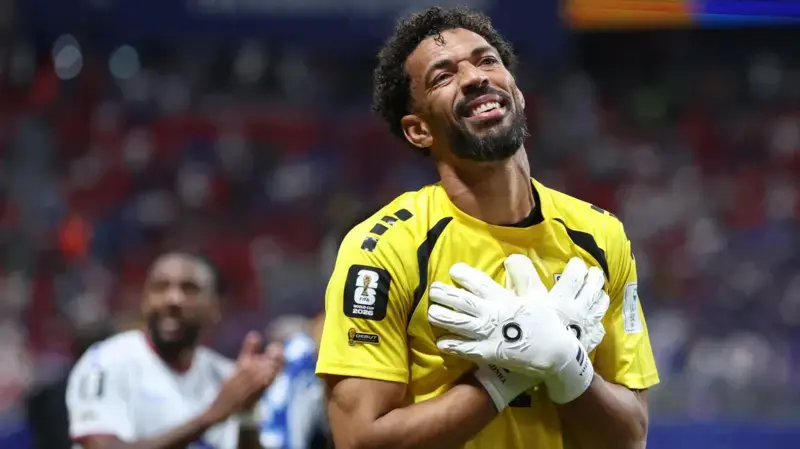
In a major upset at the 2026 FIFA World Cup, tournament favorites Spain were held to a surprising 0-0 draw by debutants Cape Verde in their Group H opener on June 16, Beijing time. Despite dominating possession (74%) and recording 27 shots with an expected goals figure of 2.16, Spain failed to break down a resilient Cape Verde defense, with their 40-year-old goalkeeper Vozinha making 7 saves to earn Man of the Match. Pre-match predictions on the Jucom prediction market had heavily favored Spain, assigning them a 92% win probability. The actual result, a goalless draw, triggered significant volatility across related prediction markets. This outcome forces a market-wide reassessment of several key probabilities, including Spain's likelihood of winning the group and the tournament itself, while Cape Verde's previously near-zero chance of advancing is now being re-evaluated. The event highlights both the efficiency and the inherent limitations of prediction markets. While prices aggregate known information, football's low-scoring, high-variance nature means unquantifiable in-game factors can lead to unlikely results. The core value of such markets lies not in perfect foresight but in their ability to dynamically reflect how new information is incorporated into collective expectations. Platforms like Jucom, which track outcomes from single matches to the final champion, provide a real-time lens into how global consensus evolves with each game.

链捕手Há 3m

Spain Held to a Draw by Cape Verde, Jucom Prediction Market Witnesses Historic Upset

链捕手Há 3m

Standard Chartered Bank Places a 40x 'Bet', Calls for UNI to Rise to $100

Standard Chartered Bank’s digital asset research head, Geoff Kendrick, initiated coverage on Uniswap with a highly bullish long-term price target of $100 for its UNI token by 2030—a roughly 40-fold increase from its ~$2.60 trading price at the time of the report. The bank’s thesis hinges on the exponential growth of tokenized real-world assets (RWA), projected to surge from ~$340 billion to $4 trillion by 2028. It expects the share of these assets deployed in DeFi to rise from 3.5% to 30%, driving total DeFi TVL to around $2.7 trillion. As the leading decentralized exchange (DEX), Uniswap is positioned to capture a significant portion of this liquidity influx. A key catalyst is Uniswap’s “fee switch,” activated in late 2024, which directs a portion of protocol fees to UNI token buybacks and burns. This transforms UNI from a pure governance token into a yield-generating, deflationary asset, narrowing its valuation gap with centralized exchanges like Coinbase. The report draws an analogy: Coinbase operates like Netflix (centralized, high-cost), while Uniswap functions like YouTube (open, user-generated, network-effect driven). Despite its dominant market share and recent institutional adoption—such as BlackRock’s BUIDL fund and Fidelity’s stablecoin using Uniswap for liquidity—the path faces challenges. Competition from Solana-based DEXs and aggregators threatens user mindshare, while regulatory delays or setbacks in RWA adoption could slow the projected growth. Furthermore, UNI remains down over 92% from its 2021 peak, reflecting persistent market skepticism. Ultimately, Standard Chartered’s report signals a shift in traditional finance’s perception of DeFi, valuing network effects and cash flow potential. However, realizing the $100 target depends on Uniswap successfully navigating intense competition, regulatory hurdles, and the multi-year timeline for massive tokenized asset adoption.

marsbitHá 28m

Standard Chartered Bank Places a 40x 'Bet', Calls for UNI to Rise to $100

marsbitHá 28m

For Those Still Obsessed with Altcoins, Just Go All-in on HOOD

Title: "For Those Still Fixated on Altcoins, Just Bet on HOOD" The article argues that Robinhood (HOOD) stock is a compelling alternative for investors still holding onto hopes for altcoin rallies. It highlights HOOD's recent strong performance, briefly touching $100, and expresses continued optimism. The bullish thesis is multi-faceted: HOOD's operational data for May showed record highs in key metrics like total assets and funded customers, though crypto volume was weaker. Positive catalysts include Robinhood launching its own prediction market (Rothera) to capture more revenue, gaining approval to act as an IPO underwriter for major upcoming listings, and being selected to manage the new "Trump Account" government savings program for millions of future US newborns. Insider and institutional buying, along with raised price targets, provide further confidence. The core argument is that HOOD is successfully decoupling from the crypto market's fortunes. While crypto-related revenue was once a major contributor, its share of total revenue has been declining, hitting 13% in Q1 2026. Although HOOD's price historically moved with Bitcoin, a recent divergence is noted. The author posits that Robinhood's growing equity trading, prediction markets, and IPO-related businesses can drive growth independently of a crypto bull market. Thus, HOOD offers asymmetric exposure: it stands to benefit if the crypto market recovers but is no longer wholly dependent on it. For those disillusioned with altcoins' risks, HOOD presents a potentially safer way to maintain exposure to the fintech and speculative trading space.

marsbitHá 36m

For Those Still Obsessed with Altcoins, Just Go All-in on HOOD

marsbitHá 36m

Trading

Spot
Futuros

Artigos em Destaque

Como comprar T

Bem-vindo à HTX.com!Tornámos a compra de Threshold Network Token (T) simples e conveniente.Segue o nosso guia passo a passo para iniciar a tua jornada no mundo das criptos.Passo 1: cria a tua conta HTXUtiliza o teu e-mail ou número de telefone para te inscreveres numa conta gratuita na HTX.Desfruta de um processo de inscrição sem complicações e desbloqueia todas as funcionalidades.Obter a minha contaPasso 2: vai para Comprar Cripto e escolhe o teu método de pagamentoCartão de crédito/débito: usa o teu visa ou mastercard para comprar Threshold Network Token (T) instantaneamente.Saldo: usa os fundos da tua conta HTX para transacionar sem problemas.Terceiros: adicionamos métodos de pagamento populares, como Google Pay e Apple Pay, para aumentar a conveniência.P2P: transaciona diretamente com outros utilizadores na HTX.Mercado de balcão (OTC): oferecemos serviços personalizados e taxas de câmbio competitivas para os traders.Passo 3: armazena teu Threshold Network Token (T)Depois de comprar o teu Threshold Network Token (T), armazena-o na tua conta HTX.Alternativamente, podes enviá-lo para outro lugar através de transferência blockchain ou usá-lo para transacionar outras criptomoedas.Passo 4: transaciona Threshold Network Token (T)Transaciona facilmente Threshold Network Token (T) no mercado à vista da HTX.Acede simplesmente à tua conta, seleciona o teu par de trading, executa as tuas transações e monitoriza em tempo real.Oferecemos uma experiência de fácil utilização tanto para principiantes como para traders experientes.

476 Visualizações TotaisPublicado em {updateTime}Atualizado em 2026.06.02

Como comprar T

Discussões

Bem-vindo à Comunidade HTX. Aqui, pode manter-se informado sobre os mais recentes desenvolvimentos da plataforma e obter acesso a análises profissionais de mercado. As opiniões dos utilizadores sobre o preço de T (T) são apresentadas abaixo.

活动图片