After semiconductors lead the gains, are funds buying into AI orders or a macroeconomic rebound?

marsbitPublicado em 2026-06-19Última atualização em 2026-06-19

Resumo

After US-Iran talks led to a temporary ceasefire and framework for reopening the strategic Strait of Hormuz, U.S. stocks rose on June 18, with the Nasdaq gaining 1.9%. The semiconductor and AI hardware sectors outperformed. This rally stemmed primarily from reduced geopolitical risk, which lowered oil prices and inflation expectations, easing discount rate pressure on high-valuation growth stocks like tech. The key question is not whether tech rebounded, but the nature of the rebound. The market appears to be selectively repricing AI infrastructure plays rather than broadly chasing AI narratives. Gains were concentrated in chips, optical interconnects, memory, and domestic manufacturing—segments tied to tangible data center build-outs and capital expenditure. Intel's ~10% surge, fueled by a Trump statement about potential Apple collaboration, exemplifies this mixed dynamic. It reflects policy catalysts and domestic manufacturing sentiment more than confirmed fundamentals. Meanwhile, strong earnings from companies like Astera Labs (revenue up 93% YoY) provided concrete evidence of AI-driven demand in hardware. In essence, the rally represents a risk-premium recalibration. Lower Middle East tensions opened a valuation repair window, and capital flowed first into AI infrastructure segments with visible near-term revenue streams. The sustainability of this move hinges on upcoming Q2 earnings, specifically continued strength in cloud provider capex, AI server orders, and hardwa...

TL;DR

According to reports from AP and Axios, following the framework arrangement reached between the U.S. and Iran regarding the ceasefire extension and the passage of oil tankers through the Strait of Hormuz, U.S. stocks rose on June 18, with the Nasdaq gaining 1.9%. The semiconductor and AI hardware supply chain performed even stronger.

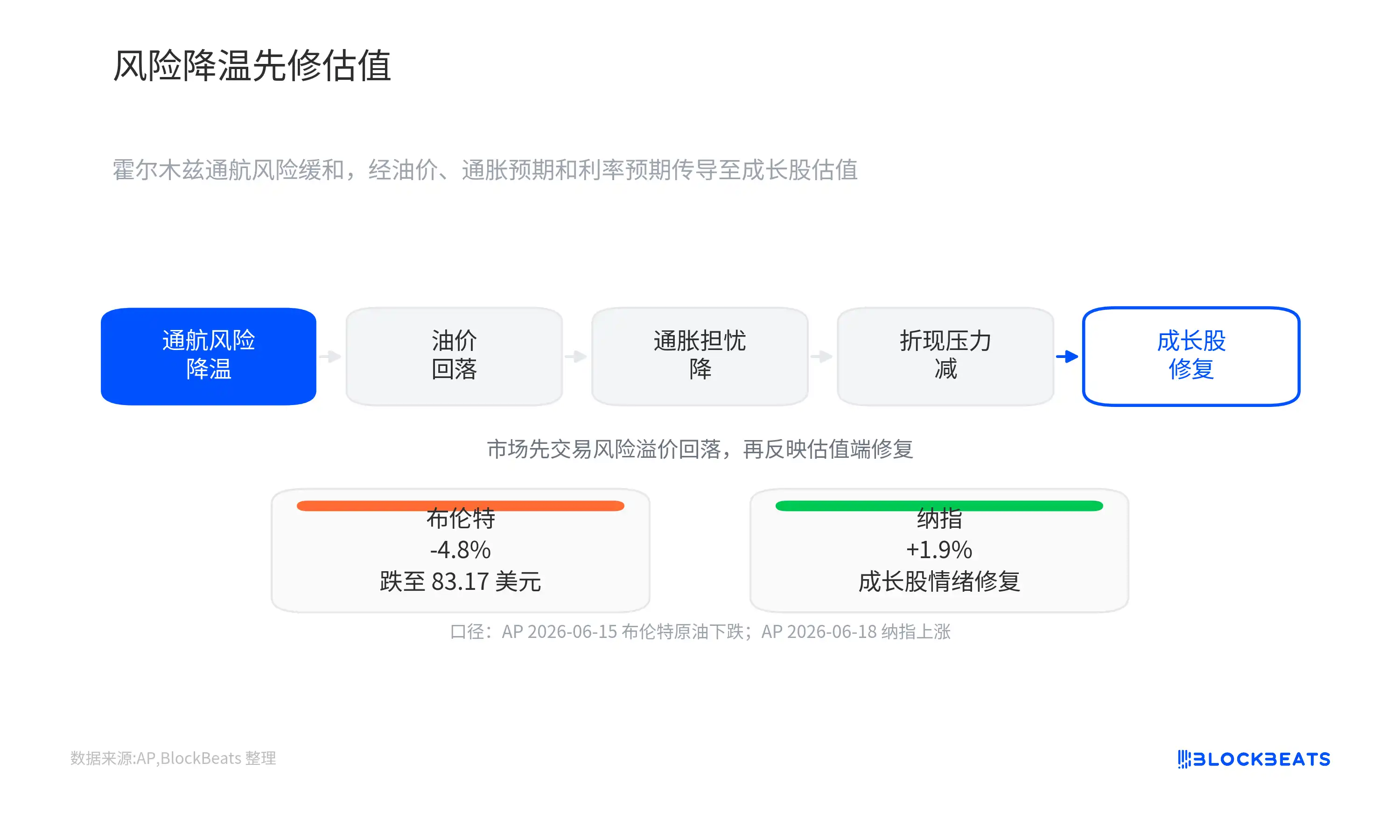
Such geopolitical news impacts technology stocks primarily through oil prices and interest rate expectations. The Strait of Hormuz is a crucial global artery for oil transportation; any disruption can quickly drive up oil prices and inflation expectations. Conversely, if the market trades on 'resumed passage and de-escalating conflict,' the discounting pressure on high-valuation growth stocks will ease.

Easing Middle East risks does not equate to a sudden improvement in AI fundamentals. What it opens up first is a window for valuation repair. What's truly worth watching is which directions funds choose after this window opens. The gains on June 18 were more concentrated not in broad technology stocks, but in chips, optical interconnects, memory, and some domestic manufacturing targets.

Intel was one of the most conspicuous trades that day. According to a Reuters report, Trump stated that Apple would collaborate with Intel to design and manufacture chips in the U.S. Influenced by this, Intel's stock price surged approximately 10%-11%. However, no formal disclosures regarding contract scale, product categories, or mass production timelines have been seen from Apple or Intel yet. This resembles more of an elasticity release driven by policy catalysts and the domestic manufacturing narrative.

Therefore, the core question of this rally is not 'whether tech stocks have rebounded,' but the nature of the rebound. Is the market buying back into AI infrastructure orders, or is it conducting a selective valuation repair by leveraging the de-escalation of geopolitical risks?

Declining Energy Risks First Repair Growth Stock Valuations

For general investors, the Strait of Hormuz can be understood as the 'chokepoint' for global oil transport. Any risk of blockade in this passage can drive up oil prices, pushing inflation expectations higher, and also affecting the Federal Reserve's path and corporate costs. High-valuation technology stocks are particularly sensitive to this chain because their valuations rely more heavily on cash flows many years into the future.

According to an AP report on June 15, Brent crude oil fell 4.8% to $83.17, returning to early March levels. Kiplinger mentioned the same day that WTI crude fell 4.9% to $80.75, its lowest settlement price since early March. Falling oil prices do not mean inflation pressure has been eliminated, but they are enough to reduce market tail-end concerns about energy shocks.

This explains why the Nasdaq and semiconductors gained greater elasticity after the news. They did not rise because of sudden profit changes at individual companies, but were prioritized for rebalancing by funds after the decline in risk premiums.

However, this chain cannot be simply described as 'Hormuz eases, therefore semiconductors rise.' A more accurate statement is that the de-escalation of geopolitical risks provided the external conditions for a rebound in growth assets. Which segments within the tech sector are favored by funds still depends on whether their fundamentals can be verified.
Ranking Within Tech Favors the Hardware Chain

This rally more resembles a re-ranking within technology stocks.

Semiconductors leading the gains indicate the market is not just buying a single leader, but is re-pricing the AI infrastructure chain. However, if one only sees 'chips are up,' it's easy to misjudge it as a full-fledged return of AI trading. More importantly, fund preferences are more concentrated in chip manufacturing, optical interconnects, memory, equipment, and domestic manufacturing.

The underlying change is that AI trading has moved from the early stage of 'the bigger the model, the better; the more GPUs, the better' to a more selective phase. Investors are now asking not whether AI has imagination space, but who can capture real revenue from data center construction.

The attention on optical interconnects and memory is also related to this stage. Large AI clusters cannot run on GPUs alone. Tens of thousands of chips require high-speed data transfer between them; optical interconnects (high-speed transmission in data centers) are akin to building highways for AI clusters. As training and inference demands expand, memory bandwidth, storage capacity, and data movement efficiency will also become bottlenecks.

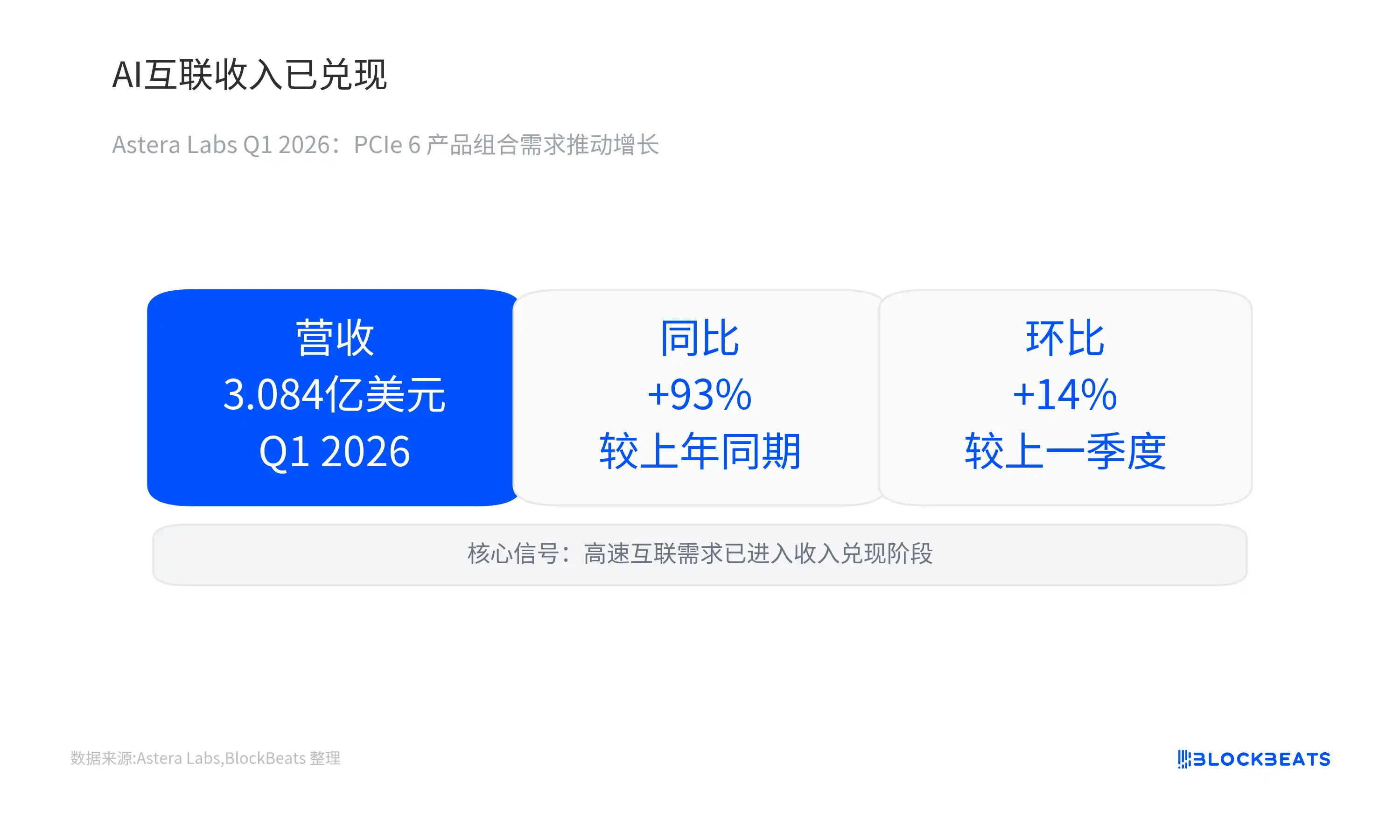
Astera Labs' earnings report provided the market with a more concrete anchor. The company's Q1 2026 revenue was $308.4 million, up 93% year-over-year and 14% quarter-over-quarter. The company stated that growth was driven by demand for its PCIe 6 product portfolio and AI interconnect-related products. Such data makes it easier for investors to believe that the AI hardware chain is not just about long-term narratives but is already translating into orders and revenue from data center construction.
This is also the difference between this round of trading and purely forward-looking tech stories. Public market performance can support chips and tech-related directions leading the gains, but 'which segments funds prioritize buying' remains a market generalization that requires a nuanced understanding. At least from the market action, the recovery in risk appetite has not turned into indiscriminate chasing of all high-valuation assets. Funds seem more inclined to first buy segments that can be verified by earnings reports and capital expenditure.

The Intel Trade Mixes Policy and Fundamental Imagination

Intel's surge is the most prone to misinterpretation.

According to Reuters, Trump stated that Apple would collaborate with Intel to design and manufacture chips in the U.S. This statement directly placed Intel into the narrative of domestic chip manufacturing. For the market, it is not an ordinary customer partnership news but a convergence point of supply chain security, manufacturing reshoring, and U.S. chip policy.

However, this does not mean Intel's fundamentals have already been turned around by the Apple partnership. A more prudent understanding currently is that Trump's remarks provided a policy catalyst which, combined with the recovery in semiconductor risk appetite, amplified the elasticity of Intel as a domestic manufacturing target. How much revenue this collaboration can bring, whether it enters advanced node mass production, the timeline, and gross margin improvements all require clearer information from Apple, Intel, or subsequent financial reports.

This precisely illustrates the divergence in this round of AI hardware revaluation. Policy catalysts can boost attention, orders and revenue can support valuation, and capital expenditure can verify cycle strength. When all three appear simultaneously, stock price elasticity is greatest. However, if there is only policy rhetoric without contract scale and financial contribution, the trade is more easily re-priced as short-term sentiment.

Intel, optical interconnects, and memory correspond to three verification paths respectively. Intel needs to see if policy and customer cooperation can translate into genuine foundry revenue. Optical interconnects depend on whether the scaling of AI clusters continues to push bandwidth demand higher. Memory and storage rely on whether AI server orders continue to drive prices and shipments.
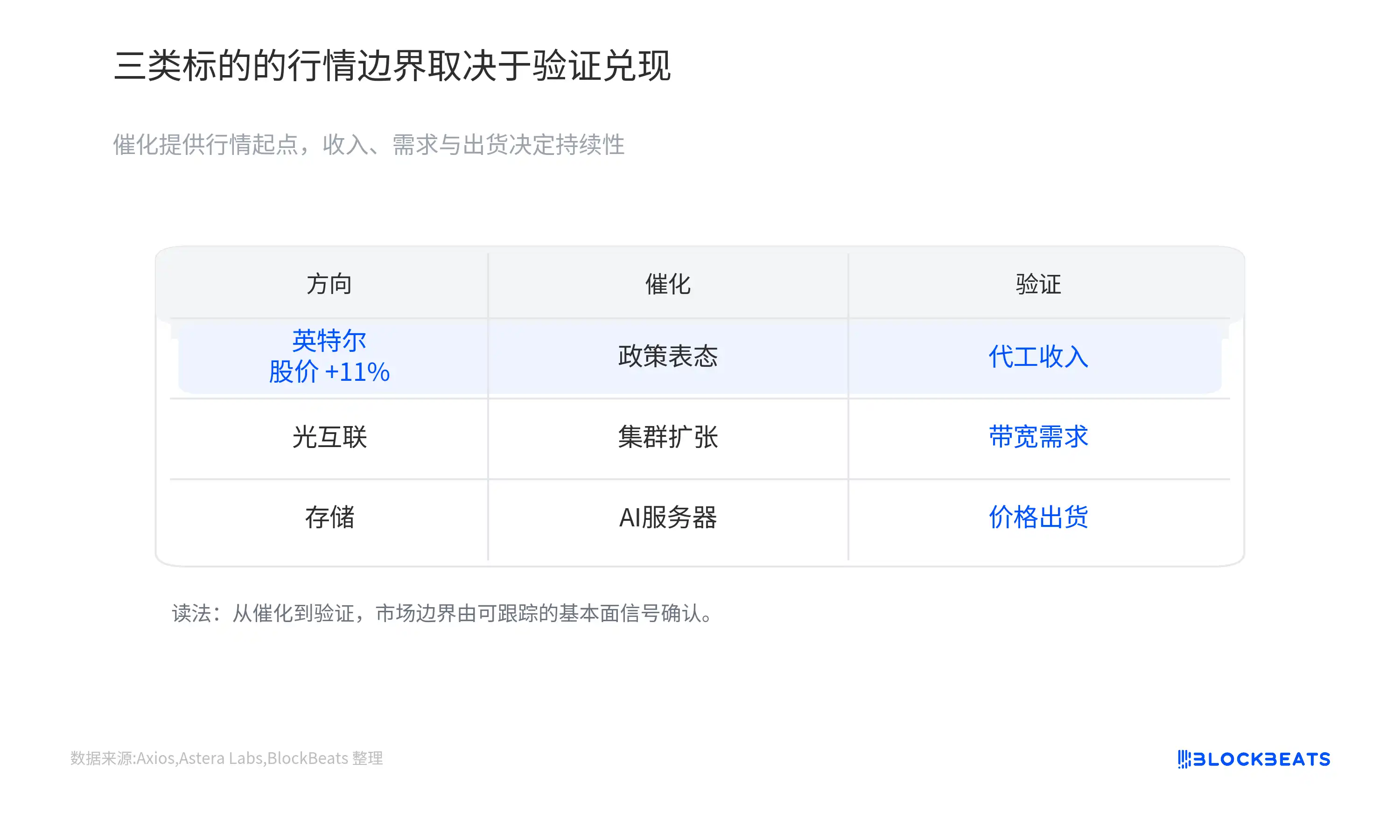
If Q2 earnings reports continue to show robust cloud provider capital expenditure, AI server orders remain high, and revenue guidance from optical interconnect and memory companies continues to grow, this rally will more closely resemble a continuation of the AI infrastructure cycle. If data falls short of expectations, the market may redefine it as a valuation repair following the easing of geopolitical risks.

Orders and Negotiation Progress Determine the Rally's Limits

The biggest misjudgment to avoid now is prematurely writing a short-term window as confirmation of a long-term trend.

The U.S.-Iran framework is still in the preliminary arrangement stage. According to Axios, both sides agreed to a 60-day ceasefire extension framework and may reopen the Strait of Hormuz. The market can trade on risk easing, but this does not mean the Hormuz risk has disappeared. Whether the ceasefire can be sustained, whether passage arrangements are stable, and whether sanctions and nuclear issues disrupt negotiations again will all impact oil prices and risk appetite.

The verification for the AI hardware chain is also straightforward. In the upcoming Q2 earnings reports, investors need to see whether large cloud providers continue to revise capital expenditure upwards, whether AI server order intensity is maintained, and whether revenue guidance from optical interconnect and memory companies continues to show growth. Once capital expenditure begins to be questioned, the elasticity of high-valuation hardware chains will conversely become a source of volatility.

Intel has an additional layer of verification. Trump's remarks are sufficient to trigger trading, but what truly affects valuation is contract scale, product categories, mass production timelines, and profit margins, not the 'Made in America' narrative itself. Policy can provide a pricing window but cannot substitute for financial realization.

This rally is better understood as a selective recovery in risk appetite: the easing of macro risks opened a window, and funds prioritized buying back the AI hardware chain. It weakens the extreme judgment that 'AI trading is over,' but it is not yet sufficient to prove that the AI infrastructure cycle is re-accelerating. The answer is not in a single day's gains but in whether capital expenditure, orders, and profit margins can continue to keep up.

Perguntas relacionadas

QAccording to the article, what is the core issue behind the rise of semiconductor and AI hardware stocks on June 18th?

AThe core issue is not whether tech stocks rebounded, but the nature of the rebound. The key question is whether the market is buying back into actual AI infrastructure orders or is merely performing a selective valuation repair based on cooling geopolitical risks.

QWhy does a de-escalation of tensions in the Middle East, specifically regarding the Strait of Hormuz, benefit high-valuation growth stocks like semiconductors?

AThe Strait of Hormuz is a critical choke point for global oil transport. Reduced risk there lowers oil prices and inflation expectations, which in turn reduces the discounting pressure on high-valuation growth stocks whose valuations rely heavily on future cash flows. This provides an external condition for a rebound in growth assets.

QWhat specific shift in AI investment focus does the article highlight as occurring in the market?

AThe focus has shifted from the early stage of 'bigger models and more GPUs are better' to a more selective phase. Investors are now asking who can actually generate real revenue from data center construction for AI, leading to increased attention on specific hardware chains like chip manufacturing, optical interconnects, memory, storage, and equipment.

QWhat are the three verification paths mentioned for the re-rating of AI hardware stocks, as illustrated by Intel, optical interconnects, and memory/storage?

A1. Intel: Verification depends on whether policy catalysts and customer cooperation translate into real foundry revenue. 2. Optical Interconnects: Verification depends on whether the scaling of AI clusters continues to drive higher bandwidth demand. 3. Memory/Storage: Verification depends on whether AI server orders continue to drive prices and shipments.

QWhat key information does the article suggest investors should look for in upcoming Q2 earnings to determine if the recent rally is sustainable?

AInvestors should look for whether large cloud providers continue to raise their capital expenditure guidance, whether AI server order strength is maintained, and whether revenue guidance from optical interconnect and memory companies continues to show growth. Capital expenditure trends, orders, and profit margins are crucial for sustainability.

Leituras Relacionadas

Behind the AI Report Card, Lies a Chinese 'Exam Setter'

Beyond the familiar performance charts like MMLU-Pro and MMMU, which major AI models strive to ace, stands a key "examiner": Chinese-Canadian researcher Wenhu Chen. An assistant professor at the University of Waterloo and founder of TIGERLab, Chen addresses the crucial need for more rigorous AI evaluation. As models like GPT-4 began scoring near-perfect results on older benchmarks like MMLU, it became difficult to distinguish their true capabilities. In response, Chen introduced MMLU-Pro in 2024, featuring harder, more reasoning-focused questions with more answer choices, successfully reintroducing meaningful performance gaps. His work extends to multi-modal evaluation with MMMU and its enhanced version, MMMU-Pro. These benchmarks test a model's ability to understand and reason with complex information from images, charts, and text across diverse academic subjects, exposing the significant challenges even top models face in genuine comprehension. Chen's background in complex QA, table reasoning, and his experience at Google DeepMind on projects like Gemini inform his approach. He understands that effective benchmarks must anticipate how models might "cheat" by memorizing data or avoiding visual analysis. His lab also actively researches video understanding and generation models (e.g., UniVideo, Vamba), ensuring his evaluation work is grounded in practical model-building challenges. Now at Meta's Super Intelligence Lab, Chen continues his focus on multi-modal data and evaluation, representing the deep yet often unseen contributions of Chinese talent in shaping the fundamental tools of the AI industry.

marsbitHá 12m

Behind the AI Report Card, Lies a Chinese 'Exam Setter'

marsbitHá 12m

Alliance Co-founder's Letter to Entrepreneurs: Written at the Moment Cursor Sold for $600 Billion

Alliance Co-founder's Letter to Entrepreneurs: On Cursor's $60 Billion Sale Many aspiring founders see massive exits like Cursor's $60B sale and wonder why they can't achieve the same, often concluding opportunities are exhausted. But great companies aren't built in obvious, crowded spaces. Cursor, like Stripe, Figma, and Shopify before it, started with a non-consensus belief about the future. Before ChatGPT, they believed AI would transform knowledge work. They focused on a genuinely exciting domain, became their own customer, and obsessed over power users. Their journey involved years of "glass-chewing" effort before the market was ready. The pattern is consistent: identify a long-term technological shift, find a missed entry point, and execute for years before the trend becomes obvious. First-generation products (PayPal, Adobe, Amazon) prove a market exists. Second-generation winners (Stripe, Figma, Shopify) rebuild that market around new insights, technology, or changing customer behaviors. Founders must identify their phase in the cycle. Early entrants like Coinbase or Cursor focus on making new technology usable for power users. Later entrants find the "yin" to the established "yang"—the blind spots incumbents miss as they grow distant from individual users. The key is deep market immersion. Use every product in your space. Talk to users. Build an audience. Stop looking for ideas and start *seeing* them everywhere. Then, choose one. The idea must offer a 10x improvement or solve a "hair-on-fire" pain point—something severe enough that users are already crafting workarounds. When building, avoid feature bloat. Ask: why would someone switch? Great startups rarely force new behaviors; they improve familiar workflows with drastically lower friction (e.g., Cursor forked VS Code instead of creating a new editor). Distribution is the underestimated moat. Before product-market fit, achieve distribution-market fit. How do customers discover new tools? Founders like those at Airbnb, Stripe, and Cursor did unscalable, manual work to recruit early users. The final, unteachable ingredient is resilience. Cursor built for years pre-market, faced rejection, and persisted. So did Airbnb, Nvidia, and Rain (which launched post-FTX collapse). The lesson isn't that these founders were smarter, but that they stayed in the game long enough for their insights to compound. Framework: Spot technological cycles. Cultivate unique insight. Obsess over your market. Talk to customers. Find a hair-on-fire problem. Build the simplest wedge. Win your distribution channel. Above all, don't quit when it gets hard. Most people won't do these things consistently. The few who do build the next generation of great companies. Go build.

marsbitHá 15m

Alliance Co-founder's Letter to Entrepreneurs: Written at the Moment Cursor Sold for $600 Billion

marsbitHá 15m

Weekly Editor's Picks (0613-0619)

Weekly Editor's Picks (0613-0619): Market Insights & Analysis This weekly digest curates in-depth analysis often lost in the information flow, focusing on key insights across macro trends, investment, and technology. **Macro & Geopolitics:** With the Strait of Hormuz reopening and military conflict shifting to negotiation, markets are pivoting from "war shock" to "supply restoration." Trades include shorting crude risk premiums, longing airlines/tourism, Asian energy importers, and bond duration, while shorting inflation expectations. LNG, fertilizer, and chemical chains are also being repriced. **Investment & VC:** Ray Dalio advises against betting on concentrated AI giants dominating indices, advocating for diversified portfolios of high-quality, low-correlation assets instead. Analysis covers the 4-year crypto cycle, predicting the core surviving product by 2029 will be asset trading markets. Current BTC metrics suggest a potential bottoming zone, presenting a patient accumulation window. SpaceX's high-profile IPO at a $2.1T valuation faces scrutiny over fundamentals, with key watchpoints being its likely inclusion in the Nasdaq index and Q2 earnings. Concerns are raised about potential "gamma squeeze" and systemic risks if its narrative-driven valuation gets amplified by passive index funds. Robinhood (HOOD) is noted for breaking its high correlation with crypto, bolstered by its stock trading and new underwriting business. **Web3 & AI:** A warning highlights ~$1.8T in off-balance-sheet AI infrastructure commitments (purchase commitments, leases) as a potential systemic risk if AI monetization lags. AI models are being used for World Cup predictions, adding a new layer for betting markets. A cost breakdown of a $20 AI subscription reveals the supply chain from model companies to cloud, GPUs, and power. **Prediction Markets:** The emergence of prediction market "concept stocks" is noted, with Robinhood developing its own platform, Rothera, signaling a shift from market competition to a "channel war" for user access. **CeFi & DeFi:** The SpaceX IPO tested perpetual contract mechanisms for pre-IPO assets, highlighting challenges in handling corporate actions like stock splits on-chain. The de-pegging of STRC (Strategy's preferred share) to ~$89 reflects market concerns over MicroStrategy's capital structure and BTC-backed leverage model. BlackRock's covered-call Bitcoin ETF (BITA) offers yield but caps upside, appealing to yield-seeking institutions. **Ethereum:** An opinion piece argues Ethereum's core strength is its vast developer community and composability, solidifying its role as the default operating system for the financial internet. **Weekly Hot Topics:** Include the US-Iran deal reopening the Strait of Hormuz, Fed's hawkish hold, Anthropic restricting model access, SpaceX acquiring Cursor, and a humorous stock surge for "Liuliumei" due to its "LLM" ticker.

marsbitHá 20m

Weekly Editor's Picks (0613-0619)

marsbitHá 20m

Alliance's Co-Founder's Letter to Entrepreneurs: Written on the Occasion of Cursor's $60 Billion Sale

In this letter to entrepreneurs, Alliance reflects on the success of Cursor's $60 billion sale to Elon Musk, using it as a case study to counter the misconception that opportunities in crowded fields like AI or crypto are exhausted. The piece argues that great companies like Cursor, Stripe, Figma, and Shopify are not built by geniuses with perfect ideas, but by founders who start with a non-consensus belief about the future and build for years before that future becomes obvious to everyone. They identify long-term shifts, find overlooked entry points, and execute relentlessly. The framework for success involves: 1. **Identifying your place in the technology cycle**: Early-stage opportunities focus on making new tech usable for power users (e.g., Coinbase, Cursor). Later-stage opportunities involve finding the "yin" to an existing "yang"—the blind spots of first-generation players (e.g., Stripe vs. PayPal, Figma vs. Adobe). 2. **Cultivating unique insights**: Immerse yourself deeply in the market. Use every product, talk to users, and build an audience. Insights will emerge naturally from deep engagement. 3. **Finding a "hair-on-fire" problem**: Look for a 10x improvement or a severe, urgent pain point. The strongest signal is people already building clumsy workarounds. 4. **Building a focused MVP**: Don't just add features because you can. Ask why users would abandon their current tool for yours. The best startups rarely force new behaviors; they improve familiar workflows with drastically lower friction. 5. **Winning a distribution channel**: Distribution is often the moat. Before product-market fit, achieve channel-market fit. Find where your customers are and build an engine to reach them, even through unscalable, manual efforts initially. 6. **Persistence**: The final, unteachable ingredient is resilience. Success stories like Cursor, Airbnb, and Nvidia involved years of grinding, rejection, and perseverance when the path forward seemed unclear. The conclusion is that there is no secret. Most people fail to consistently execute these steps over the long term. The few who do build the companies that define the next era. The world is yours to create.

链捕手Há 25m

Alliance's Co-Founder's Letter to Entrepreneurs: Written on the Occasion of Cursor's $60 Billion Sale

链捕手Há 25m

Crypto Miners' Big AI Gamble: Valuations Enter Differentiation Stage, Comeback Fight Proves Tough

Crypto Mining Firms' AI Bet: Valuation Divergence and a Challenging Transformation Facing declining profitability in crypto mining, mining companies are pivoting to AI infrastructure, capitalizing on their existing power resources, land, and data center expertise to offer GPU compute power. This transition narrative has boosted their stock prices significantly, with firms like Hut 8 and Bitfarms seeing gains over 100% year-to-date, far outpacing Bitcoin. This has led to a market valuation split, with pioneers like CoreWeave reaching a $62.8B market cap, while others remain below $5B. The market currently prioritizes growth potential over short-term profits, which remain under pressure due to heavy capital expenditures for AI build-outs and crypto asset volatility. However, the transformation is a high-stakes gamble. Bitcoin mining profitability is shrinking, with the average production cost around $63,707 and miner margins contracting. While AI offers a more lucrative long-term path, it requires massive investment—estimated at a $500B near-term funding gap. Success now hinges on execution: delivering on contracted power capacity, securing quality tenants like major cloud providers, and managing the immense financial burden. The valuation focus is shifting from mere power capacity to project delivery, future cash flows, and tenant quality, making this a difficult but critical turnaround attempt.

链捕手Há 34m

Crypto Miners' Big AI Gamble: Valuations Enter Differentiation Stage, Comeback Fight Proves Tough

链捕手Há 34m

Trading

Spot
Futuros
活动图片