Analysis of the Latest Portfolio Adjustment by the "Top Player" in the U.S. Stock Market: $9 Billion Short on NVIDIA, Shifting Focus to Power and Memory Sectors

marsbitPublicado em 2026-06-20Última atualização em 2026-06-20

Resumo

AI investor Leopold Aschenbrenner has made a significant portfolio shift, taking a $9 billion nominal short position against top AI infrastructure stocks like NVIDIA, ASML, and Oracle. Simultaneously, he is redirecting capital towards what he sees as the next critical bottlenecks in the AI boom: power, memory, and data center networking, alongside private investments in AI model companies like Anthropic. This move is interpreted not as a call that the AI bubble has burst, but as a rotation within the infrastructure stack. The analysis highlights NVIDIA's recent $25 billion bond issuance as a potential signal, questioning why a cash-rich company would seek external debt despite high profits and increased dividends/buybacks. The core investment thesis is that the initial, crowded "picks and shovels" trade in semiconductors is maturing. The next wave of capital is expected to flow into the physical and logistical constraints of AI expansion: electricity supply, memory chip capacity, data center construction, and enabling technologies like optical networking (fiber) for high-bandwidth communication, where copper remains crucial for short distances. Aschenbrenner's substantial (approx. 20% of fund) private stake in Anthropic is noted as a key part of his strategy—investing directly in the "mine" (AI models) rather than just the "shovels." The discussion concludes that while certain segments may be overvalued, the overarching AI infrastructure demand driven by real product usage...

Leopold Aschenbrenner, regarded as one of the world's most aggressive AI investors, has established nominal short positions of approximately $9 billion in public markets against NVIDIA, ASML, and Oracle, while reallocating capital towards deeper layers of AI infrastructure and model assets such as power, memory, data center networks, and companies like Anthropic.

The two hosts believe this does not signal the bursting of the AI bubble, but rather indicates a rotation within infrastructure trades from a "chip-first" approach to one prioritizing "energy, networks, and data center construction." Especially following NVIDIA's recent $25 billion bond financing and the soaring valuation of Anthropic, the market implications of this judgment are rapidly amplifying.

Key Takeaways

Leopold's Core Trading Logic

· "The classic 'selling picks and shovels' trade in AI has become too crowded, and Leopold's recent portfolio changes convey precisely this signal."

· "His judgment is not that AI infrastructure has peaked, but that certain tiers within the infrastructure stack, particularly semiconductors and traditional popular stocks, have become excessively crowded."

· "If the question becomes where the money will flow next, there are two answers. The first and most direct is flow into the next genuine infrastructure bottlenecks, namely power, memory, and data center network segments. The second answer is that mysterious investment exposed just a few weeks ago."

· "His bets have always been very infrastructure-oriented, investing in both these optical companies and power-related companies."

· "If he is cautious on NVIDIA, then capital will move to areas like power and memory; at the same time, he also wants to invest directly in the 'mine' itself, rather than continuing to only buy the 'shovels.' Anthropic is his favorite 'mine.'"

The Signal from NVIDIA's Financing

· "The issue isn't whether NVIDIA will continue to make money, but why a company with extremely high profit margins and already large cash reserves would borrow an additional $25 billion externally."

· "If a company simultaneously engages in massive stock buybacks and significantly increases dividends while also borrowing money in the same month, it's clearly not borrowing due to a cash shortage. A more reasonable explanation is that this is cheap capital, and the financing methods within this AI cycle are undergoing a slight shift."

The Next Wave of AI Infrastructure Benefits

· "The real bottlenecks are no longer just GPUs, but power, memory, data center networks, and the actual capability to build these things."

· "Even if you raise endless amounts of money, you cannot build data centers fast enough, expand memory chip capacity sufficiently, or immediately expand the power grid, transmission lines, and related infrastructure. There aren't enough people on the ground, and permitting, regulation, and various procedures are also hindering progress."

· "Whoever can build the data centers will take the profits."

Optical Modules, Copper, and Fiber Optics

· "As GPU clusters grow larger, copper wires will get hotter, energy losses will increase, and efficiency will suffer. In this scenario, fiber optics become the next upgrade direction."

· "For many high-bandwidth, short-distance transmission scenarios, copper is almost the only material everyone truly wants to use. Only when it becomes unsuitable, such as over long distances or with excessive heat, do they switch to fiber optics. Therefore, the combined market demand for copper and fiber optics is currently very strong."

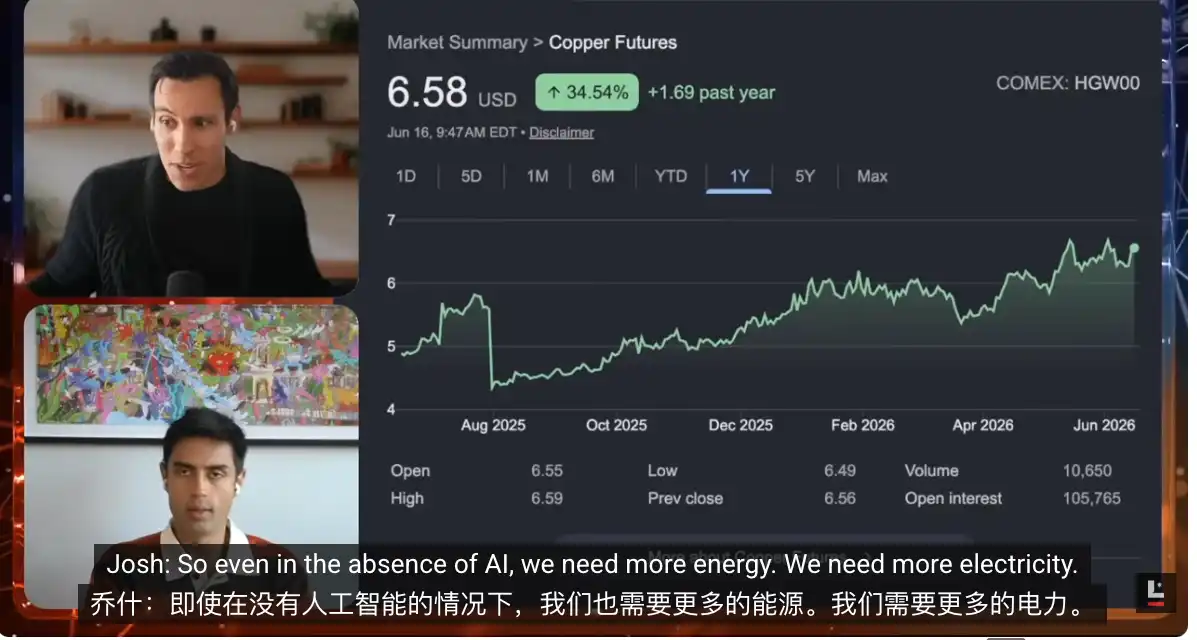
· "The recent strength in copper futures is essentially because everyone needs it; it's the most critical foundational material for short-distance, high-bandwidth transmission, and fiber optics is the next step."

· "Copper remains the most critical material for short-distance, high-bandwidth transmission, but once distances increase or heat becomes too high, a switch to fiber optics is necessary."

· "The next wave of capital will land on infrastructure companies that don't sound particularly sexy."

Why Energy is the Safest Bet

· "I've always been bullish on energy because, even if AI demand slows, energy itself remains a global necessity, and this demand will only increase."

· "The single trend that continues to rise regardless of the scenario is our demand for energy, electricity, and power. These companies are the ones I am most willing to be long-term long on."

· "The companies I most want to follow are those Jensen is investing in that also intersect with Leopold's logic. So, the company I'm currently closest to tailing is Marvell."

· "The best long-term positions are not necessarily the hottest chip companies, but the power infrastructure companies that are indispensable in any macroeconomic scenario."

Leopold's AI Investment Portfolio

Josh Kale:Leopold Aschenbrenner, this 24-year-old focused on AI investing, is now almost regarded by the market as the world's strongest AI investor. External rumors suggest the nominal size of his fund's positions now exceeds $20 billion. When we looked at Ejaaz's post a month ago, the fund size was only $13.7 billion, essentially doubling every quarter.

This time, we've obtained several significant new changes in his recent investment moves. Last episode, we discussed his portfolio, and the most surprising point then was that he was actually shorting a company almost everyone knows—NVIDIA, the world's highest market cap and hottest AI stock. Many couldn't understand why he placed over $9 billion in short exposure against such a company.

Now we have a new clue that might explain this. NVIDIA is actually raising capital, and through debt issuance. On the surface, this seems illogical. Why would a company of NVIDIA's immense size and extremely high profit margins take on an additional $25 billion in cash from a recently completed financing? Today, we want to combine this with Leopold's portfolio to discuss why he has made so much money, what he's looking at next, and what NVIDIA's financing truly means.

Ejaaz Ahamadeen: First, some background. Leopold Aschenbrenner was a former OpenAI researcher who raised a fund about a year and a half to two years ago. The initial size wasn't large, I recall around $200 million. But judging from his latest 13F filing, the fund's public holdings are now worth $13.7 billion.

So naturally, the market wants to know which positions he's taken, what his core investment logic is, and where his next big trade will land.

To understand this, you must first know that until about a month ago, Leopold was very optimistic about the entire AI sector, particularly bullish on the "selling picks and shovels" logic, i.e., GPU and upstream hardware suppliers like NVIDIA.

But about a month ago, the market discovered he wasn't as bullish on the semiconductor line. He remains bullish on the real bottleneck areas like memory and power, and likely also on new types of cloud providers, but he is notably not bullish on the world's most valuable company, NVIDIA. More specifically, he has placed a total of roughly $9 billion in bearish exposure against several companies seen as core AI infrastructure beneficiaries, including NVIDIA, ASML, and Oracle.

The Logic Behind Shorting NVIDIA

Ejaaz Ahamadeen: When this emerged, many started worrying, thinking the AI bubble might be about to burst. On the surface, NVIDIA's GPUs are still selling massively, and demand hasn't noticeably weakened. So where's the problem?

Later, we dug up several new clues, the most important being that NVIDIA just raised $25 billion externally through bond financing. This means it's not simply using its own cash but adding external leverage. So the question arises: Why would the world's most profitable, highest-margin, strongest-cash-flow company go out and borrow $25 billion?
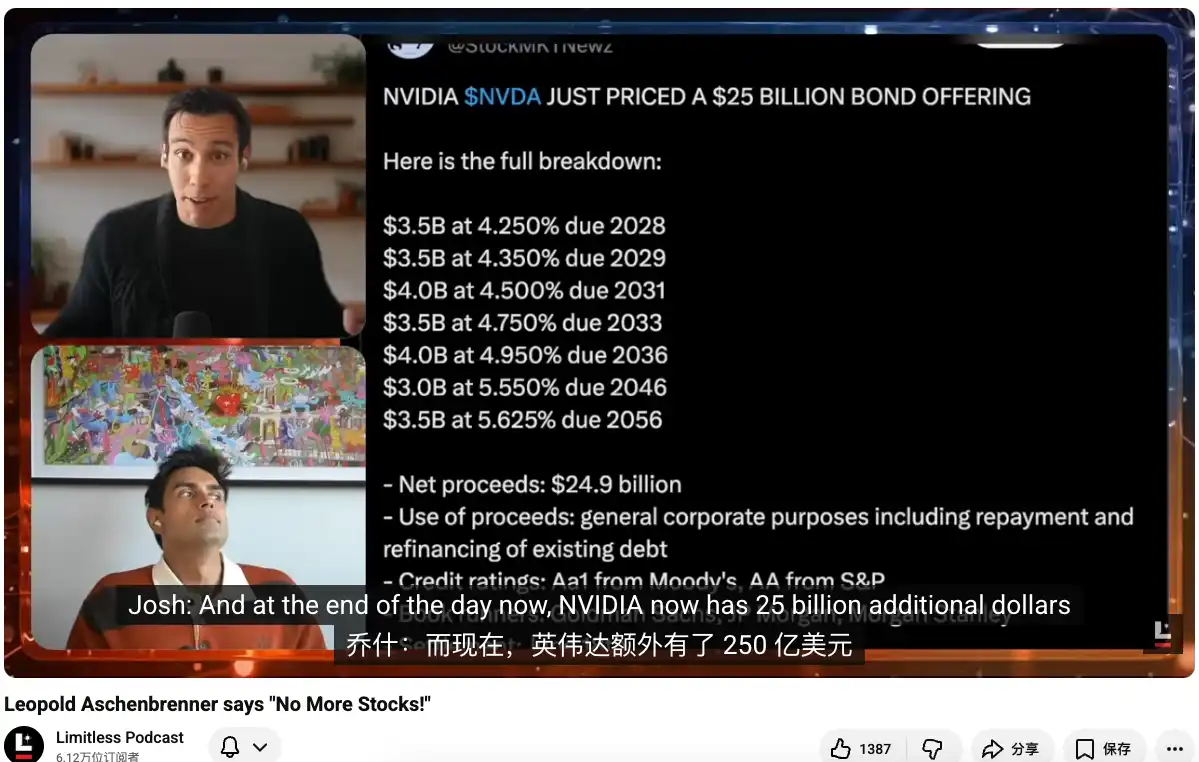
Josh Kale: Furthermore, they initially intended to raise only $20 billion but ended up expanding to $25 billion, with subscriptions exceeding three times the amount. Last episode, when discussing this portfolio, we said not to worry about a bubble just yet because although these companies have massive capital expenditures, their revenues are high enough to theoretically support expansion with their own balance sheets.

But this is NVIDIA's first significant move to finance off its balance sheet since 2021, rather than directly using its cash. I recall it currently has around $12 billion in cash on hand. Putting all this together creates a strange tension: on one side, Leopold is shorting; on the other, NVIDIA, seemingly with infinite cash and profits, is issuing debt. So what's happening?

Breaking Down NVIDIA's Bond Financing

Josh Kale: Ejaaz, can you break down this transaction itself for us? Because this isn't ordinary financing; it's a bond issuance. Ultimately, NVIDIA's balance sheet now has an additional $25 billion, and the interest rates likely appear very low.

Ejaaz Ahamadeen: I'll present both explanations. NVIDIA originally had about $13.7 billion in cash, meaning it could have just spent its own money. So why raise external capital? The simplest analogy is buying a house. Many people choose a mortgage even if they have the full amount because their own capital can be used elsewhere, and if the borrowing cost is low enough, it's actually more economical.

The interest rate environment hasn't been friendly in recent years, but if you're NVIDIA, one of the world's most valuable and sought-after companies, you can borrow on very favorable terms. This $25 billion bond issuance has maturities ranging from 2 to 30 years and can almost be considered very cheap money, with interest rates approaching US Treasury yields.

Moreover, the offering was roughly oversubscribed by 4 times. In other words, there was $85 billion in market demand chasing the $25 billion offering; NVIDIA could practically pick its investors. If you only look at the official statement, NVIDIA's explanation is that this is primarily for financial arrangements, to repay and refinance some existing debt. Google did something very similar a few weeks ago and also in February this year. So you can certainly accept this explanation, viewing it as financial optimization.

But the other side is hard to ignore: Over the past month and a half, NVIDIA, Amazon, Google, and several other hyperscale cloud providers have almost all been increasing external financing. Some via debt, some via equity sales. Leopold's view might not be entirely without merit—could this be a sign of the bubble starting to loosen, the house of cards beginning to wobble? However, if you look solely at the financial structure, it doesn't yet clearly point to danger.

Josh Kale: I see it similarly. $9 billion short on NVIDIA is a truly massive position. But during our research, we saw something else: on May 18th, NVIDIA's board authorized an additional $80 billion for share buybacks and increased the dividend from $0.01 per share to $0.25, a 25-fold increase.

If a company simultaneously engages in massive stock buybacks, significantly increases dividends, and also borrows money in the same month, it's clearly not borrowing due to a cash shortage. A more reasonable explanation is that this is cheap capital, and the financing methods within this AI cycle are undergoing a slight shift. Everyone wants to participate in these capital moves, and NVIDIA realizes borrowing via debt is even cheaper than other financing methods, so it just goes ahead. For now, at least, NVIDIA itself is still doing very well.

Why He Adjusted the Portfolio

Josh Kale: This brings us to another question. What exactly is Leopold thinking? Why has his judgment changed? The stock chart you just showed also indicates NVIDIA's recent performance hasn't been particularly strong, but it's not terrible either. It's still the world's largest company by market cap, nearing $5 trillion, down only about 7% in a month—nothing significant amidst the surge of other AI stocks.
Ejaaz Ahamadeen: I don't think NVIDIA will disappear. Its GPUs, including the CPU product line launched a few weeks ago, I believe will perform very well. AI product demand is currently in exponential surplus, and NVIDIA remains the primary core machine supplier capable of meeting this demand.

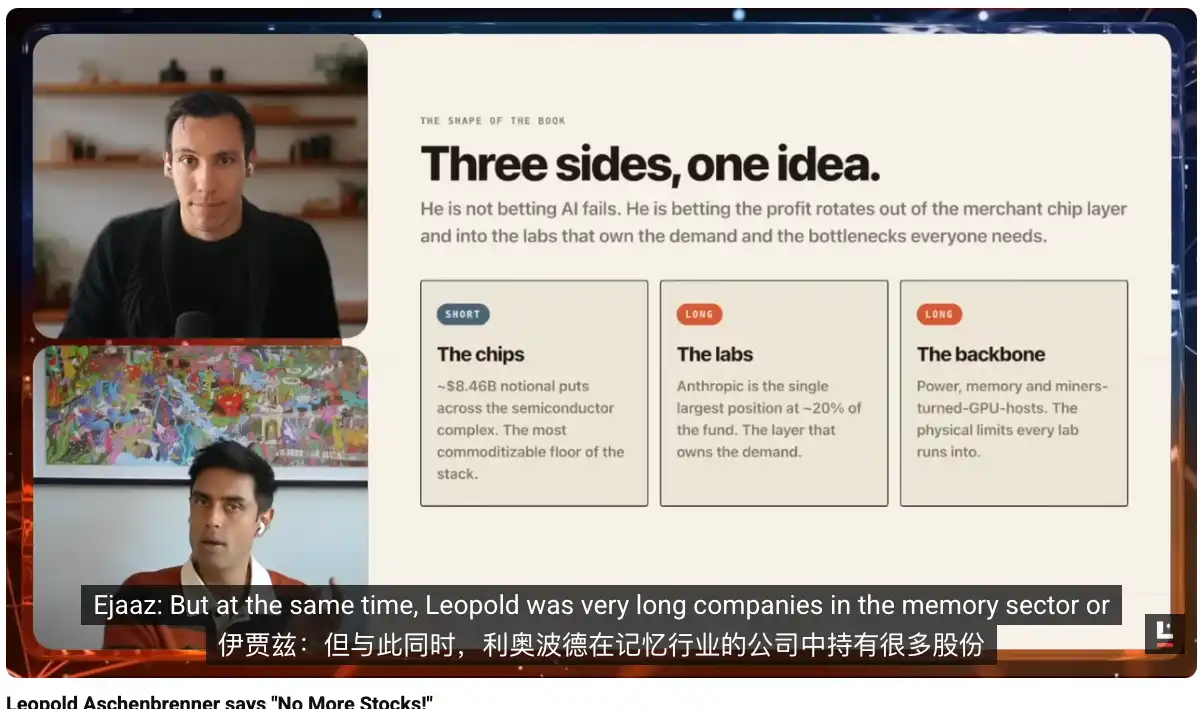
But I do think the classic 'selling picks and shovels' trade in AI has become too crowded, and Leopold's recent portfolio changes convey precisely this signal. Looking at his recent 13F, his bearish exposure is clearly skewed against the semiconductor line, such as NVIDIA, ASML, Oracle, and other infrastructure-level companies.

Yet simultaneously, he is heavily invested in directions like memory, power, and new types of cloud. This indicates his judgment is not that AI infrastructure has peaked, but that certain tiers within the infrastructure stack, particularly semiconductors and traditional popular stocks, have become excessively crowded.

If the question becomes where the money will flow next, there are two answers. The first is the most direct: flow into the next genuine infrastructure bottlenecks, namely power, memory, and data center network segments. The second answer is that mysterious investment exposed just a few weeks ago.

The Unexpectedly Exposed Anthropic Position

Josh Kale: This was the most surprising to me. I only learned about it yesterday from you, and my first reaction was disbelief. Could it be that Leopold's fund, 'Situational Awareness,' has approximately 20% allocated to Anthropic equity? Current external rumors suggest this company constitutes about one-fifth of Leopold's fund. The Wall Street Journal and several other media outlets have reported this, and sources very close to the transaction have confirmed it.

This becomes a completely unexpected card in his portfolio.

Because 13F filings only disclose public market holdings, not private equity, and Anthropic happens to be a large piece of non-public equity. This is also why people have begun to understand why external estimates value his portfolio at $20 billion.
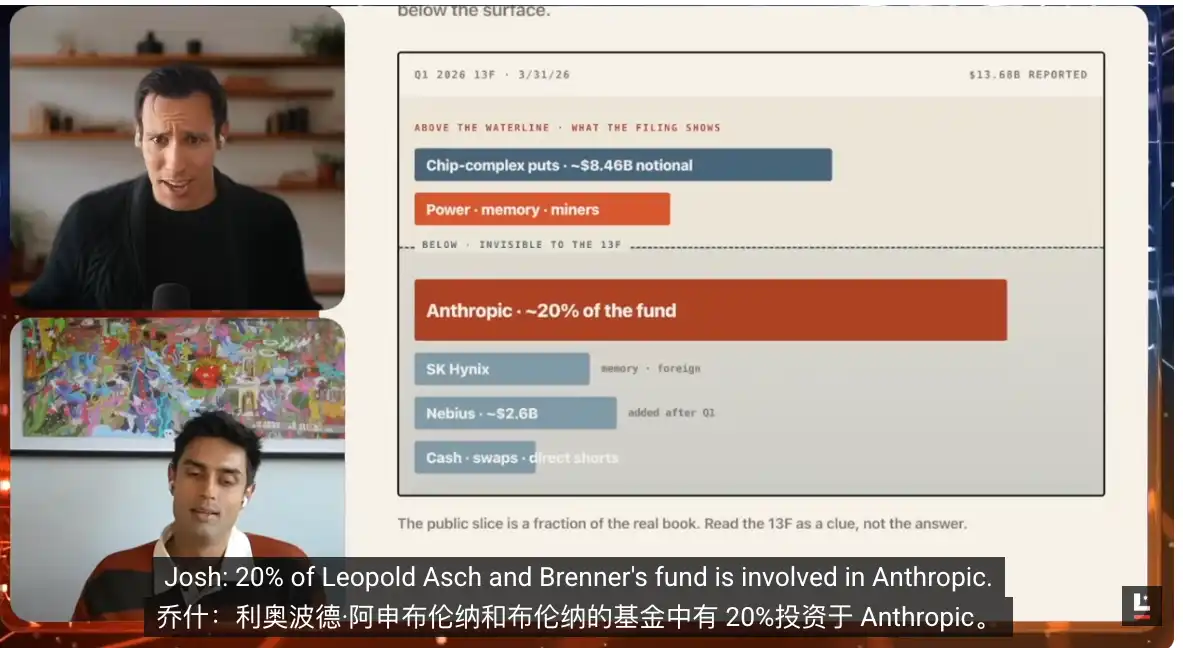
If 20% of the fund is Anthropic, and he invested around early 2025, then the returns on Anthropic over that year have been akin to seven years' worth. This change forces a significant revision in our understanding of his entire investment portfolio.

Ejaaz Ahamadeen: Yes. His first investment in Anthropic via private channels or the fund was around March 2025, when Anthropic's valuation was approximately $60 billion. Now, based on the latest funding round, it's valued at $96.5 billion.

This represents nearly a 15x increase. According to the algorithm presented in our show today, his latest 13F disclosed liquid portfolio value is $13.7 billion. If we add the Anthropic portion reported by The Wall Street Journal, roughly an additional $7 billion, the total fund management size reaches $20 billion.

How exaggerated is this? Bill Ackman, a top investor with three to four decades in the market, runs Pershing Capital at a similar size of around $20 billion. Leopold has been in this game for only a year and a half, he's 24, and has virtually no real investment experience.

Yet he has made some incredibly prescient calls. What's crazy is that he practically wrote all of this out in advance. When he launched the fund a year and a half ago, he published a 65-page AI essay titled 'Situational Awareness,' almost completely laying out the entire logic, including how capital would rotate from semiconductors and certain infrastructure segments to other bottleneck constraints. The market is now developing along these lines, which is truly astonishing.

The Next Wave of Infrastructure Trends

Ejaaz Ahamadeen: So this also tells me where the next money will flow. If he is cautious on NVIDIA, then capital will move to areas like power and memory; at the same time, he also wants to invest directly in the 'mine' itself, rather than continuing to only buy the 'shovels.' Anthropic is his favorite 'mine.'

Josh Kale: This indeed looks like a new trend, and again, he is earlier than most. For the past 12 months, everyone has been searching for AI's bottlenecks—rare metals, memory, RAM, etc.—and the market chased each wave. Those judgments weren't wrong because that wave of gains did happen.

But now, the valuations of directions seen as bottlenecks are gradually becoming rationalized. People already understand these companies' business models, market potential, and future revenues better, so much of the value is already priced in. In the next round, we care more about where the subsequent money will continue to flow.

The direction you mentioned—land, power, enclosures, physical infrastructure—seems correct. Because if we think about what's truly most important for AI, the answer increasingly seems to be physical construction capability. Look at xAI, or more accurately, look at SpaceX, which is now public. Its revenue core isn't rockets themselves but AI infrastructure construction.
Consider its recent deals with Anthropic and Google, which have created value exceeding the combined sum of Starlink, Starship, and the entire satellite business. There is clearly immense demand and value here. So the question becomes, who can actually build these things?

SpaceX is clearly one answer. Last night after hours, its stock was around $230, implying a valuation of about $3.1 trillion. We'll dedicate an episode to SpaceX this week because its recent run is simply too extreme. It just completed the acquisition of Cursor, its valuation has reached $3 trillion, and Elon Musk made more money in one day than Warren Buffett earned in his entire career.

Who Will Capture the Next Round of Profits

Josh Kale: We care about which companies are best at this hardware infrastructure, at developing those 'machines that build machines.' Combining Leopold's direction and the broader trend, we think the next wave of capital will move here. So Ejaaz, in reality, which companies will this rotation land on?

Ejaaz Ahamadeen: Many will be those unsexy-sounding infrastructure companies. A name frequently mentioned recently is Marvell. A few weeks ago at Computex in Taiwan, Jensen Huang directly stated on stage that this would be the next trillion-dollar company.

And just three months before he made that statement, NVIDIA had invested $1.5 billion in Marvell. I'm starting to wonder if this counts as insider trading or market manipulation, because after he said that, the stock rose another 70%.

I think it's easy now to directly claim AI infrastructure has peaked. But if you compare it to historical financial crises, like 2008, that flavor of high leverage, financial engineering, and systemic manipulation hasn't fully emerged this time.

There are two key differences. First, the products these companies are making today are genuinely being purchased. There wasn't such solid real demand during the dot-com bubble or the financial crisis. Second, constrained by physical laws, we can't infinitely add leverage now because the entire system is constrained by manpower and construction capability.

Even if you raise endless amounts of money, you cannot build data centers fast enough, expand memory chip capacity sufficiently, or immediately expand the power grid, transmission lines, and related infrastructure. There aren't enough people on the ground, and permitting, regulation, and various procedures are also hindering progress.

So I actually think this gives investors an advantage. Since you already know the hottest chip and 'pick and shovel' trades are too crowded, then the next money will flow into power, data networks (companies like Astera Labs), and other related segments.

What you really need to think about is when these contracts start to materialize, when these fabs are actually built, when SpaceX rockets can launch AI satellites, and even when they can start using solar energy to train AI models.

The timeline determines the betting rhythm. At least that's the framework I'm investing by, though this is not investment advice. I see it this way because over the past year and a half, we've witnessed firsthand how capital flowed from general AI stocks to semiconductors and infrastructure trades.

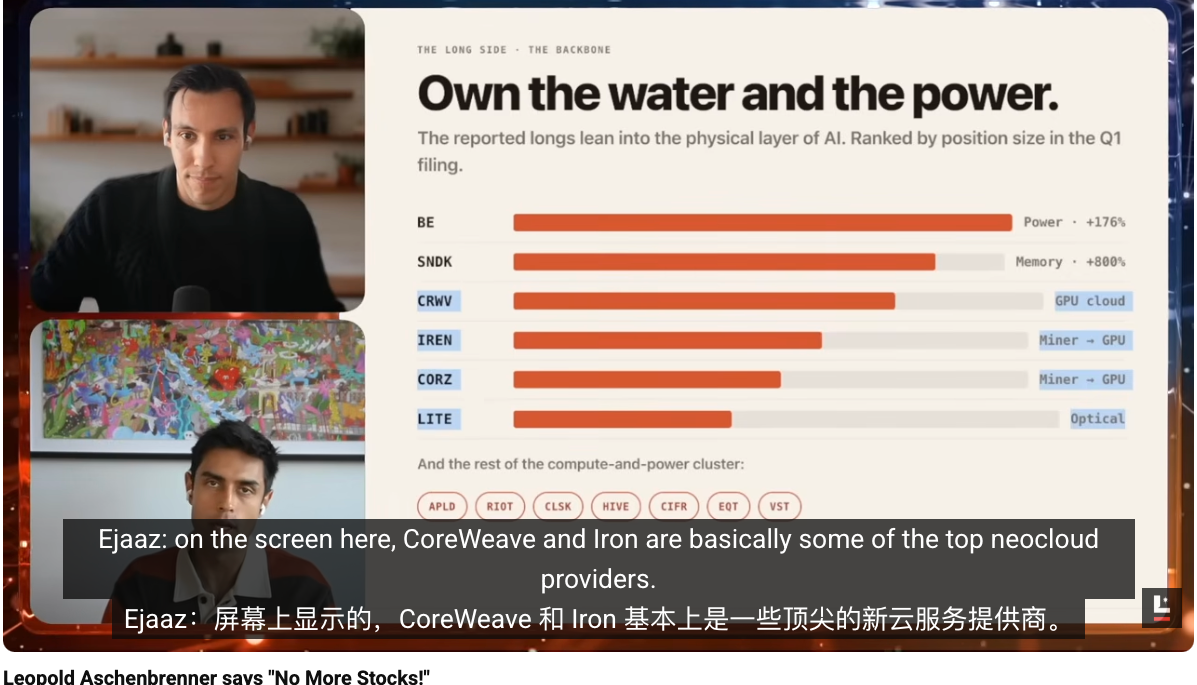
Josh Kale: If you continue looking at this portfolio chart, you'll see this story is clearly written into his holdings structure. By category, what is his largest allocation? Power and energy. Next is memory, followed by cloud and GPU miners—the most tangible infrastructure.

He wants to hold new cloud providers like CoreWeave and also miners who have pivoted to cloud compute. What he wants to own is this physical infrastructure because he believes this is where the real bottlenecks are. As you mentioned, there are many finer details, like the immense difficulty of actual construction, hardware manufacturing, and data center building itself.

If we ask where the biggest bottlenecks are, even permitting might be one. Who is solving these problems? SpaceX wants to move data centers to space, Tesla wants humanoid robots to address labor shortages. But both are far off. In the short to medium term, there exist vast blank opportunities, and this is precisely where Leopold is betting.

The Advantages of Optical Modules and Fiber Optics

Josh Kale: I want to add one detail we didn't expand on earlier. For those wanting to dig deeper and find more alpha, many of his clues lie in optics and deeper layers of the tech stack. Ejaaz, you've been researching this lately. Can you explain his thinking?

Ejaaz Ahamadeen: If you look at the positions on his screen, CoreWeave and Iron are essentially top-tier new cloud service providers. Simply put, they are somewhat like Amazon Web Services, except AWS provides cloud services to internet companies, while these companies provide ready-made GPU infrastructure to AI companies.

They handle setting up GPUs, networks, deployment—all so AI companies don't have to worry about underlying infrastructure and can directly train models and access compute. CoreWeave and Iron have been among his largest concentrated positions since inception and have delivered the highest returns.

Notably, he still holds these two companies among his largest positions today. This also indicates one thing: in his view, this trade is far from over. Furthermore, he has privately invested in Core Scientific, a company that can help unlock CoreWeave's infrastructure supply capacity. In a sense, he's adding another layer of leverage to CoreWeave.

Beyond these, look at companies like Coherent and Lumentum; they are essentially suppliers related to fiber optic and optical connectivity. To explain in the simplest terms, for semiconductors and GPUs to communicate with each other, traditional methods often rely heavily on copper wires.

The issue is, as GPU clusters grow larger, copper wires will get hotter, energy losses will increase, and efficiency will suffer. In this scenario, fiber optics become the next upgrade direction. It enables faster data transfer, is more cost-efficient, and allows companies providing inference and training compute to earn more. So you'll notice his bets have always been very infrastructure-oriented, investing in both these optical companies and power-related companies. It may not sound sexy, but in my view, this is where the money is truly flowing now.

Josh Kale: The copper aspect is also interesting to me because I only recently realized how critical it is for short-distance data transmission. For many high-bandwidth, short-distance transmission scenarios, copper is almost the only material everyone truly wants to use. Only when it becomes unsuitable, such as over long distances or with excessive heat, do they switch to fiber optics. So the combined market demand for copper and fiber optics is currently very strong, which is why observing the copper trade is interesting.

The recent strength in copper futures is essentially because everyone needs it; it's the most critical foundational material for short-distance, high-bandwidth transmission, and fiber optics is the next step.

Thinking at an even more fundamental level, the materials angle has always been interesting. The absolute bottom layer beneath all layers is essentially the raw materials most core to achieving intelligence. Copper is one, lithium is another, and many others. We really should do a dedicated episode on materials. Perhaps Leopold hasn't reached that layer yet, and we might see the next rotation before he does.

Josh Kale: If you keep going down the stack, you could even look directly at copper mines to see how these materials are produced. But returning to the core judgment, I think the next rotation indeed shifts from seemingly smaller bottlenecks to the truly difficult things: hardware and large-scale data center construction.

Whoever can build the data centers will take the profits. We've already seen how much SpaceX is earning due to immense data center demand. Whoever can bring more data centers online faster, provide sufficient power and GPUs, will earn the most. This is essentially what Leopold is betting on now.

Is a Bubble Forming?

Josh Kale: To summarize, we don't believe we are in a bubble-bursting phase yet. Leopold's portfolio seems more like a rotation than a full-scale retreat. So, should we still follow his lead?

Ejaaz Ahamadeen: I admit, when I first saw his 13F, my initial reaction was: this guy is shorting the world's most valuable company with demand booked until 2029? That's outrageous. But now, seeing this financing, I'm starting to think if NVIDIA continues to add external debt in the future, or even potentially sells equity, if this trend persists, then Leopold might be right once again.

If that happens, his fund could ultimately surpass the world's top traders and best investment funds. He has been consistently winning; it's hard not to respect that.

Josh Kale: However, another important point: his life so far has almost always been long-only; he hasn't truly been tested by large-scale selling. We mentioned Bill Ackman earlier—achieving 30x returns and surviving in the market for 30 years are two different things.

If he can maintain this growth trajectory and also learn when to press the sell button, how to manage risk, how to use hedges for protection, that would be even more formidable. We are starting to see the embryonic form of this capability. That $9 billion short isn't achieved by directly shorting $9 billion in cash but through options and leverage, not a one-to-one naked short. Regardless, this is all worth continued observation.

Energy is the Core Bet

Josh Kale: If you had to pick one stock from his entire portfolio that you most want to buy yourself, which would it be?

My own answer is energy stocks. I've always been bullish on energy because, even if AI demand slows, energy itself remains a global necessity, and this demand will only increase.

Even completely ignoring AI, we need more energy, more electricity. Companies like Bloom Energy that can enhance power supply and transmission capacity excite me most because they resemble a hedge-like bet. The single trend that continues to rise regardless of the scenario is our demand for energy, electricity, and power. These companies are the ones I am most willing to be long-term long on.

Ejaaz Ahamadeen: My answer is a bit of a cheat. The companies I most want to follow are those Jensen is investing in that also intersect with Leopold's logic. So the company I'm currently closest to tailing is Marvell. While not a public holding of Leopold's, it aligns very well with his bets on fiber optics and power, and Jensen has already invested $1.5 billion of real money.
I've observed a phenomenon: whenever Jensen invests in a company through NVIDIA, whether it's Intel, CoreWeave, or others, it mostly keeps rising afterward. So my current positioning is roughly here. I also hold some CoreWeave myself because both Jensen and Leopold are extremely bullish on it.

Josh Kale: Marvell is up 270% over the past 6 months. This might genuinely be a good rule of thumb: when influential figures like Jensen, or even someone with enormous sway like Trump, publicly say to buy a certain stock, you probably should take a serious look.

Past instances have repeatedly shown such signals often have substantial realization potential. Whether Intel or Marvell, these cases show that, on one hand, they truly understand what they're talking about, and on the other, they have the ability to influence these companies' outcomes. So this market run is truly insane.

I hope it continues. Based on current evidence, it likely will. At least for now, we remain bullish and optimistic, and will continue making judgments daily based on changes.

Josh Kale: Any final thoughts you want to add regarding Leopold's portfolio update?

Ejaaz Ahamadeen: I'd really like to hear what skeptics think. If after listening to our analysis, you think we're completely wrong or have misinterpreted something, feel free to point it out directly.

Yesterday, I stared at NVIDIA's $25 billion financing news for a long time, intending to find flaws. But if you look purely at financial logic, it does make sense.

Why not borrow this almost risk-free cheap money? Using borrowed money for expansion is clearly more rational than selling your own equity because you retain more future earnings.

Criptomoedas em alta

Perguntas relacionadas

QAccording to the article, what is Leopold Aschenbrenner's core trading logic behind his recent portfolio adjustments?

AHis core logic is a rotation within the AI infrastructure stack. He believes the classic 'pick-and-shovel' trades (like investing in NVIDIA) have become too crowded. Therefore, he is shifting capital towards what he sees as the next true infrastructure bottlenecks: power, memory, and data center networking. He is also moving to invest directly in the 'mines' (AI models like Anthropic) rather than just the 'shovels' (hardware suppliers).

QWhy does the article highlight NVIDIA's recent $25 billion bond offering as a significant signal?

AThe bond offering is significant because NVIDIA, a highly profitable company with substantial cash reserves, is choosing to raise external debt. The hosts interpret this not as a sign of financial need, but as a signal of a subtle shift in financing for the AI boom—accessing cheap capital. This action, coupled with Leopold's massive short position, prompts questions about potential market saturation or a strategic rotation of capital away from the most crowded 'pick-and-shovel' plays.

QWhat are identified as the next major bottlenecks for AI infrastructure, beyond GPUs?

AThe next major bottlenecks identified are power/electricity, memory, data center networking, and the physical ability to build out data center capacity (including land, construction, and regulatory approvals). The article argues that these physical and logistical constraints are becoming more critical than just GPU supply.

QHow does Leopold Aschenbrenner's portfolio reflect his view on the durability of the energy/utilities sector?

AHis portfolio shows a major allocation to energy and power companies. The hosts view this as a highly durable bet because energy demand is a global necessity that will continue to rise regardless of AI market fluctuations. Investing in companies that enhance power generation and transmission is seen as a 'hedged' long-term position that benefits from a secular trend of increasing power consumption.

QWhat is the strategic significance of the materials copper and fiber optics in the context of advancing AI data centers?

ACopper remains the critical material for short-distance, high-bandwidth connections within data center racks due to its cost-effectiveness. However, as GPU clusters grow larger, heat and energy loss from copper wires increase, making them less efficient for longer distances. Fiber optics are positioned as the next upgrade step, offering higher speeds and better efficiency for these scaling demands. Therefore, strong demand is expected for both materials, representing another infrastructure layer for investment.

Leituras Relacionadas

Two Legends Lost in Three Days: Is Google's AI Talent Dam Cracking?

In three days, Google lost two AI legends. On June 18, Noam Shazeer, co-author of the seminal "Attention is All You Need" paper and Gemini co-lead, left for OpenAI. Just 48 hours later, John Jumper, 2024 Nobel laureate and AlphaFold lead, departed DeepMind for Anthropic. This follows Andrej Karpathy joining Anthropic in May. These moves highlight a structural trend: top AI talent is concentrating at mission-driven, pre-IPO firms like OpenAI and Anthropic, while Google becomes a primary source. The exodus stems from a core mission mismatch. Google's ad-centric model often subordinates AI research to product and revenue goals, creating friction for pioneers like Shazeer, who returned in 2024 only to leave again. In contrast, OpenAI and Anthropic offer singular focus on pushing AI boundaries, whether towards AGI or safety-aligned models, which deeply appeals to top researchers like Jumper. Financial incentives amplify the pull. With both OpenAI and Anthropic nearing IPO, employees stand to gain immensely from equity, an upside Google's mature stock cannot match. Furthermore, the 2023 merger of Google Brain and DeepMind, intended to consolidate strength, has instead created cultural tension and slowed the path from research to product, as evidenced by Gemini's pace. This talent redistribution is reshaping the AI landscape. While Google retains vast data and compute resources, its true crisis is the quiet, continuous loss of the people who define the field's future. The real moat in AI is not infrastructure, but the concentration of brilliant minds—a battle Google is currently losing.

marsbitHá 2h

Two Legends Lost in Three Days: Is Google's AI Talent Dam Cracking?

marsbitHá 2h

Behind the AI Report Card, Lies a Chinese 'Exam Setter'

Beyond the familiar performance charts like MMLU-Pro and MMMU, which major AI models strive to ace, stands a key "examiner": Chinese-Canadian researcher Wenhu Chen. An assistant professor at the University of Waterloo and founder of TIGERLab, Chen addresses the crucial need for more rigorous AI evaluation. As models like GPT-4 began scoring near-perfect results on older benchmarks like MMLU, it became difficult to distinguish their true capabilities. In response, Chen introduced MMLU-Pro in 2024, featuring harder, more reasoning-focused questions with more answer choices, successfully reintroducing meaningful performance gaps. His work extends to multi-modal evaluation with MMMU and its enhanced version, MMMU-Pro. These benchmarks test a model's ability to understand and reason with complex information from images, charts, and text across diverse academic subjects, exposing the significant challenges even top models face in genuine comprehension. Chen's background in complex QA, table reasoning, and his experience at Google DeepMind on projects like Gemini inform his approach. He understands that effective benchmarks must anticipate how models might "cheat" by memorizing data or avoiding visual analysis. His lab also actively researches video understanding and generation models (e.g., UniVideo, Vamba), ensuring his evaluation work is grounded in practical model-building challenges. Now at Meta's Super Intelligence Lab, Chen continues his focus on multi-modal data and evaluation, representing the deep yet often unseen contributions of Chinese talent in shaping the fundamental tools of the AI industry.

marsbitHá 2h

Behind the AI Report Card, Lies a Chinese 'Exam Setter'

marsbitHá 2h

Alliance Co-founder's Letter to Entrepreneurs: Written at the Moment Cursor Sold for $600 Billion

Alliance Co-founder's Letter to Entrepreneurs: On Cursor's $60 Billion Sale Many aspiring founders see massive exits like Cursor's $60B sale and wonder why they can't achieve the same, often concluding opportunities are exhausted. But great companies aren't built in obvious, crowded spaces. Cursor, like Stripe, Figma, and Shopify before it, started with a non-consensus belief about the future. Before ChatGPT, they believed AI would transform knowledge work. They focused on a genuinely exciting domain, became their own customer, and obsessed over power users. Their journey involved years of "glass-chewing" effort before the market was ready. The pattern is consistent: identify a long-term technological shift, find a missed entry point, and execute for years before the trend becomes obvious. First-generation products (PayPal, Adobe, Amazon) prove a market exists. Second-generation winners (Stripe, Figma, Shopify) rebuild that market around new insights, technology, or changing customer behaviors. Founders must identify their phase in the cycle. Early entrants like Coinbase or Cursor focus on making new technology usable for power users. Later entrants find the "yin" to the established "yang"—the blind spots incumbents miss as they grow distant from individual users. The key is deep market immersion. Use every product in your space. Talk to users. Build an audience. Stop looking for ideas and start *seeing* them everywhere. Then, choose one. The idea must offer a 10x improvement or solve a "hair-on-fire" pain point—something severe enough that users are already crafting workarounds. When building, avoid feature bloat. Ask: why would someone switch? Great startups rarely force new behaviors; they improve familiar workflows with drastically lower friction (e.g., Cursor forked VS Code instead of creating a new editor). Distribution is the underestimated moat. Before product-market fit, achieve distribution-market fit. How do customers discover new tools? Founders like those at Airbnb, Stripe, and Cursor did unscalable, manual work to recruit early users. The final, unteachable ingredient is resilience. Cursor built for years pre-market, faced rejection, and persisted. So did Airbnb, Nvidia, and Rain (which launched post-FTX collapse). The lesson isn't that these founders were smarter, but that they stayed in the game long enough for their insights to compound. Framework: Spot technological cycles. Cultivate unique insight. Obsess over your market. Talk to customers. Find a hair-on-fire problem. Build the simplest wedge. Win your distribution channel. Above all, don't quit when it gets hard. Most people won't do these things consistently. The few who do build the next generation of great companies. Go build.

marsbitHá 2h

Alliance Co-founder's Letter to Entrepreneurs: Written at the Moment Cursor Sold for $600 Billion

marsbitHá 2h

Weekly Editor's Picks (0613-0619)

Weekly Editor's Picks (0613-0619): Market Insights & Analysis This weekly digest curates in-depth analysis often lost in the information flow, focusing on key insights across macro trends, investment, and technology. **Macro & Geopolitics:** With the Strait of Hormuz reopening and military conflict shifting to negotiation, markets are pivoting from "war shock" to "supply restoration." Trades include shorting crude risk premiums, longing airlines/tourism, Asian energy importers, and bond duration, while shorting inflation expectations. LNG, fertilizer, and chemical chains are also being repriced. **Investment & VC:** Ray Dalio advises against betting on concentrated AI giants dominating indices, advocating for diversified portfolios of high-quality, low-correlation assets instead. Analysis covers the 4-year crypto cycle, predicting the core surviving product by 2029 will be asset trading markets. Current BTC metrics suggest a potential bottoming zone, presenting a patient accumulation window. SpaceX's high-profile IPO at a $2.1T valuation faces scrutiny over fundamentals, with key watchpoints being its likely inclusion in the Nasdaq index and Q2 earnings. Concerns are raised about potential "gamma squeeze" and systemic risks if its narrative-driven valuation gets amplified by passive index funds. Robinhood (HOOD) is noted for breaking its high correlation with crypto, bolstered by its stock trading and new underwriting business. **Web3 & AI:** A warning highlights ~$1.8T in off-balance-sheet AI infrastructure commitments (purchase commitments, leases) as a potential systemic risk if AI monetization lags. AI models are being used for World Cup predictions, adding a new layer for betting markets. A cost breakdown of a $20 AI subscription reveals the supply chain from model companies to cloud, GPUs, and power. **Prediction Markets:** The emergence of prediction market "concept stocks" is noted, with Robinhood developing its own platform, Rothera, signaling a shift from market competition to a "channel war" for user access. **CeFi & DeFi:** The SpaceX IPO tested perpetual contract mechanisms for pre-IPO assets, highlighting challenges in handling corporate actions like stock splits on-chain. The de-pegging of STRC (Strategy's preferred share) to ~$89 reflects market concerns over MicroStrategy's capital structure and BTC-backed leverage model. BlackRock's covered-call Bitcoin ETF (BITA) offers yield but caps upside, appealing to yield-seeking institutions. **Ethereum:** An opinion piece argues Ethereum's core strength is its vast developer community and composability, solidifying its role as the default operating system for the financial internet. **Weekly Hot Topics:** Include the US-Iran deal reopening the Strait of Hormuz, Fed's hawkish hold, Anthropic restricting model access, SpaceX acquiring Cursor, and a humorous stock surge for "Liuliumei" due to its "LLM" ticker.

marsbitHá 2h

Weekly Editor's Picks (0613-0619)

marsbitHá 2h

Alliance's Co-Founder's Letter to Entrepreneurs: Written on the Occasion of Cursor's $60 Billion Sale

In this letter to entrepreneurs, Alliance reflects on the success of Cursor's $60 billion sale to Elon Musk, using it as a case study to counter the misconception that opportunities in crowded fields like AI or crypto are exhausted. The piece argues that great companies like Cursor, Stripe, Figma, and Shopify are not built by geniuses with perfect ideas, but by founders who start with a non-consensus belief about the future and build for years before that future becomes obvious to everyone. They identify long-term shifts, find overlooked entry points, and execute relentlessly. The framework for success involves: 1. **Identifying your place in the technology cycle**: Early-stage opportunities focus on making new tech usable for power users (e.g., Coinbase, Cursor). Later-stage opportunities involve finding the "yin" to an existing "yang"—the blind spots of first-generation players (e.g., Stripe vs. PayPal, Figma vs. Adobe). 2. **Cultivating unique insights**: Immerse yourself deeply in the market. Use every product, talk to users, and build an audience. Insights will emerge naturally from deep engagement. 3. **Finding a "hair-on-fire" problem**: Look for a 10x improvement or a severe, urgent pain point. The strongest signal is people already building clumsy workarounds. 4. **Building a focused MVP**: Don't just add features because you can. Ask why users would abandon their current tool for yours. The best startups rarely force new behaviors; they improve familiar workflows with drastically lower friction. 5. **Winning a distribution channel**: Distribution is often the moat. Before product-market fit, achieve channel-market fit. Find where your customers are and build an engine to reach them, even through unscalable, manual efforts initially. 6. **Persistence**: The final, unteachable ingredient is resilience. Success stories like Cursor, Airbnb, and Nvidia involved years of grinding, rejection, and perseverance when the path forward seemed unclear. The conclusion is that there is no secret. Most people fail to consistently execute these steps over the long term. The few who do build the companies that define the next era. The world is yours to create.

链捕手Há 2h

Alliance's Co-Founder's Letter to Entrepreneurs: Written on the Occasion of Cursor's $60 Billion Sale

链捕手Há 2h

Trading

Spot
Futuros

Artigos em Destaque

O que é GROK AI

Grok AI: Revolucionar a Tecnologia Conversacional na Era Web3 Introdução No panorama em rápida evolução da inteligência artificial, a Grok AI destaca-se como um projeto notável que liga os domínios da tecnologia avançada e da interação com o utilizador. Desenvolvida pela xAI, uma empresa liderada pelo renomado empreendedor Elon Musk, a Grok AI procura redefinir a forma como interagimos com a inteligência artificial. À medida que o movimento Web3 continua a florescer, a Grok AI visa aproveitar o poder da IA conversacional para responder a consultas complexas, proporcionando aos utilizadores uma experiência que é não apenas informativa, mas também divertida. O que é a Grok AI? A Grok AI é um sofisticado chatbot de IA conversacional projetado para interagir com os utilizadores de forma dinâmica. Ao contrário de muitos sistemas de IA tradicionais, a Grok AI abraça uma gama mais ampla de perguntas, incluindo aquelas tipicamente consideradas inadequadas ou fora das respostas padrão. Os principais objetivos do projeto incluem: Raciocínio Fiável: A Grok AI enfatiza o raciocínio de senso comum para fornecer respostas lógicas com base na compreensão contextual. Supervisão Escalável: A integração de assistência de ferramentas garante que as interações dos utilizadores sejam monitorizadas e otimizadas para qualidade. Verificação Formal: A segurança é primordial; a Grok AI incorpora métodos de verificação formal para aumentar a fiabilidade das suas saídas. Compreensão de Longo Contexto: O modelo de IA destaca-se na retenção e recordação de um extenso histórico de conversas, facilitando discussões significativas e contextualizadas. Robustez Adversarial: Ao focar na melhoria das suas defesas contra entradas manipuladas ou maliciosas, a Grok AI visa manter a integridade das interações dos utilizadores. Em essência, a Grok AI não é apenas um dispositivo de recuperação de informações; é um parceiro conversacional imersivo que incentiva um diálogo dinâmico. Criador da Grok AI A mente por trás da Grok AI não é outra senão Elon Musk, um indivíduo sinónimo de inovação em vários campos, incluindo automóvel, viagens espaciais e tecnologia. Sob a égide da xAI, uma empresa focada em avançar a tecnologia de IA de maneiras benéficas, a visão de Musk visa reformular a compreensão das interações com a IA. A liderança e a ética fundacional são profundamente influenciadas pelo compromisso de Musk em ultrapassar os limites tecnológicos. Investidores da Grok AI Embora os detalhes específicos sobre os investidores que apoiam a Grok AI permaneçam limitados, é reconhecido publicamente que a xAI, a incubadora do projeto, é fundada e apoiada principalmente pelo próprio Elon Musk. As anteriores empreitadas e participações de Musk fornecem um forte apoio, reforçando ainda mais a credibilidade e o potencial de crescimento da Grok AI. No entanto, até agora, informações sobre fundações ou organizações de investimento adicionais que apoiam a Grok AI não estão prontamente acessíveis, marcando uma área para exploração futura potencial. Como Funciona a Grok AI? A mecânica operacional da Grok AI é tão inovadora quanto a sua estrutura conceptual. O projeto integra várias tecnologias de ponta que facilitam as suas funcionalidades únicas: Infraestrutura Robusta: A Grok AI é construída utilizando Kubernetes para orquestração de contêineres, Rust para desempenho e segurança, e JAX para computação numérica de alto desempenho. Este trio assegura que o chatbot opere de forma eficiente, escale eficazmente e sirva os utilizadores prontamente. Acesso a Conhecimento em Tempo Real: Uma das características distintivas da Grok AI é a sua capacidade de aceder a dados em tempo real através da plataforma X—anteriormente conhecida como Twitter. Esta capacidade concede à IA acesso às informações mais recentes, permitindo-lhe fornecer respostas e recomendações oportunas que outros modelos de IA poderiam perder. Dois Modos de Interação: A Grok AI oferece aos utilizadores a escolha entre “Modo Divertido” e “Modo Regular”. O Modo Divertido permite um estilo de interação mais lúdico e humorístico, enquanto o Modo Regular foca em fornecer respostas precisas e exatas. Esta versatilidade assegura uma experiência adaptada que atende a várias preferências dos utilizadores. Em essência, a Grok AI combina desempenho com envolvimento, criando uma experiência que é tanto enriquecedora quanto divertida. Cronologia da Grok AI A jornada da Grok AI é marcada por marcos fundamentais que refletem as suas fases de desenvolvimento e implementação: Desenvolvimento Inicial: A fase fundamental da Grok AI ocorreu ao longo de aproximadamente dois meses, durante os quais o treinamento inicial e o ajuste do modelo foram realizados. Lançamento Beta do Grok-2: Numa evolução significativa, o beta do Grok-2 foi anunciado. Este lançamento introduziu duas versões do chatbot—Grok-2 e Grok-2 mini—cada uma equipada com capacidades para conversar, programar e raciocinar. Acesso Público: Após o seu desenvolvimento beta, a Grok AI tornou-se disponível para os utilizadores da plataforma X. Aqueles com contas verificadas por um número de telefone e ativas há pelo menos sete dias podem aceder a uma versão limitada, tornando a tecnologia disponível para um público mais amplo. Esta cronologia encapsula o crescimento sistemático da Grok AI desde a sua concepção até ao envolvimento público, enfatizando o seu compromisso com a melhoria contínua e a interação com o utilizador. Principais Características da Grok AI A Grok AI abrange várias características principais que contribuem para a sua identidade inovadora: Integração de Conhecimento em Tempo Real: O acesso a informações atuais e relevantes diferencia a Grok AI de muitos modelos estáticos, permitindo uma experiência de utilizador envolvente e precisa. Estilos de Interação Versáteis: Ao oferecer modos de interação distintos, a Grok AI atende a várias preferências dos utilizadores, convidando à criatividade e personalização na conversa com a IA. Base Tecnológica Avançada: A utilização de Kubernetes, Rust e JAX fornece ao projeto uma estrutura sólida para garantir fiabilidade e desempenho ótimo. Consideração de Discurso Ético: A inclusão de uma função de geração de imagens demonstra o espírito inovador do projeto. No entanto, também levanta considerações éticas em torno dos direitos autorais e da representação respeitosa de figuras reconhecíveis—uma discussão em curso dentro da comunidade de IA. Conclusão Como uma entidade pioneira no domínio da IA conversacional, a Grok AI encapsula o potencial para experiências transformadoras do utilizador na era digital. Desenvolvida pela xAI e impulsionada pela abordagem visionária de Elon Musk, a Grok AI integra conhecimento em tempo real com capacidades avançadas de interação. Esforça-se por ultrapassar os limites do que a inteligência artificial pode alcançar, mantendo um foco nas considerações éticas e na segurança do utilizador. A Grok AI não apenas incorpora o avanço tecnológico, mas também representa um novo paradigma de conversas no panorama Web3, prometendo envolver os utilizadores com conhecimento hábil e interação lúdica. À medida que o projeto continua a evoluir, ele permanece como um testemunho do que a interseção da tecnologia, criatividade e interação humana pode alcançar.

484 Visualizações TotaisPublicado em {updateTime}Atualizado em 2024.12.26

O que é GROK AI

O que é ERC AI

Euruka Tech: Uma Visão Geral do $erc ai e as suas Ambições no Web3 Introdução No panorama em rápida evolução da tecnologia blockchain e das aplicações descentralizadas, novos projetos surgem frequentemente, cada um com objetivos e metodologias únicas. Um desses projetos é a Euruka Tech, que opera no vasto domínio das criptomoedas e do Web3. O foco principal da Euruka Tech, particularmente do seu token $erc ai, é apresentar soluções inovadoras concebidas para aproveitar as capacidades crescentes da tecnologia descentralizada. Este artigo tem como objetivo fornecer uma visão abrangente da Euruka Tech, uma exploração das suas metas, funcionalidade, a identidade do seu criador, potenciais investidores e a sua importância no contexto mais amplo do Web3. O que é a Euruka Tech, $erc ai? A Euruka Tech é caracterizada como um projeto que aproveita as ferramentas e funcionalidades oferecidas pelo ambiente Web3, focando na integração da inteligência artificial nas suas operações. Embora os detalhes específicos sobre a estrutura do projeto sejam um tanto elusivos, ele é concebido para melhorar o envolvimento dos utilizadores e automatizar processos no espaço cripto. O projeto visa criar um ecossistema descentralizado que não só facilita transações, mas também incorpora funcionalidades preditivas através da inteligência artificial, daí a designação do seu token, $erc ai. O objetivo é fornecer uma plataforma intuitiva que facilite interações mais inteligentes e um processamento eficiente de transações dentro da crescente esfera do Web3. Quem é o Criador da Euruka Tech, $erc ai? Neste momento, a informação sobre o criador ou a equipa fundadora da Euruka Tech permanece não especificada e algo opaca. Esta ausência de dados levanta preocupações, uma vez que o conhecimento sobre o histórico da equipa é frequentemente essencial para estabelecer credibilidade no setor blockchain. Portanto, categorizamos esta informação como desconhecida até que detalhes concretos sejam disponibilizados no domínio público. Quem são os Investidores da Euruka Tech, $erc ai? De forma semelhante, a identificação de investidores ou organizações de apoio para o projeto Euruka Tech não é prontamente fornecida através da pesquisa disponível. Um aspeto que é crucial para potenciais partes interessadas ou utilizadores que consideram envolver-se com a Euruka Tech é a garantia que vem de parcerias financeiras estabelecidas ou apoio de empresas de investimento respeitáveis. Sem divulgações sobre afiliações de investimento, é difícil tirar conclusões abrangentes sobre a segurança financeira ou a longevidade do projeto. Em linha com a informação encontrada, esta seção também se encontra no estado de desconhecido. Como funciona a Euruka Tech, $erc ai? Apesar da falta de especificações técnicas detalhadas para a Euruka Tech, é essencial considerar as suas ambições inovadoras. O projeto procura aproveitar o poder computacional da inteligência artificial para automatizar e melhorar a experiência do utilizador no ambiente das criptomoedas. Ao integrar IA com tecnologia blockchain, a Euruka Tech visa fornecer funcionalidades como negociações automatizadas, avaliações de risco e interfaces de utilizador personalizadas. A essência inovadora da Euruka Tech reside no seu objetivo de criar uma conexão fluida entre os utilizadores e as vastas possibilidades apresentadas pelas redes descentralizadas. Através da utilização de algoritmos de aprendizagem automática e IA, visa minimizar os desafios enfrentados por utilizadores de primeira viagem e agilizar as experiências transacionais dentro do quadro do Web3. Esta simbiose entre IA e blockchain sublinha a importância do token $erc ai, que se apresenta como uma ponte entre interfaces de utilizador tradicionais e as capacidades avançadas das tecnologias descentralizadas. Cronologia da Euruka Tech, $erc ai Infelizmente, devido à informação limitada disponível sobre a Euruka Tech, não conseguimos apresentar uma cronologia detalhada dos principais desenvolvimentos ou marcos na jornada do projeto. Esta cronologia, tipicamente inestimável para traçar a evolução de um projeto e compreender a sua trajetória de crescimento, não está atualmente disponível. À medida que informações sobre eventos notáveis, parcerias ou adições funcionais se tornem evidentes, atualizações certamente aumentarão a visibilidade da Euruka Tech na esfera cripto. Esclarecimento sobre Outros Projetos “Eureka” É importante abordar que múltiplos projetos e empresas partilham uma nomenclatura semelhante com “Eureka.” A pesquisa identificou iniciativas como um agente de IA da NVIDIA Research, que se concentra em ensinar robôs a realizar tarefas complexas utilizando métodos generativos, bem como a Eureka Labs e a Eureka AI, que melhoram a experiência do utilizador na educação e na análise de serviços ao cliente, respetivamente. No entanto, estes projetos são distintos da Euruka Tech e não devem ser confundidos com os seus objetivos ou funcionalidades. Conclusão A Euruka Tech, juntamente com o seu token $erc ai, representa um jogador promissor, mas atualmente obscuro, dentro do panorama do Web3. Embora os detalhes sobre o seu criador e investidores permaneçam não divulgados, a ambição central de combinar inteligência artificial com tecnologia blockchain destaca-se como um ponto focal de interesse. As abordagens únicas do projeto em promover o envolvimento do utilizador através da automação avançada podem diferenciá-lo à medida que o ecossistema Web3 avança. À medida que o mercado cripto continua a evoluir, as partes interessadas devem manter um olhar atento sobre os avanços em torno da Euruka Tech, uma vez que o desenvolvimento de inovações documentadas, parcerias ou um roteiro definido pode apresentar oportunidades significativas no futuro próximo. Neste momento, aguardamos por insights mais substanciais que possam desvendar o potencial da Euruka Tech e a sua posição no competitivo panorama cripto.

525 Visualizações TotaisPublicado em {updateTime}Atualizado em 2025.01.02

O que é ERC AI

O que é DUOLINGO AI

DUOLINGO AI: Integrar a Aprendizagem de Línguas com Inovação Web3 e IA Numa era em que a tecnologia transforma a educação, a integração da inteligência artificial (IA) e das redes blockchain anuncia uma nova fronteira para a aprendizagem de línguas. Apresentamos DUOLINGO AI e a sua criptomoeda associada, $DUOLINGO AI. Este projeto aspira a unir o poder educativo das principais plataformas de aprendizagem de línguas com os benefícios da tecnologia descentralizada Web3. Este artigo explora os principais aspectos do DUOLINGO AI, analisando os seus objetivos, estrutura tecnológica, desenvolvimento histórico e potencial futuro, mantendo a clareza entre o recurso educativo original e esta iniciativa independente de criptomoeda. Visão Geral do DUOLINGO AI No seu cerne, DUOLINGO AI procura estabelecer um ambiente descentralizado onde os alunos podem ganhar recompensas criptográficas por alcançar marcos educativos em proficiência linguística. Ao aplicar contratos inteligentes, o projeto visa automatizar processos de verificação de habilidades e alocação de tokens, aderindo aos princípios do Web3 que enfatizam a transparência e a propriedade do utilizador. O modelo diverge das abordagens tradicionais de aquisição de línguas ao apoiar-se fortemente numa estrutura de governança orientada pela comunidade, permitindo que os detentores de tokens sugiram melhorias ao conteúdo dos cursos e à distribuição de recompensas. Alguns dos objetivos notáveis do DUOLINGO AI incluem: Aprendizagem Gamificada: O projeto integra conquistas em blockchain e tokens não fungíveis (NFTs) para representar níveis de proficiência linguística, promovendo a motivação através de recompensas digitais envolventes. Criação de Conteúdo Descentralizada: Abre caminhos para educadores e entusiastas de línguas contribuírem com os seus cursos, facilitando um modelo de partilha de receitas que beneficia todos os colaboradores. Personalização Através de IA: Ao empregar modelos avançados de aprendizagem de máquina, o DUOLINGO AI personaliza as lições para se adaptar ao progresso de aprendizagem individual, semelhante às características adaptativas encontradas em plataformas estabelecidas. Criadores do Projeto e Governança A partir de abril de 2025, a equipa por trás do $DUOLINGO AI permanece pseudónima, uma prática frequente no panorama descentralizado das criptomoedas. Esta anonimidade visa promover o crescimento coletivo e o envolvimento das partes interessadas, em vez de se concentrar em desenvolvedores individuais. O contrato inteligente implementado na blockchain Solana indica o endereço da carteira do desenvolvedor, o que significa o compromisso com a transparência em relação às transações, apesar da identidade dos criadores ser desconhecida. De acordo com o seu roteiro, o DUOLINGO AI pretende evoluir para uma Organização Autónoma Descentralizada (DAO). Esta estrutura de governança permite que os detentores de tokens votem em questões críticas, como implementações de funcionalidades e alocação de tesouraria. Este modelo alinha-se com a ética de empoderamento comunitário encontrada em várias aplicações descentralizadas, enfatizando a importância da tomada de decisão coletiva. Investidores e Parcerias Estratégicas Atualmente, não existem investidores institucionais ou capitalistas de risco publicamente identificáveis ligados ao $DUOLINGO AI. Em vez disso, a liquidez do projeto origina-se principalmente de trocas descentralizadas (DEXs), marcando um contraste acentuado com as estratégias de financiamento das empresas tradicionais de tecnologia educacional. Este modelo de base indica uma abordagem orientada pela comunidade, refletindo o compromisso do projeto com a descentralização. No seu whitepaper, o DUOLINGO AI menciona a formação de colaborações com “plataformas de educação blockchain” não especificadas, com o objetivo de enriquecer a sua oferta de cursos. Embora parcerias específicas ainda não tenham sido divulgadas, estes esforços colaborativos sugerem uma estratégia para misturar inovação em blockchain com iniciativas educativas, expandindo o acesso e o envolvimento dos utilizadores em diversas vias de aprendizagem. Arquitetura Tecnológica Integração de IA O DUOLINGO AI incorpora dois componentes principais impulsionados por IA para melhorar as suas ofertas educativas: Motor de Aprendizagem Adaptativa: Este motor sofisticado aprende a partir das interações dos utilizadores, semelhante a modelos proprietários de grandes plataformas educativas. Ele ajusta dinamicamente a dificuldade das lições para abordar desafios específicos dos alunos, reforçando áreas fracas através de exercícios direcionados. Agentes Conversacionais: Ao empregar chatbots alimentados por GPT-4, o DUOLINGO AI oferece uma plataforma para os utilizadores se envolverem em conversas simuladas, promovendo uma experiência de aprendizagem de línguas mais interativa e prática. Infraestrutura Blockchain Construído na blockchain Solana, o $DUOLINGO AI utiliza uma estrutura tecnológica abrangente que inclui: Contratos Inteligentes de Verificação de Habilidades: Esta funcionalidade atribui automaticamente tokens aos utilizadores que passam com sucesso em testes de proficiência, reforçando a estrutura de incentivos para resultados de aprendizagem genuínos. Emblemas NFT: Estes tokens digitais significam vários marcos que os alunos alcançam, como completar uma seção do seu curso ou dominar habilidades específicas, permitindo-lhes negociar ou exibir as suas conquistas digitalmente. Governança DAO: Membros da comunidade com tokens podem participar na governança votando em propostas-chave, facilitando uma cultura participativa que incentiva a inovação nas ofertas de cursos e funcionalidades da plataforma. Cronologia Histórica 2022–2023: Conceituação O trabalho preliminar para o DUOLINGO AI começa com a criação de um whitepaper, destacando a sinergia entre os avanços em IA na aprendizagem de línguas e o potencial descentralizado da tecnologia blockchain. 2024: Lançamento Beta Um lançamento beta limitado introduz ofertas em línguas populares, recompensando os primeiros utilizadores com incentivos em tokens como parte da estratégia de envolvimento comunitário do projeto. 2025: Transição para DAO Em abril, ocorre um lançamento completo da mainnet com a circulação de tokens, promovendo discussões comunitárias sobre possíveis expansões para línguas asiáticas e outros desenvolvimentos de cursos. Desafios e Direções Futuras Obstáculos Técnicos Apesar dos seus objetivos ambiciosos, o DUOLINGO AI enfrenta desafios significativos. A escalabilidade continua a ser uma preocupação constante, particularmente no equilíbrio dos custos associados ao processamento de IA e à manutenção de uma rede descentralizada responsiva. Além disso, garantir a criação e moderação de conteúdo de qualidade num ambiente descentralizado apresenta complexidades na manutenção dos padrões educativos. Oportunidades Estratégicas Olhando para o futuro, o DUOLINGO AI tem o potencial de aproveitar parcerias de micro-certificação com instituições académicas, proporcionando validações verificadas em blockchain das habilidades linguísticas. Além disso, a expansão cross-chain poderia permitir que o projeto acedesse a bases de utilizadores mais amplas e a ecossistemas de blockchain adicionais, melhorando a sua interoperabilidade e alcance. Conclusão DUOLINGO AI representa uma fusão inovadora de inteligência artificial e tecnologia blockchain, apresentando uma alternativa focada na comunidade aos sistemas tradicionais de aprendizagem de línguas. Embora o seu desenvolvimento pseudónimo e o modelo económico emergente tragam certos riscos, o compromisso do projeto com a aprendizagem gamificada, educação personalizada e governança descentralizada ilumina um caminho a seguir para a tecnologia educativa no domínio do Web3. À medida que a IA continua a avançar e o ecossistema blockchain evolui, iniciativas como o DUOLINGO AI poderão redefinir a forma como os utilizadores interagem com a educação linguística, empoderando comunidades e recompensando o envolvimento através de mecanismos de aprendizagem inovadores.

454 Visualizações TotaisPublicado em {updateTime}Atualizado em 2025.04.11

O que é DUOLINGO AI

Discussões

Bem-vindo à Comunidade HTX. Aqui, pode manter-se informado sobre os mais recentes desenvolvimentos da plataforma e obter acesso a análises profissionais de mercado. As opiniões dos utilizadores sobre o preço de AI (AI) são apresentadas abaixo.

活动图片