IOSG: From Hot Storage to Cold Memory – Decentralized Storage in the AI Era's Storage Boom

marsbitPublicado em 2026-07-28Última atualização em 2026-07-28

Resumo

This article explores the stark contrast between the booming AI storage sector and the currently undervalued decentralized storage market. It argues their core value propositions differ fundamentally: AI storage is a "hot data efficiency" system designed to maximize computational throughput, GPU utilization, and business monetization by accelerating data flow into processors. In contrast, decentralized storage represents a "cold data trust" system, prioritizing data immutability, censorship resistance, and the preservation of long-term human memory. The analysis details the multi-layered AI storage architecture, from high-bandwidth memory (HBM) and enterprise SSDs for high-performance needs to data lakes for capacity. It highlights how AI has repositioned storage from a cost center to a critical efficiency engine. Decentralized storage, exemplified by Filecoin and Arweave, is examined for its distinct philosophies and current challenges, including product-market fit, retrieval latency, and enterprise adoption hurdles. Despite its current quiet phase, the article posits that decentralized storage holds unique future value for AI data provenance, public dataset archiving, compliance, and safeguarding civilizational records against censorship. The conclusion suggests that while the market currently rewards efficiency, the need for trusted, permanent data layers may eventually lead to a revaluation of decentralized storage's role.

Author:0xjacobzhao, IOSG

Recently, CXMT, known as "China's first domestic storage stock," officially listed on the ChiNext board, igniting the market with a staggering 500% surge. Despite the storage sector still experiencing ripple effects from recent corrections, AI storage continues to be frantically revalued by capital within the current wave of tech narratives. Meanwhile, decentralized storage in the Web3 space has fallen into a prolonged period of silence and despondency. Why do both share the "storage" label yet exhibit such a stark contrast in market performance? The fundamental answer lies in a complete divergence in their underlying value functions.

The revaluation of storage in the AI era is essentially a frenzy centered on "hot data efficiency," serving the ultimate maximization of computational utilization and commercial monetization. In contrast, decentralized storage steadfastly upholds the value proposition of "cold data trustworthiness," defending data fairness, censorship resistance, and the long-term memory of human civilization. The former is an efficiency system for hot data, while the latter is a trust system for cold data. The current capital market undoubtedly firmly sides with "efficiency." However, human civilization ultimately still requires an immutable memory foundation. The long-term value of trustworthy cold storage has never disappeared; it merely lies dormant in the dark side of the cycle, awaiting revaluation by the era.

Why Storage Has Re-emerged as a Focal Point in the AI Industry Chain

In the traditional IT era, storage was a "capacity business." Enterprise CIOs focused on unit capacity cost, disk reliability, disaster recovery solutions, archiving strategies, and equipment refresh cycles spanning 3–5 years. Storage was seen as an accessory following server procurement.

This current storage boom is not a traditional cyclical recovery but a revaluation of data flow capabilities driven by AI. In the era of large models, the logic of storage has qualitatively shifted from "capacity-first" to "efficiency-first," relentlessly pursuing extreme metrics like GPU feeding rates, Checkpoint write speeds, and ultra-low latency for RAG. This marks the elevation of storage's value from a "final parking spot for data" to the "high-speed conduit for data entering computation."

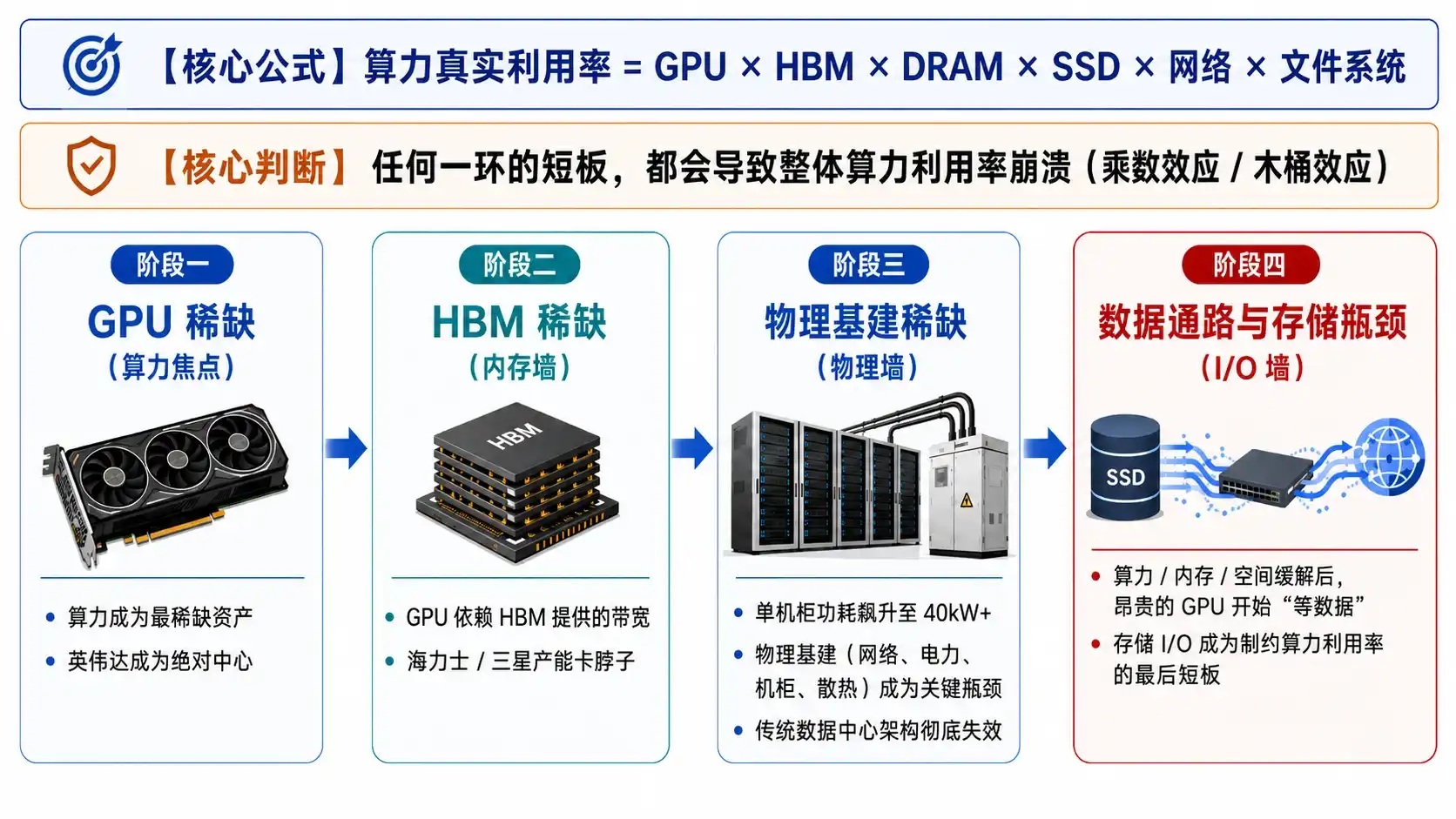
The evolution of resource bottlenecks in AI infrastructure is essentially a battle to fill the "shortest plank" in the barrel. Real computational utilization is not a linear sum of individual assets but a strict multiplicative effect: Real Computational Utilization = GPU × HBM × DRAM × SSD × Network × File System. Any weak link can cause the overall computational utilization rate to collapse. In the AI era, storage has transformed for the first time from a "cost center" into an "efficiency engine." This is the fundamental logic behind storage's revaluation.
AI Storage Architecture Overview: From HBM Bandwidth Organs to Data Lake Foundation

AI storage is by no means a simple stacking of individual hardware components but a tightly coupled, hierarchically scheduled complex system. Within this system, industrial value and capital focus are highly concentrated on HBM, enterprise-grade SSDs, SSD controllers, NVMe/CXL protocols, and high-performance storage systems. To clearly dissect the flow of value, we divide the AI storage architecture into four core layers from top to bottom:
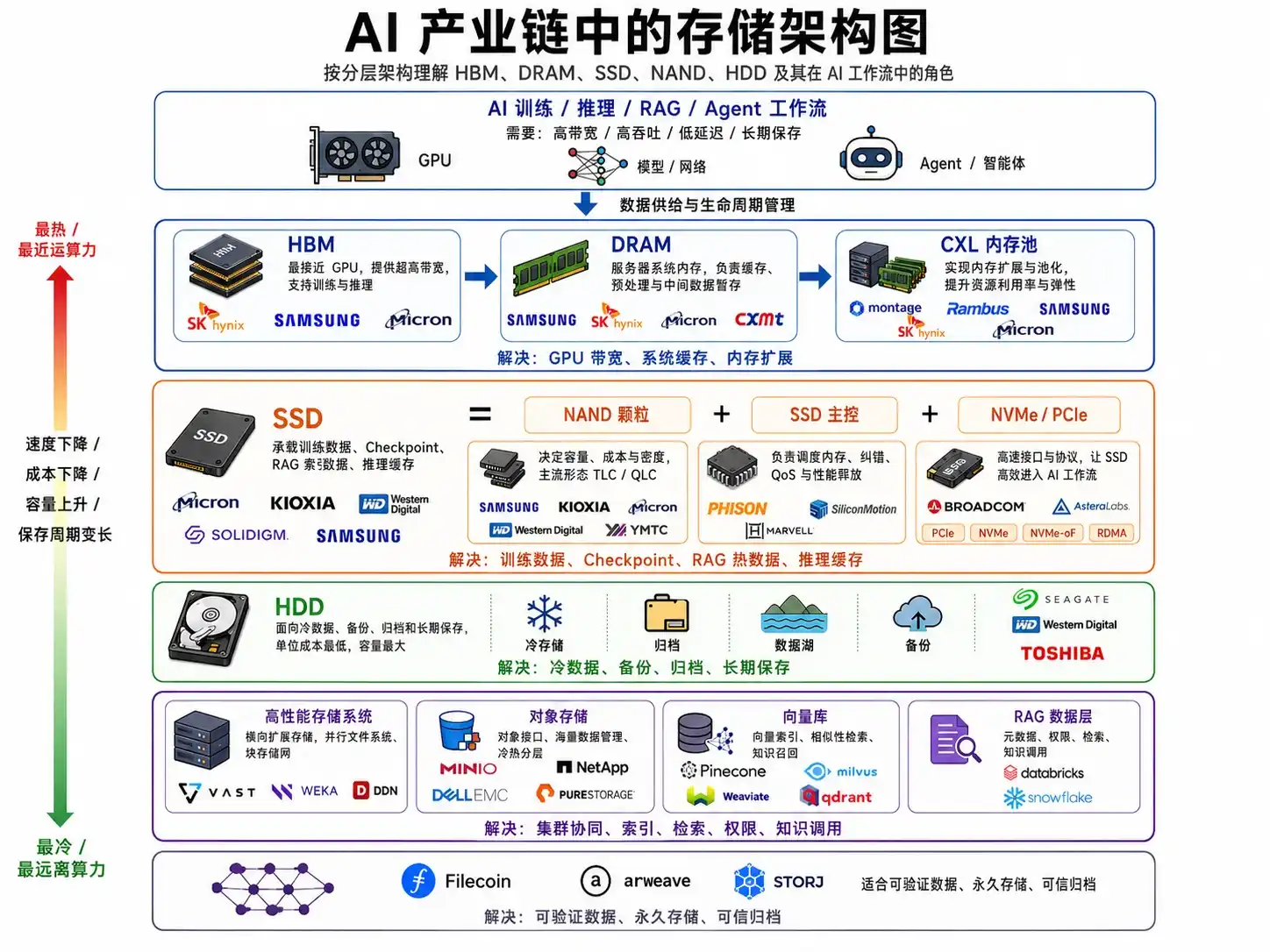
  • Compute-Proximate Memory Layer (Bandwidth Core): Primarily dominated by HBM, supplemented by DRAM and CXL memory pooling technologies. This layer is directly attached to the GPU/CPU package or bus, aiming to break the "memory wall." It is the first critical juncture determining whether computational power can be fully unleashed.

  • High-Speed Persistent Storage Layer (IO Hub): The core logic is Enterprise-grade SSD = NAND flash + SSD controller + NVMe/PCIe data path. This layer handles high-frequency Checkpoint writes, massive training dataset loads, and RAG hot data caching. It represents the most definitive persistent storage increment in AI data centers.

  • Low-Cost High-Capacity Storage Layer (Capacity Foundation): Composed of HDDs, cold storage, and data lake archiving systems. Facing exponentially growing multimodal raw data, historical logs, and compliance backups, this layer still offers an irreplaceable TCO (Total Cost of Ownership) advantage.

  • AI Storage Systems & Data Software (Scheduling Brain): Includes high-performance parallel file systems, distributed object storage, vector databases, and the RAG data governance layer. What AI truly consumes is not raw hardware but the availability of data efficiently organized, indexed, and permissioned by the software stack.

As an ecosystem extension, decentralized storage does not directly engage in the millisecond-level race for AI hot data. Instead, it anchors itself in the niches of public dataset notarization, AI training data provenance, and long-term cold memory archiving, establishing its unique position as the "trustworthy cold layer."

HBM: The "Bandwidth Organ" Closest to Compute in the AI Storage Chain

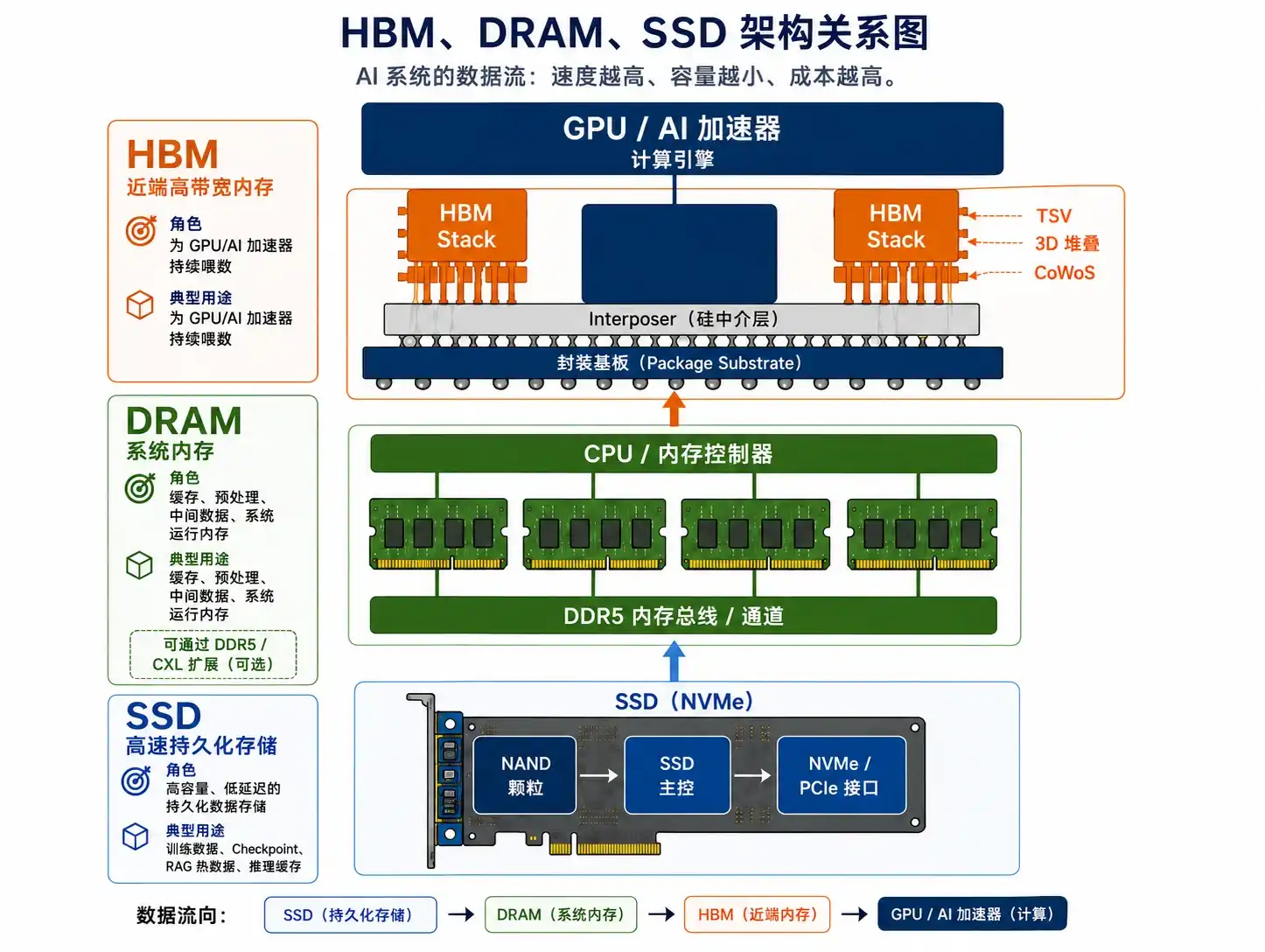
High Bandwidth Memory (HBM) is not traditional storage but a high-bandwidth memory layer proximate to the GPU. Its core mission is not to preserve data but to continuously "feed" data to the compute units with extremely high bandwidth. HBM is the closest component to compute power in the AI storage chain, with the highest certainty. It directly determines whether GPUs can be "fed adequately" and is currently the most critical supply chain bottleneck.

The core architecture of HBM is "3D DRAM stacking + 2.5D advanced packaging": Through TSV (Through-Silicon Via) vertical stacking and CoWoS (Chip-on-Wafer-on-Substrate) heterogeneous integration, the distance between memory and compute is compressed to the extreme, achieving a generational leap in bandwidth. Its industrial barriers extend beyond DRAM design, encompassing a systems engineering challenge involving DRAM process technology, TSV, ultra-thin stacking, packaging, thermal management, testing, and customer qualification. A flaw in any single step can render an entire HBM stack unusable.

Currently, only three global giants—SK hynix, Samsung, and Micron—can mass-produce HBM stably, constructing a triple moat of top-tier DRAM process, packaging capability, and certification by customers like NVIDIA/AMD.

Generation

Capacity/Stack

Bandwidth

Interface Width

Mass Production Time

Primary Customers

HBM2e

8–16GB

460 GB/s

1024-bit

2019–2020

Mature generation, used in previous-gen AI accelerators like A100

HBM3

24GB

819 GB/s

1024-bit

2022

SK hynix gained significant first-mover advantage in the H100 cycle

HBM3e

24–36GB

1.2 TB/s

1024-bit

2024–2025

Current mainstay for volume AI GPU deployments. Core suppliers are SK hynix, Micron, Samsung.

HBM4

32–48GB

>2 TB/s

2048-bit

2025–2026

Targeting next-generation AI in 2026, in the

mass production qualification/customer certification phase.

HBM4E

64GB+

>2 TB/s

2048-bit+

Post-2027

In planning/R&D for after 2027

DRAM & CXL:System Memory Foundation & Memory Pooling Engine

While HBM tackles GPU-proximate extreme bandwidth, DRAM solidifies the server's system memory foundation, and CXL aims to break physical boundaries, reconfiguring the organization of memory resources within data centers.

  • DRAM: Primarily handles CPU-side caching, data preprocessing, intermediate state buffering, and system operation. It is the most fundamental system memory layer for servers. The global DRAM market is highly concentrated among the three giants: SK hynix, Samsung, and Micron; ChangXin Memory Technologies (CXMT) is a key variable for DRAM domestic substitution in China.

  • CXL (Compute Express Link): A next-generation cache-coherent interconnect protocol for data centers. It aims to break the limitations of traditional DIMM slots, local memory capacity, and server memory silos, driving memory architecture toward expansion, pooling, and sharing. CXL is currently still in the early stages of moving from platform support to scaled deployment, with high long-term architectural value. Core companies include Astera Labs and Montage Technology.
Enterprise-grade SSD: The Data Hub Built on NAND, Controllers & NVMe

Enterprise-grade SSDs are the most crucial high-throughput persistent storage increment in AI data centers. With extremely high throughput, ultra-low latency, and stable QoS, they continuously "feed" data to GPUs, spanning the entire lifecycle from training data loading and Checkpoint writes to RAG retrieval, inference caching, and log streaming.

Within the AI storage architecture, an SSD is not an isolated hardware component but a highly coupled system, which can be summarized by the industrial formula: Enterprise-grade SSD = NAND Flash + SSD Controller + NVMe/PCIe Data Path. These three layers represent independent industrial chain segments:

  • NAND Flash (Raw Material Layer): Determines storage density and unit cost. Representative companies: Samsung, SK hynix (Solidigm), Micron, Kioxia, Western Digital, YMTC (Yangtze Memory Technologies Co.).

  • SSD Controller (Performance Enabler Layer): Determines performance unlocking, error correction, QoS stability, and wear leveling. Representative companies: Phison, Silicon Motion, Marvell, Maxio.

  • NVMe/PCIe (Data Path Layer): Determines data transfer efficiency from storage to compute. Combined with technologies like GPUDirect Storage, it reduces CPU memory bounce buffers and CPU involvement, significantly alleviating I/O bottlenecks. Representative companies: Broadcom, Marvell, Astera Labs.

HDD / Cold Storage / Archive: The Low-Cost Foundation for AI Data Lakes

AI will not eliminate HDDs. As multimodal large models crave video and image data, and enterprise compliance logs/historical datasets expand exponentially, the demand for low-cost cold data storage is also surging simultaneously. In the AI storage architecture, SSDs and HDDs collaborate based on a tiered division of business value: SSDs handle hot data and high throughput; HDDs handle low cost and long-term preservation. Representative companies include Seagate, Western Digital, Toshiba.

AI Storage Software Stack: The Scheduling Hub for Data Availability

What AI truly consumes has never been bare drives, but "data services" meticulously organized by software stacks. This architecture transforms underlying hardware into knowledge assets directly usable by upper-layer AI, specifically divided into four layers:

  • High-Performance Storage Systems (Feeding System): Core focus is on concurrent throughput and low latency. Parallel file systems address the "data starvation" problem in GPU clusters, ensuring rapid flow for training and inference. Representative companies: VAST Data, WEKA, Pure Storage.

  • Object Storage (Raw Data Lake): Core revolves around Object, Key, and Metadata management, handling massive unstructured data. It does not pursue ultimate low latency but builds a capacity foundation with low cost and cloud-native characteristics. Representative company: AWS S3.

  • Vector Database (Semantic Indexing Layer): Vector databases are responsible for storing, indexing, and retrieving vectors generated by embedding models, enabling AI to precisely locate relevant content from vast knowledge bases. Representative companies: Pinecone, Milvus.

  • RAG Data Layer (Knowledge Invocation Layer): Goes beyond mere retrieval, encompassing data chunking, cleaning, permission control, and citation provenance, ensuring enterprise data can be called by large models safely, accurately, and traceably. Representative company: Databricks.

From AI Hot Storage to Decentralized Cold Memory: Efficiency Maximization vs. Trust Maximization

AI storage is an extreme efficiency-driven system. Its value function focuses on maximizing computational output. HBM bandwidth determines whether GPUs can be fed adequately; SSD throughput determines the efficiency of dataset and Checkpoint read/writes; low latency is crucial for real-time RAG and inference experiences. These metrics ultimately converge into GPU utilization and cost per Token, directly determining the commercial profitability of AI applications. The ultimate goal of AI storage is not preservation but acceleration, serving productivity.

The value function of decentralized storage is entirely different. It questions whether data will still exist in a decade, whether it has been tampered with, and if it can resist centralized censorship. Through cryptographic proofs and distributed networks, it constructs an open-access, permanently preserved public data foundation. Its ultimate goal is to defend the absolute authenticity and sovereign independence of data, serving fairness, censorship resistance, and civilizational memory.

Dimension

AI Hot Storage

Decentralized Cold Storage

Core Value

Efficiency Maximization — Accelerating data into computation

Trust Maximization — Ensuring data is not tampered with or deleted

Data Type

Hot data / Warm data / Real-time inference

Cold data / Permanent archive / Public memory

Key Metrics

Bandwidth, Throughput, Latency, GPU Utilization

Verifiability, Censorship Resistance, Immutability, Permanent Preservation

Payment Source

Cloud providers, AI Labs, Enterprise RAG systems

Public datasets, Long-term archiving, On-chain applications

Ultimate Goal

Not preservation, but acceleration

Not speed, but trustworthiness

Market Status

Hot — Supercycle ongoing

Silent — Valuation collapse, narrative drained

AI storage is the "hot storage" fueling future productivity; decentralized storage is the "cold memory" preserving undeletable historical records for human civilization. The former serves efficiency, pursuing extreme speed; the latter serves trustworthiness, defending silent memory. The former determines how fast models run; the latter determines whether memories will be deleted. Currently, market mechanisms reward efficiency in productivity, placing AI storage at the forefront while decentralized storage seems to be experiencing a silent phase of valuation collapse and narrative drainage.

The Vision and Reality of Decentralized Storage

There are numerous decentralized storage projects, but in terms of industry mindshare and ecosystem depth, the core representatives remain Filecoin and Arweave. Although both fall under "decentralized storage," their underlying architectural philosophies are almost two completely different paths—the former uses market-based contracts to approximate the elasticity of AWS, while the latter uses a one-time social contract to approximate the permanence of a library.

  • Filecoin: Has constructed the most complete verifiable economic system through PoRep and PoSt. It should no longer compete head-on with AWS in the consumer cloud storage market. Instead, it should pivot towards AI data provenance, public dataset hosting, and compliance archiving, providing a verifiable chain for model auditing and copyright proof. Its necessary path is to encapsulate itself into an S3-compatible API supporting fiat payments, upgrading from a "cheap storage market" to "verifiable computation infrastructure."

  • Arweave: With the narrative of "pay once, store forever," its Blockweave and SPoRA mechanisms incentivize miners to preserve and provide quick access to as much data as possible, especially scarce historical data. Its optimal position is as the foundation for humanity's public memory—preserving human rights records, war crime evidence, cultural canons, archiving legal and financial history, and providing permanent, accessible long-term memory for AI Agents. Arweave's value lies not in speed but in its ability to carry civilizational memory across cycles.

Dimension

Filecoin — Verifiable Storage Market

(Data as of June 2026, source Filfox)

Arweave — Permanent Public Memory Layer

(Data as of June 2026, source ViewBlock)

Core Philosophy

"Storage is a Market" — Price discovery, elastic supply, contracts can expire without renewal

"Storage is a Public Good" — One-time social contract, data persistence does not rely on any entity's continuous payment

Underlying Structure

Standard blockchain + IPFS content addressing; data stored separately from the chain

Blockweave — Each new block links to both the previous block and a random historical "recall block"

Consensus Mechanism

Expected Consensus (EC): Proof of Replication (PoRep) + Proof of Spacetime (PoSt)

SPoRA (Succinct Proofs of Random Access, evolved from PoA in 2021)

Storage Proof Logic

PoRep proves the miner generated a unique copy of the data; PoSt continuously proves that copy remains intact and stored.

Mining requires proving the ability to access a random recall block — incentivizes miners to retain as much historical data as possible, including obscure data.

Market Structure

Two-layer market architecture: Storage Market + Retrieval Market; on-chain matching, off-chain data transfer.

Single-layer permanent writes; no independent retrieval market, relies on Gateways (e.g., AR.IO) for retrieval services.

Payment Model

Storage Market / Contract-based — Clients sign periodic lease agreements with Storage Providers (SPs), pay-as-you-go.

Endowment Permanent Fund Model — One-time payment, funds deposited into an interest-earning pool, theoretically paying miners in perpetuity.

Data Availability Guarantee

Guarantees integrity (data not tampered with), but does not inherently guarantee retrieval speed; requires purchasing additional retrieval services.

Guarantees persistence and accessibility; anyone with a transaction ID can permanently view/download, without relying on the original uploader's wallet.

Typical Use Cases

Enterprise cold archiving, compliance notarization, verifiable snapshots of AI training data, elastic on-demand storage.

Permaweb permanent websites, NFT metadata, historical archives, long-term memory for AI Agents (AO computation layer).

Token Model

FIL max supply capped at 2 billion; actual circulation affected by block reward emission, staking, penalties, and burn mechanisms.

AR max supply ~66 million; circulating supply is already near the cap, with minimal inflationary impact from new emissions.

Network Scale

Quality Adjusted Power: Approx. 14,848 PiB

Network Size: Approx. 20.2 PiB

Cumulative Stored Data

Active deals stored data: Approx. 1,110 PiB

Weave Size: Approx. 0.345 PiB

Miners / Nodes

~611 active miners

~100 online nodes

Storage Cost

Filecoin Cloud $2.50/TiB/month/copy

Approx. 10.4–10.7 AR/GiB (≈$20–21)

The dilemma for decentralized storage projects like Filecoin and Arweave does not lie in an erroneous value proposition, but in a long-term misalignment between productization, retrieval experience, real demand, and token incentives. This reveals the vast chasm between geek ideals and mainstream commercial adoption:

  • Supply-Demand Incentive Misalignment: Early networks like Filecoin rapidly expanded capacity via token rewards but failed to build a sufficiently strong paying demand side, leading to vast capacity but low utilization and poor payment conversion. The system rewarded "I can store" rather than "need me to store."

  • Lack of Enterprise-Grade Service Capabilities: AWS's moat is not hard drives, but a "data operating system" comprised of APIs, SLAs, permission management, compliance auditing, and technical support. Enterprises buy "peace of mind," not experimental infrastructure requiring them to manage keys and node selection.

  • Retrieval Experience Shortcomings: "Storing it" does not equal "retrieving it stably and with low latency." Dispersed nodes, complex topology, and a lack of unified SLAs make it difficult to handle AI hot data workflows; better suited for trusted cold archiving and data provenance.

  • Privacy & Compliance Inadequacies: Enterprise private data cannot simply be written to a public, permanent network; the right to erasure is inherently at odds with permanent immutability. Decentralized storage is better suited for public data and long-term archives, not indiscriminately hosting core private data.

  • Token Economics Amplifying Cycles: Financialization during bull markets masked insufficient demand; declining miner ROI during bear markets exposed commercial viability shortcomings. Tokens can cold-start supply but cannot automatically create demand and sustainable revenue.

Other decentralized storage projects often focus on specific ecosystems or niche segments: Storj/Sia have weaker cross-cycle industry mindshare and Web3 narrative influence compared to Filecoin/Arweave; BNB Greenfield/Walrus are tied to specific public chain ecosystems like BNB or SUI; Celestia/EigenDA belong to the Data Availability (DA) layer, serving Rollup transaction confirmation rather than long-term archiving; Projects like 0G, with mixed AI/DA narratives, attempt to integrate storage, data availability, computation, and AI agent settlement into an AI-native modular infrastructure suite, but their real demand, developer adoption, and commercialization loops remain to be validated.

Future Opportunities for Decentralized Storage: The Long-Term Pendulum Between Efficiency and Trust

During periods of technological红利 (bonanza) explosion, capital chases efficiency frantically, assigning extremely high premiums to assets like GPUs and HBM. Decentralized storage, which advocates for "trust and fairness," is naturally marginalized. However, history's pendulum will not rest forever on the side of efficiency. Events such as unreasonable platform bans and content takedowns, AI copyright lawsuits forcing data provenance proof, data sovereignty disputes triggered by geopolitical conflicts, the disappearance of public archives due to data monopolies, and regulatory pressure for auditing model training data compliance could all potentially catalyze a revaluation of "trustworthy storage." The future opportunities for decentralized storage may still manifest unique value in the following directions:

  • AI Data Provenance: Combining cryptographic proofs to construct "data lineage proof," addressing regulatory and audit pressures.

  • Public Datasets & Civilizational Archives: Anchoring censored archives and cultural heritage, building an irreplaceable, undeletable memory layer.

  • Trusted Archiving & Compliance Notarization: Implementing trusted self-attestation through hash notarization, providing high-grade digital notarization services.

  • Integration with ZK/TEE/DID Technologies: Mitigating privacy tensions, upgrading from a mere "storage protocol" to "trusted data infrastructure."

  • Invisible Product Strategy: Providing S3-compatible APIs and fiat billing, allowing users to directly purchase "trusted archiving" services.

AI storage and decentralized storage—one pursues ultimate efficiency, providing the fuel for our rush into the future; the other defends silent memory, safeguarding our right to look back at the past. Currently, the market unreservedly rewards efficiency, making decentralized storage appear silent and even collapsed. However, as the AI era further amplifies issues like data monopolies, copyright disputes, and the fragility of historical memory, decentralized storage may experience a value revaluation as a "trustworthy cold layer." Those memories that cannot be easily erased by platforms, corporations, or any single power might transform from idealistic romance, from fringe belief, into essential infrastructure.


Criptomoedas em alta

Perguntas relacionadas

QAccording to the article, what is the fundamental difference in value proposition between AI storage and decentralized storage?

AAI storage focuses on maximizing 'hot data efficiency' and serves computational productivity, aiming to accelerate data flow into computing. Decentralized storage focuses on 'cold data credibility', safeguarding data fairness, censorship resistance, and long-term human civilization memory.

QWhy has storage become a focal point in the AI industry chain, according to the article? What fundamental shift in logic does this represent?

AStorage has become an AI industry focal point due to its role in re-pricing data flow capabilities. The logic has shifted from 'capacity first' to 'efficiency first', with storage becoming an 'efficiency engine' critical for feeding data to GPUs, impacting GPU utilization and token cost, rather than just being a 'cost center' for data parking.

QDescribe the four-layer hierarchical architecture of AI storage as outlined in the article.

A1) Compute-Proximate Memory Layer (Bandwidth Core): HBM, DRAM, CXL pooling. 2) High-Speed Persistent Storage Layer (I/O Hub): Enterprise SSDs (NAND + SSD Controller + NVMe/PCIe). 3) Low-Cost High-Capacity Storage Layer (Capacity Base): HDDs, cold storage, data lake archival. 4) AI Storage Systems & Data Software (Scheduling Brain): Parallel file systems, object storage, vector databases, RAG data governance.

QHow do the core philosophies and business models of Filecoin and Arweave fundamentally differ, as described in the article?

AFilecoin's philosophy is 'storage as a market' with an elastic, contract-based pay-as-you-go model (storage/retrieval markets). Arweave's philosophy is 'storage as a public good' with a one-time-payment 'endowment' model for permanent storage, aiming to create an immutable, long-term public memory layer.

QWhat are some of the key future opportunities for decentralized storage mentioned in the article, particularly in relation to the AI era?

AKey opportunities include: 1) AI Data Provenance for audit trails, 2) Hosting public datasets and civilizational archives, 3) Trusted archival and compliance attestation, 4) Integration with ZK/TEE/DID technologies for privacy, and 5) Pursuing an 'invisible' product route with S3-compatible APIs and fiat billing.

Leituras Relacionadas

Lei Jun Earns 7 Billion in One Day from CXMT's IPO? Xiaomi Executive Responds

On July 28th, Changxin Technology's stock price on the Sci-Tech Innovation Board experienced minor fluctuations. The company had made a historic market debut the previous day, becoming the first A-share stock to record a single-day trading volume exceeding 1 trillion yuan. This led to significant paper gains for its strategic investors. Among them, Xiaomi's wholly-owned subsidiary was allocated 18.24 million shares with an initial investment of approximately 158 million yuan. Reports estimated a paper profit of 717 million yuan for Xiaomi founder Lei Jun based on his shareholding structure. However, a Xiaomi executive clarified that this was a corporate investment and should not be conflated with personal wealth. Other major beneficiaries included Alibaba and Nio. Alibaba, an early investor, held nearly a 5% stake through two entities, with an estimated paper gain exceeding 160 billion yuan. Nio, participating in the strategic placement, also saw substantial paper returns. Additionally, state-owned banks and insurance institutions that invested in Changxin recorded potential gains in the hundreds of billions. Conversely, companies like Country Garden reportedly missed out on nearly 50 billion yuan in potential gains after divesting their stakes before the IPO due to liquidity pressures. The article notes that these are paper profits based on the listing price, as the allocated shares are subject to lock-up periods, and final realized gains will depend on future stock performance. An employee from Changxin Technology commented that ordinary staff remain focused on their salaries and benefits rather than the market hype.

marsbitHá 2m

Lei Jun Earns 7 Billion in One Day from CXMT's IPO? Xiaomi Executive Responds

marsbitHá 2m

Selling Tokens or Selling Outcomes: Several Paradoxes of the AI Business Model

"The Token vs. Outcome Sale: Key Paradoxes in the AI Business Model By mid-2026, the AI industry shows rapid growth in revenue and token usage, yet the underlying business models differ significantly. This article analyzes four structural paradoxes defining the current landscape, all pointing to the commoditization of intelligence and the concentration of profits in few segments. **The Cost Paradox: Cheaper Tokens, Heavier Bills** Despite a >95% price drop for equivalent AI capability since 2023, total spending has skyrocketed due to the Jevons Paradox: lower prices expand usage into previously uneconomical tasks. Furthermore, the shift to autonomous agents operating 24/7 multiplies consumption. However, efficiency gains often remain unrealized due to unchanged organizational workflows (the Solow Paradox). The focus is shifting from optimizing token price to optimizing the task itself. **The Hierarchy Paradox: The App is King vs. The App is Dead** While conventional wisdom holds that value accrues at the application layer, the AI stack is inverted. Infrastructure (chips) captures ~70% of industry revenue and ~80% of gross profit, while application-layer margins are thin (0-30%). Fast-evolving base models threaten "thin" apps. Sustainable applications are those that embed intelligence into specific contexts, possessing private data, workflows, or delivery capabilities that become more valuable as the base model improves. **The Responsibility Paradox: Profit Follows Accountability** Growth rates alone don't guarantee profit. A key differentiator is a company's willingness and ability to take responsibility for specific outcomes. Selling by the token competes for IT budgets; selling by the outcome (e.g., a resolved support ticket) taps into larger human labor budgets. Low-responsibility, high-volume tasks (e.g., generic客服) face commoditization. High-stakes, regulated domains (e.g., law, healthcare) where vendors assume heavier liability for results command higher margins, as seen with companies like Harvey in legal tech. **The Open-Source Paradox: Open Wins Traffic, Closed Wins Revenue** Open-source models dominate in usage share and developer adoption, often being 5-20x cheaper. However, closed-source models still capture the majority of enterprise spending (~89%). Enterprises pay a premium for closed-source reliability, support, compliance, and accountability. The total cost of ownership (TCO) is converging as closed-source prices fall faster than open-source builds trust, leading to hybrid deployments. Profit is migrating from the model layer itself to upstream (compute) and downstream (orchestration, data, services)."

marsbitHá 2m

Selling Tokens or Selling Outcomes: Several Paradoxes of the AI Business Model

marsbitHá 2m

Ethereum's 2030 Blueprint: 200x Speed Increase, Quantum-Resistance, and Native Privacy

Ethereum's 2030 Roadmap: 200x Speed, Quantum-Resistant, Native Privacy Ethereum, now in its 11th year, is guided by the "Lean Ethereum" vision, a unified development blueprint aiming to streamline the network. This plan, outlined in the evolving "Strawmap" document, targets five core goals for 2030. **1. Fast L1:** Ethereum aims for near-instant finality and faster block times. By using Zero-Knowledge (ZK) proofs to aggregate validator votes, final confirmation could drop from ~15 minutes to seconds. Block times are slated to decrease from 12 seconds to 6 seconds (2027-28) and eventually 4 seconds (2029-30). The minimum staking requirement may also lower to 1 ETH, enhancing decentralization. **2. 1 Billion Gas L1:** To break the scalability-decentralization trade-off, L1 ZK-EVM will replace redundant transaction execution with ZK proofs. This allows nodes (even on phones) to verify blocks without re-running computations, paving the way to increase L1 throughput ~200x to 1 billion gas per second. **3. Trillion-Gas L2:** Ethereum will become a high-capacity settlement layer for Layer 2 networks (L2s). Planned upgrades, like PeerDAS and subsequent optimizations, target 1 GB per second of data bandwidth for L2s (Blobs), enabling a massive ecosystem of high-throughput rollups for specialized use cases. **4. Quantum-Resistant L1:** To counter future quantum computing threats, Ethereum plans to migrate its cryptographic signatures (ECDSA, BLS) to quantum-resistant, hash-based schemes. This multi-upgrade transition is targeted for completion by 2029, securing the network in the post-quantum era. **5. Privacy-Native L1:** For the first time, native transaction privacy is an official goal. Using ZK proofs, transactions could hide sender, receiver, and amount while proving compliance with rules. This infrastructure is tentatively planned, though details remain fluid and subject to regulatory landscapes. Driven by a broader ecosystem beyond the core Foundation, this ambitious roadmap seeks to make Ethereum faster, more scalable, quantum-secure, and private, while preserving its core tenets of neutrality and trustlessness. All plans remain subject to ongoing research, audits, and community consensus.

marsbitHá 16m

Ethereum's 2030 Blueprint: 200x Speed Increase, Quantum-Resistance, and Native Privacy

marsbitHá 16m

Trading

Spot

Artigos em Destaque

O que é $S$

Compreender o SPERO: Uma Visão Abrangente Introdução ao SPERO À medida que o panorama da inovação continua a evoluir, o surgimento de tecnologias web3 e projetos de criptomoeda desempenha um papel fundamental na formação do futuro digital. Um projeto que tem atraído atenção neste campo dinâmico é o SPERO, denotado como SPERO,$$s$. Este artigo tem como objetivo reunir e apresentar informações detalhadas sobre o SPERO, para ajudar entusiastas e investidores a compreender as suas bases, objetivos e inovações nos domínios web3 e cripto. O que é o SPERO,$$s$? O SPERO,$$s$ é um projeto único dentro do espaço cripto que procura aproveitar os princípios da descentralização e da tecnologia blockchain para criar um ecossistema que promove o envolvimento, a utilidade e a inclusão financeira. O projeto é concebido para facilitar interações peer-to-peer de novas maneiras, proporcionando aos utilizadores soluções e serviços financeiros inovadores. No seu núcleo, o SPERO,$$s$ visa capacitar indivíduos ao fornecer ferramentas e plataformas que melhoram a experiência do utilizador no espaço das criptomoedas. Isso inclui a possibilidade de métodos de transação mais flexíveis, a promoção de iniciativas impulsionadas pela comunidade e a criação de caminhos para oportunidades financeiras através de aplicações descentralizadas (dApps). A visão subjacente do SPERO,$$s$ gira em torno da inclusão, visando fechar lacunas dentro das finanças tradicionais enquanto aproveita os benefícios da tecnologia blockchain. Quem é o Criador do SPERO,$$s$? A identidade do criador do SPERO,$$s$ permanece algo obscura, uma vez que existem recursos publicamente disponíveis limitados que fornecem informações detalhadas sobre o(s) seu(s) fundador(es). Esta falta de transparência pode resultar do compromisso do projeto com a descentralização—uma ética que muitos projetos web3 partilham, priorizando contribuições coletivas em vez de reconhecimento individual. Ao centrar as discussões em torno da comunidade e dos seus objetivos coletivos, o SPERO,$$s$ incorpora a essência do empoderamento sem destacar indivíduos específicos. Assim, compreender a ética e a missão do SPERO é mais importante do que identificar um criador singular. Quem são os Investidores do SPERO,$$s$? O SPERO,$$s$ é apoiado por uma diversidade de investidores que vão desde capitalistas de risco a investidores-anjo dedicados a promover a inovação no setor cripto. O foco desses investidores geralmente alinha-se com a missão do SPERO—priorizando projetos que prometem avanço tecnológico social, inclusão financeira e governança descentralizada. Essas fundações de investidores estão tipicamente interessadas em projetos que não apenas oferecem produtos inovadores, mas que também contribuem positivamente para a comunidade blockchain e os seus ecossistemas. O apoio desses investidores reforça o SPERO,$$s$ como um concorrente notável no domínio em rápida evolução dos projetos cripto. Como Funciona o SPERO,$$s$? O SPERO,$$s$ emprega uma estrutura multifacetada que o distingue de projetos de criptomoeda convencionais. Aqui estão algumas das características-chave que sublinham a sua singularidade e inovação: Governança Descentralizada: O SPERO,$$s$ integra modelos de governança descentralizada, capacitando os utilizadores a participar ativamente nos processos de tomada de decisão sobre o futuro do projeto. Esta abordagem promove um sentido de propriedade e responsabilidade entre os membros da comunidade. Utilidade do Token: O SPERO,$$s$ utiliza o seu próprio token de criptomoeda, concebido para servir várias funções dentro do ecossistema. Esses tokens permitem transações, recompensas e a facilitação de serviços oferecidos na plataforma, melhorando o envolvimento e a utilidade gerais. Arquitetura em Camadas: A arquitetura técnica do SPERO,$$s$ suporta modularidade e escalabilidade, permitindo a integração contínua de funcionalidades e aplicações adicionais à medida que o projeto evolui. Esta adaptabilidade é fundamental para manter a relevância no panorama cripto em constante mudança. Envolvimento da Comunidade: O projeto enfatiza iniciativas impulsionadas pela comunidade, empregando mecanismos que incentivam a colaboração e o feedback. Ao nutrir uma comunidade forte, o SPERO,$$s$ pode melhor atender às necessidades dos utilizadores e adaptar-se às tendências do mercado. Foco na Inclusão: Ao oferecer taxas de transação baixas e interfaces amigáveis, o SPERO,$$s$ visa atrair uma base de utilizadores diversificada, incluindo indivíduos que anteriormente podem não ter participado no espaço cripto. Este compromisso com a inclusão alinha-se com a sua missão abrangente de empoderamento através da acessibilidade. Cronologia do SPERO,$$s$ Compreender a história de um projeto fornece insights cruciais sobre a sua trajetória de desenvolvimento e marcos. Abaixo está uma cronologia sugerida que mapeia eventos significativos na evolução do SPERO,$$s$: Fase de Conceituação e Ideação: As ideias iniciais que formam a base do SPERO,$$s$ foram concebidas, alinhando-se de perto com os princípios de descentralização e foco na comunidade dentro da indústria blockchain. Lançamento do Whitepaper do Projeto: Após a fase conceitual, um whitepaper abrangente detalhando a visão, os objetivos e a infraestrutura tecnológica do SPERO,$$s$ foi lançado para atrair o interesse e o feedback da comunidade. Construção da Comunidade e Primeiros Envolvimentos: Esforços ativos de divulgação foram feitos para construir uma comunidade de primeiros adotantes e investidores potenciais, facilitando discussões em torno dos objetivos do projeto e angariando apoio. Evento de Geração de Tokens: O SPERO,$$s$ realizou um evento de geração de tokens (TGE) para distribuir os seus tokens nativos a apoiantes iniciais e estabelecer liquidez inicial dentro do ecossistema. Lançamento da dApp Inicial: A primeira aplicação descentralizada (dApp) associada ao SPERO,$$s$ foi lançada, permitindo que os utilizadores interagissem com as funcionalidades principais da plataforma. Desenvolvimento Contínuo e Parcerias: Atualizações e melhorias contínuas nas ofertas do projeto, incluindo parcerias estratégicas com outros players no espaço blockchain, moldaram o SPERO,$$s$ em um jogador competitivo e em evolução no mercado cripto. Conclusão O SPERO,$$s$ é um testemunho do potencial do web3 e das criptomoedas para revolucionar os sistemas financeiros e capacitar indivíduos. Com um compromisso com a governança descentralizada, o envolvimento da comunidade e funcionalidades inovadoras, abre caminho para um panorama financeiro mais inclusivo. Como em qualquer investimento no espaço cripto em rápida evolução, potenciais investidores e utilizadores são incentivados a pesquisar minuciosamente e a envolver-se de forma ponderada com os desenvolvimentos em curso dentro do SPERO,$$s$. O projeto demonstra o espírito inovador da indústria cripto, convidando a uma exploração mais aprofundada das suas inúmeras possibilidades. Embora a jornada do SPERO,$$s$ ainda esteja a desenrolar-se, os seus princípios fundamentais podem, de facto, influenciar o futuro de como interagimos com a tecnologia, as finanças e uns com os outros em ecossistemas digitais interconectados.

126 Visualizações TotaisPublicado em {updateTime}Atualizado em 2024.12.17

O que é $S$

O que é AGENT S

Agent S: O Futuro da Interação Autónoma no Web3 Introdução No panorama em constante evolução do Web3 e das criptomoedas, as inovações estão constantemente a redefinir a forma como os indivíduos interagem com plataformas digitais. Um projeto pioneiro, o Agent S, promete revolucionar a interação humano-computador através do seu framework aberto e agente. Ao abrir caminho para interações autónomas, o Agent S visa simplificar tarefas complexas, oferecendo aplicações transformadoras em inteligência artificial (IA). Esta exploração detalhada irá aprofundar-se nas complexidades do projeto, nas suas características únicas e nas implicações para o domínio das criptomoedas. O que é o Agent S? O Agent S é um framework aberto e agente, especificamente concebido para abordar três desafios fundamentais na automação de tarefas computacionais: Aquisição de Conhecimento Específico de Domínio: O framework aprende inteligentemente a partir de várias fontes de conhecimento externas e experiências internas. Esta abordagem dupla capacita-o a construir um rico repositório de conhecimento específico de domínio, melhorando o seu desempenho na execução de tarefas. Planeamento ao Longo de Longos Horizontes de Tarefas: O Agent S emprega planeamento hierárquico aumentado por experiência, uma abordagem estratégica que facilita a decomposição e execução eficientes de tarefas intrincadas. Esta característica melhora significativamente a sua capacidade de gerir múltiplas subtarefas de forma eficiente e eficaz. Gestão de Interfaces Dinâmicas e Não Uniformes: O projeto introduz a Interface Agente-Computador (ACI), uma solução inovadora que melhora a interação entre agentes e utilizadores. Utilizando Modelos de Linguagem Multimodais de Grande Escala (MLLMs), o Agent S pode navegar e manipular diversas interfaces gráficas de utilizador de forma fluida. Através destas características pioneiras, o Agent S fornece um framework robusto que aborda as complexidades envolvidas na automação da interação humana com máquinas, preparando o terreno para uma infinidade de aplicações em IA e além. Quem é o Criador do Agent S? Embora o conceito de Agent S seja fundamentalmente inovador, informações específicas sobre o seu criador permanecem elusivas. O criador é atualmente desconhecido, o que destaca ou o estágio nascente do projeto ou a escolha estratégica de manter os membros fundadores em anonimato. Independentemente da anonimidade, o foco permanece nas capacidades e no potencial do framework. Quem são os Investidores do Agent S? Como o Agent S é relativamente novo no ecossistema criptográfico, informações detalhadas sobre os seus investidores e financiadores não estão explicitamente documentadas. A falta de informações disponíveis publicamente sobre as fundações de investimento ou organizações que apoiam o projeto levanta questões sobre a sua estrutura de financiamento e roteiro de desenvolvimento. Compreender o apoio é crucial para avaliar a sustentabilidade do projeto e o seu impacto potencial no mercado. Como Funciona o Agent S? No núcleo do Agent S reside uma tecnologia de ponta que lhe permite funcionar eficazmente em diversos ambientes. O seu modelo operacional é construído em torno de várias características-chave: Interação Humano-Computador Semelhante: O framework oferece planeamento avançado em IA, esforçando-se para tornar as interações com computadores mais intuitivas. Ao imitar o comportamento humano na execução de tarefas, promete elevar as experiências dos utilizadores. Memória Narrativa: Utilizada para aproveitar experiências de alto nível, o Agent S utiliza memória narrativa para acompanhar os históricos de tarefas, melhorando assim os seus processos de tomada de decisão. Memória Episódica: Esta característica fornece aos utilizadores orientações passo a passo, permitindo que o framework ofereça suporte contextual à medida que as tarefas se desenrolam. Suporte para OpenACI: Com a capacidade de funcionar localmente, o Agent S permite que os utilizadores mantenham o controlo sobre as suas interações e fluxos de trabalho, alinhando-se com a ética descentralizada do Web3. Fácil Integração com APIs Externas: A sua versatilidade e compatibilidade com várias plataformas de IA garantem que o Agent S possa integrar-se perfeitamente em ecossistemas tecnológicos existentes, tornando-o uma escolha apelativa para desenvolvedores e organizações. Estas funcionalidades contribuem coletivamente para a posição única do Agent S no espaço cripto, à medida que automatiza tarefas complexas e em múltiplos passos com mínima intervenção humana. À medida que o projeto evolui, as suas potenciais aplicações no Web3 podem redefinir a forma como as interações digitais se desenrolam. Cronologia do Agent S O desenvolvimento e os marcos do Agent S podem ser encapsulados numa cronologia que destaca os seus eventos significativos: 27 de Setembro de 2024: O conceito de Agent S foi lançado num artigo de pesquisa abrangente intitulado “Um Framework Agente Aberto que Usa Computadores como um Humano”, mostrando a base para o projeto. 10 de Outubro de 2024: O artigo de pesquisa foi disponibilizado publicamente no arXiv, oferecendo uma exploração aprofundada do framework e da sua avaliação de desempenho com base no benchmark OSWorld. 12 de Outubro de 2024: Uma apresentação em vídeo foi lançada, proporcionando uma visão visual das capacidades e características do Agent S, envolvendo ainda mais potenciais utilizadores e investidores. Estes marcos na cronologia não apenas ilustram o progresso do Agent S, mas também indicam o seu compromisso com a transparência e o envolvimento da comunidade. Pontos-Chave Sobre o Agent S À medida que o framework Agent S continua a evoluir, várias características-chave destacam-se, sublinhando a sua natureza inovadora e potencial: Framework Inovador: Concebido para proporcionar um uso intuitivo de computadores semelhante à interação humana, o Agent S traz uma abordagem nova à automação de tarefas. Interação Autónoma: A capacidade de interagir autonomamente com computadores através de GUI significa um avanço em direção a soluções computacionais mais inteligentes e eficientes. Automação de Tarefas Complexas: Com a sua metodologia robusta, pode automatizar tarefas complexas e em múltiplos passos, tornando os processos mais rápidos e menos propensos a erros. Melhoria Contínua: Os mecanismos de aprendizagem permitem que o Agent S melhore a partir de experiências passadas, aprimorando continuamente o seu desempenho e eficácia. Versatilidade: A sua adaptabilidade em diferentes ambientes operacionais, como OSWorld e WindowsAgentArena, garante que pode servir uma ampla gama de aplicações. À medida que o Agent S se posiciona no panorama do Web3 e das criptomoedas, o seu potencial para melhorar as capacidades de interação e automatizar processos significa um avanço significativo nas tecnologias de IA. Através do seu framework inovador, o Agent S exemplifica o futuro das interações digitais, prometendo uma experiência mais fluida e eficiente para os utilizadores em diversas indústrias. Conclusão O Agent S representa um ousado avanço na união da IA e do Web3, com a capacidade de redefinir a forma como interagimos com a tecnologia. Embora ainda esteja nas suas fases iniciais, as possibilidades para a sua aplicação são vastas e cativantes. Através do seu framework abrangente que aborda desafios críticos, o Agent S visa trazer interações autónomas para o primeiro plano da experiência digital. À medida que avançamos mais profundamente nos domínios das criptomoedas e da descentralização, projetos como o Agent S desempenharão, sem dúvida, um papel crucial na formação do futuro da tecnologia e da colaboração humano-computador.

745 Visualizações TotaisPublicado em {updateTime}Atualizado em 2025.01.14

O que é AGENT S

Como comprar S

Bem-vindo à HTX.com!Tornámos a compra de Sonic (S) simples e conveniente.Segue o nosso guia passo a passo para iniciar a tua jornada no mundo das criptos.Passo 1: cria a tua conta HTXUtiliza o teu e-mail ou número de telefone para te inscreveres numa conta gratuita na HTX.Desfruta de um processo de inscrição sem complicações e desbloqueia todas as funcionalidades.Obter a minha contaPasso 2: vai para Comprar Cripto e escolhe o teu método de pagamentoCartão de crédito/débito: usa o teu visa ou mastercard para comprar Sonic (S) instantaneamente.Saldo: usa os fundos da tua conta HTX para transacionar sem problemas.Terceiros: adicionamos métodos de pagamento populares, como Google Pay e Apple Pay, para aumentar a conveniência.P2P: transaciona diretamente com outros utilizadores na HTX.Mercado de balcão (OTC): oferecemos serviços personalizados e taxas de câmbio competitivas para os traders.Passo 3: armazena teu Sonic (S)Depois de comprar o teu Sonic (S), armazena-o na tua conta HTX.Alternativamente, podes enviá-lo para outro lugar através de transferência blockchain ou usá-lo para transacionar outras criptomoedas.Passo 4: transaciona Sonic (S)Transaciona facilmente Sonic (S) no mercado à vista da HTX.Acede simplesmente à tua conta, seleciona o teu par de trading, executa as tuas transações e monitoriza em tempo real.Oferecemos uma experiência de fácil utilização tanto para principiantes como para traders experientes.

1.3k Visualizações TotaisPublicado em {updateTime}Atualizado em 2026.06.02

Como comprar S

Discussões

Bem-vindo à Comunidade HTX. Aqui, pode manter-se informado sobre os mais recentes desenvolvimentos da plataforma e obter acesso a análises profissionais de mercado. As opiniões dos utilizadores sobre o preço de S (S) são apresentadas abaixo.

活动图片