The More It Rises, the More Dangerous? The Systemic Risks Behind SpaceX's Soaring Valuation

marsbitPublicado em 2026-06-17Última atualização em 2026-06-17

Resumo

Summary: The article raises concerns about the systemic risks posed by SpaceX's skyrocketing valuation, arguing that modern market mechanics, rather than fundamentals, are driving its price discovery. Following SpaceX's market capitalization surpassing $3 trillion in after-hours trading, the author contends that the market is no longer functioning properly. The core issue is not SpaceX's business prospects but the unhealthy market structure surrounding it. With limited float and the imminent launch of options trading, the stage is set for a potential "gamma squeeze"—a feedback loop where market makers hedging call options are forced to buy shares, pushing the price higher and attracting more speculative momentum traders. This mechanism, seen previously with Tesla and meme stocks, can decouple valuation from financial reality. The danger escalates as extreme valuations force passive funds, ETFs, pensions, and major indices to hold the stock. If SpaceX grows large enough—hypothetically reaching $5 or even $10 trillion—its performance would increasingly dictate broader market indices, embedding systemic risk. The author warns that when price appreciation itself becomes the primary bullish thesis, the market transforms from a capital allocation mechanism into a self-reinforcing speculative machine, endangering the retirement savings of ordinary investors tied to passive strategies. The piece questions whether such a system can still perform its fundamental role of price discove...

Editor's Note: After SpaceX's market cap surpassed $3 trillion in after-hours trading, this article raises a question more pointed than "What is it really worth?": When a company's market cap can increase by hundreds of billions of dollars in a single day due to a combination of limited float, options trading, and market sentiment, is the capital market still performing price discovery, or has it become a self-reinforcing speculative machine?

The author's core judgment is not about denying SpaceX's commercial prospects. SpaceX may still be one of the world's most important space infrastructure companies, and it may possess immense long-term potential. But this article is genuinely concerned with something else: If the stock price is primarily driven by call option buying, market maker hedging, momentum chasing, and passive fund allocation, then valuation is no longer merely "reflecting value"—it begins to "create value." Price appreciation itself becomes the new bullish thesis, while fundamentals are pushed to the sidelines.

The concept of a gamma squeeze (a feedback loop where market makers are forced to buy stock to hedge their positions, further driving up the price), repeatedly mentioned in the article, is key to understanding it. Over the past few years, similar mechanisms have repeatedly played out in Tesla, certain meme stocks, and high-momentum tech stocks. The author worries that if SpaceX replicates this path and continues to be pushed higher by its own narrative strength, limited float, and Elon Musk's personal influence, it could evolve from a highly valued stock into a systemic variable for the entire market.

The more dangerous part lies in indexation and passive investing. When a company becomes sufficiently large in market capitalization, it gets included in major indexes and is held passively by ETFs, pension funds, retirement accounts, sovereign wealth funds, and institutional portfolios. At that point, a bubble is no longer just the gamble of a few traders; it enters the long-term asset allocation of ordinary investors. The higher it climbs, the harder it becomes for the market to ignore it; and the harder it is to ignore, the more capital is likely to continue flowing into it.

Therefore, this article isn't really about whether SpaceX will become a $5 trillion or $10 trillion company. It's about a structural paradox of modern capital markets: When market mechanisms themselves can amplify narratives, leverage, and liquidity to a point where they overwhelm fundamentals, can "price discovery" still be said to exist? SpaceX is just an extreme case, but the problem it exposes might be more widespread—in today's U.S. stock market, systemic risk sometimes doesn't start with a bad company, but with the most popular, most unavoidable company.

The following is the original article:

"Things will just keep getting weirder and weirder and weirder, until finally, it gets so weird that people are obliged to start discussing how weird it is."
—Terence McKenna

For years, I've been asking: How ridiculous do things have to get before we admit that the stock market is fundamentally, utterly broken? Seeing SpaceX's after-hours surge today, I think the answer is clear: the market has been broken for a long time. The real question is just how absurd it has to get before others notice.

SpaceX's market cap broke through $3 trillion in after-hours trading. This means its valuation now exceeds that of Amazon and Microsoft. Microsoft generates hundreds of billions in annual revenue and over $100 billion in annual profit. Amazon has over $700 billion in annual revenue and profits in the tens of billions. And now, SpaceX is assigned a higher valuation than them.

SpaceX's relatively limited public float makes it an ideal candidate for a manipulative short squeeze. Near the end of after-hours trading, its share price approached $230. In a single day, a company still losing billions of dollars annually saw its market cap increase by about $650 billion.

$650 billion. Not in a year. Not in a decade. In one day. And tomorrow, SpaceX options will begin trading. As I predicted earlier, I'd wager it might get squeezed even further.

This is the truly unsettling part. Because I've written for years about what happens when options activity becomes a primary driver of price action.

We've seen this script before: call option buyers flood in, market makers are forced to hedge, the stock rises, momentum traders chase it, more call options are bought, and the cycle continues to reinforce itself.

The $380 strike call expiring in two days—the deepest out-of-the-money call available for purchase—was the second most popular strike among calls expiring this week and was, at one point in early trading, the most popular.

At a certain point, price stops measuring value and starts creating it. Valuation itself becomes the bullish logic. The company's industry and fundamentals become completely irrelevant. At that moment, the market formally begins doing what it's not supposed to do.

This is why tomorrow matters. Because a company that has already demonstrated powerful squeeze characteristics will have options start trading. And its "sister company" has seen similar situations before.

For years, I've written that modern markets are increasingly driven by mechanical forces, not fundamental analysis. Tomorrow could become one of the clearest examples of this yet.

My expectation is that the launch of SPCX options trading won't improve price discovery but will further distort it. If aggressive call buying emerges, the hedging activity of market makers could create a reflexive feedback loop similar to the mechanisms that drove the spectacular—yet completely illogical—runs in Tesla and other momentum stocks over the past decade.

At that point, price moves would have nothing to do with business fundamentals and everything to do with market structure. If SpaceX indeed experiences the kind of gamma squeeze many traders are openly anticipating, I believe it would serve as further proof that modern markets have become useless and extremely dangerous to ordinary retirement accounts.

Because markets are supposed to allocate capital. They are supposed to facilitate price discovery. They are supposed to connect valuations—however imperfectly—to economic reality. Markets are not supposed to become self-reinforcing feedback machines that, through purely mechanical flows, can add trillions of dollars of market cap to a single company.

The question is not whether SpaceX is a good company. The question is whether the market structure around it is healthy.

Because if a company can become more valuable than Microsoft and Amazon while having a fraction of their revenue and profits, and might surpass Nvidia tomorrow, then what is the limiting factor? What stops it from becoming a $5 trillion company? What stops it from becoming a $10 trillion company?
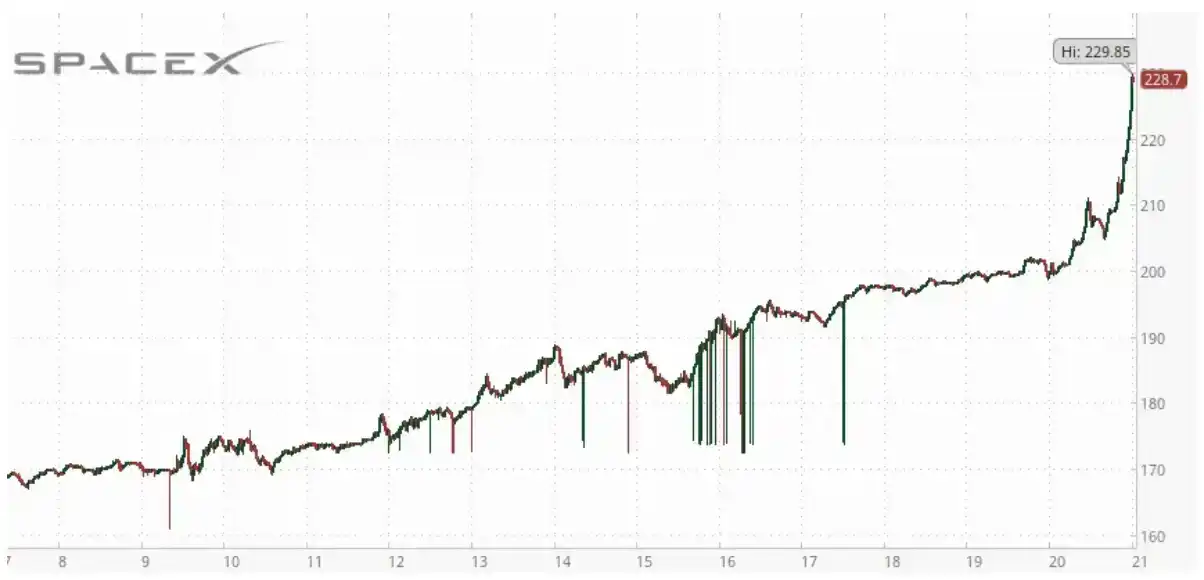
If the same kind of options-driven feedback loop that propelled Tesla after late 2019 materializes here, then these numbers no longer seem as unimaginable as they once did. And this is precisely where nobody wants to have the conversation.

Everyone wants to talk about how high SpaceX can go. Nobody wants to talk about what happens if it actually gets there.

If SpaceX reaches a $10 trillion market cap, that means one company is valued at roughly one-third of U.S. GDP. It would be large enough to dominate passive indexes, retirement accounts, ETFs, pension funds, and institutional portfolios. Its every move would increasingly dictate the performance of the entire market—all while it isn't even profitable. It would become the greatest, and most dangerous, speculative machine in human history.

Consider what this means for Elon Musk. If SpaceX is valued at $10 trillion, Musk's personal fortune would enter a realm unseen in modern history. His net worth is already equivalent to 40% of all currency in circulation.
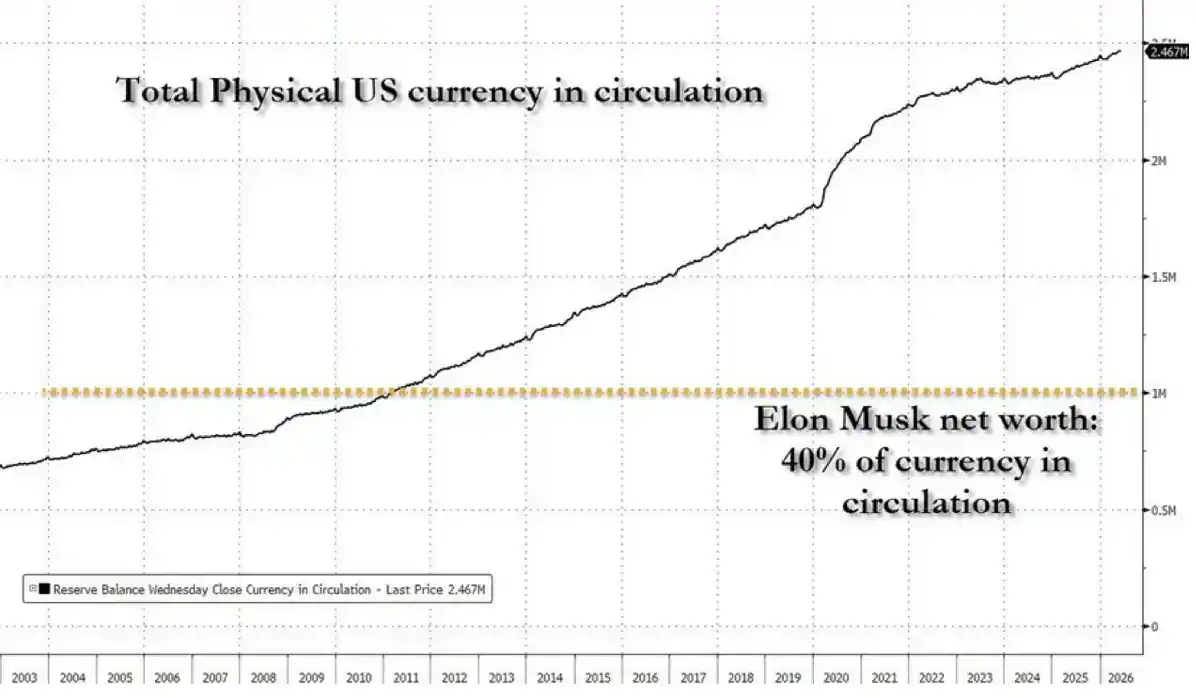
And he isn't just richer than the second-richest person. He could soon be about ten times richer.

The gap between Musk and other billionaires could exceed the total wealth of some developed nations. At that point, we are no longer discussing wealth creation in an ordinary sense.

What happens if SpaceX's market cap, due to some gamma squeeze malfunction, truly surges to $28 trillion? That's roughly equivalent to a year of U.S. economic output. Would people finally start questioning the market then? Or would they just find new reasons to rationalize it?

Because this is how every bubble in history has operated. Every new high is taken as proof the last high was too low. Every speculative mania is packaged as innovation—ask the so-called "innovation expert" Cathie Wood. Every squeeze is explained away as genius. Every warning is turned into evidence that "the skeptics don't understand the future."

The most astonishing thing about SpaceX breaking $3 trillion isn't the valuation itself.

It's that if it keeps rising, it will become too big to ignore. At some point, we must stop talking about SpaceX and start talking about the system that produced it: a speculative machine that has completely detached from its original function.

The danger is that once a company reaches sufficient scale, the distortion itself becomes a systemic risk. Every passive fund must hold it. Every major index becomes dependent on it. Pension funds, retirement accounts, sovereign wealth funds, insurance companies, and institutional portfolios become increasingly exposed to the same single trade. The higher it goes, the more unavoidable it becomes.

This is the part nobody truly understands.

If SpaceX ultimately reaches $10 trillion on a combination of hype, narrative, mechanical flows, and options-driven feedback loops, it ceases to be just a story about SpaceX. It becomes the market. Its performance will increasingly determine the performance of indexes, ETFs, and retirement accounts across the entire financial system. The market effectively becomes a referendum on a single stock.

This is how bubbles become systemic risks. Not when they're small enough to be laughed at, but when they're so big everyone is forced to participate. The same mechanisms driving the price up today will eventually create the conditions for instability tomorrow. When trillions in wealth are tied to a valuation that was never truly anchored to fundamentals, even a mild correction could have consequences far beyond that single stock.


Perguntas relacionadas

QWhat is the core concern of the author regarding SpaceX's valuation surge, beyond its business prospects?

AThe author's core concern is the health and functionality of the modern capital market structure itself. They argue that SpaceX's valuation is increasingly driven by mechanical market forces like gamma squeezes (from options trading), momentum chasing, and passive fund inflows, rather than fundamental price discovery. This creates a self-reinforcing feedback loop where price increases themselves become the justification for further buying, detaching valuation from economic reality and posing a systemic risk to the broader market and ordinary investors' portfolios.

QHow could the introduction of SpaceX options trading potentially worsen the situation, according to the article?

AThe author fears the introduction of SpaceX options trading could exacerbate price distortion through a 'gamma squeeze' feedback loop. Aggressive call option buying would force market makers to hedge by purchasing the underlying stock, pushing the stock price higher. This price rise would then attract more momentum traders and call option buyers, further reinforcing the cycle. This mechanism would make price movements almost entirely a function of market structure mechanics, not the company's business fundamentals.

QWhy does the author believe a highly inflated SpaceX could become a systemic risk rather than just a single-stock bubble?

AThe author explains that if SpaceX's market cap grows large enough, it becomes a systemic risk due to indexation and passive investment. At extreme valuations (e.g., $10 trillion), it would dominate major indices. Consequently, ETFs, pension funds, retirement accounts, and institutional portfolios would be forced to hold it in significant weightings. Its price movements would then disproportionately dictate the performance of the entire market. A correction or instability in SpaceX could therefore ripple through the financial system, impacting the savings of ordinary investors who are passively exposed.

QWhat historical market phenomenon does the author compare SpaceX's potential path to, and what is the dangerous pattern mentioned?

AThe author compares SpaceX's potential path to the gamma squeeze and feedback loop mechanisms observed in Tesla and certain 'meme stocks' in recent years. The dangerous pattern is that each new high in the stock price is used as evidence to justify the previous high, rationalizing the speculative frenzy as innovation or genius, while dismissing warnings as a lack of understanding of the future. This pattern repeats in historical bubbles.

QWhat is the 'structural paradox' of modern capital markets highlighted by the SpaceX case?

AThe structural paradox is that the very mechanisms of the modern market (options trading, passive funds, momentum algorithms) can amplify narratives, leverage, and liquidity to a point where they overwhelm fundamental analysis and price discovery. The market, meant to reflect value, instead begins to manufacture value. Systemic risk, therefore, may not start with bad companies, but with the most popular, narrative-rich companies that become too big for the market to ignore, embedding distortion at its core.

Leituras Relacionadas

Conversation with Arthur Hayes: AI Has Drained Market Liquidity, BTC Will Be Below 100k by Year-End

In this June 2026 podcast interview, BitMEX co-founder Arthur Hayes explains his decision to sell his major crypto holdings (HYPE, NEAR, Worldcoin, Zcash). His rationale is based on a macro view linking oil prices, the Iran conflict, US politics, and an impending AI bubble burst. Hayes argues that high oil prices, driven by the ongoing war, will pressure domestic US inflation. To salvage the Republican Party's chances in the midterm elections, he believes Donald Trump may pivot to a populist, anti-AI stance—advocating for taxes and regulation—which would deflate the AI investment narrative. He sees the AI sector, particularly massive capital expenditure on data centers, as having absorbed nearly all excess market liquidity (around $1.5 trillion in debt issuance since 2025), starving other assets like Bitcoin. He highlights the upcoming SpaceX IPO at a ~$1.8 trillion valuation and 100x price-to-sales ratio as a potential tipping point. If these hyped IPOs underperform, it could shatter market confidence in AI. In such a scenario, all risk assets, including crypto, would fall together as correlations converge to 1 during a broad correction. Hayes has moved his portfolio into Treasuries and energy stocks (like ExxonMobil), predicting Bitcoin will be below $100k by year-end. He sees a potential crypto bull market only after the AI frenzy cools, liquidity stops flowing exclusively into AI, and possibly after a significant market downturn prompts new monetary stimulus.

marsbitHá 1m

Conversation with Arthur Hayes: AI Has Drained Market Liquidity, BTC Will Be Below 100k by Year-End

marsbitHá 1m

Fed's Internal Doves Flock to Hawkish Stance, Warsh's Debut "Between a Rock and a Hard Place"

U.S. Federal Reserve officials who previously advocated for rate cuts, including Governor Christopher Waller, have recently shifted their stance, with many now not ruling out the possibility of future rate hikes. This sets a challenging stage for new Fed Chair Kevin Warsh's first policy meeting. Appointed by President Trump based on his dovish views, Warsh now faces a committee where the debate has pivoted from "when to cut" to "whether to hike," driven by persistent inflation above 3%, a strong labor market, and supply-side pressures from AI infrastructure demands and geopolitical tensions. Key figures illustrate the shift. Governor Waller, once concerned about employment, now says data has pushed him toward considering rate increases. Even moderate voices like Governor Lisa Cook, while expecting inflation to ease, have indicated readiness to hike if it fails to do so. Long-time hawks such as regional Fed presidents Beth Hammack, Lorie Logan, and Neel Kashkari have grown more vocal, arguing that the real policy rate is effectively falling and that action may soon be needed. The upcoming Fed meeting is expected to keep rates steady but will likely remove the "easing bias" from its statement, signaling a neutral stance between cuts and hikes. The quarterly "dot plot" is anticipated to show most officials projecting no cuts this year, with some potentially indicating hikes. Chair Warsh, a critic of the Fed's reliance on forward guidance like the dot plot, must navigate communicating this pivot using tools he has questioned, all while steering policy in a direction counter to the preferences of the president who appointed him. The consensus suggests the Fed's next move could well be a rate increase.

marsbitHá 1h

Fed's Internal Doves Flock to Hawkish Stance, Warsh's Debut "Between a Rock and a Hard Place"

marsbitHá 1h

The Trillion-Yuan Market Cap 'Yi Zhong Tian': Who is the True Value King?

The article analyzes the three leading Chinese optical module companies, collectively nicknamed "Yi Zhong Tian": Xinyisheng, Zhongji Innolight, and TFC Optical Communication. It evaluates their "cost-performance" not by current stock price, but through three lenses: PEG ratio (growth vs. valuation), earnings quality, and premium/discount for certainty. Xinyisheng shows the most attractive PEG ratio and high profitability, but its valuation reflects discounts for risks like high customer concentration and reliance on overseas markets. Zhongji Innolight, the most expensive, commands a premium for its market leadership, dominant share in key products like 800G/1.6T modules, and higher earnings certainty, though it faces geopolitical risks. TFC Optical, as an upstream component supplier ("water seller"), has the highest gross margin and bets on the long-term CPO/NPO architecture trend, but trades at a high valuation with more stable, less explosive growth. The core argument is that while these companies dominate module assembly, the true profit pool and technological moat lie upstream in laser and switch chips, currently controlled by U.S. firms like Lumentum and Coherent. The long-term "cost-performance" for these Chinese leaders hinges on whether the domestic industry, exemplified by companies like Yuanjie Technology, can successfully move up the value chain into high-power laser chips. Otherwise, their high growth may remain confined to the lower-margin assembly segment.

marsbitHá 1h

The Trillion-Yuan Market Cap 'Yi Zhong Tian': Who is the True Value King?

marsbitHá 1h

Has the Crypto Market Bottomed? Here's What Institutions Think

The crypto market is in a period of significant debate, with leading institutions offering differing views on whether a bottom has been reached. Three prominent firms have published detailed analyses: * **Galaxy Digital** argues Bitcoin has **not yet bottomed**. Their analysis of 13 historical indicators across six dimensions (valuation, profit-taking, miner pressure, etc.) shows only four are fully met. They project a potential bottom range between $30k and $54k. * **NYDIG** states a bottom is **possible but not likely**. While metrics are close to historic bear market extremes, they note the absence of a classic panic-selling event. They also suggest increased institutional adoption may have structurally altered the market cycle, potentially leading to a shallower downturn. * **Standard Chartered Bank** asserts the **bottom has already occurred** at around $59k. They cite two key factors: potential US-Iran diplomatic progress and the anticipated SpaceX IPO, which they believe absorbed capital and caused ETF selling pressure that is now subsiding. They forecast a year-end price target of $100k. Despite the surface-level disagreement, the reports share critical common ground more valuable for long-term investors: 1. All three believe the market bottom will form **within this year**. 2. All agree the current price is **closer to the bottom than to previous highs**. 3. All maintain a **bullish long-term outlook** for Bitcoin and a new cycle. The core takeaway is that while the exact bottom price ($40k, $50k, or $60k) is debated, the consensus is that a bottom is imminent. For long-term holders, the primary focus should not be pinpointing the absolute low, but on the future potential for prices to reach $100k, $200k, or higher. The fundamental thesis for Bitcoin—sovereign debt accumulation, inflation, declining trust in centralized institutions, global digitization, and improved accessibility—remains intact and is arguably strengthening. The overall landscape is viewed as more favorable than in previous crypto winters.

marsbitHá 1h

Has the Crypto Market Bottomed? Here's What Institutions Think

marsbitHá 1h

Trading

Spot
Futuros

Artigos em Destaque

O que é $S$

Compreender o SPERO: Uma Visão Abrangente Introdução ao SPERO À medida que o panorama da inovação continua a evoluir, o surgimento de tecnologias web3 e projetos de criptomoeda desempenha um papel fundamental na formação do futuro digital. Um projeto que tem atraído atenção neste campo dinâmico é o SPERO, denotado como SPERO,$$s$. Este artigo tem como objetivo reunir e apresentar informações detalhadas sobre o SPERO, para ajudar entusiastas e investidores a compreender as suas bases, objetivos e inovações nos domínios web3 e cripto. O que é o SPERO,$$s$? O SPERO,$$s$ é um projeto único dentro do espaço cripto que procura aproveitar os princípios da descentralização e da tecnologia blockchain para criar um ecossistema que promove o envolvimento, a utilidade e a inclusão financeira. O projeto é concebido para facilitar interações peer-to-peer de novas maneiras, proporcionando aos utilizadores soluções e serviços financeiros inovadores. No seu núcleo, o SPERO,$$s$ visa capacitar indivíduos ao fornecer ferramentas e plataformas que melhoram a experiência do utilizador no espaço das criptomoedas. Isso inclui a possibilidade de métodos de transação mais flexíveis, a promoção de iniciativas impulsionadas pela comunidade e a criação de caminhos para oportunidades financeiras através de aplicações descentralizadas (dApps). A visão subjacente do SPERO,$$s$ gira em torno da inclusão, visando fechar lacunas dentro das finanças tradicionais enquanto aproveita os benefícios da tecnologia blockchain. Quem é o Criador do SPERO,$$s$? A identidade do criador do SPERO,$$s$ permanece algo obscura, uma vez que existem recursos publicamente disponíveis limitados que fornecem informações detalhadas sobre o(s) seu(s) fundador(es). Esta falta de transparência pode resultar do compromisso do projeto com a descentralização—uma ética que muitos projetos web3 partilham, priorizando contribuições coletivas em vez de reconhecimento individual. Ao centrar as discussões em torno da comunidade e dos seus objetivos coletivos, o SPERO,$$s$ incorpora a essência do empoderamento sem destacar indivíduos específicos. Assim, compreender a ética e a missão do SPERO é mais importante do que identificar um criador singular. Quem são os Investidores do SPERO,$$s$? O SPERO,$$s$ é apoiado por uma diversidade de investidores que vão desde capitalistas de risco a investidores-anjo dedicados a promover a inovação no setor cripto. O foco desses investidores geralmente alinha-se com a missão do SPERO—priorizando projetos que prometem avanço tecnológico social, inclusão financeira e governança descentralizada. Essas fundações de investidores estão tipicamente interessadas em projetos que não apenas oferecem produtos inovadores, mas que também contribuem positivamente para a comunidade blockchain e os seus ecossistemas. O apoio desses investidores reforça o SPERO,$$s$ como um concorrente notável no domínio em rápida evolução dos projetos cripto. Como Funciona o SPERO,$$s$? O SPERO,$$s$ emprega uma estrutura multifacetada que o distingue de projetos de criptomoeda convencionais. Aqui estão algumas das características-chave que sublinham a sua singularidade e inovação: Governança Descentralizada: O SPERO,$$s$ integra modelos de governança descentralizada, capacitando os utilizadores a participar ativamente nos processos de tomada de decisão sobre o futuro do projeto. Esta abordagem promove um sentido de propriedade e responsabilidade entre os membros da comunidade. Utilidade do Token: O SPERO,$$s$ utiliza o seu próprio token de criptomoeda, concebido para servir várias funções dentro do ecossistema. Esses tokens permitem transações, recompensas e a facilitação de serviços oferecidos na plataforma, melhorando o envolvimento e a utilidade gerais. Arquitetura em Camadas: A arquitetura técnica do SPERO,$$s$ suporta modularidade e escalabilidade, permitindo a integração contínua de funcionalidades e aplicações adicionais à medida que o projeto evolui. Esta adaptabilidade é fundamental para manter a relevância no panorama cripto em constante mudança. Envolvimento da Comunidade: O projeto enfatiza iniciativas impulsionadas pela comunidade, empregando mecanismos que incentivam a colaboração e o feedback. Ao nutrir uma comunidade forte, o SPERO,$$s$ pode melhor atender às necessidades dos utilizadores e adaptar-se às tendências do mercado. Foco na Inclusão: Ao oferecer taxas de transação baixas e interfaces amigáveis, o SPERO,$$s$ visa atrair uma base de utilizadores diversificada, incluindo indivíduos que anteriormente podem não ter participado no espaço cripto. Este compromisso com a inclusão alinha-se com a sua missão abrangente de empoderamento através da acessibilidade. Cronologia do SPERO,$$s$ Compreender a história de um projeto fornece insights cruciais sobre a sua trajetória de desenvolvimento e marcos. Abaixo está uma cronologia sugerida que mapeia eventos significativos na evolução do SPERO,$$s$: Fase de Conceituação e Ideação: As ideias iniciais que formam a base do SPERO,$$s$ foram concebidas, alinhando-se de perto com os princípios de descentralização e foco na comunidade dentro da indústria blockchain. Lançamento do Whitepaper do Projeto: Após a fase conceitual, um whitepaper abrangente detalhando a visão, os objetivos e a infraestrutura tecnológica do SPERO,$$s$ foi lançado para atrair o interesse e o feedback da comunidade. Construção da Comunidade e Primeiros Envolvimentos: Esforços ativos de divulgação foram feitos para construir uma comunidade de primeiros adotantes e investidores potenciais, facilitando discussões em torno dos objetivos do projeto e angariando apoio. Evento de Geração de Tokens: O SPERO,$$s$ realizou um evento de geração de tokens (TGE) para distribuir os seus tokens nativos a apoiantes iniciais e estabelecer liquidez inicial dentro do ecossistema. Lançamento da dApp Inicial: A primeira aplicação descentralizada (dApp) associada ao SPERO,$$s$ foi lançada, permitindo que os utilizadores interagissem com as funcionalidades principais da plataforma. Desenvolvimento Contínuo e Parcerias: Atualizações e melhorias contínuas nas ofertas do projeto, incluindo parcerias estratégicas com outros players no espaço blockchain, moldaram o SPERO,$$s$ em um jogador competitivo e em evolução no mercado cripto. Conclusão O SPERO,$$s$ é um testemunho do potencial do web3 e das criptomoedas para revolucionar os sistemas financeiros e capacitar indivíduos. Com um compromisso com a governança descentralizada, o envolvimento da comunidade e funcionalidades inovadoras, abre caminho para um panorama financeiro mais inclusivo. Como em qualquer investimento no espaço cripto em rápida evolução, potenciais investidores e utilizadores são incentivados a pesquisar minuciosamente e a envolver-se de forma ponderada com os desenvolvimentos em curso dentro do SPERO,$$s$. O projeto demonstra o espírito inovador da indústria cripto, convidando a uma exploração mais aprofundada das suas inúmeras possibilidades. Embora a jornada do SPERO,$$s$ ainda esteja a desenrolar-se, os seus princípios fundamentais podem, de facto, influenciar o futuro de como interagimos com a tecnologia, as finanças e uns com os outros em ecossistemas digitais interconectados.

69 Visualizações TotaisPublicado em {updateTime}Atualizado em 2024.12.17

O que é $S$

O que é AGENT S

Agent S: O Futuro da Interação Autónoma no Web3 Introdução No panorama em constante evolução do Web3 e das criptomoedas, as inovações estão constantemente a redefinir a forma como os indivíduos interagem com plataformas digitais. Um projeto pioneiro, o Agent S, promete revolucionar a interação humano-computador através do seu framework aberto e agente. Ao abrir caminho para interações autónomas, o Agent S visa simplificar tarefas complexas, oferecendo aplicações transformadoras em inteligência artificial (IA). Esta exploração detalhada irá aprofundar-se nas complexidades do projeto, nas suas características únicas e nas implicações para o domínio das criptomoedas. O que é o Agent S? O Agent S é um framework aberto e agente, especificamente concebido para abordar três desafios fundamentais na automação de tarefas computacionais: Aquisição de Conhecimento Específico de Domínio: O framework aprende inteligentemente a partir de várias fontes de conhecimento externas e experiências internas. Esta abordagem dupla capacita-o a construir um rico repositório de conhecimento específico de domínio, melhorando o seu desempenho na execução de tarefas. Planeamento ao Longo de Longos Horizontes de Tarefas: O Agent S emprega planeamento hierárquico aumentado por experiência, uma abordagem estratégica que facilita a decomposição e execução eficientes de tarefas intrincadas. Esta característica melhora significativamente a sua capacidade de gerir múltiplas subtarefas de forma eficiente e eficaz. Gestão de Interfaces Dinâmicas e Não Uniformes: O projeto introduz a Interface Agente-Computador (ACI), uma solução inovadora que melhora a interação entre agentes e utilizadores. Utilizando Modelos de Linguagem Multimodais de Grande Escala (MLLMs), o Agent S pode navegar e manipular diversas interfaces gráficas de utilizador de forma fluida. Através destas características pioneiras, o Agent S fornece um framework robusto que aborda as complexidades envolvidas na automação da interação humana com máquinas, preparando o terreno para uma infinidade de aplicações em IA e além. Quem é o Criador do Agent S? Embora o conceito de Agent S seja fundamentalmente inovador, informações específicas sobre o seu criador permanecem elusivas. O criador é atualmente desconhecido, o que destaca ou o estágio nascente do projeto ou a escolha estratégica de manter os membros fundadores em anonimato. Independentemente da anonimidade, o foco permanece nas capacidades e no potencial do framework. Quem são os Investidores do Agent S? Como o Agent S é relativamente novo no ecossistema criptográfico, informações detalhadas sobre os seus investidores e financiadores não estão explicitamente documentadas. A falta de informações disponíveis publicamente sobre as fundações de investimento ou organizações que apoiam o projeto levanta questões sobre a sua estrutura de financiamento e roteiro de desenvolvimento. Compreender o apoio é crucial para avaliar a sustentabilidade do projeto e o seu impacto potencial no mercado. Como Funciona o Agent S? No núcleo do Agent S reside uma tecnologia de ponta que lhe permite funcionar eficazmente em diversos ambientes. O seu modelo operacional é construído em torno de várias características-chave: Interação Humano-Computador Semelhante: O framework oferece planeamento avançado em IA, esforçando-se para tornar as interações com computadores mais intuitivas. Ao imitar o comportamento humano na execução de tarefas, promete elevar as experiências dos utilizadores. Memória Narrativa: Utilizada para aproveitar experiências de alto nível, o Agent S utiliza memória narrativa para acompanhar os históricos de tarefas, melhorando assim os seus processos de tomada de decisão. Memória Episódica: Esta característica fornece aos utilizadores orientações passo a passo, permitindo que o framework ofereça suporte contextual à medida que as tarefas se desenrolam. Suporte para OpenACI: Com a capacidade de funcionar localmente, o Agent S permite que os utilizadores mantenham o controlo sobre as suas interações e fluxos de trabalho, alinhando-se com a ética descentralizada do Web3. Fácil Integração com APIs Externas: A sua versatilidade e compatibilidade com várias plataformas de IA garantem que o Agent S possa integrar-se perfeitamente em ecossistemas tecnológicos existentes, tornando-o uma escolha apelativa para desenvolvedores e organizações. Estas funcionalidades contribuem coletivamente para a posição única do Agent S no espaço cripto, à medida que automatiza tarefas complexas e em múltiplos passos com mínima intervenção humana. À medida que o projeto evolui, as suas potenciais aplicações no Web3 podem redefinir a forma como as interações digitais se desenrolam. Cronologia do Agent S O desenvolvimento e os marcos do Agent S podem ser encapsulados numa cronologia que destaca os seus eventos significativos: 27 de Setembro de 2024: O conceito de Agent S foi lançado num artigo de pesquisa abrangente intitulado “Um Framework Agente Aberto que Usa Computadores como um Humano”, mostrando a base para o projeto. 10 de Outubro de 2024: O artigo de pesquisa foi disponibilizado publicamente no arXiv, oferecendo uma exploração aprofundada do framework e da sua avaliação de desempenho com base no benchmark OSWorld. 12 de Outubro de 2024: Uma apresentação em vídeo foi lançada, proporcionando uma visão visual das capacidades e características do Agent S, envolvendo ainda mais potenciais utilizadores e investidores. Estes marcos na cronologia não apenas ilustram o progresso do Agent S, mas também indicam o seu compromisso com a transparência e o envolvimento da comunidade. Pontos-Chave Sobre o Agent S À medida que o framework Agent S continua a evoluir, várias características-chave destacam-se, sublinhando a sua natureza inovadora e potencial: Framework Inovador: Concebido para proporcionar um uso intuitivo de computadores semelhante à interação humana, o Agent S traz uma abordagem nova à automação de tarefas. Interação Autónoma: A capacidade de interagir autonomamente com computadores através de GUI significa um avanço em direção a soluções computacionais mais inteligentes e eficientes. Automação de Tarefas Complexas: Com a sua metodologia robusta, pode automatizar tarefas complexas e em múltiplos passos, tornando os processos mais rápidos e menos propensos a erros. Melhoria Contínua: Os mecanismos de aprendizagem permitem que o Agent S melhore a partir de experiências passadas, aprimorando continuamente o seu desempenho e eficácia. Versatilidade: A sua adaptabilidade em diferentes ambientes operacionais, como OSWorld e WindowsAgentArena, garante que pode servir uma ampla gama de aplicações. À medida que o Agent S se posiciona no panorama do Web3 e das criptomoedas, o seu potencial para melhorar as capacidades de interação e automatizar processos significa um avanço significativo nas tecnologias de IA. Através do seu framework inovador, o Agent S exemplifica o futuro das interações digitais, prometendo uma experiência mais fluida e eficiente para os utilizadores em diversas indústrias. Conclusão O Agent S representa um ousado avanço na união da IA e do Web3, com a capacidade de redefinir a forma como interagimos com a tecnologia. Embora ainda esteja nas suas fases iniciais, as possibilidades para a sua aplicação são vastas e cativantes. Através do seu framework abrangente que aborda desafios críticos, o Agent S visa trazer interações autónomas para o primeiro plano da experiência digital. À medida que avançamos mais profundamente nos domínios das criptomoedas e da descentralização, projetos como o Agent S desempenharão, sem dúvida, um papel crucial na formação do futuro da tecnologia e da colaboração humano-computador.

678 Visualizações TotaisPublicado em {updateTime}Atualizado em 2025.01.14

O que é AGENT S

Como comprar S

Bem-vindo à HTX.com!Tornámos a compra de Sonic (S) simples e conveniente.Segue o nosso guia passo a passo para iniciar a tua jornada no mundo das criptos.Passo 1: cria a tua conta HTXUtiliza o teu e-mail ou número de telefone para te inscreveres numa conta gratuita na HTX.Desfruta de um processo de inscrição sem complicações e desbloqueia todas as funcionalidades.Obter a minha contaPasso 2: vai para Comprar Cripto e escolhe o teu método de pagamentoCartão de crédito/débito: usa o teu visa ou mastercard para comprar Sonic (S) instantaneamente.Saldo: usa os fundos da tua conta HTX para transacionar sem problemas.Terceiros: adicionamos métodos de pagamento populares, como Google Pay e Apple Pay, para aumentar a conveniência.P2P: transaciona diretamente com outros utilizadores na HTX.Mercado de balcão (OTC): oferecemos serviços personalizados e taxas de câmbio competitivas para os traders.Passo 3: armazena teu Sonic (S)Depois de comprar o teu Sonic (S), armazena-o na tua conta HTX.Alternativamente, podes enviá-lo para outro lugar através de transferência blockchain ou usá-lo para transacionar outras criptomoedas.Passo 4: transaciona Sonic (S)Transaciona facilmente Sonic (S) no mercado à vista da HTX.Acede simplesmente à tua conta, seleciona o teu par de trading, executa as tuas transações e monitoriza em tempo real.Oferecemos uma experiência de fácil utilização tanto para principiantes como para traders experientes.

1.3k Visualizações TotaisPublicado em {updateTime}Atualizado em 2026.06.02

Como comprar S

Discussões

Bem-vindo à Comunidade HTX. Aqui, pode manter-se informado sobre os mais recentes desenvolvimentos da plataforma e obter acesso a análises profissionais de mercado. As opiniões dos utilizadores sobre o preço de S (S) são apresentadas abaixo.

活动图片