Cryptopolitan Report: Nearly Half of Our Readers Believe Quantum Technology Could Surpass Bitcoin by 2035

cryptonews.ruPublicado em 2026-08-08Última atualização em 2026-08-08

Resumo

Nearly half of readers surveyed believe quantum computing could break Bitcoin by 2035. The threat lies specifically in its signature scheme (ECDSA/Schnorr), vulnerable to Shor's algorithm, which could derive private keys from public ones. Estimates suggest this could require 10,000+ qubits, a target now seen as plausible this century. Approximately 6.5-6.9 million BTC (25-33% of supply) are exposed because their public keys are already on-chain. Modern unused addresses remain safe until a transaction is broadcast. Bitcoin's response includes proposals like BIP-360 (Pay-to-Merkle-Root) to hide public keys and a multi-year transition plan. Notably, post-quantum signatures are deferred. A key development occurred when an AI model (Claude Mythos) broke the post-quantum signature scheme HAWK in days—a flaw two years of human review missed—without using a quantum computer. This highlights a new risk: AI cryptanalysis may outpace traditional verification, potentially disrupting upgrade timelines faster than quantum hardware advances.

We asked our newsletter readers whether quantum computing could break Bitcoin by 2035. Last week, on July 28, an AI model, not yet publicly released, discovered a vulnerability in a post-quantum signature scheme that two years of manual review had not uncovered. No quantum computer was used here. This report examines what Bitcoin is, the real threat to $BTC, and why last week's events add a whole new dimension to the quantum computing timeline.

Where Our Readers Stand

If we add those who answered 'yes, it will probably happen' to the 'by 2030' group, it turns out that 47% of readers see the potential for a quantum breach of Bitcoin within the next nine years. To date, the largest elliptic curve key cracked on actual quantum hardware is 15 bits, which happened this past April thanks to a researcher vying for the Q-Day prize as part of Project Eleven. For comparison, Bitcoin keys are 256 bits, and progressing bit by bit over nine years would require incredible engineering innovation. About one-third of this audience currently sees this as a real possibility.

What Is Actually at Risk for $BTC?

Before we delve into the survey results in detail, it's important to clarify that Bitcoin does not encrypt anything. No secret message is encrypted, and every transaction on the network has always been public since its inception. Bitcoin only performs signing and hashing. Two different tasks, two different mathematical operations, two completely different quantum timelines.

The part responsible for signing is vulnerable. When you spend Bitcoin, your wallet generates a signature confirming your ownership of the coins, and this is done using elliptic curve cryptography called secp256k1. Over the years, Bitcoin has used two signing methods: ECDSA from the start and Schnorr since 2021. The security of both is based on one assumption: it is impossible to derive the private key from the public key.

This is where Shor's algorithm comes into play, targeting this assumption. Given a sufficiently large quantum computer, it could work backwards from a public key to the private key that generated it. In March of this year, Google researchers published estimates that this requires less than 1,200 logical qubits and less than 500,000 physical qubits. A later paper from Caltech and Oratomic reduced this number to 10,000 qubits using a neutral-atom-based architecture. No one has built anything like this yet. But these figures were previously in the millions, and it is the direction of travel that is the reason Bitcoin has stopped viewing this as a 2040s problem.

Hashing is in much better shape. Bitcoin uses SHA-256 for mining, address generation, and linking blocks. The best quantum attack against it is Grover's algorithm, which only provides a quadratic speedup. In practice, this reduces the security of a 256-bit code to something like 128-bit, which remains out of reach for any machine anyone has ever designed on paper. Mining is not the weak link here, nor is the blockchain structure.

Therefore, the precise wording of the question is narrower than 'quantum technology breaks Bitcoin.' At risk are coins whose public keys are already publicly available on the blockchain. This happens when funds at an address have been spent before, or when funds are stored in older address formats that reveal the key by default. The current estimate is between 6.5 and 6.9 million $BTC, which is roughly a quarter to a third of the total supply, and this figure includes about 1.7 million coins on early addresses widely believed to have belonged to Satoshi.

Coins stored on modern addresses and never used for a transaction do not reveal their public key at all. In the case of such coins, a quantum attacker would only have the window of a few minutes while a transaction is in the mempool awaiting confirmation to gain access to the key. Nevertheless, this is a problem worth solving. And it is much smaller than the stated figure suggests.

Bitcoin's Response to the Quantum Problem

On February 11, 2026, BIP-360 was included in the official Bitcoin BIPs, becoming the network's first formal quantum resistance proposal to reach that level. It introduces a new output type called Pay-to-Merkle-Root, or P2MR, authored by Hunter Biest, Ethan Heilman, and Isabelle Foksen Duke.

P2MR is essentially Taproot, but without spending via the key path. Taproot commits transactions to both an internal public key and a Merkle root of scripts, meaning the key can always be derived from what is on the blockchain. P2MR commits transactions only to the Merkle root. The public key is not revealed until you actually spend the funds, and even then, only the specific leaf key you used is revealed. This closes the long-term exposure vulnerability.

A companion proposal, BIP-361, was submitted on April 14, outlining a three-phase plan to completely deprecate ECDSA and spend via Schnorr. It is this one that is controversial, as the third phase effectively freezes coins that will never be migrated.

Here is what to watch. By Heilman's own estimate, it will take seven years from consensus formation to full quantum resistance, and he calls this an optimistic forecast. Two and a half years for review and testing. Six months for activation. Then another five years before roughly 90% of wallets, custodians, Lightning nodes, and treasury software are actually updated. Notably, BIP-360 does not include post-quantum signatures at all. They were removed in July 2025 and deferred to a future proposal. The scheme Bitcoin will likely eventually adopt is ML-DSA or SLH-DSA—algorithms NIST has already finalized.

And this brings us to last week's events.

A Post-Quantum Scheme Failed, and No Quantum Computer Was Involved

On July 28, Anthropic's Frontier Red Team published the results of research using their Claude Mythos Preview model, which is not publicly available. Operating in a semi-autonomous agentic environment, it discovered a previously unknown attack on HAWK, one of the nine finalists in NIST's additional post-quantum signature competition and the only lattice-based scheme that advanced to the third round in May.

The attack exploited a symmetry in HAWK's lattice structure that had not been applied before. For the HAWK-256 parameter set, the estimated number of operations to recover a key was reduced from about 2^64 to about 2^38. Simply put, that's the difference between statements like 'no adversary in the world will do this' and 'a well-funded team very well might attempt it.'

Now for the details that make this unsettling. HAWK had already undergone two rounds of human peer review over two years. The model found the vulnerability in about 60 hours, costing around $100,000 in API fees. The researcher leading the project had a theoretical computer science background and was not a lattice cryptography specialist.

Sophie Schmieg, a post-quantum cryptographer at Google, summarized it in five words: 'Essentially, with this paper, HAWK is dead.' The next day, the HAWK team withdrew the scheme from NIST consideration, noting that obvious fixes like doubling parameters or moving to higher-rank modules would render it uncompetitive against alternatives.

Quantum computers were not involved at any stage. The problem was with post-quantum cryptography, broken over a long weekend by a classic AI model.

What the Survey Really Showed

Each option in our survey asked the same core question: when will the hardware arrive? Readers' opinions on this were roughly evenly split, and the 47% forecast within nine years is quite reasonable given how qubit count estimates have shifted this year.

However, the HAWK research results suggest that hardware development timelines may not be the limiting factor. The 33% who voted for the 'not that soon' or 'only after 2050' options were betting on quantum engineering, and they may very well be right. That bet does not protect them from a classic AI attack on the replacement algorithm.

The 20% who answered 'I have no idea' deserve some credit here. In an audience that follows this closely, one in five declining to guess is not apathy. It is rather an accurate assessment of how many unknown factors are stacking up one after another: hardware progress, algorithm selection, consensus timelines, and now AI-driven cryptanalysis that is evolving faster than the verification process created to detect it.

end-content
Criptomoedas em alta

Perguntas relacionadas

QAccording to the Cryptopolitan poll, what percentage of readers believe quantum computing could crack Bitcoin by 2035?

AAccording to the poll, 47% of readers believe quantum computing has the potential to crack Bitcoin within the next nine years (by 2035), when combining the 'yes, probably will happen' and 'before 2030' groups.

QWhat specific part of Bitcoin's cryptographic system is vulnerable to a quantum attack, and what algorithm targets it?

AThe part of Bitcoin responsible for signing transactions is vulnerable. The ECDSA and Schnorr signature schemes, which are based on elliptic-curve cryptography (secp256k1), rely on the assumption that deriving a private key from a public key is impossible. Shor's algorithm targets this assumption and could, with a sufficiently powerful quantum computer, reverse-engineer the private key from the public key.

QHow does the Bitcoin improvement proposal BIP-360 (Pay-to-Merkle-Root, or P2MR) aim to improve quantum resistance?

ABIP-360 introduces Pay-to-Merkle-Root (P2MR), a new output type. Unlike Taproot, which commits to both an internal public key and a Merkle root of scripts, P2MR commits transactions only to the Merkle root. The public key is not revealed until funds are actually spent, and even then, only the specific key used is exposed. This closes the vulnerability of long-term key exposure for unused addresses.

QWhat significant event happened on July 28th regarding post-quantum cryptography, according to the article?

AOn July 28th, Anthropic's Frontier Red Team reported that their AI model, Claude Mythos Preview, discovered a previously unknown vulnerability in the HAWK signature scheme—a finalist in NIST's additional post-quantum signature competition. The AI found an attack that drastically reduced the security of HAWK-256, leading the HAWK team to withdraw the scheme. Notably, no quantum computer was involved; the attack was performed by a classic AI model.

QWhat does the article suggest might be a new, complicating factor in the timeline for achieving quantum-resistant cryptography for Bitcoin?

AThe article suggests that AI-driven cryptanalysis has emerged as a new complicating factor. The incident with the HAWK scheme showed that a classic AI model could discover vulnerabilities in a post-quantum algorithm much faster (within ~60 hours) than years of human review. This implies that the limiting factor for securing Bitcoin may no longer be just the timeline for building quantum hardware, but also the pace at which AI can analyze and potentially break proposed replacement algorithms.

Leituras Relacionadas

Conversation with Blockchain Capital Partners: The Next Bull Market May Be Right in Front of Us

In a recent Bankless podcast, Blockchain Capital partners Aleks Larsen and Spencer Bogart discussed the crypto market's evolution from infrastructure to applications. They noted that widespread stablecoin adoption has built significant on-chain liquidity, boosting revenues for lending and trading protocols. The partners defended the "buyback and burn" token model, explaining its current effectiveness in aligning incentives and establishing credibility with holders, despite past debates on capital efficiency. Addressing the sentiment divide in crypto, they highlighted positive catalysts like regulatory clarity and institutional entry, even during the bear market. Aleks compared the industry's current state to the 2003-2004 internet era—post-"broadband transition" with cheap block space, awaiting mainstream adoption through applications like stablecoins and prediction markets. They observed a shift from "fat protocol" to "fat application," where value now accrues more at the application layer than the base infrastructure, a sign of a maturing ecosystem. Drawing parallels to AI, they noted similarities in early hype cycles but emphasized crypto's transparent, token-driven market corrections versus AI's private market adjustments. On Real World Assets (RWA), Spencer projected stablecoin market cap to reach trillions by 2030, detailing its multiplier effect on on-chain economic activity. For stock tokenization, he outlined two approaches: permissionless but legally indirect models and compliant, direct ownership channels, suggesting they can coexist in "sidecar" models alongside pure DeFi. The conversation concluded that while the industry's ethos evolves with institutional adoption, crypto's core promise of upgrading global financial infrastructure for greater efficiency remains intact and is steadily progressing.

marsbitHá 22m

Conversation with Blockchain Capital Partners: The Next Bull Market May Be Right in Front of Us

marsbitHá 22m

Bitcoin's ECX Hard Fork to Introduce Three New Versions Throughout October

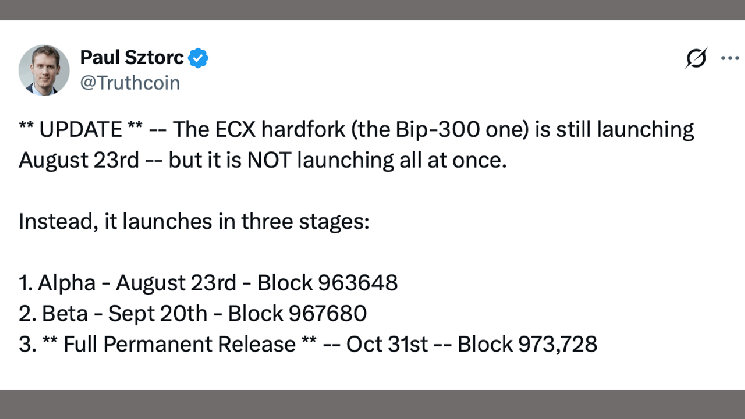
Bitcoin developer Paul Stortz, behind the Drivechain and BIP 300 proposals, has announced a hardfork for a new blockchain called ECX. Scheduled for October 31st (the 18th anniversary of the Bitcoin whitepaper), ECX will copy Bitcoin's full transaction history at a specific block height, crediting nearly all Bitcoin holders with an equal amount of ECX coins without altering the Bitcoin network itself. The launch will be executed in three phases. An "alpha" version is set for August 23rd (block 963,648), followed by a "beta" version on September 20th (block 967,680). The final mainnet launch is planned for October 31st (block 973,728). Coins accumulated during the alpha and beta phases can later be burned or swapped for real ECX. Stortz cites several reasons for the phased rollout: to address potential software bugs (including those possibly found by AI), allow an early market price to form for ECX before mining difficulty stabilizes, and let traders test and speculate. He described it as a "safety net" to manage any major issues and to demonstrate the chain's functionality. A key detail is that replay protection—a mechanism to prevent a transaction from being valid on both the Bitcoin and ECX chains—will remain optional, not automatic. The official ECX wallet software will apply this protection and warn users; Stortz warned that transactions ignoring this warning will be replayed on ECX, effectively tracking a user's spent bitcoins to their new owner unless a deliberate split is made. Stortz has given holders and exchanges 12 weeks from the alpha launch to prepare, during which they must decide on practical matters like running the wallet software to split their BTC and ECX holdings and how exchanges will credit the new asset to clients. The announcement comes as Bitcoin also faces another potential fork related to BIP-110.

cryptonews.ruHá 4h

Bitcoin's ECX Hard Fork to Introduce Three New Versions Throughout October

cryptonews.ruHá 4h

Trading

Spot

Artigos em Destaque

O que é BITCOIN

Compreender o HarryPotterObamaSonic10Inu (ERC-20) e a Sua Posição no Espaço Cripto Nos últimos anos, o mercado de criptomoedas assistiu a um aumento na popularidade das moedas meme, cativando não apenas os traders, mas também aqueles que procuram envolvimento comunitário e valor de entretenimento. Entre estes tokens únicos está o HarryPotterObamaSonic10Inu (ERC-20), um projeto intrigante que mistura referências culturais no tecido das criptomoedas. Este artigo explora os principais aspetos do HarryPotterObamaSonic10Inu, examinando os seus mecanismos, a sua ética orientada pela comunidade e o seu envolvimento com o vasto panorama cripto. O que é o HarryPotterObamaSonic10Inu (ERC-20)? Como o nome sugere, o HarryPotterObamaSonic10Inu é uma moeda meme construída na blockchain Ethereum, classificada sob o padrão ERC-20. Ao contrário das criptomoedas tradicionais, que podem enfatizar a utilidade prática ou o potencial de investimento, este token prospera no valor de entretenimento e na força da sua comunidade. O projeto visa promover um ambiente onde utilizadores envolvidos possam reunir-se, partilhar ideias e participar em atividades inspiradas por diversos fenómenos culturais. Uma característica notável do HarryPotterObamaSonic10Inu é a zero taxa sobre transações. Este elemento atraente visa encorajar a negociação e o envolvimento da comunidade, isento de encargos adicionais que podem desencorajar os traders de pequena escala. A oferta total da moeda está fixada em mil milhões de tokens, uma cifra que marca a sua intenção de manter uma circulação substancial dentro da comunidade. Criador do HarryPotterObamaSonic10Inu (ERC-20) As origens do HarryPotterObamaSonic10Inu estão um pouco envoltas em mistério; os detalhes sobre o criador permanecem desconhecidos. O desenvolvimento deste token carece de uma equipa identificável ou de um plano explícito, o que não é raro no setor das moedas meme. Em vez disso, o projeto surgiu de forma orgânica, com o seu progresso a depender fortemente do entusiasmo e da participação da sua comunidade. Investidores do HarryPotterObamaSonic10Inu (ERC-20) No que diz respeito a investimentos externos e apoios, o HarryPotterObamaSonic10Inu também permanece ambíguo. O token não lista quaisquer fundações de investimento conhecidas ou apoio organizacional significativo. Em vez disso, o “sangue vital” do projeto é a sua comunidade de base, que informa o seu crescimento e sustentabilidade através da ação coletiva e do envolvimento no espaço cripto. Como Funciona o HarryPotterObamaSonic10Inu (ERC-20)? Como uma moeda meme, o HarryPotterObamaSonic10Inu opera principalmente fora dos quadros tradicionais que muitas vezes governam o valor dos ativos. Existem vários aspetos distintivos que definem como o projeto funciona: Transações Sem Taxas: Sem taxas sobre transações, os utilizadores podem comprar e vender o token livremente, sem a preocupação de custos ocultos. Envolvimento da Comunidade: O projeto prospera na interação da comunidade, aproveitando plataformas de redes sociais para criar entusiasmo e facilitar a participação. Discussões, partilha de conteúdo e envolvimento são elementos cruciais que ajudam a expandir o seu alcance e a fomentar a lealdade entre os apoiantes. Sem Utilidade Prática: Deve ser notado que o HarryPotterObamaSonic10Inu não oferece utilidade concreta dentro do ecossistema financeiro. Em vez disso, é classificado como um token principalmente para entretenimento e atividades comunitárias. Referência Cultural: O token incorpora de forma inteligente elementos da cultura popular para atrair interesse, conectando-se tanto com entusiastas de memes como com seguidores de criptomoedas. HarryPotterObamaSonic10Inu exemplifica como as moedas meme operam de forma diferente de projetos de criptomoedas mais tradicionais, entrando no mercado como construções sociais inovadoras em vez de ativos utilitários. Linha do Tempo do HarryPotterObamaSonic10Inu (ERC-20) A história do HarryPotterObamaSonic10Inu é marcada por vários marcos notáveis: Criação: O token surgiu de um meme viral, capturando a imaginação de muitos entusiastas de criptomoedas. Datas específicas de criação não estão disponíveis, sublinhando a sua ascensão orgânica. Listagem em Exchanges: O HarryPotterObamaSonic10Inu conseguiu entrar em várias exchanges, permitindo um acesso e negociação mais fáceis pela comunidade. Iniciativas de Envolvimento da Comunidade: Atividades contínuas direcionadas a melhorar a interação comunitária, incluindo concursos, campanhas em redes sociais e geração de conteúdo por fãs e defensores. Planos de Expansão Futura: O roteiro do projeto inclui o lançamento de uma coleção de NFTs, mercadorias e um site de eCommerce relacionado aos seus temas culturais, envolvendo ainda mais a comunidade e tentando adicionar mais dimensões ao seu ecossistema. Pontos-Chave sobre o HarryPotterObamaSonic10Inu (ERC-20) Natureza Orientada pela Comunidade: O projeto prioriza a contribuição coletiva e a criatividade, assegurando que o envolvimento dos utilizadores está na vanguarda do seu desenvolvimento. Classificação como Moeda Meme: Representa o epítome da criptomoeda baseada em entretenimento, destacando-se dos veículos de investimento tradicionais. Sem Afiliação Direta com o Bitcoin: Apesar da semelhança no nome do ticker, o HarryPotterObamaSonic10Inu é distinto e não tem qualquer relação com o Bitcoin ou outras criptomoedas estabelecidas. Foco na Colaboração: O HarryPotterObamaSonic10Inu é projetado para criar um espaço de colaboração e partilha de histórias entre os seus detentores, proporcionando uma via para a criatividade e o fortalecimento da comunidade. Perspectivas Futuras: A ambição de expandir além da sua premissa inicial para NFTs e mercadorias delineia um caminho para o projeto potencialmente entrar em avenidas mais mainstream dentro da cultura digital. À medida que as moedas meme continuam a capturar a imaginação da comunidade cripto, HarryPotterObamaSonic10Inu (ERC-20) destaca-se devido aos seus laços culturais e abordagem centrada na comunidade. Embora possa não se encaixar no molde típico de um token orientado para utilidade, a sua essência reside na alegria e camaradagem fomentadas entre os seus apoiantes, destacando a natureza em evolução das criptomoedas em uma era cada vez mais digital. À medida que o projeto continua a desenvolver-se, será importante observar como as dinâmicas comunitárias influenciam a sua trajetória no panorama em constante mudança da tecnologia blockchain.

2.2k Visualizações TotaisPublicado em {updateTime}Atualizado em 2024.12.03

O que é BITCOIN

Como comprar BTC

Bem-vindo à HTX.com!Tornámos a compra de Bitcoin (BTC) simples e conveniente.Segue o nosso guia passo a passo para iniciar a tua jornada no mundo das criptos.Passo 1: cria a tua conta HTXUtiliza o teu e-mail ou número de telefone para te inscreveres numa conta gratuita na HTX.Desfruta de um processo de inscrição sem complicações e desbloqueia todas as funcionalidades.Obter a minha contaPasso 2: vai para Comprar Cripto e escolhe o teu método de pagamentoCartão de crédito/débito: usa o teu visa ou mastercard para comprar Bitcoin (BTC) instantaneamente.Saldo: usa os fundos da tua conta HTX para transacionar sem problemas.Terceiros: adicionamos métodos de pagamento populares, como Google Pay e Apple Pay, para aumentar a conveniência.P2P: transaciona diretamente com outros utilizadores na HTX.Mercado de balcão (OTC): oferecemos serviços personalizados e taxas de câmbio competitivas para os traders.Passo 3: armazena teu Bitcoin (BTC)Depois de comprar o teu Bitcoin (BTC), armazena-o na tua conta HTX.Alternativamente, podes enviá-lo para outro lugar através de transferência blockchain ou usá-lo para transacionar outras criptomoedas.Passo 4: transaciona Bitcoin (BTC)Transaciona facilmente Bitcoin (BTC) no mercado à vista da HTX.Acede simplesmente à tua conta, seleciona o teu par de trading, executa as tuas transações e monitoriza em tempo real.Oferecemos uma experiência de fácil utilização tanto para principiantes como para traders experientes.

4.7k Visualizações TotaisPublicado em {updateTime}Atualizado em 2026.06.02

Como comprar BTC

O que é $BITCOIN

OURO DIGITAL ($BITCOIN): Uma Análise Abrangente Introdução ao OURO DIGITAL ($BITCOIN) OURO DIGITAL ($BITCOIN) é um projeto baseado em blockchain que opera na rede Solana, com o objetivo de combinar as características dos metais preciosos tradicionais com a inovação das tecnologias descentralizadas. Embora partilhe um nome com o Bitcoin, frequentemente referido como “ouro digital” devido à sua percepção como uma reserva de valor, o OURO DIGITAL é um token separado projetado para criar um ecossistema único dentro da paisagem Web3. O seu objetivo é posicionar-se como um ativo digital alternativo viável, embora os detalhes sobre as suas aplicações e funcionalidades ainda estejam em desenvolvimento. O que é o OURO DIGITAL ($BITCOIN)? OURO DIGITAL ($BITCOIN) é um token de criptomoeda explicitamente projetado para uso na blockchain Solana. Em contraste com o Bitcoin, que fornece um papel amplamente reconhecido como armazenamento de valor, este token parece focar em aplicações e características mais amplas. Aspectos notáveis incluem: Infraestrutura Blockchain: O token é construído na blockchain Solana, conhecida pela sua capacidade de lidar com transações de alta velocidade e baixo custo. Dinâmicas de Oferta: O OURO DIGITAL tem um fornecimento máximo limitado a 100 quatrilhões de tokens (100P $BITCOIN), embora os detalhes sobre o seu fornecimento circulante ainda não tenham sido divulgados. Utilidade: Embora as funcionalidades precisas não estejam explicitamente delineadas, existem indicações de que o token poderia ser utilizado para várias aplicações, potencialmente envolvendo aplicações descentralizadas (dApps) ou estratégias de tokenização de ativos. Quem é o Criador do OURO DIGITAL ($BITCOIN)? Neste momento, a identidade dos criadores e da equipa de desenvolvimento por trás do OURO DIGITAL ($BITCOIN) permanece desconhecida. Esta situação é típica entre muitos projetos inovadores no espaço da blockchain, particularmente aqueles alinhados com finanças descentralizadas e fenómenos de moedas meme. Embora tal anonimato possa fomentar uma cultura orientada pela comunidade, intensifica as preocupações sobre governança e responsabilidade. Quem são os Investidores do OURO DIGITAL ($BITCOIN)? As informações disponíveis indicam que o OURO DIGITAL ($BITCOIN) não tem apoiantes institucionais conhecidos ou investimentos proeminentes de capital de risco. O projeto parece operar num modelo peer-to-peer focado no apoio e adoção da comunidade, em vez de rotas de financiamento tradicionais. A sua atividade e liquidez estão principalmente situadas em exchanges descentralizadas (DEXs), como a PumpSwap, em vez de plataformas de negociação centralizadas estabelecidas, destacando ainda mais a sua abordagem de base. Como Funciona o OURO DIGITAL ($BITCOIN) A mecânica operacional do OURO DIGITAL ($BITCOIN) pode ser elaborada com base no seu design de blockchain e nas características da rede: Mecanismo de Consenso: Ao aproveitar o exclusivo proof-of-history (PoH) da Solana combinado com um modelo de proof-of-stake (PoS), o projeto assegura uma validação eficiente das transações, contribuindo para o alto desempenho da rede. Tokenomics: Embora mecanismos deflacionários específicos não tenham sido extensivamente detalhados, o vasto fornecimento máximo de tokens implica que pode atender a microtransações ou casos de uso de nicho que ainda estão por definir. Interoperabilidade: Existe o potencial para integração com o ecossistema mais amplo da Solana, incluindo várias plataformas de finanças descentralizadas (DeFi). No entanto, os detalhes sobre integrações específicas permanecem não especificados. Cronologia de Eventos Chave Aqui está uma cronologia que destaca marcos significativos relacionados ao OURO DIGITAL ($BITCOIN): 2023: O lançamento inicial do token ocorre na blockchain Solana, marcado pelo seu endereço de contrato. 2024: O OURO DIGITAL ganha visibilidade ao tornar-se disponível para negociação em exchanges descentralizadas como a PumpSwap, permitindo que os utilizadores o negociem contra SOL. 2025: O projeto testemunha atividade de negociação esporádica e potencial interesse em envolvimentos liderados pela comunidade, embora não tenham sido documentadas parcerias ou avanços técnicos notáveis até ao momento. Análise Crítica Forças Escalabilidade: A infraestrutura subjacente da Solana suporta altos volumes de transações, o que pode aumentar a utilidade do $BITCOIN em vários cenários de transação. Acessibilidade: O potencial preço de negociação baixo por token pode atrair investidores de retalho, facilitando uma participação mais ampla devido a oportunidades de propriedade fracionada. Riscos Falta de Transparência: A ausência de apoiantes, desenvolvedores ou um processo de auditoria publicamente conhecidos pode gerar ceticismo em relação à sustentabilidade e confiabilidade do projeto. Volatilidade do Mercado: A atividade de negociação depende fortemente do comportamento especulativo, o que pode resultar em volatilidade significativa dos preços e incerteza para os investidores. Conclusão O OURO DIGITAL ($BITCOIN) surge como um projeto intrigante, mas ambíguo, dentro do ecossistema em rápida evolução da Solana. Embora tente aproveitar a narrativa do “ouro digital”, a sua divergência do papel estabelecido do Bitcoin como reserva de valor sublinha a necessidade de uma diferenciação mais clara da sua utilidade pretendida e estrutura de governança. A aceitação e adoção futuras dependerão provavelmente da abordagem da atual opacidade e da definição mais explícita das suas estratégias operacionais e económicas. Nota: Este relatório abrange informações sintetizadas disponíveis até outubro de 2023, e desenvolvimentos podem ter ocorrido além do período de pesquisa.

425 Visualizações TotaisPublicado em {updateTime}Atualizado em 2025.05.13

O que é $BITCOIN

Discussões

Bem-vindo à Comunidade HTX. Aqui, pode manter-se informado sobre os mais recentes desenvolvimentos da plataforma e obter acesso a análises profissionais de mercado. As opiniões dos utilizadores sobre o preço de BTC (BTC) são apresentadas abaixo.

活动图片