Who is Selling, Who is Holding, Who is Still Buying? The Divergence of U.S. Old Money's Crypto ETF Holdings

marsbitPublicado em 2026-05-22Última atualização em 2026-05-22

Resumo

"American Institutional Crypto ETF Holdings Show Divergence in Q1 2026. Amidst a quarter of market pullback, major institutional 13F filings reveal distinct strategies towards crypto ETFs. Key sell-offs/trimming: Harvard Management cut its iShares Bitcoin Trust (IBIT) holdings by ~43% and fully exited its iShares Ethereum Trust (ETHA) position, reallocating some funds toward AI/tech stocks. Goldman Sachs reduced its overall crypto ETF exposure, notably clearing its XRP and Solana ETF holdings while adding to selected crypto-related equities like Circle and Galaxy Digital. Hedge funds Millennium Management and Capula Management also significantly reduced or fully exited major Bitcoin and Ethereum ETF positions. Holders maintaining positions: Brown University kept its IBIT stake unchanged, demonstrating a long-term allocation approach. Dartmouth College maintained its core Bitcoin ETF holding while shifting some Ethereum exposure to a staking ETF and initiating a position in a Bitwise Solana Staking ETF. Strategic buyers increasing exposure: Sovereign wealth fund Mubadala increased its IBIT holdings by ~16%. JPMorgan significantly boosted its IBIT stake by 174%, while Wells Fargo raised its Ethereum ETF allocations. Market maker Jane Street rebalanced, cutting Bitcoin ETF holdings but adding ~$82 million in Ethereum ETF exposure. The filings indicate institutions are actively sorting crypto assets by perceived risk and liquidity, with Bitcoin often treated as a 'core' holding, ...

Original Author: KarenZ, Foresight News

The most noteworthy aspect of Q1 is not how much the price fell, but how institutions navigated through this pullback.

If you only look at the market performance, crypto ETFs in Q1 2026 did not have it easy. Bitcoin and Ethereum faced pressure during the quarter, the book value of spot ETFs generally declined, and many positions, even if not sold, would look difficult by the quarter's end. However, the truly interesting part of a downturn is never the NAV curve itself, but what different types of institutions did on the same pullback chart.

By the latest round of 13F filings disclosed as of mid-May 2026, the market can already see a group of institutions' holdings as of the quarter-end, March 31, 2026. University endowments, large investment banks, sovereign wealth funds, market makers, and wealth management firms have provided several starkly different answers.

Those Reducing Holdings: Risk Contraction First

First, let's look at the reducers.

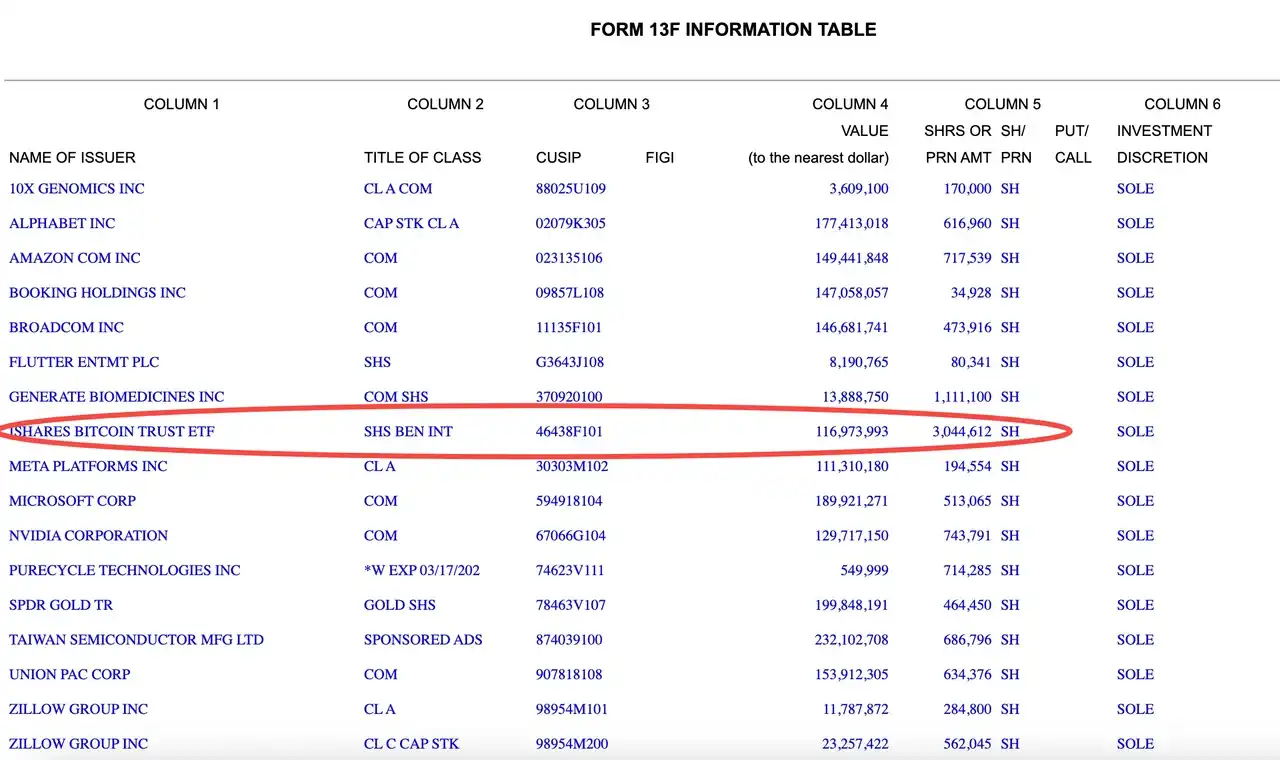
Harvard Management, which manages Harvard University's endowment and related financial assets, is one of the most typical examples in this round. According to its filed 13F report, its holdings in IBIT (iShares Bitcoin Trust ETF) decreased from 5,353,612 shares at the end of Q4 2025 to 3,044,612 shares at the end of Q1 2026, a reduction of approximately 43%, with the corresponding book value dropping from about $266 million to about $117 million. Meanwhile, its holdings in ETHA (iShares Ethereum Trust), which it still held last quarter, were completely exited this quarter. This indicates that Harvard is not merely reacting to price pullbacks but is actively compressing its public exposure to Bitcoin and Ethereum spot ETFs.
This change in holdings carries another layer of meaning. Harvard did not turn entirely defensive overall but instead reallocated part of its portfolio to assets related to the AI and computing power chain, increasing holdings in stocks like NVIDIA, Broadcom, and TSMC. Taken together, these moves look more like a structural rebalancing act of "reducing crypto, adding AI," rather than a comprehensive risk reduction.

Goldman Sachs's strategy is broadly similar, albeit with more complex tactics. Comparing the latest two 13F reports, Goldman Sachs still held approximately $690 million worth of IBIT and about $25.18 million worth of FBTC (Fidelity Wise Origin Bitcoin Fund) at the end of Q1 2026, with both showing reductions from the previous quarter. More noteworthy than the simple reduction is its position structure: Goldman holds spot, call options, and put options on IBIT simultaneously, indicating this is not merely a directional bet but carries clear trading and hedging characteristics.
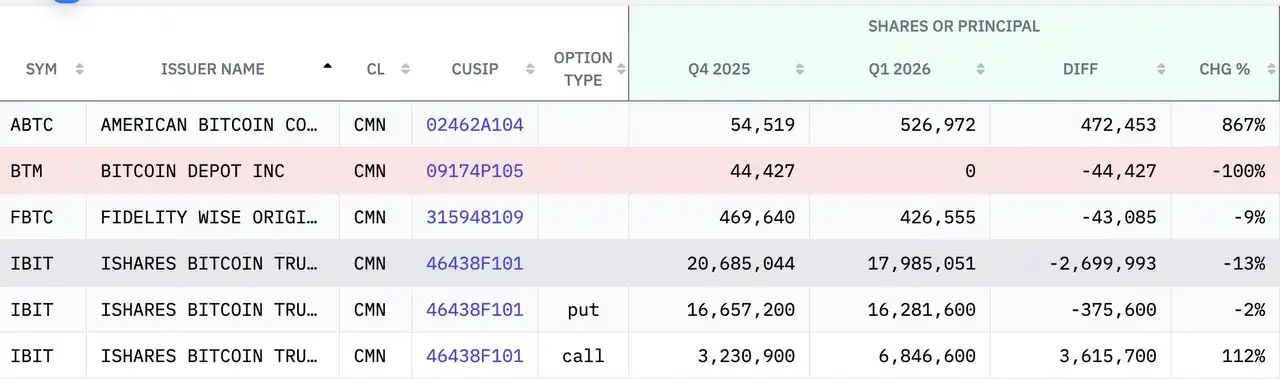
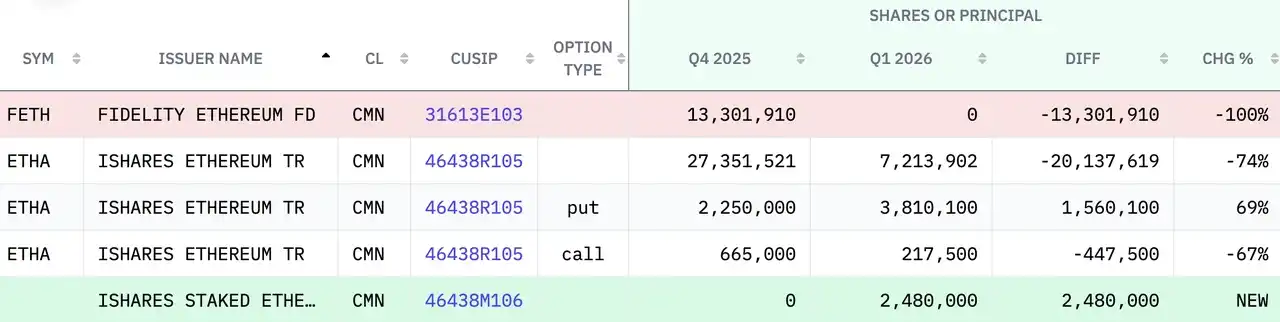
Goldman's handling of Ethereum was even more aggressive. It not only completely exited its position in the Fidelity Ethereum Fund (holding a value of $394 million at the end of Q4 2025) but also significantly reduced its spot position in iShares Ethereum Trust (ETHA) by about 74%, leaving a remaining position of about $114 million. Additionally, it newly acquired a position worth approximately $66.885 million in the iShares Staked Ethereum Trust ETF.
Meanwhile, Goldman Sachs has liquidated all its XRP and Solana-related ETFs. By the end of Q4 2025, it held a combined value of about $152 million in XRP ETFs from Bitwise, Franklin Templeton, Grayscale, and 21shares, and also liquidated all Solana ETFs/Trusts from Grayscale, Bitwise, and Fidelity (valued at $109 million at the end of Q4 2025).
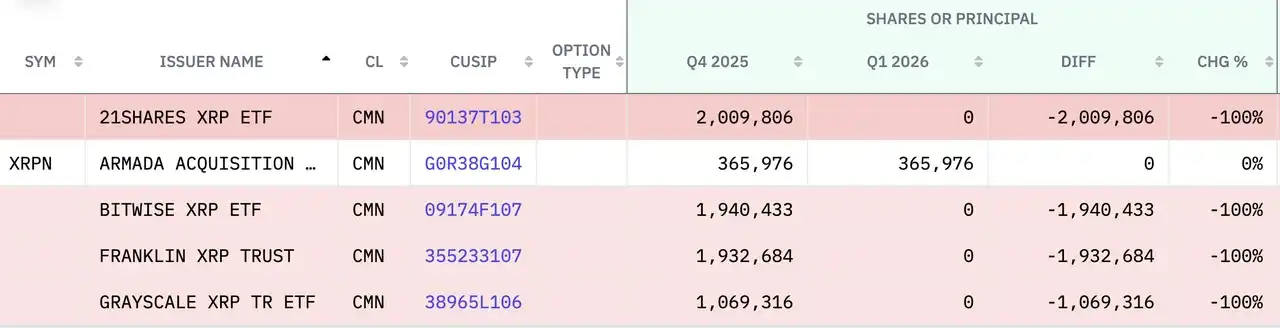
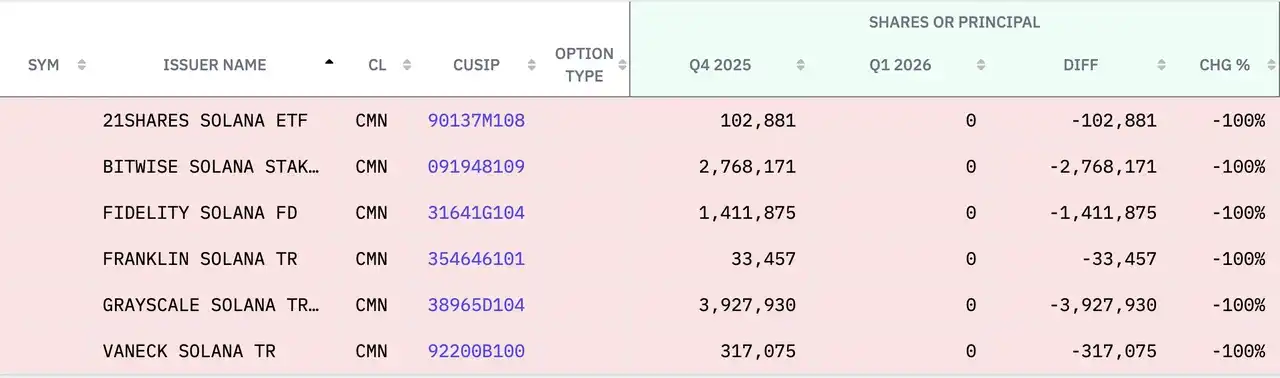
Regarding crypto-related stocks, Goldman Sachs increased its position in Circle by 249% to around $140 million, and its position in Galaxy Digital also rose by 205% (to $41.48 million). Holdings in Coinbase (+65%), Robinhood (+35%), and PayPal also increased. Meanwhile, it reduced holdings in Strategy and Riot Platforms. Overall, this resembles an internal rotation of "compressing ETF risk and shifting to selected individual stocks."

Among hedge funds, Millennium Management also gave a similar signal. Publicly compiled data shows its IBIT holdings decreased from 34.334 million shares to 19.287 million shares, a reduction of approximately 43.8%. Its ETHA holdings also declined synchronously (by about 34.3%), indicating a clear reduction in exposure to both Bitcoin and Ethereum spot ETFs.

London-based hedge fund manager Capula Management Ltd went even further. As of December 30, 2025, it held $470 million worth of IBIT, $160 million worth of FBTC, $207 million worth of ETHA, and $61.43 million worth of FETH. However, its latest 13F report shows these ETFs have been completely liquidated. Concurrently, Capula Management Ltd has also completely liquidated its Coinbase position (retaining a small options position).

Standing Pat Is Also an Attitude

The second category is those standing pat.

Brown University's IBIT holdings remain at 212,500 shares, with no increase or decrease. Calculated by disclosed market value, this position fell from about $10.551 million at the end of 2025 to about $8.164 million at the end of Q1 2026. Such university endowments do not directly convert a quarter's price volatility into trading instructions, instead emphasizing portfolio discipline and long-term allocation rhythm.

Dartmouth College's handling of crypto assets in Q1 2026 resembles a mild expansion rather than an aggressive rotation. Comparing its 13F with the previous quarter, the college retained its core Bitcoin ETF positions. The share count of IBIT remained largely unchanged, though the book value dropped from over $10 million to about $7.7 million due to the Q1 price pullback. For Ethereum exposure, it performed a product switch, replacing the previous Grayscale Ethereum Mini Trust with the staking-enabled Grayscale Ethereum Staking ETF, holding about 178,100 shares. It also newly established a position in the Bitwise Solana Staking ETF, approximately 304,803 shares, with a book value of about $3.3 million.

A Different Playbook: Buying the Dip

The third category consists of those increasing their holdings against the trend.

The Abu Dhabi sovereign wealth fund Mubadala is one of the most prominent names. Its IBIT holdings increased from 12,702,323 shares to 14,721,917 shares, a rise of about 15.9%. However, even though the share count increased, the quarter-end holding value still fell from about $631 million to about $566 million. This set of numbers is quite telling. The act of increasing holdings does not automatically lead to profits, especially when the market is still in a downtrend. Adding to positions first brings greater exposure, and only secondly might it bring higher future elasticity.

The moves by JPMorgan Chase can also be understood within this logic. The latest 13F data shows JPMorgan increased its IBIT holdings from about 3.028 million shares to about 8.30 million shares, a surge of 174%. It also increased exposure to some FBTC, BITB, and Ethereum ETFs. Judging by the share count change, it has clearly become more active; but this does not mean it has locked in excess returns during this volatility. For major banks, increasing ETF holdings is often about expanding the product shelf, meeting client allocation needs, and balancing liquidity and book risk, not just a one-way bullish bet.

The position changes at Wells Fargo are also worth examining separately. Comparing the two periods, the bank retained its core IBIT position while increasing allocations to products like BITB and the Grayscale Bitcoin Mini Trust. More notably, it significantly increased its Ethereum ETF exposure. Its ETHA holdings rose from about 672.6k shares to about 1.10 million shares, and its ETHW holdings also increased. In other words, Wells Fargo adopted a strategy of "retaining Bitcoin core positions and increasing Ethereum weight."

Market maker Jane Street showcases another typical style. Comparing the two 13F periods, it significantly reduced its Bitcoin spot ETF exposure in Q1, with IBIT holdings dropping from about 20.30 million shares to about 5.90 million shares, and FBTC also showing a clear decline. However, concurrently, it newly added about $82 million in Ethereum ETF exposure. On the crypto stock side, Jane Street increased holdings in Galaxy Digital (8746%), Circle (1162%), Coinbase (+14%), BitMine (+47%), and others. This combination looks more like a typical trading rebalancing: reducing Bitcoin ETFs, adding Ethereum ETFs, while seeking higher elasticity on the individual stock side.

Bitcoin, Ethereum, and Solana: Institutions Are Making Finer Risk Rankings

Another signal worth unpacking from this round of 13Fs is that institutional attitudes towards BTC ETFs, ETH ETFs, and even Solana ETFs are no longer uniform. The more pertinent question now is: which crypto asset are institutions prepared to keep as a core position, which one to place in an elastic position, and which one to simply remove for now.

Taking Harvard Management as an example, while it reduced IBIT, it completely exited ETHA. This resembles a risk ranking. The Bitcoin ETF still retains a relatively core position, while the Ethereum ETF was prioritized for reduction in the portfolio rebalancing.

Goldman Sachs's approach also indicates that large financial institutions are taking this ranking to an even more refined level. It still maintained a relatively large Bitcoin ETF exposure in Q1, but its contraction of Ethereum-related products was noticeably faster, while it essentially liquidated XRP and Solana-related ETFs. Taken together, Goldman is re-concentrating its portfolio onto the layer of assets it considers most liquid, easiest to hedge, and most easily incorporated into institutional risk models. Bitcoin here looks more like a "base position," Ethereum falls into the compressible category, and products like Solana and XRP are closer to peripheral experimental positions. Once market volatility amplifies, these are often the first to be cut.

On the other hand, Wells Fargo and Dartmouth College present completely different answers. Wells Fargo actively increased the weight of Ethereum ETFs, suggesting that within its internal framework, Ethereum is more like a secondary position worth increasing allocation during a pullback to capture potential upside. Dartmouth College's strategy is even more representative: it left its Bitcoin ETF core untouched but extended its new elastic exposure to Solana-related ETFs, especially those with staking attributes.

13F Gives the Market a Snapshot, But Also Leaves Blanks

This is also where the most restraint is needed when looking at institutional holdings.

13F filings allow the outside world to see, under a unified standard, how mainstream institutions allocate to crypto ETFs. But they also have very clear boundaries. First, there is a time lag. What investors see in May is only a snapshot of institutions' positions as of March 31, the quarter-end. If significant adjustments were made in Q2, the tables won't show it in advance. Second, 13F only shows holdings, not the actual purchase cost. A decline in an institution's holding value over a quarter does not necessarily mean an overall loss, as it might have bought earlier, or may have reduced and re-added positions during the quarter.

Furthermore, for institutions like Goldman Sachs, positions in spot ETFs are often overlaid with options, hedging, and market-making related positions. Looking at the table alone can easily mistake trading behavior for a long-term stance.

Yet, precisely because it is incomplete, the 13F is more like a window into institutional sentiment, not a conclusion table. Seeing Abu Dhabi's Mubadala increase holdings while its book value declined shows the patience of sovereign wealth. Seeing Brown University stand pat while enduring a pullback shows long-term allocation discipline. Seeing Harvard University reduce Bitcoin and exit Ethereum ETFs reveals the real sensitivity of university endowments to volatility. And seeing JPMorgan, Wells Fargo, and Jane Street continue to adjust exposure on certain products indicates that Wall Street still treats crypto ETFs as a category that needs to remain on the shelf and be constantly repriced.


Perguntas relacionadas

QWhat does the article reveal about the different strategies of major institutional investors regarding crypto ETF holdings during the first quarter of 2026?

AThe article reveals a clear divergence in strategies among U.S. institutional investors during the Q1 2026 market pullback. Some, like Harvard Management and Goldman Sachs, actively reduced their exposure to crypto ETFs, particularly those tied to Ethereum and altcoins like XRP and Solana, often reallocating towards assets like AI and selected crypto equities. Others, such as Brown University, maintained their holdings, reflecting a long-term discipline. Conversely, institutions like the Abu Dhabi sovereign fund Mubadala and JPMorgan increased their holdings, viewing the dip as an opportunity to expand exposure, though not necessarily signaling immediate bullishness but rather actions related to client servicing and portfolio rebalancing.

QHow did Harvard Management adjust its crypto and AI-related investments in Q1 2026, according to the 13F filings?

AAccording to 13F filings, Harvard Management significantly reduced its exposure to crypto ETFs. It cut its holdings in the iShares Bitcoin Trust (IBIT) by approximately 43% and completely exited its position in the iShares Ethereum Trust (ETHA). Concurrently, it reallocated capital into AI and computing-related assets, increasing its holdings in companies like NVIDIA, Broadcom, and TSMC. This indicates a strategic portfolio rebalancing, shifting away from crypto assets towards the AI sector, rather than a broad-based risk reduction.

QWhat specific actions did Goldman Sachs take regarding its Ethereum and altcoin ETF holdings in the reported quarter?

AGoldman Sachs took aggressive actions on its Ethereum and altcoin ETF holdings. It completely exited its position in the Fidelity Ethereum Fund and significantly reduced its holding in the iShares Ethereum Trust (ETHA) by about 74%. It also introduced a new position in the iShares Staked Ethereum Trust ETF. Furthermore, Goldman Sachs completely liquidated all its holdings in XRP and Solana-related ETFs from various issuers like Bitwise, Franklin Templeton, Grayscale, and 21Shares, which were valued at hundreds of millions of dollars at the end of Q4 2025.

QWhich institutions were cited as examples of "buying the dip" or increasing their crypto ETF exposure in Q1 2026, and what does the article suggest about their motivation?

AInstitutions cited as increasing their crypto ETF exposure include the Abu Dhabi sovereign fund Mubadala, JPMorgan, and Wells Fargo. Mubadala increased its IBIT holdings by about 15.9%, while JPMorgan dramatically boosted its IBIT position by 174%. Wells Fargo increased its holdings in Ethereum ETFs. The article suggests that for these large institutions, such increases are not solely a directional bullish bet on price. Motivations are more complex, involving expanding product offerings for clients, meeting allocation demands, balancing liquidity, managing book risk, or strategically increasing exposure to assets perceived to have higher future elasticity during a market downturn.

QWhat are the key limitations of 13F filings as a tool for understanding institutional investment behavior, as highlighted in the article?

AThe article highlights several key limitations of 13F filings. First, they have a significant time lag, showing only a snapshot of holdings at the quarter's end (e.g., March 31st), which may not reflect subsequent trades within the new quarter. Second, 13Fs show only holdings, not the actual purchase cost or the profitability of positions. A decline in reported value doesn't necessarily mean an overall loss. Third, for firms like Goldman Sachs, the reported ETF holdings are often part of a complex strategy involving options, hedging, and market-making activities. Therefore, viewing the static data alone can lead to misinterpreting tactical trades as long-term investment convictions.

Leituras Relacionadas

Warsh's First Day in Office, Markets Deliver a 'Wake-up Call': Rate Hike Expected This Year

On his first day in office, newly inaugurated Federal Reserve Chairman Warsh received a stark market warning, with expectations now fully pricing in a 25-basis-point interest rate hike this year. The shift was triggered by hawkish remarks from Fed Governor Waller, who stated that inflation is now the key policy "driver" and that the odds of a hike or cut are evenly split. This sent short-term Treasury yields higher. Waller signaled a significant pivot in his stance, citing disappointing inflation and labor data. He suggested removing "easing bias" language from Fed statements and did not rule out future rate increases if inflation fails to recede, though he noted immediate action isn't warranted without signs of unanchored inflation expectations. Chairman Warsh faces immediate pressure at his first FOMC meeting in June. With the preferred inflation gauge at a three-year high, analysts warn that failing to hike could be interpreted as an implicit easing of policy. The geopolitical situation in the Middle East is adding to existing price pressures. The market's expectation for a hike contrasts sharply with earlier forecasts for multiple cuts. While long-term Treasury yields have been contained by lower energy prices recently, analysts note they remain under structural upward pressure. Warsh's swearing-in at the White House highlights political scrutiny over Fed independence. However, the market has made it clear that inflation is the most urgent challenge, leaving the new chairman little time to settle in.

marsbitHá 4h

Warsh's First Day in Office, Markets Deliver a 'Wake-up Call': Rate Hike Expected This Year

marsbitHá 4h

Has Microsoft Lost Its Way in the AI Race, and Can Copilot Bring It Back on Track?

Microsoft, once seen as an early AI frontrunner due to its investment in OpenAI, is navigating a strategic shift amid increased competition. Its initial reliance on OpenAI’s GPT models has been complicated by OpenAI’s growing ambitions as a direct competitor, rapid advancements from rivals like Claude and Gemini, and the disruptive rise of AI agents, which challenge its traditional SaaS business model. These factors contributed to stock declines and slower-than-expected adoption of its flagship Copilot products. In response, CEO Satya Nadella has taken a hands-on role in product development, signaling the urgency of change. Microsoft is pivoting from a model-centric strategy to a "model-agnostic" enterprise platform approach. It aims to become the foundational layer connecting various AI models—from OpenAI, Anthropic, or its own new "Superintelligence" team—with enterprise workflows, data, security, and cloud services. Recent organizational changes merged consumer and enterprise Copilot teams to accelerate innovation, exemplified by new products like Copilot Tasks and Copilot Cowork. However, this transformation comes at a high cost. Microsoft faces massive capital expenditures, potentially reaching ~$190 billion by 2026, to support AI infrastructure. While its platform strategy shows early signs of traction with growing Azure AI revenue, it must balance startup-like agility with the reliability expected by enterprise clients. The core challenge is no longer being the sole AI winner but defending its position as the essential enterprise software entry point amidst rapid technological commoditization and the shift towards always-on AI agents.

marsbitHá 5h

Has Microsoft Lost Its Way in the AI Race, and Can Copilot Bring It Back on Track?

marsbitHá 5h

Why Haven't Forex Stablecoins Taken Off?

Why FX Stablecoins Never Took Off: A Path Forward via Synthetic FX Despite the explosive growth of stablecoin-powered digital banking, which has seen ~$6B in VC investment and a 24x surge in crypto card spending in under a year, a major limitation persists: these banks are essentially dollar-only accounts. This leaves 95-99% of global accounts, which are denominated in non-USD currencies, underserved. Attempts to create native foreign currency (FX) stablecoins (like EURC) have largely failed, with total FX stablecoin TVL at ~$600M compared to $400B for USD stablecoins—a 700x gap. These FX tokens face critical challenges: fragile pegs due to low liquidity, limited exchange/FinTech acceptance, poor on/off-ramps, complex regional compliance, and a chicken-and-egg adoption problem. The article argues that the solution lies not in competing with entrenched USD stablecoin networks (USDT/USDC), but in adopting a synthetic FX model inspired by traditional finance. Specifically, it advocates for Mark-to-Market Non-Deliverable Forwards (NDFs)—cash-settled FX derivatives that allow users to maintain underlying USD stablecoin holdings while having their account balance and P&L denominated in a foreign currency. This approach offers key advantages: strong oracle-based pegs, retention of deep USD stablecoin liquidity and yield, superior on/off-ramps, scalability to any currency with a reliable feed, and capital efficiency. It mirrors how modern institutional FX markets operate. Primary use cases for on-chain NDFs include: 1. **Digital Banks/Wallets:** Enabling multi-currency accounts for international users without leaving the USD stablecoin ecosystem, boosting deposits and retention. 2. **FX Carry Trade Vaults:** Offering access to sovereign interest rate differentials (e.g., earning yield on BRL) in a more stable and scalable format than crypto-native products like Ethena. 3. **Global Enterprise Payments:** Allowing merchants to receive payments in local currency equivalents while settling in USD stablecoins, similar to services offered by Stripe for fiat. The conclusion is that synthetic FX, not native FX stablecoins, is the viable path to integrating foreign exchange into the growing stablecoin digital banking landscape, potentially unlocking the next phase of institutional DeFi and multi-trillion-dollar global adoption.

链捕手Há 5h

Why Haven't Forex Stablecoins Taken Off?

链捕手Há 5h

Trading

Spot
Futuros

Artigos em Destaque

O que é $S$

Compreender o SPERO: Uma Visão Abrangente Introdução ao SPERO À medida que o panorama da inovação continua a evoluir, o surgimento de tecnologias web3 e projetos de criptomoeda desempenha um papel fundamental na formação do futuro digital. Um projeto que tem atraído atenção neste campo dinâmico é o SPERO, denotado como SPERO,$$s$. Este artigo tem como objetivo reunir e apresentar informações detalhadas sobre o SPERO, para ajudar entusiastas e investidores a compreender as suas bases, objetivos e inovações nos domínios web3 e cripto. O que é o SPERO,$$s$? O SPERO,$$s$ é um projeto único dentro do espaço cripto que procura aproveitar os princípios da descentralização e da tecnologia blockchain para criar um ecossistema que promove o envolvimento, a utilidade e a inclusão financeira. O projeto é concebido para facilitar interações peer-to-peer de novas maneiras, proporcionando aos utilizadores soluções e serviços financeiros inovadores. No seu núcleo, o SPERO,$$s$ visa capacitar indivíduos ao fornecer ferramentas e plataformas que melhoram a experiência do utilizador no espaço das criptomoedas. Isso inclui a possibilidade de métodos de transação mais flexíveis, a promoção de iniciativas impulsionadas pela comunidade e a criação de caminhos para oportunidades financeiras através de aplicações descentralizadas (dApps). A visão subjacente do SPERO,$$s$ gira em torno da inclusão, visando fechar lacunas dentro das finanças tradicionais enquanto aproveita os benefícios da tecnologia blockchain. Quem é o Criador do SPERO,$$s$? A identidade do criador do SPERO,$$s$ permanece algo obscura, uma vez que existem recursos publicamente disponíveis limitados que fornecem informações detalhadas sobre o(s) seu(s) fundador(es). Esta falta de transparência pode resultar do compromisso do projeto com a descentralização—uma ética que muitos projetos web3 partilham, priorizando contribuições coletivas em vez de reconhecimento individual. Ao centrar as discussões em torno da comunidade e dos seus objetivos coletivos, o SPERO,$$s$ incorpora a essência do empoderamento sem destacar indivíduos específicos. Assim, compreender a ética e a missão do SPERO é mais importante do que identificar um criador singular. Quem são os Investidores do SPERO,$$s$? O SPERO,$$s$ é apoiado por uma diversidade de investidores que vão desde capitalistas de risco a investidores-anjo dedicados a promover a inovação no setor cripto. O foco desses investidores geralmente alinha-se com a missão do SPERO—priorizando projetos que prometem avanço tecnológico social, inclusão financeira e governança descentralizada. Essas fundações de investidores estão tipicamente interessadas em projetos que não apenas oferecem produtos inovadores, mas que também contribuem positivamente para a comunidade blockchain e os seus ecossistemas. O apoio desses investidores reforça o SPERO,$$s$ como um concorrente notável no domínio em rápida evolução dos projetos cripto. Como Funciona o SPERO,$$s$? O SPERO,$$s$ emprega uma estrutura multifacetada que o distingue de projetos de criptomoeda convencionais. Aqui estão algumas das características-chave que sublinham a sua singularidade e inovação: Governança Descentralizada: O SPERO,$$s$ integra modelos de governança descentralizada, capacitando os utilizadores a participar ativamente nos processos de tomada de decisão sobre o futuro do projeto. Esta abordagem promove um sentido de propriedade e responsabilidade entre os membros da comunidade. Utilidade do Token: O SPERO,$$s$ utiliza o seu próprio token de criptomoeda, concebido para servir várias funções dentro do ecossistema. Esses tokens permitem transações, recompensas e a facilitação de serviços oferecidos na plataforma, melhorando o envolvimento e a utilidade gerais. Arquitetura em Camadas: A arquitetura técnica do SPERO,$$s$ suporta modularidade e escalabilidade, permitindo a integração contínua de funcionalidades e aplicações adicionais à medida que o projeto evolui. Esta adaptabilidade é fundamental para manter a relevância no panorama cripto em constante mudança. Envolvimento da Comunidade: O projeto enfatiza iniciativas impulsionadas pela comunidade, empregando mecanismos que incentivam a colaboração e o feedback. Ao nutrir uma comunidade forte, o SPERO,$$s$ pode melhor atender às necessidades dos utilizadores e adaptar-se às tendências do mercado. Foco na Inclusão: Ao oferecer taxas de transação baixas e interfaces amigáveis, o SPERO,$$s$ visa atrair uma base de utilizadores diversificada, incluindo indivíduos que anteriormente podem não ter participado no espaço cripto. Este compromisso com a inclusão alinha-se com a sua missão abrangente de empoderamento através da acessibilidade. Cronologia do SPERO,$$s$ Compreender a história de um projeto fornece insights cruciais sobre a sua trajetória de desenvolvimento e marcos. Abaixo está uma cronologia sugerida que mapeia eventos significativos na evolução do SPERO,$$s$: Fase de Conceituação e Ideação: As ideias iniciais que formam a base do SPERO,$$s$ foram concebidas, alinhando-se de perto com os princípios de descentralização e foco na comunidade dentro da indústria blockchain. Lançamento do Whitepaper do Projeto: Após a fase conceitual, um whitepaper abrangente detalhando a visão, os objetivos e a infraestrutura tecnológica do SPERO,$$s$ foi lançado para atrair o interesse e o feedback da comunidade. Construção da Comunidade e Primeiros Envolvimentos: Esforços ativos de divulgação foram feitos para construir uma comunidade de primeiros adotantes e investidores potenciais, facilitando discussões em torno dos objetivos do projeto e angariando apoio. Evento de Geração de Tokens: O SPERO,$$s$ realizou um evento de geração de tokens (TGE) para distribuir os seus tokens nativos a apoiantes iniciais e estabelecer liquidez inicial dentro do ecossistema. Lançamento da dApp Inicial: A primeira aplicação descentralizada (dApp) associada ao SPERO,$$s$ foi lançada, permitindo que os utilizadores interagissem com as funcionalidades principais da plataforma. Desenvolvimento Contínuo e Parcerias: Atualizações e melhorias contínuas nas ofertas do projeto, incluindo parcerias estratégicas com outros players no espaço blockchain, moldaram o SPERO,$$s$ em um jogador competitivo e em evolução no mercado cripto. Conclusão O SPERO,$$s$ é um testemunho do potencial do web3 e das criptomoedas para revolucionar os sistemas financeiros e capacitar indivíduos. Com um compromisso com a governança descentralizada, o envolvimento da comunidade e funcionalidades inovadoras, abre caminho para um panorama financeiro mais inclusivo. Como em qualquer investimento no espaço cripto em rápida evolução, potenciais investidores e utilizadores são incentivados a pesquisar minuciosamente e a envolver-se de forma ponderada com os desenvolvimentos em curso dentro do SPERO,$$s$. O projeto demonstra o espírito inovador da indústria cripto, convidando a uma exploração mais aprofundada das suas inúmeras possibilidades. Embora a jornada do SPERO,$$s$ ainda esteja a desenrolar-se, os seus princípios fundamentais podem, de facto, influenciar o futuro de como interagimos com a tecnologia, as finanças e uns com os outros em ecossistemas digitais interconectados.

69 Visualizações TotaisPublicado em {updateTime}Atualizado em 2024.12.17

O que é $S$

O que é AGENT S

Agent S: O Futuro da Interação Autónoma no Web3 Introdução No panorama em constante evolução do Web3 e das criptomoedas, as inovações estão constantemente a redefinir a forma como os indivíduos interagem com plataformas digitais. Um projeto pioneiro, o Agent S, promete revolucionar a interação humano-computador através do seu framework aberto e agente. Ao abrir caminho para interações autónomas, o Agent S visa simplificar tarefas complexas, oferecendo aplicações transformadoras em inteligência artificial (IA). Esta exploração detalhada irá aprofundar-se nas complexidades do projeto, nas suas características únicas e nas implicações para o domínio das criptomoedas. O que é o Agent S? O Agent S é um framework aberto e agente, especificamente concebido para abordar três desafios fundamentais na automação de tarefas computacionais: Aquisição de Conhecimento Específico de Domínio: O framework aprende inteligentemente a partir de várias fontes de conhecimento externas e experiências internas. Esta abordagem dupla capacita-o a construir um rico repositório de conhecimento específico de domínio, melhorando o seu desempenho na execução de tarefas. Planeamento ao Longo de Longos Horizontes de Tarefas: O Agent S emprega planeamento hierárquico aumentado por experiência, uma abordagem estratégica que facilita a decomposição e execução eficientes de tarefas intrincadas. Esta característica melhora significativamente a sua capacidade de gerir múltiplas subtarefas de forma eficiente e eficaz. Gestão de Interfaces Dinâmicas e Não Uniformes: O projeto introduz a Interface Agente-Computador (ACI), uma solução inovadora que melhora a interação entre agentes e utilizadores. Utilizando Modelos de Linguagem Multimodais de Grande Escala (MLLMs), o Agent S pode navegar e manipular diversas interfaces gráficas de utilizador de forma fluida. Através destas características pioneiras, o Agent S fornece um framework robusto que aborda as complexidades envolvidas na automação da interação humana com máquinas, preparando o terreno para uma infinidade de aplicações em IA e além. Quem é o Criador do Agent S? Embora o conceito de Agent S seja fundamentalmente inovador, informações específicas sobre o seu criador permanecem elusivas. O criador é atualmente desconhecido, o que destaca ou o estágio nascente do projeto ou a escolha estratégica de manter os membros fundadores em anonimato. Independentemente da anonimidade, o foco permanece nas capacidades e no potencial do framework. Quem são os Investidores do Agent S? Como o Agent S é relativamente novo no ecossistema criptográfico, informações detalhadas sobre os seus investidores e financiadores não estão explicitamente documentadas. A falta de informações disponíveis publicamente sobre as fundações de investimento ou organizações que apoiam o projeto levanta questões sobre a sua estrutura de financiamento e roteiro de desenvolvimento. Compreender o apoio é crucial para avaliar a sustentabilidade do projeto e o seu impacto potencial no mercado. Como Funciona o Agent S? No núcleo do Agent S reside uma tecnologia de ponta que lhe permite funcionar eficazmente em diversos ambientes. O seu modelo operacional é construído em torno de várias características-chave: Interação Humano-Computador Semelhante: O framework oferece planeamento avançado em IA, esforçando-se para tornar as interações com computadores mais intuitivas. Ao imitar o comportamento humano na execução de tarefas, promete elevar as experiências dos utilizadores. Memória Narrativa: Utilizada para aproveitar experiências de alto nível, o Agent S utiliza memória narrativa para acompanhar os históricos de tarefas, melhorando assim os seus processos de tomada de decisão. Memória Episódica: Esta característica fornece aos utilizadores orientações passo a passo, permitindo que o framework ofereça suporte contextual à medida que as tarefas se desenrolam. Suporte para OpenACI: Com a capacidade de funcionar localmente, o Agent S permite que os utilizadores mantenham o controlo sobre as suas interações e fluxos de trabalho, alinhando-se com a ética descentralizada do Web3. Fácil Integração com APIs Externas: A sua versatilidade e compatibilidade com várias plataformas de IA garantem que o Agent S possa integrar-se perfeitamente em ecossistemas tecnológicos existentes, tornando-o uma escolha apelativa para desenvolvedores e organizações. Estas funcionalidades contribuem coletivamente para a posição única do Agent S no espaço cripto, à medida que automatiza tarefas complexas e em múltiplos passos com mínima intervenção humana. À medida que o projeto evolui, as suas potenciais aplicações no Web3 podem redefinir a forma como as interações digitais se desenrolam. Cronologia do Agent S O desenvolvimento e os marcos do Agent S podem ser encapsulados numa cronologia que destaca os seus eventos significativos: 27 de Setembro de 2024: O conceito de Agent S foi lançado num artigo de pesquisa abrangente intitulado “Um Framework Agente Aberto que Usa Computadores como um Humano”, mostrando a base para o projeto. 10 de Outubro de 2024: O artigo de pesquisa foi disponibilizado publicamente no arXiv, oferecendo uma exploração aprofundada do framework e da sua avaliação de desempenho com base no benchmark OSWorld. 12 de Outubro de 2024: Uma apresentação em vídeo foi lançada, proporcionando uma visão visual das capacidades e características do Agent S, envolvendo ainda mais potenciais utilizadores e investidores. Estes marcos na cronologia não apenas ilustram o progresso do Agent S, mas também indicam o seu compromisso com a transparência e o envolvimento da comunidade. Pontos-Chave Sobre o Agent S À medida que o framework Agent S continua a evoluir, várias características-chave destacam-se, sublinhando a sua natureza inovadora e potencial: Framework Inovador: Concebido para proporcionar um uso intuitivo de computadores semelhante à interação humana, o Agent S traz uma abordagem nova à automação de tarefas. Interação Autónoma: A capacidade de interagir autonomamente com computadores através de GUI significa um avanço em direção a soluções computacionais mais inteligentes e eficientes. Automação de Tarefas Complexas: Com a sua metodologia robusta, pode automatizar tarefas complexas e em múltiplos passos, tornando os processos mais rápidos e menos propensos a erros. Melhoria Contínua: Os mecanismos de aprendizagem permitem que o Agent S melhore a partir de experiências passadas, aprimorando continuamente o seu desempenho e eficácia. Versatilidade: A sua adaptabilidade em diferentes ambientes operacionais, como OSWorld e WindowsAgentArena, garante que pode servir uma ampla gama de aplicações. À medida que o Agent S se posiciona no panorama do Web3 e das criptomoedas, o seu potencial para melhorar as capacidades de interação e automatizar processos significa um avanço significativo nas tecnologias de IA. Através do seu framework inovador, o Agent S exemplifica o futuro das interações digitais, prometendo uma experiência mais fluida e eficiente para os utilizadores em diversas indústrias. Conclusão O Agent S representa um ousado avanço na união da IA e do Web3, com a capacidade de redefinir a forma como interagimos com a tecnologia. Embora ainda esteja nas suas fases iniciais, as possibilidades para a sua aplicação são vastas e cativantes. Através do seu framework abrangente que aborda desafios críticos, o Agent S visa trazer interações autónomas para o primeiro plano da experiência digital. À medida que avançamos mais profundamente nos domínios das criptomoedas e da descentralização, projetos como o Agent S desempenharão, sem dúvida, um papel crucial na formação do futuro da tecnologia e da colaboração humano-computador.

645 Visualizações TotaisPublicado em {updateTime}Atualizado em 2025.01.14

O que é AGENT S

Como comprar S

Bem-vindo à HTX.com!Tornámos a compra de Sonic (S) simples e conveniente.Segue o nosso guia passo a passo para iniciar a tua jornada no mundo das criptos.Passo 1: cria a tua conta HTXUtiliza o teu e-mail ou número de telefone para te inscreveres numa conta gratuita na HTX.Desfruta de um processo de inscrição sem complicações e desbloqueia todas as funcionalidades.Obter a minha contaPasso 2: vai para Comprar Cripto e escolhe o teu método de pagamentoCartão de crédito/débito: usa o teu visa ou mastercard para comprar Sonic (S) instantaneamente.Saldo: usa os fundos da tua conta HTX para transacionar sem problemas.Terceiros: adicionamos métodos de pagamento populares, como Google Pay e Apple Pay, para aumentar a conveniência.P2P: transaciona diretamente com outros utilizadores na HTX.Mercado de balcão (OTC): oferecemos serviços personalizados e taxas de câmbio competitivas para os traders.Passo 3: armazena teu Sonic (S)Depois de comprar o teu Sonic (S), armazena-o na tua conta HTX.Alternativamente, podes enviá-lo para outro lugar através de transferência blockchain ou usá-lo para transacionar outras criptomoedas.Passo 4: transaciona Sonic (S)Transaciona facilmente Sonic (S) no mercado à vista da HTX.Acede simplesmente à tua conta, seleciona o teu par de trading, executa as tuas transações e monitoriza em tempo real.Oferecemos uma experiência de fácil utilização tanto para principiantes como para traders experientes.

1.2k Visualizações TotaisPublicado em {updateTime}Atualizado em 2025.03.21

Como comprar S

Discussões

Bem-vindo à Comunidade HTX. Aqui, pode manter-se informado sobre os mais recentes desenvolvimentos da plataforma e obter acesso a análises profissionais de mercado. As opiniões dos utilizadores sobre o preço de S (S) são apresentadas abaixo.

活动图片