An Eight-Year Investment Takes a Sharp Turn: Why Did Ethereum Suddenly Abandon Poseidon?

marsbitPublicado em 2026-08-16Última atualização em 2026-08-16

Resumo

On August 13, Ethereum researcher Justin Drake announced a significant shift in Ethereum's Layer-1 cryptographic roadmap: abandoning the SNARK-friendly hash function Poseidon in favor of traditional functions like SHA2 or BLAKE2. This decision ends eight years of research and investment, marking a major revision to the post-quantum security strategy. Poseidon, introduced in 2019, was highly efficient for zkRollups and zkVMs within SNARK circuits. However, its need for prolonged cryptanalysis and the pressing timeline for quantum resistance revealed limitations. Recent breakthroughs in SNARK design, specifically using binary fields, now enable traditional, battle-tested hash functions to perform as efficiently as Poseidon within SNARKs. Benchmarks show modern laptops can now verify over a million traditional hash calls per second. This change is partly driven by accelerated concerns over quantum computing threats. Reports warn that "Cryptographically Relevant Quantum Computers" could break current blockchain signatures like ECDSA by the early 2030s, risking trillions in assets. Ethereum's response focuses on hash-based post-quantum signature schemes, deemed more quantum-resistant than some lattice-based alternatives under pressure from AI cryptanalysis. Ethereum's updated post-quantum roadmap targets a production-ready "leanVM" for signature aggregation by 2027, with full deployment across consensus, execution, and data layers by 2028. The shift to mature hash functions lik...

On August 13th, Ethereum researcher Justin Drake posted on X, stating that the Ethereum Foundation has decided to abandon the SNARK-friendly hash algorithm Poseidon at the L1 layer in favor of traditional hash functions like SHA2 or BLAKE2.

This decision stems from eight years of research, tens of millions of dollars in investment, and a major revision to the post-quantum cryptography roadmap.

Since its introduction in 2019, Poseidon has been considered the ideal hash scheme for applications like zkRollups and zkVMs. Its structure makes it cheaper and more efficient in SNARK circuits compared to traditional hash functions based on binary operations. However, when post-quantum security became a hard requirement for Ethereum, Poseidon's limitations began to surface.

Justin Drake stated that this shift is thanks to breakthrough progress in SNARK design, specifically through a "binary field" operational approach. This makes the performance of traditional hash functions in SNARK circuits comparable to that of Poseidon, which was previously optimized for SNARKs. A single laptop can now verify about 1 million traditional hash invocations per second.

The article notes that since its 2019 launch, Poseidon has been a mainstream SNARK-friendly hash scheme, providing security for applications like zkRollups and zkVMs. Justin Drake mentioned that plans indicate a production-ready leanVM is expected by 2027, with deployment for the consensus, data, and execution layers targeted for 2028. The Ethereum Foundation's post-quantum team is also accelerating research related to binary fields.

Why Now?

Traditional hashes have long struggled to be incorporated into SNARKs, primarily due to computational language differences. SHA2, BLAKE2s, and Keccak heavily use Boolean operations like XOR and bit shifts. Traditional SNARKs typically operate over large prime fields, simulating each bit operation at a high constraint cost. Poseidon was designed directly around prime field arithmetic, achieving higher proving speed with fewer constraints at the cost of a shorter algorithm history, requiring ongoing cryptanalysis.

The binary field shifts the underlying mathematics to the smallest prime field containing only 0 and 1, using binary extension fields to handle larger data. Bit operations can thus enter the proof system directly. SNARKs are now adapting to traditional hashes, shifting the technical focus from designing SNARK-friendly hashes to designing hash-friendly SNARKs.

Binius, proposed by Jim Posen and Benjamin Diamond in 2023, demonstrated a path for SNARKs using binary tower fields. The Flock paper by Benedikt Bünz, Ron Rothblum, and William Wang was uploaded to arXiv on July 29, 2026. Its M4 Max benchmark showed single-core performance of 82,000 BLAKE3 compressions, 42,000 SHA-256 compressions, and 30,000 Keccak permutations per second. The 10-core BLAKE3 throughput exceeded 660,000 operations.

Drake noted that a laptop can now prove about 1 million traditional hash invocations per second, with an overhead roughly 100 times that of native CPU Boolean computation. SNARK.fast recently achieved 1.8 million BLAKE3 operations per second on an M3 Max.

leanVM in 2027, Three-Layer Deployment in 2028

Another key reason for abandoning Poseidon is the accelerating timeline for post-quantum security. The report "The Quantum Threat to Blockchains - 2026 Report" by Project Eleven points out that the rapid development of quantum computers poses a serious threat to blockchain security. Once a "cryptographically relevant quantum computer" (CRQC) emerges, Shor's algorithm could quickly break asymmetric encryption like ECDSA (used by Bitcoin and most public chains) and RSA. Q-Day (Quantum Decryption Day) is projected to arrive between 2030 and 2033, potentially putting trillions of dollars in on-chain assets at risk.

Since blockchain public keys are long-lived and static, and rollbacks are impossible, migration is extremely difficult. The report recommends immediately initiating Post-Quantum Cryptography (PQC) migration, including quantum-resistant signature schemes based on lattices and hashes, and transitioning gradually through hybrid schemes to avoid the full impact of the quantum threat.
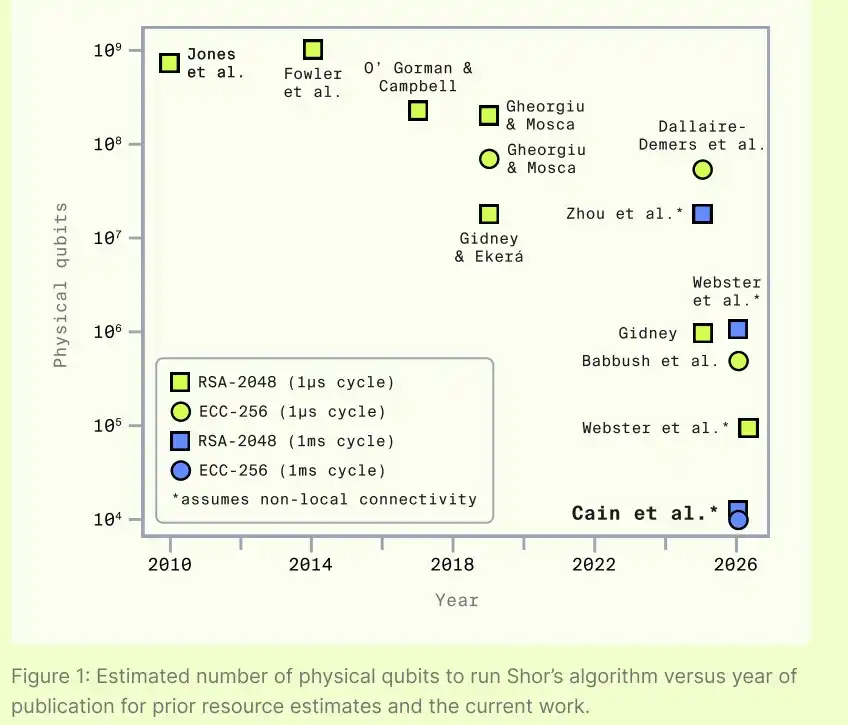
Justin Drake warned that the increasing capabilities of AI in cryptanalysis have already impacted lattice-based scheme HAWK and isogeny-based scheme SQIsign. This has forced the Ethereum Foundation to place its bets on hash-based schemes, which are considered more resistant to quantum attacks.

Previously, Ethereum announced its post-quantum roadmap, including deploying a production-ready leanVM in 2027 and completing deployment on the consensus, execution, and data availability layers by 2028. leanVM is a minimalistic zero-knowledge virtual machine specifically for post-quantum signature aggregation, seen as the core component of the entire strategy.

In March 2026, the Ethereum Foundation launched pq.ethereum.org as a post-quantum security resource center. Over 10 client teams have begun running weekly post-quantum interoperability devnets. The Foundation also established a $1 million Poseidon Prize and an equal Proximity Prize to advance post-quantum cryptography research. Vitalik Buterin himself has repeatedly emphasized that post-quantum security is a necessary condition for Ethereum's "walkaway test"—Ethereum cannot "ossify" unless it achieves quantum security.

The switch in hash functions does not alter the overall structure of Ethereum's post-quantum roadmap. The BLS signatures currently used by validators rely on elliptic curves. Future schemes will still be based on hash signatures like leanXMSS, with leanVM compressing a large number of signatures into a single small proof per block. A comparison previously provided on Ethereum's official page shows that a leanXMSS signature is about 3000 bytes, while a BLS signature is only 96 bytes. leanVM aims for a data compression target of about 250x.

SHA2 or BLAKE2s have longer histories of public analysis, allowing the EF to reduce the time spent waiting for Poseidon parameters to undergo years of cryptanalysis. Drake's suggested roadmap points to a production-ready leanVM in 2027 and deployment on the consensus, data, and execution layers in 2028.

Competition: Solana Chooses Falcon

Ethereum is not the only major public chain preparing for the post-quantum era. The Solana Foundation released its post-quantum security roadmap in April 2026. Its core developer teams, Anza and Jump Crypto's Firedancer, independently researched and converged on the same post-quantum signature scheme: Falcon.

Falcon is one of the NIST-standardized post-quantum signature schemes. Its signatures are compact, making it suitable for high-throughput blockchain environments like Solana.

The two major validator client development teams, Anza and Firedancer, after independent research, both selected the post-quantum digital signature scheme Falcon. They have publicly shared preliminary implementation code on GitHub. The current roadmap involves three steps: continuously evaluating Falcon and alternatives; adopting a post-quantum scheme for new wallets when the quantum threat materializes; and finally, migrating all existing wallets. Additionally, Blueshift's Solana Winternitz Vault has been operating within the ecosystem for over two years and was cited earlier this year as an industry-leading case in a Google Quantum AI whitepaper.

The Solana Foundation stated that a material threat from quantum computing is still years away, so immediate migration is not necessary. However, research, infrastructure, and ecosystem coordination are ready, allowing for a rapid start when the time comes. It is expected that this will not significantly impact network performance.

Starknet is currently the closest reference point to the EF's new direction. StarkWare's roadmap, announced on June 30th, is divided into three phases. The first phase will replace the Pedersen hash algorithm with BLAKE2 for state commitments, contract addresses, and network configurations, while also introducing post-quantum consensus signatures like Falcon-512. The second phase focuses on migration tools for traditional contracts. The final phase addresses remaining external dependencies still tied to Ethereum, including bridge system calls and blob data availability. The third phase depends on Ethereum's own migration path.

Compared to other public chains, Ethereum has chosen a path of "establishing standards first, then implementing code." Abandoning Poseidon in favor of SHA2/BLAKE2 is essentially a choice for more mature, widely-vetted cryptographic primitives in the post-quantum era.


Criptomoedas em alta

Perguntas relacionadas

QWhy did the Ethereum Foundation decide to abandon the Poseidon hash algorithm after eight years of investment and research?

AThe Ethereum Foundation decided to abandon the Poseidon hash algorithm at the L1 layer primarily due to the evolving requirements for post-quantum security. While Poseidon was SNARK-friendly and efficient for applications like zkRollups, new SNARK design breakthroughs using binary fields have made traditional hash functions like SHA2 or BLAKE2 perform comparably well in SNARK circuits. Additionally, these traditional functions have a longer history of public cryptographic analysis, offering greater security assurance in the face of the quantum computing threat and advanced AI cryptanalysis.

QWhat technological breakthrough enabled traditional hash functions to become viable for use in SNARK circuits, challenging Poseidon's advantage?

AThe key breakthrough was the shift to using binary fields (fields with elements 0 and 1) in SNARK construction. Traditional hash functions like SHA2 rely heavily on bitwise operations (XOR, shifts), which were expensive to simulate in older SNARKs based on large prime fields. Binary field-based SNARKs can handle these bitwise operations natively and efficiently. This allows traditional hash functions to be proven in SNARKs with performance rivaling that of SNARK-optimized designs like Poseidon, as demonstrated by projects like Binius and Flock.

QWhat is the significance of the planned 'leanVM' in Ethereum's post-quantum roadmap, and when is it expected?

AThe 'leanVM' (a minimal zero-knowledge virtual machine for post-quantum signature aggregation) is a core component of Ethereum's post-quantum strategy. Its significance lies in compressing a large number of large post-quantum signatures (e.g., ~3000 bytes for leanXMSS) into a single, small proof per block (aiming for ~250x compression). This is crucial for maintaining blockchain scalability and efficiency. The production-ready leanVM is currently targeted for 2027, with full deployment across the consensus, execution, and data availability layers planned for 2028.

QHow does Solana's approach to post-quantum security differ from Ethereum's new direction, and what scheme did it choose?

ASolana's approach differs by focusing on a specific, compact post-quantum signature scheme suitable for its high-throughput environment. Both its major client development teams (Anza and Firedancer) independently selected Falcon, a NIST-standardized lattice-based signature scheme known for its small signature size. Solana's plan is more incremental: assess schemes, adopt for new wallets when needed, and eventually migrate existing wallets. In contrast, Ethereum is taking a broader 'standards-first' approach, opting for widely analyzed traditional hash functions (SHA2/BLAKE2) as base cryptographic primitives within its new SNARK framework to build its post-quantum ecosystem.

QAccording to the article, what major external factor is accelerating the need for post-quantum cryptography in blockchain?

AThe major external factor is the rapid advancement of quantum computing and the growing threat it poses to current cryptographic systems. Reports like 'The Quantum Threat to Blockchains - 2026' warn of a potential 'Q-Day' (when quantum computers can break current encryption) between 2030 and 2033. Quantum computers running Shor's algorithm could crack the elliptic-curve cryptography (like ECDSA and BLS) that secures billions in blockchain assets. Furthermore, enhanced AI cryptanalysis has already compromised some post-quantum candidates (like HAWK and SQIsign), increasing urgency and pushing projects like Ethereum towards hash-based schemes considered more quantum-resistant.

Leituras Relacionadas

$2 Trillion: Countdown to AI's Largest IPO in History

The countdown for the largest IPO in AI history, a potential $2 trillion listing for Anthropic, is underway for October. The staggering valuation, reportedly projected by several investors, contrasts with the company's own internal restraint on setting a public target. Founded five years ago by former OpenAI core members, Anthropic's growth has been meteoric. Annual recurring revenue (ARR) surged from ~$9B in late 2025 to $47B by May 2026, with Q2 2026 revenue of $11.5B marking a 14x year-over-year increase. Bank valuations are even based on internal 2028 revenue forecasts of $190-200B. A key growth driver is Claude Code, its AI coding assistant. Its ARR quintupled in five months to $2.5B by February 2026, now constituting nearly 20% of total revenue. Surveys indicate Anthropic commands roughly 40% of enterprise LLM spending, doubling OpenAI's share in programming-specific use. However, alongside this explosive growth, reports detail significant internal cultural strife. Critics describe a divisive "priesthood" of PhD executives, led by CEO Dario Amodei, who promote a "save humanity" narrative that some employees find cult-like and alienating. This has reportedly created a demoralized workforce and a covert "underground network" of dissent among engineers torn between lucrative pre-IPO equity and a toxic work environment. Anthropic now faces a pivotal paradox: pursuing its mission of "safe" AI requires immense capital for compute, yet that capital demands relentless commercial growth. As it approaches its historic IPO, the company must navigate intense regulatory scrutiny, soaring operational costs, and internal tensions—any of which could destabilize its post-listing trajectory, much like SpaceX's significant post-IPO stock drop. The stage is set for a defining moment in tech history.

marsbitHá 55m

$2 Trillion: Countdown to AI's Largest IPO in History

marsbitHá 55m

AI Boosting Efficiency and Cutting Costs Makes VC Increasingly Expensive

"AI for Cost Reduction Makes VC Funding More Expensive" Despite the "cost-reduction and efficiency" narrative of AI, venture capital (VC) investment in the AI sector is becoming increasingly costly. While AI tools lower the initial costs for many startups—with team sizes shrinking across funding stages—the market is polarizing. For top-tier AI teams, especially those from leading companies like Google and OpenAI, funding rounds are now larger and valuations are higher than ever at the seed and early stages. For example, new ventures by prominent researchers are securing billions in funding with valuations reaching tens of billions before having a mature product. This creates a "barbell" market: lightweight startups need less capital, while elite AI firms attract massive investments early on. This dynamic raises the cost for VCs to acquire and maintain meaningful ownership stakes. As valuations soar early, securing the same equity percentage requires significantly larger capital commitments. VCs must now invest more upfront and reserve substantial funds for follow-on rounds to avoid dilution, prompting large firms like Accel and a16z to raise massive new funds. Consequently, capital is concentrating intensely in a few perceived winners like OpenAI and Anthropic, widening the gap between large and small VC funds. While high valuations bake in future growth expectations, they also compress potential returns, demanding that portfolio companies achieve unprecedented scale. For major VCs, the core strategy is clear: secure early positions in potential winners and maintain the capital to keep investing as valuations rapidly escalate.

marsbitHá 1h

AI Boosting Efficiency and Cutting Costs Makes VC Increasingly Expensive

marsbitHá 1h

Programmers Worldwide Are Wasting Money on Anthropic! The Company Can't Stand It Anymore

Anthropic recently published guidelines to help developers using Claude Code reduce unnecessary token costs. The key recommendations include: 1) Clear (/clear) conversations after completing a task to avoid carrying irrelevant file reads and command outputs into the next task. 2) Set the model and reasoning effort level at the start of a session, as switching mid-session invalidates the prompt cache, requiring a full-price recalculation of the entire dialog history. 3) Attach files using @ references instead of typing paths manually to avoid extra tool calls and searches that bloat the context. 4) Add quiet flags to verbose commands (e.g., in CLAUDE.md) to minimize lengthy output in the dialog history. 5) Use /compact while the session cache is still warm (before breaks) to compress the dialog at one-tenth the cost. 6) Offload large-output tasks to a sub-agent, which runs in an isolated context and only returns conclusions, preventing intermediate outputs from polluting the main dialog. The article explains token pricing: input tokens (prefill) are processed in parallel, while output tokens (decode) are generated serially, making output tokens five times more expensive. Caching is crucial for savings—if a request's prefix (system prompt, CLAUDE.md, dialog history) matches the previous one byte-for-byte, reading it costs only 10% of the standard input price. However, cache invalidation occurs when changing models, effort levels, fast mode, compressing dialogs, after cache expiration, or when resuming old sessions. Dialog history also grows quadratically (O(n²)) as file contents and command outputs accumulate, increasing costs per round. Proactive context management—like isolating noisy tasks, using /rewind to trim unproductive turns, and task-based session clearing—is becoming an essential skill for cost-effective AI-assisted development.

marsbitHá 4h

Programmers Worldwide Are Wasting Money on Anthropic! The Company Can't Stand It Anymore

marsbitHá 4h

Pax Silica vs. WAICO: The US Wants to Prohibit Europe from Using Chinese Artificial Intelligence

The United States is preparing to demand that European and other partners abandon Chinese artificial intelligence initiatives, threatening exclusion from the American-led "Pax Silica" coalition, according to a leaked U.S. State Department document. This ultimatum forces signatories of the "AI Opportunity Statement" to choose between the Western technological ecosystem and alternative frameworks, with China not explicitly named but clearly targeted. Pax Silica is a U.S. strategy for AI and semiconductor hegemony, launched in late 2025. Its European presence expanded significantly in mid-2026. Concurrently, China, Russia, and 27 other nations established the World AI Cooperation Organization (WAICO) in July 2026 as an independent intergovernmental platform promoting AI governance based on UN principles. This situation creates a difficult choice, especially for European nations balancing strategic autonomy with dependence on U.S. tech and security. It also pressures Global South countries with pragmatic ties to both Washington and Beijing. The formation of competing blocks risks fragmenting the global tech landscape, forcing companies to split supply chains, increasing costs, and potentially leading to incompatible standards and protocols. The era of open globalization in AI may be ending, replaced by geopolitical confrontation where technological sovereignty trumps economic efficiency. The decisions made will shape the global digital economy for decades.

cryptonews.ruHá 6h

Pax Silica vs. WAICO: The US Wants to Prohibit Europe from Using Chinese Artificial Intelligence

cryptonews.ruHá 6h

Trading

Spot

Artigos em Destaque

O que é ETH 2.0

ETH 2.0: Uma Nova Era para o Ethereum Introdução ETH 2.0, amplamente conhecido como Ethereum 2.0, marca uma atualização monumental à blockchain do Ethereum. Esta transição não é meramente uma mudança estética; visa melhorar fundamentalmente a escalabilidade, segurança e sustentabilidade da rede. Com uma mudança do mecanismo de consenso em Proof of Work (PoW), intensivo em energia, para um Proof of Stake (PoS) mais eficiente, o ETH 2.0 promete uma abordagem transformadora ao ecossistema blockchain. O que é ETH 2.0? ETH 2.0 é um conjunto de atualizações distintas e interconectadas focadas na otimização das capacidades e desempenho do Ethereum. Esta reformulação foi projetada para abordar desafios críticos que o mecanismo atual do Ethereum enfrentou, particularmente em relação à velocidade das transações e à congestão da rede. Objetivos do ETH 2.0 Os principais objetivos do ETH 2.0 giram em torno da melhoria de três aspectos centrais: Escalabilidade: Com o objetivo de melhorar significativamente o número de transações que a rede pode manejar por segundo, o ETH 2.0 procura ultrapassar a limitação atual de aproximadamente 15 transações por segundo, alcançando potencialmente milhares. Segurança: Medidas de segurança melhoradas são integrais ao ETH 2.0, especialmente através da resistência aprimorada contra ciberataques e da preservação do ethos descentralizado do Ethereum. Sustentabilidade: O novo mecanismo PoS foi projetado não apenas para melhorar a eficiência, mas também para reduzir drasticamente o consumo de energia, alinhando a estrutura operacional do Ethereum com considerações ambientais. Quem é o Criador do ETH 2.0? A criação do ETH 2.0 pode ser atribuída à Ethereum Foundation. Esta organização sem fins lucrativos, que desempenha um papel crucial no apoio ao desenvolvimento do Ethereum, é liderada pelo co-fundador notável Vitalik Buterin. A sua visão de um Ethereum mais escalável e sustentável tem sido a força motriz por trás desta atualização, envolvendo contribuições de uma comunidade global de desenvolvedores e entusiastas dedicados a melhorar o protocolo. Quem são os Investidores do ETH 2.0? Embora os detalhes sobre os investidores do ETH 2.0 não tenham sido tornados públicos, é sabido que a Ethereum Foundation recebe apoio de várias organizações e indivíduos no espaço da blockchain e tecnologia. Esses parceiros incluem firmas de capital de risco, empresas de tecnologia e organizações filantrópicas que compartilham um interesse mútuo em apoiar o desenvolvimento de tecnologias descentralizadas e infraestrutura de blockchain. Como Funciona o ETH 2.0? ETH 2.0 é notável por introduzir uma série de características chave que o diferenciam do seu predecessor. Proof of Stake (PoS) A transição para um mecanismo de consenso PoS é uma das mudanças de destaque do ETH 2.0. Ao contrário do PoW, que depende da mineração intensiva em energia para a verificação de transações, o PoS permite que os utilizadores validem transações e criem novos blocos de acordo com a quantidade de ETH que apostam na rede. Isso leva a uma maior eficiência energética, reduzindo o consumo em aproximadamente 99,95%, tornando o Ethereum 2.0 uma alternativa consideravelmente mais ecológica. Shard Chains As shard chains são outra inovação crítica do ETH 2.0. Estas cadeias menores operam em paralelo com a cadeia principal do Ethereum, permitindo que várias transações sejam processadas simultaneamente. Esta abordagem melhora a capacidade geral da rede, abordando preocupações de escalabilidade que têm atormentado o Ethereum. Beacon Chain No coração do ETH 2.0 está a Beacon Chain, que coordena a rede e gere o protocolo PoS. Ela atua como uma espécie de organizador: supervisiona os validadores, garante que as shards permaneçam conectadas à rede e monitora a saúde geral do ecossistema blockchain. Linha do Tempo do ETH 2.0 A jornada do ETH 2.0 tem sido marcada por vários marcos chave que traçam a evolução desta atualização significativa: Dezembro de 2020: O lançamento da Beacon Chain marcou a introdução do PoS, preparando o caminho para a migração para o ETH 2.0. Setembro de 2022: A conclusão de “The Merge” representa um momento crucial em que a rede Ethereum fez a transição com sucesso de um quadro PoW para um PoS, anunciando uma nova era para o Ethereum. 2023: O lançamento esperado das shard chains visa melhorar ainda mais a escalabilidade da rede Ethereum, solidificando o ETH 2.0 como uma plataforma robusta para aplicações e serviços descentralizados. Características Chave e Benefícios Escalabilidade Melhorada Uma das vantagens mais significativas do ETH 2.0 é a sua escalabilidade melhorada. A combinação de PoS e shard chains permite que a rede expanda a sua capacidade, permitindo que acomode um volume de transações muito maior em comparação com o sistema legado. Eficiência Energética A implementação do PoS representa um enorme passo em direção à eficiência energética na tecnologia blockchain. Ao reduzir drasticamente o consumo de energia, o ETH 2.0 não só reduz os custos operacionais, mas também se alinha mais estreitamente com os objetivos globais de sustentabilidade. Segurança Aprimorada Os mecanismos atualizados do ETH 2.0 contribuem para uma segurança melhorada em toda a rede. O uso do PoS, juntamente com medidas de controle inovadoras estabelecidas através das shard chains e da Beacon Chain, assegura um maior grau de proteção contra potenciais ameaças. Custos Mais Baixos para os Utilizadores À medida que a escalabilidade melhora, os efeitos sobre os custos de transação também serão evidentes. Aumentada a capacidade e reduzida a congestão, espera-se que isso se traduza em taxas mais baixas para os utilizadores, tornando o Ethereum mais acessível para transações do dia a dia. Conclusão ETH 2.0 marca uma evolução significativa no ecossistema da blockchain do Ethereum. Ao abordar questões fundamentais como a escalabilidade, o consumo de energia, a eficiência das transações e a segurança geral, a importância desta atualização não pode ser subestimada. A transição para o Proof of Stake, a introdução das shard chains e o trabalho fundamental da Beacon Chain são indicativos de um futuro em que o Ethereum pode atender à crescente demanda do mercado descentralizado. Em uma indústria movida pela inovação e progresso, o ETH 2.0 representa um testemunho das capacidades da tecnologia blockchain em pavimentar o caminho para uma economia digital mais sustentável e eficiente.

267 Visualizações TotaisPublicado em {updateTime}Atualizado em 2024.12.03

O que é ETH 2.0

O que é ETH 3.0

ETH3.0 e $eth 3.0: Uma Análise Profunda do Futuro do Ethereum Introdução No ambiente em rápida evolução da criptomoeda e da tecnologia blockchain, o ETH3.0, frequentemente denotado como $eth 3.0, emergiu como um tema de considerável interesse e especulação. O termo abrange dois conceitos principais que merecem esclarecimento: Ethereum 3.0: Esta representa uma potencial atualização futura destinada a aumentar as capacidades da atual blockchain do Ethereum, focando especialmente na melhoria da escalabilidade e desempenho. ETH3.0 Meme Token: Este distinto projeto de criptomoeda procura aproveitar a blockchain do Ethereum na criação de um ecossistema centrado em memes, promovendo o envolvimento na comunidade de criptomoedas. Compreender esses aspectos do ETH3.0 é essencial não apenas para entusiastas de criptomoedas, mas também para aqueles que observam as tendências tecnológicas mais amplas no espaço digital. O que é ETH3.0? Ethereum 3.0 Ethereum 3.0 é promovido como uma atualização proposta para a rede Ethereum já estabelecida, que tem sido a espinha dorsal de muitas aplicações descentralizadas (dApps) e contratos inteligentes desde a sua criação. As melhorias vislumbradas concentram-se principalmente na escalabilidade—integrando tecnologias avançadas como sharding e provas de conhecimento zero (zk-proofs). Essas inovações tecnológicas visam facilitar um número sem precedentes de transações por segundo (TPS), potencialmente alcançando milhões, abordando assim uma das limitações mais significativas enfrentadas pela tecnologia blockchain atual. A melhoria não é meramente técnica, mas também estratégica; visa preparar a rede Ethereum para uma adoção generalizada e utilidade em um futuro marcado por uma maior demanda por soluções descentralizadas. ETH3.0 Meme Token Em contraste com o Ethereum 3.0, o ETH3.0 Meme Token aventura-se por um domínio mais leve e divertido, combinando a cultura dos memes da internet com a dinâmica das criptomoedas. Este projeto permite que os usuários comprem, vendam e negociem memes na blockchain do Ethereum, proporcionando uma plataforma que fomenta o envolvimento da comunidade através da criatividade e interesses compartilhados. O ETH3.0 Meme Token visa demonstrar como a tecnologia blockchain pode interseccionar com a cultura digital, criando casos de uso que são tanto divertidos quanto financeiramente viáveis. Quem é o Criador do ETH3.0? Ethereum 3.0 A iniciativa em direção ao Ethereum 3.0 é impulsionada principalmente por um consórcio de desenvolvedores e pesquisadores dentro da comunidade Ethereum, notavelmente incluindo Justin Drake. Conhecido por suas percepções e contribuições para a evolução do Ethereum, Drake tem sido uma figura proeminente nas discussões sobre a transição do Ethereum para uma nova camada de consenso, referida como “Beam Chain”. Esta abordagem colaborativa ao desenvolvimento significa que o Ethereum 3.0 não é fruto de um único criador, mas sim uma manifestação da engenhosidade coletiva focada no avanço da tecnologia blockchain. ETH3.0 Meme Token Os detalhes sobre o criador do ETH3.0 Meme Token são atualmente indetectáveis. A natureza dos tokens de meme frequentemente leva a uma estrutura mais descentralizada e impulsionada pela comunidade, o que poderia explicar a falta de atribuição específica. Isso alinha-se com a ethos da comunidade de criptomoedas mais ampla, onde a inovação geralmente surge de esforços colaborativos em vez de esforços individuais. Quem são os Investidores do ETH3.0? Ethereum 3.0 O apoio ao Ethereum 3.0 provém principalmente da Fundação Ethereum, juntamente com uma comunidade entusiástica de desenvolvedores e investidores. Esta associação fundacional proporciona um grau significativo de legitimidade e melhora as perspectivas de uma implementação bem-sucedida, uma vez que aproveita a confiança e credibilidade construída ao longo de anos de operações de rede. Em um clima em rápida mudança no mundo das criptomoedas, o apoio da comunidade desempenha um papel crucial no impulso ao desenvolvimento e adoção, posicionando o Ethereum 3.0 como um sério candidato a futuros avanços na blockchain. ETH3.0 Meme Token Embora as fontes atualmente disponíveis não forneçam informações explícitas sobre as fundações ou organizações de investimento que apoiam o ETH3.0 Meme Token, é indicativo do modelo típico de financiamento para tokens de meme, que frequentemente depende de apoio base e engajamento da comunidade. Os investidores em tais projetos costumam consistir em indivíduos motivados pelo potencial de inovação impulsionada pela comunidade e pelo espírito de cooperação encontrado dentro da comunidade cripto. Como Funciona o ETH3.0? Ethereum 3.0 As características distintivas do Ethereum 3.0 residem em sua proposta de implementação de sharding e tecnologia zk-proof. Sharding é um método de partição da blockchain em partes menores e gerenciáveis ou “shards”, que podem processar transações simultaneamente em vez de sequencialmente. Esta descentralização do processamento ajuda a prevenir congestionamentos e garante que a rede permaneça responsiva mesmo sob carga pesada. A tecnologia de prova de conhecimento zero (zk-proof) contribui com outra camada de sofisticação ao permitir a validação de transações sem revelar os dados subjacentes envolvidos. Este aspecto não apenas melhora a privacidade, mas também aumenta a eficiência geral da rede. Há também conversas sobre a incorporação de uma Máquina Virtual Ethereum de conhecimento zero (zkEVM) nesta atualização, amplificando ainda mais as capacidades e utilidade da rede. ETH3.0 Meme Token O ETH3.0 Meme Token distingue-se ao capitalizar sobre a popularidade da cultura dos memes. Estabelece um mercado para que os usuários participem da negociação de memes, não apenas para entretenimento, mas também para potencial ganho econômico. Ao integrar recursos como staking, provisão de liquidez e mecanismos de governança, o projeto fomenta um ambiente que incentiva a interação e participação da comunidade. Ao oferecer uma mistura única de entretenimento e oportunidade econômica, o ETH3.0 Meme Token visa atrair um público diversificado, variando de entusiastas de criptomoedas a conhecedores casuais de memes. Cronologia do ETH3.0 Ethereum 3.0 11 de novembro de 2024: Justin Drake sugere a próxima atualização do ETH 3.0, centrada nas melhorias de escalabilidade. Este anúncio sinaliza o início de discussões formais sobre a futura arquitetura do Ethereum. 12 de novembro de 2024: A proposta antecipada para Ethereum 3.0 deve ser revelada no Devcon em Bangkok, preparando o cenário para um feedback mais amplo da comunidade e potenciais próximos passos no desenvolvimento. ETH3.0 Meme Token 21 de março de 2024: O ETH3.0 Meme Token é oficialmente listado no CoinMarketCap, marcando sua entrada no domínio público das criptomoedas e aumentando a visibilidade de seu ecossistema baseado em memes. Pontos Chave Em conclusão, Ethereum 3.0 representa uma evolução significativa dentro da rede Ethereum, focando em superar limitações quanto à escalabilidade e desempenho através de tecnologias avançadas. As atualizações propostas refletem uma abordagem proativa às futuras demandas e usabilidade. Por outro lado, o ETH3.0 Meme Token encapsula a essência da cultura impulsionada pela comunidade no espaço das criptomoedas, aproveitando a cultura dos memes para criar plataformas envolventes que incentivam a criatividade e participação dos usuários. Compreender os distintos propósitos e funcionalidades do ETH3.0 e $eth 3.0 é fundamental para qualquer pessoa interessada nos desenvolvimentos contínuos dentro do espaço cripto. Com ambas as iniciativas a pavimentar caminhos únicos, elas sublinham coletivamente a natureza dinâmica e multifacetada da inovação em blockchain.

268 Visualizações TotaisPublicado em {updateTime}Atualizado em 2024.12.03

O que é ETH 3.0

Como comprar ETH

Bem-vindo à HTX.com!Tornámos a compra de Ethereum (ETH) simples e conveniente.Segue o nosso guia passo a passo para iniciar a tua jornada no mundo das criptos.Passo 1: cria a tua conta HTXUtiliza o teu e-mail ou número de telefone para te inscreveres numa conta gratuita na HTX.Desfruta de um processo de inscrição sem complicações e desbloqueia todas as funcionalidades.Obter a minha contaPasso 2: vai para Comprar Cripto e escolhe o teu método de pagamentoCartão de crédito/débito: usa o teu visa ou mastercard para comprar Ethereum (ETH) instantaneamente.Saldo: usa os fundos da tua conta HTX para transacionar sem problemas.Terceiros: adicionamos métodos de pagamento populares, como Google Pay e Apple Pay, para aumentar a conveniência.P2P: transaciona diretamente com outros utilizadores na HTX.Mercado de balcão (OTC): oferecemos serviços personalizados e taxas de câmbio competitivas para os traders.Passo 3: armazena teu Ethereum (ETH)Depois de comprar o teu Ethereum (ETH), armazena-o na tua conta HTX.Alternativamente, podes enviá-lo para outro lugar através de transferência blockchain ou usá-lo para transacionar outras criptomoedas.Passo 4: transaciona Ethereum (ETH)Transaciona facilmente Ethereum (ETH) no mercado à vista da HTX.Acede simplesmente à tua conta, seleciona o teu par de trading, executa as tuas transações e monitoriza em tempo real.Oferecemos uma experiência de fácil utilização tanto para principiantes como para traders experientes.

3.8k Visualizações TotaisPublicado em {updateTime}Atualizado em 2026.06.02

Como comprar ETH

Discussões

Bem-vindo à Comunidade HTX. Aqui, pode manter-se informado sobre os mais recentes desenvolvimentos da plataforma e obter acesso a análises profissionais de mercado. As opiniões dos utilizadores sobre o preço de ETH (ETH) são apresentadas abaixo.

活动图片