June 19, ZHIDONGSHE News, Today, Google DeepMind researcher and Gemini co-head Noam Shazeer has officially joined OpenAI, where he will serve as the Lead for Architecture Research. He will be responsible for exploring next-generation AI model architectures and driving the further evolution of the Transformer architecture.
Shazeer himself announced his move to OpenAI in a post on the overseas social platform X, stating: "I'm thrilled to join OpenAI and look forward to working with the exceptional team here."

Simultaneously, he expressed gratitude to the Google team: "Leaving was a difficult decision. I'm immensely proud of the Google team and everything we've accomplished together. It has been a privilege to work with you all." A Google spokesperson, in a response to Reuters, stated that the company is grateful for Shazeer's significant contributions over the years and wishes him all the best in his future endeavors.
Noam Shazeer is one of the legendary figures in the AI field. He is one of the core authors of the seminal 2017 paper 'Attention Is All You Need', which first proposed the Transformer architecture, directly establishing the technical foundation for modern large models like the GPT series, Gemini, and Claude.
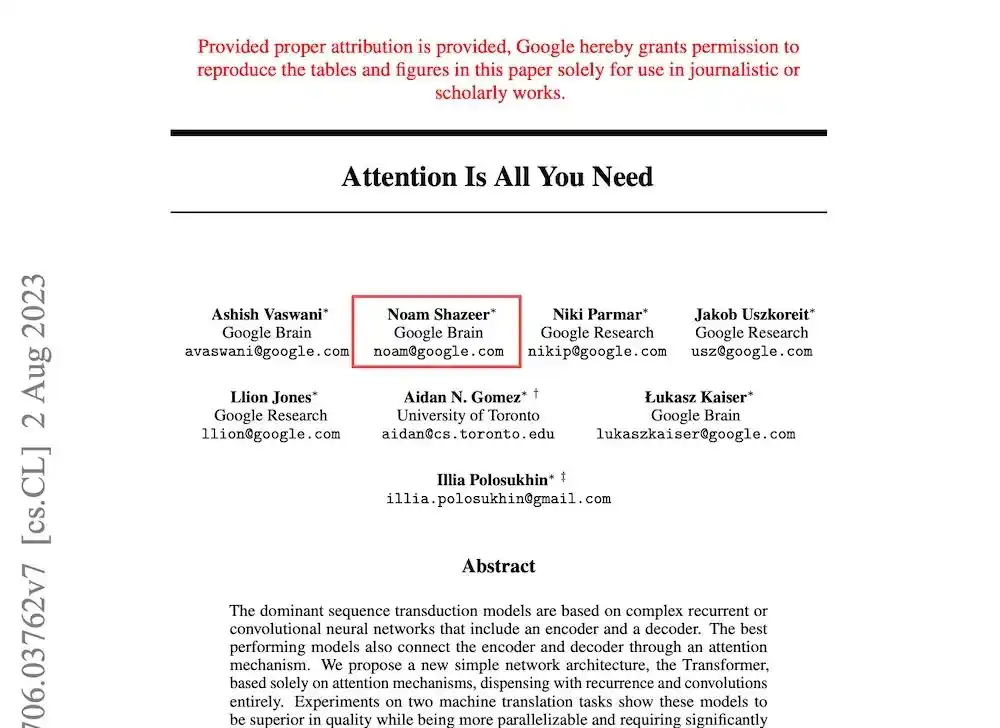
'Attention Is All You Need'
Before joining OpenAI, Shazeer had left Google in 2021 to found Character.AI. In fact, Shazeer is best known as the Co-founder and CEO of Character.AI.
This company bet on the "AI companionship"赛道 even earlier than the ChatGPT explosion, allowing users to engage in long-term conversations with various AI characters. It once became one of the fastest-growing consumer AI applications globally. By 2023, Character.AI's valuation had exceeded $1 billion (approximately RMB 6.765 billion).
In 2024, Google reached a technology licensing agreement with Character.AI valued at approximately $2.7 billion (about RMB 18.266 billion), bringing Noam Shazeer and part of the core team back into DeepMind. Noam Shazeer was appointed as a Gemini co-head, involved in the pre-training R&D of the next-generation Gemini models.
For OpenAI, which is fiercely competing with Anthropic, this is viewed externally as one of the most significant top-tier talent acquisitions in recent years. Following the announcement, OpenAI's senior leadership and several renowned researchers immediately left welcoming messages on X.
OpenAI's Chief Research Officer, Mark Chen, posted: "Very excited to welcome Noam Shazeer to OpenAI as our Lead for Architecture Research. His work on Transformers, MoE, and efficient decoding has shaped modern AI."
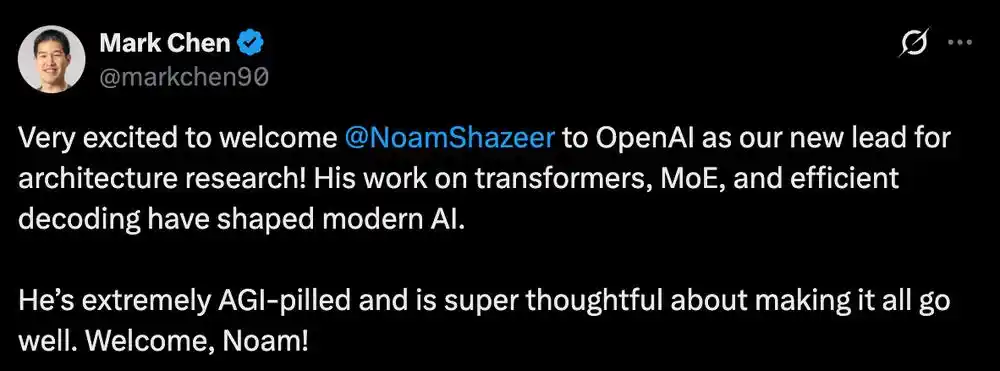
Subsequently, numerous AI researchers also offered congratulations in the comments section, including Google DeepMind researcher and Chinese member of the Gemini Thinking and Coding team, Yuchen Zhuang; OpenAI researcher and core contributor to the o-series reasoning models, Noam Brown; and former Microsoft AI VP, now OpenAI researcher, Sebastien Bubeck, among others.

Google DeepMind Chinese researcher Yuchen Zhuang

OpenAI o-series reasoning model core contributor Noam Brown

OpenAI researcher Sebastien Bubeck
Meanwhile, netizens lamented: "Losing a Transformer author and Gemini co-head is undoubtedly a heavy blow for Google."

01. Renowned Transformer Author, Worked at Google for Nearly 18 Years
From the perspective of the history of generative AI, Noam Shazeer has participated in nearly every key milestone. He joined Google in 2000, serving as a Software Engineer and later Principal Software Engineer, accumulating over 18 years of work experience.
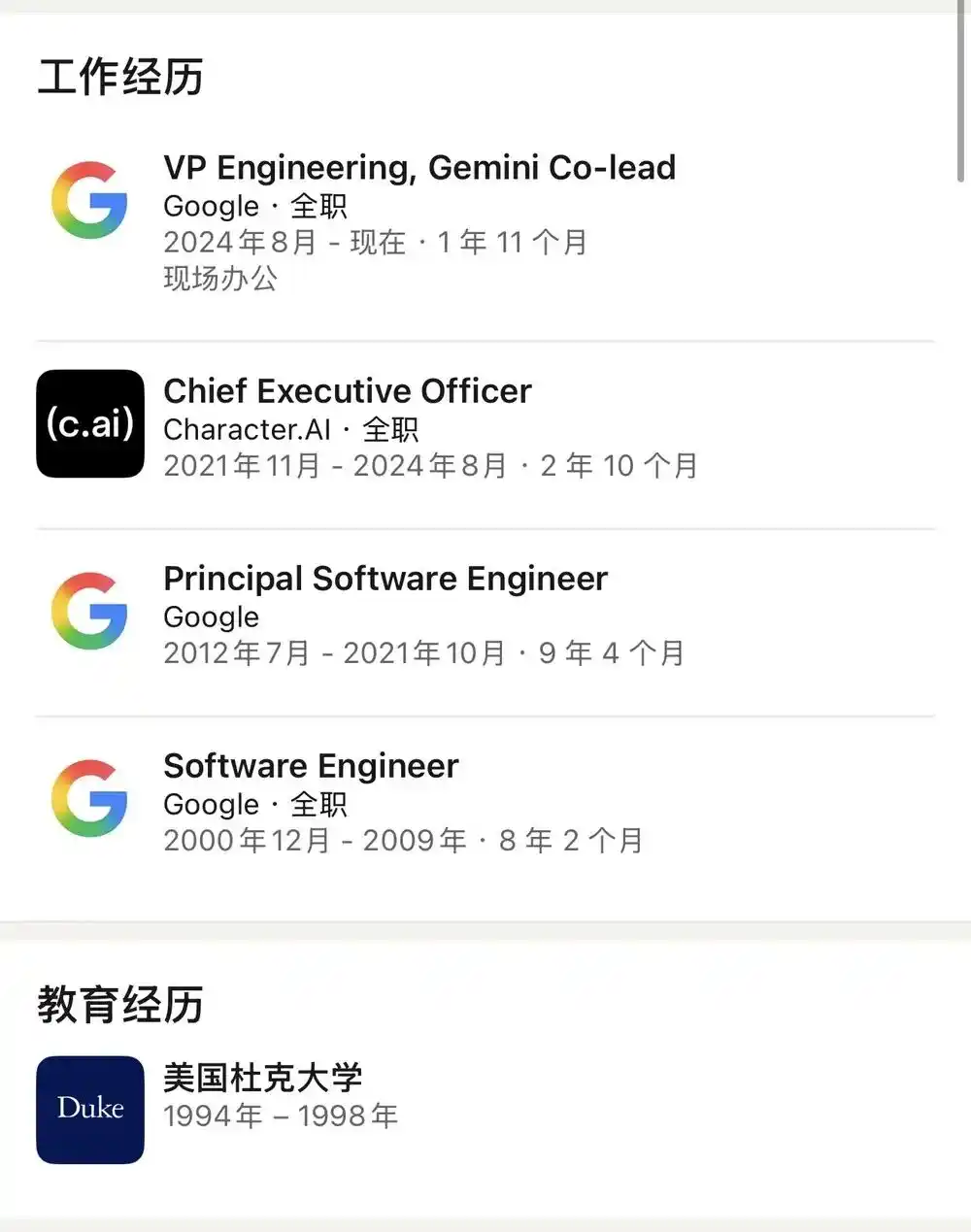
Noam Shazeer's Work Experience and Education Background (Source: LinkedIn)
In 2017, he, along with Ashish Vaswani, Jakob Uszkoreit, and six other Google researchers, co-authored the seminal paper 'Attention Is All You Need', proposing the Transformer architecture. Compared to the then-dominant RNN and LSTM models, the Transformer could process long text more efficiently and possessed greater scalability.
Over the past few years, models such as OpenAI's GPT series, Google's Gemini, Anthropic's Claude, as well as DeepSeek and Llama, are almost all built upon the Transformer architecture at their core. In other words, today's global wave of large models largely rests on the technical foundation laid by this paper.
However, the Transformer is just one of Noam Shazeer's many notable contributions.
During his tenure at Google, he also contributed to the advancement of numerous influential large model technologies. In 2017, as the first author, he proposed the Sparse Gated Mixture of Experts (MoE) architecture, providing crucial technical ideas for later models like GPT-4, Gemini, and DeepSeek-V3; in 2018, he participated in developing Mesh TensorFlow, providing foundational tools for super-large-scale Transformer training; subsequently, he was also involved in key project R&D such as the T5 model and Google's dialogue model LaMDA.
02. Left Google to Start a Company, Then Bought Back for $18.2B
In 2021, Shazeer left Google and co-founded Character.AI with Daniel De Freitas.
At that time, large language models had not yet experienced their "ChatGPT moment," but Character.AI was already pioneering efforts to bring chatbot products to the mass market, rapidly accumulating a large user base.
In 2024, Google reincorporated Shazeer and his core team into the DeepMind ecosystem through a cooperation deal worth approximately $2.7 billion (about RMB 18.266 billion). He subsequently became one of the key leaders of the Gemini project, participating in the pre-training of the next-generation Gemini models.
Shazeer's return coincided with a period of immense pressure on Google's AI business. ChatGPT had exploded in popularity, and Gemini was still in a catch-up phase. After returning to DeepMind, Shazeer participated in model R&D and eventually assumed the role of Gemini co-head, becoming one of the leading figures in Google's AI technology.
Following this, the Gemini 3 series models ranked at the forefront in multiple benchmark tests such as coding and reasoning, becoming a significant asset in Google's competition with OpenAI and Anthropic.
From Google researcher, to entrepreneur, to Gemini co-head, Shazeer has witnessed nearly every major turning point in Google's AI development over the past decade. Therefore, his departure from Google to join OpenAI is regarded by many industry insiders as one of the most significant talent loss events for Google in recent years.
03. OpenAI's Talent Battle Continues to Escalate
Shazeer's joining unfolds against the backdrop of increasingly fierce talent competition in the AI industry.
Over the past year, competition between OpenAI and Anthropic has continued to intensify. The two are not only competing over model capabilities but are also constantly vying for top researchers and core engineers.
The UK's Financial Times reported that OpenAI internally views Shazeer's addition as a major reinforcement. In the future, he will focus on researching new architectural directions beyond the Transformer, and on further enhancing model capabilities.
It's worth noting that the Transformer has dominated the AI field for nearly a decade. With the development of reasoning models, multi-agent systems, and world models, more and more researchers are beginning to ponder: Will the Transformer undergo its next major architectural upgrade?
And Shazeer is precisely one of the most qualified individuals to answer that question.
For Google, this means losing a Transformer author, a Gemini co-head, and one of its most seasoned AI architecture designers. For OpenAI, its laboratory welcomes someone who has personally shaped the modern AI technology stack.
04. Conclusion: A Significant Talent Move in the Transformer Era
As technology gradually approaches the frontier, top researchers themselves have become one of the scarcest resources. The trajectory of Noam Shazeer's career almost connects four key nodes: Transformer, Character.AI, Gemini, and OpenAI.
Now, this Transformer author's departure from Google and joining of OpenAI is not only a talent movement but also reflects the increasingly fierce competitive landscape among current AI giants.
Especially at a time when OpenAI and Anthropic are engaged in a white-hot competition over next-generation models, the enterprise market, and top research talent, and Google is also catching up through Gemini. Losing a Transformer founder and Gemini co-head at this juncture is undoubtedly a significant loss for Google.
For the entire industry, a subsequent question worth following is: When a Transformer author personally researches "architectures beyond the Transformer," where will the next generation of AI models head.
This article is from the WeChat public account "Zhixidongxi" (ID: zhidxcom), author: Jiang Yu, editor: Li Shuiqing