"Crypto Retirement Plan" Heavily Criticized by Democrats: Trump Is "Harvesting" American Workers' Pensions

marsbitPublicado em 2026-06-03Última atualização em 2026-06-03

Resumo

Democratic senators Bernie Sanders (I-VT) and Elizabeth Warren (D-MA), along with Representative Bobby Scott (D-VA), are urging the Labor Department to repeal a proposed rule that would open U.S. retirement savings accounts, such as 401(k)s, to investments in cryptocurrencies like Bitcoin and other alternative assets. The rule, stemming from an August executive order by President Trump, would provide a legal safe harbor for plan fiduciaries offering these volatile assets if they follow a prescribed process. The lawmakers argue in a 14-page letter that the rule dangerously weakens long-standing "prudent man" standards under the Employee Retirement Income Security Act (ERISA), potentially exposing the $14.2 trillion in 401(k) savings to high-risk, minimally regulated investments. They cite warnings from FINRA about crypto's high volatility and from the FBI about massive cryptocurrency scam losses. The letter also alleges a conflict of interest, noting that President Trump's adult children manage the family's crypto business, which has reportedly raised billions from digital token sales. They contend the rule change could enrich the Trump family at the expense of workers' retirement security. In defense, the Trump administration frames the rule as expanding worker choice. Acting Labor Secretary Keith Sonderling stated it ends the department "picking winners and losers," requiring fiduciaries to follow a prudent process. Treasury Secretary Scott Bessent supported it as a step ...

Original Author: Micah Zimmerman

Original Compilation: AididiaoJP, Foresight News

Senators Bernie Sanders (I-VT) and Elizabeth Warren (D-MA) have called on the Trump administration's Department of Labor to repeal a rule that would open U.S. retirement savings accounts to Bitcoin and other cryptocurrencies. The lawmakers argue this move would endanger workers' financial futures while allowing President Trump and his family to profit.

On Monday, the three Democrats sent a 14-page letter to Acting Labor Secretary Keith Sonderling. Sanders, Warren, and House Education and the Workforce Committee Ranking Member Bobby Scott (D-VA) strongly condemned the rule proposed by the Department of Labor in March.

The rule would provide fiduciary protections for 401(k) plan sponsors, allowing them to offer volatile assets—including cryptocurrencies, private equity, and private credit—as long as the fiduciaries can demonstrate they have weighed relevant factors before offering them.

The letter states: "The proposed rule is harmful to American workers and runs counter to the law, congressional intent, existing regulations, and case law."

What the Rule Would Do

This proposal stems from an executive order President Trump signed last August, directing the Department of Labor to reconsider the treatment of alternative assets in retirement plans. Under current law, fiduciaries managing 401(k) plans must adhere to a strict "prudence" standard—a requirement rooted in the 1974 Employee Retirement Income Security Act (ERISA) and reinforced by Supreme Court precedent.

Democratic lawmakers argue the new rule would flip this standard. Fiduciaries would no longer need to prove they conducted due diligence; instead, they would be presumed to have acted prudently as long as they followed the process outlined in the rule.

The lawmakers state this shift conflicts with decades of legal precedent and would expose roughly $14.2 trillion in U.S. 401(k) accounts to assets with extreme price volatility and limited regulation.

The Financial Industry Regulatory Authority (FINRA) has warned that crypto investments "exhibit higher volatility compared to traditional investment assets" and "pose a significantly higher risk of losing the entire investment." FBI reports indicate cryptocurrency scam losses exceeded $110 billion in 2025, one of the highest loss categories in cybercrime.

Trump Conflict of Interest Argument

The Democratic lawmakers' criticism extends beyond retirement policy, directly pointing to conflict of interest issues. Trump's adult children manage the family's crypto business, which, according to The Wall Street Journal, has raised approximately $50 billion for the Trump family since launching its digital currency last September.

The Trump family's crypto portfolio includes WLFI and USD1 tokens from World Liberty Financial, as well as the official Trump Meme Coin—which briefly surged above $75 around Trump's January 2025 inauguration before crashing to around $2.

The letter states: "The aforementioned change in the prudence standard expands opportunities for President Trump and his family to profit at the expense of taxpayers, workers, and retirees."

Consumer advocacy group Americans for Financial Reform expressed similar concerns. Its senior policy analyst, Oscar Valdés Viera, said: "Opening 401(k)s to these products could turn workers' retirement savings into a tool resembling a Ponzi scheme, providing a lifeline for an industry desperate for new funds."

The letter also cites elderly poverty data: Over 22.8% of American seniors live in poverty, compared to 5.1% in Denmark, 5.8% in France, and 12.6% in Germany—highlighting the risk retirees cannot afford to take significant losses.

The Administration's Defense

The Trump administration has described the rule as an effort to expand worker choice.

Acting Labor Secretary Sonderling said in a statement: "The days of the Department of Labor picking winners and losers are over. Our rule makes clear that managers must evaluate any potential product offering by following a prudent process."

Treasury Secretary Scott Bessent also expressed support, calling the rule "another step toward ushering in President Trump's 'Golden Age'."

Leituras Relacionadas

After Marvell's 32% Surge, the Chinese Chip Family Behind It Emerges

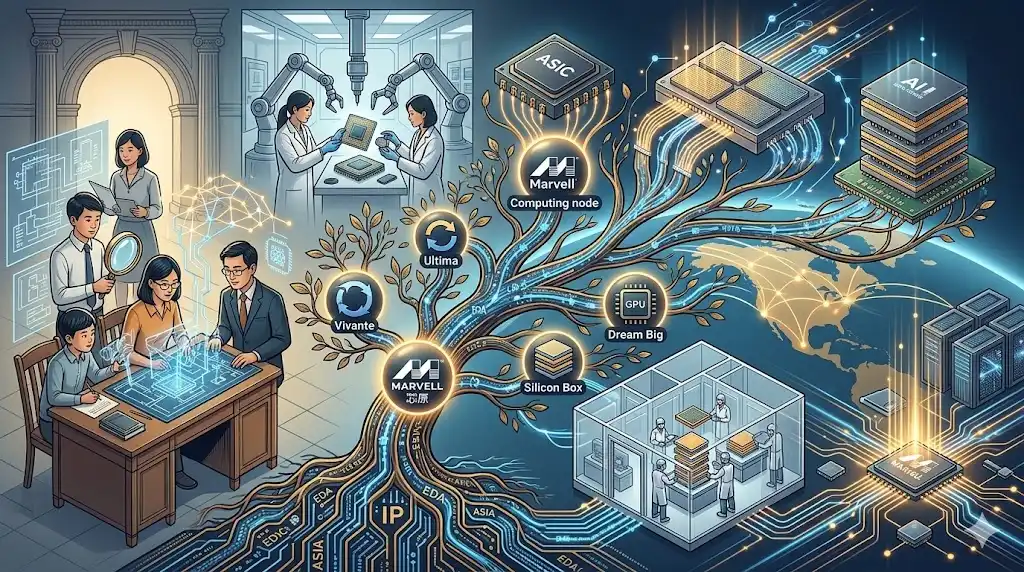
The stock price of Marvell Technology surged 32.5% on June 2nd, driven by NVIDIA CEO Jensen Huang highlighting its custom ASICs and optical interconnects as core to AI data center architecture. This event brought attention to the Chinese semiconductor family behind Marvell: the Dai siblings. The story centers on three siblings, all UC Berkeley graduates, whose three-decade entrepreneurial journey aligns with major semiconductor industry shifts. In 1995, youngest sister Dai Wei Li co-founded Marvell with her husband Sehat Sutardja and his brother, focusing on storage controllers. Eldest brother Dai Wei Min founded EDA company Ultima, later sold to Cadence, and later founded VeriSilicon (芯原) in China, becoming a leading semiconductor IP provider. Second brother Dai Wei Jin co-founded EDA firm Silicon Perspective (sold to Cadence) and GPU IP company Vivante, later acquired by VeriSilicon. The combined "Dai-Sutardja" family network extends beyond Marvell. Their ventures and investments form a comprehensive ecosystem for the post-Moore's Law, chiplet era. Key holdings include: Dream Big Semiconductor (AI SuperNICs, acquired by Arm), Alphawave (high-speed SerDes IP, acquired by Qualcomm), and Silicon Box (a chiplet advanced packaging foundry). VeriSilicon itself thrives on the AI ASIC and IP boom in China. Collectively, the family's AI infrastructure-related portfolio is estimated at over $22 billion. Their strategy represents a distinct path: building critical components for open standards and key manufacturing capacity in the chiplet era, rather than pursuing standalone AI chip dominance. While this path may not create the next NVIDIA, it has enabled repeated successful exits and sustained influence within the global semiconductor industry.

marsbitHá 43m

After Marvell's 32% Surge, the Chinese Chip Family Behind It Emerges

marsbitHá 43m

Microsoft is Afraid of Being Marginalized by AI Giants

Microsoft, once the defining force of the PC era, now faces a familiar challenge in the AI age: the risk of being relegated to a profitable but invisible infrastructure provider. This anxiety was laid bare at Build 2026, where CEO Satya Nadella unveiled a major strategic pivot. The catalyst was a quiet April agreement that dissolved Microsoft's exclusive licensing and cloud-hosting deal with OpenAI, its once-vital partner. This erased Microsoft's key AI moat. With OpenAI and Anthropic defining AI applications and gaining enterprise traction—even within Microsoft's own ranks—Nadella had to answer: without exclusivity, what is Microsoft's role? The answer was a suite of seven in-house AI models, a developer-focused AI workstation (Surface RTX Spark Dev Box), and, most crucially, the Agent 365 platform for enterprise AI governance. The models, notably targeting Anthropic's strengths in coding and enterprise, signal a defensive move. However, the broader strategy is to make the models themselves less decisive. Financially, Microsoft's AI revenue is strong, driven largely by Azure running others' models. Yet its user-facing products like Copilot show weak penetration and engagement. Microsoft earns infrastructure money but lacks direct user mindshare. Nadella's core fear is being "hollowed out." As OpenAI and Anthropic prepare for IPOs and gain financial independence, they may build their own infrastructure, threatening Azure's lucrative AI revenue stream. Microsoft's window is to entrench itself deeper: not as the model creator, but as the indispensable platform for securely deploying, managing, and governing all AI models within the enterprise through Agent 365. Build 2026 revealed Microsoft's bet: in the AI era, the ultimate power lies not in any single model, but in the enterprise "operating system" that controls them. Nadella is determined to ensure Microsoft is the driver of this new era, not just a passenger.

marsbitHá 56m

Microsoft is Afraid of Being Marginalized by AI Giants

marsbitHá 56m

CPU, Quietly Returning to the Center of the AI Computing Power Stage

Over the past three years, AI computing power narratives have been dominated by GPUs. However, starting in 2026, this story began to shift. While training large models remains GPU-intensive, the rapid growth of inference and AI agent workloads, which require high levels of task orchestration, concurrency, and data flow management, has highlighted a renewed critical role for CPUs. These are tasks GPUs are not designed to handle. Intel's recent launch of the Xeon 6+ processor, built on its Intel 18A process and featuring up to 288 efficiency cores (E-cores), exemplifies this strategic pivot. It is positioned not as a mere companion to GPUs but as the essential "control plane" for AI infrastructure, optimized for high-density, energy-efficient, and high-throughput workloads characteristic of AI agents and inference. This "CPU resurgence" is not about CPUs outperforming GPUs in raw computation. It reflects a systemic bottleneck: as AI scales from training single models to deploying countless intelligent agents, the demand for coordination and data handling surges. Major cloud providers are also developing their own high-density ARM-based server CPUs for similar workloads. However, Intel's success with this strategy faces significant challenges. Competition includes NVIDIA's integrated CPU-GPU solutions, the expanding adoption of cloud vendors' in-house ARM CPUs, and the crucial market test of Intel's 18A manufacturing process against rivals like TSMC's N2. In conclusion, CPUs are indeed reclaiming a central, though redefined, role in AI compute—managing the complex orchestration that enables massive-scale AI deployment. While the trend is clear, which company will ultimately lead this CPU resurgence remains an open question to be decided in the data centers of 2027 and beyond.

marsbitHá 1h

CPU, Quietly Returning to the Center of the AI Computing Power Stage

marsbitHá 1h

Trading

Spot
Futuros
活动图片