Source: Sourcery with Molly O'Shea
Compiled by: Felix, PANews
The humanoid robotics company Figure is dedicated to creating a general-purpose humanoid robot capable of performing human tasks, whether on the factory floor or at home. Over multiple funding rounds involving backers such as Jeff Bezos, Microsoft, NVIDIA, and Amazon, its valuation has multiplied 15-fold in just 18 months to reach $39 billion. In this episode of the Sourcery podcast, we take a comprehensive tour of Figure's headquarters and conduct an in-depth interview with Figure's founder and CEO, Brett Adcock, on the future of robotics, AI, and employment.
Brett shares why humanoid robots are now ready for deployment, how Figure plans to scale production from thousands this year to 1 million units annually, and why he believes Figure has the potential to become the world's largest company. We also explore Brett's reasons for leaving OpenAI, the challenges of building physical AI, and what it takes to solve one of engineering's most difficult problems. PANews has compiled this podcast.
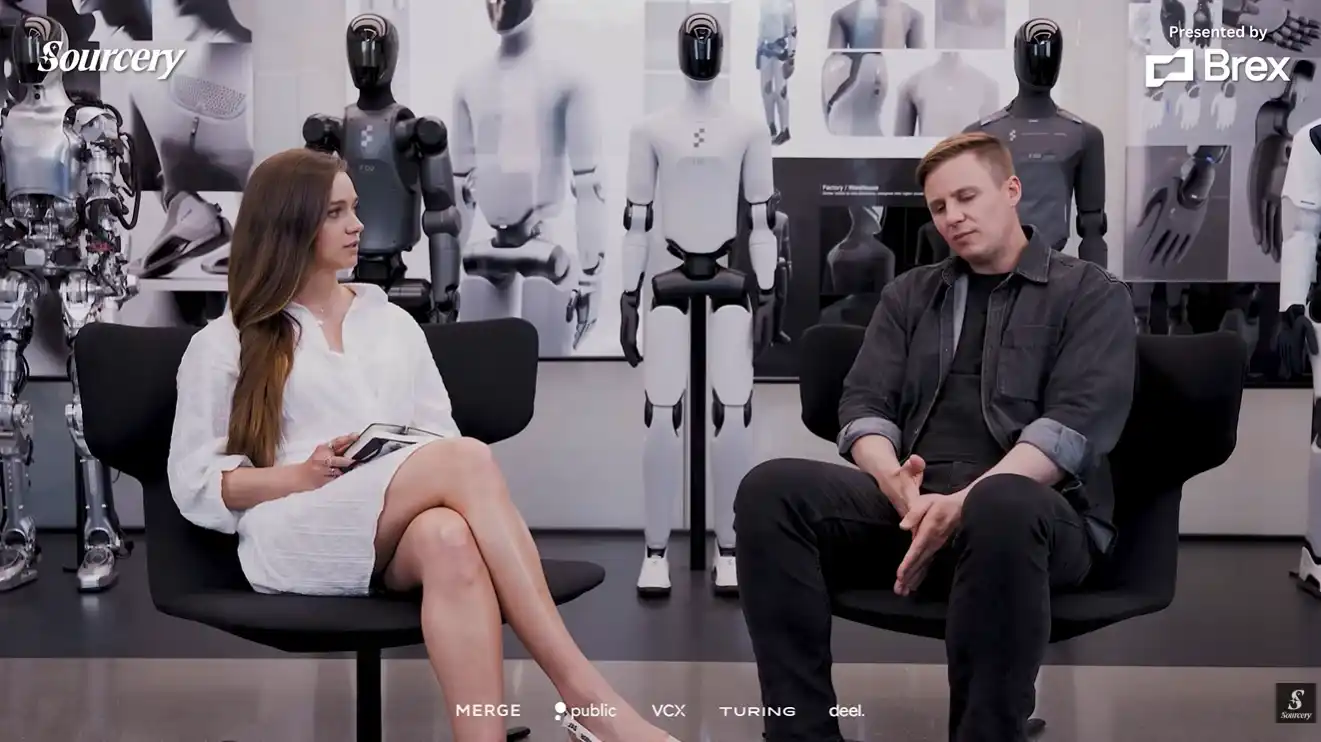
Host: What's your hottest take in robotics right now?
Brett: I think we've spent a lot of time making things fully autonomous and end-to-end. When you came in, you asked a few questions like 'Is this teleoperated?' We don't teleoperate these. I think our view on robotics is that it's hard to see what's really happening in the field without being here in person to see what we're doing. So I hope you have a good time here today seeing everything we're working on. My hottest take, I think, is: we just want humanoid robots to actually work, and they do work now. Robots can handle everyday tasks, like tidying a living room or commercial operations. It's really cool to see this happening in the coming years.
Host: It's a very competitive field and getting more competitive. How does it feel facing that competition? What is your goal?
Brett: Our internal goal is how to make these robots do real things and get paid for it. So we're very focused on how to achieve useful, autonomous work. That's our benchmark. We need to do this exceptionally well with AI models, and we also need good hardware. It must be cost-effective and able to produce robots in large quantities. I think we are roughly a few years ahead of everyone globally at this level. We are still in the early chapters of the humanoid robot book. Hopefully, the next step is how to get many more robots out into the world at scale, and we want to be the first to do that.
How do we get hundreds, thousands, tens of thousands of robots running in the world every day? The field is still very early. We are like in the first phase of humanoid robots entering society at scale. What we are most excited about internally is: it's working, and this is just phase one. Phase two is getting more robots out there, having them work at a much larger scale. After that, we hope to truly generalize to being able to do everything a human can do.
Host: How many do you want to produce in a year? What is the target?
Brett: This year we'll produce thousands of robots here as fast as we can. We're pushing the BotQ production line full throttle. We set a production record in March, and plan to triple that in May. We'll produce thousands. We have the parts on hand and are ramping up production. From there, we want to get to tens of thousands, hundreds of thousands. We hope to reach one million per year. We also need commercial progress to match that pace. We have a tremendous amount of commercial demand. If the robots were ready today, I feel like I could place a huge number of them with commercial customers today. The biggest gap is getting the robots to operate autonomously at scale.
Host: So the current bottleneck for commercialization is?
Brett: It's having enough robots and getting them to human-level performance at scale. We don't want to push a thousand robots into the market and have a thousand problems per hour. That's not good for anyone. Last year we had a small batch delivered to BMW, working every day, running for six months, performing excellently. We learned a lot from that, and then completely redesigned the entire approach to commercialization software and AI systems. This also led us to develop Helix 2. It's the second-generation AI model, launched just a few months ago. The question now is how to deploy these robots to many different customers. We'll probably announce a lot about that in the next 90 days, and deploy them at a significant scale this year. If it goes well, we'll continue to expand like crazy. The robots we deployed last year worked well, we learned a lot. This year we'll have more robots deployed to many different customers. If it goes well, we'll continue to expand like crazy.
Host: Figure is less than four years old. How did you scale so quickly? What was the process like?
Brett: Yeah, I've been an entrepreneur for about 20 years. I've quickly grown and sold a software company, and quickly grew Archer and took it public. So each time I'm at this stage, I look back and think: What did I learn from past experiences? How can I do it better? At Figure, we took a very differentiated approach, basically vertically integrating and designing everything. I don't think any company globally designs more robotic hardware components than we do. We design our own motors, rotors, stators, sensors, structures, kinematics, joints, batteries. This allows us to control our own destiny and build our own supply chain. Without this, you're reliant on suppliers - what do you do if something goes wrong? Can you understand it? Fix it? Patch it? So we understand the entire tech stack from top to bottom. It took a huge effort at the beginning to bring the right people in. Now we've iterated to having a fairly reliable system that runs well.
I self-funded all of it from the start, and the burn rate hit a million dollars a month within four months, no joke. We built a team of 40 people in about four or five months, and they were fantastic. Then it was 100-hour weeks just to get this done with the team. We made some mistakes, learned a lot, got some things right, and just kept recursively improving.
Host: Why did you leave Archer?
Brett: The meta-question in robotics is whether you can solve the humanoid robot. If you can solve it, it will be the world's biggest business by a huge margin. Close to half of global GDP is human labor. I wanted to work on building this 'holy grail' of robotics. At Archer, I was responsible for the design of all our aircraft. I felt that in this decade, we would bring humanoid robots to the masses. This could be one of the most important businesses of our lifetime. So now I can spend my time on one of the most important areas of my career. I built the entire team at Archer, led all engineering design, took the company public. Now the aircraft is in a good position to be certified and enter federal airspace. And Figure is in a good position to truly scale physical intelligence.
Host: Why did you decide to start and fund another company after an IPO?
Brett: Actually, I started a few companies after that. Simply put, I've been following the humanoid robot space for decades. But humanoid robots were always going in the wrong direction, building the wrong things, or just doing it as a hobby, and I didn't think the engineering decisions were correct enough. I felt someone needed to significantly accelerate the field's development. Four years ago, the best product was still Boston Dynamics' hydraulic humanoid robot, Atlas. It would leak oil everywhere, only run for 20 minutes, was big and unsafe, couldn't be placed near humans at all, and used traditional control methods. Boston Dynamics has a strong research background but less commercialization strength. So I felt a company was needed to truly bring humanoid robots to the masses. Without my intervention, I'm not sure we would have gotten here. Figure has proven that we've pulled the timeline forward significantly.
Host: You recently went viral for comments about the OpenAI partnership. What actually happened?
Brett: Two years ago, OpenAI led our Series B, and they also brought in Microsoft. As part of the deal, we signed an agreement to co-develop the next generation of AI models. We spent about a year working together, figuring out how to make AI models work on humanoid robots, how to make language models work on humanoid robots. They were interested in robotics, and we wanted to better understand the role of language models in robotics.
We worked with them for a year; they are great people. I was working with them almost daily or weekly. Later, our internal team designing models had surpassed OpenAI. We were doing better at testing, training models, everything on the robots. My team has over a decade of background in robot learning. In the end, I terminated the partnership.
Host: Then why did you let them invest initially?
Brett: I thought there might be significant strategic synergy potential, that we could learn from each other. But I turned out to be wrong about that.
Host: Did you start beefing up security very early? Because when I came in, my phone was taken, there were many restricted areas, you're very strict about IP protection.
Brett: We've always been fairly security-conscious. I think there's a high IP risk in what we're doing, so we're very careful with engineering CAD, software, etc., and strict from both a cybersecurity and internal security perspective. Our office is actually quite open; you can see a lot when you come in. But in the Bay Area, there are a lot of spies and lures. One day we looked up and saw a drone right above the corner of our office window looking in. We immediately hardened everything. Now we are very strict on both physical and digital security.
Host: As a leader, how do you maintain your own performance and team leadership?
Brett: I used to have three time pockets in my life: family, work, friends. But five years ago, I realized I couldn't manage all three, so I decided to drop things like annual golf trips, dinners with friends I hadn't seen in a decade, etc. I now only spend time on family and the company.
I go home every night at 6 PM to have dinner with my kids and put them to bed, then come back to work if needed. I focus on solving the toughest problems in the company, helping it scale. I now sit in the open-plan area, not a corner office. I spend most of my time on product and engineering; these are the things that really matter, not traditional PR, attending trade shows, etc.
Host: What's the biggest risk for this business?
Brett: The humanoid robot thing is just really, really hard. I can hardly even explain it. Getting robots to do what we're showing today almost killed me. We have a long way to go. The biggest risk is achieving long-term end-to-end useful work: putting a robot in a home and having it work flawlessly, without human intervention, for 7-10 hours straight, day after day, forever. No one has ever done that. The hardware is incredibly complex; we designed the entire supply chain from scratch. Failure rates have to be extremely low, costs need to be low enough, we need to mass produce, and we need consumers to actually want them.
Host: You've raised nearly $2 billion, with a $39 billion valuation. Do you think capital or valuation is a risk?
Brett: This will become the world's largest business. Close to half of commercial GDP is human labor wages. If robots can do the job, and we can deploy billions of robots, we're talking about trillions in revenue. Tech companies are often valued at 10-20 times revenue. This will be a trillion-dollar super business.
Host: Finally, what are you most looking forward to this year?
Brett: This year, I want to deliver robots to the world at scale. The second thing is solving what I call the 'general-purpose robot' problem: a robot that can do everything a human can do. We have intense focus on Helix, hoping that this is the first place in the physical world to see AGI. We think we have the right recipe and training process. This year and next are crucial for whether we can break through on this.
Related reading: 11 Application Guidelines for Humanoid Robots: China Leads Globally, Who's Making Money, Who's Still Piloting?







