Token Plans Launch: The 'Traffic War' in the AI Era, Now It's the Turn of Doubaos to Compete

marsbitPublicado em 2026-05-19Última atualização em 2026-05-19

Resumo

China's major telecom operators are launching standardized "Token" service packages, marking a new phase in the AI era where model usage is becoming a commodity akin to mobile data plans. Operators like China Telecom and China Mobile are offering monthly subscription plans for individuals and enterprises, allowing access to dozens of AI models through unified platforms at set Token rates (e.g., 9.9 yuan for 10 million Tokens). This shift lowers the cost and technical barrier for users to switch between models like Doubao, Qwen, and DeepSeek. The article explains that a Token is the basic computational unit for large language models. Operators are transforming from selling voice minutes and data bandwidth to selling AI compute measured in Tokens. This model benefits developers and SMEs by providing predictable costs and easy access to multiple models without managing underlying infrastructure. As operators become aggregation platforms, competition among model providers intensifies. They must now compete not just on model capability but also on price, computational efficiency (cost per quality Token), and higher-value AI application solutions. The future may see a split where operators control the user access point, while model companies focus on core AI capabilities and specialized enterprise applications.

By Silicon Base Quadrant

When users are no longer debating whether to upgrade their monthly data plan, they may soon start debating how many Token services to purchase each month.

Tokens are about to be packaged and sold as standardized services by telecom operators, just like data, broadband, and SMS.

Recently, China's three major telecom operators have successively launched Token plan products: monthly subscription-based Token schemes for individual users, and tiered computing power packages for developers and enterprise customers. They have announced the integration of dozens to hundreds of large models into their platforms, allowing for "monthly purchase, multi-model calls, and payment via phone bill."

China Telecom has launched personal and enterprise Token plans, with a minimum monthly fee of 9.9 yuan for 10 million Tokens; local operators like Shanghai Mobile and Shanghai Telecom have introduced billing models based on quota points or general Tokens, with Shanghai Mobile offering 400,000 Tokens for 1 yuan.

As operators begin selling Token services, the cost for users to switch between large models will significantly decrease. For large model companies, this means "user stickiness" will be weakened, and only by "competing more fiercely" can they retain their market.

In the future, large model vendors like Doubao, Qwen, and DeepSeek will not only compete on "price" and "Token quality per unit of energy consumption," but also on "higher-value AI application solution capabilities."

01 What is Token Service?

To understand Token service, first understand what a Token is.

Computers cannot directly recognize text; they can only recognize 0 and 1 codes. Therefore, every word, character, punctuation, or piece of speech we input is converted into 0 and 1 codes through a specific encoding mechanism.

In the context of large models, they also first recognize numeric codes, and the number of bits in the code converted from each character varies slightly.

A Token is the smallest unit of computation for a large model to process information. User input, context memory, and model output are all calculated in Tokens. More complex model calls, longer contexts, and deeper Agent execution chains consume more Tokens.

Typically: In English, one Token is roughly equivalent to 4 letters; In Chinese, due to the higher information density of Chinese characters, one Chinese character, one punctuation mark, or one phrase often corresponds to 1 to 2 Tokens.

Since large models think and output Token by Token, the industry sells and settles the cost and usage quota of large models in the form of "Per Million Tokens" or "quota points."

Currently, large model companies implement tiered pricing for Tokens. Ordinary users using general modes of models like Doubao or Qwen are free; for enterprise-level heavy usage, one can purchase different tiers of API monthly packages or metered services.

Starting last year, operators opened large model "computing power supermarkets." Model vendors are the "tenant merchants," and operators charge "platform fees + computing power fees + channel fees." What users buy is not the "operator's model," but rather: on the telecom platform, using telecom computing power, to call any large model, billed per Token.

In July 2025, China Mobile launched the model service platform MoMA (Mobile Model Access); in April, China Telecom launched the Xingchen TokenHub operation service platform; in May, "Unicom Xingluo" Token service platform was released. These platforms have integrated mainstream large models from companies like Baidu, Alibaba, ByteDance, and DeepSeek, offering unified API, unified authentication, and unified billing.

Operators' platforms internally adapt to multiple large models; users only need to change the model name (Model ID) to switch smoothly.

02 Why Are Operators Selling Tokens?

The explosion of Token service is not accidental.

First, changes in billing models. In the traditional cloud computing era, users were accustomed to paying for "server rental time" or "fixed bandwidth" (i.e., computing power payment at the IaaS layer), buying bandwidth speed and time. However, with the development of large models, the capabilities provided by different models and the costs consumed by different tasks vary greatly. For example, a stronger model costs more per Token; longer contexts consume more Tokens; higher inference complexity leads to higher actual costs. Billing per Token aligns "the level of intelligence consumed by the user" with "the computing power cost paid by the vendor."

Second, lowering technical barriers and "trial-and-error costs." The R&D and deployment of large models often require investments of tens of millions or even billions of dollars. For the vast majority of SMEs and individual developers, building their own models is not realistic. Token service breaks down "Artificial General Intelligence (AGI)" capabilities into pieces, packaging them so developers don't need to worry about how many tens of thousands of GPUs are burning electricity underneath; they only need to call APIs on demand and pay Token fees.

Finally, urgent demand driven by the explosion at the application layer. Entering 2026, application-layer scenarios such as AI Agents, AI-assisted programming, and multimodal content generation have exploded. These applications, in their daily operation, require frequent "throughput" interactions with underlying large models. An automated AI code-writing tool might consume millions of Tokens overnight. This high-frequency, massive-volume interaction forces the market to provide more standardized, stable, and price-competitive Token plan services.

Over the past two decades, operator business models have undergone three core changes in measurement units.

The first stage was the voice era, where operators sold minutes; the second stage was the mobile internet era, selling data GB; and entering the AI era, operators are beginning to experiment with selling Tokens.

Tokens are undergoing a similar evolution to data. Initially, they were just technical metrics; then they became billing units; finally, they evolved into standardized commodities.

The entry of operators marks that Tokens have begun to move beyond the technical realm and enter the consumption system.

In the coming years, the way users purchase AI capabilities may fundamentally change: individual users purchase "AI monthly packages," enterprises procure "Token resource pools," home broadband comes with AI quotas, and government/enterprise dedicated lines integrate Agent services. Tokens will become a basic resource, like electricity, water, and data.

However, this does not mean operators will replace large model vendors.

03 How to Buy Tokens Appropriately?

Should Token service be purchased directly from native large model vendors or from operator platforms? What are the pros and cons of the two current business models?

The first is the native model vendor model, which bills per million Tokens. Vendors like OpenAI, Anthropic, DeepSeek, Qwen, etc., commonly use this system. Users pay separately for input Tokens and output Tokens. Some, like Qwen, might use a pre-purchase at the beginning of the month, settle at the end of the month format.

The second is the operator's monthly subscription Token quota. For example, Shanghai Telecom offers a minimum of 9.9 yuan for 10 million Tokens, with additional purchases for excess, and plans to integrate Token rights into the family's "Beautiful Home" digital space, supporting one-click payment via phone bill.

This "all-in-one price" or "bill integration" model allows Chinese users to purchase large model computing power like they buy data packages.

While overseas markets are dominated by the API tiered pricing of native large model enterprises, the domestic market is pushing Token service into a "packaged" era similar to mobile phone plans.

Currently, both billing models have their advantages, as the user base for Token plans can be divided into three main types.

The first is independent developers and technology enthusiasts (Geeks). They use the API interfaces provided by various vendors to build their own personalized AI applications, such as productivity tools, automatic translation plugins, personal knowledge bases, etc.

The second category is SMEs, startups, and B2B independent software vendors (ISVs). This is the core customer group for Token service. Whether purchasing Tokens for company employees for programming, developing industry-specific AI Agents, or embedding AI assistance into existing enterprise ERP, CRM systems, SMEs need to subscribe to "team edition Token plans" from cloud vendors or operators.

The third category is "AI-heavy dependent" professionals and ordinary households, who need to frequently use AI for copywriting, code writing in home settings, or require AI to tutor their children with homework.

For SMEs and startups, from a techno-economic perspective, the pure Token billing model of native large models is more scientific.

The operator's package model has two advantages. On one hand, independent developers are not tied to one specific large model; they can independently choose from multiple models through the platform provider. On the other hand, Token service may reach mass consumers faster. Most people know what 100GB of data means, but cannot perceive what 10 million Tokens represent.

Operators adopting monthly subscriptions are essentially lowering the cognitive barrier. Users don't need to understand Tokens; they just need to start with a basic package like 9.9 yuan/10 million Tokens to understand their needs.

As operators start selling Token services, "Doubaos" are about to begin competing fiercely at three levels.

From "competing on parameters" to "competing on energy efficiency ratio": For large model companies, they can no longer blindly pursue large parameters and high energy consumption for large models. Instead, they must focus on capabilities like model distillation, quantization, and inference optimization that can output higher quality Tokens with smaller energy consumption.

Price competition will further intensify. After operators aggregate hundreds of models, user switching costs decrease. If model A raises prices, it can be replaced with model B via the platform. When model capability differences are insufficient, price becomes the core competitive factor.

The profit center for large model enterprises will shift. Simply selling APIs offers limited profits. Future profit focus may shift to Agents, industry applications, and enterprise solutions. The model itself gradually becomes infrastructure, while the application layer becomes the value center.

Perhaps, a "two-sided market" is forming: operators control the entry point, model vendors control the capabilities.


Perguntas relacionadas

QWhat is the significance of telecom operators launching Token service packages?

AIt signifies that Token is transitioning from a technical metric to a standardized consumer commodity, similar to how mobile data became a utility. It lowers the barrier for AI adoption by offering a familiar, subscription-based model, reduces user lock-in to specific models, and will likely intensify competition among large language model providers.

QHow do the Token purchasing models from native AI firms and telecom operators differ?

ANative AI firms typically charge per million tokens (input/output) with tiered pricing. Telecom operators offer monthly subscription packages with a fixed Token allowance (like 9.9 RMB for 10 million Tokens), bundling it with existing services like phone bills. This model is simpler for general consumers, while the per-token model is more precise for business use.

QWhat are the primary motivations for telecom operators to sell Token services?

AKey motivations include: 1) Adapting the billing model from traditional compute/time to align cost with AI's 'intelligence consumption'. 2) Lowering the technical and trial-and-error barriers for SMEs and developers to access AGI. 3) Meeting the booming demand from AI Agent and other application-layer services that require massive, frequent token interactions. 4) Finding a new core billing unit (like minutes and GB before) for the AI era.

QHow will the emergence of Token platforms impact large language model companies like Doubao?

AIt will weaken user stickiness and force these companies to compete more fiercely ('juan'). Competition will shift to three levels: 1) Efficiency: Improving token quality per unit of energy (via distillation, quantization). 2) Price: Intensifying price competition as users can easily switch models on a platform. 3) Value Shift: Moving their profit center from selling basic API calls to offering higher-value AI Agents, industry applications, and enterprise solutions.

QWhat types of users are the main target audience for Token service packages?

AThree main groups: 1) Independent developers and tech enthusiasts building custom AI tools. 2) SMEs, startups, and B2B software vendors integrating AI into their products or workflows. This is the core audience. 3) Professionals and households that heavily rely on AI for tasks like content creation, coding, or tutoring, who need high-frequency access in daily life.

Leituras Relacionadas

When Hyperliquid Steals Solana's 'Internet Capital Market' Script

The article "When Hyperliquid Steals Solana's 'Internet Capital Markets' Playbook" discusses Solana's struggles to maintain its "internet capital markets" narrative by 2026. Despite its initial success as a high-performance "Ethereum killer," SOL's price has underperformed, dropping significantly compared to other major cryptocurrencies. Solana's vision of a global, on-chain trading network for all assets is being challenged not primarily by Ethereum, but by Hyperliquid. Hyperliquid, evolving from a perpetual contracts platform into a dedicated financial infrastructure Layer 1, has become a major beneficiary of the shift of derivatives trading from centralized exchanges to on-chain. The article argues that for high-frequency financial trading, a specialized, performance-focused chain like Hyperliquid may be more suitable than a general-purpose ecosystem like Solana. Further compounding Solana's issues was a major $200+ million exploit on its key perpetual protocol, Drift, in April, which damaged market confidence. In response, Solana founder Anatoly Yakovenko heavily promoted the protocol Phoenix as a replacement, boosting its visibility but not its trading volume, which remains far behind leading platforms. Solana supporters have launched a public critique of Hyperliquid's decentralization, pointing to its limited validators and closed-source code. Critics, however, note Solana's own declining validator count and centralization metrics. This strategy has also caused internal friction, with developers of other Solana protocols expressing discontent over the foundation's perceived favoritism towards Phoenix. The conclusion is that Hyperliquid's rise represents a challenge to the "general-purpose blockchain" narrative, proving that the core of a capital market might be a specialized trading engine rather than a broad ecosystem. If Solana cannot regain dominance in derivatives, it risks remaining a "meme coin paradise" while its grand "internet capital markets" ambition slips away.

marsbitHá 21m

When Hyperliquid Steals Solana's 'Internet Capital Market' Script

marsbitHá 21m

When Hyperliquid Steals Solana's 'Internet Capital Markets' Playbook

The article discusses how Solana's grand vision of becoming an "Internet Capital Markets" platform is facing significant challenges in 2026, primarily from the unexpected rise of Hyperliquid. Solana's performance has weakened, with its token SOL experiencing the largest price decline among major cryptocurrencies. Its core narrative of building a global, chain-based marketplace for all assets is under pressure both internally and externally. Hyperliquid, originally a perpetual futures exchange, has evolved into a dedicated Layer 1 financial infrastructure network. Its focused, trading-centric approach is attracting capital and challenging the assumption that a "general-purpose" ecosystem like Solana is necessary for a capital market. Hyperliquid's success suggests that for high-frequency trading, superior performance, liquidity, and user experience may be more critical than a broad application ecosystem. Internally, Solana's strategy suffered a blow from a major hack on the Drift Protocol in April, resulting in over $200 million in losses. In response, Solana founder Anatoly Yakovenko has heavily promoted Phoenix as a new decentralized perpetual futures platform on Solana. While this boosted Phoenix's visibility, its trading volume remains far behind leading platforms. Solana's community has launched a rhetorical attack against Hyperliquid, questioning its decentralization due to its limited validator set and closed-source code. Critics, however, point out Solana's own decreasing validator count and increasing centralization of stake. This focus on "decentralization metrics" has also caused internal friction, with other Solana ecosystem developers expressing discontent over the foundation's perceived favoritism towards Phoenix. The article concludes that the rise of Hyperliquid represents a challenge to the "general-purpose blockchain" narrative, proving that an efficient trading engine might be more central to a capital market than a vast ecosystem. If Solana cannot regain dominance in the derivatives space, it risks remaining a "meme coin paradise" rather than achieving its ambition of hosting global assets.

链捕手Há 29m

When Hyperliquid Steals Solana's 'Internet Capital Markets' Playbook

链捕手Há 29m

Samsung Bets on Mobile HBM: AI Moves from Cloud to Palm, a New Frontier in Semiconductor Investment?

Samsung is betting on bringing high-bandwidth memory (HBM) technology from servers to mobile devices, aiming to enable powerful on-device AI features in smartphones and tablets. This move is driven by the booming AI market, where HBM demand from data centers has fueled Samsung's record profits, with HBM4 already in mass production. By integrating mobile HBM, Samsung seeks to transform user AI experiences—making tasks like image generation and real-time translation faster, seamless, and more private by processing data locally. Strategically, this allows Samsung to leverage its vertical integration in memory, advanced packaging, and Exynos processors to differentiate its Galaxy devices against competitors like Apple and Qualcomm. It also opens a new consumer growth avenue, reducing reliance on volatile server HBM demand alone. The initiative is expected to benefit the broader supply chain, boosting demand for advanced packaging materials, thermal solutions, and other components. While promising, risks include potential delays in mobile HBM mass production beyond 2027, high initial costs, and the cyclical nature of the memory market. Nonetheless, Samsung's push signals a broader industry shift toward hybrid cloud-edge AI computing, positioning it as a key player in defining the future of AI-powered devices and presenting a potential long-term investment theme in semiconductors.

marsbitHá 39m

Samsung Bets on Mobile HBM: AI Moves from Cloud to Palm, a New Frontier in Semiconductor Investment?

marsbitHá 39m

Trillion-Dollar Banking Giant Adjusts Portfolio: Buys XRP Heavily, Clears Out Solana

In a significant portfolio rebalancing move, Italian banking giant Intesa Sanpaolo, with $1.1 trillion in assets, has made a notable shift in its cryptocurrency holdings. According to disclosures from Q4 2025 to Q1 2026, the bank's total crypto exposure surged from $100 million to approximately $235 million. The most striking action was its first-time establishment of an XRP position, investing around $18 million through the Grayscale XRP Trust. This marks a milestone as one of the first major European banks to adopt XRP via a regulated investment vehicle. This move is part of a broader, systematic digital asset strategy. The bank also substantially increased its Bitcoin exposure via ETFs and initiated its first Ethereum investment through a staking trust. In a contrasting strategic pivot, Intesa Sanpaolo drastically reduced its Solana holdings by over 99%, nearly exiting its position in a Bitwise Solana staking ETF. This shift is interpreted as reflecting a institutional preference for assets perceived with lower regulatory and operational risk, especially following Solana's network stability issues and improved clarity for XRP after its legal settlements. The bank's actions highlight key drivers for institutional adoption: clearer regulations, the availability of compliant ETF products, and the search for portfolio diversification. This trend signifies crypto's evolving status from a niche experiment to a recognized component of mainstream asset allocation, with institutions favoring gradual, regulated entry points over direct token ownership.

marsbitHá 1h

Trillion-Dollar Banking Giant Adjusts Portfolio: Buys XRP Heavily, Clears Out Solana

marsbitHá 1h

Base Native Leveraged Prediction Market OmenX Officially Launches on Mainnet

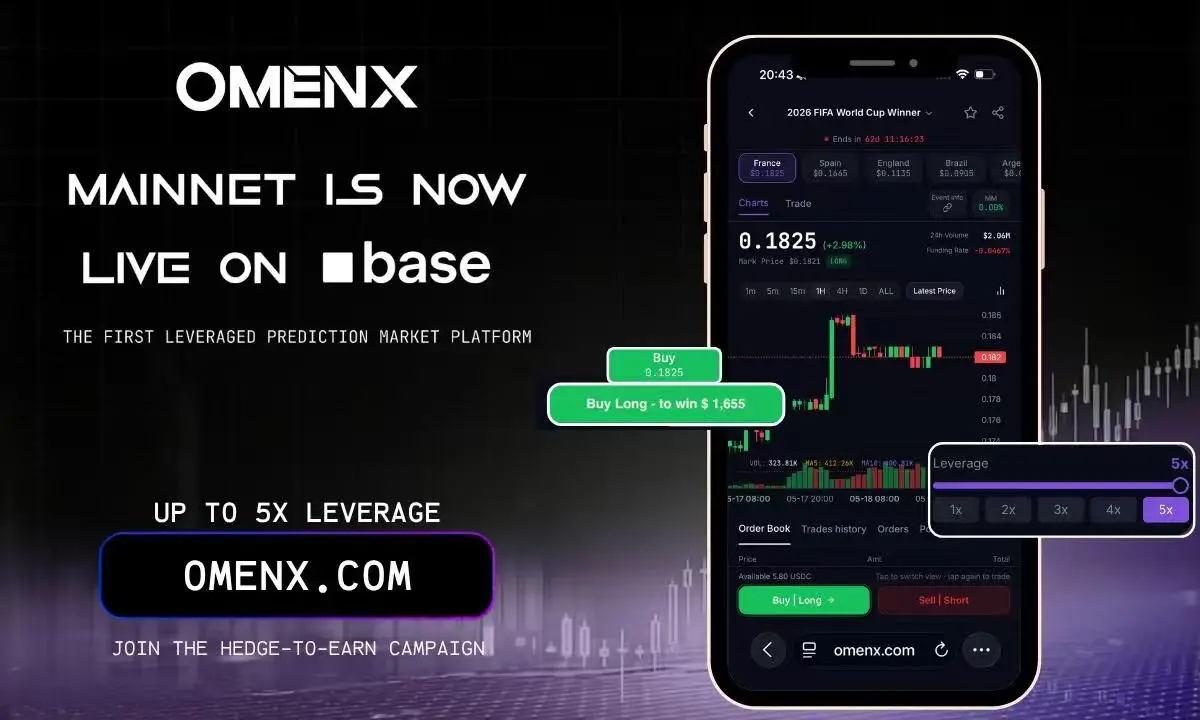
Base-native leveraged prediction market platform OmenX has officially launched on mainnet. It currently supports up to 5x leverage, with plans to increase to 10x based on platform liquidity and market conditions. Unlike traditional prediction markets where users fully collateralize YES/NO positions and wait for settlement, OmenX aims to create a trading platform-like experience. Users can open leveraged positions on event outcomes, and actively trade, adjust, or hedge these positions before the event concludes for greater capital efficiency. Alongside the mainnet launch, OmenX introduced a "Hedge-to-Earn" campaign targeting existing users of other prediction markets (initially Polymarket). This initiative allows users to claim incentives or hedging benefits on OmenX based on their existing positions, aiming to introduce them to leveraged trading and active risk management. OmenX positions itself as a derivatives trading platform for prediction market assets. The team believes that as platforms like Polymarket mainstream prediction markets, event outcomes are becoming a new tradable asset class. The next phase of demand will focus on leverage, liquidity, and advanced trading tools. Post-launch, OmenX plans to expand supported market types, optimize liquidity, and develop APIs and additional trading tools. The team is also in discussions with investors and partners to secure resources for further development.

链捕手Há 1h

Base Native Leveraged Prediction Market OmenX Officially Launches on Mainnet

链捕手Há 1h

Trading

Spot
Futuros

Artigos em Destaque

Como comprar ERA

Bem-vindo à HTX.com!Tornámos a compra de Caldera (ERA) simples e conveniente.Segue o nosso guia passo a passo para iniciar a tua jornada no mundo das criptos.Passo 1: cria a tua conta HTXUtiliza o teu e-mail ou número de telefone para te inscreveres numa conta gratuita na HTX.Desfruta de um processo de inscrição sem complicações e desbloqueia todas as funcionalidades.Obter a minha contaPasso 2: vai para Comprar Cripto e escolhe o teu método de pagamentoCartão de crédito/débito: usa o teu visa ou mastercard para comprar Caldera (ERA) instantaneamente.Saldo: usa os fundos da tua conta HTX para transacionar sem problemas.Terceiros: adicionamos métodos de pagamento populares, como Google Pay e Apple Pay, para aumentar a conveniência.P2P: transaciona diretamente com outros utilizadores na HTX.Mercado de balcão (OTC): oferecemos serviços personalizados e taxas de câmbio competitivas para os traders.Passo 3: armazena teu Caldera (ERA)Depois de comprar o teu Caldera (ERA), armazena-o na tua conta HTX.Alternativamente, podes enviá-lo para outro lugar através de transferência blockchain ou usá-lo para transacionar outras criptomoedas.Passo 4: transaciona Caldera (ERA)Transaciona facilmente Caldera (ERA) no mercado à vista da HTX.Acede simplesmente à tua conta, seleciona o teu par de trading, executa as tuas transações e monitoriza em tempo real.Oferecemos uma experiência de fácil utilização tanto para principiantes como para traders experientes.

459 Visualizações TotaisPublicado em {updateTime}Atualizado em 2025.07.17

Como comprar ERA

Discussões

Bem-vindo à Comunidade HTX. Aqui, pode manter-se informado sobre os mais recentes desenvolvimentos da plataforma e obter acesso a análises profissionais de mercado. As opiniões dos utilizadores sobre o preço de ERA (ERA) são apresentadas abaixo.

活动图片