Semiconductor Stock Rebound: Is the Technical Correction Over or a Trend Reversal?

marsbitPublicado em 2026-06-24Última atualização em 2026-06-24

Resumo

The core of recent semiconductor stock volatility is not about daily price swings, but rather the market questioning whether AI-driven semiconductor pricing has entered a new phase. Following a sharp sell-off in Korean stocks on June 23rd, led by Samsung and SK Hynix, a subsequent rebound is seen more as a technical positioning adjustment rather than a confirmed trend reversal. The key variable is HBM (High Bandwidth Memory), essential for AI chips. Its supply-demand imbalance granted memory makers significant pricing power. The current market focus is on whether this dynamic remains strong enough to justify elevated valuations. All eyes are on Micron's upcoming earnings report. The critical factor is not whether results meet already high expectations, but whether the company's guidance confirms that AI memory pricing power, order visibility, and future margins are still expanding. Micron's outlook will serve as a crucial test for the broader AI semiconductor chain, including Samsung, SK Hynix, and other infrastructure players. The recent bounce appears to be a pre-earnings positioning repair. For it to evolve into a sustained uptrend, concrete evidence is needed that the AI infrastructure expansion cycle's fundamentals—particularly for high-end memory—remain robust and can continue to surpass elevated market expectations. The risk is that strong demand alone may not be sufficient if future guidance hints at peaking momentum or increasing supply-side pressures.

TL;DR

On June 23, the South Korean stock market experienced severe selling, with the Kospi closing down about 10%, trading suspended for 20 minutes at one point, and Samsung Electronics and SK Hynix both falling over 12%. A day later, according to media reports, Samsung Electronics rebounded by about 8.5% during intraday trading, and sentiment in Asian tech stocks showed some recovery.
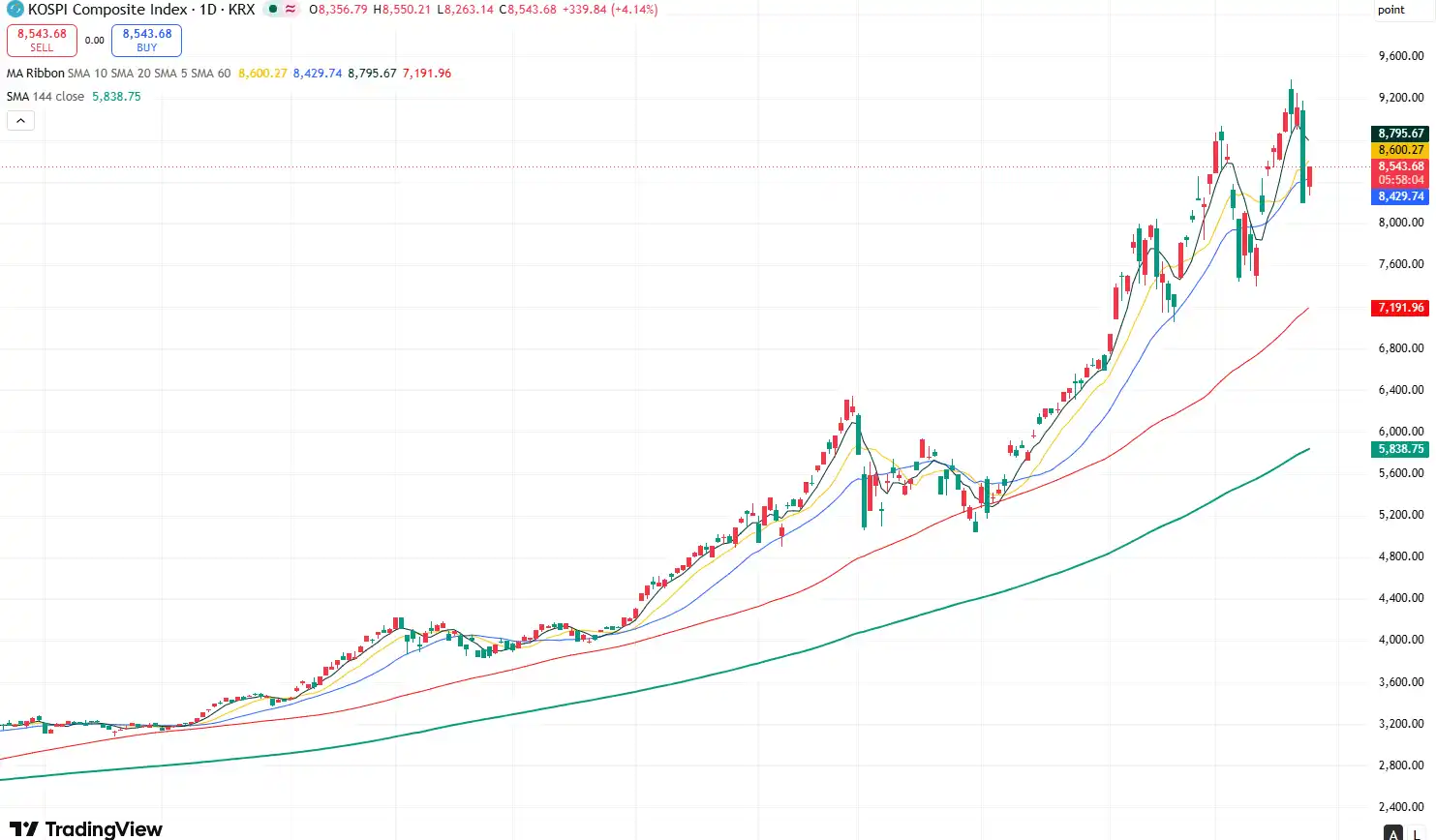
The core of this round of volatility is not the single-day rise and fall, but that semiconductor stocks have entered a new pricing phase after the crowding of AI trades. Over the past year, the expansion of AI infrastructure has linked South Korean memory stocks, U.S. stocks like Micron, NVIDIA, and TSMC on the same chain. As long as AI server expansion continues, high-end memory will remain tight, memory manufacturers' profit expectations will continue to be revised upward, and related semiconductor stocks will still be seen as beneficiaries of the same wave of AI capital expenditure cycle.

What the market now needs to confirm is whether this round of correction is merely a technical release or an early signal of a trend reversal. Samsung's potential shareholder return expectations have provided emotional repair for the Korean market, but a more direct stress test comes from the earnings season, especially from Micron. The company will announce its FY2026 Q3 financial results after the U.S. market closes on June 24, with the conference call scheduled for 14:30 Mountain Time. What investors are looking at is not whether the last quarter was good, but whether the pricing power of AI memory can continue to expand, thereby supporting the valuation of the entire semiconductor chain.

HBM (AI chip high-bandwidth memory) is the core variable in this round of market activity. AI chips need to process massive amounts of data in an extremely short time, regular memory isn't fast enough, making HBM a critical component for high-end GPUs and AI servers. Over the past two years, the supply shortage of HBM has given Micron, Samsung Electronics, and SK Hynix rare pricing power again, making memory stocks one of the most elastic segments in the AI semiconductor trade.

Strong demand has already been heavily traded by the market. Whether the rebound after the plunge can continue does not depend on "whether the AI story is still there," but on whether the semiconductor chain can continue to prove that order visibility, memory prices, subsequent guidance, and profit margins remain sufficiently strong. Micron is one verification point, but what the market truly cares about is whether this AI semiconductor theme can continue to bear the high expectations.

Post-Crash Rebound, More Like Position Repair

This round of volatility first reflects positioning, not a sudden disappearance of demand. Korean tech stocks performed strongly from 2025 to 2026, with AI memory becoming one of the market's most crowded themes. When heavyweight stocks like Samsung Electronics and SK Hynix come under simultaneous pressure, index-level declines can be amplified, and the entire Asian tech sector can easily be repriced in sync.

The selling on June 23 was precisely the concentrated release of this structure. Media reports indicated the Kospi closed down about 10%, with Samsung Electronics and SK Hynix both falling over 12%. For investors, this kind of drop already indicates one problem: AI semiconductor trading is no longer just about fundamentals; it has also become a positioning trade with high concentration and high expectations.

The rebound the next day cannot be directly interpreted as a bottom confirmation either. Samsung Electronics' rise partly stemmed from market expectations for potential shareholder returns. Samsung's previously announced shareholder return policy for 2024-2026 is to return 50% of its three-year free cash flow and maintain a fixed annual dividend of 9.8 trillion Korean Won. If 50% of the three-year free cash flow exceeds the total regular dividend amount, the company will return the balance.

Based on this, the market and media have estimated that if the chip super-cycle significantly boosts free cash flow, Samsung's potential total return or buyback capacity could reach about 90 trillion Korean Won. However, this is not a new buyback plan already announced by the company, merely a projection based on the existing policy framework. It can improve short-term risk appetite but cannot alone prove that AI semiconductor demand has not cooled.

Therefore, the rebound in Korean tech stocks looks more like positioning repair after a plunge, not confirmation that the trend has already turned upward again. For semiconductor stocks, the real issue isn't whether they can rebound, but whether they can find new fundamental support after rebounding. If it's only about shareholder return expectations, short covering, and sentiment repair, the rally may remain at the level of a technical rebound; if earnings reports continue to prove that AI server demand, HBM prices, and the capital expenditure chain are still strengthening, the market will reprice it as a continuation of the trend.

What can cut through the noise of sentiment are the upcoming earnings reports and conference calls. Micron is one of the more direct validators in this round of AI memory trading. It doesn't have Samsung's vast consumer electronics business, and its stock price more centrally reflects the memory cycle and AI server demand. Its earnings and guidance can answer the market's most pressing questions: Are AI server customers still scrambling for memory? Can prices still rise? Will capacity expansion begin to pressure future profit margins?

These questions don't belong only to Micron; they will also affect Samsung Electronics, SK Hynix, and broader AI infrastructure stocks. For the semiconductor stock rebound to upgrade from "technical covering" to "trend continuation," it requires the most sensitive link in the chain to continue providing strong signals.

Micron Needs to Prove Pricing Power Remains

The easiest numbers to see in the earnings report are revenue and EPS, but what's more important this time is whether the pricing logic behind these numbers can continue. For the entire semiconductor sector, Micron's significance lies not in the profitability of a single company, but in its ability to prove that AI memory supply and demand remain in a seller-favorable phase.

Micron's FY2026 Q2 revenue was $23.860 billion, with non-GAAP EPS at $12.20. The company's capital expenditure net for the quarter was $5.0 billion, and adjusted free cash flow was $6.9 billion. The company previously provided FY2026 Q3 guidance of revenue $33.5 billion, plus or minus $750 million, gross margin approximately 81%, non-GAAP EPS of $19.15, plus or minus $0.40.

This set of data explains why the market is willing to assign higher valuations to memory stocks. If HBM is pre-locked by customers and visibility is increased through long-term supply arrangements, memory manufacturers are no longer just traditional cyclical stocks but more like scarce suppliers in the expansion of AI infrastructure. Micron management and market reports have emphasized that HBM supply visibility is high, and high-end memory is transitioning from a common component to a strategic resource in AI capital expenditure.

For average investors, this can be understood as a supply-demand mismatch model. AI companies and cloud providers need to expand data centers, requiring more GPUs. GPUs need more HBM to perform. But HBM capacity expansion is slow, customer qualification cycles are long, and suppliers are concentrated, leading buyers to pre-commit volumes and sellers to gain stronger pricing power.

This is also why memory stocks affect broader semiconductor sentiment. NVIDIA represents AI computing demand, TSMC represents advanced process supply, while Samsung Electronics, SK Hynix, and Micron represent high-end memory constraints. When any of these links show changes in price, orders, or guidance, the market reassesses the pace of AI infrastructure expansion and profit distribution.

The key to Micron's earnings is not "whether this quarter remains strong," as the market already expects it to be strong. The incremental information lies in three areas: whether the Q3 results beat the company's previously high guidance, whether forward-quarter guidance continues to exceed the already elevated market expectations, and whether the shipment schedule for new products like HBM4 proceeds smoothly.

This is also why a good earnings report may not be enough. Over the past few quarters, the basis for AI memory stock gains has been consecutive beats. If Micron only meets expectations, or if the tone of the conference call shifts from supply tightness toward supply-demand balancing, the market may deem that valuation anchors need to be lowered. At that point, pressure wouldn't stay on MU stock alone but could spread to Samsung Electronics, SK Hynix, and other stocks traded as beneficiaries of the AI semiconductor cycle.

Strong Demand Also Brings Low Error Tolerance

Current evidence supports that demand has not yet been disproven, not that the cycle has ended. Micron's HBM supply visibility, strong performance last quarter, and continued expansion of AI infrastructure by cloud providers still point to the memory chain being in a high-activity phase. The rapid rebound in semiconductor stocks also indicates the market hasn't abandoned the AI demand theme.

But investors need to be wary of another layer of risk: strong fundamentals do not mean stock prices have no downside. Especially when valuations have baked in continued beats as the default assumption, the market's definition of bad news becomes harsher. In other words, semiconductor stocks might adjust not because demand disappears, but potentially because demand "doesn't get stronger."

In the past, the core risk for memory stocks was a downward price cycle. Now the risk is more complex. Customers are still ordering, but growth is no longer being revised upward—the stock may adjust first. HBM is still in short supply, but new capacity in 2027 cools price expectations—valuations may also drop first. Micron is still profitable, but rising capital expenditures compress future free cash flow—the market will similarly recalculate cycle quality.

This is precisely the key to judging whether it's a "technical correction ending" or a "trend reversal." A technical correction usually corresponds to release after positioning becomes crowded; as long as earnings and guidance continue to support the original logic, funds may return to the main theme. A trend reversal is different; it means the market begins to doubt future profit revision potential or believes the supply-demand relationship has shifted from extreme tightness toward balance.

The warning from the June 23 plunge lies here. It may not indicate that AI demand has peaked, but it shows the error tolerance of this trade chain has lowered. Foreign capital profit-taking in the Korean market, concentrated index weights, and crowded AI themes mean any signal not strong enough could be amplified into sector-wide volatility.

Samsung's potential shareholder returns should also be understood within this framework. Returning free cash flow benefits shareholders, but only if free cash flow can be sustainably generated. If chip profits continue to be revised upward, large dividends and buybacks will strengthen stock price support. If future capital expenditures intensify and cyclical profits are discounted anew, shareholder return expectations could also be downgraded.

So, this rebound looks more like a verification repair ahead of earnings. What investors are buying back is not certainty, but an option to wait for Micron and other semiconductor companies to provide stronger evidence. Only when fundamentals continue to exceed already high expectations does the rebound have a chance to shift from sentiment repair to trend continuation.

Valuation Anchor Lies in Guidance and 2027 Supply-Demand

After Micron's earnings release, the market's immediate reaction may still be to revenue, EPS, and gross margin, but what determines whether the AI semiconductor trade can continue expanding is management's tone regarding subsequent quarters.

If Q3 results beat guidance and forward guidance is revised upward again, it indicates customer orders, prices, and product mix are still improving, making the Korean tech stock plunge look more like a positioning clearance. Especially the HBM4 shipment schedule—if it proves Micron is increasing its share of high-end products—the market will continue to see it as a beneficiary of tight AI memory supply and also reinforce risk appetite for memory stocks like Samsung Electronics and SK Hynix.

Conversely, if management becomes cautious about 2027 supply-demand or capital expenditure rises faster than profit revisions, investors will reassess the quality of this cycle. The dangerous moment for the memory industry often isn't when demand disappears immediately, but when supply expansion begins to change future price expectations.

The current market's contradiction lies here: AI memory hasn't been disproven, but valuations have begun to demand higher-frequency, clearer evidence. Micron doesn't need to prove AI demand exists; the market already believes that. It needs to prove that demand intensity, supply constraints, and price elasticity are still sufficient to support the already high pricing.

This is also a common problem facing the entire semiconductor sector. NVIDIA, TSMC, memory manufacturers, and Asian tech stocks are all traded on the same AI infrastructure chain. As long as key links in the chain continue to beat expectations, the sector rebound can be interpreted as the correction ending; but if guidance starts turning cautious, or the market finds profit revisions can't keep up with valuations, the rebound may just be a technical repair before a trend weakens.

Until this answer emerges, the rebound in Asian tech stocks can only be seen as repair. For investors holding MU, Samsung Electronics, SK Hynix, and broader AI infrastructure stocks, daily ups and downs are not the main theme. Whether Micron can translate high supply visibility into higher guidance and strong demand into higher profit margins is the validation point for whether this semiconductor trade can continue.


Criptomoedas em alta

Perguntas relacionadas

QWhat is the core issue behind the recent volatility in semiconductor stocks, according to the article?

AThe core issue is not a single day's price movement, but that semiconductor stocks, after becoming a crowded AI trade, have entered a new pricing phase. The market is trying to determine if the recent correction is just a technical release of pressure or an early signal of a trend reversal.

QWhy is Micron's upcoming earnings report considered a crucial test for the AI semiconductor trade?

AMicron's report is a key test because it can validate whether the pricing power for AI memory (especially HBM) can continue to expand, thereby supporting the valuation of the entire semiconductor chain. The market needs to see strong order visibility, memory prices, future guidance, and margins to confirm the trend.

QWhat is HBM, and why is it a central variable in the current semiconductor market rally?

AHBM (High Bandwidth Memory) is high-speed memory for AI chips. It's crucial because AI chips need to process massive data quickly, and regular memory isn't fast enough. HBM's supply shortage over the past two years has given memory makers like Micron, Samsung, and SK Hynix significant pricing power, making them high-leverage plays in the AI semiconductor trade.

QWhy does the article describe the post-crash rebound in South Korean tech stocks as more of a 'positioning repair' rather than a confirmed trend reversal?

AThe rebound is seen as positioning repair because the initial sell-off reflected high concentration and crowded positioning in the AI memory trade. The subsequent bounce was partly driven by expectations of potential shareholder returns from Samsung and short-covering, not necessarily new fundamental evidence of sustained AI demand strength.

QWhat are the two main scenarios the article presents for interpreting the semiconductor stock rebound, and what determines which scenario is correct?

AThe two scenarios are: 1) A technical correction ending, where strong earnings and guidance continue to support the original AI logic. 2) A trend reversal, where the market starts doubting future profit growth or sees the supply-demand balance shifting from extreme tightness towards equilibrium. The key determinant is whether upcoming reports (like Micron's) provide stronger-than-expected evidence on order visibility, pricing, and future guidance.

Leituras Relacionadas

Stablecoin Salaries: Why Are They Becoming the First Choice for Cross-Border Workers?

Stablecoin Salaries: Why They're Becoming the Top Choice for Global Remote Workers The traditional global salary system carries hidden exchange rate risks for freelancers in countries like India, Argentina, and Turkey who earn in USD but spend in local currencies. When salaries are instantly converted to local currency, workers lose purchasing power if that currency depreciates against the dollar. For instance, an Indian designer converting a $2000 monthly salary to rupees lost over 10% in purchasing power last year due to the rupee's decline. Holding even a portion of income in USD or USD-pegged stablecoins can preserve value. Stablecoins offer a solution by breaking down barriers to holding dollars. Opening foreign USD bank accounts is difficult, and international wire transfers incur high fees (averaging 6.5%) and delays. In contrast, stablecoin transfers are fast and low-cost. Furthermore, many countries with high inflation and depreciating currencies restrict citizens' access to foreign currency. Self-custody stablecoin wallets enable workers to hold dollar-equivalent assets without needing bank approval, bypassing these limits. These wallets integrate multiple functions: they allow users to convert only what's needed for daily expenses into local currency, keep the remainder in stablecoins, connect to on-chain lending or yield products, and even link to payment cards for direct spending. While challenges remain—such as the lack of deposit insurance and evolving regulatory frameworks—the trend is clear. Reports indicate a growing preference for USD or stablecoin payments among freelancers in high-inflation countries. This shift represents a fundamental restructuring of salary functions: payment currency, asset storage, yield generation, spending, and cross-border flow. It offers the freedom and flexibility that are core to money's purpose, signaling a profound change in the global financial landscape.

Foresight NewsHá 6m

Stablecoin Salaries: Why Are They Becoming the First Choice for Cross-Border Workers?

Foresight NewsHá 6m

Don't Just Focus on Layoffs, The New Structure of the Ethereum Foundation is More Worthy of Appreciation

The Ethereum Foundation (EF) has undergone a significant organizational restructuring, with the most notable change being a strategic refocusing of its priorities rather than just a 20% staff reduction (approximately 54 people). The new structure clearly prioritizes the Protocol and Access layers, which now comprise the largest teams (57 and 34 people, respectively). This signals EF's intent to concentrate its core resources on fundamental, hard-to-outsource aspects of Ethereum: protocol evolution, security, privacy, client development, and the foundational access layer. Key areas within the Protocol layer, led by an architecture group including Vitalik Buterin and Justin Drake, receive heightened emphasis. These include post-quantum security, zkEVM, formal verification, and long-term roadmap development ("Strawmap"). This reflects a shift towards tackling complex, interdependent challenges like scalability, privacy, and future-proofing the protocol, potentially moving from a pure "redundant security" multi-client model towards more specialized clients aided by AI-assisted formal verification. Financially, EF's budget is being reduced by approximately 40%. The goal is to transition from spending about 15% of its remaining funds annually to a more sustainable 5% rate, akin to a long-term endowment, ensuring its longevity. Concurrently, the restructuring involves pushing certain responsibilities—such as application development, adoption, and ecosystem coordination—to external organizations like EthLabs, the Ethereum Apps Guild, and others. This "multi-node" model aims to increase ecosystem resilience by decentralizing functions beyond the EF, though it introduces new coordination challenges. In essence, the reorganization represents EF consciously narrowing its scope to focus on the hardest, most critical protocol-level problems while fostering a more distributed and sustainable ecosystem structure for Ethereum's future growth.

Foresight NewsHá 35m

Don't Just Focus on Layoffs, The New Structure of the Ethereum Foundation is More Worthy of Appreciation

Foresight NewsHá 35m

Report Analysis: What Is Coherent Planning as CPO Booms?

Title: Report Interpretation: What Moves Is Coherent Making Amid the CPO Boom? Summary: JP Morgan analyst Samik Chatterjee reiterates an Overweight rating on Coherent (COHR), citing undervalued growth potential across three core areas: data center optical transceivers, co-packaged optics (CPO) chips, and industrial lasers/thermal management. COHR's 1.6T data center transceivers are in high demand, with pricing remaining firm. The rise of CPO is seen not as a threat but as a catalyst, creating higher demand for sophisticated optical components, an area where COHR holds a competitive edge with its comprehensive portfolio (lasers, isolators, VCSELs, thermoelectric coolers). Each CPO chip offers significantly greater revenue potential than traditional transceivers. Furthermore, its Optical Circuit Switch (OCS) technology targets a potential $4B market with reliability and power advantages. The company is expanding its InP (Indium Phosphide) device capacity fourfold within two years, securing substrate supply and transitioning to more cost-effective 6-inch wafers. As one of only two major suppliers of high-quality pump lasers—currently in severe shortage—COHR can now move up the value chain from components to complete line cards/systems, boosting ASP over tenfold. Gross margin targets (>42%) may be revised upward due to high-end product premiums, cost improvements from the wafer transition, and contributions from new high-margin products like CPO and OCS. Its efficient thermadite thermal material also offers long-term growth. Industrial segment revenue grows at a steady 5-10%, supported by semiconductor equipment orders. Changes in Apple's Face ID protocol present a re-competition opportunity for 3D sensing. Overall, Coherent is positioned as a key infrastructure provider, with AI-driven compute demand fueling the need for high-speed optical interconnectivity. Growth from CPO/OCS, stable industrial performance, and margin improvement support the bullish thesis. *Disclaimer: This summary interprets a third-party analyst report from JP Morgan. It does not constitute investment advice.*

marsbitHá 57m

Report Analysis: What Is Coherent Planning as CPO Booms?

marsbitHá 57m

After Laying Off 20% of Staff, What Are the Key Points of EF's New Structure?

Following the completion of a months-long organizational restructuring, the Ethereum Foundation (EF) announced a 20% workforce reduction (approximately 54 employees) on June 23rd. It reorganized its teams into five new core clusters: Protocol, Access, User, Community, and Institutional (plus Operations/Management support units). Officially, this move implements the EF's 2026 Mandate and 2025 Treasury Management Policy, aiming to create a more focused and "self-sovereign" organization. The restructuring prioritizes the CROPS principles—Censorship Resistance, Openness & Freedom, Privacy, and Security—as foundational organizational tenets. The Protocol cluster will focus on core protocol R&D, including MEV reduction and zkEVM. The Access cluster emphasizes preserving user "zero option" for non-custodial, permissionless interaction. The User, Community, and Institutional clusters will manage external engagement, with the latter handling institutional and regulatory matters. While offering enhanced severance and transition support for affected employees, the EF did not disclose budget allocations or specific KPIs for the new clusters. This has led to market uncertainty about the impact on project funding and development priorities. Analysts note the announcement's positive tone of mission focus contrasts with a backdrop of recent EF leadership changes and broader ecosystem pressures. The true impact—whether this signifies strategic realignment or reactive contraction—will become clearer as the new structure's resource allocation and project prioritization are revealed in the coming months.

marsbitHá 1h

After Laying Off 20% of Staff, What Are the Key Points of EF's New Structure?

marsbitHá 1h

Trading

Spot
Futuros

Artigos em Destaque

O que é USDC(WORMHOLE)

USD Coin (Wormhole): Uma Visão Abrangente Introdução No mundo em rápida evolução das criptomoedas, o USD Coin (Wormhole), referido como $USDC(Wormhole), destaca-se como uma solução pioneira no panorama DeFi (Finanças Descentralizadas). Operando em várias plataformas de blockchain, incluindo Solana, o USD Coin (Wormhole) é mais do que apenas uma representação digital do dólar americano. Ele incorpora o espírito inovador das finanças modernas, permitindo transações intercadeias sem problemas e uma maior interoperabilidade entre diversos ecossistemas de blockchain através do avançado protocolo Wormhole. O que é o USD Coin (Wormhole)? O USD Coin (Wormhole) é uma versão tokenizada do dólar americano, projetada para facilitar transações sem atritos entre diferentes redes de blockchain. O seu objetivo principal é aumentar a liquidez e melhorar a funcionalidade do ecossistema DeFi. Ao aproveitar o protocolo Wormhole, que estabelece uma rede robusta de comunicação intercadeias, os utilizadores podem transferir tokens USDC sem esforço entre várias plataformas. Esta capacidade intercadeias marca um avanço significativo no uso de criptomoedas, promovendo um ecossistema mais interconectado e eficiente, onde os ativos podem fluir livremente entre diferentes blockchains. A proposta de valor do USD Coin (Wormhole) reside não apenas na sua estabilidade, estando atrelado ao dólar americano, mas também na sua capacidade de preencher lacunas entre ambientes de blockchain díspares. Esta abordagem inovadora promove um maior nível de participação entre utilizadores e desenvolvedores, pavimentando o caminho para novas e emocionantes aplicações nas finanças descentralizadas. Quem é o criador do USD Coin (Wormhole)? As origens do USD Coin (Wormhole) estão intrinsecamente ligadas à rede Wormhole, que foi desenvolvida pela Jump Crypto. Embora criadores individuais específicos não sejam documentados de forma proeminente, a Jump Crypto é notável pelo seu envolvimento no avanço da tecnologia blockchain e no suporte às suas aplicações nas finanças. Ao criar a rede Wormhole, a Jump Crypto desempenhou um papel vital na promoção de transferências de ativos intercadeias, aumentando a eficiência e diversidade do uso de criptomoedas. Quem são os investidores do USD Coin (Wormhole)? O sucesso do USD Coin (Wormhole) é apoiado por investimentos de vários fundos e organizações notáveis dentro do reino das criptomoedas. Os principais investidores incluem: Coinbase Ventures: Um relevante braço de capital de risco apoiado por uma das principais exchanges de criptomoedas da indústria, a Coinbase Ventures fornece capital essencial e suporte estratégico a projetos promissores de blockchain. Arrington XRP Capital: Especializando-se em ativos digitais, a Arrington XRP Capital reconhece o potencial de projetos inovadores como o USD Coin (Wormhole) e investiu de acordo para apoiar o seu desenvolvimento. Jump Trading: Como a organização-mãe da Jump Crypto, a Jump Trading traz não apenas investimento, mas uma vasta experiência em tecnologia de negociação e dinâmicas de mercado para fortalecer o projeto Wormhole. Como Funciona o USD Coin (Wormhole)? A estrutura operacional do USD Coin (Wormhole) é cuidadosamente projetada para facilitar transações intercadeias eficazes, maximizando a segurança e a eficiência. Aqui está uma visão simplificada de como funciona: Bloqueio de Ativos: Quando um utilizador deseja transferir USDC de uma blockchain para outra, ele primeiro bloqueia os seus tokens na blockchain de origem. Este processo assegura que os ativos estejam seguros e que sejam queimados ou movidos mais tarde. Mintagem de Tokens: Após os tokens serem bloqueados, uma quantidade equivalente de USDC é criada na blockchain de destino. Isso proporciona ao utilizador acesso aos seus fundos em uma nova plataforma, refletindo a flexibilidade que o protocolo Wormhole permite. Transferência Intercadeias: O protocolo Wormhole facilita de forma eficiente todo o processo de transferência. Ele assegura que, uma vez que o USDC é criado na cadeia de destino, os tokens equivalentes sejam queimados na cadeia de origem. O resultado é uma transferência de valor sem interrupções entre dois ambientes distintos de blockchain. Esta metodologia intercadeias assegura que as transações permaneçam seguras e transparentes, melhorando significativamente a liquidez dentro dos diferentes ecossistemas DeFi. Linha do Tempo do USD Coin (Wormhole) Compreender a evolução do USD Coin (Wormhole) fornece um contexto vital para a sua importância na arena das criptomoedas. Aqui está uma linha do tempo destacando marcos importantes na história do projeto: 2021: O projeto Wormhole é lançado, estabelecendo uma estrutura para transferências de ativos intercadeias e preparando o caminho para o desenvolvimento do USD Coin (Wormhole). 2022: A rede Wormhole enfrenta um desafio significativo com uma violação de segurança que resulta no roubo de 325 milhões de dólares. No entanto, o incidente é posteriormente tratado e reembolsado pela Jump Crypto, demonstrando o compromisso do projeto com a segurança e a transparência. 2023: O USD Coin (Wormhole) integra-se com o Protocolo de Transferência Intercadeias da Circle (CCTP), aprimorando suas capacidades para transferências intercadeias e solidificando ainda mais a sua posição dentro do ecossistema DeFi. 2024: O desenvolvimento contínuo e a expansão da rede Wormhole prosseguem, visando aumentar a utilidade e o alcance do USD Coin (Wormhole) e aprimorar sua estrutura operacional. Características Principais O sucesso do USD Coin (Wormhole) pode ser atribuído a várias características principais que o diferenciam de outras ofertas de criptomoedas: Interoperabilidade Intercadeias No cerne do USD Coin (Wormhole) está a sua capacidade de facilitar transferências sem problemas entre várias redes de blockchain. Esta interoperabilidade serve como um pilar para as finanças descentralizadas, permitindo que várias plataformas interajam entre si, acelerando assim a evolução dos serviços financeiros. Segurança Wormhole utiliza uma Rede de Guardiões bem projetada, composta por validadores de nós que garantem transações intercadeias seguras. Esta supervisão coletiva minimiza o risco de fraudes e proporciona aos utilizadores a confiança de que os seus ativos estão protegidos durante as transferências intercadeias. Aumento da Liquidez Ao permitir que o USDC circule livremente entre diferentes blockchains, o USD Coin (Wormhole) aumenta a liquidez no ecossistema DeFi. Esta liquidez aumentada pode promover uma negociação mais eficiente, contribuir para melhores estratégias de preços e melhorar a dinâmica geral do mercado que abrange vários ativos digitais. Conclusão O USD Coin (Wormhole) é uma inovação crucial no espaço blockchain, reforçando as capacidades das finanças descentralizadas (DeFi) e estabelecendo um ecossistema financeiro mais conectado. Com sua estrutura robusta para transações intercadeias, características de segurança e forte apoio de investidores respeitáveis, o USD Coin (Wormhole) está posicionado para desempenhar um papel fundamental no futuro das criptomoedas. À medida que o panorama das finanças digitais continua a evoluir, o USD Coin (Wormhole) não apenas abraça o futuro da interconectividade entre redes de blockchain, mas também reafirma o poder da tokenização e da tecnologia blockchain na transformação de como percebemos e utilizamos o valor em um mundo digital. Ao navegar pelas complexidades da funcionalidade intercadeias, demonstra uma abordagem sofisticada para capacitar a inclusão financeira e a inovação no mundo das criptomoedas.

92 Visualizações TotaisPublicado em {updateTime}Atualizado em 2024.12.03

O que é USDC(WORMHOLE)

O que é W$C

World$tateCoin ($W$C): Uma Exploração Abrangente do Emergente Projecto de Criptomoeda Introdução No panorama em constante evolução das criptomoedas, o World$tateCoin ($W$C) surgiu como um projecto que visa aproveitar o poder das tecnologias web3 para criar um ecossistema digital distinto. À medida que os modelos tradicionais de interação online sofrem uma transformação significativa, o World$tateCoin procura estabelecer-se nesta emergente terceira geração da internet. Este artigo irá explorar as minúcias do World$tateCoin, oferecendo uma visão geral do projecto, dos seus objetivos e do seu potencial impacto no espaço web3. O que é o World$tateCoin ($W$C)? O World$tateCoin ($W$C) é concebido como uma criptomoeda que facilita transações sem costura dentro de um ambiente web3. Destinado a criar uma plataforma descentralizada onde os utilizadores podem interagir com várias aplicações web3, o $W$C pretende simplificar a experiência do utilizador e melhorar a acessibilidade aos serviços digitais. Embora o projecto aspire a tornar-se uma parte integral do panorama web3, informações detalhadas sobre os seus objetivos específicos e casos de uso permanecem limitadas, levantando questões sobre o seu potencial papel e utilidade num contexto digital em rápida evolução. A essência do web3 gira à volta da descentralização e do empoderamento dos usuários com maior controle sobre as suas interações online. O World$tateCoin pretende alinhar-se com estes princípios, embora as aplicações e funcionalidades específicas da moeda ainda estejam em discussão dentro da comunidade. Quem é o Criador do World$tateCoin ($W$C)? Ao explorar as origens do World$tateCoin, a informação sobre o seu criador permanece elusiva. Até agora, não existem dados publicamente disponíveis que identifiquem os indivíduos ou organizações por trás do projecto. Esta obscuridade pode lançar uma sombra de incerteza sobre a credibilidade do projecto, mas o compromisso com a inovação dentro do quadro das criptomoedas poderia ser uma força propulsora para a sua adoção no futuro. A falta de liderança identificável pode resultar em obstáculos relacionados com a confiança e a transparência—elementos cruciais para estabelecer uma comunidade sólida no espaço cripto. Quem são os Investidores do World$tateCoin ($W$C)? A investigação atual não revela investidores específicos ou organizações de apoio envolvidas com o World$tateCoin. Não é incomum que projectos emergentes de criptomoedas atraiam investimentos discretos ou operem numa estrutura financeira minimalista durante a sua fase inicial. A ambiguidade em torno dos apoios financeiros e metodologias de financiamento pode afetar a sustentabilidade e as perspectivas de crescimento do projecto. Ao avaliar novos projectos no domínio das criptomoedas, os investidores geralmente procuram transparência em relação ao apoio financeiro e suporte de entidades estabelecidas. A ausência desta informação pode exigir uma abordagem cautelosa para potenciais utilizadores e partes interessadas interessadas no futuro do World$tateCoin. Como Funciona o World$tateCoin ($W$C)? A mecânica operacional do World$tateCoin é fundamentada nos princípios da descentralização, uma característica das tecnologias web3. Ao facilitar transações diretamente entre utilizadores sem a intervenção de intermediários, o $W$C é concebido para aumentar a confiança e a eficiência. No entanto, a documentação abrangente que detalha as características únicas e o quadro operacional que distinguem o World$tateCoin de outras criptomoedas é notavelmente escassa. Esta falta de informação complica a compreensão de como o $W$C funciona dentro do ecossistema web3 mais amplo e quais propostas únicas traz para utilizadores e desenvolvedores. Não obstante, o objetivo fundamental de permitir transações descentralizadas detém a promessa de um panorama financeiro mais libertado, caso o projecto cumpra as suas aspirações de implementar mecanismos robustos e interfaces amigáveis ao usuário. Cronologia do World$tateCoin ($W$C) Construir uma cronologia que encapsule a progressão histórica do World$tateCoin apresenta desafios devido à ausência de documentação significativa sobre eventos e marcos chave. Não obstante, uma sequência aproximada de fases hipotéticas pode ser imaginada, constituindo um caminho à frente para o projecto: Conceito Inicial (Data Desconhecida): Conceituação do quadro do World$tateCoin no contexto mais amplo das tecnologias web3. Fase de Desenvolvimento (Data Desconhecida): Início do desenvolvimento técnico e processos de codificação. Engajamento da Comunidade (Data Desconhecida): Contato com potenciais utilizadores e partes interessadas para promover o interesse da comunidade no projecto. Meta de Lançamento (Data Desconhecida): Anunciar uma data de lançamento esperada, dependente do progresso das fases de desenvolvimento e testes. Devido à falta de datas substanciadas e detalhes em torno destas fases, as partes interessadas precisarão permanecer vigilantes e envolvidas com as comunicações do projecto para atualizações sobre a sua trajetória. Tópicos Chave Sobre o World$tateCoin ($W$C) À medida que o projecto se desenrola, certos temas chave emergem que incorporam o potencial e as aspirações do World$tateCoin: Descentralização: A filosofia central que motiva o projecto, visando promover interações diretas entre utilizadores. Integração Web3: O objetivo de espelhar os princípios web3 e permitir acesso sem costura dos utilizadores a uma variedade de serviços digitais. Criptomoeda Digital: Posicionada como uma moeda para facilitar transações baseadas na internet, o World$tateCoin visa injetar liquidez adicional no mercado web3. Desafio da Escassez de Informação: A notável ausência de informações detalhadas sobre as fundações do projecto, criadores e métodos operacionais, necessitando de uma maior transparência por parte dos desenvolvedores para construir a confiança da comunidade. Conclusão O World$tateCoin ($W$C) está posicionado dentro de um terreno emocionante, mas incerto, de integração de criptomoedas e web3. Enquanto aspira a cultivar um ambiente descentralizado, a disponibilidade limitada de informações sobre os seus criadores, investidores e funcionalidades específicas apresenta desafios para potenciais partes interessadas e utilizadores. No dinâmico mundo das criptomoedas, a transparência, o engajamento e a comunicação bem estruturada são vitais para o sucesso de projectos como o World$tateCoin. À medida que o panorama continua a evoluir, as partes interessadas estarão ansiosas para ver como o projecto pode solidificar o seu lugar na narrativa web3 e contribuir para a transformação contínua do ecossistema digital.

42 Visualizações TotaisPublicado em {updateTime}Atualizado em 2024.12.03

O que é W$C

Como comprar W

Bem-vindo à HTX.com!Tornámos a compra de Wormhole (W) simples e conveniente.Segue o nosso guia passo a passo para iniciar a tua jornada no mundo das criptos.Passo 1: cria a tua conta HTXUtiliza o teu e-mail ou número de telefone para te inscreveres numa conta gratuita na HTX.Desfruta de um processo de inscrição sem complicações e desbloqueia todas as funcionalidades.Obter a minha contaPasso 2: vai para Comprar Cripto e escolhe o teu método de pagamentoCartão de crédito/débito: usa o teu visa ou mastercard para comprar Wormhole (W) instantaneamente.Saldo: usa os fundos da tua conta HTX para transacionar sem problemas.Terceiros: adicionamos métodos de pagamento populares, como Google Pay e Apple Pay, para aumentar a conveniência.P2P: transaciona diretamente com outros utilizadores na HTX.Mercado de balcão (OTC): oferecemos serviços personalizados e taxas de câmbio competitivas para os traders.Passo 3: armazena teu Wormhole (W)Depois de comprar o teu Wormhole (W), armazena-o na tua conta HTX.Alternativamente, podes enviá-lo para outro lugar através de transferência blockchain ou usá-lo para transacionar outras criptomoedas.Passo 4: transaciona Wormhole (W)Transaciona facilmente Wormhole (W) no mercado à vista da HTX.Acede simplesmente à tua conta, seleciona o teu par de trading, executa as tuas transações e monitoriza em tempo real.Oferecemos uma experiência de fácil utilização tanto para principiantes como para traders experientes.

215 Visualizações TotaisPublicado em {updateTime}Atualizado em 2026.06.02

Como comprar W

Discussões

Bem-vindo à Comunidade HTX. Aqui, pode manter-se informado sobre os mais recentes desenvolvimentos da plataforma e obter acesso a análises profissionais de mercado. As opiniões dos utilizadores sobre o preço de W (W) são apresentadas abaixo.

活动图片