Qualcomm Chip Price Hike Deals a Blow to Android Phones

marsbitPublicado em 2026-07-31Última atualização em 2026-07-31

Resumo

Qualcomm has officially announced a new round of price increases for its entire chip portfolio, effective September 1. The hikes, reaching up to 18% for the flagship Snapdragon 8 Elite Gen 6 Pro, follow similar moves by MediaTek, intensifying cost pressures on the already strained smartphone industry. CEO Cristiano Amon confirmed the plan, citing the need to offset rising industry-wide costs and restore declining profit margins. Qualcomm's Q3 FY2026 results showed a 25% drop in net profit, with mobile revenue plunging 20% year-over-year, hitting its lowest level since 2021. The surge in AI computing demand has led memory manufacturers to prioritize HBM production, creating a shortage in general-purpose DRAM and NAND Flash chips. Their prices soared by 93%-98% and 55%-60% respectively in Q1 2026, causing the memory cost share in smartphones to jump from 10%-15% to over 30%. Coupled with the soaring cost of advanced nodes like TSMC's 2nm and packaging, overall chip costs have reached historic highs. These upstream pressures are forcing downstream smartphone brands like Xiaomi, OPPO, and vivo to cut orders for mid-to-low-end models by up to 20% and use cost-saving measures like older chipsets. Reportedly, the Snapdragon 8E5 will be repurposed as a "long-lasting" chip for sub-brand phones in H2 2026. Amid this cost crisis, the Android market remains sluggish. Q2 2026 smartphone shipments in China fell 4.3% year-over-year, marking five consecutive quarters of decline. Major An...

Recently, global chip giant Qualcomm officially announced a new round of price adjustments for its product line. Effective September 1st, the entire series of chip products will see double-digit percentage price increases, with the new flagship Snapdragon 8 Elite Gen 6 Pro seeing the highest increase of up to 18%.

Following MediaTek's announcement of price hikes for its Dimensity series chips in late June, Qualcomm has now followed suit. This brings a new wave of cost pressure to the already strained mobile terminal industry.

It is reported that Qualcomm issued price increase notifications to global customers on July 24th local time. The new prices will uniformly apply to all chip products shipped after September 1st, covering multiple product lines including smartphones, tablets, wearables, and automotive chips. Qualcomm CEO Cristiano Amon confirmed the adjustment plan during the earnings call, stating that the core reason for the price increase is to hedge against rising costs across the entire industry chain, repair the company's declining gross margin, and drive profitability back to historical normal levels.
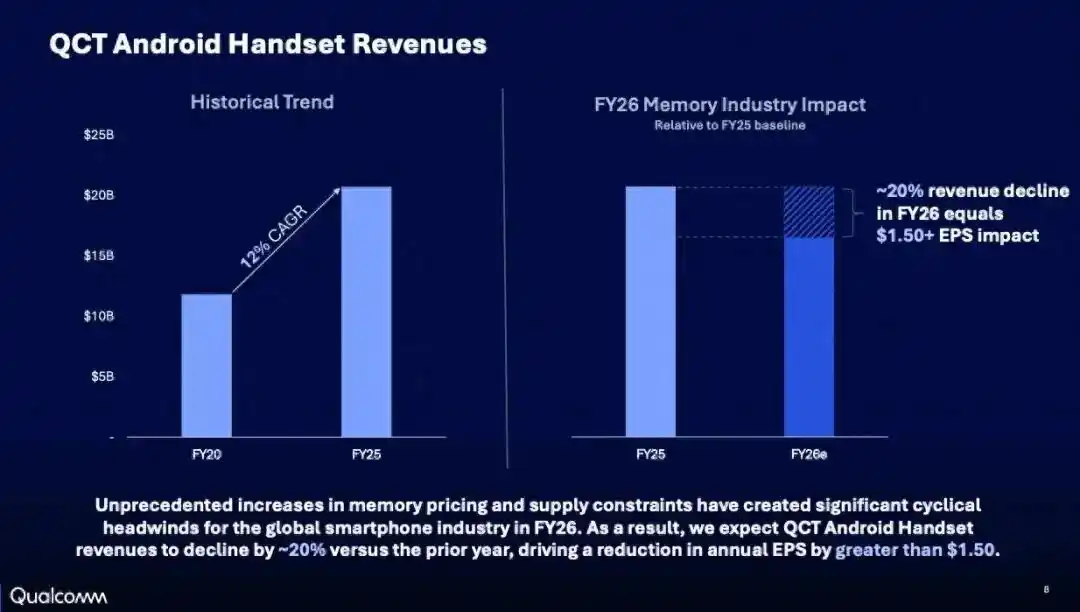
Data shows that Qualcomm's Q3 FY2026 revenue was $9.947 billion, a year-over-year increase of 4%, but net profit plummeted by 25% YoY. Revenue from the mobile handset business plunged by 20% YoY, hitting the lowest record since 2021. The main reason cited is industry-wide price increases triggered by the AI boom.

As demand for AI computing power surges, memory manufacturers like Samsung and SK Hynix have significantly increased production capacity for HBM memory, leading to an imbalance in the supply and demand for general-purpose memory chips.

According to data from TrendForce, general-purpose DRAM contract prices increased by 93%-98% quarter-over-quarter in Q1 2026, while NAND Flash contract prices rose by 55%-60% QoQ. The share of memory costs in mobile phone material costs has skyrocketed from 10%-15% to over 30%. At the same time, the wafer cost for TSMC's 2nm advanced process has exceeded $30,000, coupled with a price increase of over 20% for advanced packaging, pushing chip costs to a historical high.

The cost pressures on chip giants have ultimately been passed down to downstream smartphone manufacturers, trapping the industry in a vicious cycle.

Previously, continuous price increases for memory chips had already squeezed the profit margins of terminal manufacturers. To control costs, brands like Xiaomi, OPPO, and vivo have significantly reduced orders for mid-range and low-end models in 2026, with cuts up to 20%. Some manufacturers are also compressing costs by simplifying hardware configurations and even resorting to using older-generation chips.

Reportedly, the Snapdragon 8 Gen 5 Ultimate Edition (SD 8E5) released last September has "been forced" to become a long-lasting workhorse chip. Qualcomm is set to release a downclocked version specifically for sub-brand iterative new models in the second half of this year, offering performance not inferior to the standard SD 8E5 but at a price significantly lower than the concurrently released SD 8E6.

Under heavy cost pressure, the Android smartphone market continues to be sluggish. IDC data shows that domestic smartphone shipments in Q2 2026 fell by 4.3% year-over-year, marking five consecutive quarters of decline. The market shares of major Android brands like OPPO, vivo, Xiaomi, and Honor have all dropped significantly. In contrast, Huawei and Apple, which do not rely on external high-end SoC chips, have seen noticeable growth in market share, leveraging their advantages in self-developed chips and stable pricing.

Compared to smartphone manufacturers, Qualcomm could potentially pass on cost pressures even without raising prices.

Currently, Qualcomm is accelerating its business diversification transformation, focusing on new sectors like automotive, IoT, and data centers. Its automotive business has achieved 23 consecutive quarters of double-digit year-over-year growth, and it recently secured a ten-year chip supply agreement with BMW. However, the scale of these new businesses is still limited and cannot fully offset the gap left by the handset business.

Industry insiders predict that as the rising costs of chips and memory are fully reflected in the second half of the year, price increases for new Android flagship models may exceed market expectations. The decline in domestic smartphone market shipments in 2026 could further widen.

This article is sourced from the WeChat public account "镁客网", author: 镁客网

Criptomoedas em alta

Perguntas relacionadas

QAccording to the article, what is the main reason for Qualcomm's decision to increase the prices of its chips across the board?

AThe main reason for Qualcomm's price increase is to hedge against rising costs across the entire industry supply chain, repair the company's declining gross margin, and restore profitability to historically normal levels.

QWhich specific Qualcomm chip model is mentioned as seeing the highest price increase, and what is the percentage?

AThe new flagship chip, the Snapdragon 8 Elite Gen 6 Pro, is mentioned as having the highest price increase, reaching up to 18%.

QHow did the surge in AI computing power indirectly affect smartphone material costs, specifically regarding memory?

AThe surge in AI computing power led memory manufacturers like Samsung and SK Hynix to significantly increase production of HBM memory. This created an imbalance in supply and demand for general-purpose memory chips, causing DRAM and NAND Flash contract prices to soar. As a result, the proportion of memory costs in smartphone material costs surged from 10-15% to over 30%.

QWhat contrasting trend in market share is highlighted between brands like OPPO, vivo, and Xiaomi compared to Huawei and Apple?

AThe article highlights that mainstream Android brands like OPPO, vivo, Xiaomi, and Honor have all seen significant declines in market share. In contrast, Huawei and Apple, which do not rely on external high-end SoC chips and benefit from their in-house chip advantages and stable pricing, have shown noticeable growth in market share.

QWhat strategy did Qualcomm adopt regarding the Snapdragon 8E5 chip to help smartphone manufacturers cope with cost pressures?

ATo help smartphone manufacturers cope with cost pressures, Qualcomm is planning to release a down-clocked version of the Snapdragon 8E5 chip in the second half of the year. This version will offer performance comparable to the standard Snapdragon 8E5 but at a significantly lower price than the concurrently released Snapdragon 8E6, making it suitable for sub-brand iterative new models.

Leituras Relacionadas

South Korean Stock Market Sees Sharp Rebound After Forceful De-leveraging, SK Hynix Rises 30%

On July 31, South Korean stocks staged a historic rebound. The benchmark KOSPI index surged 18.27%, with chipmaker SK Hynix hitting a 30% gain limit. This followed a brutal, near-40% decline in the KOSPI over the previous month, driven largely by a deleveraging spiral involving leveraged ETFs. Analysts attributed the sharp sell-off to structural liquidity issues rather than deteriorating corporate fundamentals. The rally was triggered by a confluence of positive catalysts. Firstly, strong earnings from U.S. cloud giants Microsoft and Amazon alleviated fears of an "AI bubble burst," boosting global tech sentiment. Secondly, SK Group Chairman Chey Tae-won made a rare personal purchase of SK Hynix shares, seen as a strong vote of confidence. Thirdly, the South Korean government announced a 20 trillion won ($139 billion) AI investment fund. In response to the market turmoil, South Korean regulators are tightening controls on leveraged ETFs, admitting oversight shortcomings. Measures include raising minimum cash保证金 requirements for散户 investors and suspending new product launches. While the rebound signals eased liquidity pressure, analysts note deep structural issues remain. The market's future stability is seen as dependent on global tech capital expenditure trends and memory chip price cycles, with some viewing the surge as a technical correction rather than a definitive trend reversal.

marsbitHá 20m

South Korean Stock Market Sees Sharp Rebound After Forceful De-leveraging, SK Hynix Rises 30%

marsbitHá 20m

Cryptocurrency Company Wintermute Makes Pessimistic Statements Regarding Expected Altcoin Growth! Here are the Details

Crypto market maker Wintermute has made a pessimistic assessment regarding the anticipated altcoin season, suggesting that any upcoming rally may benefit only a limited number of projects. The company reports a record 72% of its spot OTC trading volume in H1 2026 came from institutional clients, whose capital is becoming more selective and concentrated. Data shows institutional traders act quickly on price spikes, while retail interest lasts longer. This selective behavior indicates the classic altcoin season, where hundreds of tokens rise simultaneously, may be changing. Wintermute believes only projects with strong use cases, high liquidity, and institutional appeal will stand out. Supporting this view, CryptoQuant data shows altcoin trading volume against Bitcoin is near its lowest since 2021, with the top 10 altcoins (excluding stablecoins) holding about 80.5% of the total altcoin market cap. Similarly, Kaiko reports that the top 10 altcoins now account for 63% of total altcoin trading volume, up from ~50% a few months ago, indicating capital concentration. Analysts suggest that in the current cautious institutional climate, projects with advanced technology, liquidity, and robust ecosystems will attract disproportionate attention. Therefore, any potential new altcoin season may be less broad than past bull markets, with gains concentrated in a narrower set of promising tokens.

cryptonews.ruHá 20m

Cryptocurrency Company Wintermute Makes Pessimistic Statements Regarding Expected Altcoin Growth! Here are the Details

cryptonews.ruHá 20m

UNI Activates Fee Switch: Uniswap Completes Commercial Debut, Faces First Test in September

Uniswap's Fee Switch activation on V4 has driven a surge in protocol revenue, with daily income jumping from $118,000 to $318,000. The newly launched Robinhood Chain has become the primary contributor, accounting for over 52% of total revenue, largely fueled by meme coin trading. This revenue fuels a new tokenomic "flywheel": fees accumulate in a pool, incentivizing arbitrageurs to buy and burn UNI tokens, creating deflationary pressure and boosting the token's price. However, concerns loom beneath the surface. Uniswap's revenue is now highly concentrated and dependent on the speculative, volatile activity on Robinhood Chain, which is currently subsidized by free gas fees. This subsidy is set to expire in late September, posing a significant test for sustained transaction volume and, consequently, protocol revenue. Furthermore, UNI's high valuation faces pressure if growth expectations aren't met. Debate also centers on the Fee Switch's impact. While Uniswap founder Hayden Adams clarified that the protocol fee is an "add-on" for traders and does not cut into Liquidity Providers' (LPs) existing share, questions remain about whether higher overall trading costs could indirectly reduce volume and LP earnings over time. Despite these challenges, Uniswap's Fee Switch marks a major step in protocol monetization, with its long-term success hinging on cultivating more sustainable usage beyond speculative trading.

marsbitHá 29m

UNI Activates Fee Switch: Uniswap Completes Commercial Debut, Faces First Test in September

marsbitHá 29m

Trading

Spot

Artigos em Destaque

Como comprar CHIP

Bem-vindo à HTX.com!Tornámos a compra de USD.AI (CHIP) simples e conveniente.Segue o nosso guia passo a passo para iniciar a tua jornada no mundo das criptos.Passo 1: cria a tua conta HTXUtiliza o teu e-mail ou número de telefone para te inscreveres numa conta gratuita na HTX.Desfruta de um processo de inscrição sem complicações e desbloqueia todas as funcionalidades.Obter a minha contaPasso 2: vai para Comprar Cripto e escolhe o teu método de pagamentoCartão de crédito/débito: usa o teu visa ou mastercard para comprar USD.AI (CHIP) instantaneamente.Saldo: usa os fundos da tua conta HTX para transacionar sem problemas.Terceiros: adicionamos métodos de pagamento populares, como Google Pay e Apple Pay, para aumentar a conveniência.P2P: transaciona diretamente com outros utilizadores na HTX.Mercado de balcão (OTC): oferecemos serviços personalizados e taxas de câmbio competitivas para os traders.Passo 3: armazena teu USD.AI (CHIP)Depois de comprar o teu USD.AI (CHIP), armazena-o na tua conta HTX.Alternativamente, podes enviá-lo para outro lugar através de transferência blockchain ou usá-lo para transacionar outras criptomoedas.Passo 4: transaciona USD.AI (CHIP)Transaciona facilmente USD.AI (CHIP) no mercado à vista da HTX.Acede simplesmente à tua conta, seleciona o teu par de trading, executa as tuas transações e monitoriza em tempo real.Oferecemos uma experiência de fácil utilização tanto para principiantes como para traders experientes.

424 Visualizações TotaisPublicado em {updateTime}Atualizado em 2026.06.02

Como comprar CHIP

Discussões

Bem-vindo à Comunidade HTX. Aqui, pode manter-se informado sobre os mais recentes desenvolvimentos da plataforma e obter acesso a análises profissionais de mercado. As opiniões dos utilizadores sobre o preço de CHIP (CHIP) são apresentadas abaixo.

活动图片