This weekly report covers the period from March 21, 2026, to March 27, 2026.
This week, the total on-chain market capitalization of RWA saw steady growth, with the growth rate of asset holders outpacing that of scale. The total stablecoin market cap remained in a consolidation phase, while monthly active addresses and transfer volume declined for the second consecutive month. The total number of holders continued to expand, indicating a market dominated by hold-for-investment strategies.
Key regulatory developments emerged: A compromise was reached on the stablecoin yield provisions of the U.S. Crypto Market Structure Bill (CLARITY Act), sparking divisions within the industry, including dissatisfaction from Coinbase, yet potentially breaking the legislative deadlock. Delaware proposed bringing stablecoins under its banking regulatory framework, signaling a shift from macro principles to enforceable细则 (specific rules) in U.S. regulation.
Project updates: Three major exchanges announced tokenization solutions; Glider and Franklin Templeton partnered with Ondo to launch a tokenized stock portfolio platform and a 24/7 tradable ETF product, respectively; Invesco acquired a $900 million on-chain fund from Superstate, entering the tokenized treasury track.
Ecosystem applications deepened: Circle achieved its first African partnership to integrate USDC into the Sasai payment network; USDT0 launched on the payment-centric Tempo blockchain; Ripple is testing automatic settlement of cross-border trade with its stablecoin in Singapore's sandbox; Movement launched its native stablecoin USDCx; Obex deployed $1 billion into credit, energy, and AI assets to diversify stablecoin yield sources.
Funding rounds: XFX raised $17 million in Series A funding for fiat and stablecoin foreign exchange settlement; Payy raised $6 million in seed funding to build a private stablecoin payment network.
Data Perspective
RWA Sector Overview
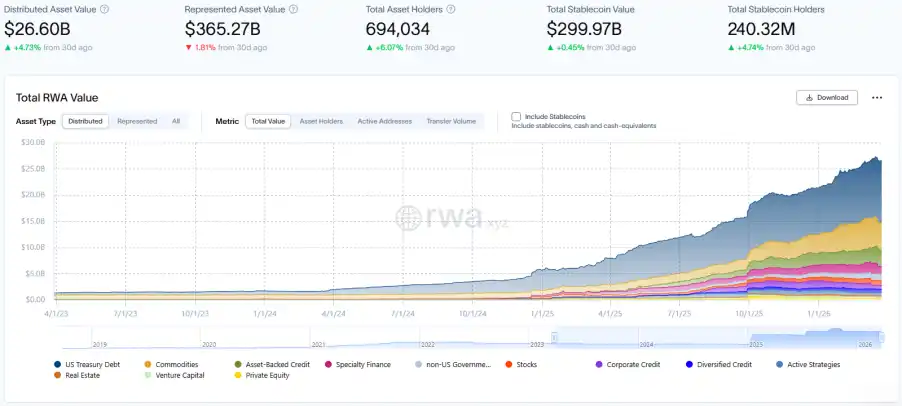
Latest data from RWA.xyz reveals that as of March 27, 2026, the total on-chain market capitalization of RWA maintained steady growth, reaching $26.6 billion, a increase of 4.73% compared to the previous month, serving as the main driver of scale expansion. The total number of asset holders increased to approximately 694,000, a rise of 6.07% compared to the previous month, with the growth rate exceeding that of asset scale.
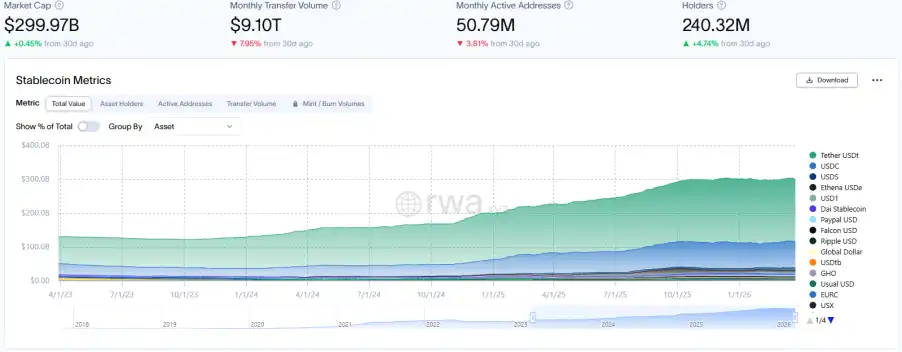
Stablecoin Market
The total stablecoin market cap slightly recovered to $2,999.7 billion, a微增 (slight increase) of 0.45% compared to the previous month, continuing its overall consolidation trend; monthly transfer volume declined to $9.1 trillion, a decrease of 7.95% compared to the previous month, marking the second consecutive month of decline, reflecting continued cooling demand for large-scale settlements and arbitrage.
The total number of monthly active addresses fell to 5,079 million, a decrease of 3.81% compared to the previous month; the total number of holders expanded to 2.4 billion, an increase of 4.74% compared to the previous month. This divergence indicates that incoming funds are more for hold-for-investment purposes rather than trading demand, suggesting a broadening user base but a slight dip in actual participation.
The leading stablecoins are USDT, USDC, and USDS. Among them, USDT's market cap increased slightly by 0.42% compared to the previous month; USDC's market cap increased slightly by 0.47%; USDS's market cap surged by 21.84% compared to the previous month.
Regulatory News
Compromise on Crypto Market Structure Bill Sparks Industry Divisions, Coinbase Expresses Dissatisfaction But Has Not Publicly Opposed
According to CoinDesk, the U.S. Crypto Market Structure Bill, the CLARITY Act, has elicited mixed reactions from the crypto industry after reaching a compromise on stablecoin yield provisions. Informed sources revealed that Coinbase is dissatisfied with the latest compromise but has not publicly opposed it. The proposal was presented to the crypto industry on Monday and to the banking industry on Tuesday, with some stakeholders "pleasantly surprised," but Coinbase and others expressed dissatisfaction, believing the proposal could create unexpected obstacles for stablecoin-related products and services.
The new proposal would instruct regulators to draft rules clarifying how to regulate issues like yields. Some are concerned that regulators setting subjective standards could lead to restrictions on different types of reward programs and are calling for rulemaking to remain neutral. During Monday's industry conference call, Coinbase was at odds with other parties, with some believing that giving up certain stablecoin yields is too costly, while others believe the risk of the bill failing to pass is greater. The updated text is expected to be released this weekend or early next week. The banking industry has not publicly expressed its views on the proposal. A White House crypto advisor stated on social media that "everything will work out, bullish."
New Bill in Delaware, USA, Proposes Bringing Stablecoins Under Banking Regulatory Framework
According to Cointelegraph, two legislators in Delaware have submitted the "Delaware Payment Stablecoin Act," proposing to establish a licensing framework for stablecoin issuers and digital asset service providers. The bill adopts definitions from the U.S. federal "Stablecoin Act," covering contents such as remedies for reserve shortfalls, mandatory redemption time standards, capital standards, and anti-money laundering obligations. If approved, the State Bank Commissioner will formulate implementation rules within a specified time frame.
Simultaneously submitted, the "Delaware Banking Modernization Act" aims to update the state's banking law, which hasn't undergone major revisions since 1981, by providing definitions for digital assets to clarify the regulatory framework. The Governor of Delaware stated that this legislative package aims to lower the barrier to entry for financial services, enabling residents to send, receive, and store funds with just an internet connection. Both bills still need to be reviewed by the Senate Banking Committee and undergo full debate before becoming law. Legislators also plan to submit the "Delaware Money Transmission and Virtual Currency Modernization Act" in the coming days, focusing on implementing consumer protection and regulating licensed activity types.
Project Progress
NYSE Collaborates with Securitize to Develop Tokenized Securities Platform
According to The Wall Street Journal, the New York Stock Exchange (NYSE) is collaborating with tokenized asset platform Securitize to develop a tokenized securities platform.
Nasdaq and Talos to Collaborate on Developing Tokenized Collateral Management Solutions
According to an official announcement, Nasdaq and digital asset infrastructure platform Talos have announced a collaboration to integrate Talos's digital asset infrastructure with Nasdaq's Calypso and trade monitoring platforms to develop tokenized collateral management solutions. Through integration, financial institutions can manage on-chain and off-chain collateral workflows in a unified environment.
CME Partners with Bank of Montreal to Launch Institutional "Tokenized Cash" Settlement Service
According to Bloomberg, Bank of Montreal (BMO) plans to offer institutional clients tokenized cash services and deposits through the CME Group network, enabling continuous fund transfers outside of bank business hours. The service is expected to launch in the second half of this year, pending regulatory approval. Then, regulated financial institutions and commercial banks that are clients of both BMO and CME can use this service for 7x24 processing of trade settlement, margin calls, and collateral transfers. Previously, CME tested Google Cloud blockchain technology to enhance market infrastructure and support round-the-clock trading.
Bitpanda Launches Vision Chain Public Blockchain to Connect EU Banks with Tokenized Assets
According to CoinDesk, Austrian crypto broker Bitpanda has launched a new public blockchain, Vision Chain, targeting European banks and fintech companies for issuing and settling tokenized assets under regulatory frameworks like MiCA and MiFID II. The network is built on Optimism's Ethereum infrastructure and uses compliant euro stablecoins to pay on-chain transaction fees, reducing the risk associated with the price volatility of the native chain token. Bitpanda stated that Vision Chain aims to provide traditional brokers, banks, and other institutions with infrastructure for 7x24 trading and settlement of tokenized securities, promoting the on-chain movement of traditional assets like stocks and funds.
BitGo and ZKsync Collaborate to Build Tokenized Deposit Infrastructure for Banks
According to CoinDesk, BitGo is collaborating with ZKsync to provide banks with a full-stack infrastructure for tokenized deposits, helping financial institutions bring traditional funds onto the blockchain without overstepping regulatory boundaries. The solution integrates BitGo's institutional custody and wallet services with ZKsync's Prividium permissioned chain, supporting banks in issuing, transferring, and settling tokenized deposits while maintaining compliance and control. The infrastructure is currently being tested and is expected to go into production later this year.
Glider and Ondo Launch Tokenized Stock Portfolio Platform; Franklin Templeton Partners with Ondo to Launch ETF Tradable 24/7 in Crypto Wallets
According to Cointelegraph, Glider and Ondo Finance have jointly launched a new platform allowing retail investors to build and automatically manage custom investment portfolios of tokenized U.S. stocks. The platform lets users create personalized baskets of on-chain stocks, directly holding the underlying assets without needing a brokerage account, wallet, gas fees, or manual trade management. Brian Huang, co-founder of Glider, stated that unlike traditional ETFs which bundle assets into fixed products, this platform allows users to build index-like portfolios with custom weights that are automatically maintained, avoiding reliance on pooled products. The platform will initially focus on tokenized U.S. stocks, with plans to expand to asset classes like commodities and introduce features like borrowing against holdings and yield generation. The platform is not yet available to U.S. users, but the company holds several SEC registrations in preparation for a future U.S. launch.
According to Bloomberg, asset manager Franklin Templeton partnered with Ondo Finance to launch tokenized versions of ETFs that can be traded 24/7 within crypto wallets, bypassing traditional brokerage accounts and limited trading hours. The related products cover U.S. stocks, fixed income, and gold, initially targeting investors in Europe, Asia-Pacific, the Middle East, and Latin America. Franklin stated that the launch timing in the U.S. market will depend on further clarity from regulators regarding the model of third-party on-chain distribution of registered funds.
Invesco Acquires $900 Million On-Chain Fund from Superstate, Entering Tokenized Treasury Track
According to CoinDesk, Invesco, with $2.2 trillion in assets under management, will take over approximately $900 million in tokenized U.S. Treasury fund USTB from Superstate, formally entering the tokenized fund market. The fund holds short-duration U.S. Treasuries and will be renamed "Invesco Short Duration US Government Securities Fund" while maintaining the USTB ticker and token structure unchanged; the transition is expected to be completed in Q2 2026. The transaction technology and on-chain infrastructure will remain managed by Superstate, including tokenized share issuance, on-chain settlement, and digital registry systems, while Invesco's global liquidity team will handle daily investment management. This product will place Invesco among traditional asset managers like BlackRock and Franklin Templeton participating in the approximately $12 billion tokenized U.S. Treasury market.
Deloitte and Stablecorp Plan to Build Stablecoin Infrastructure for Canadian Institutions
According to Cointelegraph, Deloitte Canada is collaborating with Stablecorp to develop stablecoin infrastructure for Canadian financial institutions, planning to integrate the Canadian dollar stablecoin QCAD, issued by Stablecorp, into the payment and settlement processes of institutional clients. Soumak Chatterjee, a partner in Deloitte Canada's financial services division, stated that this move aims to help banks and other institutions prepare for stablecoin adoption once regulatory regimes are established. Potential application scenarios include 24/7 payments, improved settlement efficiency, and transparent transaction records based on blockchain.
Movement Launches Native Stablecoin USDCx
Move Industries, a core contributor to the Movement Network, has launched USDCx on the Movement M1 mainnet. This stablecoin is fully backed 1:1 by USDC reserves, utilizes Circle's xReserve for automatic USDC cross-chain conversion (requiring no third-party bridge and near-zero minting fees), and has been integrated into ecosystem applications like DEXs, lending protocols, wallets, and institutional custody services.
USDT0 Launches on Payment-Centric Tempo Blockchain, Now Covering Over 23 Chains
According to The Block, USDT0 has launched on Tempo, a payment-centric blockchain jointly developed by Stripe and Paradigm. USDT0 is issued based on LayerZero's Omnichain Fungible Token standard, pegged 1:1 to USDT, and utilizes a lock+mint/burn mechanism for "bridge-less" flow across multiple chains. It has currently been deployed to at least 23 networks, including Ethereum mainnet, major Layer 2s, Monad, HyperLiquid, as well as Bitcoin scaling networks like Corn, Rootstock, and USDT-specific networks like Stable and Plasma. Tempo is designed for stablecoin payment scenarios, emphasizing high throughput and low fees, and has a built-in stablecoin AMM at the protocol layer for stablecoin-to-stablecoin swaps.
Ripple Tests Automatic Settlement of Cross-Border Trade with RLUSD Stablecoin in Singapore Sandbox
According to CoinDesk, Ripple is participating in the Singapore Monetary Authority's BLOOM sandbox program, collaborating with supply chain finance company Unloq to test using the RLUSD stablecoin to automatically complete cross-border trade payments. Payments are automatically triggered when shipping conditions are verified, aiming to replace the manual verification and letter of credit processes in traditional trade finance that take days or weeks. This pilot utilizes Unloq's SC+ platform to integrate trade obligations, settlement conditions, and financing processes into a single execution layer, with fund transfers completed via RLUSD on the XRP Ledger.
This participation in the BLOOM sandbox is Ripple's third significant move within three weeks. Previously, Ripple expanded Ripple Payments into a full-stack stablecoin infrastructure platform and acquired an Australian financial services license. Ripple is accumulating regulatory and institutional credibility to transform RLUSD from a stablecoin with limited adoption into an enterprise-grade, compliant, and programmable settlement asset.
Sky-Backed Obex Deploys $1 Billion into Credit, Energy, and AI Assets to Diversify Stablecoin Yield Sources
According to CoinDesk, Obex, an incubator backed by Framework Ventures, has begun deploying $1 billion to link the yield from real-world assets like AI data centers, energy, and housing to the USDS stablecoin from the Sky ecosystem, promoting the expansion of stablecoin yield sources from crypto-native cycles to the real world. Initial partners include Maple, USD.ai, Daylight, Centrifuge, Securitize, River, TVL Capital, and Better. These institutions will bring lending, housing finance, energy, and AI infrastructure from the real economy onto the chain through tokenization. It is reported that Obex was authorized last year to allocate up to $2.5 billion from Sky's USDS reserves to real-world assets to generate yield.
RWA Trading Platform MSX Lists Multiple Aerospace Sector Assets
According to an official announcement, MSX has listed U.S. commercial space company $MNTS.M, aerospace and defense technology company $SIDU.M, earth observation leader $PL.M, real-time space intelligence company $BKSY.M, and the largest supplier $YSS.M for the U.S. military's PWSA program.
Funding Dynamics
Foreign Exchange Settlement Company XFX Completes $17 Million Series A Funding, Focuses on Fiat and Stablecoin FX Settlement
According to Fortune, foreign exchange settlement startup XFX announced the completion of a $17 million Series A funding round led by Castle Island Ventures, with participation from Haun Ventures and Coinbase Ventures, among others. Its previous seed round was $9 million. XFX was co-founded by three former Bitso employees, is headquartered in Miami, and focuses on providing institutional clients with high-speed foreign exchange and payment infrastructure between fiat currencies and stablecoins. It currently supports exchanges between USD, Mexican Peso, Colombian Peso, and various stablecoins, focusing on deep liquidity in a few currency pairs. It plans to use the new funds to expand its quantitative team and strengthen cooperation with trading desks and banks.
Privacy-Focused Stablecoin Payment Network Payy Completes $6 Million Seed Round Led by FirstMark Capital
According to The Block, Payy, a startup focused on private stablecoin payments, completed a $6 million seed funding round led by FirstMark Capital, with participation from Robot Ventures and DBA Crypto. Payy, formerly known as the Web3 database project Polybase, pivoted to stablecoin payments in 2023. It currently offers a self-custody wallet and a Visa card supporting USDC spending, and is developing the Payy Network, a Layer 2 network on Ethereum using zero-knowledge proofs to provide on-chain privacy for transaction amounts and addresses. The company claims its platform already covers over 100,000 users in 120 countries with an annualized transaction volume of approximately $130 million. It will subsequently focus on providing stablecoin payment solutions to financial institutions and fintech companies and plans to launch a native token.
Insights Highlights
Financial Stability Board Warns Dollar Stablecoins Heighten Financial Risks in Emerging Economies
The Financial Stability Board (FSB), in its 2025 annual report, stated that cross-border circulating U.S. dollar-denominated stablecoins pose "sharper" financial stability and macroeconomic risks to emerging markets and developing economies. The FSB noted that such stablecoins could lead to currency substitution, weaken the use of domestic payment systems, reduce the effectiveness of monetary policy, increase overall fiscal pressure, and be used to circumvent capital flow management measures. The FSB stated that continuous assessment of developments in the stablecoin sector is needed, focusing on its vulnerabilities in liquidity, operational risk, and linkages with the traditional financial system, and urged countries to implement the global stablecoin regulatory framework issued in 2023, which still has implementation gaps.
TD Securities: Nasdaq's Tokenization Plan Could Fragment Trading into Two Markets
According to Cointelegraph, TD Securities warned that Nasdaq's tokenization plan could lead to a dual market structure in the U.S., with traditional exchanges and blockchain trading platforms operating in parallel. Reid Noch, VP of US Market Structure at TD Securities, pointed out that Nasdaq is advancing three initiatives: upgrading trade settlement processes, supporting companies in issuing tokenized stocks, and facilitating trading on offshore platforms like Kraken. The institution believes that although tokenized stocks are backed by real shares, they operate outside the U.S. regulatory framework. The same asset could have price differences on different platforms, trading activity might flow out of traditional exchanges, and market predictability could consequently decrease.
Electric Capital: Only 34 RWA Assets Have On-Chain Scale Exceeding $50 Million; AI Infrastructure Spending Could Be a Catalyst
According to TheDefiant, Electric Capital reviewed 501 real-world yield (RWA) assets and cross-referenced them with currently active on-chain tokenized assets. The report shows that only 34 yield assets have an on-chain scale exceeding $50 million, and these assets are mainly concentrated in U.S. Treasuries, private credit, corporate bonds, and non-U.S. sovereign bonds; the remaining 93% of yield sources are still constrained by seven types of obstacles, including imperfect legal structures, challenges faced by asset-backed securities, and practical integration difficulties with commodities and computing infrastructure.
Further research indicates that distribution is the main bottleneck for RWA development: among 35 non-stablecoin on-chain yield assets, only 2 assets have more than 2,000 holders. This phenomenon is partly due to asset design limitations, such as BlackRock's BUIDL product having a minimum investment threshold as high as $5 million. Data also shows that most tokenized assets still heavily rely on a few large deployers and treasury managers. For example, the top 10 holders of BUIDL control 98% of the supply, and these holders are mostly other protocols.
Electric Capital predicts that five factors will drive more real-world assets on-chain: continued growth in stablecoin scale and diversification of market yield preferences, intensified product competition among protocols, improved treasury infrastructure's ability to handle duration risk, tiered mechanisms to expand the buyer base, and leverage cycles amplifying demand for collateral assets. Additionally, AI infrastructure spending (Goldman Sachs estimates it will exceed $500 billion in 2026) is expected to be a significant catalyst, with potential for on-chain financing of GPU leasing, data center construction, and energy contracts worth watching.
Policy Tailwinds and Giant Bets: The Institutional Game Behind Solana's Stablecoin ATH
PANews Summary: Solana's on-chain stablecoin supply reached a historic high of $17 billion in March 2026, marking a transition from endogenous recovery to a new growth phase driven by policy dividends and institutional giants.
This milestone benefits from the legal safeguards provided by the GENIUS Act for compliant assets, as well as deep integration by traditional financial giants like Stripe, Visa, PayPal, and BlackRock in cross-border payments, clearing, and asset tokenization.
Simultaneously, locked liquidity within DeFi protocols, explosive growth in the RWA market, and the rise of AI Agent micro-payment scenarios have collectively built powerful synergies.
Despite challenges like MEV attacks and tightening macro liquidity, Solana is attracting global mainstream capital through its high-performance infrastructure, accelerating towards its goal of becoming the "Internet capital market."
U.S. Regulation Successively Eases Crypto: Stablecoins Become "Quasi-Cash," Derivatives Shed Position Limits
PANews Summary: Recent policy adjustments by the SEC, CFTC, and NYSE have systematically relaxed regulations on crypto assets, accelerating their integration into the traditional financial system.
The SEC drastically reduced the capital haircut for compliant stablecoins from 100% to 2%, granting them "quasi-cash" status and improving broker capital efficiency by 50 times.
The CFTC approved BTC and ETH as collateral for futures margins, releasing cross-market arbitrage liquidity and utilizing their 24/7 settlement advantage to optimize risk management.
The NYSE removed position limits for Bitcoin and Ethereum spot ETF options, elevating their regulatory status to that of mature commodities like gold, significantly enhancing institutional participation and market depth.
These measures collectively build a liquidity closed loop from underlying assets to risk hedging tools, marking crypto assets' move from the financial fringe to the mainstream stage, but also posing new challenges for cross-market systemic risk macro-control.
Stablecoin Battlefield Shifts: Circle's Rebound Meets Policy Hurdles, Tether Seeks Legitimacy Through Audit
PANews Summary: After surpassing a $3 trillion scale, the stablecoin market's competition is shifting from pure market cap contests to deeper games of compliance and application scenarios.
Circle, affected by policy fluctuations from the U.S. Transparency Act, is actively transforming after experiencing significant stock price volatility. By deploying the Arc blockchain and delving into new scenarios like AI payments and prediction market settlement, it attempts to evolve from a single issuer to a digital dollar infrastructure platform.
Meanwhile, Tether, responding to regulatory pressure and possibly配合 (coordinating with) potential financing plans, officially initiated its first comprehensive financial audit conducted by a "Big Four" accounting firm, striving to consolidate its trust moat through enhanced transparency.
Overall, the industry is accelerating towards compliance and transparency, with giants opening a new era of "open card" competition in the stablecoin market by expanding infrastructure functionality and strengthening audits.