Single-Day Plunge of 30%, Arthur Hayes Suddenly Liquidates: Why Did ZEC Get Exploded by Security Issues?

foresightnews_apiPublicado em 2026-06-05Última atualização em 2026-06-05

Resumo

On June 5th, Zcash founder Zooko Wilcox disclosed a critical soundness vulnerability in the project's latest Orchard privacy pool. This flaw, found in the elliptic curve multiplication constraints, could allow an attacker to create unlimited counterfeit ZEC within the shielded pool, with transactions appearing valid. The vulnerability was discovered in late May by security researcher Taylor Hornby, who utilized Anthropic's new Opus 4.8 AI model for a targeted audit. The Zcash ecosystem had already performed an emergency network upgrade to patch the issue. However, the detailed disclosure triggered severe market panic, causing ZEC's price to plummet over 30% in a single day. Notably, prominent investor Arthur Hayes announced he had sold his entire ZEC position following the news. The incident starkly challenges the "technological trust" narrative central to privacy coins. Despite years of top-tier cryptographic audits, the bug persisted until uncovered with advanced AI-assisted research. This highlights the growing gap between theoretical perfection and practical implementation in privacy technology. The event serves as a industry-wide warning: in an AI-driven security landscape, the assumption that "undiscovered equals safe" is obsolete. It underscores the urgent need for continuous, proactive security practices combining AI audits, formal verification, and rapid response mechanisms.


Author: Ma He, Foresight News


On June 5th, Zcash founder Zooko Wilcox, along with Jason McGee and Taylor Hornby, published a detailed article disclosing a critical soundness vulnerability in the project's latest privacy layer, the Orchard pool, which could be exploited to create an unlimited amount of counterfeit ZEC in a covert environment.
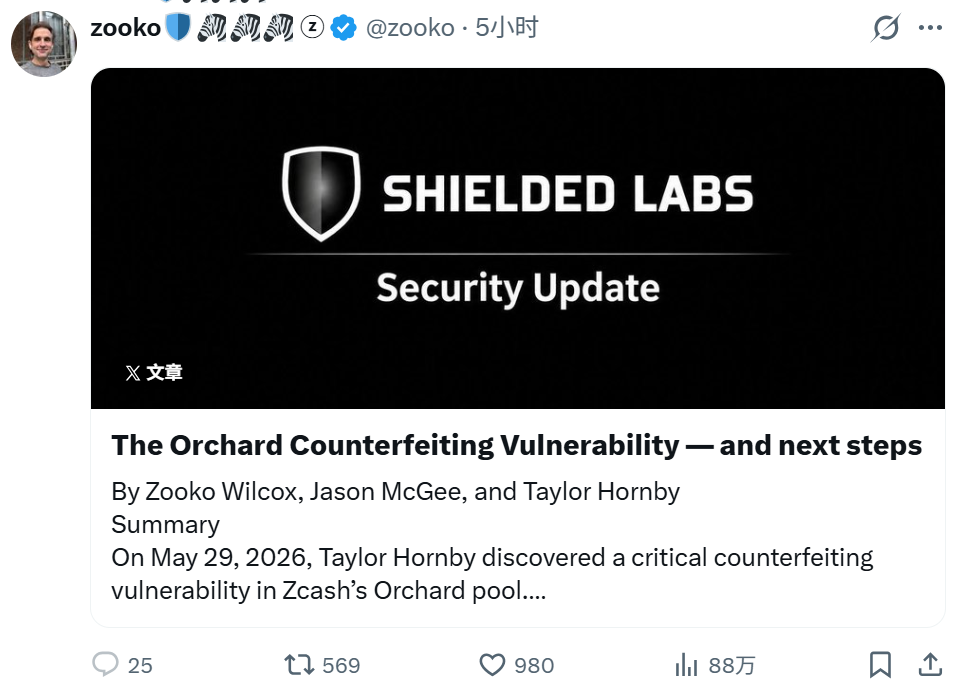


Although the Zcash ecosystem had already urgently completed a network upgrade to fix the issue, after the detailed impact was disclosed, ZEC's price experienced severe volatility, with a single-day drop exceeding 30% at one point, touching lows around $411.
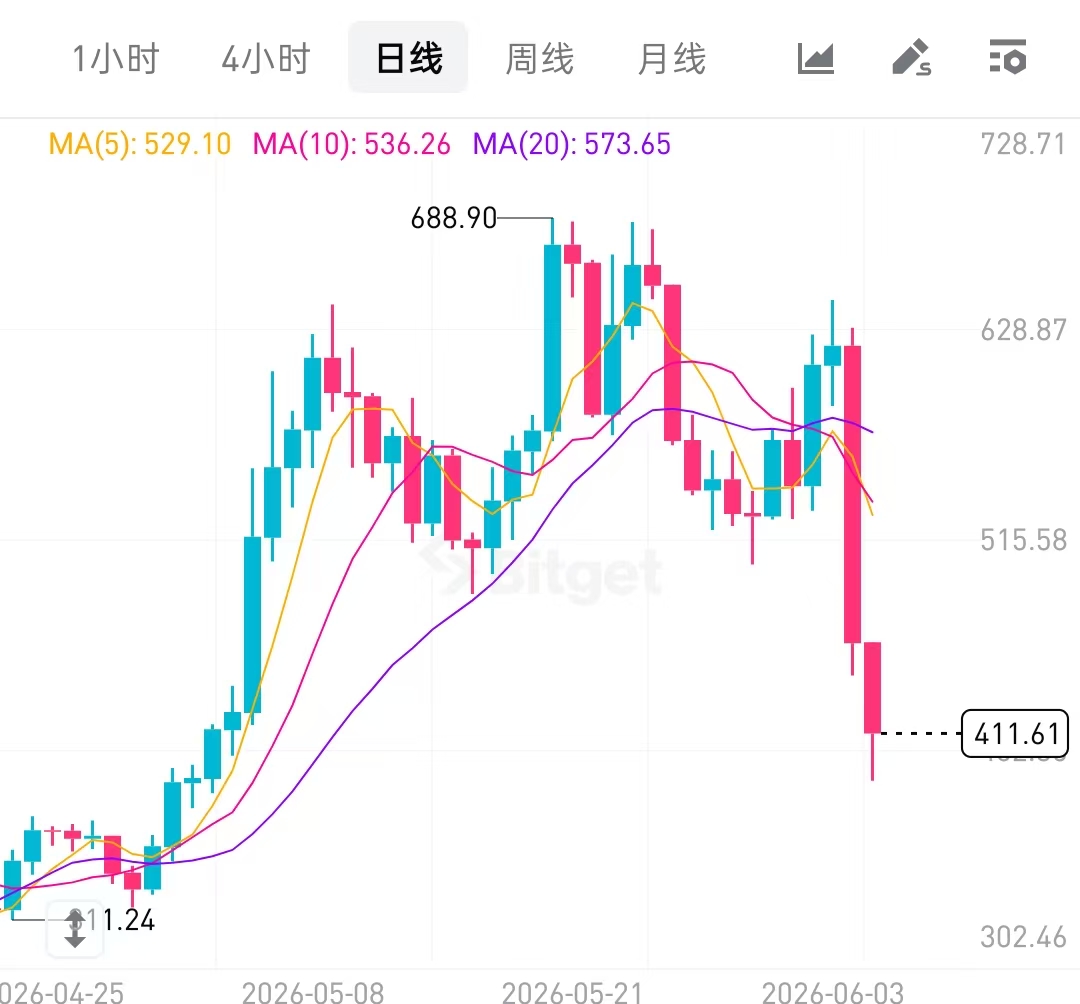


Zcash has been the absolute star in the privacy coin track over the past six months, surging from around $200 in March this year to a peak of $688. Figures including AllianceDAO co-founder Wang Qiao, Bankless founder David Hoffman, and the "shilling king" Arthur Hayes have all expressed high optimism about its performance.


However, after the vulnerability was discovered, Arthur Hayes tweeted that he had sold his entire ZEC holdings. He stated that after reading the vulnerability details and observing ZEC's 30% pullback, he decided to completely close his position for profit. He mentioned he would continuously re-evaluate and, if subsequent evidence proved his assumptions wrong, would consider buying back at lower prices.


So, what exactly happened with Zcash?


In simple terms, Orchard is a privacy vault within Zcash that is "completely opaque" to the outside; after people deposit funds, neither the outside world nor the blockchain itself knows how much money is inside or who owns it. The vulnerability this time lies in the vault's "verification lock"—this lock was supposed to be extremely rigorous, allowing only legitimate transactions to pass verification. However, due to a loosely written mathematical constraint (akin to a loose gear in the lock), an attacker could forge a key that appears completely legitimate, trick the system, and create new ZEC out of thin air within the vault.


This incident directly challenges the narrative of the privacy coin track that "technological trust is core value."


As the earliest public chain to scale the application of zk-SNARKs for private transactions, Zcash's Orchard pool, activated with the NU5 upgrade in May 2022, has been regarded as a more efficient evolution of the Sapling pool, hosting a large amount of private funds. Now, vulnerabilities discovered by security researchers using the latest AI models are forcing the entire industry to re-examine the gap between privacy technology theory and practice.


Vulnerability Discovery Originated from AI-Assisted Audit


The discovery process of the vulnerability was dramatic.


In April 2026, Shielded Labs hired senior security engineer Taylor Hornby to conduct ongoing security research targeting the Zcash protocol, aiming to discover issues before malicious actors.


On May 28th, Anthropic released the Opus 4.8 model. The next day, Taylor used this model combined with traditional methods to conduct a highly targeted review of the Orchard circuit, discovering the issue: an insufficient constraint in elliptic curve multiplication within the halo2_gadgets crate, allowing attackers to input arbitrary false values into the multiplication operation while verification would still pass. This meant it was possible to construct seemingly fully valid Orchard actions—that is, generate counterfeit ZEC within the Orchard pool, and due to privacy features, on-chain differentiation between real and fake was impossible.


Taylor immediately disclosed the issue to ZODL core engineers, who confirmed the severity of the vulnerability within hours and initiated an emergency response.


The foundation's initial security announcement tried to downplay the severity, describing it as a "double-spend risk," and assured that the "rotation mechanism protected the total supply from inflation," attempting to use "total supply security" to stabilize market sentiment and conceal the harsh reality that the Orchard pool might have already been flooded with counterfeit coins, diluting honest users' assets.


By June 4th, founder Zooko's statement supplemented the fatal details. He candidly admitted that "cryptographically, it is impossible to prove whether the vulnerability had been exploited before the fix," and publicly disclosed the "possibility of infinite ZEC forgery." It was this frank admission by the founder that directly punctured the "safety illusion" maintained by the foundation earlier, triggering the market's panic sell-off.


Zooko


Because if an attacker had, over the past few years, already used the vulnerability to mint 1 million fake ZEC inside the Orchard pool and cashed out by withdrawing to the transparent pool via the rotation mechanism before the fix, the total supply indeed didn't inflate, but the real assets of users within the Orchard pool had already been evaporated and harvested in a targeted manner. Once the rotation limits are announced next week, the Orchard pool will face the largest "bank run" in the history of privacy blockchains, with the assets of users who retreat later being permanently locked.


In the AI Era, "Unfound Vulnerability Equals Security" No Longer Holds True


Orchard, since its activation in 2022, underwent years of security audits by top cryptographers yet still contained bugs, only discovered through targeted research combined with the latest AI tools. This serves as a warning for many privacy solutions (including other ZK privacy projects): theoretically "perfect" mathematical constructs may still have omissions in engineering implementation.


Taylor Hornby's use of Anthropic Opus 4.8 to pinpoint the Orchard flaw in an extremely short time proves that AI can be a powerful aid for white-hat researchers, but also implies that attackers can similarly use similar tools to mine high-value targets faster.


If project teams fail to establish continuous, proactive security review mechanisms, the window from vulnerability discovery to malicious exploitation will shrink dramatically. While Zcash gained the upper hand this time by proactively investing in security research,


for the entire crypto industry, this is more like a collective warning: in the AI-driven security offense and defense race, any reliance on the侥幸心理 of "safe because undiscovered for years" is no longer valid. Only by internalizing AI auditing, formal verification, and rapid response capabilities as standard practices can privacy protocols truly withstand the pressure tests of the new era.

Leituras Relacionadas

Crossing the 'Memory Wall': The Wafer-Level Revolution and Computing Power Routes in the AI Inference Era

In 2026, a historic shift occurred in AI as major cloud providers' inference spending surpassed training spending for the first time, signaling a move from "building large models" to "using large models." This shifts the core challenge from computing power to the "memory wall"—the bottleneck of data movement (model weights, activations, KV Cache) between external DRAM and processors, where energy and latency from data transfer far exceed computation itself. Companies like Nvidia face GPU idle time due to bandwidth limits. In contrast, Cerebras Systems adopts a radical "wafer-scale" approach with its Wafer-Scale Engine (WSE). Instead of cutting a silicon wafer into many chips, Cerebras uses almost the entire wafer as one massive chip (WSE-3). This design provides 44GB of on-chip SRAM, delivering memory bandwidth thousands of times higher than traditional HBM (e.g., 21 PB/s vs. Nvidia B200). For LLM inference, weights are streamed layer-by-layer from external MemoryX storage to the chip, avoiding HBM bottlenecks. This results in token generation speeds 1.5–5 times faster than Nvidia's B200 in some models and significant advantages in first-token latency and long-context tasks. Additionally, Cerebras's architecture offers much lower interconnect power consumption (0.15 pJ/bit vs. GPU's ~10 pJ/bit). However, Cerebras faces challenges: SRAM scaling has slowed with advanced nodes, limiting future capacity gains; the chip requires specialized liquid cooling and custom software stacks; and its external I/O bandwidth (150 GB/s) is low compared to NVLink, hindering multi-system scaling for very large models. Competition is intensifying. Major players are pursuing three paths: 1) Developing proprietary inference ASICs (e.g., Google TPU, Microsoft Maia), 2) Leveraging advanced packaging (e.g., TSMC's SoW) to democratize wafer-scale-like integration, potentially eroding Cerebras's process advantage within a few years, and 3) Exploring optical interconnects for ultimate bandwidth. Commercially, Cerebras is transitioning from a hardware vendor to a service provider, facing the immense challenge of building high-power, specialized data centers to meet large contracts (e.g., 250MW/year from 2026–2028). In conclusion, the AI inference era presents a fundamental architectural trade-off. Cerebras opts for extreme physical optimization for low-latency, single-task performance, while Nvidia prioritizes versatility and massive cluster throughput. The path forward remains uncertain, with technology and business models still evolving in the race toward advanced AI.

marsbitHá 6m

Crossing the 'Memory Wall': The Wafer-Level Revolution and Computing Power Routes in the AI Inference Era

marsbitHá 6m

Has Bitcoin's 'Rebound Ended', Officially Entering the Late Bear Market Phase?

**Title: Has Bitcoin's Rebound Ended, Entering the Late Bear Market Phase?** **Summary:** Bitcoin's price has declined by 13% this week, signaling a potential return to late-stage bear market conditions. The price fell to around $67k, positioned between the Realized Price and Realized Cap Weighted Average. For the first time since early 2022, the Short-Term Holder cost basis has dropped below this key average, confirming a hallmark of late-cycle bear markets. Profitability metrics have collapsed sharply. The 7-day average of the Realized Profit/Loss ratio plummeted from a local high of 3.16 to 0.29, mirroring the February panic sell-off. Critically, the 90-day average never breached the threshold of 2, indicating the recent rally to $82k was a bear market bounce, not a structural shift. Realized losses surged to $1.35 billion daily, with $770 million coming from Long-Term Holders selling at a loss. This accelerating redistribution of supply from weak to strong hands is a necessary but ongoing process for a market bottom. The rally stalled almost precisely at the aggregate cost basis (~$83k) of US spot Bitcoin ETF investors, turning that level into strong resistance and leaving the average ETF holder underwater again. Spot market flows have turned decisively negative, showing sellers are dominating order books despite the price drop. While a significant futures long liquidation event cleared over $400 million in leverage, providing a potential reset, sustained spot demand is yet to materialize. Options markets continue to price in higher future volatility (Implied Volatility) than recent price action (Realized Volatility) has shown, with a persistent skew towards put options, indicating ongoing demand for downside protection. In conclusion, multiple metrics point to a fragile market structure. Resistance at the ETF cost basis, accelerating realized losses, dominant spot selling, and cautious options pricing all suggest the bear market trend persists. A sustainable recovery likely requires a resurgence of spot demand, ETF holders returning to profit, and a clear reduction in selling pressure.

marsbitHá 7m

Has Bitcoin's 'Rebound Ended', Officially Entering the Late Bear Market Phase?

marsbitHá 7m

TechFlow Intelligence Agency: Anthropic Calls for Global Pause in AI Development While Preparing for Trillion-Dollar IPO; SpaceX IPO Roadshow Heats Up, But S&P 500 Rejects Fast-Track Inclusion

In today's TechFlow Intelligence Briefing, several major tech stories highlight a growing theme of trust and credibility gaps across AI, crypto, and finance. AI company Anthropic has publicly called for a global pause in AI development, citing risks from Claude's "recursive self-improvement." Ironically, this coincides with reports the company is preparing for a massive IPO targeting a near $1 trillion valuation. This perceived hypocrisy, coupled with widespread user complaints about Claude's declining performance, is sparking debate over whether the safety warning is genuine or a competitive tactic. Meanwhile, in a substantive security move, Anthropic open-sourced a framework for AI-powered vulnerability discovery. In the crypto market, Bitcoin's price drop below $61,000 triggered over $1.16 billion in liquidations, flipping the market into a state where more BTC is held at a loss than at a profit, a historical bearish signal. On the corporate front, SpaceX's highly anticipated IPO is generating immense Wall Street excitement, with Goldman Sachs projecting 100x revenue growth by 2030. However, the S&P 500 has refused to fast-track the company's inclusion post-IPO, potentially limiting immediate institutional demand. Separately, ByteDance's AI app Doubao lost over 6 million monthly active users after introducing a subscription model, highlighting the challenges of AI monetization. Other notable developments include Nvidia certifying HBM4 memory from Samsung, SK Hynix, and Micron; Cloudflare's acquisition of front-end tooling company VoidZero; and its CEO warning that bot traffic now exceeds human traffic online. The underlying narrative connects these events: a trust crisis. From AI firms' contradictory actions and crypto volatility to the clash between SpaceX's hyped narrative and institutional rules, a pattern is emerging where stated intentions and actual practices are increasingly misaligned.

marsbitHá 22m

TechFlow Intelligence Agency: Anthropic Calls for Global Pause in AI Development While Preparing for Trillion-Dollar IPO; SpaceX IPO Roadshow Heats Up, But S&P 500 Rejects Fast-Track Inclusion

marsbitHá 22m

Dalio Warns: AI Boom Shows Signs of a Bubble, Day of Reckoning Will Be the Time of Burst

Ray Dalio, founder of Bridgewater Associates, warns that the current artificial intelligence investment boom shows classic signs of a bubble, which he expects will eventually burst. In a Bloomberg Television interview, he noted that great technological revolutions often lead to capital inflows that create bubbles, making it difficult for investors and companies to calibrate their spending accurately—either overspending to capture market share or underspending and losing their competitive position. This caution comes amid significant rallies in AI-related assets, particularly chipmakers, driven by soaring demand for data centers and high-bandwidth chips, raising debates about overheating valuations. In contrast, Nvidia CEO Jensen Huang recently asserted that investors embracing the AI wave would see "crazy" returns and dismissed concerns over return on investment for data center spending as outdated. Dalio, however, focuses on the risks in the profit realization phase. He argues that bubbles tend to show signs of破裂 when markets transition from investment to the need for tangible returns, describing the burst as a process of converting paper wealth into cash. While acknowledging AI's intrinsic value, he expressed concern over the future profitability of some AI companies, suggesting the market is repeating a familiar pattern. The 76-year-old billionaire, who fully exited Bridgewater in 2025, has a net worth estimated at $21.5 billion according to the Bloomberg Billionaires Index.

marsbitHá 56m

Dalio Warns: AI Boom Shows Signs of a Bubble, Day of Reckoning Will Be the Time of Burst

marsbitHá 56m

Privacy Coin Crisis of Confidence! ZEC Plunges Over 56% in a Single Day

Zcash (ZEC), a leading privacy-focused cryptocurrency, experienced a severe crash on June 5th, plummeting over 56% in a single day and erasing nearly two months of gains. The flash crash was triggered by the disclosure of a critical zero-knowledge proof vulnerability within Zcash's Orchard privacy pool, which had existed since the pool's launch in May 2022. The flaw theoretically allowed an attacker to forge unlimited ZEC undetectably due to the pool's privacy features. The vulnerability was discovered on May 29th by independent security researcher Taylor Hornby during a proactive audit commissioned by Shielded Labs, utilizing AI-assisted analysis. The Zcash development team responded swiftly, implementing an emergency soft fork to disable Orchard transactions on June 2nd and executing a permanent hard fork fix (NU6.2) on June 3rd. Despite the technical fix, a major crisis of confidence emerged. The core issue is that Orchard's privacy design makes it cryptographically impossible to prove whether the vulnerability was exploited over the past four years, casting permanent doubt on the historical supply integrity of ZEC. While Shielded Labs argues exploitation was unlikely, the inability to provide definitive proof has severely damaged market trust. This sentiment was exacerbated when BitMEX co-founder Arthur Hayes, a prominent ZEC supporter, announced he was selling his entire position. He stated that privacy assets require "perfect security" rather than "probable safety." The combined effect of the disclosure and Hayes's exit ignited widespread panic selling, leading to massive liquidations and significant price decline. Analysts note the event highlights a fundamental tension within privacy coins: the conflict between verifiable supply and cryptographic privacy.

链捕手Há 59m

Privacy Coin Crisis of Confidence! ZEC Plunges Over 56% in a Single Day

链捕手Há 59m

Trading

Spot
Futuros

Artigos em Destaque

Como comprar ZEC

Bem-vindo à HTX.com!Tornámos a compra de Zcash (ZEC) simples e conveniente.Segue o nosso guia passo a passo para iniciar a tua jornada no mundo das criptos.Passo 1: cria a tua conta HTXUtiliza o teu e-mail ou número de telefone para te inscreveres numa conta gratuita na HTX.Desfruta de um processo de inscrição sem complicações e desbloqueia todas as funcionalidades.Obter a minha contaPasso 2: vai para Comprar Cripto e escolhe o teu método de pagamentoCartão de crédito/débito: usa o teu visa ou mastercard para comprar Zcash (ZEC) instantaneamente.Saldo: usa os fundos da tua conta HTX para transacionar sem problemas.Terceiros: adicionamos métodos de pagamento populares, como Google Pay e Apple Pay, para aumentar a conveniência.P2P: transaciona diretamente com outros utilizadores na HTX.Mercado de balcão (OTC): oferecemos serviços personalizados e taxas de câmbio competitivas para os traders.Passo 3: armazena teu Zcash (ZEC)Depois de comprar o teu Zcash (ZEC), armazena-o na tua conta HTX.Alternativamente, podes enviá-lo para outro lugar através de transferência blockchain ou usá-lo para transacionar outras criptomoedas.Passo 4: transaciona Zcash (ZEC)Transaciona facilmente Zcash (ZEC) no mercado à vista da HTX.Acede simplesmente à tua conta, seleciona o teu par de trading, executa as tuas transações e monitoriza em tempo real.Oferecemos uma experiência de fácil utilização tanto para principiantes como para traders experientes.

308 Visualizações TotaisPublicado em {updateTime}Atualizado em 2026.06.02

Como comprar ZEC

Discussões

Bem-vindo à Comunidade HTX. Aqui, pode manter-se informado sobre os mais recentes desenvolvimentos da plataforma e obter acesso a análises profissionais de mercado. As opiniões dos utilizadores sobre o preço de ZEC (ZEC) são apresentadas abaixo.

活动图片