Wuhan is About to Witness Its Largest IPO in History

marsbitPublicado em 2026-08-24Última atualização em 2026-08-24

Resumo

Wuhan is poised for its largest-ever IPO as Yangtze Memory Technologies Co., Ltd. (YMTC) has officially applied for a listing on the Shanghai Stock Exchange's STAR Market, seeking to raise 33 billion yuan. The domestic leader in 3D NAND flash memory chips completed its IPO辅导 (tutoring) process in a record three months, with market expectations valuing the company at 300 billion yuan or higher. YMTC's roots trace back to 2006 with the founding of Wuhan Xinxin. After surviving the global financial crisis and periods of operational difficulty, the company was formally established in 2016 through a joint investment involving Tsinghua Unigroup, the National Integrated Circuit Industry Investment Fund (the "Big Fund"), and local Hubei government funds. With a distinct "national team" background, its major shareholders include provincial and municipal state-owned assets committees and the Big Fund. Based in Wuhan's Optics Valley (East Lake High-tech Development Zone), YMTC's potential listing highlights the region's rise as a tech hub. Optics Valley is already home to 72 listed companies and has ambitious plans to exceed 100 by 2030. The zone recently established four industry-focused母基金 (mother funds) totaling 18 billion yuan to further boost sectors like integrated circuits and optoelectronics. YMTC's IPO would complete the "Optics Valley Seven Stars," a group of leading local optoelectronic and communication giants.

By Rongzhong Finance

Another super IPO is on the way.

Recently, the Shanghai Stock Exchange website showed that the IPO review status of Yangtze Memory Technologies Co., Ltd. on the STAR Market has changed to "Accepted." The company plans to raise 33 billion yuan, with CITIC Securities and China Securities as its sponsors.
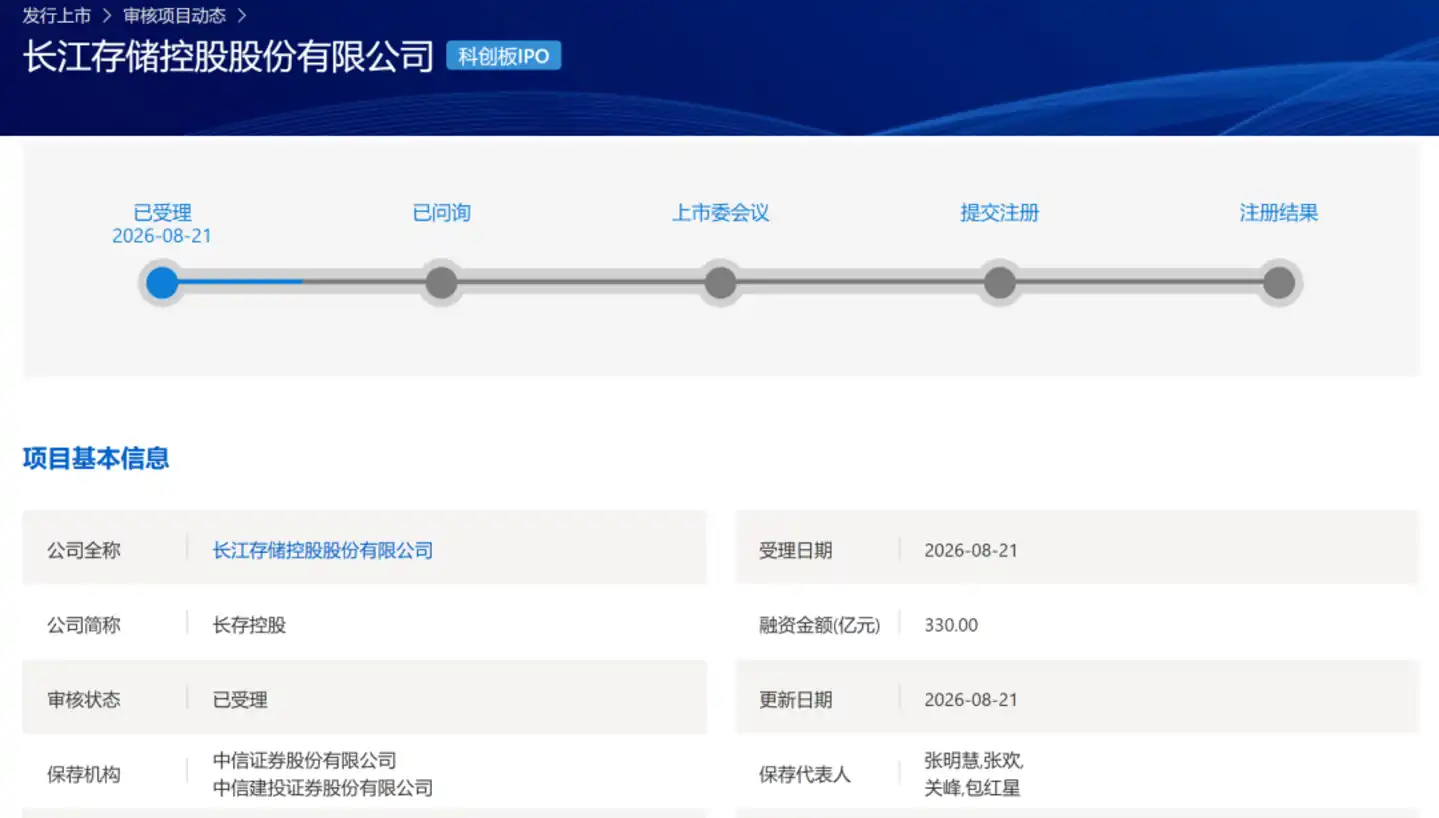
From completing the tutoring filing on May 19th to passing the tutoring acceptance on August 19th, Yangtze Memory took only three months, setting a record for the speed of IPO tutoring in the semiconductor industry. At the same time, this brings it closer to the title of "Wuhan's largest IPO in history." Previously, the Hurun Research Institute's "2025 Global Unicorn List" showed Yangtze Memory's valuation at 160 billion yuan. With the IPO process advancing, market expectations have been revised upwards to 300 billion yuan or even higher.

As we can see, this domestic-only 3D NAND flash memory IDM manufacturer is pushing Wuhan's Optics Valley into the spotlight of the capital market.

A Decade Sharpening the 'Memory Chip'

The story of Yangtze Memory is generally considered to have begun in 2016, but to understand where this hundred-billion behemoth unicorn came from, the clock needs to be turned back to 2000.

That year, the State Council issued the "No. 18 Document" on the integrated circuit industry, triggering the first wave of chip entrepreneurship in China. The landmark event was the return of "the father of Chinese chips," Zhang Rujing, to mainland China to found SMIC. Around the same time, Wuhan began planning to develop its integrated circuit industry.

The difficulty was considerable. Back then, Wuhan's traditional industry was dominated by steel. As a central city, it urgently needed to find an industrial engine for the next decade. Wuhan's leaders ambitiously looked toward this unfamiliar track. Zou Xuecheng, Director of the Research Center for Very Large Scale Integrated Circuits and Systems at Huazhong University of Science and Technology, later told the Yangtze River Daily, "If we don't do this, Hubei and Wuhan will have no name on the map of China's future semiconductor industry."

So, Wuhan spent two years fully preparing, contacting over a dozen well-known domestic and international chip manufacturers seeking cooperation. In 2006, an opportunity arose when SMIC executives were invited to inspect Wuhan. After repeated studies and expert evaluations, it was finally decided that the provincial, municipal, and East Lake High-tech Development Zone governments would jointly invest to establish XMC (Wuhan Xinxin Semiconductor Manufacturing Corp.), with the goal of building the first 12-inch integrated circuit production line in central China. Initially, it was fully managed by SMIC.

Looking back from a god's-eye perspective, this plan was not unanimously approved at the expert evaluation meeting at the time. The reason for opposition was simple: "An investment scale of tens of billions of yuan is too small, lacking economies of scale to be profitable, and the full-process management model is not conducive to subsequent independent development."

But amid such controversy, Phase I of XMC—the first 12-inch integrated circuit production line in central China—was established. According to statistics, provincial and municipal government investments at the time totaled 10.7 billion yuan, accounting for nearly one-tenth of Hubei Province's total state-owned economic investment that year. This production line, which started operations in 2008, coincidentally hit the global financial crisis. Affected by it, the semiconductor industry fell into a downturn, and XMC was severely hit upon its debut.

To survive, the company once shifted to manufacturing for the American flash memory manufacturer Spansion, relying on China's manufacturing cost advantages to secure orders. However, Spansion soon went bankrupt, plunging XMC back into dire straits. At that time, SMIC itself was struggling and unable to continue injecting capital. International giants like TSMC and Micron once eyed this production line, intending to take advantage of the situation.

As the saying goes, "No destruction, no construction." At the last critical moment, the Wuhan government chose to persist, deciding to develop XMC independently. In 2011, both parties established a joint venture; in 2013, SMIC officially withdrew. Wuhan East Lake High-tech Development Zone strongly invited Yang Shining, who had served as SMIC's COO and worked at Intel for over a decade, to become XMC's CEO. The company began to explore the market independently, and its 3D flash memory technology gradually caught up with international giants like SK Hynix, Micron, and Toshiba.

Thus, with the support of the new CEO and Wuhan's "national team," XMC secured orders from important clients like GigaDevice and gradually gained a foothold. In 2014, the National Integrated Circuit Industry Investment Fund launched a second round of large-scale investment in the domestic semiconductor industry. Wuhan decided to "gamble once more" in the memory track. After multiple efforts, in March 2016, the National Memory Base, with a total investment of approximately $24 billion, officially landed in Wuhan Optics Valley. Local media press releases described it as "the largest single high-tech industry investment project in our province since the founding of the People's Republic of China."

On July 26th of the same year, based on XMC, Yangtze Memory Technologies Co., Ltd. was established through joint investment by Tsinghua Unigroup, the National Integrated Circuit Industry Investment Fund, Hubei Guoxin Industry Investment Fund, and Hubei Provincial Science & Technology Investment Group.

Counting from the establishment of XMC in 2006 to the birth of Yangtze Memory in 2016, Wuhan's layout in the memory industry took a full decade.

Massive 'National Team' Background

Looking at the equity structure, Yangtze Memory currently has no controlling shareholder or actual controller.

Before the issuance, Hubei Changsheng is the largest shareholder, holding 26.54%; Xinfei Technology holds 25.35%; the National Integrated Circuit Industry Investment Fund Phase I and Phase II hold 11.97% and 11.38%, respectively; Optics Valley Industry Investment and Guoxin Fund hold 9.25% and 5.90%, respectively.

The prospectus states that the shareholding ratios of the four major shareholders holding more than 10% are relatively close, and none exceed 30%, meaning no single shareholder can significantly influence shareholder meeting resolutions. "During the reporting period, the main capital contributors behind the upward tracing of the company's major shareholders are the Hubei Provincial State-owned Assets Supervision and Administration Commission, Wuhan Municipal State-owned Assets Supervision and Administration Commission, East Lake High-tech Development Zone Management Committee, Big Fund Phase I, and Big Fund Phase II."

Reviewing Yangtze Memory's financing history, one can directly see its distinct "national team" colors.
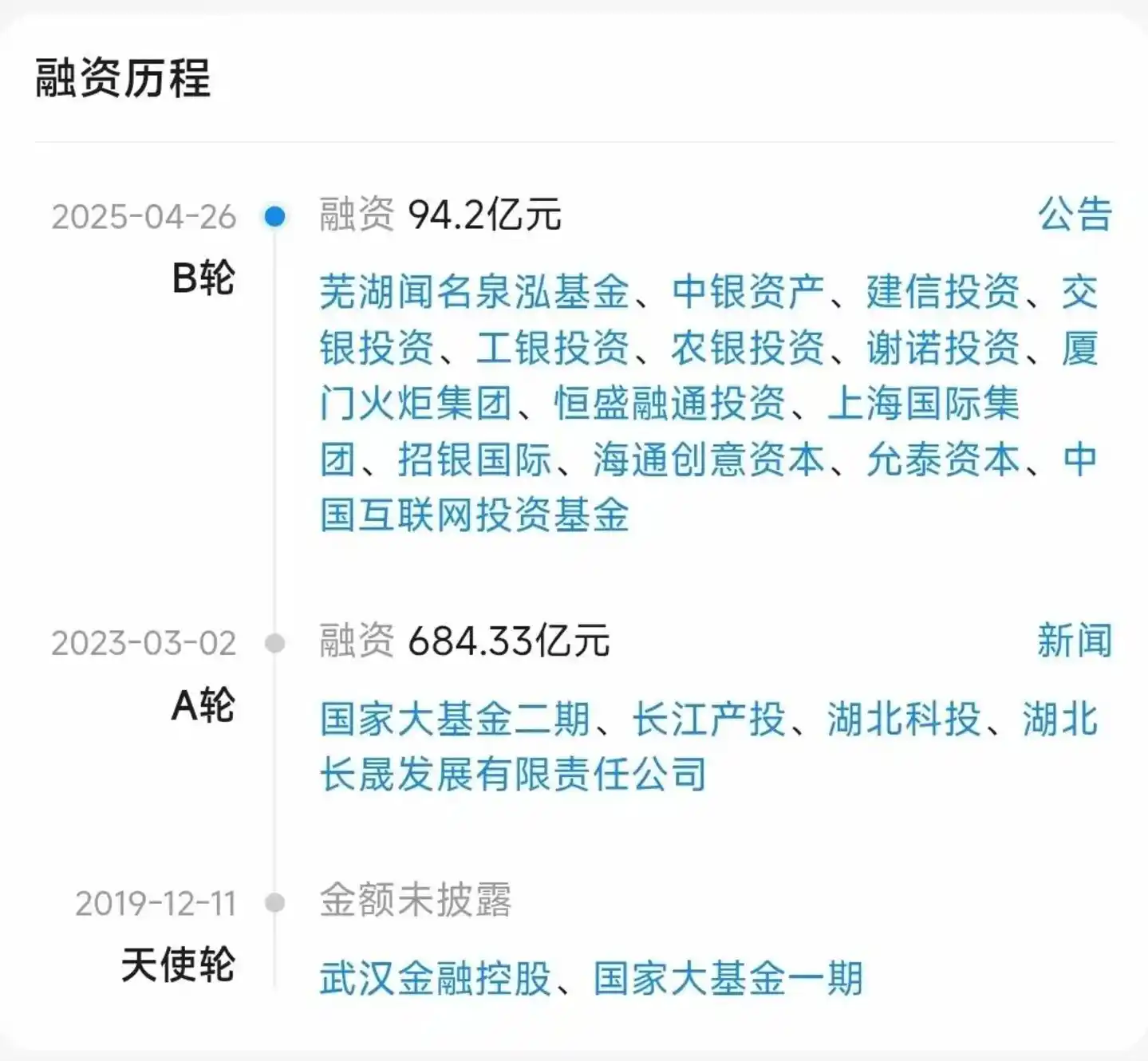
Qichacha data shows that in December 2019, the company completed its Angel round of financing, with Wuhan Financial Holdings and the National Big Fund Phase I investing. In March 2023, the company completed its Series A financing, raising 68.433 billion yuan, with the National Big Fund Phase II, Changjiang Industry Investment, Hubei Science & Technology Investment, and Hubei Changsheng entering successively. In April 2025, the company completed its Series B financing of 9.42 billion yuan. The investor lineup further expanded to include over ten institutions such as Wuhu Wenming Quanhong Fund, BOC Asset Management, CCB Investment, BoCom Investment, ICBC Investment, ABC Investment, Xienuo Investment, Xiamen Torch Group, Hengsheng Rongtong Investment, Shanghai International Group, CMBI, Haitong Creative Capital, Yuntai Capital, and China Internet Investment Fund.

The combined scale of these three rounds of financing far exceeds that of general market-oriented projects, also indirectly confirming the national-team nature of this company's capital structure. The aforementioned employee持股 platforms "Wuhan Zhixin Plan No. 1" to "No. 6" were implemented alongside the shareholding system reform around the Series B round, binding the core technical team to the company's long-term development.

Behind this continuously bolstered shareholder list is the direct financial support from the provincial, municipal, and East Lake High-tech Development Zone governments over a decade, on multiple occasions. Now, as the IPO enters the acceptance stage, this early investment spanning ten years is about to be priced by the capital market. According to estimates, the shares held by Wuhan's state-owned assets through various platforms alone, once Yangtze Memory successfully goes public, are expected to be worth hundreds of billions of yuan on paper, with paper gains being incalculable.

Optics Valley, More IPOs Are on the Way

Undoubtedly, if all goes smoothly, Wuhan will reap the city's largest IPO in history. For this enterprise, whose every step of growth bears the imprint of its locality, its location, "Optics Valley," is also pushed into the spotlight of the capital market.

As of June this year, Optics Valley has gathered 72 listed companies. The total market value of domestic and foreign listed companies has exceeded 1.8 trillion yuan, accounting for about one-third of Hubei Province's and over 60% of Wuhan's total.

Optics Valley authorities have stated more than once, "Listed companies are the main force of technological innovation, the strong engine of industrial development, and the spokesperson of urban vitality in Optics Valley." Centered on this positioning, Optics Valley has successively introduced special policies in recent years such as the "Action Plan for High-quality Development of Listed Companies," the "New 15 Articles for IPOs," and the "10 Articles for Venture Capital," established the Central China Service Base of the Beijing Stock Exchange, and launched the "IPO Seedling Loan" for technology-based SMEs, with single loans up to 50 million yuan supported by financing. The government sets up a risk compensation fund for financial institutions, with the proportion reaching up to 30%.

Currently, this report card is only a阶段性 achievement, as Optics Valley's latest goal has been updated—by 2030, the total number of listed enterprises in Optics Valley aims to exceed 100, and the number of companies with a market value of 100 billion yuan aims to double compared to the current number, reaching 8.

The liveliness of the secondary market cannot be sustained without the接力 of primary market investment; it is also a consensus that the source of活水 must first flow into early-stage projects. The latest move occurred at the World Optics Valley Science and Technology Financial Ecology Co-construction Conference held on June 27th.

At this conference, Optics Valley established four industrial-focused mother funds in one go, with a total scale of 18 billion yuan, targeting four major directions: optoelectronics information, life health, integrated circuits, and future industries. According to the plan, by 2030, these four mother funds will leverage a new fund cluster of no less than 100 billion yuan, driving total investment exceeding 300 billion yuan.

It is worth noting that tracks that sound distant, such as photonic integration, embodied intelligence, and quantum technology, have already been提前布局 by Optics Valley. Among them, Liuxin Optoelectronics' 8-inch wafer photonic integration chip technology is industry-leading; Yuwei Optics' full-spectrum industrial LiDAR and high-precision ranging products are already among the top domestic enterprises; Langyi Robot specializes in the "embodied cerebellum" for humanoid robots, and its products have become the first choice for many national robotics companies... The list goes on and on.

Moreover, new candidates are continuously being produced under this system. According to disclosures from Optics Valley, since 2026, there have been at least 40公开融资 events for tech companies in the region, covering seed rounds from the million-yuan level to industrial rounds in the billion-yuan level. In the past three years, Optics Valley's technology credit has累计 provided support exceeding 300 billion yuan to nearly 6,000 enterprises, with 426 registered funds in the region. These enterprises that have received financial support are the reserve army for the "Optics Valley sector."

Currently, the "Optics Valley Seven Stars," represented by seven optical communication giants including Yangtze Memory, Changfei Fiber, Huagong Tech, Accelink, FiberHome, Guide Infrared, and CITIC Mobile, are整链崛起 at an unprecedented speed and姿态. Among them, Yangtze Memory is the only unlisted company among the "Optics Valley Seven Stars." As its IPO process advances further, Optics Valley will also welcome the团圆时刻 of the "Seven Stars" in the capital market.


Criptomoedas em alta

Perguntas relacionadas

QWhat is the current status of Yangtze Memory Technologies Co., Ltd.'s IPO application on the Shanghai Stock Exchange?

AThe IPO application of Yangtze Memory Technologies Co., Ltd. on the Shanghai Stock Exchange has been updated to 'accepted'.

QHow much capital does Yangtze Memory Technologies Co., Ltd. plan to raise through its IPO?

AYangtze Memory Technologies Co., Ltd. plans to raise 33 billion yuan through its IPO.

QWhat is Yangtze Memory's business focus and its significance in the domestic market?

AYangtze Memory is China's only 3D NAND flash memory IDM (Integrated Device Manufacturer).

QWhich are the major state-backed shareholders in Yangtze Memory Technologies Co., Ltd. prior to the IPO?

AMajor state-backed shareholders include Hubei Changsheng (26.54%), Xinfei Technology (25.35%), National Integrated Circuit Industry Investment Fund Phase I (11.97%) and Phase II (11.38%), Optics Valley Industry Investment (9.25%), and Guoxin Fund (5.90%).

QWhat is the future goal for the number of listed companies in Optics Valley by 2030?

AOptics Valley aims to have the total number of listed companies exceed 100 by 2030.

Leituras Relacionadas

Bitcoin's Record-Breaking Week: Surge Over $16,000 and Predictions for the 'Strongest' Cycle in History

Bitcoin recorded its largest weekly dollar gain in history, surging approximately from $63,000 to $79,000 between August 17 and 23, 2026. Strive CEO Matt Cole noted Bitcoin's explosive breakout not only against the US dollar but also against gold, suggesting the world is entering a period of heightened demand for scarce assets like gold, silver, and Bitcoin. He believes Bitcoin could attract a disproportionate share of new liquidity and anticipates the next market cycle could be the "strongest" in history, though a short-term pullback is possible. Analysts highlighted key factors for continued growth. Zeus Research's Dominic John pointed to new ETF inflows and improving macroeconomic liquidity, with the potential CLARITY Act in September as a positive catalyst. He sees a path to $85,000-$90,000 if Bitcoin reclaims $80,000, with $100,000 possible under favorable conditions. Conversely, BTC Markets' Rachel Lucas warned against attributing the rally to a single factor, noting it likely resulted from short squeezes, spot demand, and derivatives market activity. She advised monitoring spot ETF inflows, open interest, and funding rates. Predominantly spot-driven demand creates a firmer foundation, while overheated funding rates and high open interest signal increased risk of a sharp correction. She added that profit-taking and volatility post-rally are normal and not inherently bearish. The report also recalled that Bitcoin and Ethereum ETFs saw their best weekly inflow of 2026 at $2.62 billion from August 17-21.

cryptonews.ruHá 23m

Bitcoin's Record-Breaking Week: Surge Over $16,000 and Predictions for the 'Strongest' Cycle in History

cryptonews.ruHá 23m

The Strategy of Accumulating Cryptocurrency on Company Balance Sheets Is Worn Out — Bloomberg

The strategy of companies accumulating cryptocurrency on their balance sheets has become outdated, according to Bloomberg. Since the start of the year, the market capitalization of such Digital Asset Treasury (DAT) companies in the US and Canada has fallen by 43%. Shares of Strategy, a major corporate Bitcoin holder, have dropped over 20% this year and are down more than 70% from their mid-2025 peak. This downturn, turning DATs into a toxic asset for investors, followed the broader crypto market's decline from its autumn 2025 highs, where Bitcoin lost over a third and Ethereum halved in value. This created a negative cycle where falling crypto prices reduced the collateral for company loans, forcing asset sales that further depressed prices. Attempts by at least ten DATs to pivot, often to artificial intelligence, have largely failed, resulting in significant stock price declines for companies like Wave Media and AlphaTON Capital. The exception has been crypto miners like CoreWeave, who successfully leveraged their existing computing infrastructure for new ventures. Many companies, including miners and data center operators, are now selling their crypto holdings. Recent examples include Hyperscale Data selling $43 million in Bitcoin, Strategy selling $108.6 million in BTC for a share buyback, and Japan's Quantum Solutions selling Ethereum to fund its AI business.

cryptonews.ruHá 25m

The Strategy of Accumulating Cryptocurrency on Company Balance Sheets Is Worn Out — Bloomberg

cryptonews.ruHá 25m

Trading

Spot

Artigos em Destaque

O que é $S$

Compreender o SPERO: Uma Visão Abrangente Introdução ao SPERO À medida que o panorama da inovação continua a evoluir, o surgimento de tecnologias web3 e projetos de criptomoeda desempenha um papel fundamental na formação do futuro digital. Um projeto que tem atraído atenção neste campo dinâmico é o SPERO, denotado como SPERO,$$s$. Este artigo tem como objetivo reunir e apresentar informações detalhadas sobre o SPERO, para ajudar entusiastas e investidores a compreender as suas bases, objetivos e inovações nos domínios web3 e cripto. O que é o SPERO,$$s$? O SPERO,$$s$ é um projeto único dentro do espaço cripto que procura aproveitar os princípios da descentralização e da tecnologia blockchain para criar um ecossistema que promove o envolvimento, a utilidade e a inclusão financeira. O projeto é concebido para facilitar interações peer-to-peer de novas maneiras, proporcionando aos utilizadores soluções e serviços financeiros inovadores. No seu núcleo, o SPERO,$$s$ visa capacitar indivíduos ao fornecer ferramentas e plataformas que melhoram a experiência do utilizador no espaço das criptomoedas. Isso inclui a possibilidade de métodos de transação mais flexíveis, a promoção de iniciativas impulsionadas pela comunidade e a criação de caminhos para oportunidades financeiras através de aplicações descentralizadas (dApps). A visão subjacente do SPERO,$$s$ gira em torno da inclusão, visando fechar lacunas dentro das finanças tradicionais enquanto aproveita os benefícios da tecnologia blockchain. Quem é o Criador do SPERO,$$s$? A identidade do criador do SPERO,$$s$ permanece algo obscura, uma vez que existem recursos publicamente disponíveis limitados que fornecem informações detalhadas sobre o(s) seu(s) fundador(es). Esta falta de transparência pode resultar do compromisso do projeto com a descentralização—uma ética que muitos projetos web3 partilham, priorizando contribuições coletivas em vez de reconhecimento individual. Ao centrar as discussões em torno da comunidade e dos seus objetivos coletivos, o SPERO,$$s$ incorpora a essência do empoderamento sem destacar indivíduos específicos. Assim, compreender a ética e a missão do SPERO é mais importante do que identificar um criador singular. Quem são os Investidores do SPERO,$$s$? O SPERO,$$s$ é apoiado por uma diversidade de investidores que vão desde capitalistas de risco a investidores-anjo dedicados a promover a inovação no setor cripto. O foco desses investidores geralmente alinha-se com a missão do SPERO—priorizando projetos que prometem avanço tecnológico social, inclusão financeira e governança descentralizada. Essas fundações de investidores estão tipicamente interessadas em projetos que não apenas oferecem produtos inovadores, mas que também contribuem positivamente para a comunidade blockchain e os seus ecossistemas. O apoio desses investidores reforça o SPERO,$$s$ como um concorrente notável no domínio em rápida evolução dos projetos cripto. Como Funciona o SPERO,$$s$? O SPERO,$$s$ emprega uma estrutura multifacetada que o distingue de projetos de criptomoeda convencionais. Aqui estão algumas das características-chave que sublinham a sua singularidade e inovação: Governança Descentralizada: O SPERO,$$s$ integra modelos de governança descentralizada, capacitando os utilizadores a participar ativamente nos processos de tomada de decisão sobre o futuro do projeto. Esta abordagem promove um sentido de propriedade e responsabilidade entre os membros da comunidade. Utilidade do Token: O SPERO,$$s$ utiliza o seu próprio token de criptomoeda, concebido para servir várias funções dentro do ecossistema. Esses tokens permitem transações, recompensas e a facilitação de serviços oferecidos na plataforma, melhorando o envolvimento e a utilidade gerais. Arquitetura em Camadas: A arquitetura técnica do SPERO,$$s$ suporta modularidade e escalabilidade, permitindo a integração contínua de funcionalidades e aplicações adicionais à medida que o projeto evolui. Esta adaptabilidade é fundamental para manter a relevância no panorama cripto em constante mudança. Envolvimento da Comunidade: O projeto enfatiza iniciativas impulsionadas pela comunidade, empregando mecanismos que incentivam a colaboração e o feedback. Ao nutrir uma comunidade forte, o SPERO,$$s$ pode melhor atender às necessidades dos utilizadores e adaptar-se às tendências do mercado. Foco na Inclusão: Ao oferecer taxas de transação baixas e interfaces amigáveis, o SPERO,$$s$ visa atrair uma base de utilizadores diversificada, incluindo indivíduos que anteriormente podem não ter participado no espaço cripto. Este compromisso com a inclusão alinha-se com a sua missão abrangente de empoderamento através da acessibilidade. Cronologia do SPERO,$$s$ Compreender a história de um projeto fornece insights cruciais sobre a sua trajetória de desenvolvimento e marcos. Abaixo está uma cronologia sugerida que mapeia eventos significativos na evolução do SPERO,$$s$: Fase de Conceituação e Ideação: As ideias iniciais que formam a base do SPERO,$$s$ foram concebidas, alinhando-se de perto com os princípios de descentralização e foco na comunidade dentro da indústria blockchain. Lançamento do Whitepaper do Projeto: Após a fase conceitual, um whitepaper abrangente detalhando a visão, os objetivos e a infraestrutura tecnológica do SPERO,$$s$ foi lançado para atrair o interesse e o feedback da comunidade. Construção da Comunidade e Primeiros Envolvimentos: Esforços ativos de divulgação foram feitos para construir uma comunidade de primeiros adotantes e investidores potenciais, facilitando discussões em torno dos objetivos do projeto e angariando apoio. Evento de Geração de Tokens: O SPERO,$$s$ realizou um evento de geração de tokens (TGE) para distribuir os seus tokens nativos a apoiantes iniciais e estabelecer liquidez inicial dentro do ecossistema. Lançamento da dApp Inicial: A primeira aplicação descentralizada (dApp) associada ao SPERO,$$s$ foi lançada, permitindo que os utilizadores interagissem com as funcionalidades principais da plataforma. Desenvolvimento Contínuo e Parcerias: Atualizações e melhorias contínuas nas ofertas do projeto, incluindo parcerias estratégicas com outros players no espaço blockchain, moldaram o SPERO,$$s$ em um jogador competitivo e em evolução no mercado cripto. Conclusão O SPERO,$$s$ é um testemunho do potencial do web3 e das criptomoedas para revolucionar os sistemas financeiros e capacitar indivíduos. Com um compromisso com a governança descentralizada, o envolvimento da comunidade e funcionalidades inovadoras, abre caminho para um panorama financeiro mais inclusivo. Como em qualquer investimento no espaço cripto em rápida evolução, potenciais investidores e utilizadores são incentivados a pesquisar minuciosamente e a envolver-se de forma ponderada com os desenvolvimentos em curso dentro do SPERO,$$s$. O projeto demonstra o espírito inovador da indústria cripto, convidando a uma exploração mais aprofundada das suas inúmeras possibilidades. Embora a jornada do SPERO,$$s$ ainda esteja a desenrolar-se, os seus princípios fundamentais podem, de facto, influenciar o futuro de como interagimos com a tecnologia, as finanças e uns com os outros em ecossistemas digitais interconectados.

402 Visualizações TotaisPublicado em {updateTime}Atualizado em 2024.12.17

O que é $S$

O que é AGENT S

Agent S: O Futuro da Interação Autónoma no Web3 Introdução No panorama em constante evolução do Web3 e das criptomoedas, as inovações estão constantemente a redefinir a forma como os indivíduos interagem com plataformas digitais. Um projeto pioneiro, o Agent S, promete revolucionar a interação humano-computador através do seu framework aberto e agente. Ao abrir caminho para interações autónomas, o Agent S visa simplificar tarefas complexas, oferecendo aplicações transformadoras em inteligência artificial (IA). Esta exploração detalhada irá aprofundar-se nas complexidades do projeto, nas suas características únicas e nas implicações para o domínio das criptomoedas. O que é o Agent S? O Agent S é um framework aberto e agente, especificamente concebido para abordar três desafios fundamentais na automação de tarefas computacionais: Aquisição de Conhecimento Específico de Domínio: O framework aprende inteligentemente a partir de várias fontes de conhecimento externas e experiências internas. Esta abordagem dupla capacita-o a construir um rico repositório de conhecimento específico de domínio, melhorando o seu desempenho na execução de tarefas. Planeamento ao Longo de Longos Horizontes de Tarefas: O Agent S emprega planeamento hierárquico aumentado por experiência, uma abordagem estratégica que facilita a decomposição e execução eficientes de tarefas intrincadas. Esta característica melhora significativamente a sua capacidade de gerir múltiplas subtarefas de forma eficiente e eficaz. Gestão de Interfaces Dinâmicas e Não Uniformes: O projeto introduz a Interface Agente-Computador (ACI), uma solução inovadora que melhora a interação entre agentes e utilizadores. Utilizando Modelos de Linguagem Multimodais de Grande Escala (MLLMs), o Agent S pode navegar e manipular diversas interfaces gráficas de utilizador de forma fluida. Através destas características pioneiras, o Agent S fornece um framework robusto que aborda as complexidades envolvidas na automação da interação humana com máquinas, preparando o terreno para uma infinidade de aplicações em IA e além. Quem é o Criador do Agent S? Embora o conceito de Agent S seja fundamentalmente inovador, informações específicas sobre o seu criador permanecem elusivas. O criador é atualmente desconhecido, o que destaca ou o estágio nascente do projeto ou a escolha estratégica de manter os membros fundadores em anonimato. Independentemente da anonimidade, o foco permanece nas capacidades e no potencial do framework. Quem são os Investidores do Agent S? Como o Agent S é relativamente novo no ecossistema criptográfico, informações detalhadas sobre os seus investidores e financiadores não estão explicitamente documentadas. A falta de informações disponíveis publicamente sobre as fundações de investimento ou organizações que apoiam o projeto levanta questões sobre a sua estrutura de financiamento e roteiro de desenvolvimento. Compreender o apoio é crucial para avaliar a sustentabilidade do projeto e o seu impacto potencial no mercado. Como Funciona o Agent S? No núcleo do Agent S reside uma tecnologia de ponta que lhe permite funcionar eficazmente em diversos ambientes. O seu modelo operacional é construído em torno de várias características-chave: Interação Humano-Computador Semelhante: O framework oferece planeamento avançado em IA, esforçando-se para tornar as interações com computadores mais intuitivas. Ao imitar o comportamento humano na execução de tarefas, promete elevar as experiências dos utilizadores. Memória Narrativa: Utilizada para aproveitar experiências de alto nível, o Agent S utiliza memória narrativa para acompanhar os históricos de tarefas, melhorando assim os seus processos de tomada de decisão. Memória Episódica: Esta característica fornece aos utilizadores orientações passo a passo, permitindo que o framework ofereça suporte contextual à medida que as tarefas se desenrolam. Suporte para OpenACI: Com a capacidade de funcionar localmente, o Agent S permite que os utilizadores mantenham o controlo sobre as suas interações e fluxos de trabalho, alinhando-se com a ética descentralizada do Web3. Fácil Integração com APIs Externas: A sua versatilidade e compatibilidade com várias plataformas de IA garantem que o Agent S possa integrar-se perfeitamente em ecossistemas tecnológicos existentes, tornando-o uma escolha apelativa para desenvolvedores e organizações. Estas funcionalidades contribuem coletivamente para a posição única do Agent S no espaço cripto, à medida que automatiza tarefas complexas e em múltiplos passos com mínima intervenção humana. À medida que o projeto evolui, as suas potenciais aplicações no Web3 podem redefinir a forma como as interações digitais se desenrolam. Cronologia do Agent S O desenvolvimento e os marcos do Agent S podem ser encapsulados numa cronologia que destaca os seus eventos significativos: 27 de Setembro de 2024: O conceito de Agent S foi lançado num artigo de pesquisa abrangente intitulado “Um Framework Agente Aberto que Usa Computadores como um Humano”, mostrando a base para o projeto. 10 de Outubro de 2024: O artigo de pesquisa foi disponibilizado publicamente no arXiv, oferecendo uma exploração aprofundada do framework e da sua avaliação de desempenho com base no benchmark OSWorld. 12 de Outubro de 2024: Uma apresentação em vídeo foi lançada, proporcionando uma visão visual das capacidades e características do Agent S, envolvendo ainda mais potenciais utilizadores e investidores. Estes marcos na cronologia não apenas ilustram o progresso do Agent S, mas também indicam o seu compromisso com a transparência e o envolvimento da comunidade. Pontos-Chave Sobre o Agent S À medida que o framework Agent S continua a evoluir, várias características-chave destacam-se, sublinhando a sua natureza inovadora e potencial: Framework Inovador: Concebido para proporcionar um uso intuitivo de computadores semelhante à interação humana, o Agent S traz uma abordagem nova à automação de tarefas. Interação Autónoma: A capacidade de interagir autonomamente com computadores através de GUI significa um avanço em direção a soluções computacionais mais inteligentes e eficientes. Automação de Tarefas Complexas: Com a sua metodologia robusta, pode automatizar tarefas complexas e em múltiplos passos, tornando os processos mais rápidos e menos propensos a erros. Melhoria Contínua: Os mecanismos de aprendizagem permitem que o Agent S melhore a partir de experiências passadas, aprimorando continuamente o seu desempenho e eficácia. Versatilidade: A sua adaptabilidade em diferentes ambientes operacionais, como OSWorld e WindowsAgentArena, garante que pode servir uma ampla gama de aplicações. À medida que o Agent S se posiciona no panorama do Web3 e das criptomoedas, o seu potencial para melhorar as capacidades de interação e automatizar processos significa um avanço significativo nas tecnologias de IA. Através do seu framework inovador, o Agent S exemplifica o futuro das interações digitais, prometendo uma experiência mais fluida e eficiente para os utilizadores em diversas indústrias. Conclusão O Agent S representa um ousado avanço na união da IA e do Web3, com a capacidade de redefinir a forma como interagimos com a tecnologia. Embora ainda esteja nas suas fases iniciais, as possibilidades para a sua aplicação são vastas e cativantes. Através do seu framework abrangente que aborda desafios críticos, o Agent S visa trazer interações autónomas para o primeiro plano da experiência digital. À medida que avançamos mais profundamente nos domínios das criptomoedas e da descentralização, projetos como o Agent S desempenharão, sem dúvida, um papel crucial na formação do futuro da tecnologia e da colaboração humano-computador.

996 Visualizações TotaisPublicado em {updateTime}Atualizado em 2025.01.14

O que é AGENT S

Como comprar S

Bem-vindo à HTX.com!Tornámos a compra de Sonic (S) simples e conveniente.Segue o nosso guia passo a passo para iniciar a tua jornada no mundo das criptos.Passo 1: cria a tua conta HTXUtiliza o teu e-mail ou número de telefone para te inscreveres numa conta gratuita na HTX.Desfruta de um processo de inscrição sem complicações e desbloqueia todas as funcionalidades.Obter a minha contaPasso 2: vai para Comprar Cripto e escolhe o teu método de pagamentoCartão de crédito/débito: usa o teu visa ou mastercard para comprar Sonic (S) instantaneamente.Saldo: usa os fundos da tua conta HTX para transacionar sem problemas.Terceiros: adicionamos métodos de pagamento populares, como Google Pay e Apple Pay, para aumentar a conveniência.P2P: transaciona diretamente com outros utilizadores na HTX.Mercado de balcão (OTC): oferecemos serviços personalizados e taxas de câmbio competitivas para os traders.Passo 3: armazena teu Sonic (S)Depois de comprar o teu Sonic (S), armazena-o na tua conta HTX.Alternativamente, podes enviá-lo para outro lugar através de transferência blockchain ou usá-lo para transacionar outras criptomoedas.Passo 4: transaciona Sonic (S)Transaciona facilmente Sonic (S) no mercado à vista da HTX.Acede simplesmente à tua conta, seleciona o teu par de trading, executa as tuas transações e monitoriza em tempo real.Oferecemos uma experiência de fácil utilização tanto para principiantes como para traders experientes.

1.8k Visualizações TotaisPublicado em {updateTime}Atualizado em 2026.06.02

Como comprar S

Discussões

Bem-vindo à Comunidade HTX. Aqui, pode manter-se informado sobre os mais recentes desenvolvimentos da plataforma e obter acesso a análises profissionais de mercado. As opiniões dos utilizadores sobre o preço de S (S) são apresentadas abaixo.

活动图片