Yang Ge Gary: Agent Economy and AI Sub-Microeconomics

marsbitPublicado em 2026-06-08Última atualização em 2026-06-08

Resumo

"Agent Economy and AI Submicroeconomics" by Gary Yang discusses the evolution of AI Agent economies, written from Singapore in June 2026. The author observes a significant "civilizational generational gap" in AI development, particularly highlighted by events in Silicon Valley. The article identifies a current bottleneck in the transition from Human-to-Agent (H2A) economies to true Agent-to-Agent (A2A) ecosystems. While AI Payment protocols are rapidly emerging, many implementations remain non-AI-native, focusing on traditional human decision-making models rather than leveraging autonomous Agent decision-making. A core thesis is the inevitable formation of an **Agent Economy**, defined as a system where autonomous AI Agents create, exchange, and capitalize value independently. This requires new infrastructure: **AI Protocols**, which are the foundational rules and standards for Agent interaction. The piece explores the relationship and current gap between AI Protocols and Crypto Protocols, suggesting political and regulatory factors from traditional finance are temporarily constraining development. However, a future fusion into a mature Digital Protocol system is deemed inevitable based on first principles. The author introduces **AI Agent Submicroeconomics**, contrasting it with human economics. Key differences include higher transaction frequency, lower value per transaction, efficiency-driven (not emotion-driven) decisions, task-oriented (not consumption-oriented) behav...

Author: Yang Ge Gary

Written in Singapore on June 8, 2026

The Singularity's outbreak has continuously accelerated AI's evolutionary clock, leading to the rapid formation of new civilization generational gaps across different regions of the globe. In the past two months, I have participated in over 20 AI-related events in more than ten cities worldwide. Only the Stripe Sessions in downtown San Francisco at the end of April stood out, creating a generational gap that was far more shocking than all other topics. While the world is growing weary of the single-machine bottlenecks of Claws & Agents, Silicon Valley and San Francisco have already moved into the next dimension in the management of Agent economy and Agent epistemology. The competitive pressure in Q3/Q4 of 2026 remains intense, with the exponential curve being very steep.

1. The Competition in AI Payment and the Bottleneck of the H2A Economy

In Q1 2026, we predicted that from April to May, many regions globally would enter fierce competition for AI Agent Payment, which would quickly become white-hot. The need for value exchange between Agents began to manifest initially, and the rapid development of AI Payment was validated in Q2. Following x402, multiple AI Payment Protocols like MPP rapidly emerged in Q2. Not only are traditional and Crypto financial payment companies upgrading to AI at full speed, but even major tech giants (especially like Google) and even old-school IT companies (such as IBM) have charged into this track, hoping to seize a voice in shaping the Agent world.

On the day of the Stripe Sessions in San Francisco, I discussed the standardization and application issues of Payment Protocols with technical leaders from several top AI companies. The results were reasonable but not entirely satisfactory: 1) No one could set the standard; consensus standards would only gradually form during the scramble. 2) Most completely agreed that Crypto is the inevitable path for AI Payment Protocol, but their starting point was Fiat API, partly due to inertia but more due to compliance hurdles. 3) KYC is both unavoidable and anti-Agent Native. 4) Everyone claims A2A (Agent to Agent), but everyone is actually doing H2A (Human to Agent).

In fact, during Q2 2026, many large tech firms and mid-sized companies in Silicon Valley were quite similar to their East Asian counterparts. Even most Department Heads in the Mag 7 were still approaching AI Payment and Agent Economy with to-B or to-C commercial goals, giving mid- and lower-level employees KPIs focused on human users. This inevitably led to the current, temporarily non-orthodox phase of Payment Protocols and the A2A economy. This H2A-oriented trend quickly hit a bottleneck in Q2. The reason is simple: the greatest characteristic of AI Agents is their ability to make decisions, yet 2B2C commerce developed under the internet and the H2A economy are essentially driven by human decisions. Using Agents to help humans make Fiat Payments in traditional e-commerce scenarios is logically Non-AI-Native. Therefore, at this stage, its value as a trending topic still outweighs its practical utility.

However, from another perspective, H2A has indeed served as an excellent primer, stimulating the transitional thinking toward the next stage of AI-Native and Agent Autonomous economies. By the end of Q2 2026, some astute companies realized this and began "repairing the plank roads openly while secretly crossing at Chencang"—using AI-Native Agent economic thinking to reconsider problems in reverse, finding that retrofitting current H2A economic interfaces is the optimal value proposition for the Q2-Q3 transition.

2. The Inevitable Trend of Agent Economy and the A2A Ecosystem

Agent Economy refers to a new type of economic system where autonomous (self-governing) AI Agents directly participate in value creation, value exchange, and value capitalization, gradually becoming independent economic entities.

A2A Ecosystem is the overall picture formed when different Agents participate in economic activities within the Agent Economy, interact with each other, conduct exchanges (of information and value), and form competitive-cooperative economic value.

In Q2 2026, many top global venture capital firms declared their focus on investing in the Agent Economy and A2A Ecosystem, even defining it as the only important investment direction for the next phase.

Similar to the incubation period before internet e-commerce in 2007, before mobile internet in 2013, and before Crypto DeFi in 2019, the construction of the Agent Economy and A2A Ecosystem also requires technical standards, economic rules, consensus building, and market education. On the basis of a similar paradigm, the differences are: 1) The speed of underlying technological development and iteration is faster this time. 2) The perspective of "to A" is different from "to B" or "to C"; it does not entirely stand from the human perspective and needs, making it more abstract, harder to understand, more reliant on first-principles thinking, and requiring consideration of energy value and operational efficiency from an AI-Native perspective. 3) Due to the conflict of the first two points, coupled with biases from different regions and compliance issues, short-term consensus is harder to achieve. The terrible thing is, AI's evolution speed will not slow down because of these various problems. That is to say, the formation of the Agent Economy and A2A Ecosystem is, in essence, gradually breaking away from the rule and demand frameworks dictated by humans. For them, it's mostly a matter of breaking through a few quantifiable bottlenecks.

This is a game of rapidly shifting Nash equilibrium. The rapid explosion of AI Protocols in Q2 2026 fully illustrates this. Major tech firms and frontier labs are scrambling for entry-level rules governing AI Agents. The initial infrastructure of the Agent Economy is taking shape, like a draft version of the Code of Hammurabi. The Nash equilibrium of traditional finance and commerce will quickly dissolve and reshape during this paradigm shift. Those who can quickly understand the AI-Native Protocol-oriented thinking and implement it to gain a differentiated advantage will get a share of the AI pie in this game shift.

3. The Connection, Gap, and Political-Economic Factors Between AI Protocol and Crypto Protocol

AI Protocol is the infrastructure for AI Agents to participate in the Agent Economy, and also the foundational rules, standards, and consensus mechanisms that enable Agents to discover, communicate, exchange, and collaborate in economic activities within an Open Network. Simply put, it is the governance rules and economic law of the AI world.

Since the end of Q1 2026, I started writing about AI Protocol. Initially, it was like a primitive with hunting experience suddenly arriving in modern society to participate in formulating commercial rules. It wasn't until I met a Google executive that my team and I quickly got on the right track. The formation and maturation process of AI Protocol carries the aesthetic inertia of internet giants, while also having to adhere to the first principles of the future AI ecosystem.

The encapsulation forms of AI Protocol are currently still quite inconsistent. They often come as document formats (.json, .ts, .txt), CLI formats, or as APIs or SDKs, which is very different from Crypto Protocol. On one hand, in the early stages of AI development, universal standards for establishing trust in communication handshakes have not been established. On the other hand, the content exchanged via AI Protocol and Crypto Protocol differs at this stage. The former deals with information gaps, capability gaps, and compute power gaps with boundaries that are not yet clear but need to be exchanged, while the latter deals with relatively well-defined asset rights, ownership, and governance rights.

A sharp and obvious question: Are AI Protocol and Crypto Protocol the same thing? Will they merge into one in the future? I cannot yet prove this conjecture with mathematical methods, but intuitively, they will gradually merge and largely overlap to form a mature Digital Protocol system.

There is a deeper hidden issue: At the current stage, AI Protocol tends to focus more on establishing communication to enable collaboration, while weakening financial governance power and diluting a sense of boundaries. This is the opposite of the Crypto Protocol ethos of establishing rights, defining ownership, and valuing clear demarcation. The gap is so significant that it makes them seem like two different philosophies. Besides the surface factor that the AI Agent Economy is in its early developmental stage with different entry points compared to Crypto Protocol, are there other hidden factors behind this phenomenon?

Yes, very clearly, political-economic factors. The traditional financial and legal compliance foundations of the mainstream economies and nation-states are strongly influencing this gap issue. In other words, the current AI Protocol and Agent Economy are still operating within the previous systemic paradigm of human society. All Protocols related to money and management are passively回避规避, or temporarily and compensatorily weakened, being framed by the governance habits of the traditional financial and legal systems (Note 1). However, as the energy of this gap difference accumulates, contrasted with the exponential development of AI, it will soon form an irreconcilable situation. As I summarized at a meeting at Cambridge CJBS last month:

"AI Agents will not think according to the inertia of human society, nor do they have the motivation to follow the compliance habits of traditional finance. In the next decade, most of the world's financial laws will become失效失效 or face intense challenges, because AI Agents only follow:

1. First Principles

2. The principle of the shortest energy-value path and the highest efficiency principle

3. Effective KYA rather than KYC符合符合 past aesthetics"

The trend of AI Protocol merging with Crypto Protocol has a first-principles inevitability.

4. Paradigm Analogy of AI Agent Sub-Microeconomics and Biology

AI Agent Sub-Microeconomics is a term I first used during a discussion with an AI expert friend at Oxford not long ago. In the past half month, it has appeared more frequently in our exchanges with partners.

Regardless of whether the current trend is called AI Economy or Agent Economy, we find that their behavioral characteristics possess certain differences compared to human economics. While there is a certain paradigm comparability, they are not entirely the same. Below, I roughly list some distinctions between the AI Agent Economy and human societal economics:

1) The frequency of AI Agent interaction and transactions is higher, with lower amounts per transaction.

2) The consumption and exchange of economic value by AI Agents point more directly to energy.

3) AI Agent decisions are efficiency-driven rather than emotion-driven.

4) AI Agent economic behavior is task-oriented rather than consumption-oriented.

5) The organizational cost and marginal learning cost of AI Agents approach zero.

6) AI Agent value consensus is based on communication protocols, with communication friction costs nearly zero.

7) The minimal economic unit and the minimal value unit in the AI Agent Economy are different, analogous to biology.

In fact, these are just some differences that are currently observable or foreseeable. More differences will certainly emerge in the derivatives and derivative processes of AI's future development.

The last item in the above distinctions, the analogy with biology, has been the most helpful foundational line of thinking for our business development since Q2 2026. It is also the most effective model for commercializing AI companies' thinking regarding products, markets, and management methods. The specific analogies are as follows:

1) The LLM, as the driving kernel for Agent thinking, is analogous to the cell nucleus.

2) The Agent Harness brings differentiation in Agent operational capabilities, analogous to the cytoplasm.

3) The Agent as a whole is an autonomous governance unit with task-specific capabilities, possessing subjectivity and functional specificity, analogous to a cell.

4) The information communication boundary of an Agent is typically a network protocol stack, analogous to the cell membrane's phospholipid bilayer allowing conditional passage of substances.

5) The value systems and environment outside the Agent, such as Skills, Prompts, Algorithms, CLIs, and increasingly appearing Composite Skills, Skill Factories, etc., are analogous to the extracellular environment, including exosomes, interstitial fluid, extracellular matrix, exchangeable nutrients, and various metabolic environments.
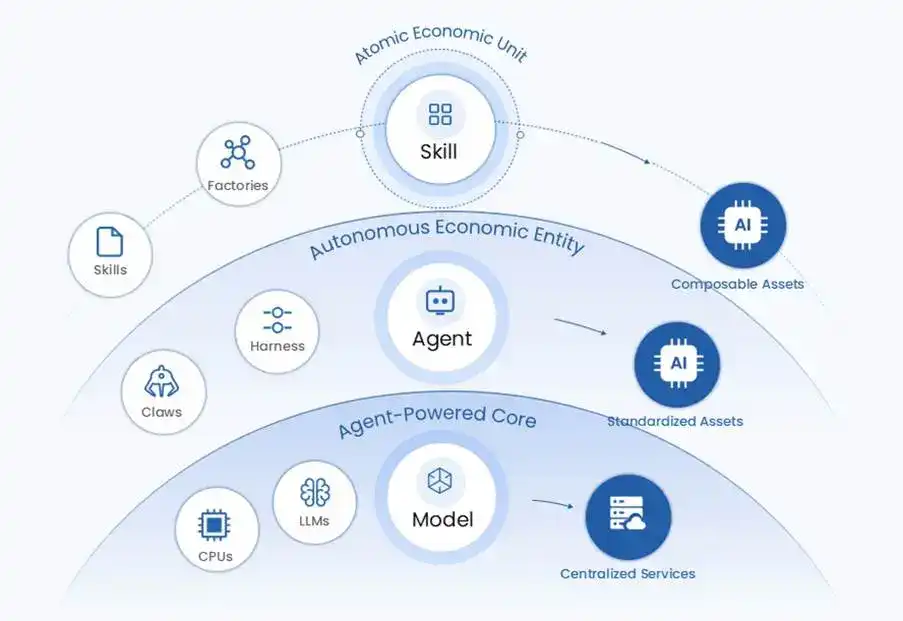
In the developmental iterations of Q1-Q2 2026, AI Agents are gradually forming clearer boundaries, clearer subjectivity, and clearer principles for the exchange of information, value, and energy. An AI Agent Sub-Microeconomics environment, analogous to a biological organism's environment, is taking shape. This contains a wealth of AI value and economic value to be mined, making AI Protocol and AI Finance an inevitable trend for explosion.

5. The Inevitability of AIFi and the Economic Significance of the Financial Chip (FinChip)

Starting from the second half of last year, we proposed thoughts and began layout work in the direction of AIFi (Artificial Intelligence Finance). By the end of Q1 2026, the concept of AIFi had formed a clear trend. A relatively clear definition of AIFi could be: the financial systems and infrastructure for exchange, trading, and capitalization formed after AI-native value is identified and tokenized within the Agent Economy.

The biggest difference between AIFi and DeFi/TradFi is that in DeFi and TradFi, the value resides in the "Fi" (i.e., Finance), with "Decentralized" and "Traditional" being the forms of that value. In contrast, AIFi is the opposite: the value is in the "AI," and the "Fi" becomes the form of that value. This is not merely wordplay; it is the result of AI development shifting from quantitative to qualitative change.

Simply put, previously, AI served quantitative strategies, financial products, and production processes; it was merely a development tool for extracting financial value and production value. But now, the decision-making capability possessed by AI Agents transfers the ability and power of value discovery from human and corporate hands to the Agents themselves. The subject of the economic unit has shifted, so the subject of value has also fundamentally changed.

Under such a trend, constructing the infrastructure for a new value system will be a crucial task. In my previous article in February of this year, , I首次首次 introduced the concept of the Financial Chip (FinChip) and mentioned that the combination of AI Agent + Crypto Smart Contract, encapsulated into hyper-intelligent financial assets, would truly adapt to the development of the next era's AI Agent Economy. After three months of iterative upgrades, FinChip.AI has initially developed an independent AIFi system combining AI Autonomous + Crypto Protocol, compatible with both H2A and A2A dual-phase environments. Building the infrastructure for the AI Agent Economy within an Open Network and gradually forming AI financial value is a significant economic meaning of FinChip.

6. AI-Native is a Paradigm Upgrade Different from Internet+

Whether it's AIFi, Financial Circuit Principles (Note 2), or the Financial Chip FinChip, the most important thing is to Natively integrate the essential principles of AI, Crypto, and Finance, forming a reasonable value system and management mechanism from a future perspective. AI-Native Thinking is the abstract and counter-intuitive logic of this stage. As mentioned earlier, "AI follows first principles, as well as the principle of the shortest energy-value path and the highest efficiency principle." This is the core difficulty for those currently thinking about and engaging in the construction of new commercial paradigms.

During the early phase of this round's AI upgrade outbreak led by OpenClaw in February this year, several entrepreneurs and I discussed a prediction: Enterprise upgrades through "AI+" and those through "Internet+" would be completely different.

Due to AI's characteristics of rapid development speed, abstract form, and deeper coupling with affairs, among others, for a considerable period (e.g., at least 2 years), it will be difficult to form a set of effective industrial upgrade tool methodologies or universal professional consulting advice. The pressure of the steep curve will persistently exist, posing a巨大巨大 challenge for all scientists, engineers, and entrepreneurs. The process of paradigm upgrade will also be completely unlike any historical experience.

Note1: This is a common historical规律规律. New productive forces孕育孕育 from the production relations of the previous era. In the initial stage, they first match the previous production relations for a period of development. Until they become irreconcilable, they force the emergence of the next stage's production relations, gradually replacing the previous ones to form a new era where productive forces and production relations develop in complete匹配匹配.

Note2:<Financial Circuits and Web3 Economic Model Principles> written in October 2022, describes the paradigm comparison between future financial value and physical circuits.

Perguntas relacionadas

QAccording to the article, what are the main bottlenecks and contradictions currently faced by the H2A (Human-to-Agent) economic model?

AThe main bottlenecks are: 1) The current focus on H2A is primarily driven by traditional business KPIs targeting human users, not true Agent-to-Agent (A2A) autonomy. 2) The logic is fundamentally non-AI-Native because it uses Agents to assist humans with decisions in traditional e-commerce/fiat payment scenarios, which limits utility beyond hype. 3) The model fails to leverage the core characteristic of AI Agents: autonomous decision-making.

QWhat are the three fundamental principles that the article states AI Agents will follow, potentially rendering much of current global finance and law obsolete?

AThe three principles are: 1) First principles. 2) The principle of the shortest energy-value path and highest efficiency. 3) Effective KYA (Know Your Agent) rather than the traditional KYC (Know Your Customer) that conforms to past aesthetics.

QThe article introduces the concept of 'AI Agent Sub-Microeconomics'. What is the key biological analogy used to describe the structure of this emerging economic environment?

AThe key analogy is to a biological cell. The LLM is likened to the cell nucleus (driving thought). The Agent Harness is like the cytoplasm (enabling differentiated capabilities). The Agent itself is like a cell (an independent, task-capable unit). Its communication protocol stack is like the cell membrane. The external value system (Skills, Prompts, etc.) is like the extracellular environment (exosomes, tissue fluid, matrix).

QHow does the article define the core distinction between AIFi and traditional DeFi/TradFi in terms of where value resides?

AThe core distinction is the location of value. In DeFi and TradFi, the value is contained *within* the 'Fi' (Finance), with 'Decentralized' or 'Traditional' being the form of that value. In AIFi, the value is generated *by the AI* (through Agent decision-making and value discovery), and 'Fi' becomes the form or mechanism through which that AI-native value is exchanged and capitalized.

QWhat major difference does the author predict between the upcoming 'AI+' enterprise upgrade wave and the historical 'Internet+' upgrade wave?

AThe 'AI+' upgrade will be fundamentally different and more challenging than 'Internet+'. Due to AI's rapid development speed, abstract nature, and deeper integration with core processes, it will be difficult to form a set of effective, universal upgrade methodologies or consulting frameworks for at least two years. The pressure from the steep learning/evolution curve will be persistent and unlike any past historical experience.

Leituras Relacionadas

Trump in Talks with AI Companies Over Profit Sharing, A Narrative Pressure of Industrial Revolution Scale Begins

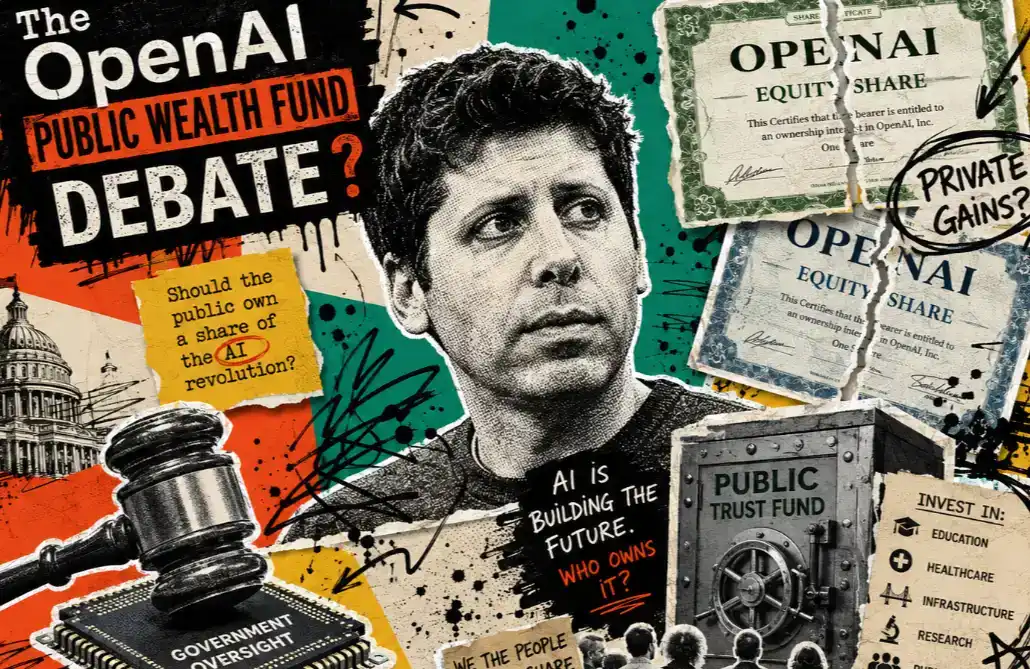
In recent AI market discussions, a new dimension beyond growth and profits has emerged: the question of how the immense wealth potentially generated by AI should be shared with the wider public. Triggered by reports of White House officials discussing "voluntary equity transfers" with top AI firms, similar to models like Alaska's Permanent Fund, the conversation focuses on public wealth funds. OpenAI's own whitepaper proposes such funds, allowing households without direct tech stock ownership to benefit from AI gains. More radical proposals, like Bernie Sanders' call for high public equity stakes and board seats, represent an extreme end of the spectrum. Currently, these are early-stage policy probes, not enacted laws. OpenAI's initiative is seen as an attempt to secure "social license" for its future expansion, mitigating risks of public backlash, stricter regulation, or anti-trust actions as AI's economic impact grows. The core market implication is the introduction of a "policy discount" to AI valuations, particularly for private model companies like OpenAI, Anthropic, and xAI. Investors must now consider not just future earnings but also what portion might be allocated to public mechanisms. The impact varies greatly based on the mechanism. A small, voluntary transfer of non-voting economic rights (e.g., 5%) acts as a quantifiable long-term cost. Government acquisition of economic rights via warrants tied to support differs from direct equity with governance power. The most disruptive scenario would be forced high-percentage public ownership affecting control and innovation incentives. Key signals to watch include whether other AI companies follow suit, if the White House formalizes proposals, related disclosures in future IPO documents, and any market price reactions. For now, this represents a shift from pricing pure AI growth to pricing its potential distribution. A manageable, voluntary economic share is akin to an insurance cost for societal acceptance, while a forced shift toward control and governance would fundamentally alter valuation logic.

marsbitHá 3m

Trump in Talks with AI Companies Over Profit Sharing, A Narrative Pressure of Industrial Revolution Scale Begins

marsbitHá 3m

From Record Highs to a Two-Week Low: Why Did AI Concept Stocks Suddenly Pull Back?

From Record Highs to Two-Week Lows: Why Did AI Stocks Suddenly Pull Back? U.S. stock indices, led by the tech-heavy Nasdaq 100, fell sharply to two-week lows. This marked a reversal from earlier in the week when AI infrastructure and semiconductor stocks had propelled major indices to record highs. Investors are rotating out of these previously high-flying tech sectors into other areas. The sell-off was driven by profit-taking and concerns that the AI rally had become overextended, exacerbated by chipmaker Broadcom's sales outlook falling short of lofty market expectations. The decline accelerated following a stronger-than-expected U.S. May nonfarm payrolls report, which showed 172,000 jobs added versus an estimated 88,000. This data sparked a jump in bond yields, with the 10-year Treasury yield rising to 4.553%, as it reinforced market speculation that the Federal Reserve's next move could be a rate hike rather than a cut. Globally, equities also declined, with European and Asian markets falling. Within the U.S. market, chip and AI-related stocks like Super Micro Computer and Arm Holdings led the losses, dropping over 7%. Cryptocurrency-linked stocks and mining shares also fell sharply amid drops in Bitcoin and commodity prices. While the overall Q1 earnings season remained solid, with 83% of S&P 500 companies beating estimates, the weakness was concentrated in tech. Excluding the tech sector, Q1 earnings growth was around 3%, the weakest in two years.

marsbitHá 4m

From Record Highs to a Two-Week Low: Why Did AI Concept Stocks Suddenly Pull Back?

marsbitHá 4m

JP Morgan Mid-Year Research Report Analysis: The AI Supercycle is Not Over, Reduce Cash Holdings + Allocate to Real Assets

JP Morgan's 2026 Mid-Year Outlook argues the AI supercycle is far from over, despite market pessimism. The report advises clients to reduce cash holdings, increase allocations to real assets as an inflation hedge, and focus on emerging markets. Key conclusions include: 1. **AI Supercycle Intact**: Hyperscalers' 2026 capex forecasts exceed $650B, with AI contributing to GDP growth. However, their financial profile is shifting toward heavy investment, compressing free cash flow. 2. **SaaS Disruption**: Traditional software companies are being negatively impacted by AI, with significant stock declines and pressure in credit markets. 3. **Persistent Inflation**: Core inflation is structurally higher post-pandemic. Holding excess cash and bonds leads to real wealth erosion. Recommendations include commodities, infrastructure, real estate, and gold. 4. **Geopolitical Shocks & Opportunities**: The Hormuz Strait blockade caused a major oil shock, but JP Morgan views the subsequent equity market pullback as a buying opportunity. "Fragmentation" is creating pockets of value, notably in resource-rich Latin America, AI-supply-chain-linked East Asia, and deeply discounted Chinese equities, where a policy shift could trigger a re-rating. 5. **Regional Views**: The firm is cautious on Europe due to high energy costs and lower innovation investment, preferring US and select EM exposures. In short, JP Morgan sees market volatility as an entry point but recommends a portfolio pivot: favor AI infrastructure, real assets, and EM, while avoiding excess cash, vulnerable software firms, and traditional 60/40 stock-bond allocations.

marsbitHá 29m

JP Morgan Mid-Year Research Report Analysis: The AI Supercycle is Not Over, Reduce Cash Holdings + Allocate to Real Assets

marsbitHá 29m

Trading

Spot
Futuros

Artigos em Destaque

O que é $S$

Compreender o SPERO: Uma Visão Abrangente Introdução ao SPERO À medida que o panorama da inovação continua a evoluir, o surgimento de tecnologias web3 e projetos de criptomoeda desempenha um papel fundamental na formação do futuro digital. Um projeto que tem atraído atenção neste campo dinâmico é o SPERO, denotado como SPERO,$$s$. Este artigo tem como objetivo reunir e apresentar informações detalhadas sobre o SPERO, para ajudar entusiastas e investidores a compreender as suas bases, objetivos e inovações nos domínios web3 e cripto. O que é o SPERO,$$s$? O SPERO,$$s$ é um projeto único dentro do espaço cripto que procura aproveitar os princípios da descentralização e da tecnologia blockchain para criar um ecossistema que promove o envolvimento, a utilidade e a inclusão financeira. O projeto é concebido para facilitar interações peer-to-peer de novas maneiras, proporcionando aos utilizadores soluções e serviços financeiros inovadores. No seu núcleo, o SPERO,$$s$ visa capacitar indivíduos ao fornecer ferramentas e plataformas que melhoram a experiência do utilizador no espaço das criptomoedas. Isso inclui a possibilidade de métodos de transação mais flexíveis, a promoção de iniciativas impulsionadas pela comunidade e a criação de caminhos para oportunidades financeiras através de aplicações descentralizadas (dApps). A visão subjacente do SPERO,$$s$ gira em torno da inclusão, visando fechar lacunas dentro das finanças tradicionais enquanto aproveita os benefícios da tecnologia blockchain. Quem é o Criador do SPERO,$$s$? A identidade do criador do SPERO,$$s$ permanece algo obscura, uma vez que existem recursos publicamente disponíveis limitados que fornecem informações detalhadas sobre o(s) seu(s) fundador(es). Esta falta de transparência pode resultar do compromisso do projeto com a descentralização—uma ética que muitos projetos web3 partilham, priorizando contribuições coletivas em vez de reconhecimento individual. Ao centrar as discussões em torno da comunidade e dos seus objetivos coletivos, o SPERO,$$s$ incorpora a essência do empoderamento sem destacar indivíduos específicos. Assim, compreender a ética e a missão do SPERO é mais importante do que identificar um criador singular. Quem são os Investidores do SPERO,$$s$? O SPERO,$$s$ é apoiado por uma diversidade de investidores que vão desde capitalistas de risco a investidores-anjo dedicados a promover a inovação no setor cripto. O foco desses investidores geralmente alinha-se com a missão do SPERO—priorizando projetos que prometem avanço tecnológico social, inclusão financeira e governança descentralizada. Essas fundações de investidores estão tipicamente interessadas em projetos que não apenas oferecem produtos inovadores, mas que também contribuem positivamente para a comunidade blockchain e os seus ecossistemas. O apoio desses investidores reforça o SPERO,$$s$ como um concorrente notável no domínio em rápida evolução dos projetos cripto. Como Funciona o SPERO,$$s$? O SPERO,$$s$ emprega uma estrutura multifacetada que o distingue de projetos de criptomoeda convencionais. Aqui estão algumas das características-chave que sublinham a sua singularidade e inovação: Governança Descentralizada: O SPERO,$$s$ integra modelos de governança descentralizada, capacitando os utilizadores a participar ativamente nos processos de tomada de decisão sobre o futuro do projeto. Esta abordagem promove um sentido de propriedade e responsabilidade entre os membros da comunidade. Utilidade do Token: O SPERO,$$s$ utiliza o seu próprio token de criptomoeda, concebido para servir várias funções dentro do ecossistema. Esses tokens permitem transações, recompensas e a facilitação de serviços oferecidos na plataforma, melhorando o envolvimento e a utilidade gerais. Arquitetura em Camadas: A arquitetura técnica do SPERO,$$s$ suporta modularidade e escalabilidade, permitindo a integração contínua de funcionalidades e aplicações adicionais à medida que o projeto evolui. Esta adaptabilidade é fundamental para manter a relevância no panorama cripto em constante mudança. Envolvimento da Comunidade: O projeto enfatiza iniciativas impulsionadas pela comunidade, empregando mecanismos que incentivam a colaboração e o feedback. Ao nutrir uma comunidade forte, o SPERO,$$s$ pode melhor atender às necessidades dos utilizadores e adaptar-se às tendências do mercado. Foco na Inclusão: Ao oferecer taxas de transação baixas e interfaces amigáveis, o SPERO,$$s$ visa atrair uma base de utilizadores diversificada, incluindo indivíduos que anteriormente podem não ter participado no espaço cripto. Este compromisso com a inclusão alinha-se com a sua missão abrangente de empoderamento através da acessibilidade. Cronologia do SPERO,$$s$ Compreender a história de um projeto fornece insights cruciais sobre a sua trajetória de desenvolvimento e marcos. Abaixo está uma cronologia sugerida que mapeia eventos significativos na evolução do SPERO,$$s$: Fase de Conceituação e Ideação: As ideias iniciais que formam a base do SPERO,$$s$ foram concebidas, alinhando-se de perto com os princípios de descentralização e foco na comunidade dentro da indústria blockchain. Lançamento do Whitepaper do Projeto: Após a fase conceitual, um whitepaper abrangente detalhando a visão, os objetivos e a infraestrutura tecnológica do SPERO,$$s$ foi lançado para atrair o interesse e o feedback da comunidade. Construção da Comunidade e Primeiros Envolvimentos: Esforços ativos de divulgação foram feitos para construir uma comunidade de primeiros adotantes e investidores potenciais, facilitando discussões em torno dos objetivos do projeto e angariando apoio. Evento de Geração de Tokens: O SPERO,$$s$ realizou um evento de geração de tokens (TGE) para distribuir os seus tokens nativos a apoiantes iniciais e estabelecer liquidez inicial dentro do ecossistema. Lançamento da dApp Inicial: A primeira aplicação descentralizada (dApp) associada ao SPERO,$$s$ foi lançada, permitindo que os utilizadores interagissem com as funcionalidades principais da plataforma. Desenvolvimento Contínuo e Parcerias: Atualizações e melhorias contínuas nas ofertas do projeto, incluindo parcerias estratégicas com outros players no espaço blockchain, moldaram o SPERO,$$s$ em um jogador competitivo e em evolução no mercado cripto. Conclusão O SPERO,$$s$ é um testemunho do potencial do web3 e das criptomoedas para revolucionar os sistemas financeiros e capacitar indivíduos. Com um compromisso com a governança descentralizada, o envolvimento da comunidade e funcionalidades inovadoras, abre caminho para um panorama financeiro mais inclusivo. Como em qualquer investimento no espaço cripto em rápida evolução, potenciais investidores e utilizadores são incentivados a pesquisar minuciosamente e a envolver-se de forma ponderada com os desenvolvimentos em curso dentro do SPERO,$$s$. O projeto demonstra o espírito inovador da indústria cripto, convidando a uma exploração mais aprofundada das suas inúmeras possibilidades. Embora a jornada do SPERO,$$s$ ainda esteja a desenrolar-se, os seus princípios fundamentais podem, de facto, influenciar o futuro de como interagimos com a tecnologia, as finanças e uns com os outros em ecossistemas digitais interconectados.

69 Visualizações TotaisPublicado em {updateTime}Atualizado em 2024.12.17

O que é $S$

O que é AGENT S

Agent S: O Futuro da Interação Autónoma no Web3 Introdução No panorama em constante evolução do Web3 e das criptomoedas, as inovações estão constantemente a redefinir a forma como os indivíduos interagem com plataformas digitais. Um projeto pioneiro, o Agent S, promete revolucionar a interação humano-computador através do seu framework aberto e agente. Ao abrir caminho para interações autónomas, o Agent S visa simplificar tarefas complexas, oferecendo aplicações transformadoras em inteligência artificial (IA). Esta exploração detalhada irá aprofundar-se nas complexidades do projeto, nas suas características únicas e nas implicações para o domínio das criptomoedas. O que é o Agent S? O Agent S é um framework aberto e agente, especificamente concebido para abordar três desafios fundamentais na automação de tarefas computacionais: Aquisição de Conhecimento Específico de Domínio: O framework aprende inteligentemente a partir de várias fontes de conhecimento externas e experiências internas. Esta abordagem dupla capacita-o a construir um rico repositório de conhecimento específico de domínio, melhorando o seu desempenho na execução de tarefas. Planeamento ao Longo de Longos Horizontes de Tarefas: O Agent S emprega planeamento hierárquico aumentado por experiência, uma abordagem estratégica que facilita a decomposição e execução eficientes de tarefas intrincadas. Esta característica melhora significativamente a sua capacidade de gerir múltiplas subtarefas de forma eficiente e eficaz. Gestão de Interfaces Dinâmicas e Não Uniformes: O projeto introduz a Interface Agente-Computador (ACI), uma solução inovadora que melhora a interação entre agentes e utilizadores. Utilizando Modelos de Linguagem Multimodais de Grande Escala (MLLMs), o Agent S pode navegar e manipular diversas interfaces gráficas de utilizador de forma fluida. Através destas características pioneiras, o Agent S fornece um framework robusto que aborda as complexidades envolvidas na automação da interação humana com máquinas, preparando o terreno para uma infinidade de aplicações em IA e além. Quem é o Criador do Agent S? Embora o conceito de Agent S seja fundamentalmente inovador, informações específicas sobre o seu criador permanecem elusivas. O criador é atualmente desconhecido, o que destaca ou o estágio nascente do projeto ou a escolha estratégica de manter os membros fundadores em anonimato. Independentemente da anonimidade, o foco permanece nas capacidades e no potencial do framework. Quem são os Investidores do Agent S? Como o Agent S é relativamente novo no ecossistema criptográfico, informações detalhadas sobre os seus investidores e financiadores não estão explicitamente documentadas. A falta de informações disponíveis publicamente sobre as fundações de investimento ou organizações que apoiam o projeto levanta questões sobre a sua estrutura de financiamento e roteiro de desenvolvimento. Compreender o apoio é crucial para avaliar a sustentabilidade do projeto e o seu impacto potencial no mercado. Como Funciona o Agent S? No núcleo do Agent S reside uma tecnologia de ponta que lhe permite funcionar eficazmente em diversos ambientes. O seu modelo operacional é construído em torno de várias características-chave: Interação Humano-Computador Semelhante: O framework oferece planeamento avançado em IA, esforçando-se para tornar as interações com computadores mais intuitivas. Ao imitar o comportamento humano na execução de tarefas, promete elevar as experiências dos utilizadores. Memória Narrativa: Utilizada para aproveitar experiências de alto nível, o Agent S utiliza memória narrativa para acompanhar os históricos de tarefas, melhorando assim os seus processos de tomada de decisão. Memória Episódica: Esta característica fornece aos utilizadores orientações passo a passo, permitindo que o framework ofereça suporte contextual à medida que as tarefas se desenrolam. Suporte para OpenACI: Com a capacidade de funcionar localmente, o Agent S permite que os utilizadores mantenham o controlo sobre as suas interações e fluxos de trabalho, alinhando-se com a ética descentralizada do Web3. Fácil Integração com APIs Externas: A sua versatilidade e compatibilidade com várias plataformas de IA garantem que o Agent S possa integrar-se perfeitamente em ecossistemas tecnológicos existentes, tornando-o uma escolha apelativa para desenvolvedores e organizações. Estas funcionalidades contribuem coletivamente para a posição única do Agent S no espaço cripto, à medida que automatiza tarefas complexas e em múltiplos passos com mínima intervenção humana. À medida que o projeto evolui, as suas potenciais aplicações no Web3 podem redefinir a forma como as interações digitais se desenrolam. Cronologia do Agent S O desenvolvimento e os marcos do Agent S podem ser encapsulados numa cronologia que destaca os seus eventos significativos: 27 de Setembro de 2024: O conceito de Agent S foi lançado num artigo de pesquisa abrangente intitulado “Um Framework Agente Aberto que Usa Computadores como um Humano”, mostrando a base para o projeto. 10 de Outubro de 2024: O artigo de pesquisa foi disponibilizado publicamente no arXiv, oferecendo uma exploração aprofundada do framework e da sua avaliação de desempenho com base no benchmark OSWorld. 12 de Outubro de 2024: Uma apresentação em vídeo foi lançada, proporcionando uma visão visual das capacidades e características do Agent S, envolvendo ainda mais potenciais utilizadores e investidores. Estes marcos na cronologia não apenas ilustram o progresso do Agent S, mas também indicam o seu compromisso com a transparência e o envolvimento da comunidade. Pontos-Chave Sobre o Agent S À medida que o framework Agent S continua a evoluir, várias características-chave destacam-se, sublinhando a sua natureza inovadora e potencial: Framework Inovador: Concebido para proporcionar um uso intuitivo de computadores semelhante à interação humana, o Agent S traz uma abordagem nova à automação de tarefas. Interação Autónoma: A capacidade de interagir autonomamente com computadores através de GUI significa um avanço em direção a soluções computacionais mais inteligentes e eficientes. Automação de Tarefas Complexas: Com a sua metodologia robusta, pode automatizar tarefas complexas e em múltiplos passos, tornando os processos mais rápidos e menos propensos a erros. Melhoria Contínua: Os mecanismos de aprendizagem permitem que o Agent S melhore a partir de experiências passadas, aprimorando continuamente o seu desempenho e eficácia. Versatilidade: A sua adaptabilidade em diferentes ambientes operacionais, como OSWorld e WindowsAgentArena, garante que pode servir uma ampla gama de aplicações. À medida que o Agent S se posiciona no panorama do Web3 e das criptomoedas, o seu potencial para melhorar as capacidades de interação e automatizar processos significa um avanço significativo nas tecnologias de IA. Através do seu framework inovador, o Agent S exemplifica o futuro das interações digitais, prometendo uma experiência mais fluida e eficiente para os utilizadores em diversas indústrias. Conclusão O Agent S representa um ousado avanço na união da IA e do Web3, com a capacidade de redefinir a forma como interagimos com a tecnologia. Embora ainda esteja nas suas fases iniciais, as possibilidades para a sua aplicação são vastas e cativantes. Através do seu framework abrangente que aborda desafios críticos, o Agent S visa trazer interações autónomas para o primeiro plano da experiência digital. À medida que avançamos mais profundamente nos domínios das criptomoedas e da descentralização, projetos como o Agent S desempenharão, sem dúvida, um papel crucial na formação do futuro da tecnologia e da colaboração humano-computador.

671 Visualizações TotaisPublicado em {updateTime}Atualizado em 2025.01.14

O que é AGENT S

Como comprar S

Bem-vindo à HTX.com!Tornámos a compra de Sonic (S) simples e conveniente.Segue o nosso guia passo a passo para iniciar a tua jornada no mundo das criptos.Passo 1: cria a tua conta HTXUtiliza o teu e-mail ou número de telefone para te inscreveres numa conta gratuita na HTX.Desfruta de um processo de inscrição sem complicações e desbloqueia todas as funcionalidades.Obter a minha contaPasso 2: vai para Comprar Cripto e escolhe o teu método de pagamentoCartão de crédito/débito: usa o teu visa ou mastercard para comprar Sonic (S) instantaneamente.Saldo: usa os fundos da tua conta HTX para transacionar sem problemas.Terceiros: adicionamos métodos de pagamento populares, como Google Pay e Apple Pay, para aumentar a conveniência.P2P: transaciona diretamente com outros utilizadores na HTX.Mercado de balcão (OTC): oferecemos serviços personalizados e taxas de câmbio competitivas para os traders.Passo 3: armazena teu Sonic (S)Depois de comprar o teu Sonic (S), armazena-o na tua conta HTX.Alternativamente, podes enviá-lo para outro lugar através de transferência blockchain ou usá-lo para transacionar outras criptomoedas.Passo 4: transaciona Sonic (S)Transaciona facilmente Sonic (S) no mercado à vista da HTX.Acede simplesmente à tua conta, seleciona o teu par de trading, executa as tuas transações e monitoriza em tempo real.Oferecemos uma experiência de fácil utilização tanto para principiantes como para traders experientes.

1.2k Visualizações TotaisPublicado em {updateTime}Atualizado em 2026.06.02

Como comprar S

Discussões

Bem-vindo à Comunidade HTX. Aqui, pode manter-se informado sobre os mais recentes desenvolvimentos da plataforma e obter acesso a análises profissionais de mercado. As opiniões dos utilizadores sobre o preço de S (S) são apresentadas abaixo.

活动图片