Trump in Talks with AI Companies Over Profit Sharing, A Narrative Pressure of Industrial Revolution Scale Begins

marsbitPublicado em 2026-06-08Última atualização em 2026-06-08

Resumo

In recent AI market discussions, a new dimension beyond growth and profits has emerged: the question of how the immense wealth potentially generated by AI should be shared with the wider public. Triggered by reports of White House officials discussing "voluntary equity transfers" with top AI firms, similar to models like Alaska's Permanent Fund, the conversation focuses on public wealth funds. OpenAI's own whitepaper proposes such funds, allowing households without direct tech stock ownership to benefit from AI gains. More radical proposals, like Bernie Sanders' call for high public equity stakes and board seats, represent an extreme end of the spectrum. Currently, these are early-stage policy probes, not enacted laws. OpenAI's initiative is seen as an attempt to secure "social license" for its future expansion, mitigating risks of public backlash, stricter regulation, or anti-trust actions as AI's economic impact grows. The core market implication is the introduction of a "policy discount" to AI valuations, particularly for private model companies like OpenAI, Anthropic, and xAI. Investors must now consider not just future earnings but also what portion might be allocated to public mechanisms. The impact varies greatly based on the mechanism. A small, voluntary transfer of non-voting economic rights (e.g., 5%) acts as a quantifiable long-term cost. Government acquisition of economic rights via warrants tied to support differs from direct equity with governance power. The m...

Over the past two years, the AI market has only cared about one question: Who can make the most money?

NVIDIA orders, cloud providers' capital expenditures, data center construction, model company valuations, and the pace of enterprise adoption have formed the main threads of this wave of AI transactions. Capital is buying growth, betting on profit pools, and discussing how much economic value AI can convert into corporate revenue.

But now, another question is beginning to emerge:

If AI truly creates unprecedented wealth, should that money only go to companies, employees, and shareholders?

This is the truly noteworthy aspect of OpenAI's discussion about a public wealth fund.

It is not an implemented regulatory policy, nor is it the U.S. government immediately "seizing equity in AI companies." More accurately, it is the first time the AI industry has pushed the question of "how to distribute future excess returns" onto the public policy table.

The counterintuitive aspect of this is that the market is not discussing distribution because it doubts AI's ability to make money. On the contrary, precisely because more and more people believe AI will generate substantial excess profits, the political system is beginning to ask: Can these gains be exclusively enjoyed by a few companies and investors?
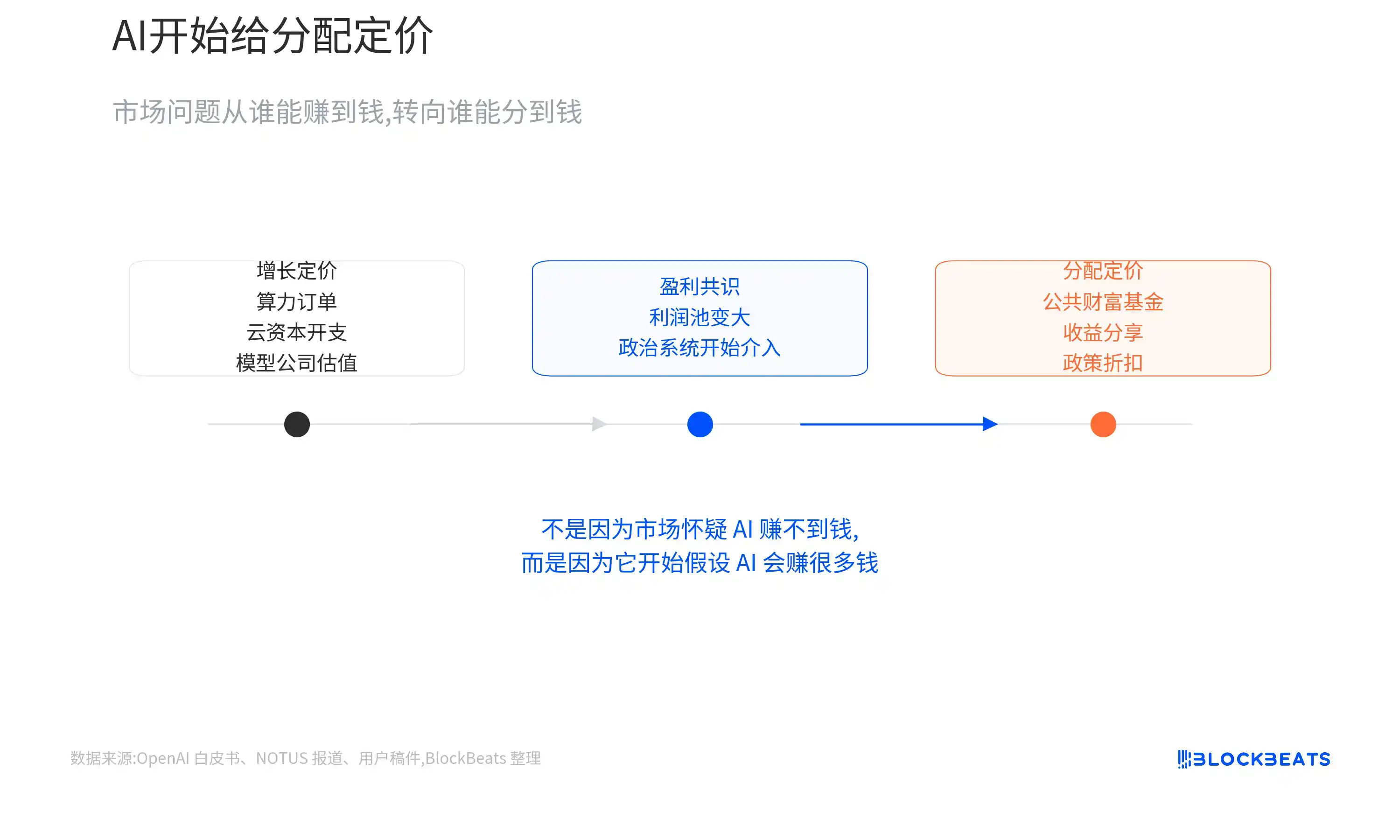
AI Transactions Begin to Include a Policy Bill

First, let's clarify the factual boundaries.

According to a NOTUS report on June 4, senior White House officials have held preliminary discussions with leading AI companies about "voluntarily ceding some equity." This direction is similar to the Alaska Permanent Fund: assets are held in part by the government or a public trust, with some of the proceeds distributed to residents.

In a white paper released in April, OpenAI also proposed the idea of establishing a public wealth fund. Large model enterprises could contribute funds, equity, or other means to allow ordinary families, who do not directly hold tech stocks, venture capital assets, or private equity, to share in the benefits of AI growth.

Sanders's version is more radical. He advocates that large AI companies cede a higher proportion of equity to the public and grant the public some governance rights. The "50% stock tax" and board seats mentioned in the materials represent the most radical political sample in this round of discussion.

But these three things cannot be viewed interchangeably.
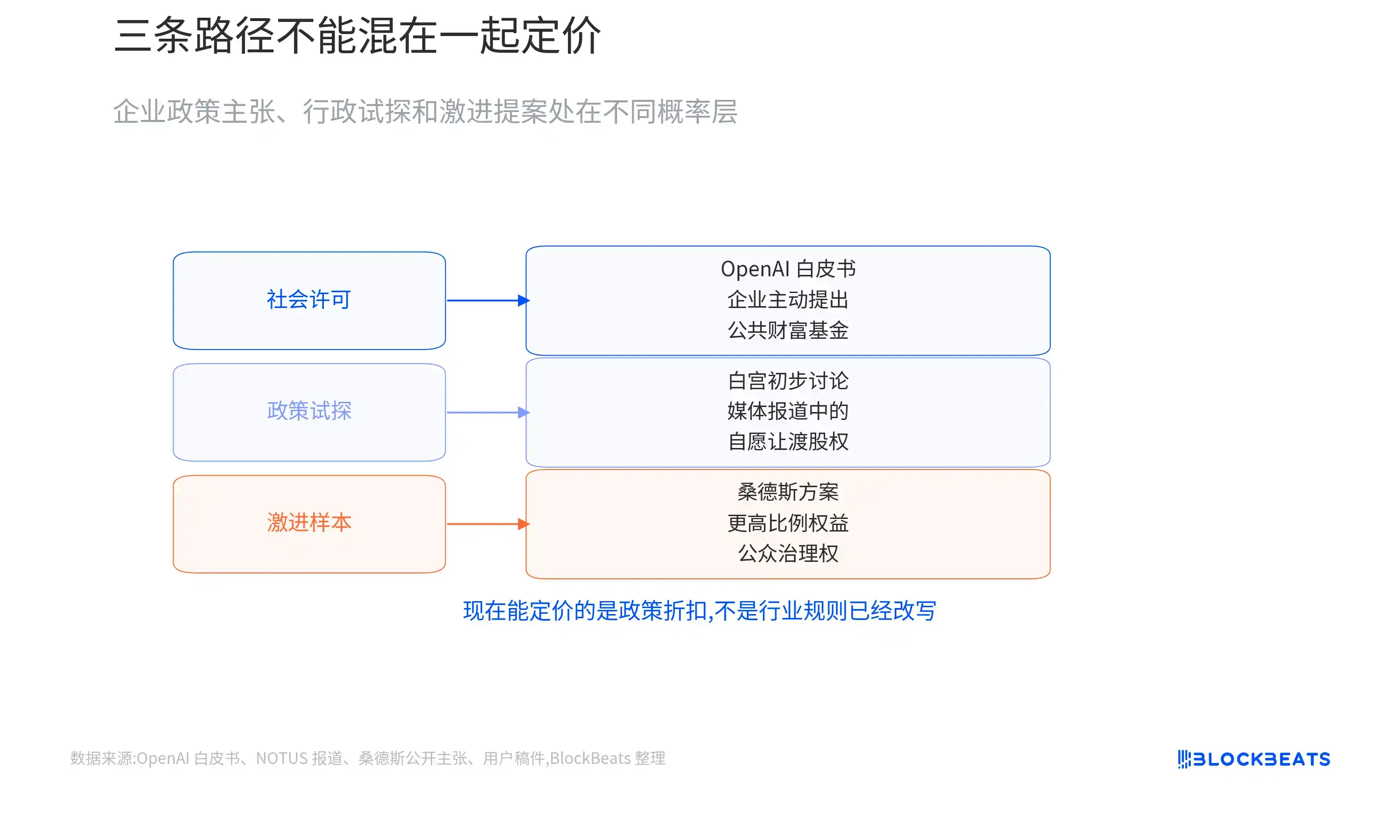
The White House discussion remains a preliminary exploration reported by the media, with no formal proportions, legal structure, or timeline. The OpenAI white paper is a corporate policy proposal, not a government document. The Sanders proposal has strong impact, but is still a long way from becoming actual policy.

Therefore, the most reasonable assessment currently is not that "AI companies are about to be nationalized," but that a new variable, not present before, has begun to appear on the AI valuation sheet:

Will the most profitable AI companies of the future need to allocate a portion of their economic rights to gain acceptance from society and regulators?

The short-term impact on the secondary market is limited. Public market AI proxy assets like NVDA, MSFT, AMZN, GOOGL, and META are still primarily driven by demand for computing power, cloud capital expenditures, order expectations, and profit realization.

But the impact is more direct for unlisted model companies.

If companies like OpenAI, Anthropic, and xAI go public in the future, investors will not only ask how much money they can make, but also: How much of that money will need to be ceded to public funds, governments, or other public mechanisms?

This is not an immediate valuation hit that has materialized, but a new policy discount.

OpenAI is Purchasing a Social License

OpenAI's proactive proposal for a public wealth fund is essentially purchasing a "social license" for its future expansion.

A social license is not a formal permit, but the tolerance of the public, regulators, and the political system for a company's continued expansion. The more successful an AI company becomes, the more acute this question becomes.

The stronger the model capabilities, the more discussions there are about human job displacement. The higher the valuation, the easier it is for ordinary people to perceive AI as a wealth machine exclusively for a few companies, employees, and shareholders.

OpenAI is not facing a problem typical for ordinary tech companies, but a narrative pressure approaching the scale of the Industrial Revolution:

If AI truly changes productivity, who gets to share in those benefits?

OpenAI's white paper emphasizes the need for the U.S. to maintain AI leadership while acknowledging that automation may reshape a large number of jobs. The public wealth fund is one of the buffer solutions it proposes.

Translating this into market language, OpenAI may hope to use a portion of controllable future economic rights to reduce more uncontrollable political risks.

If it completely fails to address the narrative of "AI taking jobs, profits going to the few," it may face higher taxes, stricter regulation, antitrust pressure in the future, and even be forced to disclose more complex policy risks during a potential IPO.

Proactively designing a moderate sharing mechanism might instead transform the risk from an "unknown political shock" into a "long-term cost that can be estimated."

This is somewhat like a resource company designing local employment, infrastructure, and benefit-sharing schemes before entering a region. The difference is that AI companies are not dealing with residents around a single mine, but the entire labor market and electorate.

It also isn't dealing with a one-time compensation, but with how future excess profits are accepted by society.

5% Sharing and 50% Mandatory Equity are Not the Same Thing

The phrase "cede equity" is easily alarming, but different paths have completely different impacts on valuation.

The first path involves companies voluntarily contributing a small percentage of economic rights, likely without voting rights, to a public wealth fund.

If the proportion is limited and the rights are clear, it more closely resembles a long-term policy cost. Assuming a future AI company valuation of $1 trillion, allocating 5% of economic rights to a public fund is certainly dilutive for existing shareholders, but the market can discount it as a specific figure.

The second path involves the government obtaining economic rights through industrial policy.

For example, certain subsidies, loans, or industrial support might come attached with warrants—the right to obtain a portion of future equity returns under agreed conditions. It's important to distinguish here: Warrants are not equivalent to directly taking over common shares, and non-voting economic rights are not equivalent to board seats.

The former is more like fiscal sharing; the latter enters the realm of corporate governance.

The third path is the Sanders-style mandatory high-percentage public ownership.

If large AI companies are required to surrender a high percentage of equity and allow public or government representatives onto the board, the impact is no longer just profit sharing, but issues of control, governance conflict, and innovation incentives.

The government acting simultaneously as regulator and shareholder also creates new conflicts of interest: Is it protecting consumers and competition, or is it protecting the value of the company it partly owns?

This is also why, although radical proposals are highly transmissible, they cannot currently be treated as high-probability pricing benchmarks.

The more realistic scenario remains the repeated discussion of small-scale, voluntary, economically-focused proposals. These may not materialize immediately but will become unavoidable issues in AI company financing, IPO processes, and policy communications.

For OpenAI, what is truly sensitive is not "whether to share," but whether the sharing mechanism will ultimately affect the governance structure.

Microsoft, venture capitalists, employee stock ownership entities, and strategic investors will all be concerned: Does the public fund receive economic rights or voting rights? What is the proportion? Does it affect exit valuations? Will it change the pricing logic of a future IPO?

Enterprise clients will also ask: If the government becomes an economic beneficiary in some sense, will procurement, data governance, and regulatory neutrality become more complex?

Therefore, the market implication of this is not that AI company profits are being immediately sliced away, but that the AI profit pool is being placed within a public distribution framework for the first time.
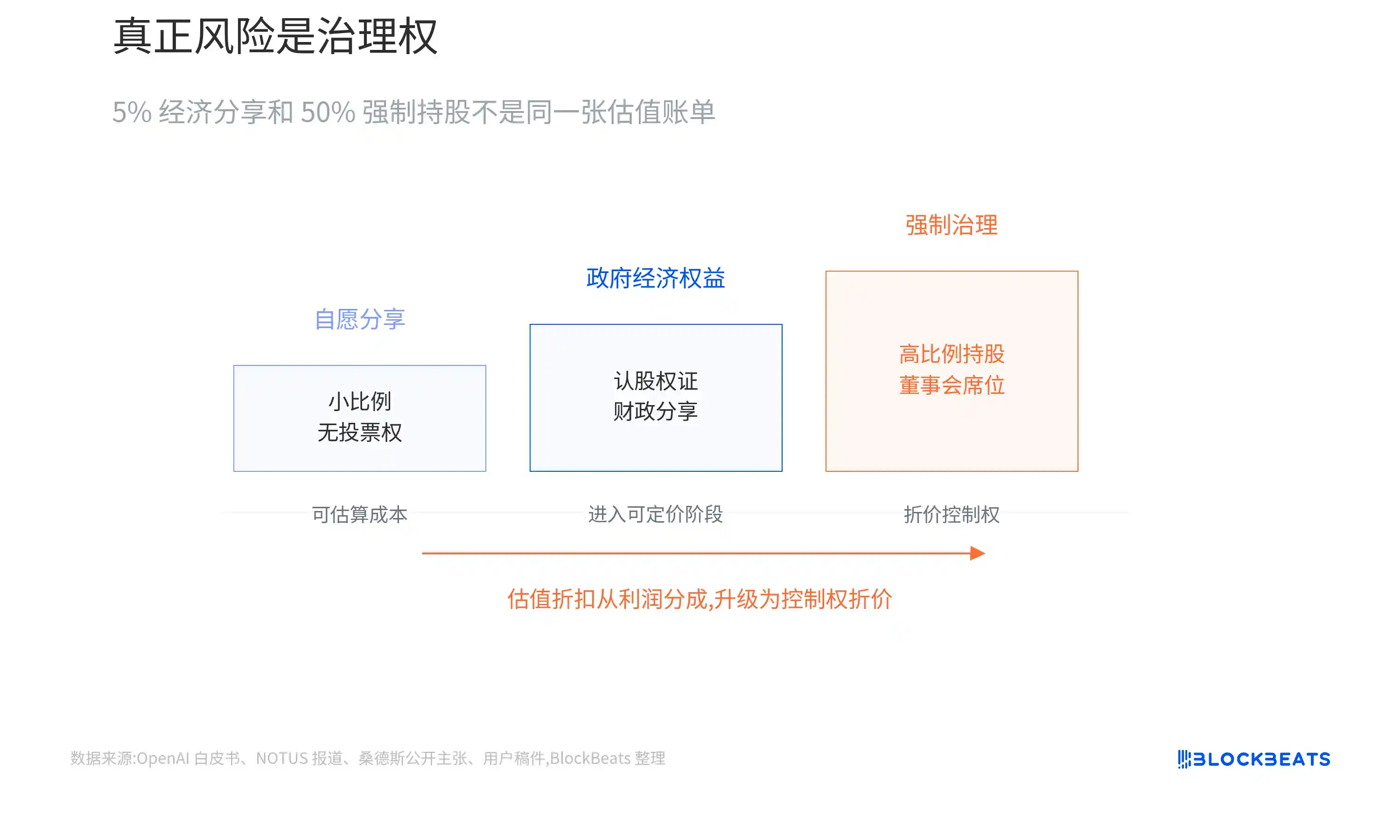
The Real Risk is the Shift from 'Voluntary Sharing' to 'Mandatory Governance'

This line of development is still in its early stages.

The evidence chain is sufficient to show that the publicization of AI returns is entering the stage of public policy exploration; but it is not yet sufficient to conclude that the rules of the AI industry have already changed.

The next four observation points are most important:
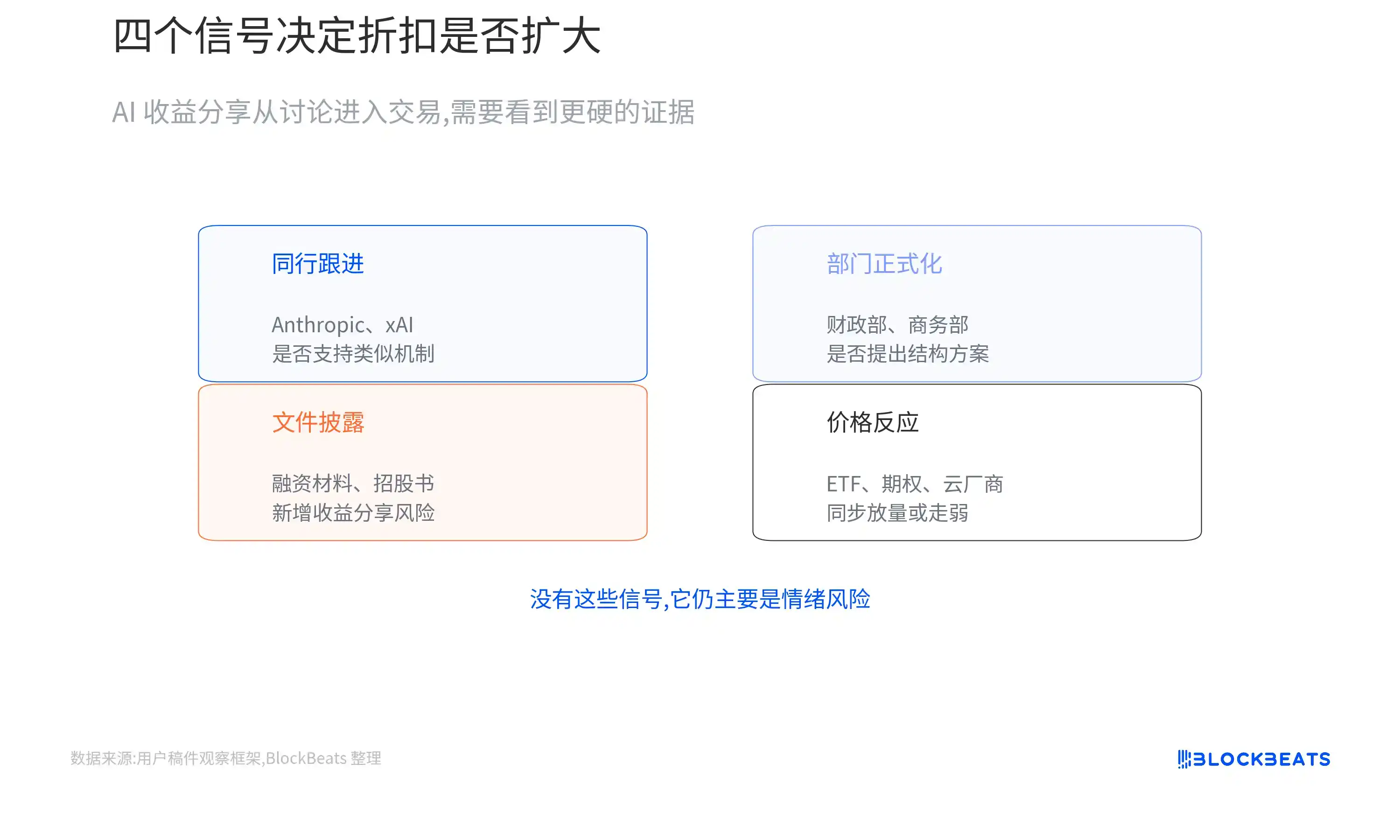
First, observe whether companies other than OpenAI follow suit:

If Anthropic, xAI, or other leading model companies also begin to support similar mechanisms, this could evolve from OpenAI's single-company strategy into an industry negotiation framework. Conversely, if more companies publicly avoid or oppose it, the market will tend to view it as OpenAI's particular approach.

Second, observe whether the White House and executive departments formalize it:

If departments like the Treasury, Commerce, or the National Economic Council begin proposing fund structures, tax arrangements, or warrant schemes, policy exploration will enter a priceable stage. If it remains at the level of meetings and media leaks, the impact is mainly sentiment risk.

Third, observe financing documents and future prospectuses:

If OpenAI, Anthropic, or others add risk disclosures about "public wealth fund, revenue sharing, government economic rights, special governance arrangements" in future financing materials or IPO documents, the valuation discount will move from discussion into trading.

Fourth, observe whether market prices begin to react:

If AI-themed ETFs, semiconductor ETFs, leading cloud companies, or related options start showing amplified trading volume, rising volatility synchronized with policy news, or relative underperformance against the broader market, it would indicate capital is starting to treat this variable as a main trading theme. There is no such evidence yet.

Therefore, there is currently no need to interpret this as a valuation collapse for the AI industry.

A more accurate description is:

The AI market used to price only growth; now it's beginning to price distribution.

If the final solution is merely a small proportion, non-voting, clearly disclosed allocation of economic rights, it more closely resembles an insurance premium paid by AI companies for long-term expansion. The cost exists but is estimable, tradable, and acceptable.

But if voluntary sharing is pushed by political pressure toward mandatory equity holding, or even board and governance rights arrangements, the valuation logic will change significantly.

Because then the market would be discounting not just a portion of profits, but corporate control and long-term growth freedom.


Perguntas relacionadas

QWhat is the core question emerging in the AI market according to the article?

AAccording to the article, the emerging core question is: If AI truly generates unprecedented wealth, should that money belong only to companies, employees, and shareholders, or should there be a mechanism for broader public distribution?

QWhat is the purpose of OpenAI's proposed public wealth fund, as explained in the article?

AOpenAI's proposed public wealth fund aims to purchase 'social license' for future expansion. It serves as a buffer to address public and political concerns about AI potentially replacing jobs and concentrating wealth, potentially mitigating future regulatory, tax, or antitrust risks by proactively designing a controlled, voluntary sharing mechanism for future economic gains.

QWhat are the key differences between the three potential paths for AI companies to share equity or profits, as outlined in the article?

A1. Voluntary Contribution: Companies offer a small, likely non-voting, share of economic rights to a public fund, viewed as a long-term policy cost. 2. Government Equity via Policy: The government obtains economic rights (e.g., warrants) tied to subsidies or support, often without voting rights. 3. Mandatory High-Equity Public Holding: A mandatory, high-percentage public equity stake with governance rights (like board seats), which affects control, governance, and innovation incentives. The market impact differs significantly, with the third being far more disruptive.

QAccording to the article, what is the current market interpretation of these discussions on AI profit distribution?

AThe current market interpretation is not an immediate valuation collapse but the introduction of a new variable or 'policy discount' into the AI valuation framework. The market is beginning to price not just growth but also the distribution of future profits. If limited to a small, voluntary, non-voting economic share, it acts like a predictable long-term insurance cost. The real risk would be a shift from voluntary sharing to forced governance involvement.

QWhat four key indicators does the article suggest for assessing the development of the AI profit distribution debate?

AThe four key indicators are: 1. Industry Alignment: Whether other leading AI companies like Anthropic or xAI support similar mechanisms, indicating an industry-wide trend. 2. Policy Formalization: Whether the White House or executive departments propose concrete structures, making the policy 'priceable.' 3. Financial Documentation: Whether future financing or IPO filings include disclosures about public wealth funds or profit-sharing arrangements. 4. Market Reaction: Whether AI-related securities (ETFs, stocks, options) start showing price or volatility movements correlated with this policy news.

Leituras Relacionadas

Different Choices After the Plunge: Institutions Buy the Dip, Traders Shift to US Stocks

Title: Diverging Strategies After the Crash: Institutions Buying the Dip, Traders Shifting to US Stocks Following a sharp decline where Bitcoin briefly fell below $60,000 on June 6th, market sentiment remains "extreme fear" despite a partial recovery. This has led to varied responses from major market participants. Several institutional figures and analysts present a cautiously optimistic long-term view for Bitcoin. Glassnode's co-founder identifies $46k-$54k as a probable key bottom range based on historical on-chain models, while a Standard Chartered executive suggests the bottom is nearly formed. Strive's CEO points to Bitcoin touching its 200-week moving average as a historically reliable buy signal. Analysts highlight metrics like MVRV ratio and the "Power Law" model indicating Bitcoin is in an extremely undervalued zone. Conversely, some traders are exiting the crypto space. One trader cited a more attractive risk/reward profile and deeper research opportunities in US stocks, particularly with AI-related equities outperforming and capital rotating away from crypto. This shift is partly attributed to perceived ongoing risks, including those related to Strategy's Bitcoin sales. Market prediction data suggests a high probability (72%) of Bitcoin falling below $55,000, but lower odds for a deeper crash below $35k-$40k. The overall picture is one of division: institutions and long-term analysts see a accumulating opportunity, while some active traders are seeking alpha elsewhere amidst the volatility and shifting capital flows.

marsbitHá 22m

Different Choices After the Plunge: Institutions Buy the Dip, Traders Shift to US Stocks

marsbitHá 22m

Tech Stocks in the Midst of Deleveraging: Rather Than Rushing to Buy the Dip, Wait for the Macro Environment to Stabilize First

"Technology Stocks in Deleveraging Phase: Wait for Macro Stability Before Buying the Dip" The current sell-off in tech/AI stocks is primarily driven by macro headwinds, not a breakdown in AI fundamentals. After a parabolic rise, the market faced a perfect storm: an overcrowded trade, a massive SpaceX IPO draining liquidity, pre-CPI/PPI/FOMC hedging, and strong jobs data renewing "higher-for-longer" rate fears. This triggered a concentrated deleveraging in hot tech names. Key historical context: Unlike the December 2023 sell-off focused on AI capex returns, the current correction centers on the "denominator" – rising concerns over rates, inflation, the Fed, geopolitics, and liquidity. Leading memory stocks like Micron have seen ~20% pullbacks, significant but not yet at panic levels seen in March. The intense selling wave may be largely over, but a quick V-shaped recovery is unlikely. The market will likely churn in high volatility, awaiting clarity. The immediate catalyst needed for a sustainable reversal is a "stop-bleeding" signal from macro conditions. This doesn't require a major positive shock (like the April Iran ceasefire), but simply a halt to further deterioration: CPI not surprising hotter, Treasury yields stabilizing, the Fed not turning more hawkish, and post-SpaceX IPO liquidity easing. Once macro pressure plateaus, the intact AI investment thesis – centered on persistent compute/memory shortages and accelerating commercialization – can quickly regain market focus. The strategy is clear: prioritize monitoring macro stabilization over rushing to bottom-fish individual AI stories. Patience is key.

marsbitHá 29m

Tech Stocks in the Midst of Deleveraging: Rather Than Rushing to Buy the Dip, Wait for the Macro Environment to Stabilize First

marsbitHá 29m

South Korean Stocks Plunge, Global Funds Liquidate: Has the Semiconductor Fundamentals Really Changed?

South Korean stocks experienced their sharpest decline of the year, with the KOSPI index plunging nearly 9% on Monday, triggering a market circuit breaker. Leading semiconductor firms Samsung Electronics and SK Hynix were heavily sold off, raising questions about whether the AI-driven bull market has reached an inflection point. This sell-off was largely triggered by a significant drop in the U.S. semiconductor sector late last week. Concurrently, NVIDIA CEO Jensen Huang visited Seoul over the weekend, meeting with top executives from SK Group, Samsung, LG, and NAVER. He announced a new multi-year partnership with SK Hynix to co-develop next-generation memory products for AI data centers. Huang emphasized that AI infrastructure build-out remains in its early stages, creating a stark contrast between market panic and ongoing, strengthened industry collaboration. The article argues that South Korea has become one of the most sensitive markets for global AI-related capital flows, functioning like a large AI memory ETF due to the heavy weighting of its chipmakers. The current market turmoil reflects a shift in investor focus: from simply betting on overall AI growth to scrutinizing which companies will actually capture the profits from that growth. This "profit pool reassessment" phase is causing high volatility based on supply chain news and earnings guidance. Ultimately, the direction of the Korean market will be determined by external factors—NVIDIA's orders, HBM supply-demand dynamics, and capital expenditures from cloud service providers—rather than domestic conditions. The disconnect between sharp price corrections and continued strong signals from the industry core leaves the market at a crossroads, awaiting clearer data on the durability of AI infrastructure demand.

marsbitHá 1h

South Korean Stocks Plunge, Global Funds Liquidate: Has the Semiconductor Fundamentals Really Changed?

marsbitHá 1h

From Record Highs to a Two-Week Low: Why Did AI Concept Stocks Suddenly Pull Back?

From Record Highs to Two-Week Lows: Why Did AI Stocks Suddenly Pull Back? U.S. stock indices, led by the tech-heavy Nasdaq 100, fell sharply to two-week lows. This marked a reversal from earlier in the week when AI infrastructure and semiconductor stocks had propelled major indices to record highs. Investors are rotating out of these previously high-flying tech sectors into other areas. The sell-off was driven by profit-taking and concerns that the AI rally had become overextended, exacerbated by chipmaker Broadcom's sales outlook falling short of lofty market expectations. The decline accelerated following a stronger-than-expected U.S. May nonfarm payrolls report, which showed 172,000 jobs added versus an estimated 88,000. This data sparked a jump in bond yields, with the 10-year Treasury yield rising to 4.553%, as it reinforced market speculation that the Federal Reserve's next move could be a rate hike rather than a cut. Globally, equities also declined, with European and Asian markets falling. Within the U.S. market, chip and AI-related stocks like Super Micro Computer and Arm Holdings led the losses, dropping over 7%. Cryptocurrency-linked stocks and mining shares also fell sharply amid drops in Bitcoin and commodity prices. While the overall Q1 earnings season remained solid, with 83% of S&P 500 companies beating estimates, the weakness was concentrated in tech. Excluding the tech sector, Q1 earnings growth was around 3%, the weakest in two years.

marsbitHá 1h

From Record Highs to a Two-Week Low: Why Did AI Concept Stocks Suddenly Pull Back?

marsbitHá 1h

Trading

Spot
Futuros
活动图片




