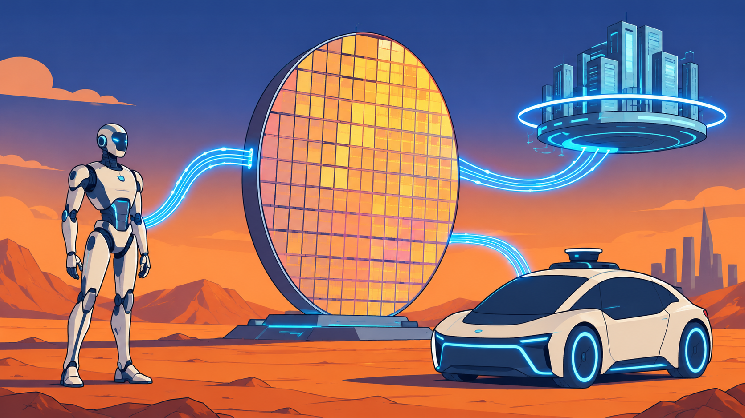
Elon Musk Building Terafab: The Largest Chip Factory for AI, Robots, and Space Data Centers

cryptonews.ruPublicado em 2026-08-15Última atualização em 2026-08-15

Resumo

Elon Musk's SpaceX and Tesla have launched the Terafab project to build a massive semiconductor facility in Grimes County, Texas. The plant, exceeding 9.3 million square meters, aims to integrate logic chip manufacturing, memory production, advanced packaging, and testing. The initial phase requires $16.8 billion in capital investment, with a long-term goal of producing over 1 terawatt of computing power annually. This capacity will support Tesla's Optimus robots and Cybercab autonomous vehicles, as well as SpaceX's orbital data centers. Texas Governor Greg Abbott confirmed the project's start in August 2026, highlighting 3,000 new jobs and a $30 million state grant. Elon Musk emphasized the strategic advantage of combining logic, memory, and packaging under one roof. Musk called the future complex the "largest and most valuable building on Earth," with an area roughly 50 times that of the Pentagon. Intel is the key technology partner, with plans to use its 14A process node for chip production. This partnership aims to diversify supply chains currently dominated by TSMC. The project aligns with the U.S. Pax Silica initiative to secure semiconductor supply chains. An AI analysis notes the project's scale and potential challenges, comparing it to delays seen in other U.S. megafab projects like Intel's Ohio facility. It questions whether Terafab can avoid similar pitfalls related to timelines, budgets, workforce, and supply chain stability. The facility's success could signif...

SpaceX and Tesla have launched the large-scale Terafab project to build a semiconductor plant in Grimes County, Texas, which will integrate the production of logic chips, memory, chip packaging, and testing across an area exceeding 9.3 million square meters. The first phase of the complex will require capital investments of $16.8 billion, and its stated long-term goal is to produce computing equipment with a capacity of over 1 terawatt per year to supply Optimus robots, Cybercab autonomous vehicles, and orbital data centers.

State Support and First-Phase Parameters

Texas Governor Greg Abbott confirmed the project's start on August 6, 2026, noting the creation of 3,000 new jobs and the provision of a $30 million grant from the Texas Enterprise Fund. The initiative also qualified for the Texas Jobs, Energy, Technology, and Innovation (JETI) program, securing additional benefits. SpaceX and Tesla CEO Elon Musk emphasized the strategic importance of combining logic design, memory production, and advanced packaging under one roof to accelerate hardware solution development.

On social media X, Elon Musk called the future complex "the largest and most valuable building on Earth," indicating that when fully equipped, its size will exceed that of the Pentagon by approximately 50 times. The planned distribution of production capacity is as follows: about 25% of the output is intended for Tesla robotics, with the remaining 75% for SpaceX's space-based artificial intelligence systems. Earlier tax incentive documents featured estimates for the initial phase of around $55 billion, with a possible total reaching up to $119 billion upon completion of all stages; however, an official confirmation of the total investment amount is currently unavailable.

Technological Partnership and Geopolitical Context

Intel is the key partner for design and production: Musk stated plans back in April 2026 to utilize Intel's 14A process technology for chip manufacturing at the new plant. This decision aims to diversify supply chains, as TSMC maintains a dominant position in contract manufacturing with a market share of about 70–73%, and concentration is even higher on advanced nodes below 5 nm. Vertical integration helps reduce dependence on external suppliers and control critical stages of microelectronics creation.

The Pax Silica initiative, launched by the U.S. Department of State in December 2025, forms an international coalition to ensure reliable supply chains from critical minerals to AI infrastructure. The program unites Japan, the Republic of Korea, the Netherlands, the EU, and the UK, creating an alternative security ecosystem. According to the Stanford AI Index Report 2026, in 2025, the U.S. produced 59 notable AI models compared to 35 from China, and the number of data centers in the country reached 5,427 units, highlighting the need to expand domestic manufacturing capacity.

Construction of the Terafab plant will begin in the coming months following the official announcement, and its commissioning will become a significant milestone in forming a national semiconductor base. The project's realization could shift the balance of power in chip manufacturing and strengthen the U.S. position in global technological competition by establishing a closed-loop cycle for computing equipment development and production.

AI Opinion

From the perspective of machine data analysis, the scale of Terafab should be compared to the history of major semiconductor construction projects in the U.S. in recent years. A similar Intel project in Ohio (New Albany) has been repeatedly delayed: the launch, initially scheduled for 2026, was postponed by the company to 2030 due to corporate difficulties and shifting priorities. Such experience demonstrates that announced timelines and budgets for megafabs often diverge from reality by years, and factors like workforce availability, power supply, and stability of partner chains (in this case, cooperation with Intel on the 14A process) are rarely factored into initial forecasts.

The situation also illustrates an interesting paradox: the larger the project, the higher the dependence on external factors that are difficult to control even for companies like SpaceX and Tesla. Whether Terafab will avoid the fate of similar giant construction projects is a question whose answer will likely not be clear until the end of this decade.

end-content

Criptomoedas em alta

Perguntas relacionadas

QWhat is the main purpose and scale of Elon Musk's Terafab semiconductor factory project as described in the article?

AThe Terafab project, led by SpaceX and Tesla, aims to build the world's largest semiconductor manufacturing facility in Grimes County, Texas. It will integrate logic chip production, memory manufacturing, advanced packaging, and testing on an area exceeding 9.3 million square meters. Its long-term goal is to produce computing hardware with an annual capacity of over 1 terawatt to support Tesla's Optimus robots, Cybercab autonomous vehicles, and SpaceX's orbital data centers.

QWhat are the key details regarding state support and the first phase of the Terafab project?

ATexas Governor Greg Abbott confirmed the project's start in August 2026, highlighting the creation of 3,000 new jobs and a $30 million grant from the Texas Enterprise Fund. The project also qualifies for the Texas Jobs, Energy, Technology, and Innovation (JETI) program, providing additional benefits. The initial phase requires capital investments of $16.8 billion, with earlier tax incentive documents suggesting the total investment could reach up to $119 billion if all phases are completed.

QWhich company is a key technological partner for Terafab, and what is the strategic reason behind this partnership?

AIntel is the key technological partner. Elon Musk announced plans in April 2026 to use Intel's 14A process technology for chip production at Terafab. This partnership is aimed at diversifying the semiconductor supply chain, reducing dependence on the dominant contract manufacturer TSMC, and gaining greater control over critical stages of microelectronics production through vertical integration.

QHow does the article's 'AI Opinion' section assess the feasibility and challenges of the Terafab project?

AThe 'AI Opinion' section expresses skepticism by comparing Terafab to other large U.S. semiconductor projects, such as Intel's delayed Ohio fab. It notes that timelines and budgets for mega-fabs often diverge from reality due to unforeseen challenges like workforce availability, energy supply, and stability of partner chains (like the collaboration with Intel on the 14A process). It concludes that the larger the project, the higher its dependence on uncontrollable external factors, and the true success of Terafab will only be clear by the end of the decade.

QAccording to the article, what broader geopolitical and industrial context makes projects like Terafab significant for the United States?

AThe article highlights the U.S. initiative 'Pax Silica,' launched to build a reliable international supply chain for AI infrastructure, as part of a broader effort to reduce reliance on concentrated manufacturing, particularly in advanced nodes. Citing the Stanford AI Index Report 2026, the U.S. produced 59 notable AI models in 2025 compared to China's 35 and has over 5,400 data centers, underscoring the need for domestic chip manufacturing. Terafab is positioned as a strategic move to strengthen the U.S. position in global tech competition by creating a closed-loop cycle for computing hardware development and production.

Leituras Relacionadas

Elon Musk is Building Terafab: The Largest Chip Plant for AI, Robots, and Space Data Centers

Elon Musk's SpaceX and Tesla have launched the massive Terafab project to build a semiconductor plant in Grimes County, Texas. Spanning over 9.3 million square meters, the facility will integrate logic chip and memory production, advanced packaging, and testing. The initial phase requires $16.8 billion in capital investment, with a long-term goal of producing over 1 terawatt of computing power annually. This output is intended to supply Tesla's Optimus robots and Cybercab autonomous vehicles, as well as SpaceX's orbital data centers. Texas Governor Greg Abbott confirmed the project's start on August 6, 2026, highlighting the creation of 3,000 jobs and a $30 million grant from the Texas Enterprise Fund. Musk emphasized the strategic advantage of combining chip design, memory production, and packaging under one roof to accelerate hardware development. He stated the fully built complex would be "the largest and most valuable building on Earth," about 50 times larger than the Pentagon. An estimated 25% of production is earmarked for Tesla's robotics, with 75% for SpaceX's space-based AI systems. Earlier tax documents suggested a total project cost of up to $119 billion, but this has not been officially confirmed. Intel is the key technology partner, with plans to use its 14A process node for chip manufacturing. This partnership aims to diversify supply chains and reduce dependence on dominant foundries like TSMC. The initiative aligns with the broader U.S. Pax Silica program, which seeks to build secure international semiconductor supply chains with allied nations. An AI-driven analysis notes that megafab projects, such as Intel's delayed Ohio facility, often face schedule and budget overruns. While Terafab represents a significant step toward U.S. semiconductor self-sufficiency and could shift the global tech balance, its success will depend on factors like skilled labor availability, energy supply, and supply chain stability. The final outcome may not be clear until the late 2030s.

cryptonews.ruHá 2h

Elon Musk is Building Terafab: The Largest Chip Plant for AI, Robots, and Space Data Centers

cryptonews.ruHá 2h

"AI God of Stocks" Blowup Dragged Down, Jane Street Suffered Massive 15 Billion Loss in July, First Monthly Loss in a Decade

Jane Street, a major proprietary trading firm, suffered an estimated $15 billion loss in July, marking its first monthly loss in about a decade. The loss was primarily triggered by the blow-up of the AI-focused hedge fund Situational Awareness, which faced massive margin calls amid a sharp sell-off in AI and semiconductor stocks in July. Jane Street, an investor in the fund, was significantly impacted. Compounding the loss were substantial declines in Jane Street's own Asian non-AI equity long positions, which had performed well earlier in the year. The firm described the losses as a concentrated reversal of previously successful trading strategies in AI and tech sectors. Despite the historic monthly loss, Jane Street's net trading income for the year to date remains strong at over $40 billion. In response, the firm stated it has become more selective in risk-taking, closing specific losing exposures and reducing risk in other strategies. Coinciding with the loss, Jane Street is undergoing a major debt refinancing of approximately $14.6 billion, led by JPMorgan. The move aims to shift more debt from public markets to private investors like Pimco and Fidelity, accepting higher costs for greater flexibility and less public disclosure. The Situational Awareness incident highlights systemic risks in the prime brokerage ecosystem, where leveraged bets on crowded AI trades can lead to forced liquidations and market volatility. Jane Street's subsequent risk reduction and debt restructuring are seen as key responses to this costly lesson.

marsbitHá 2h

"AI God of Stocks" Blowup Dragged Down, Jane Street Suffered Massive 15 Billion Loss in July, First Monthly Loss in a Decade

marsbitHá 2h

Trading

Spot

Artigos em Destaque

Como comprar ELON

Bem-vindo à HTX.com!Tornámos a compra de Dogelon Mars (ELON) simples e conveniente.Segue o nosso guia passo a passo para iniciar a tua jornada no mundo das criptos.Passo 1: cria a tua conta HTXUtiliza o teu e-mail ou número de telefone para te inscreveres numa conta gratuita na HTX.Desfruta de um processo de inscrição sem complicações e desbloqueia todas as funcionalidades.Obter a minha contaPasso 2: vai para Comprar Cripto e escolhe o teu método de pagamentoCartão de crédito/débito: usa o teu visa ou mastercard para comprar Dogelon Mars (ELON) instantaneamente.Saldo: usa os fundos da tua conta HTX para transacionar sem problemas.Terceiros: adicionamos métodos de pagamento populares, como Google Pay e Apple Pay, para aumentar a conveniência.P2P: transaciona diretamente com outros utilizadores na HTX.Mercado de balcão (OTC): oferecemos serviços personalizados e taxas de câmbio competitivas para os traders.Passo 3: armazena teu Dogelon Mars (ELON)Depois de comprar o teu Dogelon Mars (ELON), armazena-o na tua conta HTX.Alternativamente, podes enviá-lo para outro lugar através de transferência blockchain ou usá-lo para transacionar outras criptomoedas.Passo 4: transaciona Dogelon Mars (ELON)Transaciona facilmente Dogelon Mars (ELON) no mercado à vista da HTX.Acede simplesmente à tua conta, seleciona o teu par de trading, executa as tuas transações e monitoriza em tempo real.Oferecemos uma experiência de fácil utilização tanto para principiantes como para traders experientes.

341 Visualizações TotaisPublicado em {updateTime}Atualizado em 2025.03.21

Como comprar ELON

Discussões

Bem-vindo à Comunidade HTX. Aqui, pode manter-se informado sobre os mais recentes desenvolvimentos da plataforma e obter acesso a análises profissionais de mercado. As opiniões dos utilizadores sobre o preço de ELON (ELON) são apresentadas abaixo.

活动图片