Predicting the Dormant Period of Market Heat, Polymarket Prepares a Killer Move to Catch Up with Kalshi

marsbitPublicado em 2026-08-12Última atualização em 2026-08-12

Resumo

Following a period of lower trading activity after the World Cup and during a sports offseason, Polymarket is restructuring in preparation for upcoming major sports events and the US midterm elections in November. Key personnel changes include the appointment of Travis VanderZanden, former Bird founder and Uber/Lyft executive, as Chief Growth Officer to oversee marketing. The company has also hired executives from Robinhood, Coinbase, Nasdaq, and the FBI to strengthen compliance, risk management, and regulatory functions. This push supports Polymarket's renewed focus on the US market after its 2022 exit due to regulatory issues. Its US re-entry accelerated with the 2025 acquisition of licensed exchange QCEX, rebranded as Polymarket US. After launching on iOS in May, a web version recently went live. Trading volume on Polymarket US has surged, growing from $1.77 billion in May to approximately $5 billion in July. This represents 62% of the international platform's volume, up from just 25% two months prior. VanderZanden's immediate task involves addressing past marketing controversies, including CFTC investigations into promotional practices that used simulated trades. The company has since reformed its marketing rules and partner vetting. Despite rapid growth, Polymarket US still trails the US prediction market leader, Kalshi, which saw about $37.7 billion in July volume compared to Polymarket's combined ~$13 billion. Kalshi's valuation also significantly outpaces Polymark...

Author | Asher(@Asher_ 0210)
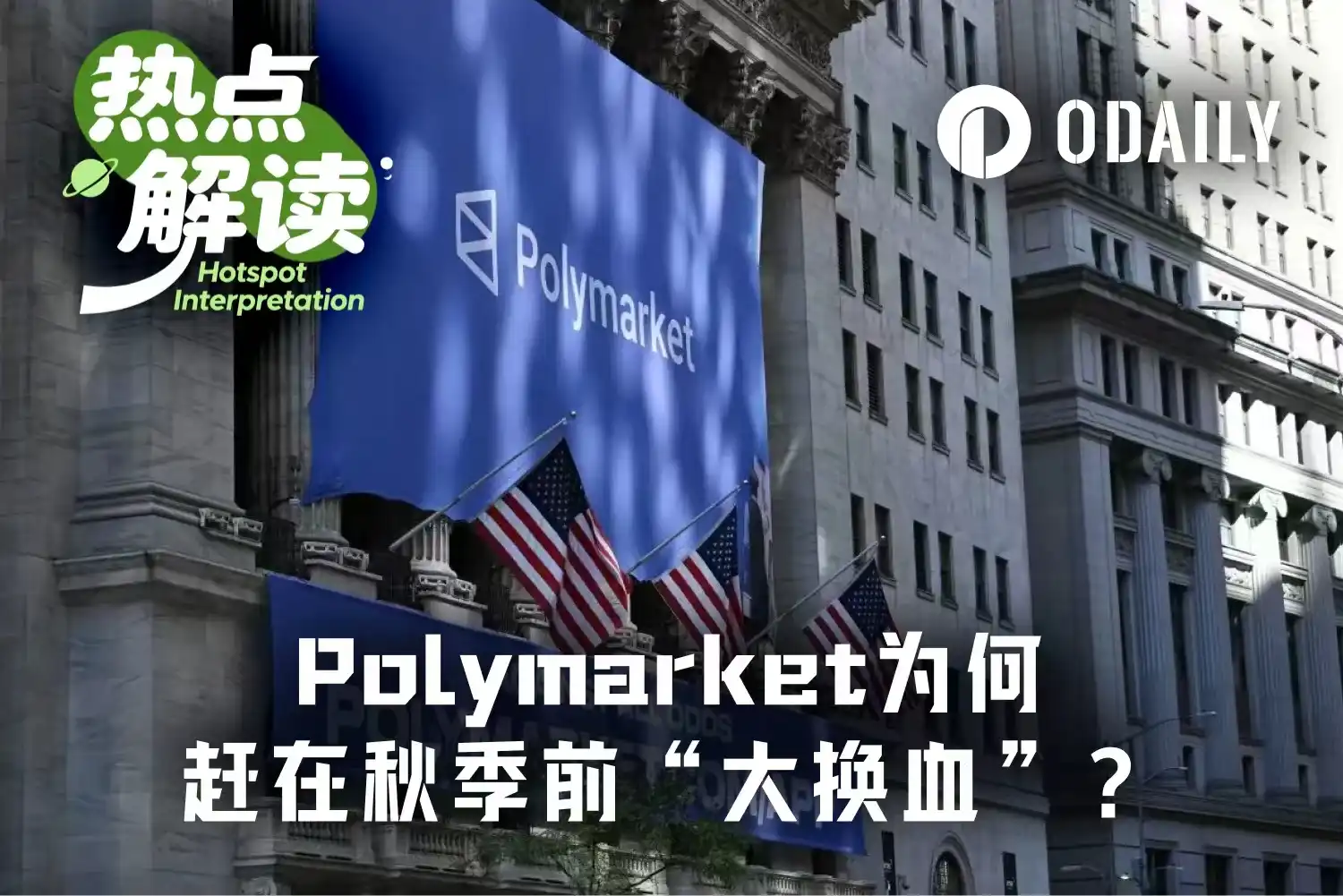
After the World Cup, with most other popular sports events also being in the off-season recently, trading enthusiasm on Polymarket has declined. The platform recently conducted a round of intensive adjustments to management, market direction, and promotion strategies to prepare for upcoming popular sports events and the US midterm elections in November.

In terms of personnel, Travis VanderZanden, founder of shared electric scooter company Bird and former executive at Uber and Lyft, has joined Polymarket as Chief Growth Officer, responsible for the company's marketing system. Additionally, Polymarket has recruited several executives from institutions like Robinhood, Coinbase, Nasdaq, and the FBI, covering compliance, regulation, investigation, and risk management roles.

Furthermore, Polymarket continues to exert efforts in returning to the US market. The series of upcoming sports events and political events are also expected to further boost trading heat for its US business.

One Year After Returning to the US, Polymarket US Enters Growth Phase

From Acquiring a Licensed Exchange to Launching a Web Version, Polymarket US Accelerates Rollout

In 2022, Polymarket reached a settlement with the CFTC for unregistered derivatives trading business and exited the US market.

It wasn't until July 2025 that Polymarket paved the way for its US return by acquiring CFTC-licensed derivatives exchange and clearing agency QCEX for $112 million. Subsequently, QCX LLC operated under the name Polymarket US and, in November of that year, obtained an amended order from the CFTC, further solidifying its foundation for conducting regulated trading in the US.

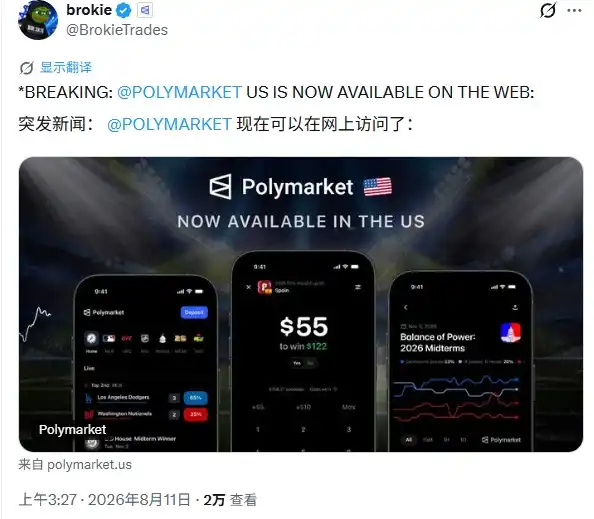
In December of the same year, Polymarket US began opening to users on the waitlist; in May this year, Polymarket US was fully opened to US iOS users. Just yesterday, community members reported that Polymarket US has launched a web version, continuing to expand channels accessible to US users.
Polymarket US Trading Volume Continues to Grow, Gradually Approaching Polymarket International

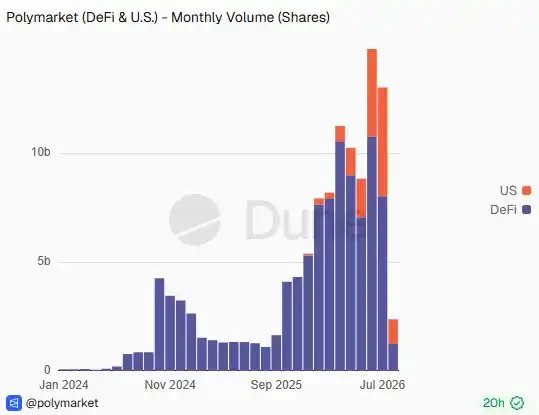
In May this year, as access for US users gradually opened, Polymarket US trading volume began to show significant growth.

According to Dune data, Polymarket US trading volume in May was $1.769 billion, while Polymarket International's volume was $7.077 billion during the same period, with US volume being about 25% of International's. By June, Polymarket US trading volume rapidly increased to $4.041 billion, more than doubling from May. International volume for the same period was $10.773 billion, bringing the ratio to about 38%.

In July, this gap narrowed further. Polymarket US monthly trading volume reached approximately $5 billion, setting a new high, while International's July volume was only $8.044 billion. US volume was equivalent to 62% of International's, whereas just two months prior this ratio was only 25%.
With user access increasing and trading scale continuing to rise, Polymarket now needs not only to further acquire US users but also to face a series of more specific issues like marketing, compliance, and risk management. Therefore, growth, marketing, compliance, and risk control have become the most concentrated areas in this round of team adjustments.

Simultaneously Adding Staff for Growth and Compliance, But First Must Address Previous Marketing Issues

After taking over marketing operations, Travis VanderZanden, founder of Bird and former Uber and Lyft executive, must first deal with the promotional controversies left from earlier actions.

Previously, a Wall Street Journal investigation found that Polymarket had used promotional partners to have content creators display simulated trading. Some videos used website interfaces highly similar to the real Polymarket, leading viewers to believe the creators were conducting real trades and making profits. The related investigation stated that approximately $1.9 million in bets shown across over 1,100 related videos were simulated trades. Subsequently, the CFTC launched an investigation into Polymarket's related marketing practices.

Polymarket then began rectifying its marketing system, including restructuring the marketing department, updating rules for promotion partners, and conducting relevant training for employees. The company also hired consulting firm AlixPartners to review content released by partners, checking for compliance with new promotion guidelines.

Therefore, VanderZanden's task upon joining Polymarket is not merely to continue expanding the user base. He is taking over a marketing system still under adjustment. Polymarket US is currently continuing to expand user access, with trading volume also in a growth phase. With more sports events and political events on the horizon, the platform hopes to further attract US users and increase trading activity. However, previous regulatory investigations also mean that some of the more aggressive promotion methods used in the past can no longer be readily employed.

Autumn is the Real Test, Polymarket Still Needs to Catch Up with Kalshi

In the US prediction market, Kalshi still holds a significant lead over Polymarket US. In July, Kalshi's monthly trading volume was approximately $37.7 billion, Polymarket US about $5 billion, and Polymarket International about $8 billion for the same period—the two platforms combined about $13 billion, less than one-third of Kalshi's. Moreover, Kalshi's business is almost entirely concentrated in the US market.

This gap is also reflected in capital market valuations. At the end of June, Kalshi was negotiating a new round of financing with a target valuation of about $40 billion; just a month earlier, the company had completed a $1 billion funding round with a valuation of $22 billion at that time. In contrast, Polymarket was valued at about $9 billion in October 2025. After completing approximately $1 billion in financing in April this year, its valuation rose to $15 billion. Entering August, it began seeking another round of about $1 billion in financing, targeting a valuation exceeding $20 billion.

After September, a series of popular sports events and the US midterm elections in November will arrive. The US compliant prediction market is Kalshi's foundation and is also becoming Polymarket's most important growth engine. For Polymarket, the next few months will be a critical window for US to further expand trading scale. How effective this round of team adjustments will be will also soon be put to the test.


Criptomoedas em alta

Perguntas relacionadas

QAccording to the article, what was the key reason behind Polymarket's recent management and strategy adjustments?

AThe article states that Polymarket is adjusting its management, market direction, and promotion strategies in preparation for upcoming hot sports events and the US mid-term elections in November.

QWhat steps did Polymarket take to facilitate its return to the US market in 2025?

AIn 2025, Polymarket acquired CFTC-licensed derivatives exchange and clearing agency QCEX for $112 million, paving the way for its US return. The entity QCX LLC then operated as Polymarket US and obtained a revised CFTC Designation Order in November of that year.

QHow did the trading volume of Polymarket US change from May to July, and how did it compare to Polymarket International?

AThe trading volume of Polymarket US grew significantly from $1.769 billion in May to over $5 billion in July. Its proportion compared to Polymarket International's volume increased from 25% in May to 62% in July.

QWhat was the main marketing controversy Polymarket faced, and what actions did the company take in response?

APolymarket faced a controversy where promotional partners used simulated trading on websites that looked very similar to the real Polymarket platform, misleading viewers. Over 1,100 videos showcased about $1.9 million in simulated bets. In response, Polymarket restructured its marketing department, updated partner rules, trained employees, and hired AlixPartners to audit partner content for compliance.

QWhat is the competitive landscape between Polymarket and Kalshi in the US prediction market as described in the article?

AKalshi holds a significant lead over Polymarket in the US. In July, Kalshi's monthly trading volume was about $37.7 billion, while Polymarket US and International combined had about $13 billion, which is less than one-third of Kalshi's volume. Kalshi's valuation was also much higher, targeting around $40 billion in June compared to Polymarket's valuation of over $20 billion in August.

Leituras Relacionadas

The Last Mile of Stablecoins: MoneyGram Connects Crypto Wallets to Cash Outlets in Over 170 Countries

Stablecoins have revolutionized cross-border payments with speed and low cost, but a fundamental barrier remains: converting digital money into physical cash in most parts of the world. On August 11th, global remittance giant MoneyGram announced its "MoneyGram Ramps" crypto-cash service is now live on the Solana blockchain. This allows developers, via a simple API, to connect their applications to MoneyGram's network of nearly 500,000 cash agent locations across over 170 countries. Users can now walk into a local MoneyGram agent to convert their USDC into local currency cash or use cash to purchase USDC for their wallets. Solana wallet Rift is the first to integrate the service. MoneyGram, founded in 1940 and historically second only to Western Union in global remittance volume, was privatized in 2023. Since then, it has accelerated its shift into a fintech platform, opening its compliance capabilities, cash network, and settlement infrastructure as services for developers. Its involvement with crypto is not new, having previously partnered with Ripple, Stellar, and Circle, and even issuing its own stablecoin, MGUSD, on Stellar in 2026. The Ramps API solves a critical physical obstacle to stablecoin adoption. While a USDC transfer from New York to Lagos takes seconds and costs cents on-chain, the recipient often lacks a bank account to access the funds. MoneyGram's extensive physical agent network, prevalent in regions like Sub-Saharan Africa, Southeast Asia, and Latin America, bridges this gap, connecting on-chain dollars to the offline cash-based economy. No crypto-native company could replicate this network quickly. MoneyGram chose Solana for its multi-chain expansion due to its extremely low transaction fees (often less than a cent) and fast confirmation times, making it ideal for small-value, frequent remittances. Solana's developer ecosystem is also geared toward consumer-facing applications. This partnership represents a pragmatic path for stablecoins in everyday remittances. Users don't need to understand blockchain or have a bank account; they simply visit a trusted local agent. The underlying settlement shifts from SWIFT to Solana, but the user experience remains familiar. The true path to stablecoin adoption is being paved by an 85-year-old remittance company, using its physical network to solve the "last mile" problem for crypto.

marsbitHá 11m

The Last Mile of Stablecoins: MoneyGram Connects Crypto Wallets to Cash Outlets in Over 170 Countries

marsbitHá 11m

How to Adapt to Frequent Miraculous Comebacks After the New Patch When Trading in Polymarket's LOL Section?

After recent League of Legends (LoL) game updates, major comebacks and unpredictable outcomes have become more frequent, making trading on Polymarket's LoL prediction markets challenging. This article analyzes the causes and offers adaptation strategies. The author, a longtime LoL fan turned Polymarket trader, notes that post-update, a large early-game gold lead no longer guarantees victory. The current meta reduces the decisive weight of economy, emphasizing instead "advantage conversion, resource trading, team composition strength, and teamfight execution." Key systemic changes aiding comebacks include: Bounty/Kill Gold Compensation, Strategic Objective Bounties, and reduced Baron Nashor rewards. Furthermore, the prevalence of mage picks in the bot lane, instead of traditional marksmen (ADC), can lower sustained damage and teamfight reliability in the late game, contributing to throws. For more successful trading, the article suggests: 1. **Choosing the Right Region:** Prioritize major regions (LPL, LCK, LEC, LCS) where matches matter for World Championship qualification or player contracts, leading to more serious play. Avoid or be extremely cautious with regions like CBLOL (Brazil), TCL (Turkey), and North American Challengers, citing high volatility and potential for unreliable outcomes. 2. **Trading Strategies:** * **Placing Orders:** Use limit orders below market price for strong favorites. In close matchups, consider placing equal low-ball bids (e.g., 25-40 cents) on both sides of a match; if both fill for a total under $1, you secure profit regardless of the winner. Exploit team "power spikes" by buying low before their composition peaks and selling high. * **Timely Selling:** The most crucial lesson is to take profits. If you buy the early-leading team at a low price (e.g., 50-60 cents), sell most of your position (e.g., 75%) at 85-90 cents to lock in gains and avoid a potential comeback zeroing your position. * **Position Sizing:** Practice strict risk management. Do not exceed 5-10% of your capital per match and avoid "tilting" or chasing losses after a few bad trades. In summary, adapting to the new meta requires understanding that early advantages are less stable. Success depends on analyzing team compositions, player form, and regional contexts, combined with disciplined order placement, profit-taking, and capital preservation. The next patch in August is expected to revive traditional ADCs, potentially shifting the dynamics again.

Odaily星球日报Há 24m

How to Adapt to Frequent Miraculous Comebacks After the New Patch When Trading in Polymarket's LOL Section?

Odaily星球日报Há 24m

Strategy CEO Announces Plan to Resume Bitcoin Purchases This Year, With Buying Volume 25 Times Selling Volume

Strategy CEO Announces Resumption of Bitcoin Purchases This Year, Buy-to-Sell Ratio at 25x In a FOX Business interview, Phong Le, CEO of Strategy (formerly MicroStrategy), stated the company plans to resume its Bitcoin acquisition strategy within the current year. This ends a pause in buying that began in May. Le revealed that since the start of the year, Strategy has purchased approximately 175,000 bitcoins while selling around 7,000, making its buy volume about 25 times its sell volume. The company remains the world's largest corporate holder of Bitcoin, with 840,447 BTC, representing roughly 4% of the circulating supply. Le explained that recent sales were used to fulfill capital obligations under a newly approved framework, including paying preferred stock dividends, funding share buybacks, and bolstering the company's US dollar reserves, which now stand at about $4.7 billion. This move marks a shift from the firm's previous "never sell" mantra, which had contributed to its market premium. The change in strategy and the associated financial pressures led to a significant drop in its stock price (MSTR) and a rating downgrade from JPMorgan. The CEO framed the company's role as the "JPMorgan of the crypto economy," emphasizing its long-term goal of increasing the amount of Bitcoin per MSTR share. The announcement signals the return of a major institutional buyer to the Bitcoin market, which could provide price support. It is also viewed as a micro-indicator of recovering institutional confidence, suggesting the company believes the most acute phase of liquidity pressure has passed.

marsbitHá 46m

Strategy CEO Announces Plan to Resume Bitcoin Purchases This Year, With Buying Volume 25 Times Selling Volume

marsbitHá 46m

ArthurHayes新文:押注日元升值,ENA未来几月或涨5至10倍

Arthur Hayes argues that the Japanese Yen is significantly undervalued and posits that its appreciation against the US Dollar is imminent. He outlines three potential mechanisms for this shift, dismissing the first two—the Bank of Japan raising interest rates and domestic institutions selling foreign assets—as politically or economically unfeasible. He identifies the third and preferred method: the Japanese Ministry of Finance (MOF) using its holdings of US Treasuries as collateral in the Fed's FIMA repo facility to borrow US dollars, then selling those dollars to buy Yen in the forex market. Hayes believes US Treasury Secretary Bessant has signaled support for this approach, which requires the Fed's Foreign Currency Subcommittee, led by Chairman Walsh, to remove lending limits on the FIMA tool. Hayes asserts that implementing this "Scheme 3" would lead to a significant expansion of US dollar liquidity. He predicts this surge in liquidity will act as a catalyst, driving up the prices of assets like Bitcoin and physical gold. Within the crypto space, he views Ethereum (ETH) as undervalued and singles out Ethena's ENA token as a speculative play with potential for 5-10x gains in the coming months, contingent on a recovery in Bitcoin basis trades that would boost demand for its USDe stablecoin. He concludes that investors should watch for the Fed's rule change as the key trigger for these market movements.

marsbitHá 58m

ArthurHayes新文:押注日元升值,ENA未来几月或涨5至10倍

marsbitHá 58m

Trading

Spot

Artigos em Destaque

Como comprar MOVE

Bem-vindo à HTX.com!Tornámos a compra de Movement (MOVE) simples e conveniente.Segue o nosso guia passo a passo para iniciar a tua jornada no mundo das criptos.Passo 1: cria a tua conta HTXUtiliza o teu e-mail ou número de telefone para te inscreveres numa conta gratuita na HTX.Desfruta de um processo de inscrição sem complicações e desbloqueia todas as funcionalidades.Obter a minha contaPasso 2: vai para Comprar Cripto e escolhe o teu método de pagamentoCartão de crédito/débito: usa o teu visa ou mastercard para comprar Movement (MOVE) instantaneamente.Saldo: usa os fundos da tua conta HTX para transacionar sem problemas.Terceiros: adicionamos métodos de pagamento populares, como Google Pay e Apple Pay, para aumentar a conveniência.P2P: transaciona diretamente com outros utilizadores na HTX.Mercado de balcão (OTC): oferecemos serviços personalizados e taxas de câmbio competitivas para os traders.Passo 3: armazena teu Movement (MOVE)Depois de comprar o teu Movement (MOVE), armazena-o na tua conta HTX.Alternativamente, podes enviá-lo para outro lugar através de transferência blockchain ou usá-lo para transacionar outras criptomoedas.Passo 4: transaciona Movement (MOVE)Transaciona facilmente Movement (MOVE) no mercado à vista da HTX.Acede simplesmente à tua conta, seleciona o teu par de trading, executa as tuas transações e monitoriza em tempo real.Oferecemos uma experiência de fácil utilização tanto para principiantes como para traders experientes.

539 Visualizações TotaisPublicado em {updateTime}Atualizado em 2026.06.02

Como comprar MOVE

Discussões

Bem-vindo à Comunidade HTX. Aqui, pode manter-se informado sobre os mais recentes desenvolvimentos da plataforma e obter acesso a análises profissionais de mercado. As opiniões dos utilizadores sobre o preço de MOVE (MOVE) são apresentadas abaixo.

活动图片