Foundation Steps Back, Ethlabs Steps Forward: Ethereum Undergoes Its Largest Restructuring in History

链捕手Publicado em 2026-06-23Última atualização em 2026-06-23

Resumo

On June 23rd, the Ethereum ecosystem witnessed two major shifts, signaling a significant governance realignment. First, former Ethereum Foundation researchers established Ethlabs, a new independent non-profit. Backed by major ETH holders like Bitmine and SharpLink, Ethlabs aims to address practical needs for institutional adoption, including faster settlement, native asset issuance, cross-chain transactions, and mainnet scaling. Secondly, the Ethereum Foundation announced a major restructuring, laying off 54 employees (20% of its staff) to become a leaner entity focused on protocol governance and maintenance rather than being the primary builder. This move represents a pivotal correction. Criticisms had mounted over the Foundation's perceived slowness, lack of clear strategy, and over-reliance on Vitalik Buterin's influence. Ethlabs emerges as a more execution-oriented, "industrialized" layer focused on market adoption—bridging the gap between research and real-world use. Notably, Vitalik Buterin is absent from its list of supporters, interpreted as an intentional step to avoid excessive personal endorsement and allow the organization to build independent credibility. The Ethereum Foundation's downsizing and redefinition mark a retreat from its former central coordinating role. It now aims to share the "privilege of stewarding Ethereum" with other emerging groups like Ethlabs, the Ethereum Applications Guild, and The Ethereum Economic Zone. Analysts frame this dual shift a...

Author: Gu Yu, ChainCatcher

On June 23, the long-questioned Ethereum ecosystem welcomed two significant announcements.

First, several former Ethereum Foundation researchers established an independent nonprofit organization, Ethlabs, with major funding support from key ETH holders such as Bitmine and SharpLink. According to its introduction, Ethlabs' early work will focus on key requirements for large-scale institutional on-chain adoption, including faster settlement speeds, native asset issuance, cross-chain transactions based on robust infrastructure, mainnet capacity scaling, and foundational research supporting ETH's monetary properties.

Soon after, the Ethereum Foundation announced it had completed a restructuring lasting several months, laying off 54 people, approximately 20% of its previous workforce. This adjustment continues the "Lean Ethereum" strategic transformation, repositioning the Ethereum Foundation as a lighter-weight protocol governance and maintainer, rather than the primary core builder.

With one stepping forward and the other stepping back, Ethereum is sending a clear signal: the Foundation is proactively yielding ground, with ecosystem organizations taking on more execution responsibilities. Ethereum is no longer attempting to have a centralized nonprofit organization oversee the roadmap, development, promotion, and adoption entirely.

For Ethereum, this may be the most important governance correction in the past decade.

Over the past year, external criticism of Ethereum has extended beyond ETH's price performance to target its organizational efficiency, strategic articulation, and ecosystem mobilization capabilities. Ethereum had at times appeared overly "correct," overly slow, and overly reliant on the implicit endorsement of the Foundation and Vitalik.

Today's two changes precisely respond to these criticisms: Ethereum is not directionless; it is attempting to change the way direction is generated.

I. Ethlabs Gains Ecosystem Support, but Vitalik is Absent

The establishment of Ethlabs first signifies the emergence of a new organization within the Ethereum ecosystem that is closer to an "industrialized execution layer."

Unlike traditional research institutions, Ethlabs' goal is not merely to propose new cryptographic directions or long-term roadmaps but to more explicitly address practical issues like institutional on-chain adoption, financial asset issuance, cross-chain transactions, mainnet capacity, and ETH's monetary properties. These issues correspond to Ethereum's core anxieties in recent years: it remains the most important smart contract network, but its advantages in real institutional adoption, on-chain financial scale, and user experience are not as solid as the market imagines.

Ethereum does not lack research or vision. What it lacks is the intermediate layer that translates research into market adoption. This is precisely the significance of Ethlabs' emergence.

Among the list of supporters on Ethlabs' official website, one can see many high-influence figures within the Ethereum ecosystem, including several important figures from the Ethereum Foundation, investors from VCs like Dragonfly and Electric Capital, and ecosystem contributors from Base, Flashbots, Uniswap. It is worth noting, however, that Vitalik is not on this list of supporters.
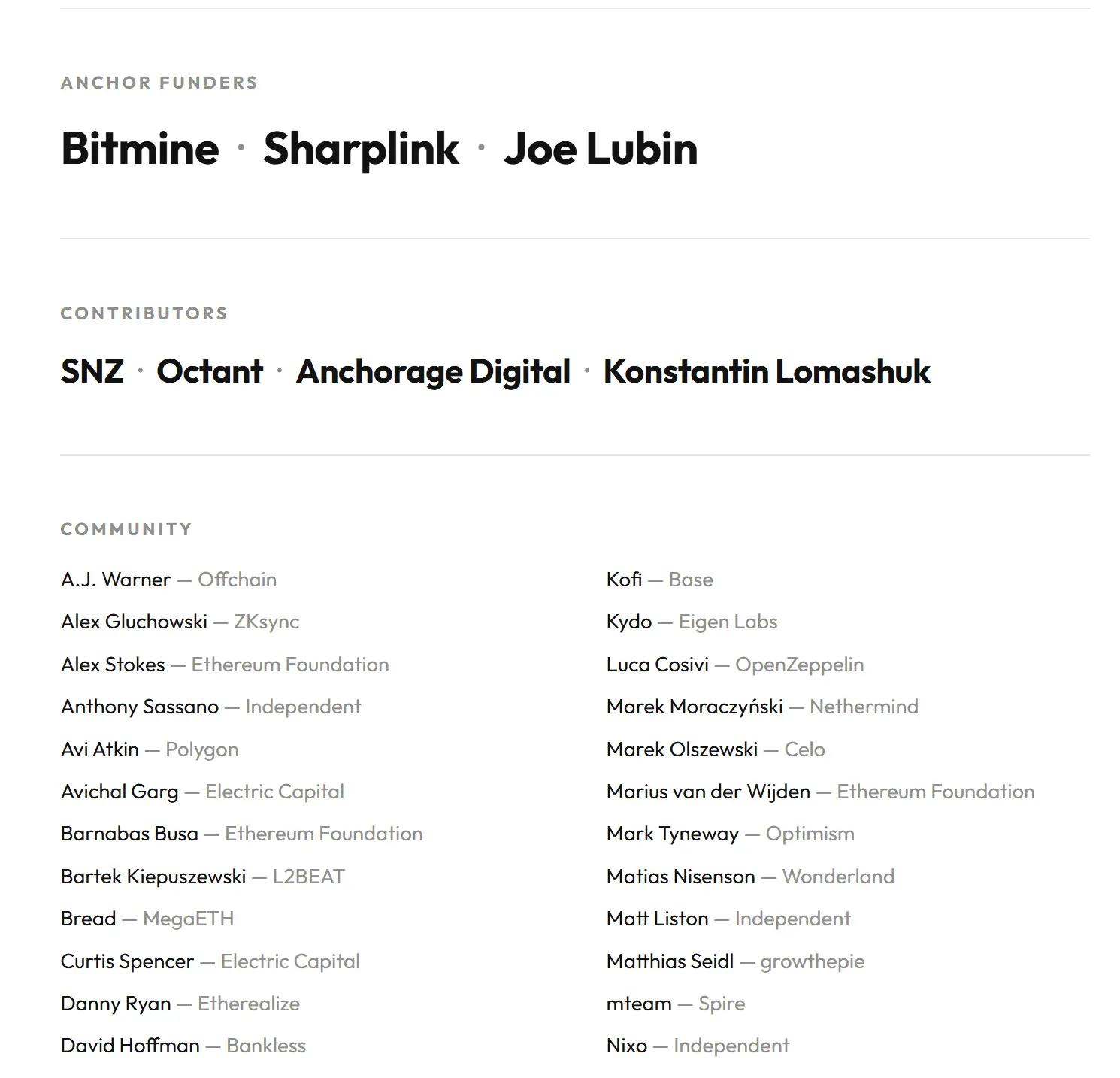
This does not necessarily mean Vitalik disagrees with Ethlabs. On the contrary, a more reasonable understanding is that he is intentionally avoiding forming too strong a personal endorsement or path interference for this new organization.

For many years, Vitalik has held immense symbolic significance for the Ethereum ecosystem. He has proposed many forward-looking directions like soulbound tokens, DeSoc, privacy, account abstraction, and public goods funding, but not many have achieved large-scale market adoption.

The issue is not that these directions lack value, but that when every expression by Vitalik is viewed by the market as "the next phase narrative for Ethereum," the entire ecosystem can fall into a kind of implicit dependency, mistakenly investing excessive time and capital costs.

So far this year, Vitalik has only published 2 articles on his official blog, whereas he previously published at least 15 articles annually. This change itself is noteworthy. It does not represent a decline in Vitalik's influence over Ethereum but rather appears to be an active restraint: letting Ethereum gradually shift from "founder-driven public narrative" to a "technical network driven by multiple organizations, teams, and stakeholders."

If Ethlabs is to take on stronger institutional, financial, and execution functions, it cannot be merely an extension of Vitalik's will. It must prove it can gain ecosystem trust without the founder's direct endorsement and respond to the market with tangible results.

II. The New Structure and Positioning of the Ethereum Foundation

As Ethlabs steps forward, the Ethereum Foundation is stepping back.

For a long time, although nominally just a nonprofit supporting the Ethereum ecosystem, the Ethereum Foundation has in practice long played multiple roles: strategic coordinator, research funder, protocol roadmap setter, and cultural center. It has been unwilling to become a traditional corporate headquarters yet has taken on similar functions on many critical issues.

This structure once helped Ethereum maintain neutrality and decentralization but also brought side effects: slow decision-making, ambiguous communication, unclear responsibility boundaries. The outside world both hoped the Foundation would provide clearer strategy and criticized it for having too much influence.

Simultaneously, internal disagreements within the Ethereum Foundation have been reported. According to a previous report by The Guardian, there were clear disagreements within the Ethereum Foundation regarding strategic direction, leadership changes, and institutional adoption, with tensions also existing in the community between the "cypherpunk faction" and the "pragmatic business faction"; the Foundation's appointment of Hsiao-Wei Wang and Tomasz Stańczak as co-executive directors in March 2025 was also seen as a compromise between these two cultures.

However, it became clear that after both executive directors left their posts, the Foundation's 2025 team restructuring was declared a failure. Key figures like Josh Stark, Trenton Van Epps, and Dankrad Feist left successively. Coupled with persistently low token prices and growing skepticism, the Ethereum Foundation had to restructure again.

After this restructuring, the Ethereum Foundation split its organization into clusters such as the protocol layer, access layer, user layer, community layer, and institutional layer, and laid off 54 people, about 20% of its previous workforce. This is not a simple cost-cutting and efficiency improvement, but a contraction of boundaries: the Foundation is repositioning itself as a lighter-weight protocol governance and maintainer, rather than the primary builder for all directions in the ecosystem.

In fact, besides Ethlabs, multiple other nonprofit organizations like Ethereum Applications Guild, The Ethereum Economic Zone, and Argot Collective have emerged within the Ethereum ecosystem over the past year. They contribute from different angles, such as promoting applications, Rollup collaboration, and maintaining Solidity.

"The privilege to manage Ethereum should not be monopolized but carefully shared with those committed to building self-sovereign infrastructure, whether they are old friends or newcomers," the Ethereum Foundation clearly stated in its latest post.

III. Turning "Correct" into "Effective"

In the past, Ethereum's advantages came from its developer community, DeFi liquidity, L2 ecosystem, and protocol security. But over the past two years, these advantages have not fully translated into ETH's market performance. The community's criticism of the EF is, in essence, a form of "shareholder anxiety."

Enterprise Ethereum Alliance Chairman Paul Brody once commented that the Ethereum community, to some extent, behaves like ordinary shareholders, "They want a return on investment." This statement is harsh but true.

A month ago, Bankless co-founder Ryan Sean Adams tweeted, "Ethereum's future can no longer rely on the Ethereum Foundation (EF). The EF is important, but Ethereum needs new institutions to step in and fill the gaps. We need an organization that truly wants the Ethereum asset (ETH) to win—for its quantity to grow—and that dares to speak out and execute effectively. The EF is not that, and never will be."

Now, Ethlabs emerges, carrying the expectations of major ETH holders Bitmine, SharpLink, and the broader token-holding community. These two companies hold a combined total of over 6 million ETH. Their demand for Ethereum is clearly not just about whether the technical roadmap continues to advance, but whether ETH can deliver substantial returns for their shareholders.

This inherently differs from the Ethereum Foundation's positioning. The EF must maintain credible neutrality; it cannot directly serve ETH's price like a listed company, nor can it simplify protocol governance to maximizing token holder interests. But new organizations like Ethlabs can take on more explicit market-oriented functions.

In other words, the EF is responsible for keeping Ethereum "correct," while Ethlabs needs to prove Ethereum remains "effective."

Ethereum could previously respond to market skepticism with "long-termism." But when Hyperliquid captures the derivatives narrative, Solana captures the meme narrative, and Bitcoin captures the asset narrative, Ethereum must prove it is not only the most secure smart contract platform but also the network most capable of hosting the next wave of on-chain financial expansion.

Of course, this shift is not without risks. Ethlabs receiving support from major ETH holders and institutionalized forces may raise new concerns about "whether Ethereum is moving from Foundation centralization to whale centralization." Institutional adoption may also create tension with Ethereum's original cypherpunk spirit.

But for Ethereum today, the greater risk is not turning too fast, but continuing to linger between technical correctness and organizational sluggishness.

The market ultimately will not reward vision alone, nor will it reward a stance of decentralization alone. It will reward networks that can maintain credible neutrality while continuously attracting capital, applications, developers, and institutions.

The establishment of Ethlabs and the Foundation's restructuring are key steps Ethereum is taking in that direction.

Criptomoedas em alta

Perguntas relacionadas

QAccording to the article, what is the primary focus of the newly established Ethlabs organization in its early work?

AAccording to the article, Ethlabs's early work will focus on key demands for institutional-scale blockchain adoption, including faster settlement speeds, native asset issuance, cross-chain transactions based on robust infrastructure, mainnet capacity scaling, and fundamental research supporting ETH's monetary properties.

QHow does the article describe the role shift of the Ethereum Foundation (EF) after its major restructuring?

AThe article states that the Ethereum Foundation has repositioned itself as a lighter-weight protocol governance and maintenance body through its restructuring and downsizing, stepping back from its previous role as a primary core builder and strategic coordinator for the ecosystem.

QWhat significant absence is noted in Ethlabs's list of supporters, and what is the suggested interpretation for this according to the article?

AEthereum co-founder Vitalik Buterin is notably absent from Ethlabs's list of supporters. The article suggests this is likely an intentional move to avoid his personal endorsement creating strong path dependency or interference, allowing Ethlabs to operate and gain trust independently of the founder's direct influence.

QWhat core difference in function between the Ethereum Foundation (EF) and Ethlabs is highlighted in the article's conclusion?

AThe article concludes that the core functional difference is that the Ethereum Foundation is responsible for keeping Ethereum 'correct' (maintaining credible neutrality and protocol integrity), while Ethlabs needs to prove Ethereum is still 'effective' (driving market adoption, institutional use, and tangible results).

QWhat two companies are mentioned as major ETH holders providing primary funding for Ethlabs, and what is their combined approximate ETH holding?

AThe two major ETH holder companies providing primary funding for Ethlabs are Bitmine and SharpLink. Their combined ETH holdings exceed 6 million tokens.

Leituras Relacionadas

Second Half of U.S. Crypto Policy: The Clarity Act Aims for 60 Votes, CFTC's "One-Person Commission" Becomes Biggest Variable

In a pivotal year for US crypto policy, the "CLARITY Act" is advancing in the Senate but faces a high hurdle, needing 60 votes to pass. Key challenges include bridging partisan divides on ethics and swaying undecided Republican senators within a tight legislative calendar of only about 40 working days. The policy "second half" involves intense negotiations on a broader framework for Web3 and DeFi, including crypto tax reforms and the Blockchain Regulatory Certainty Act. A significant uncertainty is the understaffed CFTC, operating with four commissioner vacancies, which complicates regulatory clarity. Meanwhile, the departure of key "crypto champions"—SEC Commissioner Hester Peirce and Senator Cynthia Lummis—will impact ongoing policy efforts. Industry experts are cautiously optimistic but realistic. Sara K. Weed notes that while progress is being made, CLARITY is unlikely to pass this Congress, pushing agencies like the SEC and CFTC to provide more guidance. Sulolit Mukherjee suggests meaningful crypto tax legislation is more likely to be attached to larger must-pass bills. Rashan Colbert discusses the jurisdictional debate over prediction markets, emphasizing the need for a regulatory framework that fosters their development as financial tools rather than treating them broadly as gambling. The clock is ticking, but opportunities remain for substantive progress through continued bipartisan dialogue and pragmatic efforts.

marsbitHá 5h

Second Half of U.S. Crypto Policy: The Clarity Act Aims for 60 Votes, CFTC's "One-Person Commission" Becomes Biggest Variable

marsbitHá 5h

Research Report Analysis: Morgan Stanley Details SanDisk SNDK, The Truth About Cloud Data Center Pricing Power and AI Inference Benefits

Morgan Stanley raised its price target for SanDisk (SNDK) from $1100 to $1750 on June 22, maintaining an Overweight rating. The upgrade is driven by AI inference demand reshaping the NAND market, particularly for KV Cache and context window storage in cloud data centers. These cloud clients exhibit price inelasticity and sign long-term contracts, granting SanDisk significant pricing power. SanDisk's New Business Model (NBM) agreements, covering over one-third of FY27 bit shipments with 3-5 year terms and fixed price/price collar structures, are crucial. They are projected to sustain gross margins around 80% even at floor prices, providing a buffer against cyclical downturns. Morgan Stanley forecasts gross margins to surge from 30.3% in FY25 to 86.7% in FY27e. With NAND supply expected to remain tight into 2026/2027 and cloud/data centers becoming the largest end-market, SanDisk holds supply-side pricing power. The company targets 15-19% bit growth via technology transitions, not capacity expansion. Revenue is projected to grow ~6.6x from FY25 to FY27, with EPS rising from $2.74 to $14.73, driven by high-margin cloud business. Key upside catalysts include faster enterprise SSD adoption and edge AI growth. Downside risks involve slower industry growth, competitor capex increases, market share loss, and competition from Chinese players like YMTC. The investment thesis rests on AI-driven structural demand, NBM's margin protection, and sustained supply tightness. The $1750 target implies ~28x FY27e P/E.

marsbitHá 6h

Research Report Analysis: Morgan Stanley Details SanDisk SNDK, The Truth About Cloud Data Center Pricing Power and AI Inference Benefits

marsbitHá 6h

Trading

Spot
Futuros

Artigos em Destaque

O que é ETH 2.0

ETH 2.0: Uma Nova Era para o Ethereum Introdução ETH 2.0, amplamente conhecido como Ethereum 2.0, marca uma atualização monumental à blockchain do Ethereum. Esta transição não é meramente uma mudança estética; visa melhorar fundamentalmente a escalabilidade, segurança e sustentabilidade da rede. Com uma mudança do mecanismo de consenso em Proof of Work (PoW), intensivo em energia, para um Proof of Stake (PoS) mais eficiente, o ETH 2.0 promete uma abordagem transformadora ao ecossistema blockchain. O que é ETH 2.0? ETH 2.0 é um conjunto de atualizações distintas e interconectadas focadas na otimização das capacidades e desempenho do Ethereum. Esta reformulação foi projetada para abordar desafios críticos que o mecanismo atual do Ethereum enfrentou, particularmente em relação à velocidade das transações e à congestão da rede. Objetivos do ETH 2.0 Os principais objetivos do ETH 2.0 giram em torno da melhoria de três aspectos centrais: Escalabilidade: Com o objetivo de melhorar significativamente o número de transações que a rede pode manejar por segundo, o ETH 2.0 procura ultrapassar a limitação atual de aproximadamente 15 transações por segundo, alcançando potencialmente milhares. Segurança: Medidas de segurança melhoradas são integrais ao ETH 2.0, especialmente através da resistência aprimorada contra ciberataques e da preservação do ethos descentralizado do Ethereum. Sustentabilidade: O novo mecanismo PoS foi projetado não apenas para melhorar a eficiência, mas também para reduzir drasticamente o consumo de energia, alinhando a estrutura operacional do Ethereum com considerações ambientais. Quem é o Criador do ETH 2.0? A criação do ETH 2.0 pode ser atribuída à Ethereum Foundation. Esta organização sem fins lucrativos, que desempenha um papel crucial no apoio ao desenvolvimento do Ethereum, é liderada pelo co-fundador notável Vitalik Buterin. A sua visão de um Ethereum mais escalável e sustentável tem sido a força motriz por trás desta atualização, envolvendo contribuições de uma comunidade global de desenvolvedores e entusiastas dedicados a melhorar o protocolo. Quem são os Investidores do ETH 2.0? Embora os detalhes sobre os investidores do ETH 2.0 não tenham sido tornados públicos, é sabido que a Ethereum Foundation recebe apoio de várias organizações e indivíduos no espaço da blockchain e tecnologia. Esses parceiros incluem firmas de capital de risco, empresas de tecnologia e organizações filantrópicas que compartilham um interesse mútuo em apoiar o desenvolvimento de tecnologias descentralizadas e infraestrutura de blockchain. Como Funciona o ETH 2.0? ETH 2.0 é notável por introduzir uma série de características chave que o diferenciam do seu predecessor. Proof of Stake (PoS) A transição para um mecanismo de consenso PoS é uma das mudanças de destaque do ETH 2.0. Ao contrário do PoW, que depende da mineração intensiva em energia para a verificação de transações, o PoS permite que os utilizadores validem transações e criem novos blocos de acordo com a quantidade de ETH que apostam na rede. Isso leva a uma maior eficiência energética, reduzindo o consumo em aproximadamente 99,95%, tornando o Ethereum 2.0 uma alternativa consideravelmente mais ecológica. Shard Chains As shard chains são outra inovação crítica do ETH 2.0. Estas cadeias menores operam em paralelo com a cadeia principal do Ethereum, permitindo que várias transações sejam processadas simultaneamente. Esta abordagem melhora a capacidade geral da rede, abordando preocupações de escalabilidade que têm atormentado o Ethereum. Beacon Chain No coração do ETH 2.0 está a Beacon Chain, que coordena a rede e gere o protocolo PoS. Ela atua como uma espécie de organizador: supervisiona os validadores, garante que as shards permaneçam conectadas à rede e monitora a saúde geral do ecossistema blockchain. Linha do Tempo do ETH 2.0 A jornada do ETH 2.0 tem sido marcada por vários marcos chave que traçam a evolução desta atualização significativa: Dezembro de 2020: O lançamento da Beacon Chain marcou a introdução do PoS, preparando o caminho para a migração para o ETH 2.0. Setembro de 2022: A conclusão de “The Merge” representa um momento crucial em que a rede Ethereum fez a transição com sucesso de um quadro PoW para um PoS, anunciando uma nova era para o Ethereum. 2023: O lançamento esperado das shard chains visa melhorar ainda mais a escalabilidade da rede Ethereum, solidificando o ETH 2.0 como uma plataforma robusta para aplicações e serviços descentralizados. Características Chave e Benefícios Escalabilidade Melhorada Uma das vantagens mais significativas do ETH 2.0 é a sua escalabilidade melhorada. A combinação de PoS e shard chains permite que a rede expanda a sua capacidade, permitindo que acomode um volume de transações muito maior em comparação com o sistema legado. Eficiência Energética A implementação do PoS representa um enorme passo em direção à eficiência energética na tecnologia blockchain. Ao reduzir drasticamente o consumo de energia, o ETH 2.0 não só reduz os custos operacionais, mas também se alinha mais estreitamente com os objetivos globais de sustentabilidade. Segurança Aprimorada Os mecanismos atualizados do ETH 2.0 contribuem para uma segurança melhorada em toda a rede. O uso do PoS, juntamente com medidas de controle inovadoras estabelecidas através das shard chains e da Beacon Chain, assegura um maior grau de proteção contra potenciais ameaças. Custos Mais Baixos para os Utilizadores À medida que a escalabilidade melhora, os efeitos sobre os custos de transação também serão evidentes. Aumentada a capacidade e reduzida a congestão, espera-se que isso se traduza em taxas mais baixas para os utilizadores, tornando o Ethereum mais acessível para transações do dia a dia. Conclusão ETH 2.0 marca uma evolução significativa no ecossistema da blockchain do Ethereum. Ao abordar questões fundamentais como a escalabilidade, o consumo de energia, a eficiência das transações e a segurança geral, a importância desta atualização não pode ser subestimada. A transição para o Proof of Stake, a introdução das shard chains e o trabalho fundamental da Beacon Chain são indicativos de um futuro em que o Ethereum pode atender à crescente demanda do mercado descentralizado. Em uma indústria movida pela inovação e progresso, o ETH 2.0 representa um testemunho das capacidades da tecnologia blockchain em pavimentar o caminho para uma economia digital mais sustentável e eficiente.

108 Visualizações TotaisPublicado em {updateTime}Atualizado em 2024.12.03

O que é ETH 2.0

O que é ETH 3.0

ETH3.0 e $eth 3.0: Uma Análise Profunda do Futuro do Ethereum Introdução No ambiente em rápida evolução da criptomoeda e da tecnologia blockchain, o ETH3.0, frequentemente denotado como $eth 3.0, emergiu como um tema de considerável interesse e especulação. O termo abrange dois conceitos principais que merecem esclarecimento: Ethereum 3.0: Esta representa uma potencial atualização futura destinada a aumentar as capacidades da atual blockchain do Ethereum, focando especialmente na melhoria da escalabilidade e desempenho. ETH3.0 Meme Token: Este distinto projeto de criptomoeda procura aproveitar a blockchain do Ethereum na criação de um ecossistema centrado em memes, promovendo o envolvimento na comunidade de criptomoedas. Compreender esses aspectos do ETH3.0 é essencial não apenas para entusiastas de criptomoedas, mas também para aqueles que observam as tendências tecnológicas mais amplas no espaço digital. O que é ETH3.0? Ethereum 3.0 Ethereum 3.0 é promovido como uma atualização proposta para a rede Ethereum já estabelecida, que tem sido a espinha dorsal de muitas aplicações descentralizadas (dApps) e contratos inteligentes desde a sua criação. As melhorias vislumbradas concentram-se principalmente na escalabilidade—integrando tecnologias avançadas como sharding e provas de conhecimento zero (zk-proofs). Essas inovações tecnológicas visam facilitar um número sem precedentes de transações por segundo (TPS), potencialmente alcançando milhões, abordando assim uma das limitações mais significativas enfrentadas pela tecnologia blockchain atual. A melhoria não é meramente técnica, mas também estratégica; visa preparar a rede Ethereum para uma adoção generalizada e utilidade em um futuro marcado por uma maior demanda por soluções descentralizadas. ETH3.0 Meme Token Em contraste com o Ethereum 3.0, o ETH3.0 Meme Token aventura-se por um domínio mais leve e divertido, combinando a cultura dos memes da internet com a dinâmica das criptomoedas. Este projeto permite que os usuários comprem, vendam e negociem memes na blockchain do Ethereum, proporcionando uma plataforma que fomenta o envolvimento da comunidade através da criatividade e interesses compartilhados. O ETH3.0 Meme Token visa demonstrar como a tecnologia blockchain pode interseccionar com a cultura digital, criando casos de uso que são tanto divertidos quanto financeiramente viáveis. Quem é o Criador do ETH3.0? Ethereum 3.0 A iniciativa em direção ao Ethereum 3.0 é impulsionada principalmente por um consórcio de desenvolvedores e pesquisadores dentro da comunidade Ethereum, notavelmente incluindo Justin Drake. Conhecido por suas percepções e contribuições para a evolução do Ethereum, Drake tem sido uma figura proeminente nas discussões sobre a transição do Ethereum para uma nova camada de consenso, referida como “Beam Chain”. Esta abordagem colaborativa ao desenvolvimento significa que o Ethereum 3.0 não é fruto de um único criador, mas sim uma manifestação da engenhosidade coletiva focada no avanço da tecnologia blockchain. ETH3.0 Meme Token Os detalhes sobre o criador do ETH3.0 Meme Token são atualmente indetectáveis. A natureza dos tokens de meme frequentemente leva a uma estrutura mais descentralizada e impulsionada pela comunidade, o que poderia explicar a falta de atribuição específica. Isso alinha-se com a ethos da comunidade de criptomoedas mais ampla, onde a inovação geralmente surge de esforços colaborativos em vez de esforços individuais. Quem são os Investidores do ETH3.0? Ethereum 3.0 O apoio ao Ethereum 3.0 provém principalmente da Fundação Ethereum, juntamente com uma comunidade entusiástica de desenvolvedores e investidores. Esta associação fundacional proporciona um grau significativo de legitimidade e melhora as perspectivas de uma implementação bem-sucedida, uma vez que aproveita a confiança e credibilidade construída ao longo de anos de operações de rede. Em um clima em rápida mudança no mundo das criptomoedas, o apoio da comunidade desempenha um papel crucial no impulso ao desenvolvimento e adoção, posicionando o Ethereum 3.0 como um sério candidato a futuros avanços na blockchain. ETH3.0 Meme Token Embora as fontes atualmente disponíveis não forneçam informações explícitas sobre as fundações ou organizações de investimento que apoiam o ETH3.0 Meme Token, é indicativo do modelo típico de financiamento para tokens de meme, que frequentemente depende de apoio base e engajamento da comunidade. Os investidores em tais projetos costumam consistir em indivíduos motivados pelo potencial de inovação impulsionada pela comunidade e pelo espírito de cooperação encontrado dentro da comunidade cripto. Como Funciona o ETH3.0? Ethereum 3.0 As características distintivas do Ethereum 3.0 residem em sua proposta de implementação de sharding e tecnologia zk-proof. Sharding é um método de partição da blockchain em partes menores e gerenciáveis ou “shards”, que podem processar transações simultaneamente em vez de sequencialmente. Esta descentralização do processamento ajuda a prevenir congestionamentos e garante que a rede permaneça responsiva mesmo sob carga pesada. A tecnologia de prova de conhecimento zero (zk-proof) contribui com outra camada de sofisticação ao permitir a validação de transações sem revelar os dados subjacentes envolvidos. Este aspecto não apenas melhora a privacidade, mas também aumenta a eficiência geral da rede. Há também conversas sobre a incorporação de uma Máquina Virtual Ethereum de conhecimento zero (zkEVM) nesta atualização, amplificando ainda mais as capacidades e utilidade da rede. ETH3.0 Meme Token O ETH3.0 Meme Token distingue-se ao capitalizar sobre a popularidade da cultura dos memes. Estabelece um mercado para que os usuários participem da negociação de memes, não apenas para entretenimento, mas também para potencial ganho econômico. Ao integrar recursos como staking, provisão de liquidez e mecanismos de governança, o projeto fomenta um ambiente que incentiva a interação e participação da comunidade. Ao oferecer uma mistura única de entretenimento e oportunidade econômica, o ETH3.0 Meme Token visa atrair um público diversificado, variando de entusiastas de criptomoedas a conhecedores casuais de memes. Cronologia do ETH3.0 Ethereum 3.0 11 de novembro de 2024: Justin Drake sugere a próxima atualização do ETH 3.0, centrada nas melhorias de escalabilidade. Este anúncio sinaliza o início de discussões formais sobre a futura arquitetura do Ethereum. 12 de novembro de 2024: A proposta antecipada para Ethereum 3.0 deve ser revelada no Devcon em Bangkok, preparando o cenário para um feedback mais amplo da comunidade e potenciais próximos passos no desenvolvimento. ETH3.0 Meme Token 21 de março de 2024: O ETH3.0 Meme Token é oficialmente listado no CoinMarketCap, marcando sua entrada no domínio público das criptomoedas e aumentando a visibilidade de seu ecossistema baseado em memes. Pontos Chave Em conclusão, Ethereum 3.0 representa uma evolução significativa dentro da rede Ethereum, focando em superar limitações quanto à escalabilidade e desempenho através de tecnologias avançadas. As atualizações propostas refletem uma abordagem proativa às futuras demandas e usabilidade. Por outro lado, o ETH3.0 Meme Token encapsula a essência da cultura impulsionada pela comunidade no espaço das criptomoedas, aproveitando a cultura dos memes para criar plataformas envolventes que incentivam a criatividade e participação dos usuários. Compreender os distintos propósitos e funcionalidades do ETH3.0 e $eth 3.0 é fundamental para qualquer pessoa interessada nos desenvolvimentos contínuos dentro do espaço cripto. Com ambas as iniciativas a pavimentar caminhos únicos, elas sublinham coletivamente a natureza dinâmica e multifacetada da inovação em blockchain.

109 Visualizações TotaisPublicado em {updateTime}Atualizado em 2024.12.03

O que é ETH 3.0

Como comprar ETH

Bem-vindo à HTX.com!Tornámos a compra de Ethereum (ETH) simples e conveniente.Segue o nosso guia passo a passo para iniciar a tua jornada no mundo das criptos.Passo 1: cria a tua conta HTXUtiliza o teu e-mail ou número de telefone para te inscreveres numa conta gratuita na HTX.Desfruta de um processo de inscrição sem complicações e desbloqueia todas as funcionalidades.Obter a minha contaPasso 2: vai para Comprar Cripto e escolhe o teu método de pagamentoCartão de crédito/débito: usa o teu visa ou mastercard para comprar Ethereum (ETH) instantaneamente.Saldo: usa os fundos da tua conta HTX para transacionar sem problemas.Terceiros: adicionamos métodos de pagamento populares, como Google Pay e Apple Pay, para aumentar a conveniência.P2P: transaciona diretamente com outros utilizadores na HTX.Mercado de balcão (OTC): oferecemos serviços personalizados e taxas de câmbio competitivas para os traders.Passo 3: armazena teu Ethereum (ETH)Depois de comprar o teu Ethereum (ETH), armazena-o na tua conta HTX.Alternativamente, podes enviá-lo para outro lugar através de transferência blockchain ou usá-lo para transacionar outras criptomoedas.Passo 4: transaciona Ethereum (ETH)Transaciona facilmente Ethereum (ETH) no mercado à vista da HTX.Acede simplesmente à tua conta, seleciona o teu par de trading, executa as tuas transações e monitoriza em tempo real.Oferecemos uma experiência de fácil utilização tanto para principiantes como para traders experientes.

3.2k Visualizações TotaisPublicado em {updateTime}Atualizado em 2026.06.02

Como comprar ETH

Discussões

Bem-vindo à Comunidade HTX. Aqui, pode manter-se informado sobre os mais recentes desenvolvimentos da plataforma e obter acesso a análises profissionais de mercado. As opiniões dos utilizadores sobre o preço de ETH (ETH) são apresentadas abaixo.

活动图片