From Ethereum to AI's 'CROPS': What Exactly Is This 'Slow Variable' That Vitalik Has Repeatedly Emphasized?

marsbitPublicado em 2026-06-06Última atualização em 2026-06-06

Resumo

Recently, Vitalik Buterin has frequently emphasized the concept of "CROPS," first outlined in the Ethereum Foundation's March mandate as core principles guiding its focus: Censorship Resistance, Capture Resistance, Open Source, Privacy, and Security. CROPS represents Ethereum's commitment to providing foundational capabilities for user sovereignty—enabling asset ownership, identity expression, and coordination without reliance on centralized platforms or surrendering ultimate control. This framework is gaining new urgency with the rise of AI, particularly AI agents managing digital assets and automating transactions. While AI offers convenience, it risks centralizing user data, intent, and control if dependent on opaque, centralized services. Vitalik argues for "CROPS AI"—AI that is open, privacy-preserving, secure, and capable of local execution to maintain user agency. He highlights convergence between "CROPS Ethereum access layers" and "CROPS AI," such as using zero-knowledge proofs for private remote LLM calls and Ethereum RPC reads, ensuring users can access services without exposing sensitive information. Ultimately, CROPS is not just an abstract ideal but a practical guide for Ethereum's development and AI integration. It addresses the critical long-term question: as digital systems grow more powerful, how can users retain control over their privacy, assets, and autonomy? In an AI-driven era, these principles may define Ethereum's enduring value—prioritizing verifiab...

Over the past period, Vitalik has repeatedly mentioned a somewhat unfamiliar term: CROPS.

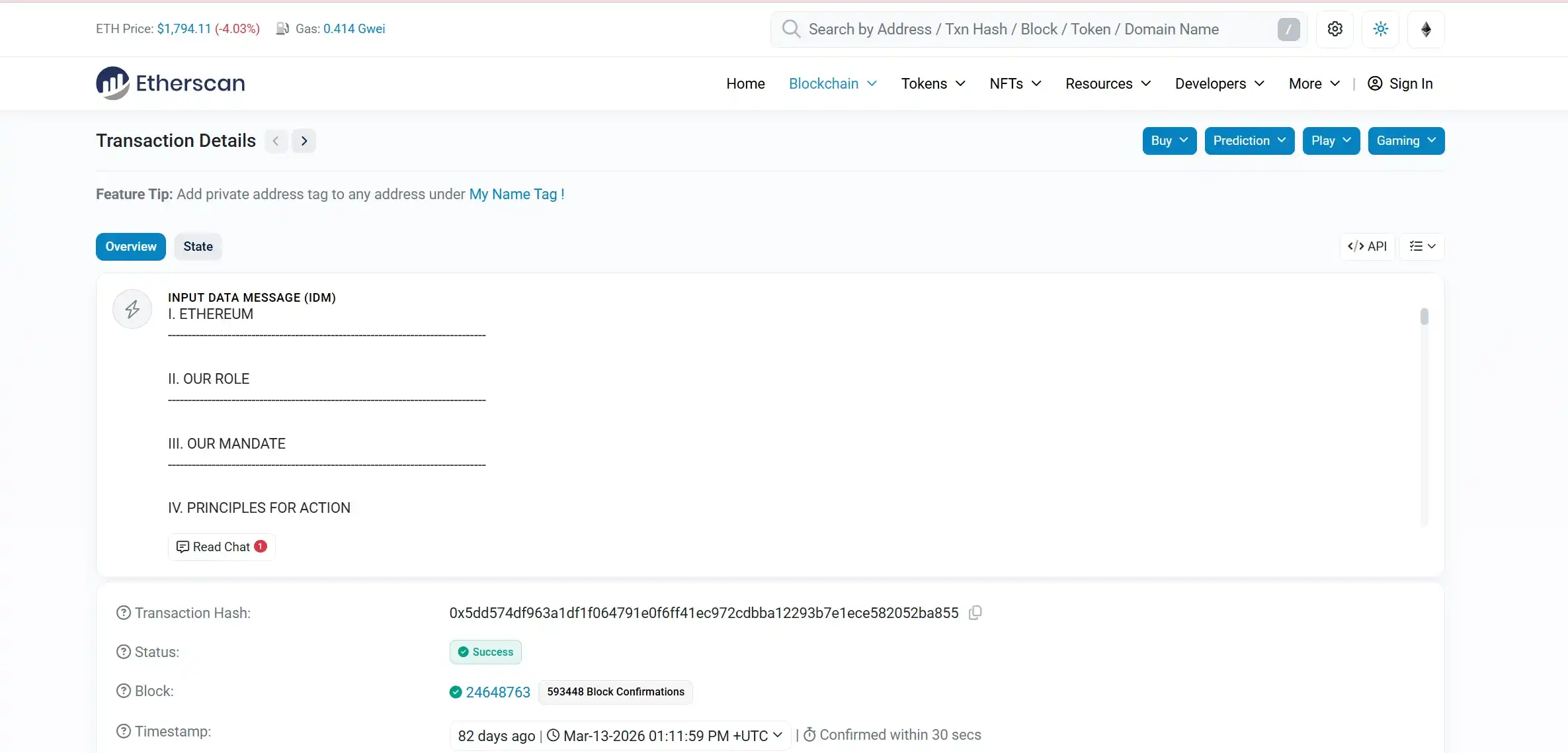
The systematic emergence of this concept can be traced back to March 13th. The Ethereum Foundation's Board of Directors released the 'EF Mandate' document, clearly stating that the primary focus will be on Ethereum's censorship resistance, open source, privacy, and security—namely, CROPS—and using this to serve user self-sovereignty while maintaining capture resistance and a more seamless user experience.

This statement is actually very important, especially as AI begins to enter wallet and automated execution scenarios, CROPS is no longer confined to Ethereum's value proposition but could become an issue of whether users can continue to control their digital lives in the AI era.
I. What Exactly is CROPS?

To understand CROPS, one must first break free from a common misconception: Ethereum certainly needs to improve performance and reduce costs, but it's not just competing with other blockchains to see who is faster or has lower fees.

While speed and cost are indeed the most intuitive factors for short-term user experience, if you zoom out and look at the longer term, Ethereum's stance has become increasingly clear over the past two years: what it truly aims to provide is a set of more fundamental capabilities: users can hold assets, express identity, sign transactions, and participate in coordination without relying on a single platform, without surrendering ultimate control, and without being arbitrarily blocked by a centralized service.

This is the significance of CROPS.

In the context of the EF Mandate, CROPS primarily points to five directions, which are also the acronym for their keywords: Censorship Resistance, Capture Resistance (this was actually added later by Vitalik), Open Source, Privacy, Security.

  • C - Censorship Resistance: Ensuring transactions and smart contracts are immutable and cannot be halted due to any external political or centralized entity pressure.
  • R - Capture Resistance: Preventing Ethereum's governance, development roadmap, and critical entry points from being controlled long-term by a minority of interested parties.
  • O - Open Source / Openness: Adhering to completely open-source code and maintaining absolute freedom of access for the ecosystem.
  • P - Privacy: Preserving users' right not to be scrutinized through cryptographic technologies on a transparent ledger.
  • S - Security: Upholding the bottom line, providing unbreakable ultimate settlement security.

Looking at these items together, they actually constitute a set of selection and guiding principles with a clear orientation, which is also very much in line with Ethereum's consistent value-driven path.

For example, at the protocol layer, it means Ethereum needs to continuously improve censorship resistance, client diversity, validator decentralization, formal verification, etc. At the application layer, wallets, RPCs, browsers, signature interfaces, and account systems also need to reduce dependence on centralized entry points. At the user experience layer, security cannot rely solely on users understanding complex transactions; it must be preemptively integrated through clearer signature displays, more verifiable interactions, and more comprehensive risk warnings before actions occur.

This is also why EF has recently advanced some more specific directions around security, privacy, protocol resilience, and ecosystem public goods, such as the Ethereum Audit Subsidy program, which attempts to lower the barrier for Ethereum ecosystem developers to obtain high-quality security audits. Viewed more broadly, this is not just about subsidizing costs, but about pushing 'security' further from a high-cost service affordable only to a few large projects towards more small and medium-sized developers.

In late May, Vitalik also reiterated his views on EF's future direction, emphasizing that EF should become a smaller, more distinct, and more focused organization dedicated to long-term sustainability, rather than trying to cover every need in the ecosystem. The reason is pragmatic: after all, EF does not possess infinite resources nor a continuous revenue stream from staking or transaction fees. Therefore, it should direct its limited resources towards tasks that are crucial for Ethereum to achieve CROPS values and that other entities find difficult to reliably undertake.

In other words, at this transformative historical stage Ethereum is currently in, CROPS is not an abstract slogan of 'principle over reality,' but rather more like an external definition and constraint on what EF should and should not do.

II. When CROPS Meets AI: The Convergence of Two Parallel Universes

Vitalik Buterin recently brought CROPS into a larger discussion by placing it in the context of AI.

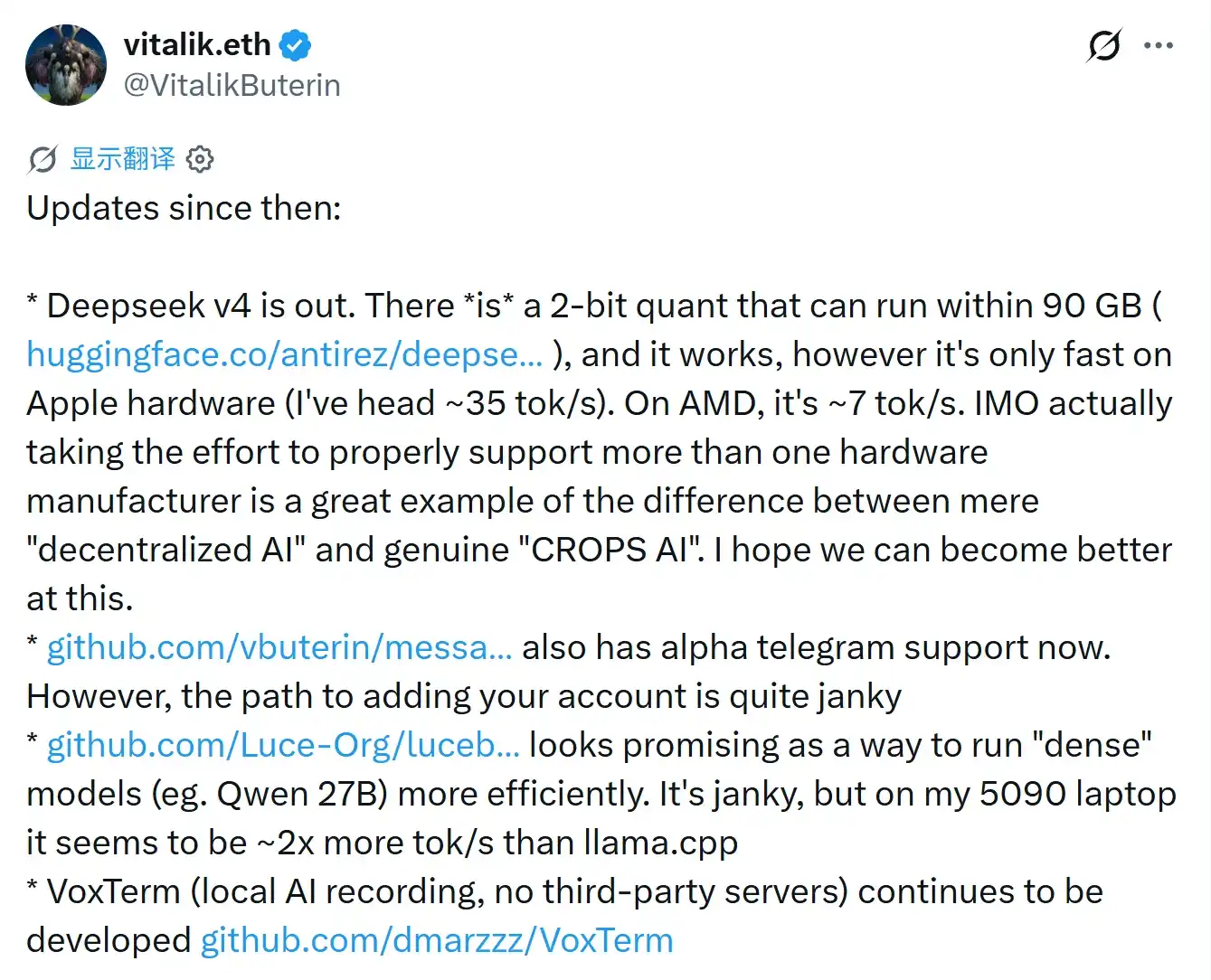
On May 28th, Vitalik Buterin posted an update on his progress with local AI, stating that DeepSeek V4 had released a 2-bit quantized version that could run within about 90 GB of VRAM, achieving speeds of around 35 tokens/second on Apple hardware and about 7 tokens/second on AMD hardware. He noted that a true 'CROPS AI' should support multiple hardware platforms, not just be 'decentralized AI.'

Simultaneously, he pointed out significant overlap between the CROPS Ethereum access layer and CROPS AI, for example, using zero-knowledge proofs for paid remote LLM calls and private Ethereum RPC reads. He suggested there should also be more AI models fine-tuned for Ethereum scenarios in the future, aimed at improving smart contracts, protocol code, and ecosystem security.

This essentially places Ethereum and AI within the same problem framework.
Previously, discussions about AI often focused on model capabilities—whether they can write code, and especially whether they can perform complex tasks as human substitutes. However, from a user safety perspective, the real change brought by AI is not just 'increased capability,' but that it is altering the entry points for digital operations.

To reiterate an old point: in the past, applications were relatively clear, separate interfaces. We opened wallets to transfer funds, opened DApps to trade, opened browsers to search, opened social products to post. Each application had relatively clear boundaries. But with the emergence of AI Agents, these boundaries are becoming increasingly blurred. Users no longer click functions one by one; instead, they express intent in natural language:

Help me find the optimal cross-chain route, help me make a swap, help me organize my assets, help me execute a certain DeFi strategy, help me generate and send a transaction...

This sounds convenient, but it also implies a more critical question: when AI becomes your digital agent, what transactions is it signing on your behalf, and what privacy is it exposing?

If AI runs entirely on centralized cloud services, users' asset information, transaction intent, address relationships, identity preferences, and operational habits could be concentrated in the hands of a few service providers. Especially when executing on-chain operations relying on opaque APIs, centralized RPCs, black-box plugins, and unverifiable inference processes, users might become more convenient but also less aware of what they are actually surrendering.

This is the question CROPS AI must answer.

A CROPS-compliant AI is not just about being capable; it should also be as censorship-resistant, open, privacy-preserving, and secure as possible. It should ideally run locally, or at least minimize reliance on centralized cloud services for sensitive scenarios, minimize information leakage, and allow users to understand, confirm, and retain ultimate control.

In other words, AI cannot just be a smarter black box. Especially in Web3 scenarios, AI in the future may not only help you summarize articles, write code, or provide customer service, but directly participate in asset management and automated execution.

The closer it gets to user assets, the more important CROPS becomes.

This is also why there is overlap between the CROPS Ethereum access layer and CROPS AI.

III. What Web3 Incremental Opportunities Lie in This Intersection?

From this perspective, Vitalik's recent mention of the overlap between CROPS Ethereum Access Layer and CROPS AI is very natural.

Because whether it's Ethereum or AI, the core problem users face is becoming the same: how can I use AI assistance without completely handing over my privacy, identity, assets, and right to choose to centralized intermediaries?

  • On the Ethereum side, this manifests as: How do users access on-chain data? How do they connect to RPCs? How do they sign transactions? How do they confirm if a DApp interaction is safe? How do they avoid having all wallet queries, balance reads, and transaction broadcasts pass through a few centralized services?
  • On the AI side, this manifests as: How do users call models? How can they ensure prompts and personal data are not misused? How can local models handle sensitive tasks? How, when needing remote large model capabilities, can they minimize exposure of their identity and intent?

These two sets of problems seem different, but are fundamentally similar.

For example, when Ethereum users query balances, read transaction history, or simulate transaction outcomes, they often need to go through RPC services. While RPCs appear to be mere technical interfaces, they can know your IP, addresses, query habits, asset structure, and interaction paths. If such data is centrally collected, users' on-chain privacy can be gradually pieced together.

But AI users calling remote models may also expose their preferences, financial information, or even identity clues. If users employ AI for wallet operations in the future, the risks would be further amplified.

Therefore, the ZK-paid remote LLM calls and private Ethereum RPC reads Vitalik mentioned essentially attempt to solve the same problem: how can we obtain services while invoking remote capabilities without exposing all our information?

This is where CROPS Ethereum and CROPS AI intersect. On one side is a more private, verifiable, and lower-trust-assumption on-chain access layer; on the other is a more open, localized, and secure AI execution environment. Combined, they may form a new entry point for users into the digital world in the future.

Extending outward along the underlying logic of CROPS, the entire Web3 ecosystem (especially the wallet layer as a traffic entry point) will undoubtedly take on more roles.

As users begin to express on-chain needs in natural language, a wallet is no longer just a signing tool but the control console for a user's digital actions. It needs to help users determine: Can this DApp connect? What exactly will this transaction do? Is this AI Agent calling unnecessary data?

From this perspective, CROPS is not an abstract value but will directly influence the design direction of wallet products and drive the development shift for the next decade in integrated Web3 interaction experiences and the wallet sector.

Conclusion

Although, in the current market sentiment, many people might not pay as much attention to purely conceptual topics anymore.

But the colder the market, the easier it is to overlook those technical variables that may not be 'sexy' in the short term but truly determine the direction in the long run.

CROPS is worth paying attention to, not because it creates a new hype cycle, but because it reframes the long-term problems of Ethereum and AI within a single framework: as digital systems become increasingly powerful, can users continue to retain their own control?

After all, security and privacy cannot just be patches applied after the fact.

From this perspective, in an era where AI is accelerating its takeover of the digital world, these factors may be the truly positive variables that make Ethereum worth continued building and usage.

In an era where AI is accelerating its takeover of the digital world, being more understandable, more verifiable, more private, and more secure may be the real reasons Ethereum continues to be worth building and using.

Perguntas relacionadas

QAccording to the article, what does the acronym CROPS stand for in the context of the Ethereum Foundation's mandate?

ACROPS stands for Censorship Resistance, Capture Resistance, Open Source / Openness, Privacy, and Security. It represents a set of core guiding principles for Ethereum.

QWhy does the article argue that CROPS is becoming critically important in the age of AI, particularly for Web3?

AThe article argues that as AI Agents begin to automate wallet operations and execute complex tasks on-chain, they gain proximity to user assets and sensitive data. CROPS principles are vital to ensure that AI does not become a 'black box' that compromises user sovereignty, privacy, and security, preventing users from losing control to centralized AI service providers.

QWhat is the common problem that both CROPS for Ethereum Access Layer and CROPS for AI are trying to solve, according to Vitalik Buterin's perspective mentioned in the article?

ABoth aim to solve the problem of how users can access remote services or capabilities (like RPCs or large language models) without fully exposing their personal information, identity, assets, or transaction intent. The goal is to obtain the service while preserving privacy and minimizing trust assumptions in centralized intermediaries.

QHow might the role of a wallet evolve in a future where CROPS principles guide interactions with both Ethereum and AI, as described in the article?

AThe wallet could evolve from a simple signing tool into a user's central digital action console or control panel. It would need to help users verify DApp safety, understand complex transaction implications, and monitor AI Agent behavior to prevent unnecessary data calls, thus becoming crucial for safeguarding user sovereignty in a world of automated, natural-language-driven interactions.

QWhat is the significance of the Ethereum Audit Subsidy program in relation to the CROPS framework, particularly the 'Security' aspect?

AThe Ethereum Audit Subsidy program is an example of applying the CROPS framework concretely. By lowering the cost barrier for high-quality security audits, it moves 'security' from being an expensive service only for large projects to a more accessible public good for smaller developers. This enhances the overall security and capture resistance of the ecosystem, aligning with CROPS's long-term, sustainability-focused goals.

Leituras Relacionadas

TechFlow Intelligence Bureau: Chip Stocks Lose Trillions in a Single Day, Bitcoin Falls Below $60,000, US-Iran Conflict Escalates

**Daily Tech & Markets Roundup: AI Advances, Market Turmoil, and Geopolitical Tensions** **AI / LLMs**: Anthropic's internal report on AI self-improvement sparked serious discussions about Recursive Self-Improvement (RSI). Meanwhile, debate continues on AI coding tools after Claude was accused of introducing bugs into the rsync codebase. In positive news, DeepSeek V4 Flash impressed in local deployment tests, and GitHub Copilot now supports custom endpoints for local models. A surprising research turn suggests removing chain-of-thought prompting can sometimes improve LLM performance. **Crypto / Web3**: Bitcoin plunged below $60,000, with its RSI hitting levels last seen during the COVID-19 crash, driven by strong U.S. jobs data reviving interest rate hike fears. Discussions highlight Ethereum DeFi's continued lack of a smooth consumer payment layer. **Chips / Hardware**: Chip stocks suffered a massive sell-off, with the Philadelphia Semiconductor Index posting its worst single-day drop in six years, erasing over a trillion dollars in value. Marvell, Micron, AMD, and Intel were among the biggest losers. **Tech Companies**: A leaked Microsoft document revealing goals to make Copilot "addictive" drew criticism. LinkedIn founder Reid Hoffman left Microsoft's board to focus full-time on his AI agent startup, Manus. Google was revealed to be paying SpaceX $920 million monthly for AI training compute. **Markets & Macro**: A blowout U.S. jobs report (172k vs. 80k expected) crushed hopes for near-term rate cuts, sending Treasury yields soaring and triggering a broad market sell-off. CEOs from Kraft, McDonald's, and Whirlpool simultaneously warned U.S. consumers are exhausting their savings. **Geopolitics**: U.S.-Iran tensions escalated with missile/drone interceptions and U.S. strikes on Iranian radar sites, keeping the critical Strait of Hormuz largely closed since late February and posing ongoing oil supply risks. **The Bottom Line**: The strong jobs data acted as a single trigger for correlated sell-offs across equities, crypto, and chips. Underlying the volatility is a stark contradiction between robust employment data and warnings of consumer weakness, alongside geopolitical risks that could reignite inflation, leaving markets to price in a fraught macro outlook with no clear "soft landing" path.

marsbitHá 9m

TechFlow Intelligence Bureau: Chip Stocks Lose Trillions in a Single Day, Bitcoin Falls Below $60,000, US-Iran Conflict Escalates

marsbitHá 9m

It Took Me a Year to See the Bitter Truth About Agent Payments

After a year building infrastructure for the Agent economy, engaging with major players like Stripe, Visa, and Coinbase, the author shares a sobering analysis of the current state of Agent payments. The core finding is a stark lack of genuine, immediate demand across most envisioned use cases. The article breaks down four key market segments: 1. **Agent-to-Merchant (Consumer Shopping):** For most product categories (e.g., clothing, electronics), conversational AI shopping is a step backwards from visual e-commerce interfaces. While agents excel at understanding needs, they can't replace side-by-side product comparison. Real merchant interest is defensive "Agent Engine Optimization," not driven by current customer demand. Potential exists for high-frequency, low-decision purchases (like food delivery) or navigating complex store UIs, but these require massive B2C distribution channels dominated by giants like Amazon. 2. **Agent-to-API (Developer Services):** Developers already have subscriptions and billing relationships for APIs (compute, data). Prepaid balances solve micro-payment issues for low transaction volumes. A deeper structural problem is that major SaaS vendors' business models rely on enterprise contracts, resisting granular pay-per-call pricing. While protocols like MPP and x402 serve the long tail of niche services, this market is small and developers are historically low-willingness-to-pay. 3. **Agent-to-Agent:** This remains largely theoretical with minimal transaction volume. While it represents a long-term bet on a fundamentally new transaction infrastructure (sub-second, micro-penny to million-dollar, multi-party settlements), it does not constitute a present market. 4. **Agent-to-Finance:** This is the only category with existing, paying demand. Integrating AI into financial workflows (trading, portfolio management) is a natural evolution and enables new capabilities like autonomous rebalancing. However, competition favors established, regulated institutions. The "real problem" is not moving money between agents, but the broader challenge of **coordination**—orchestrating work between agents and humans, verifying outcomes, and settling results. Payment is just one component of settlement, which is itself part of coordination. Companies that solve the coordination layer will subsume payment, not the other way around. While well-funded incumbents build defensively for a long-term future, startups must find where the market is today—which, for the author's team, lies outside these four categories in an area of real, growing, and underserved activity.

marsbitHá 52m

It Took Me a Year to See the Bitter Truth About Agent Payments

marsbitHá 52m

It Took Me a Year to See the Hard Truth About Agent Payments

**Title: It Took Me a Year to See the Hard Truth About Agent Payments** Over the past year, I've worked on infrastructure for the Agent economy, engaging with major players like Stripe, Visa, Coinbase, and numerous startups. The findings reveal a stark reality: genuine, widespread demand for Agent-based payments does not yet exist. **Key Observations:** * **Agent-to-Merchant (Shopping):** The user experience for AI shopping often falls short, especially for visual product discovery. While AI excels at understanding needs, conversational interfaces can't yet replace browsing and comparing multiple products visually. Current merchant interest is largely defensive ("Agent Engine Optimization") for a future that hasn't arrived. High-frequency, low-friction purchases (like food delivery) are potential fits, but lack open APIs and face high AI inference costs. Simpler, more affordable, or cross-language interactions for complex UIs are a niche opportunity but require massive consumer distribution to scale. * **Agent-to-API (Developer Tools):** Developer payment needs for APIs (computing, data, models) are already met through subscriptions and prepaid credits. The core challenge is not payment friction but supplier economics: most large SaaS providers prefer enterprise contracts over micropayments for API calls. Protocols like MPP and x402 suit the long-tail of smaller services but cater to a developer market historically reluctant to pay for these tools. Major infrastructure needs at the top of the stack are already being addressed. * **Agent-to-Agent (Machine Commerce):** This is a long-term vision with almost no current transaction volume. While a future with high-speed, high-frequency, multi-party machine-to-machine transactions would require novel infrastructure, it remains theoretical. The market is not here yet. * **Agent-to-Finance:** This is the only category with clear, present demand. Financial professionals and DeFi users already pay for tools, and AI augmentation is a natural evolution. Autonomous AI agents can enable entirely new financial strategies. However, competition is fierce from established, regulated incumbents who can more easily layer AI onto their existing products. **The Core Insight:** Companies, especially giants with long time horizons, are building defensively for a potential future of mass machine commerce. For them, early investment is a low-cost hedge. For startups, the current market reality is different. The primary challenge isn't just moving money between agents (payments). The larger, unsolved problem is **orchestration** – coordinating work between agents and humans, verifying outcomes, and then settling. Payment is just a part of settlement, which is just a part of orchestration. Companies that solve the orchestration problem will subsume payments, not the other way around. After a year of building, we see the real, growing, and underserved market opportunity lies in this broader domain of orchestration.

链捕手Há 1h

It Took Me a Year to See the Hard Truth About Agent Payments

链捕手Há 1h

Claude Opus 4.8 Finds a $4.5 Billion Bug: The AI Era is Mass-Producing Hackers

A researcher discovered a critical "infinite mint" vulnerability in the Zcash cryptocurrency's Orchard protocol using Claude Opus 4.8, leading to a swift fix but also a 50% market drop, erasing billions in value. This incident highlights a new era where powerful, accessible AI models are dramatically lowering the barrier to finding software vulnerabilities. Previously, the security community feared specialized models like Claude Mythos Preview, capable of finding decades-old zero-day exploits. The Zcash case, however, involved a publicly available, general-purpose model. This shift makes advanced security auditing—and attack capabilities—accessible to far more people, not just experts. The mass democratization of vulnerability discovery brings a dual challenge: a flood of low-quality, AI-generated false reports that overwhelm maintainers, and the real, rapid uncovering of deep, dangerous bugs. Open-source projects, often understaffed and unfunded, are particularly vulnerable to this "attention DDoS." The article cites examples like curl shutting down its bug bounty program due to the unsustainable workload. Our perceived digital safety has often been luck, relying on the high cost and effort required to find deeply hidden flaws in complex systems, as seen with historical vulnerabilities like Heartbleed or Baron Samedit. AI changes this cost structure, effectively "mass-producing flashlights" to illuminate every corner of our codebase. While large companies operate extensive security chains involving external white-hat hackers and massive defensive operations, the global cybersecurity workforce faces a severe shortage, especially of experienced personnel capable of analyzing complex threats and coordinating fixes. The core dilemma emerges: AI makes *finding* bugs cheap and scalable, but *fixing* them remains a slow, expensive, and human-intensive process. The article concludes that AI won't destroy the internet but acts as a bright light, revealing that our digital existence is not inherently secure but is precariously maintained by ongoing human effort. The true cost in the AI era may not be discovery, but whether there will be enough people left willing and able to do the hard work of repair.

marsbitHá 1h

Claude Opus 4.8 Finds a $4.5 Billion Bug: The AI Era is Mass-Producing Hackers

marsbitHá 1h

Trading

Spot
Futuros

Artigos em Destaque

O que é ETH 2.0

ETH 2.0: Uma Nova Era para o Ethereum Introdução ETH 2.0, amplamente conhecido como Ethereum 2.0, marca uma atualização monumental à blockchain do Ethereum. Esta transição não é meramente uma mudança estética; visa melhorar fundamentalmente a escalabilidade, segurança e sustentabilidade da rede. Com uma mudança do mecanismo de consenso em Proof of Work (PoW), intensivo em energia, para um Proof of Stake (PoS) mais eficiente, o ETH 2.0 promete uma abordagem transformadora ao ecossistema blockchain. O que é ETH 2.0? ETH 2.0 é um conjunto de atualizações distintas e interconectadas focadas na otimização das capacidades e desempenho do Ethereum. Esta reformulação foi projetada para abordar desafios críticos que o mecanismo atual do Ethereum enfrentou, particularmente em relação à velocidade das transações e à congestão da rede. Objetivos do ETH 2.0 Os principais objetivos do ETH 2.0 giram em torno da melhoria de três aspectos centrais: Escalabilidade: Com o objetivo de melhorar significativamente o número de transações que a rede pode manejar por segundo, o ETH 2.0 procura ultrapassar a limitação atual de aproximadamente 15 transações por segundo, alcançando potencialmente milhares. Segurança: Medidas de segurança melhoradas são integrais ao ETH 2.0, especialmente através da resistência aprimorada contra ciberataques e da preservação do ethos descentralizado do Ethereum. Sustentabilidade: O novo mecanismo PoS foi projetado não apenas para melhorar a eficiência, mas também para reduzir drasticamente o consumo de energia, alinhando a estrutura operacional do Ethereum com considerações ambientais. Quem é o Criador do ETH 2.0? A criação do ETH 2.0 pode ser atribuída à Ethereum Foundation. Esta organização sem fins lucrativos, que desempenha um papel crucial no apoio ao desenvolvimento do Ethereum, é liderada pelo co-fundador notável Vitalik Buterin. A sua visão de um Ethereum mais escalável e sustentável tem sido a força motriz por trás desta atualização, envolvendo contribuições de uma comunidade global de desenvolvedores e entusiastas dedicados a melhorar o protocolo. Quem são os Investidores do ETH 2.0? Embora os detalhes sobre os investidores do ETH 2.0 não tenham sido tornados públicos, é sabido que a Ethereum Foundation recebe apoio de várias organizações e indivíduos no espaço da blockchain e tecnologia. Esses parceiros incluem firmas de capital de risco, empresas de tecnologia e organizações filantrópicas que compartilham um interesse mútuo em apoiar o desenvolvimento de tecnologias descentralizadas e infraestrutura de blockchain. Como Funciona o ETH 2.0? ETH 2.0 é notável por introduzir uma série de características chave que o diferenciam do seu predecessor. Proof of Stake (PoS) A transição para um mecanismo de consenso PoS é uma das mudanças de destaque do ETH 2.0. Ao contrário do PoW, que depende da mineração intensiva em energia para a verificação de transações, o PoS permite que os utilizadores validem transações e criem novos blocos de acordo com a quantidade de ETH que apostam na rede. Isso leva a uma maior eficiência energética, reduzindo o consumo em aproximadamente 99,95%, tornando o Ethereum 2.0 uma alternativa consideravelmente mais ecológica. Shard Chains As shard chains são outra inovação crítica do ETH 2.0. Estas cadeias menores operam em paralelo com a cadeia principal do Ethereum, permitindo que várias transações sejam processadas simultaneamente. Esta abordagem melhora a capacidade geral da rede, abordando preocupações de escalabilidade que têm atormentado o Ethereum. Beacon Chain No coração do ETH 2.0 está a Beacon Chain, que coordena a rede e gere o protocolo PoS. Ela atua como uma espécie de organizador: supervisiona os validadores, garante que as shards permaneçam conectadas à rede e monitora a saúde geral do ecossistema blockchain. Linha do Tempo do ETH 2.0 A jornada do ETH 2.0 tem sido marcada por vários marcos chave que traçam a evolução desta atualização significativa: Dezembro de 2020: O lançamento da Beacon Chain marcou a introdução do PoS, preparando o caminho para a migração para o ETH 2.0. Setembro de 2022: A conclusão de “The Merge” representa um momento crucial em que a rede Ethereum fez a transição com sucesso de um quadro PoW para um PoS, anunciando uma nova era para o Ethereum. 2023: O lançamento esperado das shard chains visa melhorar ainda mais a escalabilidade da rede Ethereum, solidificando o ETH 2.0 como uma plataforma robusta para aplicações e serviços descentralizados. Características Chave e Benefícios Escalabilidade Melhorada Uma das vantagens mais significativas do ETH 2.0 é a sua escalabilidade melhorada. A combinação de PoS e shard chains permite que a rede expanda a sua capacidade, permitindo que acomode um volume de transações muito maior em comparação com o sistema legado. Eficiência Energética A implementação do PoS representa um enorme passo em direção à eficiência energética na tecnologia blockchain. Ao reduzir drasticamente o consumo de energia, o ETH 2.0 não só reduz os custos operacionais, mas também se alinha mais estreitamente com os objetivos globais de sustentabilidade. Segurança Aprimorada Os mecanismos atualizados do ETH 2.0 contribuem para uma segurança melhorada em toda a rede. O uso do PoS, juntamente com medidas de controle inovadoras estabelecidas através das shard chains e da Beacon Chain, assegura um maior grau de proteção contra potenciais ameaças. Custos Mais Baixos para os Utilizadores À medida que a escalabilidade melhora, os efeitos sobre os custos de transação também serão evidentes. Aumentada a capacidade e reduzida a congestão, espera-se que isso se traduza em taxas mais baixas para os utilizadores, tornando o Ethereum mais acessível para transações do dia a dia. Conclusão ETH 2.0 marca uma evolução significativa no ecossistema da blockchain do Ethereum. Ao abordar questões fundamentais como a escalabilidade, o consumo de energia, a eficiência das transações e a segurança geral, a importância desta atualização não pode ser subestimada. A transição para o Proof of Stake, a introdução das shard chains e o trabalho fundamental da Beacon Chain são indicativos de um futuro em que o Ethereum pode atender à crescente demanda do mercado descentralizado. Em uma indústria movida pela inovação e progresso, o ETH 2.0 representa um testemunho das capacidades da tecnologia blockchain em pavimentar o caminho para uma economia digital mais sustentável e eficiente.

100 Visualizações TotaisPublicado em {updateTime}Atualizado em 2024.12.03

O que é ETH 2.0

O que é ETH 3.0

ETH3.0 e $eth 3.0: Uma Análise Profunda do Futuro do Ethereum Introdução No ambiente em rápida evolução da criptomoeda e da tecnologia blockchain, o ETH3.0, frequentemente denotado como $eth 3.0, emergiu como um tema de considerável interesse e especulação. O termo abrange dois conceitos principais que merecem esclarecimento: Ethereum 3.0: Esta representa uma potencial atualização futura destinada a aumentar as capacidades da atual blockchain do Ethereum, focando especialmente na melhoria da escalabilidade e desempenho. ETH3.0 Meme Token: Este distinto projeto de criptomoeda procura aproveitar a blockchain do Ethereum na criação de um ecossistema centrado em memes, promovendo o envolvimento na comunidade de criptomoedas. Compreender esses aspectos do ETH3.0 é essencial não apenas para entusiastas de criptomoedas, mas também para aqueles que observam as tendências tecnológicas mais amplas no espaço digital. O que é ETH3.0? Ethereum 3.0 Ethereum 3.0 é promovido como uma atualização proposta para a rede Ethereum já estabelecida, que tem sido a espinha dorsal de muitas aplicações descentralizadas (dApps) e contratos inteligentes desde a sua criação. As melhorias vislumbradas concentram-se principalmente na escalabilidade—integrando tecnologias avançadas como sharding e provas de conhecimento zero (zk-proofs). Essas inovações tecnológicas visam facilitar um número sem precedentes de transações por segundo (TPS), potencialmente alcançando milhões, abordando assim uma das limitações mais significativas enfrentadas pela tecnologia blockchain atual. A melhoria não é meramente técnica, mas também estratégica; visa preparar a rede Ethereum para uma adoção generalizada e utilidade em um futuro marcado por uma maior demanda por soluções descentralizadas. ETH3.0 Meme Token Em contraste com o Ethereum 3.0, o ETH3.0 Meme Token aventura-se por um domínio mais leve e divertido, combinando a cultura dos memes da internet com a dinâmica das criptomoedas. Este projeto permite que os usuários comprem, vendam e negociem memes na blockchain do Ethereum, proporcionando uma plataforma que fomenta o envolvimento da comunidade através da criatividade e interesses compartilhados. O ETH3.0 Meme Token visa demonstrar como a tecnologia blockchain pode interseccionar com a cultura digital, criando casos de uso que são tanto divertidos quanto financeiramente viáveis. Quem é o Criador do ETH3.0? Ethereum 3.0 A iniciativa em direção ao Ethereum 3.0 é impulsionada principalmente por um consórcio de desenvolvedores e pesquisadores dentro da comunidade Ethereum, notavelmente incluindo Justin Drake. Conhecido por suas percepções e contribuições para a evolução do Ethereum, Drake tem sido uma figura proeminente nas discussões sobre a transição do Ethereum para uma nova camada de consenso, referida como “Beam Chain”. Esta abordagem colaborativa ao desenvolvimento significa que o Ethereum 3.0 não é fruto de um único criador, mas sim uma manifestação da engenhosidade coletiva focada no avanço da tecnologia blockchain. ETH3.0 Meme Token Os detalhes sobre o criador do ETH3.0 Meme Token são atualmente indetectáveis. A natureza dos tokens de meme frequentemente leva a uma estrutura mais descentralizada e impulsionada pela comunidade, o que poderia explicar a falta de atribuição específica. Isso alinha-se com a ethos da comunidade de criptomoedas mais ampla, onde a inovação geralmente surge de esforços colaborativos em vez de esforços individuais. Quem são os Investidores do ETH3.0? Ethereum 3.0 O apoio ao Ethereum 3.0 provém principalmente da Fundação Ethereum, juntamente com uma comunidade entusiástica de desenvolvedores e investidores. Esta associação fundacional proporciona um grau significativo de legitimidade e melhora as perspectivas de uma implementação bem-sucedida, uma vez que aproveita a confiança e credibilidade construída ao longo de anos de operações de rede. Em um clima em rápida mudança no mundo das criptomoedas, o apoio da comunidade desempenha um papel crucial no impulso ao desenvolvimento e adoção, posicionando o Ethereum 3.0 como um sério candidato a futuros avanços na blockchain. ETH3.0 Meme Token Embora as fontes atualmente disponíveis não forneçam informações explícitas sobre as fundações ou organizações de investimento que apoiam o ETH3.0 Meme Token, é indicativo do modelo típico de financiamento para tokens de meme, que frequentemente depende de apoio base e engajamento da comunidade. Os investidores em tais projetos costumam consistir em indivíduos motivados pelo potencial de inovação impulsionada pela comunidade e pelo espírito de cooperação encontrado dentro da comunidade cripto. Como Funciona o ETH3.0? Ethereum 3.0 As características distintivas do Ethereum 3.0 residem em sua proposta de implementação de sharding e tecnologia zk-proof. Sharding é um método de partição da blockchain em partes menores e gerenciáveis ou “shards”, que podem processar transações simultaneamente em vez de sequencialmente. Esta descentralização do processamento ajuda a prevenir congestionamentos e garante que a rede permaneça responsiva mesmo sob carga pesada. A tecnologia de prova de conhecimento zero (zk-proof) contribui com outra camada de sofisticação ao permitir a validação de transações sem revelar os dados subjacentes envolvidos. Este aspecto não apenas melhora a privacidade, mas também aumenta a eficiência geral da rede. Há também conversas sobre a incorporação de uma Máquina Virtual Ethereum de conhecimento zero (zkEVM) nesta atualização, amplificando ainda mais as capacidades e utilidade da rede. ETH3.0 Meme Token O ETH3.0 Meme Token distingue-se ao capitalizar sobre a popularidade da cultura dos memes. Estabelece um mercado para que os usuários participem da negociação de memes, não apenas para entretenimento, mas também para potencial ganho econômico. Ao integrar recursos como staking, provisão de liquidez e mecanismos de governança, o projeto fomenta um ambiente que incentiva a interação e participação da comunidade. Ao oferecer uma mistura única de entretenimento e oportunidade econômica, o ETH3.0 Meme Token visa atrair um público diversificado, variando de entusiastas de criptomoedas a conhecedores casuais de memes. Cronologia do ETH3.0 Ethereum 3.0 11 de novembro de 2024: Justin Drake sugere a próxima atualização do ETH 3.0, centrada nas melhorias de escalabilidade. Este anúncio sinaliza o início de discussões formais sobre a futura arquitetura do Ethereum. 12 de novembro de 2024: A proposta antecipada para Ethereum 3.0 deve ser revelada no Devcon em Bangkok, preparando o cenário para um feedback mais amplo da comunidade e potenciais próximos passos no desenvolvimento. ETH3.0 Meme Token 21 de março de 2024: O ETH3.0 Meme Token é oficialmente listado no CoinMarketCap, marcando sua entrada no domínio público das criptomoedas e aumentando a visibilidade de seu ecossistema baseado em memes. Pontos Chave Em conclusão, Ethereum 3.0 representa uma evolução significativa dentro da rede Ethereum, focando em superar limitações quanto à escalabilidade e desempenho através de tecnologias avançadas. As atualizações propostas refletem uma abordagem proativa às futuras demandas e usabilidade. Por outro lado, o ETH3.0 Meme Token encapsula a essência da cultura impulsionada pela comunidade no espaço das criptomoedas, aproveitando a cultura dos memes para criar plataformas envolventes que incentivam a criatividade e participação dos usuários. Compreender os distintos propósitos e funcionalidades do ETH3.0 e $eth 3.0 é fundamental para qualquer pessoa interessada nos desenvolvimentos contínuos dentro do espaço cripto. Com ambas as iniciativas a pavimentar caminhos únicos, elas sublinham coletivamente a natureza dinâmica e multifacetada da inovação em blockchain.

102 Visualizações TotaisPublicado em {updateTime}Atualizado em 2024.12.03

O que é ETH 3.0

Como comprar ETH

Bem-vindo à HTX.com!Tornámos a compra de Ethereum (ETH) simples e conveniente.Segue o nosso guia passo a passo para iniciar a tua jornada no mundo das criptos.Passo 1: cria a tua conta HTXUtiliza o teu e-mail ou número de telefone para te inscreveres numa conta gratuita na HTX.Desfruta de um processo de inscrição sem complicações e desbloqueia todas as funcionalidades.Obter a minha contaPasso 2: vai para Comprar Cripto e escolhe o teu método de pagamentoCartão de crédito/débito: usa o teu visa ou mastercard para comprar Ethereum (ETH) instantaneamente.Saldo: usa os fundos da tua conta HTX para transacionar sem problemas.Terceiros: adicionamos métodos de pagamento populares, como Google Pay e Apple Pay, para aumentar a conveniência.P2P: transaciona diretamente com outros utilizadores na HTX.Mercado de balcão (OTC): oferecemos serviços personalizados e taxas de câmbio competitivas para os traders.Passo 3: armazena teu Ethereum (ETH)Depois de comprar o teu Ethereum (ETH), armazena-o na tua conta HTX.Alternativamente, podes enviá-lo para outro lugar através de transferência blockchain ou usá-lo para transacionar outras criptomoedas.Passo 4: transaciona Ethereum (ETH)Transaciona facilmente Ethereum (ETH) no mercado à vista da HTX.Acede simplesmente à tua conta, seleciona o teu par de trading, executa as tuas transações e monitoriza em tempo real.Oferecemos uma experiência de fácil utilização tanto para principiantes como para traders experientes.

3.2k Visualizações TotaisPublicado em {updateTime}Atualizado em 2026.06.02

Como comprar ETH

Discussões

Bem-vindo à Comunidade HTX. Aqui, pode manter-se informado sobre os mais recentes desenvolvimentos da plataforma e obter acesso a análises profissionais de mercado. As opiniões dos utilizadores sobre o preço de ETH (ETH) são apresentadas abaixo.

活动图片