EtherFi Founder Criticizes: All Crypto Apps Are Variants of Casinos, We Choose to Be a "Boring" Bank

marsbitPublicado em 2026-08-17Última atualização em 2026-08-17

Resumo

**Title:** EtherFi Founder Criticizes Crypto "Casino" Apps, Embraces "Boring" Banking Model **Summary:** EtherFi CEO Mike Silagadze argues that mainstream crypto applications like Pump.fun, CEXs, and Polymarket are merely "casino" variants—highly profitable but failing to retain ordinary users. In contrast, EtherFi is pursuing a "boring" and sustainable path by building a self-custody neobank that aims to function as a new brokerage. The platform's summer rollout introduces key features aligned with this vision: expanded fiat on-ramps, an integrated Aave credit line, and tokenized stocks/metals (starting with xStocks). This marks a progression from its initial focus on savings (via liquid restaking vaults) and spending (stablecoins & card) to now include "investing" and "borrowing." A core anti-casino design is embedded in its new Aave-powered lending market. Unlike typical DeFi lending pools which Silagadze calls "woodchippers" for users, EtherFi's system features a conservative threshold that halts further borrowing well before liquidation, aiming to serve as a personal finance tool rather than a high-leverage gambling venue. Silagadze highlights the untapped potential, noting that traditional neobanking is a $300 billion revenue industry—roughly 300 times larger than current DeFi. He believes moving beyond the "casino" phase is crucial for crypto's real economic accumulation. Looking ahead, EtherFi's "Autumn" update plans to add a social, peer-to-peer layer, envision...

Author: William Peaster

Compiled by: Deep Tide TechFlow

Deep Tide's Introduction: The crypto casino business is highly profitable but struggles to retain average users. EtherFi has chosen an anti-casino route, integrating stocks, lending, and self-custody into a new banking portal. This might be the sustainable path for crypto finance to go mainstream.

EtherFi Bets Against the Crypto Casino Economy

EtherFi CEO Mike Silagadze believes the crypto industry doesn't have a product problem, but a distraction problem:

"Look at crypto consumer apps like Pump.fun, centralized exchanges, and even Polymarket — they're all Casino 1.0, Casino 2.0, just with different facades. 'Now bet on the weather.' It's very profitable because gambling is an extremely high-margin industry."

Silagadze said this to David Hoffman in a recent podcast episode, while outlining the alternative that EtherFi is championing instead. EtherFi is a self-custody neo-bank that is evolving into a de facto neo-broker.

EtherFi explicitly positions itself as the more boring, more sustainable antithesis, aiming to provide useful financial products that can genuinely attract and retain ordinary people. This vision naturally drives the platform's new feature rollout this summer, including expanded fiat on-ramps, Aave credit lines, and tokenized stocks.

As David noted in the show, EtherFi's roadmap so far has been a series of gradually unlocked "money verbs," aligned with the maturation of Ethereum's own infrastructure. Step one was saving, launching with liquid restaking vaults. Step two was spending, with stablecoins and the EtherFi Card making those restaked assets spendable in daily life.

This summer release adds two verbs at once: investing and borrowing.

Investing means the EtherFi app can now hold tokenized stocks and metals alongside crypto assets, starting with xStocks. According to Silagadze, the plan is to extend permissionlessly to any asset that emerges on Ethereum in the future. "I think this is the first time a crypto neo-bank is letting people trade stocks with the same non-custodial benefits," he said.

Borrowing means EtherFi now has a new Aave V4 market that treats your entire portfolio (crypto assets, stablecoins, stocks, gold, etc.) uniformly. Users can draw a single line of credit against a collateral pool, instead of borrowing separately against each asset. The design of this lending market is where EtherFi's anti-casino ethos is written into code. In Silagadze's view, most DeFi lending markets are built for gamblers:

"It's a wood chipper. You feed users in: they lose money, get liquidated, earn a bit back, and then put more in. That's the casino business model. We can't treat our users like that, or we'll go out of business ourselves."

Therefore, EtherFi deliberately built something more conservative. Here are a few details worth knowing about this new Aave integration:

Typical Aave markets have a single line, crossing which triggers liquidation. EtherFi's market adds an earlier, gentler threshold that merely pauses further borrowing, with liquidation triggered much later. As Silagadze puts it: "We have a conservative threshold that won't kill you even with a 40% price swing, and a much higher threshold for actual liquidation. We don't want people coming here to over-leverage themselves to the max. This should be a personal finance tool."

Furthermore, the current market is a single unified pool on Optimism, with reported plans to add a second spoke for more DeFi-native activities. Deposits are permissionless, open to anyone wanting to earn yield, with external capital effectively funding the loans on the other side.

As for the economic model, according to the public Aave governance proposal, the plan is for EtherFi to retain 80% of the revenue generated by its market, with Aave taking 20% as a fee for the underlying infrastructure service.

Will this new product succeed? Time will tell. But ultimately, the key point is that the crypto casino seems to be leaving ordinary, non-gambler revenue on the table. As Silagadze stated:

Neo-banking, let alone the entire banking industry, is a $300 billion revenue industry today. That's roughly 300 times the size of DeFi. All these gambling shenanigans we're playing with are really just a distraction. The sooner we move past this phase, the sooner the real gains for cryptocurrency begin to accumulate.

Similarly, whether the neo-broker model can replace the "casino" as crypto's biggest growth engine remains an open question. But EtherFi has already spent multiple product cycles polishing in that direction. If any team can pull it off, they currently have the best shot at getting there first.

Meanwhile, we only need to look to the future, and we've already seen a preview. EtherFi's next version was teased in the show as "Autumn." Reportedly, it aims to add a social, peer-to-peer layer to the app. Silagadze described the idea like this:

Imagine sending someone $10, and when they open it, it's a fully functional account without needing a bank account. They can spend it or send it to someone else. The monetary unit itself becomes self-sovereign.

That's a rather interesting idea and the next natural frontier for EtherFi to explore. So for now, let's see if these experiments translate into deeper adoption of the EtherFi tech stack.


Criptomoedas em alta

Perguntas relacionadas

QAccording to EtherFi's founder Mike Silagadze, what is the fundamental problem of the crypto industry regarding consumer applications?

AMike Silagadze believes the crypto industry does not have a product problem, but a distraction problem. He states that many leading crypto consumer applications, such as Pump.fun, centralized exchanges, and even Polymarket, are essentially variations of casinos ('Casino 1.0, Casino 2.0') with different facades, designed primarily for high-profit gambling activities.

QWhat is the core vision and alternative path that EtherFi is pursuing, as opposed to the 'crypto casino' model?

AEtherFi's core vision is to build a 'boring' and sustainable alternative to the crypto casino model. It aims to be a self-custody neobank evolving into a de facto neobrokerage, providing genuinely useful financial products that can attract and retain ordinary, non-gambling users.

QWhat are the two new key functionalities ('money verbs') introduced in EtherFi's summer release?

AThe two new key functionalities introduced in EtherFi's summer release are 'Invest' and 'Borrow'. 'Invest' allows the app to hold tokenized stocks and metals (starting with xStocks) alongside crypto assets. 'Borrow' integrates a new Aave V4 market where users can get a single credit line against their entire portfolio (crypto, stablecoins, stocks, gold, etc.).

QHow does EtherFi's new Aave-integrated lending market specifically embody its anti-casino philosophy in its design?

AEtherFi's new lending market is designed conservatively to avoid a casino-like 'wood chipper' model. It features two thresholds instead of one: a conservative 'pause threshold' that only halts further borrowing during moderate price drops (~40%), and a much higher threshold for actual liquidation. This structure discourages extreme leverage and is intended as a personal finance tool rather than a high-risk gambling platform.

QWhat future development for EtherFi was previewed as 'Autumn', and what is its intended purpose?

AThe future development previewed as 'Autumn' aims to add a social, peer-to-peer layer to the EtherFi application. The idea is to enable scenarios where sending someone money (e.g., $10) automatically opens a fully functional account for the recipient without needing a bank account. They can then spend it or send it to others, with the currency unit itself enabling self-sovereignty.

Leituras Relacionadas

U.S. National Debt Approaches $40 Trillion in 5 Months, Bitcoin Debate Gains Momentum

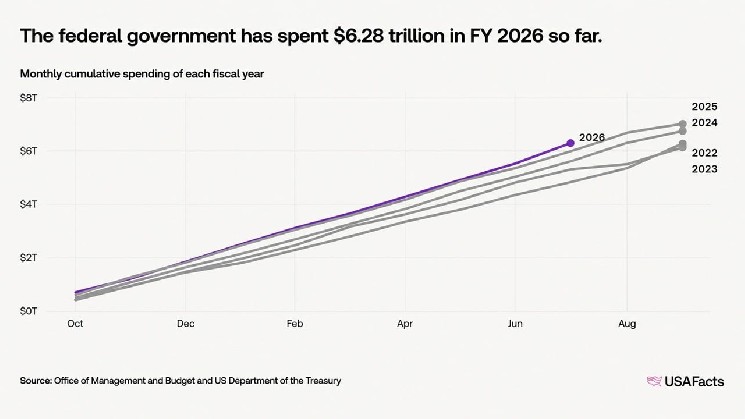
The US national debt has surged to nearly $40 trillion in just five months, the fastest trillion-dollar increase on record. The debt's growth has accelerated dramatically over time, from taking 192 years to reach the first $1 trillion in 1981 to adding the latest $1 trillion in only five months. The federal budget deficit for the fiscal year is already over $1.8 trillion, exceeding last year's total, and net interest payments on the debt have surpassed $1 trillion, now exceeding defense or Medicare spending. This rapid debt accumulation is fueling arguments within the cryptocurrency industry that Bitcoin serves as a hedge against government-backed currencies and fiscal irresponsibility. Proponents, including some lawmakers and industry leaders, argue Bitcoin could act as a "hard currency" fiscal control mechanism. Legislation has even been proposed for the Treasury to acquire Bitcoin to help reduce the national debt. The International Monetary Fund has warned that global public debt could hit 100% of world GDP by 2029 if current trends continue, with the US and China as primary drivers. Some analyses suggest a sovereign debt crisis could drive capital into alternative assets like Bitcoin, similar to past regional banking crises. However, skeptics point out that both Bitcoin and gold have fallen in price at times during 2026 despite record debt, indicating the depreciation hedge theory may operate over a much longer timeframe than short-term price action.

cryptonews.ruHá 9m

U.S. National Debt Approaches $40 Trillion in 5 Months, Bitcoin Debate Gains Momentum

cryptonews.ruHá 9m

Technological Self-Reliance in China: A War from Lithography Machines to ABF Films

"China's Tech Independence: A Battle from Lithography Machines to ABF Film" In August 2026, Japan's Ajinomoto announced a 30% supply cut of ABF film to Chinese mainland clients, causing industry-wide shock and fears of price hikes and shortages in the semiconductor supply chain. That same year, Chinese company Lotus Holdings, known for its MSG business, acquired a small domestic ABF film startup for 103 million yuan, aiming to change this passive situation. ABF film is a core insulating material for advanced CPU, GPU, and AI chip packages. Ajinomoto, originally a food flavoring company, has monopolized over 95% of the global ABF film market for nearly 30 years, deriving its technology from byproducts of monosodium glutamate production. With AI chips consuming 5-10 times more ABF film than traditional chips, the supply-demand gap is widening. Ajinomoto's supply cut to China, where domestic ABF film production accounts for less than 5%, directly threatens the production of domestic high-end AI chips and their substrates. This incident highlights a crucial but often overlooked truth: the vulnerabilities in China's quest for technological self-reliance extend beyond headline areas like lithography machines to critical but seemingly minor components—insulating films, photoresists, electronic specialty gases, etc. The article frames China's tech independence as a multi-front war. While major breakthroughs have been achieved in chip design (e.g., Huawei's HiSilicon), foundry (e.g., SMIC), and memory chips (e.g., YMTC), countless smaller "Ajinomoto-style" chokepoints remain. Lotus Holdings' acquisition represents a significant shift: the battle is no longer fought only by tech giants but has become a collective, industry-wide effort involving companies from diverse backgrounds. Historically, external blockades have often spurred China's technological breakthroughs, as seen with Huawei's Kirin chips and YMTC's 3D NAND flash memory. Ajinomoto's supply cut, while a short-term challenge, may similarly catalyze domestic innovation in ABF film and other critical materials. The path to technological sovereignty is long and arduous, requiring sustained patience and investment to fill every gap in the complex supply chain. Lotus's move is not an immediate solution but a step towards that future, symbolizing a broader, relentless march toward independence.

marsbitHá 28m

Technological Self-Reliance in China: A War from Lithography Machines to ABF Films

marsbitHá 28m

The Great Ethereum "Rate Cut" Debate: Is Now the Golden Window for Staking with the Unconventional EIP-8363?

Ethereon's economic policy is under review as a new proposal, EIP-8363, sparks debate over potential "interest rate cuts" for staking. The unconventional proposal suggests gradually increasing the proportion of newly issued ETH rewards that are burned as the total staked ETH ratio rises, with issuance fully offset by burns once the ratio nears 50%. This would drive the protocol-level staking APR towards 0%, though validators would still earn transaction fees and MEV. This discussion emerges as staked ETH approaches 35% of supply, with the current protocol APR at ~2.6%. The core question is whether Ethereum needs to continue paying high issuance costs for marginal gains in security once sufficient participation is achieved. EIP-8363 aims to optimize security spending, but critics warn it could disproportionately impact solo stakers and potentially increase centralization among large, resilient operators. Paradoxically, this debate coincides with the Pectra upgrade (EIP-7251), which introduces native compounding for staking rewards, significantly improving capital efficiency for long-term holders. This creates a dual narrative: the protocol is making staking more efficient while reconsidering the economic incentive to stake. For long-term ETH holders, this environment may present a "time window" rather than a fixed-rate opportunity. While future APRs are expected to trend downward, starting staking earlier maximizes the compounding effect over time. The decision to stake depends on individual factors like investment horizon, liquidity needs, and risk tolerance regarding options like native validation, staking services, or liquid staking tokens (LSTs). The evolution from encouraging staking to managing its economic cost marks a new, mature phase for Ethereum's tokenomics, where the true value of staking may increasingly lie in the long-term power of compounding time.

marsbitHá 36m

The Great Ethereum "Rate Cut" Debate: Is Now the Golden Window for Staking with the Unconventional EIP-8363?

marsbitHá 36m

Analyst States Bitcoin Remains Within $61-68k Range

An analyst stated that Bitcoin is likely to remain within a trading range of $61,000 to $68,000. According to Kirill Komalenkov, director of strategic communications at Bitbanker, Bitcoin continues to trade sideways amidst declining market volatility. He attributes its current stability to high market liquidity, with volatility near three-year lows. Komalenkov warned that sustained low activity carries risks of a price decline, with potential tests of support at $62,300 and $61,600. He suggested that major market players might use the current situation to accumulate liquidity, meaning any initial breakout from the range could be a false move. The analyst expects this sideways movement to persist until the latter part of August. Key factors for determining future market direction include fund flows into Exchange-Traded Funds (ETFs) and trader activity. However, Komalenkov noted a potential negative scenario for the second half of August, where heightened geopolitical tensions or hawkish rhetoric from US monetary authorities could trigger a new decline. In such a case, Bitcoin could fall to a range of $45,000–$50,000 by early autumn, which might form a new base for a potential market recovery later in the season. Separately, a Russian deputy finance minister recently announced that non-qualified investors in Russia will soon be allowed to legally purchase Bitcoin, Ethereum, and popular stablecoins, with an annual limit of 300,000 rubles per intermediary.

cryptonews.ruHá 38m

Analyst States Bitcoin Remains Within $61-68k Range

cryptonews.ruHá 38m

Trading

Spot

Artigos em Destaque

O que é $BANK

Bank AI: Um Passo Revolucionário no Futuro da Banca Introdução Em uma era marcada por avanços rápidos na tecnologia, o Bank AI está na interseção da inteligência artificial (IA) e dos serviços bancários. Este projeto inovador visa redefinir o panorama financeiro, melhorando a eficiência operacional, as medidas de segurança e as experiências dos clientes através do poder da IA. Ao embarcarmos nesta exploração do Bank AI, iremos aprofundar no que o projeto implica, suas dinâmicas operacionais, seu contexto histórico e marcos significativos. O que é o Bank AI? No seu cerne, o Bank AI representa uma iniciativa transformadora com o objetivo de integrar a inteligência artificial em várias operações bancárias. Este projeto aproveita as capacidades da IA para automatizar processos, melhorar os protocolos de gestão de risco e melhorar a interação com os clientes através de serviços personalizados. Os principais objetivos do Bank AI incluem: Automatização das Funções Bancárias: Ao aproveitar as tecnologias de IA, o Bank AI visa automatizar tarefas rotineiras, reduzindo o peso sobre os recursos humanos e aumentando a eficiência. Gestão de Risco Melhorada: O projeto utiliza algoritmos de IA para prever e identificar riscos, fortalecendo assim as medidas de segurança contra fraudes e outras ameaças. Personalização dos Serviços Bancários: O Bank AI foca em oferecer produtos e serviços financeiros ajustados, analisando dados e comportamentos dos clientes. Melhoria da Experiência do Cliente: A implementação de soluções impulsionadas por IA, como chatbots e assistentes virtuais, visa proporcionar aos usuários interações mais humanizadas, revolucionando a forma como os clientes se envolvem com os bancos. Com esses objetivos, o Bank AI posiciona-se como um ator crucial para tornar a banca mais eficiente, segura e centrada no usuário. Quem é o Criador do Bank AI? Os detalhes sobre o criador do Bank AI permanecem desconhecidos. Assim, nenhuma pessoa ou organização específica foi identificada nas informações disponíveis. O anonimato que cerca a origem do projeto levanta questões, mas não diminui a sua ambiciosa visão e objetivos. Quem são os Investidores do Bank AI? Semelhante ao criador do projeto, informações específicas sobre os investidores ou organizações que apoiam o Bank AI não foram divulgadas. Sem essas informações, é difícil delinear o apoio financeiro e institucional que pode estar impulsionando o projeto para frente. No entanto, a importância de ter uma sólida base de investimento é fundamental para sustentar o desenvolvimento em um campo tão inovador. Como Funciona o Bank AI? O Bank AI opera em várias frentes inovadoras, focando em fatores únicos que o diferenciam das estruturas bancárias tradicionais. Abaixo estão as principais características operacionais: Automatização: Ao aplicar algoritmos de aprendizado de máquina, o Bank AI automatiza vários processos manuais dentro dos bancos. Isso resulta na redução dos custos operacionais e permite que os trabalhadores humanos redirecionem os seus esforços para atividades mais estratégicas. Gestão de Risco Avançada: A integração da IA nas práticas de gestão de risco equipa os bancos com ferramentas para prever com precisão potenciais ameaças, como fraudes, garantindo que as informações e ativos dos clientes permaneçam seguros. Recomendações Financeiras Personalizadas: Através do aprendizado contínuo a partir das interações com os clientes, os sistemas de IA desenvolvem uma compreensão sutil das necessidades dos usuários, permitindo oferecer conselhos adaptados sobre decisões financeiras. Interações Melhoradas com os Clientes: Utilizando chatbots e assistentes virtuais alimentados por IA, o Bank AI permite uma experiência de cliente mais envolvente, permitindo que os usuários tenham suas dúvidas resolvidas rapidamente, reduzindo assim os tempos de espera e melhorando os níveis de satisfação. Juntas, estas características operacionais posicionam o Bank AI como um pioneiro no setor bancário, estabelecendo novos padrões para a prestação de serviços e a excelência operacional. Cronologia do Bank AI Compreender a trajetória do Bank AI requer uma análise do seu contexto histórico. Abaixo está uma cronologia que destaca marcos e desenvolvimentos importantes: Início de 2010: A conceituação da integração da IA nos serviços bancários começou a ganhar atenção à medida que instituições bancárias reconheciam os potenciais benefícios. 2018: Ocorreu um aumento significativo na implementação de tecnologias de IA, quando os bancos começaram a usar ferramentas de IA como chatbots para atendimento ao cliente básico e sistemas de gestão de risco para melhorar o tratamento de segurança. 2023: A sofisticação da IA continuou a avançar, com a introdução de IA generativa para tarefas mais complexas, como processamento de documentos e análise de investimentos em tempo real. Este ano marcou um salto significativo nas capacidades proporcionadas aos bancos pela tecnologia de IA. 2024-Estado Atual: Neste ano, o Bank AI está em uma trajetória ascendente, com pesquisas e desenvolvimentos em andamento prontos para aprimorar ainda mais as capacidades nas operações bancárias. A exploração contínua das aplicações de IA sugere desenvolvimentos emocionantes por vir. Pontos Chave Sobre o Bank AI Integração da IA na Banca: O Bank AI foca na adoção da inteligência artificial para simplificar os processos bancários e melhorar as experiências dos usuários. Automatização e Foco em Gestão de Risco: O projeto enfatiza fortemente essas áreas, visando transferir o peso das tarefas rotineiras enquanto melhora as estruturas de segurança através de análises preditivas. Soluções Bancárias Personalizadas: Ao aproveitar os dados dos clientes, o Bank AI possibilita serviços bancários ajustados que atendem às necessidades individuais dos usuários. Compromisso com o Desenvolvimento: O Bank AI permanece comprometido com contínuas pesquisas e esforços de desenvolvimento, garantindo a sua adaptabilidade e relevância contínua à medida que a tecnologia continua a evoluir. Conclusão Em resumo, o Bank AI exemplifica um passo crucial em frente na indústria bancária, aproveitando a inteligência artificial para remodelar paradigmas operacionais, melhorar a segurança e promover a satisfação do cliente. Apesar das lacunas de informação em torno do criador e dos investidores, os objetivos claros e os mecanismos funcionais do Bank AI fornecem uma base sólida para sua evolução contínua. À medida que a tecnologia de IA continua a avançar e se fundir com o setor bancário, o Bank AI está bem posicionado para impactar significativamente o futuro dos serviços financeiros, aprimorando a maneira como entendemos e interagimos com a banca.

222 Visualizações TotaisPublicado em {updateTime}Atualizado em 2024.12.03

O que é $BANK

Como comprar BANK

Bem-vindo à HTX.com!Tornámos a compra de Lorenzo Protocol (BANK) simples e conveniente.Segue o nosso guia passo a passo para iniciar a tua jornada no mundo das criptos.Passo 1: cria a tua conta HTXUtiliza o teu e-mail ou número de telefone para te inscreveres numa conta gratuita na HTX.Desfruta de um processo de inscrição sem complicações e desbloqueia todas as funcionalidades.Obter a minha contaPasso 2: vai para Comprar Cripto e escolhe o teu método de pagamentoCartão de crédito/débito: usa o teu visa ou mastercard para comprar Lorenzo Protocol (BANK) instantaneamente.Saldo: usa os fundos da tua conta HTX para transacionar sem problemas.Terceiros: adicionamos métodos de pagamento populares, como Google Pay e Apple Pay, para aumentar a conveniência.P2P: transaciona diretamente com outros utilizadores na HTX.Mercado de balcão (OTC): oferecemos serviços personalizados e taxas de câmbio competitivas para os traders.Passo 3: armazena teu Lorenzo Protocol (BANK)Depois de comprar o teu Lorenzo Protocol (BANK), armazena-o na tua conta HTX.Alternativamente, podes enviá-lo para outro lugar através de transferência blockchain ou usá-lo para transacionar outras criptomoedas.Passo 4: transaciona Lorenzo Protocol (BANK)Transaciona facilmente Lorenzo Protocol (BANK) no mercado à vista da HTX.Acede simplesmente à tua conta, seleciona o teu par de trading, executa as tuas transações e monitoriza em tempo real.Oferecemos uma experiência de fácil utilização tanto para principiantes como para traders experientes.

658 Visualizações TotaisPublicado em {updateTime}Atualizado em 2026.06.02

Como comprar BANK

Discussões

Bem-vindo à Comunidade HTX. Aqui, pode manter-se informado sobre os mais recentes desenvolvimentos da plataforma e obter acesso a análises profissionais de mercado. As opiniões dos utilizadores sobre o preço de BANK (BANK) são apresentadas abaixo.

活动图片