Geopolitical Risks Persist, Bitcoin Becomes a Key Barometer?

marsbitPublicado em 2026-04-20Última atualização em 2026-04-20

Resumo

Amid escalating geopolitical tensions in the Middle East, particularly around Iran and the Strait of Hormuz, and a sudden injection of nearly $200 billion in liquidity by the Federal Reserve and the U.S. Treasury, financial markets are caught in a tug-of-war between liquidity-driven gains and risk-off sentiment. Bitcoin is emerging as a key indicator in this environment due to its high sensitivity to liquidity shifts. It has historically acted as a leading signal—declining ahead of equity downturns and recovering before broader markets. Currently, its ability to break above the $80,000–$85,000 resistance level will test whether recent liquidity injections can outweigh geopolitical uncertainties. Failure to do so may signal underlying weaknesses, potentially in private credit or fading liquidity impact. Other indicators show mixed signals: The CNN Fear & Greed Index reflects greed, volatility indices are relatively calm, and major equity indices like the S&P 500 and Nasdaq have hit new highs. However, the situation remains fragile, with Iran-related risks capable of swiftly reversing sentiment. The key question is whether liquidity or geopolitical risk will dominate market pricing in the near term.

Editor's Note: Just as the market regained upward momentum driven by liquidity, new uncertainties have begun to accumulate on the other end. The situation in Iran has reversed again, and the risks in the Strait of Hormuz are emerging, bringing geopolitical conflicts back to the core variable of asset pricing. Within just a few days, the market has shifted from the single logic of "fund-driven" to a dual game of "liquidity vs. risk events."

The current market is in a tug-of-war between "liquidity-driven gains" and "risk shocks from the escalation of the Iran situation." On one hand, the Federal Reserve and the U.S. Treasury injected nearly $200 billion in liquidity into the financial system in a short period, driving a rapid rebound in stocks and risk assets; on the other hand, geopolitical uncertainty, private credit risks, and overheated sentiment continue to make the market fragile.

In this structure, Bitcoin's role is beginning to change. Unlike traditional risk assets, it is more sensitive to changes in liquidity and often gives signals first when the funding environment shifts. Historical experience shows that whether it was the early decline in October 2025 or the率先 stabilization in this round of rebound, Bitcoin has, to some extent, played the role of a "leading indicator."

Therefore, the question is no longer just "will the market rise," but—as liquidity continues to be released and war risks resurface, which force will dominate pricing? If funds cannot continuously hedge external shocks, the current gains may only be a temporary mismatch; if liquidity persists, the market may continue to rise amid fluctuations.

What matters next is not a single variable, but their relative strength. And Bitcoin may once again be the asset that provides the earliest answer.

Below is the original text:

"Oh, think twice, 'cause it's another day for you and me in paradise." —Phil Collins

For traders and investors, Friday was an unusual trading day. But Monday is still some time away, and the market is already brewing new variables—as early as Saturday morning, reports indicated that Iran's stance on the Strait of Hormuz issue had reversed, which could once again trigger market turbulence.

Additionally, Friday's rebound has pushed market sentiment indicators (see below) to a relatively fragile level, making the market more prone to corrections. This has plunged the market into a "tug-of-war": on one side is the massive liquidity injection discussed below, and on the other is the uncertainty brought by the potential reversal of the Iran war situation.

What Just Happened?

The impact of liquidity on the market is facing a test—against the potential further escalation of Iran war volatility.

Q: What happens when approximately $200 billion floods into the financial system almost simultaneously?

A: Asset prices experience a sharp "melt-up."

Lately, I've been focusing on four factors collectively suppressing the stock market: the Iran war, the liquidity crunch in the financial system that has persisted since January this year, widespread market pessimism, and insufficient understanding of the true state of the private credit market.

But last week, these factors were almost "all overturned": the liquidity crunch reversed, the Iran situation seemed to ease, and market pessimism once again proved to be—as it often is—a leading indicator of a potential stock market rebound.

Are we out of the woods? No one can be sure, as the Iran situation is heating up again. Moreover, if investors re-enter "panic mode," liquidity could dry up again. And we still lack a clear understanding of what is happening in the private credit market.

For now, however, let's focus on a relatively observable variable: liquidity.

Dual "Liquidity Tsunamis"

If you're wondering where the money driving the stock market rally over the past two weeks came from—think again: the answer is the Federal Reserve and the U.S. Treasury. Around April 15, the two injected approximately $200 billion into the financial system combined, providing traders with a "Tax Day buffer."

First, the first "barrel"—the Federal Reserve.

On April 15, the Fed injected nearly $110 billion into the market through repo operations (via Treasury bonds and mortgage-backed securities). This alone is not insignificant, but more crucially, the Fed is still injecting about $40 billion per month into the market through its Reserve Management Purchase (RMP) program.

The real focus is on the second "barrel"—the U.S. Treasury.

Drawing on Garret Baldwin's analysis, the U.S. Treasury injected approximately $140 billion to $200 billion into the market during the same period. That is, roughly speaking, without any formal quantitative easing (QE) announcement, the Fed and the Treasury quietly injected close to $240 billion in liquidity into the market.

It's not hard to understand why the stock market experienced an explosive rally.

The More Subtle Part: The Treasury's Operations

How did the Treasury accomplish this "covert operation"?

The key lies in an account—the "U.S. Treasury General Account" (TGA) held at the Fed. When the balance of this account rises, it usually signals tightening liquidity; when the balance falls, it means liquidity is being released.

According to Garret's calculations, around Tax Day, the balance of this "checking account" of the U.S. government at the Fed dropped from about $837 billion to about $697 billion. And on April 15, it rose back to about $924 billion.

The key is that about $140 billion of this had already flowed into the banking system before Tax Day, meaning the financial system was actually in a "liquidity-abundant" state before April 15.

Even more interestingly, the U.S. National Financial Conditions Index (NFCI, tracked weekly in this report) reversed its previous tightening trend in the latest data (April 10).

We pointed out this change in the daily report of "Smart Money Passport": "The Fed injected about $10.5 billion into the financial system that day, while the NFCI index fell for the first time since January 23, 2026. The combination of these two signals may indicate that the Fed has adjusted its liquidity-tightening stance."

The biggest suspense now is: will liquidity take the lead, or will a new round of escalation in the Iran war once again become the core variable for the market.

Bitcoin Starts to "Act": Why It's a Barometer of Liquidity

Bitcoin's performance next is crucial.

Because compared to stocks, Bitcoin is more sensitive to liquidity. Therefore, its performance after recently breaking through $75,000, and whether it can challenge the $80,000–$85,000 range, deserves close attention.

From a technical perspective, the resistance in the $80,000–$85,000 range is not strong. The volume-by-price (VBP) distribution in this range is relatively thin, indicating that no effective support was formed during the previous decline. Therefore, under normal circumstances, this level should not pose strong resistance during a price recovery.

If the rally fails here, it implies two things: first, the market lacks confidence in this rebound; second, there may be issues with liquidity itself. More importantly, if Bitcoin cannot break through this key range, it may also mean that the "liquidity tsunami" created by the Fed and the Treasury is rapidly receding.

If $200 billion in bank reserves are digested by the market in just a few weeks, it would be a dangerous signal. This could mean that risks are accumulating in the private credit market or elsewhere.

Don't forget, Bitcoin's decline in October 2025 accurately predicted the stock market's troubles in 2026. At the same time, Bitcoin stabilized weeks before the stock market bottomed and rallied ahead of time when the Fed and the Treasury released liquidity.

Against the backdrop of the evolving Iran situation and unresolved global risks, any weakness in Bitcoin should not be ignored.
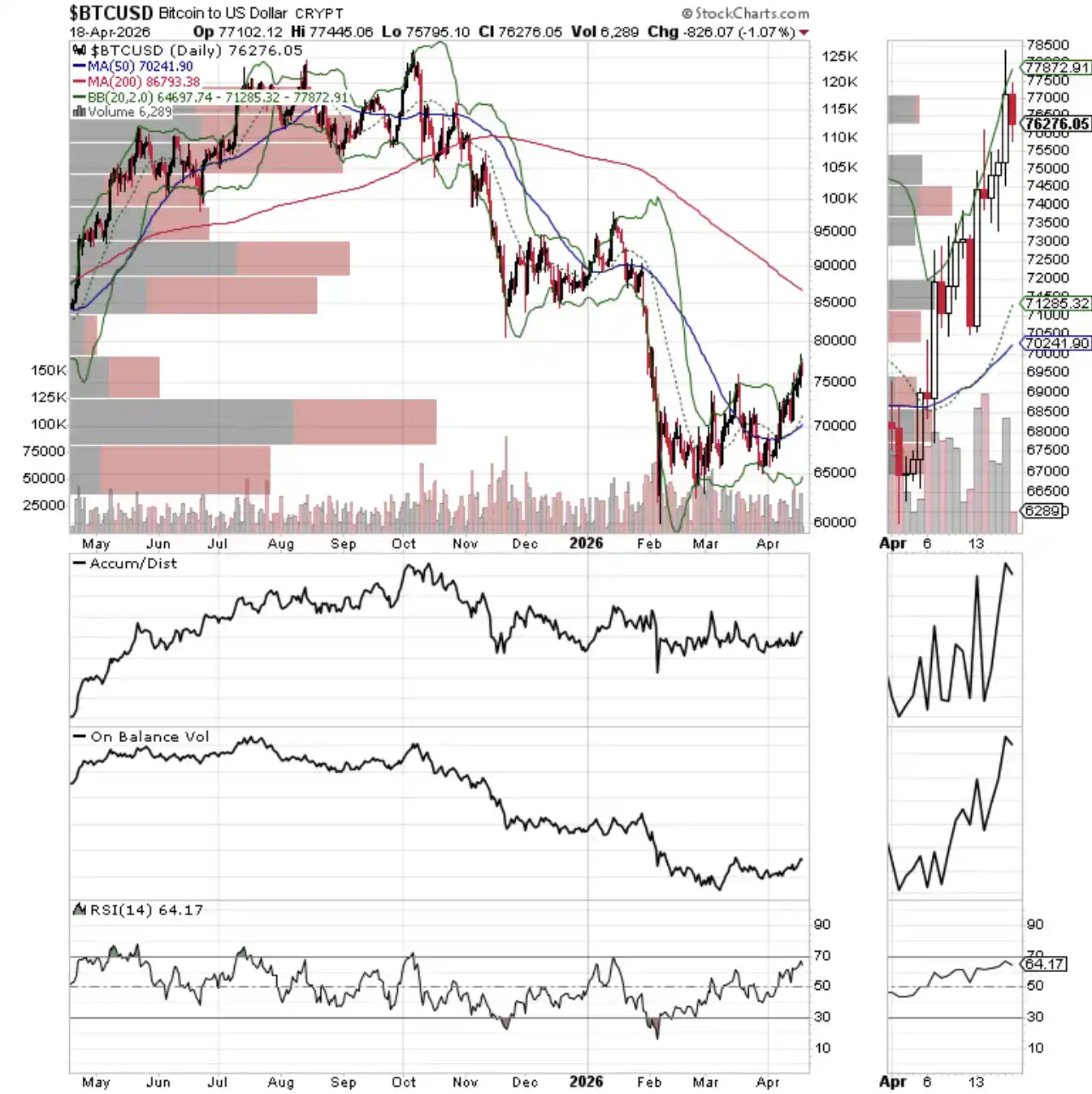
The $70,000–$75,000 range is a key support level.

Sentiment Summary: Market Suddenly Turns Fully Optimistic

The CNN Fear & Greed Index (GFI) closed at 68 on April 17, 2026, in the "Greed" zone.

CoinMarketCap's Crypto Fear & Greed Index was at 59 on Saturday morning, in the relatively high "Neutral" level.

The Chicago Board Options Exchange (CBOE) Total Put/Call Ratio was 0.65, with the index options P/C ratio closing at 0.82. The options market sentiment overall remains neutral, but as bullish sentiment heats up rapidly, it is gradually tilting towards the bearish area.

The CBOE Volatility Index (VIX) closed at 17.48, a relatively positive level. However, it could still rise back above 20 (often seen as the risk警戒线) in the short term.

It's worth noting that the VIX typically rises when traders heavily buy put options. Increased demand for puts forces market makers to hedge by selling stock index futures, thereby putting downward pressure on the market.

Conversely, when the VIX falls, it means reduced demand for puts, market sentiment turns optimistic, and more call buying often follows. This prompts market makers to buy stock index futures to hedge risks, increasing the probability of stock market gains.

Liquidity Watch

1. Bullish: Liquidity is easing

The National Financial Conditions Index (NFCI) released by the Federal Reserve, in its latest reading for March 27, 2026 (published April 10), was -0.47, down from the previous week's -0.44, indicating that financial conditions are easing and liquidity is improving.

A decline in NFCI is usually seen as a bullish signal, and a negative index means market liquidity is relatively abundant.

2. Bond yields retreat

U.S. Treasury yields fell in the latter part of the week, but could rise again depending on developments in Iran.
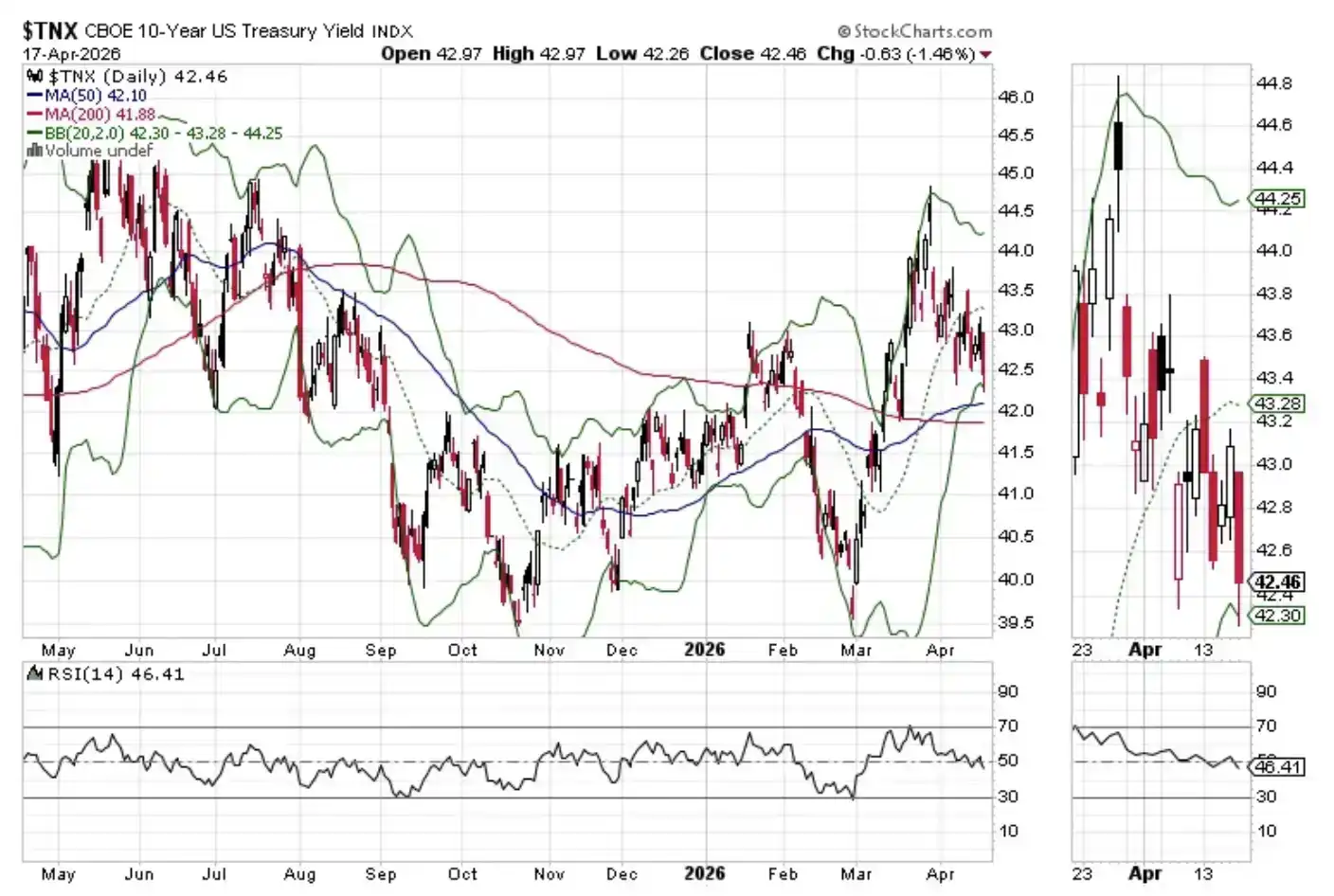
The U.S. 10-Year Treasury Yield closed the week below 4.3%, also falling below its 20-day moving average. A further break below the 200-day moving average would be seen as a bullish signal; conversely, a rise back above 4.5% could push yields back towards the highs near 4.6% seen in May 2025.

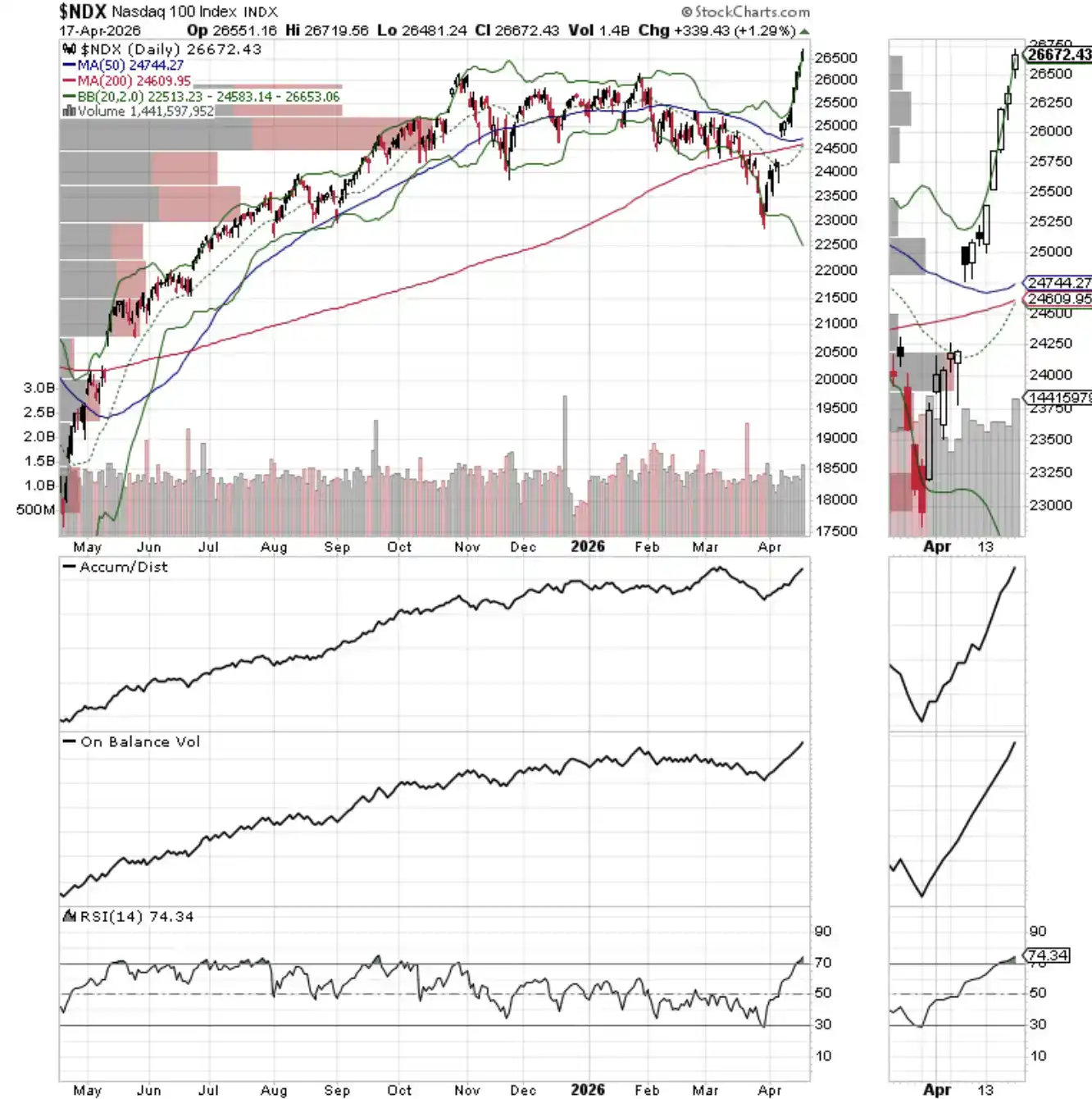
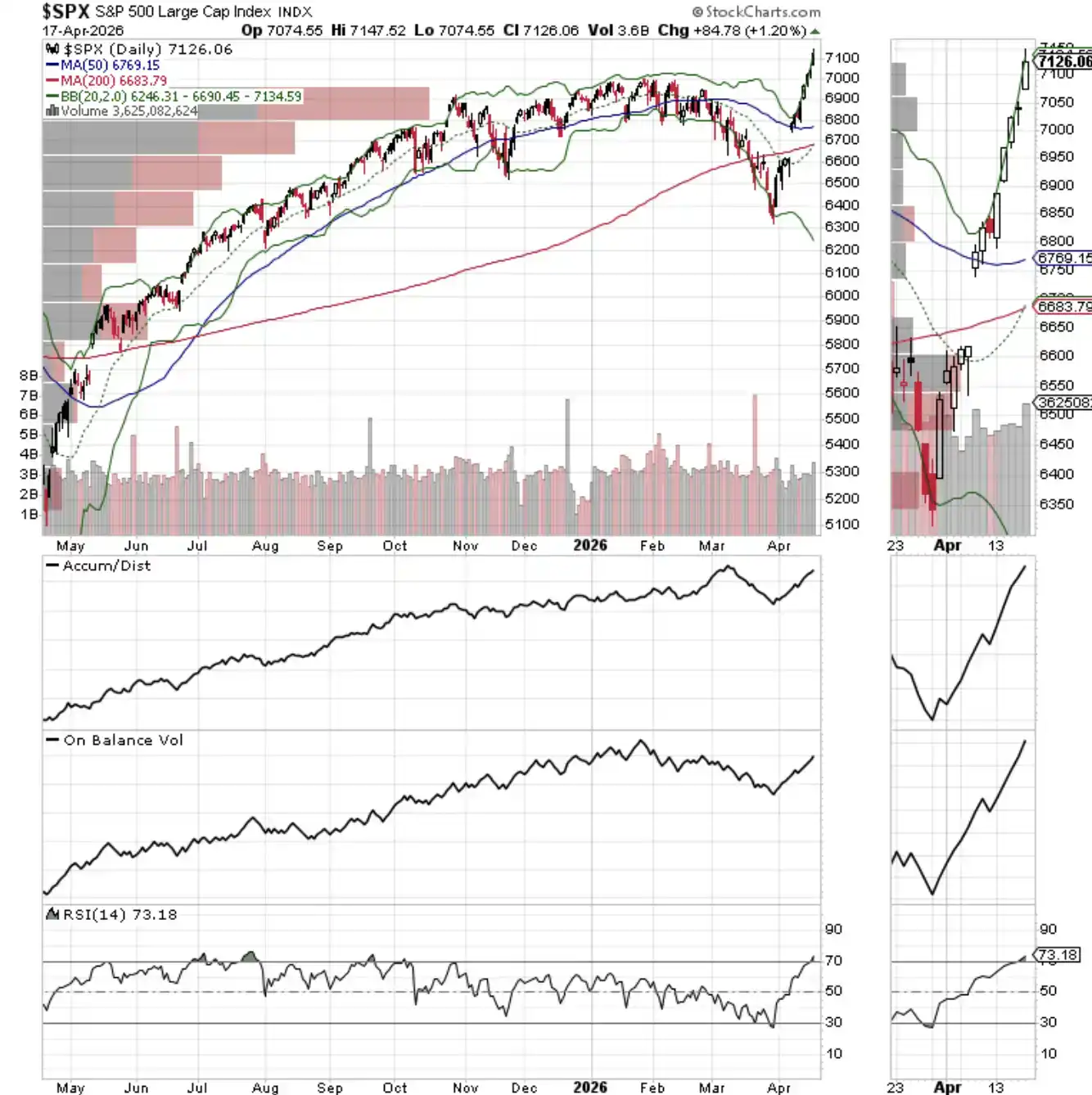
3. NYAD, SPX, and NDX all hit new highs simultaneously

The NYSE Advance-Decline Line hit a new high, confirming the new highs in the S&P 500 Index and the NASDAQ-100 Index, forming a confirmation signal.

The current uptrend is validated—but only for now. A break below the 20-day or 50-day moving average could quickly change the market situation.

The NASDAQ-100 Index hit a new high last week, with 26,000 points now becoming a short-term support level.
The S&P 500 Index hit a new high last week and broke through the 7000 point mark. 7000 points has now become a short-term support level.
Perguntas relacionadas

QWhat is the main factor that has recently driven the sharp rise in stock and risk asset prices according to the article?

AThe main factor is the injection of nearly $200 billion in liquidity into the financial system by the Federal Reserve and the U.S. Treasury around April 15, which created a massive liquidity surge.

QWhy does the article suggest that Bitcoin is a key leading indicator for the market?

ABitcoin is more sensitive to liquidity changes than traditional risk assets. It often signals turning points in the funding environment first, as seen in its early decline in October 2025 and its率先企稳 (first to stabilize) in the current rebound.

QWhat is the 'TGA' (Treasury General Account) and how does its balance affect market liquidity?

AThe TGA is the U.S. Treasury's checking account at the Federal Reserve. When its balance decreases, it releases liquidity into the financial system; when its balance increases, it tightens liquidity.

QWhat key price level for Bitcoin does the article identify as a crucial test for market confidence and liquidity?

AThe $80,000–$85,000 range is identified as a crucial test. A failure to break through this level could indicate a lack of confidence in the rally or that the liquidity surge is fading.

QWhat new uncertainty has emerged that could challenge the market's liquidity-driven rally?

AThe uncertainty is a potential escalation in the Iran situation, specifically a reversal in Iran's stance on the Strait of Hormuz, which has reintroduced geopolitical risk as a core variable in asset pricing.

Leituras Relacionadas

Warsh Hearing Concludes: What Are the Notable Signals for the Crypto Industry?

The Senate Banking Committee held a confirmation hearing for Judy Shelton, a Federal Reserve nominee, who faced intense questioning regarding her ability to maintain the central bank's independence amid pressure from President Trump to lower interest rates. Shelton denied any pre-arranged commitments on rate cuts and emphasized her independence, though Democrats remained skeptical, citing contradictions with Trump's public statements. Shelton characterized post-pandemic inflation as a major policy failure and called for a "regime change" in the Fed’s approach, including reforms to inflation measurement and communication strategies. She criticized the current practice of Fed officials frequently signaling future rate moves and did not commit to maintaining post-meeting press conferences, suggesting potential reductions in transparency. Regarding crypto markets, Shelton’s extensive investments in digital asset companies—including Solana, DeFi, and blockchain infrastructure—were noted, though she has pledged to divest these holdings due to ethics rules. Her familiarity with the crypto industry and deregulatory leanings may signal a more open, though cautious, stance toward digital assets. However, concerns were raised about potential conflicts of interest, especially given Trump family involvement in crypto-financial ventures. The timing of her confirmation remains uncertain, pending a Justice Department investigation into current Chair Powell. Shelton’s potential leadership could lead to a more hawkish, productivity-focused Fed with tighter policy communication—factors that may significantly influence liquidity conditions and macro narratives for crypto markets.

marsbitHá 7h

Warsh Hearing Concludes: What Are the Notable Signals for the Crypto Industry?

marsbitHá 7h

Trading

Spot
Futuros

Artigos em Destaque

O que é BITCOIN

Compreender o HarryPotterObamaSonic10Inu (ERC-20) e a Sua Posição no Espaço Cripto Nos últimos anos, o mercado de criptomoedas assistiu a um aumento na popularidade das moedas meme, cativando não apenas os traders, mas também aqueles que procuram envolvimento comunitário e valor de entretenimento. Entre estes tokens únicos está o HarryPotterObamaSonic10Inu (ERC-20), um projeto intrigante que mistura referências culturais no tecido das criptomoedas. Este artigo explora os principais aspetos do HarryPotterObamaSonic10Inu, examinando os seus mecanismos, a sua ética orientada pela comunidade e o seu envolvimento com o vasto panorama cripto. O que é o HarryPotterObamaSonic10Inu (ERC-20)? Como o nome sugere, o HarryPotterObamaSonic10Inu é uma moeda meme construída na blockchain Ethereum, classificada sob o padrão ERC-20. Ao contrário das criptomoedas tradicionais, que podem enfatizar a utilidade prática ou o potencial de investimento, este token prospera no valor de entretenimento e na força da sua comunidade. O projeto visa promover um ambiente onde utilizadores envolvidos possam reunir-se, partilhar ideias e participar em atividades inspiradas por diversos fenómenos culturais. Uma característica notável do HarryPotterObamaSonic10Inu é a zero taxa sobre transações. Este elemento atraente visa encorajar a negociação e o envolvimento da comunidade, isento de encargos adicionais que podem desencorajar os traders de pequena escala. A oferta total da moeda está fixada em mil milhões de tokens, uma cifra que marca a sua intenção de manter uma circulação substancial dentro da comunidade. Criador do HarryPotterObamaSonic10Inu (ERC-20) As origens do HarryPotterObamaSonic10Inu estão um pouco envoltas em mistério; os detalhes sobre o criador permanecem desconhecidos. O desenvolvimento deste token carece de uma equipa identificável ou de um plano explícito, o que não é raro no setor das moedas meme. Em vez disso, o projeto surgiu de forma orgânica, com o seu progresso a depender fortemente do entusiasmo e da participação da sua comunidade. Investidores do HarryPotterObamaSonic10Inu (ERC-20) No que diz respeito a investimentos externos e apoios, o HarryPotterObamaSonic10Inu também permanece ambíguo. O token não lista quaisquer fundações de investimento conhecidas ou apoio organizacional significativo. Em vez disso, o “sangue vital” do projeto é a sua comunidade de base, que informa o seu crescimento e sustentabilidade através da ação coletiva e do envolvimento no espaço cripto. Como Funciona o HarryPotterObamaSonic10Inu (ERC-20)? Como uma moeda meme, o HarryPotterObamaSonic10Inu opera principalmente fora dos quadros tradicionais que muitas vezes governam o valor dos ativos. Existem vários aspetos distintivos que definem como o projeto funciona: Transações Sem Taxas: Sem taxas sobre transações, os utilizadores podem comprar e vender o token livremente, sem a preocupação de custos ocultos. Envolvimento da Comunidade: O projeto prospera na interação da comunidade, aproveitando plataformas de redes sociais para criar entusiasmo e facilitar a participação. Discussões, partilha de conteúdo e envolvimento são elementos cruciais que ajudam a expandir o seu alcance e a fomentar a lealdade entre os apoiantes. Sem Utilidade Prática: Deve ser notado que o HarryPotterObamaSonic10Inu não oferece utilidade concreta dentro do ecossistema financeiro. Em vez disso, é classificado como um token principalmente para entretenimento e atividades comunitárias. Referência Cultural: O token incorpora de forma inteligente elementos da cultura popular para atrair interesse, conectando-se tanto com entusiastas de memes como com seguidores de criptomoedas. HarryPotterObamaSonic10Inu exemplifica como as moedas meme operam de forma diferente de projetos de criptomoedas mais tradicionais, entrando no mercado como construções sociais inovadoras em vez de ativos utilitários. Linha do Tempo do HarryPotterObamaSonic10Inu (ERC-20) A história do HarryPotterObamaSonic10Inu é marcada por vários marcos notáveis: Criação: O token surgiu de um meme viral, capturando a imaginação de muitos entusiastas de criptomoedas. Datas específicas de criação não estão disponíveis, sublinhando a sua ascensão orgânica. Listagem em Exchanges: O HarryPotterObamaSonic10Inu conseguiu entrar em várias exchanges, permitindo um acesso e negociação mais fáceis pela comunidade. Iniciativas de Envolvimento da Comunidade: Atividades contínuas direcionadas a melhorar a interação comunitária, incluindo concursos, campanhas em redes sociais e geração de conteúdo por fãs e defensores. Planos de Expansão Futura: O roteiro do projeto inclui o lançamento de uma coleção de NFTs, mercadorias e um site de eCommerce relacionado aos seus temas culturais, envolvendo ainda mais a comunidade e tentando adicionar mais dimensões ao seu ecossistema. Pontos-Chave sobre o HarryPotterObamaSonic10Inu (ERC-20) Natureza Orientada pela Comunidade: O projeto prioriza a contribuição coletiva e a criatividade, assegurando que o envolvimento dos utilizadores está na vanguarda do seu desenvolvimento. Classificação como Moeda Meme: Representa o epítome da criptomoeda baseada em entretenimento, destacando-se dos veículos de investimento tradicionais. Sem Afiliação Direta com o Bitcoin: Apesar da semelhança no nome do ticker, o HarryPotterObamaSonic10Inu é distinto e não tem qualquer relação com o Bitcoin ou outras criptomoedas estabelecidas. Foco na Colaboração: O HarryPotterObamaSonic10Inu é projetado para criar um espaço de colaboração e partilha de histórias entre os seus detentores, proporcionando uma via para a criatividade e o fortalecimento da comunidade. Perspectivas Futuras: A ambição de expandir além da sua premissa inicial para NFTs e mercadorias delineia um caminho para o projeto potencialmente entrar em avenidas mais mainstream dentro da cultura digital. À medida que as moedas meme continuam a capturar a imaginação da comunidade cripto, HarryPotterObamaSonic10Inu (ERC-20) destaca-se devido aos seus laços culturais e abordagem centrada na comunidade. Embora possa não se encaixar no molde típico de um token orientado para utilidade, a sua essência reside na alegria e camaradagem fomentadas entre os seus apoiantes, destacando a natureza em evolução das criptomoedas em uma era cada vez mais digital. À medida que o projeto continua a desenvolver-se, será importante observar como as dinâmicas comunitárias influenciam a sua trajetória no panorama em constante mudança da tecnologia blockchain.

1.2k Visualizações TotaisPublicado em {updateTime}Atualizado em 2024.12.03

O que é BITCOIN

Como comprar BTC

Bem-vindo à HTX.com!Tornámos a compra de Bitcoin (BTC) simples e conveniente.Segue o nosso guia passo a passo para iniciar a tua jornada no mundo das criptos.Passo 1: cria a tua conta HTXUtiliza o teu e-mail ou número de telefone para te inscreveres numa conta gratuita na HTX.Desfruta de um processo de inscrição sem complicações e desbloqueia todas as funcionalidades.Obter a minha contaPasso 2: vai para Comprar Cripto e escolhe o teu método de pagamentoCartão de crédito/débito: usa o teu visa ou mastercard para comprar Bitcoin (BTC) instantaneamente.Saldo: usa os fundos da tua conta HTX para transacionar sem problemas.Terceiros: adicionamos métodos de pagamento populares, como Google Pay e Apple Pay, para aumentar a conveniência.P2P: transaciona diretamente com outros utilizadores na HTX.Mercado de balcão (OTC): oferecemos serviços personalizados e taxas de câmbio competitivas para os traders.Passo 3: armazena teu Bitcoin (BTC)Depois de comprar o teu Bitcoin (BTC), armazena-o na tua conta HTX.Alternativamente, podes enviá-lo para outro lugar através de transferência blockchain ou usá-lo para transacionar outras criptomoedas.Passo 4: transaciona Bitcoin (BTC)Transaciona facilmente Bitcoin (BTC) no mercado à vista da HTX.Acede simplesmente à tua conta, seleciona o teu par de trading, executa as tuas transações e monitoriza em tempo real.Oferecemos uma experiência de fácil utilização tanto para principiantes como para traders experientes.

3.8k Visualizações TotaisPublicado em {updateTime}Atualizado em 2025.03.21

Como comprar BTC

O que é $BITCOIN

OURO DIGITAL ($BITCOIN): Uma Análise Abrangente Introdução ao OURO DIGITAL ($BITCOIN) OURO DIGITAL ($BITCOIN) é um projeto baseado em blockchain que opera na rede Solana, com o objetivo de combinar as características dos metais preciosos tradicionais com a inovação das tecnologias descentralizadas. Embora partilhe um nome com o Bitcoin, frequentemente referido como “ouro digital” devido à sua percepção como uma reserva de valor, o OURO DIGITAL é um token separado projetado para criar um ecossistema único dentro da paisagem Web3. O seu objetivo é posicionar-se como um ativo digital alternativo viável, embora os detalhes sobre as suas aplicações e funcionalidades ainda estejam em desenvolvimento. O que é o OURO DIGITAL ($BITCOIN)? OURO DIGITAL ($BITCOIN) é um token de criptomoeda explicitamente projetado para uso na blockchain Solana. Em contraste com o Bitcoin, que fornece um papel amplamente reconhecido como armazenamento de valor, este token parece focar em aplicações e características mais amplas. Aspectos notáveis incluem: Infraestrutura Blockchain: O token é construído na blockchain Solana, conhecida pela sua capacidade de lidar com transações de alta velocidade e baixo custo. Dinâmicas de Oferta: O OURO DIGITAL tem um fornecimento máximo limitado a 100 quatrilhões de tokens (100P $BITCOIN), embora os detalhes sobre o seu fornecimento circulante ainda não tenham sido divulgados. Utilidade: Embora as funcionalidades precisas não estejam explicitamente delineadas, existem indicações de que o token poderia ser utilizado para várias aplicações, potencialmente envolvendo aplicações descentralizadas (dApps) ou estratégias de tokenização de ativos. Quem é o Criador do OURO DIGITAL ($BITCOIN)? Neste momento, a identidade dos criadores e da equipa de desenvolvimento por trás do OURO DIGITAL ($BITCOIN) permanece desconhecida. Esta situação é típica entre muitos projetos inovadores no espaço da blockchain, particularmente aqueles alinhados com finanças descentralizadas e fenómenos de moedas meme. Embora tal anonimato possa fomentar uma cultura orientada pela comunidade, intensifica as preocupações sobre governança e responsabilidade. Quem são os Investidores do OURO DIGITAL ($BITCOIN)? As informações disponíveis indicam que o OURO DIGITAL ($BITCOIN) não tem apoiantes institucionais conhecidos ou investimentos proeminentes de capital de risco. O projeto parece operar num modelo peer-to-peer focado no apoio e adoção da comunidade, em vez de rotas de financiamento tradicionais. A sua atividade e liquidez estão principalmente situadas em exchanges descentralizadas (DEXs), como a PumpSwap, em vez de plataformas de negociação centralizadas estabelecidas, destacando ainda mais a sua abordagem de base. Como Funciona o OURO DIGITAL ($BITCOIN) A mecânica operacional do OURO DIGITAL ($BITCOIN) pode ser elaborada com base no seu design de blockchain e nas características da rede: Mecanismo de Consenso: Ao aproveitar o exclusivo proof-of-history (PoH) da Solana combinado com um modelo de proof-of-stake (PoS), o projeto assegura uma validação eficiente das transações, contribuindo para o alto desempenho da rede. Tokenomics: Embora mecanismos deflacionários específicos não tenham sido extensivamente detalhados, o vasto fornecimento máximo de tokens implica que pode atender a microtransações ou casos de uso de nicho que ainda estão por definir. Interoperabilidade: Existe o potencial para integração com o ecossistema mais amplo da Solana, incluindo várias plataformas de finanças descentralizadas (DeFi). No entanto, os detalhes sobre integrações específicas permanecem não especificados. Cronologia de Eventos Chave Aqui está uma cronologia que destaca marcos significativos relacionados ao OURO DIGITAL ($BITCOIN): 2023: O lançamento inicial do token ocorre na blockchain Solana, marcado pelo seu endereço de contrato. 2024: O OURO DIGITAL ganha visibilidade ao tornar-se disponível para negociação em exchanges descentralizadas como a PumpSwap, permitindo que os utilizadores o negociem contra SOL. 2025: O projeto testemunha atividade de negociação esporádica e potencial interesse em envolvimentos liderados pela comunidade, embora não tenham sido documentadas parcerias ou avanços técnicos notáveis até ao momento. Análise Crítica Forças Escalabilidade: A infraestrutura subjacente da Solana suporta altos volumes de transações, o que pode aumentar a utilidade do $BITCOIN em vários cenários de transação. Acessibilidade: O potencial preço de negociação baixo por token pode atrair investidores de retalho, facilitando uma participação mais ampla devido a oportunidades de propriedade fracionada. Riscos Falta de Transparência: A ausência de apoiantes, desenvolvedores ou um processo de auditoria publicamente conhecidos pode gerar ceticismo em relação à sustentabilidade e confiabilidade do projeto. Volatilidade do Mercado: A atividade de negociação depende fortemente do comportamento especulativo, o que pode resultar em volatilidade significativa dos preços e incerteza para os investidores. Conclusão O OURO DIGITAL ($BITCOIN) surge como um projeto intrigante, mas ambíguo, dentro do ecossistema em rápida evolução da Solana. Embora tente aproveitar a narrativa do “ouro digital”, a sua divergência do papel estabelecido do Bitcoin como reserva de valor sublinha a necessidade de uma diferenciação mais clara da sua utilidade pretendida e estrutura de governança. A aceitação e adoção futuras dependerão provavelmente da abordagem da atual opacidade e da definição mais explícita das suas estratégias operacionais e económicas. Nota: Este relatório abrange informações sintetizadas disponíveis até outubro de 2023, e desenvolvimentos podem ter ocorrido além do período de pesquisa.

92 Visualizações TotaisPublicado em {updateTime}Atualizado em 2025.05.13

O que é $BITCOIN

Discussões

Bem-vindo à Comunidade HTX. Aqui, pode manter-se informado sobre os mais recentes desenvolvimentos da plataforma e obter acesso a análises profissionais de mercado. As opiniões dos utilizadores sobre o preço de BTC (BTC) são apresentadas abaixo.

活动图片