Long-Divided Must Unite, Long-United Must Divide: When L1 Becomes Its Own Rollup, What Is Ethereum's Endgame?

链捕手Publicado em 2026-07-22Última atualização em 2026-07-22

Resumo

"The Inevitable Cycle: When L1 Becomes Its Own Rollup – What is Ethereum's Endgame?" For years, the Ethereum community grappled with concerns that L2s were fragmenting the ecosystem and eroding L1's value. While L2s provided cheaper execution, they also splintered liquidity and the unified user experience of a single chain. This has prompted a fundamental reassessment of the relationship between L1 and L2. Ethereum's roadmap is evolving. The "Scale" initiative merges L1 and L2 expansion into a holistic framework. L1 itself is advancing with higher gas limits, statelessness, and zkEVM verification, no longer content to be just a low-throughput settlement layer. Consequently, the primary value proposition of L2s is shifting from merely providing cheap blockspace to offering L1 cannot easily provide: application-specific optimizations, privacy features, and flexible governance models. L2s are becoming a spectrum of execution environments with varying degrees of security inheritance from Ethereum. A critical challenge in this multi-chain future is interoperability. The vision is to make Ethereum "feel like one chain again." This relies on advancements in native account abstraction (like EIP-7702) and intent-based architectures (Open Intents Framework), where users declare desired outcomes, and solvers handle the complex cross-chain execution. Furthermore, shortening Ethereum's finality time from minutes to seconds is crucial, as it underpins trust between chains for bridges, s...

"Are L2s cannibalizing L1's value?" "Is Ethereum losing its global composability?" During the years when L2s were at the peak of their popularity, such anxieties almost permeated the entire Ethereum community.

In Ethereum's scaling framework at that time, L1 was the stable but expensive settlement layer, while L2s, as cheap and efficient execution layers, indeed granted Ethereum more block space, but also gradually eroded the experience of a "unified chain."

Therefore, over the past two years, these questions have continuously driven Ethereum to re-examine the relationship between L1 and L2.

On one hand, Ethereum L1 persistently increased the Gas Limit, advanced statelessness and zkEVM verification, no longer content with merely being a low-throughput settlement base; on the other hand, community discussions intensified. Early this year, Vitalik explicitly stated that as Ethereum's own scaling capabilities improve, some premises of the roadmap established five years ago—which viewed L2s as the primary scaling solution—had already changed.

More recently, Ethereum researcher Barnabé Monnot further expressed the need to re-evaluate the long-term relationship between L1 and L2, including how L2s should create value in the future, why finality needs to be dramatically shortened, and whether L1 could also become a sort of "rollup of itself" as proof systems gradually enter the mainnet validation process.

While these viewpoints do not yet equate to a confirmed protocol roadmap, they provide a valuable lens for observation.

Ultimately, the problem Ethereum faces today is not just about continuing to increase block space, but rather how to re-divide labor among L1, L2, execution layers, and settlement layers as transactions, assets, and user states are dispersed across an increasing number of execution environments.
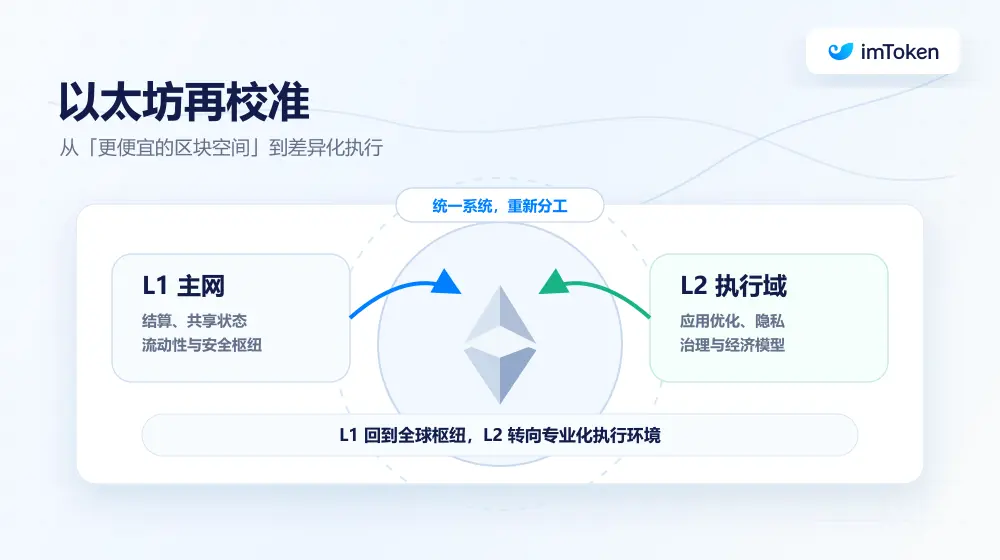
1. Ethereum Hasn't "Abandoned" L2, But Must Find a New Positioning

To be realistic, when the Ethereum scaling roadmap centered around Rollups was initially formed, L2's most important task was relatively singular: to provide Ethereum with more and cheaper transaction space.

Under the technological conditions of that time, this division of labor was quite reasonable.

Because Ethereum validators all needed to re-execute L1 transactions, mainnet throughput couldn't be aggressively increased in the short term. Rollups, however, could execute transactions in batches off-chain, submitting only compressed data or state commitments back to the mainnet, retaining a degree of Ethereum's security properties while significantly reducing unit transaction costs.

Thus, scaling gradually formed two parallel paths: L1 remained restrained, prioritizing decentralization and security, while L2s accommodated new transactions, continuously reducing costs through Blobs, data compression, and proof technologies.

But now, the premises of this division have changed.

In 2026, the Ethereum Foundation consolidated its protocol work, merging the previously separate "Scaling L1" and "Scaling Blobs" into a unified Scale roadmap. Increasing the Gas Limit, expanding data availability, optimizing execution clients, advancing statelessness, and zkEVM attester clients were all placed within the same scaling framework.

In other words, Ethereum no longer views L1 and L2 scaling as two separate tasks but has begun to reallocate execution, consensus, and data capacity from a system-wide perspective.

This change does not mean Ethereum is preparing to abandon L2s or pull all activity back to the mainnet. On the contrary, it means L2s can no longer easily justify their long-term value merely by being "faster and cheaper."

After all, if L1 itself can increase execution capacity by several orders of magnitude while maintaining security and decentralization, then ordinary EVM execution and low-cost block space will no longer be capabilities unique to L2s; L2s will need to shift focus towards providing differentiated needs that L1 cannot uniformly satisfy, such as application-specific optimizations, privacy features, and more flexible governance and economic models.

The Ethereum Foundation's latest statement this year on the L1-L2 relationship also explicitly emphasizes this. Previously, L2's primary goal was to scale Ethereum, with differentiation and customization as secondary values; now, it's about providing differentiated functionality while continuing to contribute additional scaling capacity.

Correspondingly, L1 needs to become a sufficiently powerful, permissionless, and highly resilient global hub, carrying settlement, shared state, liquidity, and DeFi.

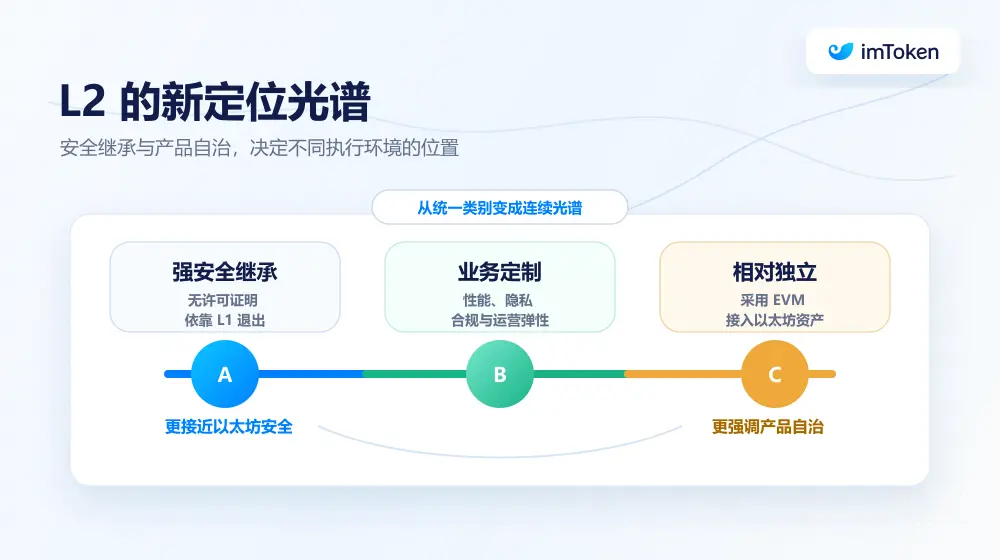
This essentially pushes L2 from a uniform technical category towards a more complex continuum:

  • At one end of the spectrum are Rollups that aim to inherit as many of Ethereum's security properties as possible, seeking to reduce multisig security committees, open permissionless proof mechanisms, and ensure users can still exit to L1 even if operators cease functioning.
  • In the middle are execution environments that inherit some Ethereum properties based on business needs, potentially possessing stronger management permissions, independent sequencers, or specific compliance designs in exchange for performance, privacy, and operational flexibility.
  • At the other end might be chains that adopt EVM, use Ethereum assets, or connect to some cross-chain facilities, but are relatively independent in terms of security and settlement.

This is why Ethereum isn't abandoning L2s, but rather redefining the division of labor. Essentially, over the past 3-5 years, L2 first and foremost represented a scaling technology; in the future, it is more likely to represent a set of execution environments that establish different security, settlement, and liquidity relationships with Ethereum.
2. Interoperability Isn't Just About Cross-Chain, But How States Trust Each Other

However, as Ethereum scales into a system comprising numerous L2s, another perennial issue gradually surfaces: the proliferation of L2s inevitably fragments liquidity, account states, and application experiences.

This has been vividly demonstrated in actual usage over the past few years. For instance, users might hold assets on one chain, use applications on another, and need to go to a third chain to complete a transaction. This results in the same stable币 having different versions across networks, and the same account needing to handle different Gas Tokens, bridges, and asset entry points.

Therefore, interoperability has become an increasingly important part of Ethereum's roadmap.

The Ethereum protocol team has focused its 2026 "Improve UX" roadmap on two directions: native account abstraction and interoperability, believing the core to solving L2 fragmentation lies in making Ethereum "feel like one chain again." This vision relies on the maturation of intent-based architecture.

  • Among them, the Open Intents Framework allows users to simply declare their desired outcome, such as "convert a certain asset on Chain A to USDC on Chain B," with solvers handling path computation, bridging, execution, and fund rebalancing behind the scenes.
  • A step further, the Ethereum Interoperability Layer (EIL) attempts to build a trustless transport layer, aiming for cross-L2 transactions to have an experience indistinguishable from single-chain transactions.

On the account side, EIP-7702 in the Pectra upgrade already allows traditional EOAs to temporarily execute smart contract code, supporting transaction batching, gas sponsorship, and recovery mechanisms. Subsequent native account abstraction proposals, represented by EIP-8141, aim to further embed smart account logic into the protocol, making smart contract wallets the default account form and reducing reliance on additional Bundlers, Relayers, and intermediary services.

The L1 Fast Finality proposal attempts to provide a stronger confirmation signal within tens of seconds, before full finality is achieved, significantly shortening application wait times in most normal scenarios. This directly benefits all cross-chain applications relying on L1 finality, which is crucial for bridges, stablecoin settlement, and RWA asset trading.

Because the real bottleneck for many cross-chain interactions isn't whether a message can be sent, but when the target chain can be sufficiently confident that the state on the source chain will not be reverted.

A commonly overlooked point is that a transaction being included in a block does not mean it has achieved finality—from a user's perspective, a transaction might show success within seconds, but for bridges, exchanges, lending protocols, and cross-chain solvers, they still need to assess the possibility of this transaction being affected by a chain reorganization, and whether they can release assets or execute the next operation on another chain based on it.

This is why many cross-chain services today that appear "instant" do not actually wait for the source chain to achieve finality; rather, solvers or liquidity providers advance the funds. This mechanism optimizes user experience but doesn't make the underlying wait time disappear.
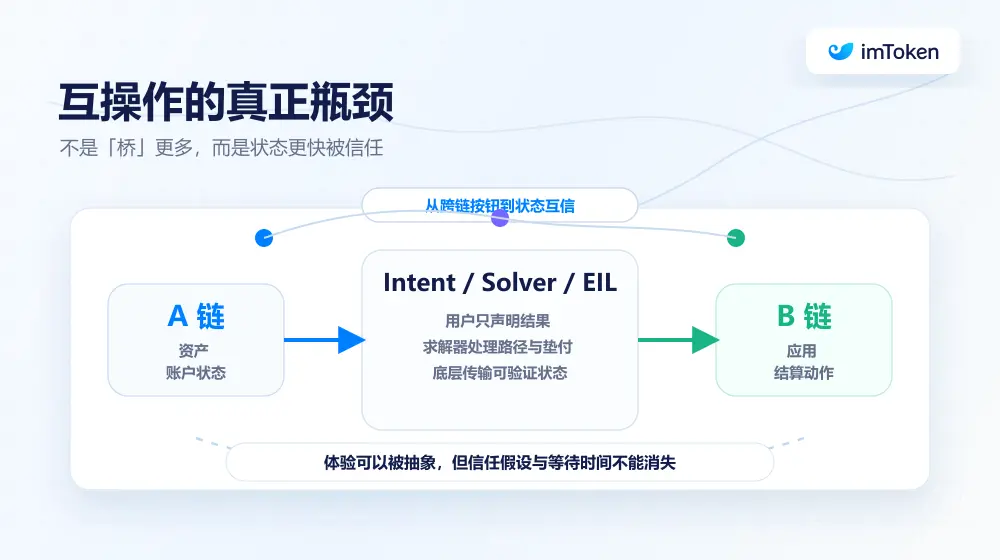
Therefore, Ethereum's long-term goal is to gradually shorten finality itself from minutes to seconds. However, this is not a single upgrade scheduled for deployment, but a set of research tasks requiring phased advancement, including decoupling finality votes from fork choice, optimizing validator sets, vote aggregation and network propagation, and gradually changing the consensus protocol.

Overall, good interoperability experience is not about giving dozens of chains the same cross-chain button, but about enabling different execution environments to trust each other's states faster and at lower cost.

3. When L1 Becomes a Rollup, Does the Layered Boundary Still Exist?

If the repositioning of L2s and shortening finality are adjustments within the existing layered architecture, then another point raised by Barnabé touches the very definition of L1 and L2: with proof systems entering the Ethereum mainnet, L1 may eventually also become a sort of "rollup of itself."

This sounds somewhat counterintuitive.

After all, a rollup is typically understood as a scaling network built on top of L1; it executes transactions externally, with L1 validating the state results. So how could Ethereum, being the underlying consensus and settlement network, become its own L2?

Understanding this viewpoint requires first separating "Rollup" from the hierarchical relationship. In today's Ethereum, after a node receives a block, it needs to re-execute all transactions within, independently compute state changes, and judge whether the block adheres to protocol rules.

This model ensures nodes can verify independently, but it also means the network's overall execution capacity must be constrained by ordinary nodes' hardware capabilities. The more computation in a block, the more hardware and time validators need to complete execution.

In the future, as real-time proofs and L1 zkEVM mature, transactions can still be computed by high-performance execution nodes, but ordinary validators may not need to personally re-execute every transaction. For instance, after an execution node completes computation and generates a validity proof, other validators only need to verify the smaller, cheaper proof to confirm the state transition is correct.

From the perspective of the relationship between execution and verification, this indeed shares similarities with Rollups: a subset of participants is responsible for high-performance execution, execution results are compressed into cryptographic proofs, and a broader set of consensus participants no longer repeats all computations, but verifies proofs and confirms the final state.

Therefore, Barnabé's phrase "L1 becoming its own rollup" is better understood as a summary of this verification paradigm, not that the Ethereum mainnet will be placed on another underlying chain or be "demoted" to its own L2.

His point is that when proofs gradually replace repeated execution by all nodes, a rollup may no longer be just a layer name above L1, but become a more general execution and verification architecture.
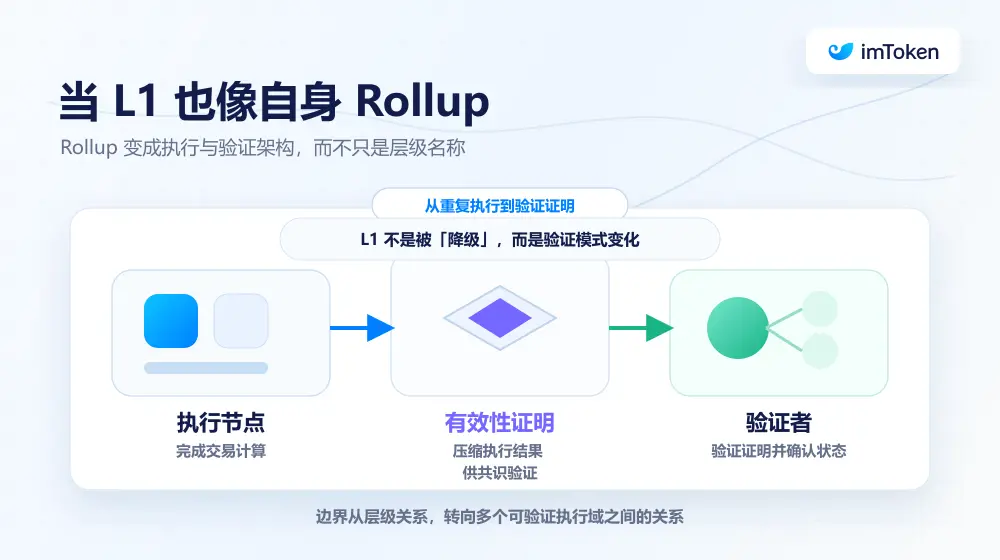
This will further blur the traditional boundary between L1 and L2.

On one hand, L1 can expand its own execution capacity with zkEVM proofs; on the other hand, Native Rollups aim to allow L2s to more directly invoke validation capabilities within the Ethereum protocol, with L1 validating L2 state transitions in a more native, unified manner.

Today, different Rollups typically need to build their own proof systems, verification contracts, upgrade mechanisms, and security committees. Once a proof system has errors, a protocol needs emergency upgrades, or an operator fails, users often still rely on additional governance and trust structures. The long-term direction of Native Rollups is to turn part of the Rollup validation logic into a native Ethereum capability, allowing L2s to reduce self-built security structures, inherit L1's state transition rules more completely, and potentially move away from security committees.

Going a step further, when multiple L2s can rely on faster L1 confirmation, unified proof mechanisms, and synchronous composability to access each other's states, their relationship with the mainnet may no longer be connected by bridges as it is today.

They would be more like multiple execution domains under the same Ethereum consensus, some responsible for general finance, some for gaming, social, or payments, some providing privacy or special compliance capabilities. They have different execution logics and product forms, yet collectively rely on a set of verifiable state, security foundations, and asset settlement systems.

Of course, this remains a long-term direction.

But regardless of the final form these technologies take, they have already transformed the L1-L2 boundary from a clear architectural line into a spectrum of different degrees of security inheritance.

In Conclusion

Long-divided, must unite; long-united, must divide.

Ethereum once gained global composability through shared state; later, it split execution out via Rollups to gain greater capacity. Now, its task is to reconnect the fragmented assets, accounts, and applications without undoing the scaling achievements.

For ordinary users, the ideal Ethereum should never be a network map of dozens of chains, different Gas tokens, and bridges. Where transactions execute, where liquidity comes from, and who ultimately settles can gradually be handled by wallets, applications, and underlying protocols. However, the trust assumptions, security boundaries, and exit paths involved cannot be hidden along with the operational experience.

Therefore, the endgame for L2s is perhaps neither replacing L1 nor being made obsolete by an increasingly scalable L1. Instead, it is to become a set of execution environments with different functionalities and performances, yet sharing security, liquidity, and state relationships.

In the past, Ethereum gained greater capacity by splitting execution apart.

In the next phase, let's see if, after being split apart, it can still be put back together as one Ethereum.


Criptomoedas em alta

Perguntas relacionadas

QAccording to the article, what is the main reason for the shift in the division of roles between L1 and L2?

AThe shift is driven by the premise that L1 is no longer just a low-throughput settlement layer. With advancements like increased Gas Limit, statelessness, and zkEVM verification, Ethereum L1 is enhancing its own scalability. This means L2 can no longer justify its long-term value solely based on being 'faster and cheaper.' L2 must now focus on providing differentiated needs that L1 cannot uniformly satisfy, such as application-specific optimizations, privacy features, and more flexible governance and economic models.

QWhat is the primary goal of the 'Scale' roadmap that merged the previously separate 'Expanding L1' and 'Expanding Blob' workstreams?

AThe primary goal of the unified 'Scale' roadmap is to approach L1 and L2 scaling not as two separate tasks, but from the perspective of the entire system. It aims to reallocate execution, consensus, and data capacity holistically, allowing Ethereum to become a more powerful, permissionless, and resilient global hub for settlement, shared state, liquidity, and DeFi.

QHow does the article define the spectrum of future L2 roles in relation to Ethereum L1?

AThe article defines a complex continuous spectrum for L2 roles. At one end are Rollups that inherit as much of Ethereum's security properties as possible. In the middle are execution environments that inherit some Ethereum properties for specific business needs like performance or privacy. At the other end are chains that are relatively independent in security and settlement but might use EVM, Ethereum assets, or cross-chain facilities. Thus, L2 will represent a set of execution environments with different security, settlement, and liquidity relationships with Ethereum.

QWhat does the researcher Barnabé Monnot suggest about the future relationship between L1 and Rollup architecture?

ABarnabé Monnot suggests that as proof systems gradually enter the mainnet validation process, L1 itself could become a 'rollup of itself' in a sense. This means that with technologies like real-time proofs and L1 zkEVM, high-performance nodes could execute transactions and generate validity proofs. Other validators would then verify these proofs instead of re-executing every transaction, blurring the traditional boundary between L1 and L2. In this future, 'Rollup' might become a more generic execution and verification architecture rather than just a layer above L1.

QWhat are the two key directions of Ethereum's 'Improve UX' roadmap for 2026, as mentioned in the article, to address L2 fragmentation?

AThe two key directions are native account abstraction and interoperability. The goal is to make Ethereum 'feel like one chain again.' This relies on the maturity of intent-based architectures like the Open Intents Framework (which lets users declare desired outcomes) and the Ethereum Interoperability Layer (EIL), which aims to build a trustless transport layer for seamless cross-L2 transactions.

Leituras Relacionadas

Can Japan Buy Growth with AI? Will the Bond Market Believe It?

Japan's cabinet has introduced the 2026 Basic Policy on Economic and Fiscal Management and Reform, shifting its primary fiscal target. The new framework moves away from the traditional annual primary balance goal and instead prioritizes a stable reduction of the debt-to-GDP ratio. This change is tied to a strategy of increased "responsible proactive fiscal" spending, aiming to boost long-term growth through investments in strategic sectors like AI, semiconductors, energy, and robotics. The government estimates total public and private investment in 62 key technologies could exceed 370 trillion yen by 2040. The market reaction has been mixed and cautious. While equity markets may respond to policy signals, bond markets are focused on fiscal credibility. Concerns center on whether the weakening of the clear primary balance anchor could lead to looser fiscal discipline. If investors doubt that these strategic investments will generate sufficient productivity gains, tax revenue, and nominal growth to outpace rising interest costs, they may demand higher yields on Japanese Government Bonds (JGBs). Recent volatility in the yen and JGB yields, with the 10-year yield briefly reaching 2.9%, reflects this skepticism. The success of this new framework hinges on two factors: whether Japan can achieve a nominal growth rate consistently higher than its long-term interest rates, and whether future budgets demonstrate disciplined control over bond issuance. The government's narrative is that strategic investment is essential to break Japan's cycle of low growth, aging, and labor shortages. However, the bond market will continuously assess the credibility of this plan, pricing the risk that it may represent fiscal expansion rather than a viable growth strategy.

marsbitHá 20m

Can Japan Buy Growth with AI? Will the Bond Market Believe It?

marsbitHá 20m

Misjudged A-Shares: Resilience, Expectations, and Confidence

China's A-share market recently faced selling pressure, especially in tech sectors, initially triggered by a global tech sell-off that began in South Korea. However, the article argues this is a case of "mistaken injury" and highlights the market's underlying resilience. This resilience stems from three main pillars: **1) Tech Sector Fundamentals:** Unlike Korea's market dominated by a few memory chip stocks, China's tech sector is diversified across computing, communications, electronics, and semiconductors, supported by dual narratives of global AI supply chains and domestic substitution. Core areas like optical modules and fiber optics continue to show strong earnings growth. **2) "National Team" Support:** State-backed institutions and large corporations have made significant market purchases and announced buybacks, providing liquidity and signaling confidence. This is seen as a stabilizing policy signal, often associated with market bottoms. **3) Broader Market Pillars:** Other major sectors are showing endogenous recovery momentum. Consumer stocks benefit from stabilizing CPI and signs of sector recovery (e.g., liquor price hikes). Cyclical sectors like aluminum have high earnings, potential price increases due to tight supply, and low valuations. The financial sector offers stable dividends and low valuations. The conclusion is that the sell-off was driven by external contagion, not a collapse in fundamentals. With strong policy support and recovering momentum across key sectors, the A-share market possesses the toughness to regain stability.

marsbitHá 51m

Misjudged A-Shares: Resilience, Expectations, and Confidence

marsbitHá 51m

Trading

Spot

Artigos em Destaque

O que é $S$

Compreender o SPERO: Uma Visão Abrangente Introdução ao SPERO À medida que o panorama da inovação continua a evoluir, o surgimento de tecnologias web3 e projetos de criptomoeda desempenha um papel fundamental na formação do futuro digital. Um projeto que tem atraído atenção neste campo dinâmico é o SPERO, denotado como SPERO,$$s$. Este artigo tem como objetivo reunir e apresentar informações detalhadas sobre o SPERO, para ajudar entusiastas e investidores a compreender as suas bases, objetivos e inovações nos domínios web3 e cripto. O que é o SPERO,$$s$? O SPERO,$$s$ é um projeto único dentro do espaço cripto que procura aproveitar os princípios da descentralização e da tecnologia blockchain para criar um ecossistema que promove o envolvimento, a utilidade e a inclusão financeira. O projeto é concebido para facilitar interações peer-to-peer de novas maneiras, proporcionando aos utilizadores soluções e serviços financeiros inovadores. No seu núcleo, o SPERO,$$s$ visa capacitar indivíduos ao fornecer ferramentas e plataformas que melhoram a experiência do utilizador no espaço das criptomoedas. Isso inclui a possibilidade de métodos de transação mais flexíveis, a promoção de iniciativas impulsionadas pela comunidade e a criação de caminhos para oportunidades financeiras através de aplicações descentralizadas (dApps). A visão subjacente do SPERO,$$s$ gira em torno da inclusão, visando fechar lacunas dentro das finanças tradicionais enquanto aproveita os benefícios da tecnologia blockchain. Quem é o Criador do SPERO,$$s$? A identidade do criador do SPERO,$$s$ permanece algo obscura, uma vez que existem recursos publicamente disponíveis limitados que fornecem informações detalhadas sobre o(s) seu(s) fundador(es). Esta falta de transparência pode resultar do compromisso do projeto com a descentralização—uma ética que muitos projetos web3 partilham, priorizando contribuições coletivas em vez de reconhecimento individual. Ao centrar as discussões em torno da comunidade e dos seus objetivos coletivos, o SPERO,$$s$ incorpora a essência do empoderamento sem destacar indivíduos específicos. Assim, compreender a ética e a missão do SPERO é mais importante do que identificar um criador singular. Quem são os Investidores do SPERO,$$s$? O SPERO,$$s$ é apoiado por uma diversidade de investidores que vão desde capitalistas de risco a investidores-anjo dedicados a promover a inovação no setor cripto. O foco desses investidores geralmente alinha-se com a missão do SPERO—priorizando projetos que prometem avanço tecnológico social, inclusão financeira e governança descentralizada. Essas fundações de investidores estão tipicamente interessadas em projetos que não apenas oferecem produtos inovadores, mas que também contribuem positivamente para a comunidade blockchain e os seus ecossistemas. O apoio desses investidores reforça o SPERO,$$s$ como um concorrente notável no domínio em rápida evolução dos projetos cripto. Como Funciona o SPERO,$$s$? O SPERO,$$s$ emprega uma estrutura multifacetada que o distingue de projetos de criptomoeda convencionais. Aqui estão algumas das características-chave que sublinham a sua singularidade e inovação: Governança Descentralizada: O SPERO,$$s$ integra modelos de governança descentralizada, capacitando os utilizadores a participar ativamente nos processos de tomada de decisão sobre o futuro do projeto. Esta abordagem promove um sentido de propriedade e responsabilidade entre os membros da comunidade. Utilidade do Token: O SPERO,$$s$ utiliza o seu próprio token de criptomoeda, concebido para servir várias funções dentro do ecossistema. Esses tokens permitem transações, recompensas e a facilitação de serviços oferecidos na plataforma, melhorando o envolvimento e a utilidade gerais. Arquitetura em Camadas: A arquitetura técnica do SPERO,$$s$ suporta modularidade e escalabilidade, permitindo a integração contínua de funcionalidades e aplicações adicionais à medida que o projeto evolui. Esta adaptabilidade é fundamental para manter a relevância no panorama cripto em constante mudança. Envolvimento da Comunidade: O projeto enfatiza iniciativas impulsionadas pela comunidade, empregando mecanismos que incentivam a colaboração e o feedback. Ao nutrir uma comunidade forte, o SPERO,$$s$ pode melhor atender às necessidades dos utilizadores e adaptar-se às tendências do mercado. Foco na Inclusão: Ao oferecer taxas de transação baixas e interfaces amigáveis, o SPERO,$$s$ visa atrair uma base de utilizadores diversificada, incluindo indivíduos que anteriormente podem não ter participado no espaço cripto. Este compromisso com a inclusão alinha-se com a sua missão abrangente de empoderamento através da acessibilidade. Cronologia do SPERO,$$s$ Compreender a história de um projeto fornece insights cruciais sobre a sua trajetória de desenvolvimento e marcos. Abaixo está uma cronologia sugerida que mapeia eventos significativos na evolução do SPERO,$$s$: Fase de Conceituação e Ideação: As ideias iniciais que formam a base do SPERO,$$s$ foram concebidas, alinhando-se de perto com os princípios de descentralização e foco na comunidade dentro da indústria blockchain. Lançamento do Whitepaper do Projeto: Após a fase conceitual, um whitepaper abrangente detalhando a visão, os objetivos e a infraestrutura tecnológica do SPERO,$$s$ foi lançado para atrair o interesse e o feedback da comunidade. Construção da Comunidade e Primeiros Envolvimentos: Esforços ativos de divulgação foram feitos para construir uma comunidade de primeiros adotantes e investidores potenciais, facilitando discussões em torno dos objetivos do projeto e angariando apoio. Evento de Geração de Tokens: O SPERO,$$s$ realizou um evento de geração de tokens (TGE) para distribuir os seus tokens nativos a apoiantes iniciais e estabelecer liquidez inicial dentro do ecossistema. Lançamento da dApp Inicial: A primeira aplicação descentralizada (dApp) associada ao SPERO,$$s$ foi lançada, permitindo que os utilizadores interagissem com as funcionalidades principais da plataforma. Desenvolvimento Contínuo e Parcerias: Atualizações e melhorias contínuas nas ofertas do projeto, incluindo parcerias estratégicas com outros players no espaço blockchain, moldaram o SPERO,$$s$ em um jogador competitivo e em evolução no mercado cripto. Conclusão O SPERO,$$s$ é um testemunho do potencial do web3 e das criptomoedas para revolucionar os sistemas financeiros e capacitar indivíduos. Com um compromisso com a governança descentralizada, o envolvimento da comunidade e funcionalidades inovadoras, abre caminho para um panorama financeiro mais inclusivo. Como em qualquer investimento no espaço cripto em rápida evolução, potenciais investidores e utilizadores são incentivados a pesquisar minuciosamente e a envolver-se de forma ponderada com os desenvolvimentos em curso dentro do SPERO,$$s$. O projeto demonstra o espírito inovador da indústria cripto, convidando a uma exploração mais aprofundada das suas inúmeras possibilidades. Embora a jornada do SPERO,$$s$ ainda esteja a desenrolar-se, os seus princípios fundamentais podem, de facto, influenciar o futuro de como interagimos com a tecnologia, as finanças e uns com os outros em ecossistemas digitais interconectados.

121 Visualizações TotaisPublicado em {updateTime}Atualizado em 2024.12.17

O que é $S$

O que é AGENT S

Agent S: O Futuro da Interação Autónoma no Web3 Introdução No panorama em constante evolução do Web3 e das criptomoedas, as inovações estão constantemente a redefinir a forma como os indivíduos interagem com plataformas digitais. Um projeto pioneiro, o Agent S, promete revolucionar a interação humano-computador através do seu framework aberto e agente. Ao abrir caminho para interações autónomas, o Agent S visa simplificar tarefas complexas, oferecendo aplicações transformadoras em inteligência artificial (IA). Esta exploração detalhada irá aprofundar-se nas complexidades do projeto, nas suas características únicas e nas implicações para o domínio das criptomoedas. O que é o Agent S? O Agent S é um framework aberto e agente, especificamente concebido para abordar três desafios fundamentais na automação de tarefas computacionais: Aquisição de Conhecimento Específico de Domínio: O framework aprende inteligentemente a partir de várias fontes de conhecimento externas e experiências internas. Esta abordagem dupla capacita-o a construir um rico repositório de conhecimento específico de domínio, melhorando o seu desempenho na execução de tarefas. Planeamento ao Longo de Longos Horizontes de Tarefas: O Agent S emprega planeamento hierárquico aumentado por experiência, uma abordagem estratégica que facilita a decomposição e execução eficientes de tarefas intrincadas. Esta característica melhora significativamente a sua capacidade de gerir múltiplas subtarefas de forma eficiente e eficaz. Gestão de Interfaces Dinâmicas e Não Uniformes: O projeto introduz a Interface Agente-Computador (ACI), uma solução inovadora que melhora a interação entre agentes e utilizadores. Utilizando Modelos de Linguagem Multimodais de Grande Escala (MLLMs), o Agent S pode navegar e manipular diversas interfaces gráficas de utilizador de forma fluida. Através destas características pioneiras, o Agent S fornece um framework robusto que aborda as complexidades envolvidas na automação da interação humana com máquinas, preparando o terreno para uma infinidade de aplicações em IA e além. Quem é o Criador do Agent S? Embora o conceito de Agent S seja fundamentalmente inovador, informações específicas sobre o seu criador permanecem elusivas. O criador é atualmente desconhecido, o que destaca ou o estágio nascente do projeto ou a escolha estratégica de manter os membros fundadores em anonimato. Independentemente da anonimidade, o foco permanece nas capacidades e no potencial do framework. Quem são os Investidores do Agent S? Como o Agent S é relativamente novo no ecossistema criptográfico, informações detalhadas sobre os seus investidores e financiadores não estão explicitamente documentadas. A falta de informações disponíveis publicamente sobre as fundações de investimento ou organizações que apoiam o projeto levanta questões sobre a sua estrutura de financiamento e roteiro de desenvolvimento. Compreender o apoio é crucial para avaliar a sustentabilidade do projeto e o seu impacto potencial no mercado. Como Funciona o Agent S? No núcleo do Agent S reside uma tecnologia de ponta que lhe permite funcionar eficazmente em diversos ambientes. O seu modelo operacional é construído em torno de várias características-chave: Interação Humano-Computador Semelhante: O framework oferece planeamento avançado em IA, esforçando-se para tornar as interações com computadores mais intuitivas. Ao imitar o comportamento humano na execução de tarefas, promete elevar as experiências dos utilizadores. Memória Narrativa: Utilizada para aproveitar experiências de alto nível, o Agent S utiliza memória narrativa para acompanhar os históricos de tarefas, melhorando assim os seus processos de tomada de decisão. Memória Episódica: Esta característica fornece aos utilizadores orientações passo a passo, permitindo que o framework ofereça suporte contextual à medida que as tarefas se desenrolam. Suporte para OpenACI: Com a capacidade de funcionar localmente, o Agent S permite que os utilizadores mantenham o controlo sobre as suas interações e fluxos de trabalho, alinhando-se com a ética descentralizada do Web3. Fácil Integração com APIs Externas: A sua versatilidade e compatibilidade com várias plataformas de IA garantem que o Agent S possa integrar-se perfeitamente em ecossistemas tecnológicos existentes, tornando-o uma escolha apelativa para desenvolvedores e organizações. Estas funcionalidades contribuem coletivamente para a posição única do Agent S no espaço cripto, à medida que automatiza tarefas complexas e em múltiplos passos com mínima intervenção humana. À medida que o projeto evolui, as suas potenciais aplicações no Web3 podem redefinir a forma como as interações digitais se desenrolam. Cronologia do Agent S O desenvolvimento e os marcos do Agent S podem ser encapsulados numa cronologia que destaca os seus eventos significativos: 27 de Setembro de 2024: O conceito de Agent S foi lançado num artigo de pesquisa abrangente intitulado “Um Framework Agente Aberto que Usa Computadores como um Humano”, mostrando a base para o projeto. 10 de Outubro de 2024: O artigo de pesquisa foi disponibilizado publicamente no arXiv, oferecendo uma exploração aprofundada do framework e da sua avaliação de desempenho com base no benchmark OSWorld. 12 de Outubro de 2024: Uma apresentação em vídeo foi lançada, proporcionando uma visão visual das capacidades e características do Agent S, envolvendo ainda mais potenciais utilizadores e investidores. Estes marcos na cronologia não apenas ilustram o progresso do Agent S, mas também indicam o seu compromisso com a transparência e o envolvimento da comunidade. Pontos-Chave Sobre o Agent S À medida que o framework Agent S continua a evoluir, várias características-chave destacam-se, sublinhando a sua natureza inovadora e potencial: Framework Inovador: Concebido para proporcionar um uso intuitivo de computadores semelhante à interação humana, o Agent S traz uma abordagem nova à automação de tarefas. Interação Autónoma: A capacidade de interagir autonomamente com computadores através de GUI significa um avanço em direção a soluções computacionais mais inteligentes e eficientes. Automação de Tarefas Complexas: Com a sua metodologia robusta, pode automatizar tarefas complexas e em múltiplos passos, tornando os processos mais rápidos e menos propensos a erros. Melhoria Contínua: Os mecanismos de aprendizagem permitem que o Agent S melhore a partir de experiências passadas, aprimorando continuamente o seu desempenho e eficácia. Versatilidade: A sua adaptabilidade em diferentes ambientes operacionais, como OSWorld e WindowsAgentArena, garante que pode servir uma ampla gama de aplicações. À medida que o Agent S se posiciona no panorama do Web3 e das criptomoedas, o seu potencial para melhorar as capacidades de interação e automatizar processos significa um avanço significativo nas tecnologias de IA. Através do seu framework inovador, o Agent S exemplifica o futuro das interações digitais, prometendo uma experiência mais fluida e eficiente para os utilizadores em diversas indústrias. Conclusão O Agent S representa um ousado avanço na união da IA e do Web3, com a capacidade de redefinir a forma como interagimos com a tecnologia. Embora ainda esteja nas suas fases iniciais, as possibilidades para a sua aplicação são vastas e cativantes. Através do seu framework abrangente que aborda desafios críticos, o Agent S visa trazer interações autónomas para o primeiro plano da experiência digital. À medida que avançamos mais profundamente nos domínios das criptomoedas e da descentralização, projetos como o Agent S desempenharão, sem dúvida, um papel crucial na formação do futuro da tecnologia e da colaboração humano-computador.

735 Visualizações TotaisPublicado em {updateTime}Atualizado em 2025.01.14

O que é AGENT S

Como comprar S

Bem-vindo à HTX.com!Tornámos a compra de Sonic (S) simples e conveniente.Segue o nosso guia passo a passo para iniciar a tua jornada no mundo das criptos.Passo 1: cria a tua conta HTXUtiliza o teu e-mail ou número de telefone para te inscreveres numa conta gratuita na HTX.Desfruta de um processo de inscrição sem complicações e desbloqueia todas as funcionalidades.Obter a minha contaPasso 2: vai para Comprar Cripto e escolhe o teu método de pagamentoCartão de crédito/débito: usa o teu visa ou mastercard para comprar Sonic (S) instantaneamente.Saldo: usa os fundos da tua conta HTX para transacionar sem problemas.Terceiros: adicionamos métodos de pagamento populares, como Google Pay e Apple Pay, para aumentar a conveniência.P2P: transaciona diretamente com outros utilizadores na HTX.Mercado de balcão (OTC): oferecemos serviços personalizados e taxas de câmbio competitivas para os traders.Passo 3: armazena teu Sonic (S)Depois de comprar o teu Sonic (S), armazena-o na tua conta HTX.Alternativamente, podes enviá-lo para outro lugar através de transferência blockchain ou usá-lo para transacionar outras criptomoedas.Passo 4: transaciona Sonic (S)Transaciona facilmente Sonic (S) no mercado à vista da HTX.Acede simplesmente à tua conta, seleciona o teu par de trading, executa as tuas transações e monitoriza em tempo real.Oferecemos uma experiência de fácil utilização tanto para principiantes como para traders experientes.

1.3k Visualizações TotaisPublicado em {updateTime}Atualizado em 2026.06.02

Como comprar S

Discussões

Bem-vindo à Comunidade HTX. Aqui, pode manter-se informado sobre os mais recentes desenvolvimentos da plataforma e obter acesso a análises profissionais de mercado. As opiniões dos utilizadores sobre o preço de S (S) são apresentadas abaixo.

活动图片













