Domestic First Explosion-Proof Certification, World's First Fueling Brain Solution: How Did They Secure Two 'Firsts'?
China's embodied AI sector is booming, with over ¥37 billion in funding this year. The focus has shifted decisively to real-world application, particularly in hazardous, repetitive tasks humans should avoid. A key, often prohibitive, barrier to entry for robots in environments like gas stations and oil fields is obtaining explosion-proof certification, requiring meticulous hardware and circuit design from the ground up.
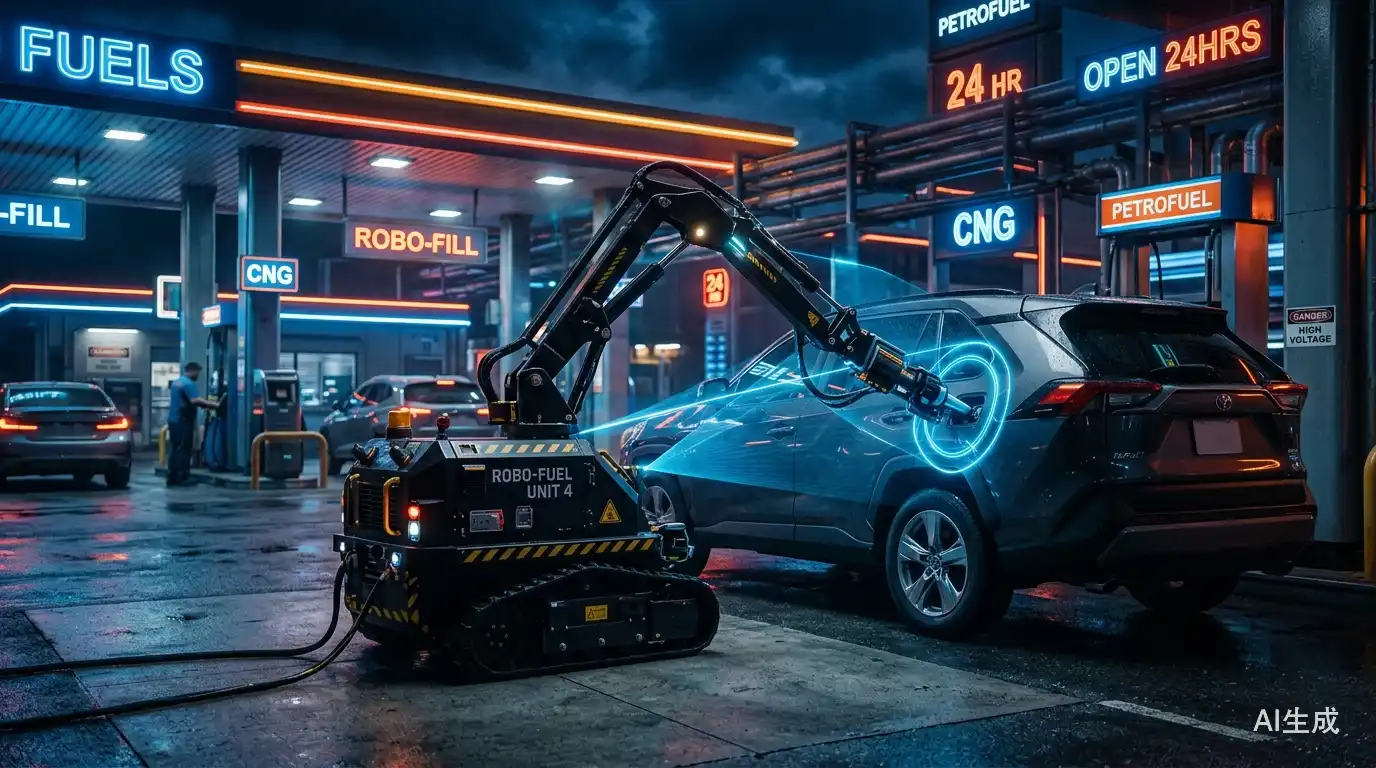
The article explores three main application areas. At gas stations, the challenge lies in executing a long, precise sequence of actions (opening caps, handling the fuel nozzle) with millimeter accuracy across diverse car models. For facility inspections, robots need sustained autonomous patrols combined with real-time anomaly detection and response. Port scenarios introduce the complexity of multi-robot coordination.
Addressing the core challenge of long-horizon tasks, the piece highlights a technical breakthrough: a "world model"-driven approach. This enables predictive planning, allowing the AI to visualize the desired end-state (e.g., nozzle returned, cap closed) and work backward to synthesize intermediate visual frames. This "imagination" of the task trajectory, as implemented in the H-GAR architecture, guides action generation, significantly reducing cumulative error in multi-step operations. The three-step H-GAR process involves generating a coarse action draft, synthesizing target-conditioned observation frames, and then refining actions based on visual context and a memory of past successful motions.
The conclusion emphasizes that success in specialized, safety-critical fields requires long-term commitment and deep integration of the "embodied brain" (AI) with a purpose-built, certified physical "body." Mastering this brain-body-data闭环 (closed-loop) is positioned as a crucial competitive advantage for commercialization.
marsbit06/26 03:49
![Assessing Sonic’s [S] 12% price drop and why more selling may be next](https://d1x7dwosqaosdj.cloudfront.net/images/2026-06/161e3d66eea4402796d2e6a66d93d453.jpg)