[Featured Research]A16z: Trend of crypto for 2023

a16zPublicado em 2022-12-26Última atualização em 2022-12-26

Resumo

Despite the uncertainty surrounding the potential impact, institutional adoption of crypto remains steadfast, with many investors taking the long view and recognizing the cyclical nature of these markets. Rather than abandoning their bets on Crypto, they are using this environment to hone their knowledge and build infrastructure to be ready for the future.

Below is a shortlist of just some of the things that excite partners across the engineering, research, and investing teams about what’s ahead.

Blockchain’s Mobile Moment

How far or close are we to the “mobile moment” for crypto? There is a large group of blockchain users and others whose main access to the internet is through their smartphones, but which relies on centralized infrastructure — which is convenient, but also risky. Users have traditionally solved this problem by running their own nodes — a time- and resource-intensive endeavor that, at the very least, requires a constantly-online machine, hundreds of gigabytes of storage, and around a day to sync from scratch… not to mention special skills.

But more people are now starting to care about decentralizing access to blockchains for all users — even those who cannot run a node themselves. With the introduction of “light” clients that provide similar functionality to running a full node — such as Helios (released by a16z crypto), Kevlar, and Nimbus — users can now verify blockchain data directly from their devices. I’m hoping to see similar trust and decentralization improvements in other parts of the stack, such as event indexing and user data storage. Taken together, all of these can help achieve true decentralization for mobile frontends.

—Noah Citron, engineering partner, crypto team (@noahcitron, @ncitron on Farcaster)

Zero Knowledge, Multi-Party Computation, and Post-Quantum Crypto

Zero knowledge systems are powerful, foundational technologies that hold the keys to blockchain scalability, privacy-preserving applications, and much more. But there are a lot of tradeoffs between prover efficiency, proof succinctness, and the need for a trusted setup. It would be fantastic to see more constructions for zk-proofs that fill the gaps in the multidimensional space of these tradeoffs. For me, it would be most interesting to see whether trusted setups are required for constant-size proofs (and constant-time verification), which would further justify the need for more transparent trusted setup ceremonies.

We also need better constructions for threshold ECDSA (elliptic curve digital signature algorithm) signatures. Attaining thresholds removes the need to trust a single signer, which is why threshold signatures are important for multi-party, distributed computation on private data and have several applications in web3. The most interesting threshold ECDSA signatures would be those that minimize the overall number of rounds — including the pre-signing rounds where the message is not known yet. Finally: As new post-quantum signatures near the end of standardization, per NIST, it would be great to explore which of these could be made friendly to aggregation or thresholdization.

—Valeria Nikolaenko, research partner, crypto team (@lera_banda)

Developer Onboarding for Zero Knowledge

Zero knowledge systems have been a long time coming. In recent years, they moved from theory to practice, but in 2022 it felt like we turned the corner on developer onboarding for ZK. Specifically, we saw the proliferation of educational materials and the maturation of high-level programming languages (such as Noir and Leo) that made it easier than ever for engineers to start writing ZK applications. I expect these developments, along with continued theoretical advances, will lead to an influx of application developers, given how significant zero knowledge is to so many use cases. Putting things into the hands of developers often leads to unexpected new use cases; I’m excited to see what comes next.

—Michael Zhu, engineering partner, crypto team (@moodlezoup)

VDF Hardware

Verifiable Delay Functions (VDFs) are an exciting cryptographic tool with many applications, from verifiable lotteries to leader election to preventing front-running. But the biggest catch has long been hardware implementations, which are needed to have confidence that attackers can’t compute the VDF faster. I’m excited for the first generation of VDF hardware to be available, paving the way for practical deployment.

—Joseph Bonneau, research partner, crypto team (@josephbonneau)

Fully On-Chain Games and Autonomous Worlds

What if you could create a game world that could not be taken down or censored, had no need for servers, and could live far beyond any of our individual (or even organizational) lifetimes? For the first time ever, we can. We are at the very beginning of crypto-native, fully “on-chain games,” or — as others prefer to call its superset — “autonomous worlds,” built on top of blockchain technology.

Whatever you call it (and the lexicon is still forming!), the nascent movement toward maximally decentralized games offers new affordances that make it possible to actually build these games online. Specifically, the ability to put a game’s entire state and logic on a publicly verifiable, censorship-resistant, and decentralized blockchain… as well as advances in on-chain procedural generation, which not only overcome constraints like storage, but are essentially “a trick to compress a complex world into an executable.” What new games, and gameplay, become possible that were never possible before? Are such games still… games?

—Carra Wu, investing partner, crypto team (@carrawu, @carra on Farcaster)

Non-Transferable Tokens

I much prefer the term “non-transferable tokens” over “soulbound” tokens (a term borrowed from gaming by Vitalik Buterin for NFTs); these tokens are for cases where it doesn’t make sense to transfer NFTs. I’m excited to see the various web3 applications that will be built on top of not just this primitive, but also with decentralized identifiers and verifiable credentials. While the discussion of these primitives usually revolves around decentralized identity, there are many other applications to be explored as well: For instance, tickets, digital <> physical, reputation… and much more ahead.

—Michael Blau, investing partner, crypto team (@blauyourmind, @michaelblau on Farcaster)

Decentralized Energy

How can we apply the decentralization ethos to energy? For instance, power grids are dated, centralized, and face several other issues like high upfront capital expenditures and misaligned incentives. There are great opportunities to build microgrids and storage and transmissions networks, by solving issues such as high capital expenditures and disparate incentives solved through tokens. There are also burgeoning markets for renewable energy certificates (REC), and carbon credits on-chain. I’m excited to see builders continue to expand what’s possible in this category of decentralized energy coordinated by blockchains.

—Guy Wuollet, investing partner, crypto team (@guywuolletjr, @guy on Farcaster)

Leituras Relacionadas

If It's Not a Clear Yes, It's a No: A Nine-Year Retrospective by a VC Who Survived Four Cycles

**"Invest Only When Certain": A Nine-Year Retrospective from a VC Across Four Cycles** IOSG founder Jocy shares hard-earned lessons from nine years and over a hundred investments in Web3. The core challenge isn't identifying successful founders, but understanding why talented founders with solid ideas still fail. Through building a "failed founder database," IOSG identified six recurring failure patterns. **Founder Trait Red Flags:** 1. **Emotionally Unstable:** Founders who react defensively to criticism or publicly lash out under pressure (e.g., 80% drawdowns) often fail. Resilience is key. 2. **Lacking Hunger / Having a Fallback:** Founders with significant safety nets (family wealth, cushy fallback jobs) may lack the "do-or-die" commitment needed to survive crypto's brutal cycles. 3. **Unchecked Ego:** Includes "polished execution machines" who excel in known frameworks but struggle when paradigms shift, and "professor-types" who are technically brilliant but resistant to commercial feedback or coaching. **Project Structure Red Flags:** 4. **Token-First, Not Product-First:** Treating the token solely as a fundraising tool with no real utility or connection to product value is a major warning sign. The project should have value even if the token goes to zero. 5. **No Day-1 Exit Thesis:** Founders must have a clear, staged capital strategy from the start, understanding what each funding round needs to prove to unlock the next. "Exit before entry" is crucial. 6. **No Full-Cycle Experience:** Founders who haven't lived through a complete crypto bull/bear cycle (e.g., 2018, 2022) often underestimate their vulnerability. IOSG limits initial checks for such teams to $250k, sizing for risk. **The Positive Flipside: Desirable Founder Traits** The ideal candidate exhibits: obsessive problem-depth, being a second-time founder with a non-consensus vision, strong communication skills with *controlled* ego, relentless perseverance, and a global perspective with agency and taste (increasingly vital in the AI era). **Three Survival Tips for Founders:** 1. **Cash Flow Over Narrative:** Real revenue is what sustains projects, not vanity metrics. 2. **Tokens Are a Liability:** Avoid issuing a token unless absolutely necessary. The hidden costs (market making, liquidity, compliance) are immense, often a multi-million-dollar burden. 3. **Respect Liquidity:** Sell during peaks to build treasury, buy back to support the protocol during troughs. Be realistic about valuations and your ability to deliver for the next round. The final principle is simple yet paramount: **"If it's a borderline 'yes' or 'no,' don't invest."** In an industry that reinvents itself every few years, the discipline to consistently say "no" is the ultimate secret to longevity.

Foresight NewsHá 17m

If It's Not a Clear Yes, It's a No: A Nine-Year Retrospective by a VC Who Survived Four Cycles

Foresight NewsHá 17m

SemiAnalysis Deep Dive into CXMT: $50 Billion Revenue, An IPO Amidst a Supercycle

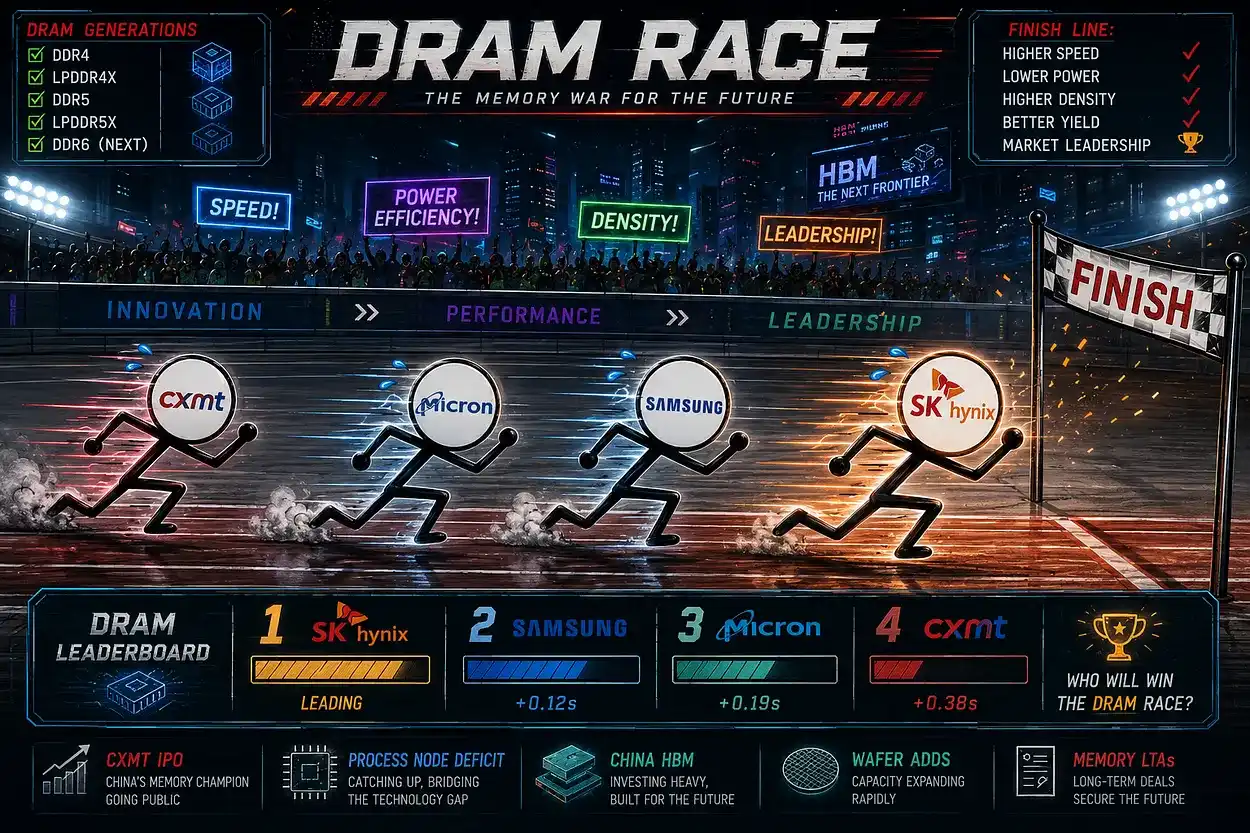
SemiAnalysis' in-depth report on ChangXin Memory Technologies (CXMT) details its rapid rise as China's largest upcoming semiconductor IPO. Founded in 2016 by Zhu Yiming, CXMT built its DRAM foundation on acquired patents and talent from the bankrupt German firm Qimonda. It achieved its first annual profit in 2025 after nearly a decade of significant capital support, primarily from patient Hefei municipal investors who fostered a local supply chain. The company is now capitalizing on a strong DRAM supercycle. Its revenue soared from ~$3.3B in 2024 to ~$8.6B in 2025, with Q1 2026 alone reaching ~$7.3B. SemiAnalysis projects full-year 2026 revenue could exceed $50B, driven by soaring ASPs rather than massive market share gains. While CXMT is closing the capacity gap with Micron, its product mix remains heavily focused on commodity DDR/LPDDR, which currently offers higher margins than its nascent HBM business. CXMT faces significant challenges in HBM, struggling with yield and stability for HBM3 8-Hi stacks while lagging behind the big three (Samsung, SK Hynix, Micron) in advanced nodes. However, strategic national priorities for AI self-sufficiency may push it to accelerate HBM capacity. Its complex IPO structure reveals heavy state-backed ownership and voting control over its fabs, with Alibaba appearing as both a key cloud customer and a minority shareholder. The IPO aims to raise ~$4.1B, primarily to strengthen its core DRAM manufacturing base.

marsbitHá 37m

SemiAnalysis Deep Dive into CXMT: $50 Billion Revenue, An IPO Amidst a Supercycle

marsbitHá 37m

From Corning to Ciena: The 10x Opportunity in the AI Optical Communication Chain

The transition from copper to optical communication in AI data centers is creating significant investment opportunities beyond just chipmakers. The entire photonics supply chain, from glass and fiber to connectors and test equipment, is critical. Corning, a key fiber supplier, has locked in multi-billion dollar, multi-year contracts with major cloud providers (Meta, Amazon, Google, Microsoft, OpenAI, NVIDIA), demonstrating pricing power and scale. Its profit growth is outpacing revenue growth. In the interconnect layer, Amphenol benefits from high growth in AI data centers, driven by strategic acquisitions and operational efficiency, while Credo Technology acts as a bridge between copper and optical solutions, though with high customer concentration risk. At the systems level, Ciena enables higher data capacity on existing fiber lines, with a strong backlog and cloud customer adoption. Further upstream, AXT is a bottleneck supplier of key indium phosphide wafers for lasers but faces geopolitical supply chain risks. VEO Solutions provides essential testing equipment for the entire photonics industry. A new pure-play photonics ETF (FOTO) offers a consolidated investment approach. The core thesis is that the physical limits of copper are driving an inevitable shift to optical technologies, with wealth flowing to essential, often overlooked, suppliers across the photonics value chain.

marsbitHá 49m

From Corning to Ciena: The 10x Opportunity in the AI Optical Communication Chain

marsbitHá 49m

Collector Crypt's DAU Is Only 800, Yet It's Already One of Crypto's Most Profitable Projects?

"Collector Crypt: A Highly Profitable Crypto Project with Only 800 Daily Active Users?" Collector Crypt (CARDS) is a crypto project tokenizing physical graded trading cards (primarily Pokémon) on Solana, achieving significant real-world profitability and growth. According to a Maelstrom Fund analysis, it generated approximately $53M in annualized profit in May, with a June run-rate nearing $109M, against a $550M FDV. Its core revenue driver is a digital pack-opening 'Gacha' system. The platform bulk-buys cards at a 5-15% discount. Users can open digital packs and choose to keep cards or sell them back to the platform at a 7-15% discount to market price. Most users sell back common cards, creating an efficient model: users get packs with a ~2% positive expected value, while Collector Crypt captures ~4.5% profit. The project aims to disrupt the inefficient $22.2B GMV (Q1 2026) eBay trading card market, which charges sellers 16-20% in total fees. Collector Crypt offers 2% fees, instant settlement, insured custody, and one-click trading. Beyond Gacha, future revenue streams include secondary market trading fees, infrastructure partnerships, and an eBay "snipe" tool. It holds ~$23M in card inventory and ~$10M in cash, and has already begun token buybacks. With a total supply of 2B tokens, effective circulation post-2027 unlocks is estimated at ~1.3B. Trading primarily on DEXs has so far limited large institutional entry. The project is expanding into sports cards and attracting Web2 users. Maelstrom Fund's price target is $4 by summer's end, positioning Collector Crypt at the forefront of migrating collectibles on-chain.

Foresight NewsHá 1h

Collector Crypt's DAU Is Only 800, Yet It's Already One of Crypto's Most Profitable Projects?

Foresight NewsHá 1h

Trading

Spot
Futuros
活动图片