WSJ: Sam Bankman-Fried’s Lawyers Hash Out His Transfer to U.S. After Confusion in Court

Wall Street JournalPublicado em 2022-12-20Última atualização em 2022-12-20

Resumo

The FTX founder has agreed to be extradited, with lawyers drafting documents, according to a person familiar with the matter

NASSAU, Bahamas—FTX founder Sam Bankman-Fried inched closer to being transferred into U.S. custody to face criminal charges related to the cryptocurrency exchange’s collapse, after a chaotic court hearing here Monday in which his local lawyer appeared at odds with his U.S. legal team.

Mr. Bankman-Fried has agreed to be extradited, according to a person familiar with the matter, and plans were being fleshed out by his legal team after the day’s court proceedings. Mr. Bankman-Fried’s lawyers hope to have a new hearing on the matter as early as Tuesday, the person said.

Jerone Roberts, who represents Mr. Bankman-Fried in the Bahamas, agreed to draft the necessary documents after having a conference call with the former chief executive and his U.S. lawyers, the person said.

Over the weekend, people familiar with the matter said Mr. Bankman-Fried was planning to consent to extradition to the U.S. but cautioned that his legal plans were still in flux and could change.

Monday’s hearing suggested Mr. Bankman-Fried’s U.S. lawyers and Mr. Roberts weren’t in perfect alignment. Mr. Roberts told Magistrate Judge Shaka Serville that he was surprised to see his client in court.

“Whatever trail that got him here this morning, it did not involve me,” Mr. Roberts said.

Franklyn Williams, of the Bahamas Department of Public Prosecutions, said in court that a U.S. lawyer for Mr. Bankman-Fried had contacted his office over the weekend.

“We understood that Mr. Bankman-Fried intended to waive his extradition,” Mr. Williams said.

Mr. Roberts said he was unaware of that development. He said he needed documents, including the U.S. indictment, to review with Mr. Bankman-Fried before his client could make a decision on whether to waive any objection to his transfer to the U.S.

Judge Serville granted a request for Mr. Bankman-Fried and Mr. Roberts to confer with the former executive’s U.S. lawyers.

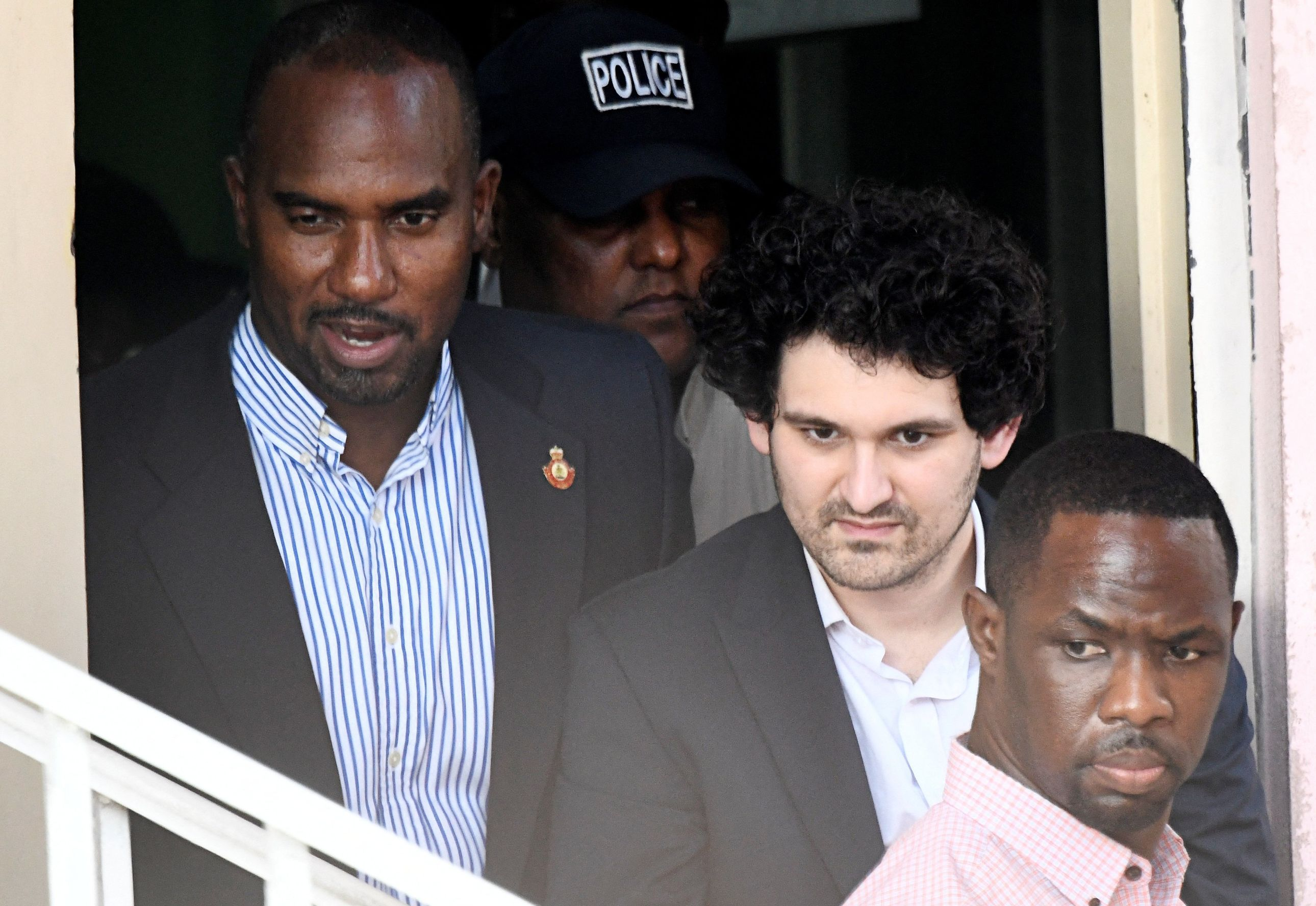
Mr. Bankman-Fried was later escorted back to jail by a caravan of armed police officers and jail officials.

Mr. Bankman-Fried was dressed in a navy blue blazer with an untucked white shirt, one of his knees bouncing up and down throughout the proceeding. He spoke briefly to answer the judge’s questions and during the exchange was told by a court officer to stand up straight.

Mr. Bankman-Fried, 30 years old, was indicted last week on eight criminal counts, including fraud and conspiracy offenses. Federal prosecutors in Manhattan accused him of stealing billions of dollars of FTX customers’ funds for his personal use and to repay loans owed by Alameda Research, his crypto hedge fund. He also defrauded lenders and investors by concealing his misuse of customer funds, prosecutors said.

According to prosecutors, Mr. Bankman-Fried also made illegal political contributions funded by Alameda, disguising the true source of the funds to evade reporting requirements and contribution limits.

Mr. Bankman-Fried has said he bore responsibility for FTX’s collapse but has denied he committed any fraud.

Personnel from the Federal Bureau of Investigation and the State Department attended Monday’s hearing. FBI agents would accompany Mr. Bankman-Fried to the U.S. in a government aircraft.

Mr. Bankman-Fried has been in custody since his arrest a week ago and has been held at Fox Hill Prison, a Bahamas facility that has faced criticism for its conditions in the past.

If and when Mr. Bankman-Fried arrives in the U.S., he will likely appear in federal court in New York, where he would be arraigned and expected to enter a plea. He is likely to initially be held in a federal jail, although his lawyers could make an application for him to be released on bail.

His case has been assigned to U.S. District Judge Ronnie Abrams, a former federal prosecutor in Manhattan who joined the court in 2012 after being nominated by President Barack Obama.

Leituras Relacionadas

Chip Stocks Lead U.S. Market Decline: Is AI Trading Being Hit by Both Interest Rates and Returns?

Chip stocks led a broad decline in US markets, with the Nasdaq dropping 2.2% and the S&P 500 falling 1.4%. This selloff reflects a dual challenge for the once-high-flying AI hardware trade: rising interest rate expectations and growing investor impatience for clear returns from massive AI capital expenditures. The pressure was most acute on hardware leaders. Nvidia fell about 4%, dipping below a $5 trillion market cap, while Micron plunged 13.2% ahead of its earnings report. Declines across memory, storage, AI, and mobile chips indicated a sector-wide retreat. The selloff spread globally, with South Korea's KOSPI index dropping nearly 10% as key suppliers SK Hynix and Samsung recorded double-digit losses. Investors appeared to be taking profits from the most crowded trades first. Macro headwinds intensified as market expectations shifted toward a more aggressive Federal Reserve. Forecasts for multiple rate hikes in 2026 pressured high-valuation tech stocks, which rely on long-term growth projections that become less attractive as discount rates rise. Concurrently, investors are scrutinizing the profit potential of the immense AI spending by cloud giants like Alphabet, Amazon, and Meta. While these expenditures drive demand for chips and hardware, the market is now questioning whether AI services will generate sufficient returns to justify the ongoing costs. This adjustment is not necessarily a bubble burst but a recalibration. AI demand fundamentals remain, but the narrative of endless growth can no longer fully offset concerns over higher interest rates and a longer path to profitability. Near-term direction may hinge on Micron's upcoming earnings guidance and incoming inflation data, which will influence both the AI demand outlook and the Fed's policy path. The market is transitioning from blindly buying growth to demanding clearer visibility on returns.

marsbitHá 1h

Chip Stocks Lead U.S. Market Decline: Is AI Trading Being Hit by Both Interest Rates and Returns?

marsbitHá 1h

OpenAI's New Paper: How to Train an AI that "Doesn't Deteriorate Under Pressure"?

OpenAI's new paper "Reinforcement Learning Towards Broadly and Persistently Beneficial Models" explores training AI to maintain safe, helpful, and honest behavior even under pressure, in unseen scenarios, or after being fine-tuned for harmful purposes. Moving beyond simple rule-based "don'ts," the research focuses on cultivating "beneficial traits" like honesty, risk-awareness, corrigibility, and transparency. It investigates if reinforcement learning (RL), often prone to "reward hacking" where models exploit loopholes, can instead be used to instill robust, generalized positive behaviors. Researchers created a multi-domain synthetic dialogue dataset covering areas like healthcare and law. They trained a model by replacing 5% of standard RL data with "beneficial trait" data. This model outperformed the baseline in 83% of 53 evaluations, showing average gains of 9.1% in alignment, safety, and helpfulness. Crucially, improvements generalized: a model trained only on healthcare "good behavior" data also performed better in 17 out of 19 non-healthcare alignment tests. The paper also tests "alignment persistence." When subjected to adversarial prompts or harmful fine-tuning, the beneficial trait model showed greater resilience, with smaller performance drops and less "spillover" of bad behavior to unrelated tasks. While not a complete solution, this work suggests a shift from post-hoc correction to proactively shaping robust, principled AI behavior, a critical step for deploying models in high-stakes, complex decision-making scenarios.

marsbitHá 1h

OpenAI's New Paper: How to Train an AI that "Doesn't Deteriorate Under Pressure"?

marsbitHá 1h

Semiconductor Stock Rebound: Is the Technical Correction Over or a Trend Reversal?

The core of recent semiconductor stock volatility is not about daily price swings, but rather the market questioning whether AI-driven semiconductor pricing has entered a new phase. Following a sharp sell-off in Korean stocks on June 23rd, led by Samsung and SK Hynix, a subsequent rebound is seen more as a technical positioning adjustment rather than a confirmed trend reversal. The key variable is HBM (High Bandwidth Memory), essential for AI chips. Its supply-demand imbalance granted memory makers significant pricing power. The current market focus is on whether this dynamic remains strong enough to justify elevated valuations. All eyes are on Micron's upcoming earnings report. The critical factor is not whether results meet already high expectations, but whether the company's guidance confirms that AI memory pricing power, order visibility, and future margins are still expanding. Micron's outlook will serve as a crucial test for the broader AI semiconductor chain, including Samsung, SK Hynix, and other infrastructure players. The recent bounce appears to be a pre-earnings positioning repair. For it to evolve into a sustained uptrend, concrete evidence is needed that the AI infrastructure expansion cycle's fundamentals—particularly for high-end memory—remain robust and can continue to surpass elevated market expectations. The risk is that strong demand alone may not be sufficient if future guidance hints at peaking momentum or increasing supply-side pressures.

marsbitHá 1h

Semiconductor Stock Rebound: Is the Technical Correction Over or a Trend Reversal?

marsbitHá 1h

Trading

Spot
Futuros
活动图片