Прогноз цены биткоина: Почему BTC все еще может упасть ниже $16K

NewsBTCPublicado em 2022-12-17Última atualização em 2022-12-17

Resumo

Цена биткоина не смогла преодолеть отметку $18 000 и скорректировалась вниз. BTC подает медвежьи сигналы и может даже начать новое снижение в ближайшие сессии. Биткоин начал нисходящее движение...

Цена биткоина не смогла преодолеть отметку $18 000 и скорректировалась вниз. BTC подает медвежьи сигналы и может даже начать новое снижение в ближайшие сессии.

  • Биткоин начал нисходящее движение и торгуется ниже уровня поддержки $17 600.
  • Цена торгуется ниже $17 500 и 100-часовой простой скользящей средней.
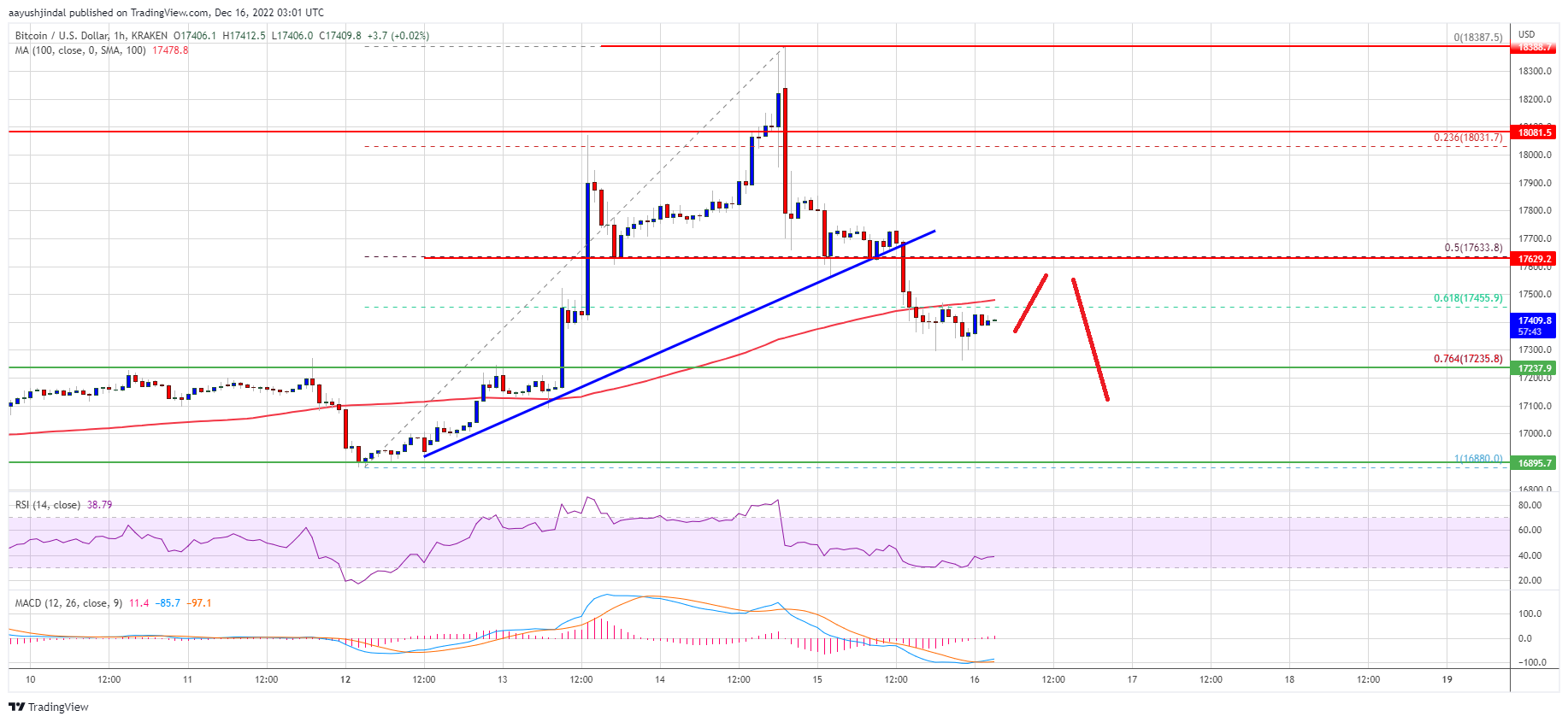
  • На часовом графике пары BTC/USD произошел прорыв ниже основной линии бычьего тренда с поддержкой около $17 620 (данные с Kraken).
  • Пара может продолжить движение вниз, если не вернется к 100-часовой скользящей средней.

Цена биткоина возобновляет падение

Цена биткоина предприняла попытку прорыва вверх над зоной сопротивления $18 400. BTC не смог удержаться выше разворотного уровня $18 000 и возобновил нисходящее движение.

В районе $18 387 был сформирован максимум, после чего цена начала новое снижение. Произошло явное движение ниже уровней $18 200 и $18 000. Цена опустилась ниже уровня 50%-ной коррекции ключевой волны от минимума $16 881 до максимума $18 387.

Кроме того, на часовом графике пары BTC/USD произошел прорыв ниже основной линии бычьего тренда с поддержкой в районе $17 620. Цена биткоина сейчас находится ниже $17 500 и 100-часовой простой скользящей средней.
Источник: BTCUSD на TradingView.com

На восходящем тренде непосредственное сопротивление находится вблизи уровня $17 500 и 100-часовой простой скользящей средней. Первое крупное сопротивление находится вблизи зоны $17 650, выше которой цена может вернуться к зоне $18 000. Следующее серьезное сопротивление находится около $18 380, выше которого цена может набрать темп и подняться к уровню $19 000.

Новые потери в BTC?

Если биткоин не сможет преодолеть сопротивление на уровне $17 650, возможны новые потери. Непосредственная поддержка со стороны нисходящего тренда находится вблизи уровня $17 240. Он находится вблизи уровня 76,4% коррекции Фибс ключевой волны от минимума $16 881 до максимума $18 387.

Следующая крупная поддержка находится вблизи зоны $17 000. Прорыв вниз ниже уровня поддержки $17 000 может привести к большим потерям. В этом случае цена может снизиться к уровню поддержки $16 500 в ближайшей перспективе. Любые дальнейшие потери могут привести к более существенному снижению ниже уровня $16 000 в ближайшие дни.

Технические индикаторы:

Часовой MACD - MACD сейчас набирает обороты в медвежьей зоне.

Часовой RSI (индекс относительной силы) - RSI для BTC/USD сейчас находится ниже уровня 50.

Основные уровни поддержки - $17 250, затем $17 000.

Основные уровни сопротивления - $17 650, $18 000 и $18 380.

Leituras Relacionadas

Trillion-Dollar Pension Fund Entry? Franklin Bitcoin Dividend Reinvestment ETF Comes with a Built-in Selling Pressure Ceiling

Franklin Templeton has filed to launch two ETFs that embed a "default configuration" logic into Bitcoin investment, aiming to tap into massive pension fund flows. These "Bitcoin Dividend Reinvestment Index ETFs" will initially hold 95% equities and 5% Bitcoin, automatically reinvesting stock dividends to buy Bitcoin. However, a quarterly rebalancing rule forces selling of Bitcoin if its allocation exceeds 5%, capping its maximum holding at 20%. While the product cleverly circumvents advisor reluctance and compliance hurdles by labeling itself as a U.S. equity product, its actual Bitcoin buying power is minimal. Given low dividend yields (e.g., ~1% for broad market indices), annual Bitcoin purchases from a fund the size of Franklin's existing Bitcoin ETF would be a mere $3.6 million—negligible against Bitcoin's daily trading volume. Crucially, during bull markets, the fund becomes a programmed, passive *seller* of Bitcoin, potentially creating sustained sell pressure if many similar funds emerge. The strategy leverages investor inertia and automatic enrollment, similar to the success of target-date funds in 401(k) plans. It also uses an offshore Cayman subsidiary for holding Bitcoin and raises a tax complication where investors must pay taxes on dividends they never receive as cash. Although recent U.S. regulatory changes allow crypto in retirement plans, widespread adoption as a default option faces legal hurdles. The core premise remains: the system doesn't need to convince anyone to buy Bitcoin actively; it simply relies on people doing nothing.

marsbitHá 26m

Trillion-Dollar Pension Fund Entry? Franklin Bitcoin Dividend Reinvestment ETF Comes with a Built-in Selling Pressure Ceiling

marsbitHá 26m

Bitcoin Hits 20-Month Low as Largest Bull Suffers $15 Billion Paper Loss

Bitcoin Hits 20-Month Low as Major Bull Loses $15 Billion On June 25th, Bitcoin fell below $60,000, hitting a low of $58,030—its lowest level since October 2024. The sell-off triggered over $1 billion in leveraged liquidations in 24 hours, with longs accounting for $788 million. This marks a more than 53% decline from the October 2025 all-time high of $126,198. A critical factor in the downturn is the weakening position of MicroStrategy, the largest corporate Bitcoin holder. With 847,363 BTC at an average cost of $75,651, the company now faces over $14.6 billion in unrealized losses. Its core financing flywheel—raising capital to buy Bitcoin—is stalling. Its variable-rate preferred shares (STRC), a key fundraising tool, have fallen 25% below their $100 target. This raises doubts about its ability to continue providing steady institutional demand for Bitcoin. Simultaneously, U.S. spot Bitcoin ETFs are experiencing significant outflows, with a single-day net outflow of $469 million on June 24th. This represents the most severe sustained capital flight since their launch. The macroeconomic backdrop remains restrictive, with persistent inflation delaying expected Fed rate cuts. Analysts note a shift in capital allocation, with institutional funds moving away from crypto towards AI infrastructure stocks. Immediate pressure comes from approximately $10 billion worth of Bitcoin options expiring on June 26th, which could increase market volatility. The combined effect of these factors—eroding core demand pillars, macro headwinds, and capital rotation—has decisively broken the $60,000 support level.

Foresight NewsHá 33m

Bitcoin Hits 20-Month Low as Largest Bull Suffers $15 Billion Paper Loss

Foresight NewsHá 33m

STRC Falls Below $80, Can Conservative Investors Still Buy the Dip?

The article analyzes whether the STRC (a perpetual preferred stock issued by MicroStrategy) presents a buying opportunity after its price fell below its $100 par value to around $80, offering a seemingly high yield of 13-15%. The core argument is that STRC's discount reflects market skepticism about the sustainability of MicroStrategy's capital structure model, not just temporary panic. This model relies on issuing securities (like STRC) to raise funds to buy more Bitcoin, a "flywheel" that works in a bull market. The recent small sale of BTC to fund dividends, while minor, broke the psychological "never sell" anchor and signaled potential strain. Key risks identified are not a traditional Ponzi collapse but a potential breakdown in the financing narrative: 1) If Bitcoin enters a deep bear market, crushing MicroStrategy's stock premium (mNAV), its ability to raise cheap capital weakens. 2) If STRC remains deeply discounted, it signifies permanently higher funding costs. 3) The high cash dividend yield represents a significant ongoing expense. 4) If selling BTC to pay dividends becomes routine, the bullish narrative reverses. The conclusion is that STRC is not a risk-free high-yield asset. It is a high-coupon bet on whether MicroStrategy's BTC treasury financing model can withstand a bear market. Buying it is a wager that the market will continue to believe in and fund this structure at acceptable costs. The current price asks if this cycle's "casualty" might be a BTC treasury company's融资 model itself.

marsbitHá 48m

STRC Falls Below $80, Can Conservative Investors Still Buy the Dip?

marsbitHá 48m

Why Do Crypto Projects Keep Changing Their Names?

**Why Do Crypto Projects Keep Changing Names?** In the crypto world, changing a project's name is common—over 16% of projects have done so, including major ones like Polygon (formerly Matic Network). This contrasts sharply with traditional businesses, which fiercely protect brand equity. The core reason is that in crypto, brand loyalty is often weak. Users are frequently investors, airdrop hunters, or yield seekers, not traditional consumers. A name associated with price crashes, hacks, or failed narratives becomes a liability, not an asset. Renaming can be a strategic reset to shed this baggage. Name changes serve as a potent marketing tool. They can signal a genuine pivot in strategy or scope (e.g., EthSign dropping "Eth" as it expanded). However, they are often used to "narrative surf," rebranding to align with hot trends like AI, RWA, or the metaverse (e.g., Elrond → MultiversX). Critically, renaming is also a PR tactic to distance a project from past failures like security breaches (e.g., Anyswap → Multichain). The most significant risk emerges when a name change is coupled with a token migration or swap. This process can allow projects to reset exchange price charts, erase visible historical downtrends, and create an illusion of a fresh start. It often facilitates liquidity resets, where low float can be exploited for pumps. More alarmingly, migrations sometimes mask overhauls to tokenomics, introducing substantial new token supply through "ecosystem funds" or "node rewards," effectively diluting existing holders. The fundamental issue isn't renaming itself, which can be valid for strategic evolution. The problem is when it functions as an escape from history—a way to avoid accountability for past mistakes, failed promises, and poor performance. When a project announces a rebrand, the critical questions are: What tangible new capability or strategy does it represent? Has the tokenomics changed? And what part of its past is it most trying to make users forget?

marsbitHá 55m

Why Do Crypto Projects Keep Changing Their Names?

marsbitHá 55m

Trading

Spot
Futuros
活动图片