3AC subpoenas issued as dispute grows over claims of Terraform dump

CointelegraphPublicado em 2022-12-07Última atualização em 2022-12-07

Resumo

The bankruptcy judge has given approvals to subpoenas aimed at Three Arrows Capital’s leadership, while a new Terra Luna conspiracy has been floated.

A federal judge overseeing Three Arrows Capital’s (3AC’s) bankruptcy proceedings has signed an order approving subpoenas to be delivered to 3AC’s former leadership, including co-founders Su Zhu and Kyle Davies.

The subpoenas require the founders to give up any “recorded information, including books, documents, records, and papers” in their custody that relates to the firm’s property or financial affairs.

The infamous hedge fund, worth $10 billion at its peak, filed for Chapter 15 bankruptcy on Jul. 1 with its troubles tied up in too much leverage and the collapse of Terra Luna (LUNA), known now as Terra Classic (LUNC), and its algorithmic stablecoin formerly known as TerraUSD (UST).

Since then, the liquidators — advisory firm Teneo — have been trying to hunt down the firm’s assets and pin down the 3AC's co-founders.

The latest order allowing for the subpoenas will require recipients to give up any and all account information, seed phrases, and private keys for its digital and fiat assets, details about the securities and unregistered shares, and any accounts held on centralized or decentralized exchanges, along with any other tangible or intangible assets.

The order also labels hedge fund attorney Hannah Terhune, directors Mark Dubois and Cheuk Yao Pau, and Kelly Chen — wife of co-founder Kyle Davies — as “discovery targets”, alongside trading desk company Tai Ping Shan Limited, venture capital firm DeFiance Capital, 3AC-backed NFT fund Starry Night Capital and all of their associates.

Any individuals served with the subpoena are required to comply within 14 days unless otherwise agreed with the parties.

At the time of writing there has been no solid information on the whereabouts of either Zhu or Davies, it’s rumored Zhu is residing in Dubai while Davies is residing on the Indonesian island of Bali. Both have been active on social media commenting on developments relating to the collapse of FTX and Alameda research.

Claim: Terraform dumped $450M UST before crash

Meanwhile, self-proclaimed Terra whistleblower FatMan has made new claims on Twitter that it was the actions of Terraform Labs itself that led to the de-pegging of TerraUSD (UST), now TerraClassicUSD (USTC), in May — as opposed to a concerted attack.

That being said, not everyone is convinced about the theory or that the information is new.

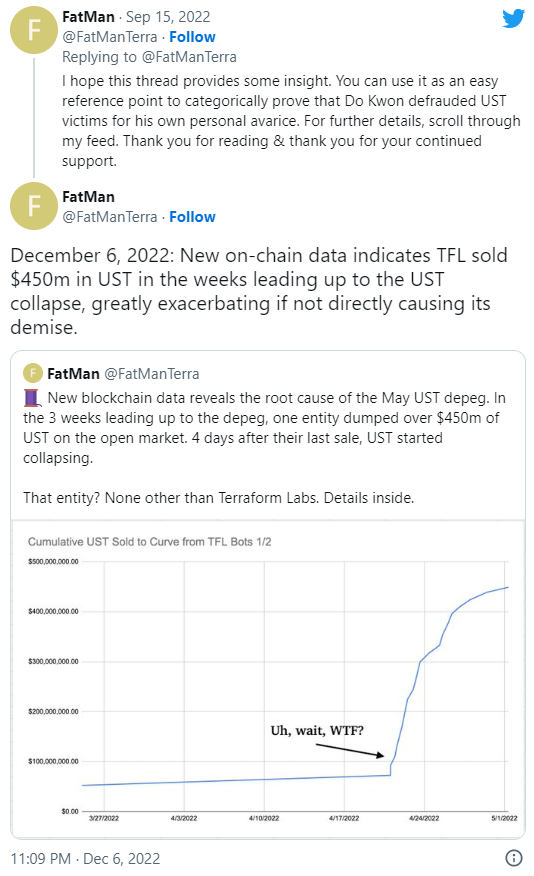
In a Dec. 6 Twitter thread FatMan cited “bombshell data” from anonymous researcher Cycle_22 that purportedly discovered two trading wallets which are verified to be owned by Terraform Labs had “dumped” $450 million worth of UST on the open market in the three weeks leading up to the de-peg, explaining:

“TFL has been perpetrating the narrative that UST was ‘attacked.’ This is a false flag.”

“In reality, TFL themselves weakened the Curve pool by irresponsibly dumping a massive amount of UST in a short timeframe. This reduced liquidity and severely weakened the peg," FatMan said.
However, some Twitter users responding to the thread have stated it was “public knowledge” that TFL was withdrawing UST from a Curve liquidity pool (3Pool) in preparation to seed its new stablecoin liquidity pool (4Pool) it was working with Frax Finance at the time.

Others, such as Twitter user RyanLion said it had been “clearly communicated” that the UST swaps into the curve pool were part of moves of swapping UST into other stables to purchase Bitcoin (BTC) for the Luna Foundation Guard reserves.

A June blog from blockchain firm Chainalysis said that while Terraform Labs withdrew millions of UST from 3Pool at the time (approximately 150 million), it was the actions of two traders in the hour following — swapping a total of 185 million UST for USDC and TFL’s response to that, which led to the depeg and resulting panic sell-off.

Criptomoedas em alta

Leituras Relacionadas

Foundation Steps Back, Ethlabs Steps Forward: Ethereum Undergoes Its Largest Restructuring in History

On June 23rd, the Ethereum ecosystem witnessed two major shifts, signaling a significant governance realignment. First, former Ethereum Foundation researchers established Ethlabs, a new independent non-profit. Backed by major ETH holders like Bitmine and SharpLink, Ethlabs aims to address practical needs for institutional adoption, including faster settlement, native asset issuance, cross-chain transactions, and mainnet scaling. Secondly, the Ethereum Foundation announced a major restructuring, laying off 54 employees (20% of its staff) to become a leaner entity focused on protocol governance and maintenance rather than being the primary builder. This move represents a pivotal correction. Criticisms had mounted over the Foundation's perceived slowness, lack of clear strategy, and over-reliance on Vitalik Buterin's influence. Ethlabs emerges as a more execution-oriented, "industrialized" layer focused on market adoption—bridging the gap between research and real-world use. Notably, Vitalik Buterin is absent from its list of supporters, interpreted as an intentional step to avoid excessive personal endorsement and allow the organization to build independent credibility. The Ethereum Foundation's downsizing and redefinition mark a retreat from its former central coordinating role. It now aims to share the "privilege of stewarding Ethereum" with other emerging groups like Ethlabs, the Ethereum Applications Guild, and The Ethereum Economic Zone. Analysts frame this dual shift as the Foundation ensuring Ethereum remains "correct" (credibly neutral), while Ethlabs must prove it remains "effective" (competitive and attractive for capital and adoption). This addresses community "shareholder-like anxiety" about ETH's market performance. While risks exist—such as concerns over shifting from Foundation centrality to large-holder influence—the consensus is that the greater risk for Ethereum was inaction, caught between technical idealism and organizational inertia. These steps aim to create a more multi-stakeholder, execution-driven future for the network.

链捕手Há 7h

Foundation Steps Back, Ethlabs Steps Forward: Ethereum Undergoes Its Largest Restructuring in History

链捕手Há 7h

Second Half of U.S. Crypto Policy: The Clarity Act Aims for 60 Votes, CFTC's "One-Person Commission" Becomes Biggest Variable

In a pivotal year for US crypto policy, the "CLARITY Act" is advancing in the Senate but faces a high hurdle, needing 60 votes to pass. Key challenges include bridging partisan divides on ethics and swaying undecided Republican senators within a tight legislative calendar of only about 40 working days. The policy "second half" involves intense negotiations on a broader framework for Web3 and DeFi, including crypto tax reforms and the Blockchain Regulatory Certainty Act. A significant uncertainty is the understaffed CFTC, operating with four commissioner vacancies, which complicates regulatory clarity. Meanwhile, the departure of key "crypto champions"—SEC Commissioner Hester Peirce and Senator Cynthia Lummis—will impact ongoing policy efforts. Industry experts are cautiously optimistic but realistic. Sara K. Weed notes that while progress is being made, CLARITY is unlikely to pass this Congress, pushing agencies like the SEC and CFTC to provide more guidance. Sulolit Mukherjee suggests meaningful crypto tax legislation is more likely to be attached to larger must-pass bills. Rashan Colbert discusses the jurisdictional debate over prediction markets, emphasizing the need for a regulatory framework that fosters their development as financial tools rather than treating them broadly as gambling. The clock is ticking, but opportunities remain for substantive progress through continued bipartisan dialogue and pragmatic efforts.

marsbitHá 10h

Second Half of U.S. Crypto Policy: The Clarity Act Aims for 60 Votes, CFTC's "One-Person Commission" Becomes Biggest Variable

marsbitHá 10h

Dan Koe's New Essay: Escaping the Fate of the Wage Slave, How to Survive the AI Replacement Wave?

Dan Koe argues that the true threat in the AI era isn't technology itself, but a reliance on others for one's livelihood and happiness. The core problem is "wage slavery"—spending life on unfulfilling work. To survive and thrive, one must escape this by building their own enterprise. The key is developing five elements: Agency (initiative), Taste (discernment), Persuasion, Persistence, and Iteration. These boil down to problem-solving skills and experiential knowledge, which cannot be learned passively but only through doing your own projects. The solution is to become "unemployable" by shifting your identity. This requires: 1) Radically changing your environment to force growth, 2) Choosing a medium (like content creation) that provides real feedback through trial and error, and 3) Mastering either code or, preferably, media (content). Content creation is more valuable because its subjective nature and need for human perspective create a durable advantage over generic AI output. To start, define your life's work by answering foundational questions about your innate knowledge, unique abilities, and contrarian beliefs. Then, immediately act by publishing your first piece of content. The cycle of creating, receiving feedback, and iterating is the essential path to developing the skills needed for an independent, meaningful career and financial resilience.

marsbitHá 10h

Dan Koe's New Essay: Escaping the Fate of the Wage Slave, How to Survive the AI Replacement Wave?

marsbitHá 10h

Research Report Analysis: Morgan Stanley Details SanDisk SNDK, The Truth About Cloud Data Center Pricing Power and AI Inference Benefits

Morgan Stanley raised its price target for SanDisk (SNDK) from $1100 to $1750 on June 22, maintaining an Overweight rating. The upgrade is driven by AI inference demand reshaping the NAND market, particularly for KV Cache and context window storage in cloud data centers. These cloud clients exhibit price inelasticity and sign long-term contracts, granting SanDisk significant pricing power. SanDisk's New Business Model (NBM) agreements, covering over one-third of FY27 bit shipments with 3-5 year terms and fixed price/price collar structures, are crucial. They are projected to sustain gross margins around 80% even at floor prices, providing a buffer against cyclical downturns. Morgan Stanley forecasts gross margins to surge from 30.3% in FY25 to 86.7% in FY27e. With NAND supply expected to remain tight into 2026/2027 and cloud/data centers becoming the largest end-market, SanDisk holds supply-side pricing power. The company targets 15-19% bit growth via technology transitions, not capacity expansion. Revenue is projected to grow ~6.6x from FY25 to FY27, with EPS rising from $2.74 to $14.73, driven by high-margin cloud business. Key upside catalysts include faster enterprise SSD adoption and edge AI growth. Downside risks involve slower industry growth, competitor capex increases, market share loss, and competition from Chinese players like YMTC. The investment thesis rests on AI-driven structural demand, NBM's margin protection, and sustained supply tightness. The $1750 target implies ~28x FY27e P/E.

marsbitHá 11h

Research Report Analysis: Morgan Stanley Details SanDisk SNDK, The Truth About Cloud Data Center Pricing Power and AI Inference Benefits

marsbitHá 11h

Trading

Spot
Futuros

Artigos em Destaque

Como comprar CRV

Bem-vindo à HTX.com!Tornámos a compra de Curve DAO Token (CRV) simples e conveniente.Segue o nosso guia passo a passo para iniciar a tua jornada no mundo das criptos.Passo 1: cria a tua conta HTXUtiliza o teu e-mail ou número de telefone para te inscreveres numa conta gratuita na HTX.Desfruta de um processo de inscrição sem complicações e desbloqueia todas as funcionalidades.Obter a minha contaPasso 2: vai para Comprar Cripto e escolhe o teu método de pagamentoCartão de crédito/débito: usa o teu visa ou mastercard para comprar Curve DAO Token (CRV) instantaneamente.Saldo: usa os fundos da tua conta HTX para transacionar sem problemas.Terceiros: adicionamos métodos de pagamento populares, como Google Pay e Apple Pay, para aumentar a conveniência.P2P: transaciona diretamente com outros utilizadores na HTX.Mercado de balcão (OTC): oferecemos serviços personalizados e taxas de câmbio competitivas para os traders.Passo 3: armazena teu Curve DAO Token (CRV)Depois de comprar o teu Curve DAO Token (CRV), armazena-o na tua conta HTX.Alternativamente, podes enviá-lo para outro lugar através de transferência blockchain ou usá-lo para transacionar outras criptomoedas.Passo 4: transaciona Curve DAO Token (CRV)Transaciona facilmente Curve DAO Token (CRV) no mercado à vista da HTX.Acede simplesmente à tua conta, seleciona o teu par de trading, executa as tuas transações e monitoriza em tempo real.Oferecemos uma experiência de fácil utilização tanto para principiantes como para traders experientes.

469 Visualizações TotaisPublicado em {updateTime}Atualizado em 2026.06.02

Como comprar CRV

Discussões

Bem-vindo à Comunidade HTX. Aqui, pode manter-se informado sobre os mais recentes desenvolvimentos da plataforma e obter acesso a análises profissionais de mercado. As opiniões dos utilizadores sobre o preço de CRV (CRV) são apresentadas abaixo.

活动图片