3 reasons why Ethereum price keeps rejecting at the $1,300 level

CointelegraphPublicado em 2022-12-07Última atualização em 2022-12-07

Resumo

Traders are not sure if ETH will be able to hold the $1,200 level while the S&P 500 rapidly approaches the crucial 3,900 support and ETH derivatives data hints at more downside.

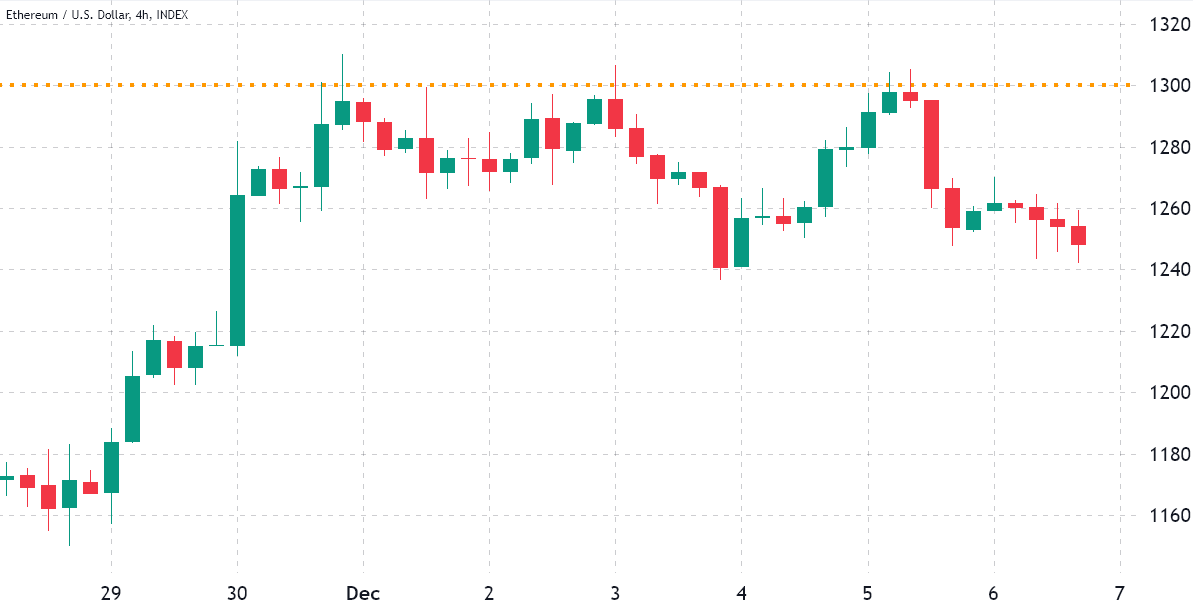
Ether rallied 11.3% between Nov. 28 and Dec. 5, peaking at $1,300 before facing a 4.6% rejection. The $1,300 resistance level has been holding ground for twenty-six days and is the most likely explanation for the correction to $1,240 on Dec. 6.

Ether/USD price index, 12-hour. Source: TradingView

So from one side, traders are relieved that Ether is trading 16% above the $1,070 low reached on Nov. 22, but it must be frustrating to fail at the same level the entire week. In addition to the price rejection, investors' mood worsened after three members of the United States Senate reportedly requested information from Silvergate Bank regarding its relationship with FTX.

The lawmakers raised questions after "reports suggesting that Silvergate facilitated the transfer of FTX customer funds to Alameda'' and gave the bank until Dec. 19 to issue a response.

On Dec. 5, NBC News reported that Silvergate claimed to be a "victim" of FTX's and Alameda Research's "apparent misuse of customer assets and other lapses of judgment."

Newsflow remained negative after the Financial Times reported that the United Kingdom Treasury is finalizing some guidelines to restrict cryptocurrency sales from abroad. The changes would enable the Financial Conduct Authority (FCA) to monitor the crypto companies' operations in the region. The guidelines are being prepared as a part of the financial services and markets bill.

Investors are afraid that Ether could lose the $1,200 support, but as highlighted by trader CashMontee, the S&P 500 stock market index will be the key — but for now, "market too bullish."

Let's look at Ether derivatives data to understand if the bearish newsflow has impacted crypto investors' sentiment.

Slight uptick in bearish demand for ETH futures' leverage

Retail traders usually avoid quarterly futures due to their price difference from spot markets. Meanwhile, professional traders prefer these instruments because they prevent the fluctuation of funding rates in a perpetual futures contract.

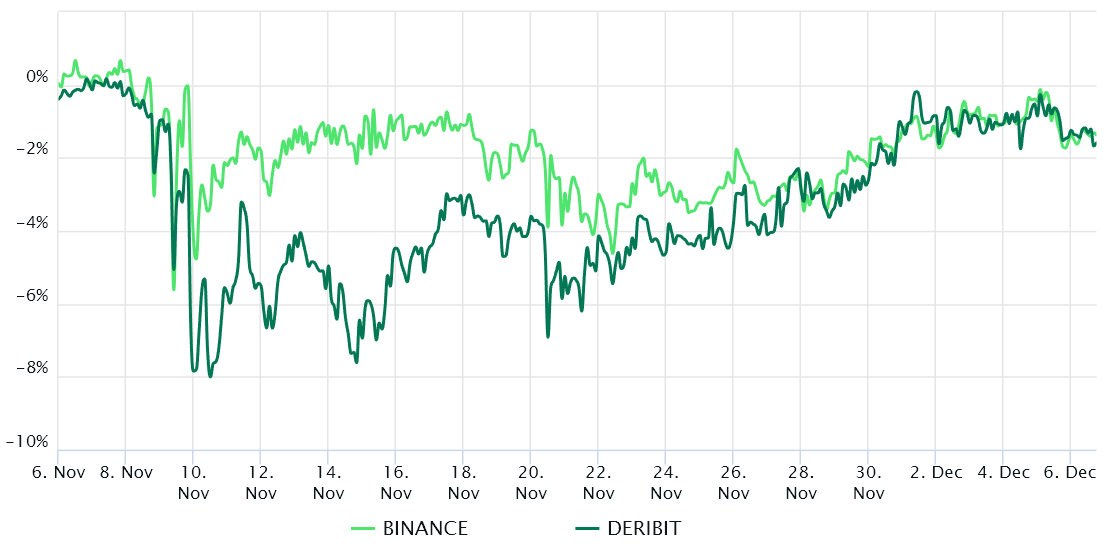
The two-month futures annualized premium should trade between +4% to +8% in healthy markets to cover costs and associated risks. Thus, when the futures trade at a discount versus regular spot markets, it shows a lack of confidence from leverage buyers — a bearish indicator.

Ether 2-month futures annualized premium. Source: Laevitas.ch

The above chart shows that derivatives traders remain bearish as the Ether futures premium is negative. So, bears can celebrate that the indicator is far from the neutral 0% to 4% premium, but that does not mean traders expect an immediate adverse price action.

For this reason, traders should analyze Ether's options markets to exclude externalities specific to the futures instrument.

Options traders are getting comfortable with the downside risks

The 25% delta skew is a telling sign when market makers and arbitrage desks are overcharging for upside or downside protection.

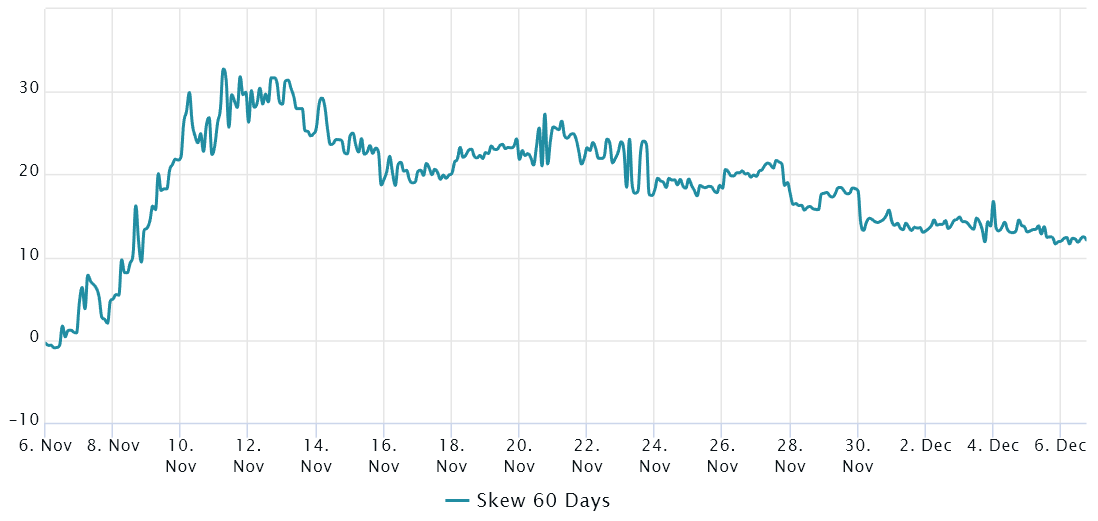
In bear markets, options investors give higher odds for a price dump, causing the skew indicator to rise above 10%. On the other hand, bullish markets tend to drive the skew indicator below -10%, meaning the bearish put options are discounted.

Ether 60-day options 25% delta skew: Source: Laevitas.ch

The delta skew has stabilized in the past week, signaling that options traders are more comfortable with downside risks.

As the 60-day delta skew stands at 12%, whales and market makers are getting closer to a neutral sentiment for Ether. Ultimately, both options and futures markets point to pro traders fearing that the $1,200 support retest is the natural course for ETH.

The answer might as well be hidden under the macroeconomic calendar ahead, which includes the EuroZone's and Canada's Gross Domestic Product (GDP) on Dec. 7 and the United States Consumer Price Index (CPI) on Dec. 13.

Currently, the odds favor Ether bears because the newsflow implies that the possibility of stricter regulation is weighing down the market.


Leituras Relacionadas

Foundation Steps Back, Ethlabs Steps Forward: Ethereum Undergoes Its Largest Restructuring in History

On June 23rd, the Ethereum ecosystem witnessed two major shifts, signaling a significant governance realignment. First, former Ethereum Foundation researchers established Ethlabs, a new independent non-profit. Backed by major ETH holders like Bitmine and SharpLink, Ethlabs aims to address practical needs for institutional adoption, including faster settlement, native asset issuance, cross-chain transactions, and mainnet scaling. Secondly, the Ethereum Foundation announced a major restructuring, laying off 54 employees (20% of its staff) to become a leaner entity focused on protocol governance and maintenance rather than being the primary builder. This move represents a pivotal correction. Criticisms had mounted over the Foundation's perceived slowness, lack of clear strategy, and over-reliance on Vitalik Buterin's influence. Ethlabs emerges as a more execution-oriented, "industrialized" layer focused on market adoption—bridging the gap between research and real-world use. Notably, Vitalik Buterin is absent from its list of supporters, interpreted as an intentional step to avoid excessive personal endorsement and allow the organization to build independent credibility. The Ethereum Foundation's downsizing and redefinition mark a retreat from its former central coordinating role. It now aims to share the "privilege of stewarding Ethereum" with other emerging groups like Ethlabs, the Ethereum Applications Guild, and The Ethereum Economic Zone. Analysts frame this dual shift as the Foundation ensuring Ethereum remains "correct" (credibly neutral), while Ethlabs must prove it remains "effective" (competitive and attractive for capital and adoption). This addresses community "shareholder-like anxiety" about ETH's market performance. While risks exist—such as concerns over shifting from Foundation centrality to large-holder influence—the consensus is that the greater risk for Ethereum was inaction, caught between technical idealism and organizational inertia. These steps aim to create a more multi-stakeholder, execution-driven future for the network.

链捕手Há 7h

Foundation Steps Back, Ethlabs Steps Forward: Ethereum Undergoes Its Largest Restructuring in History

链捕手Há 7h

Second Half of U.S. Crypto Policy: The Clarity Act Aims for 60 Votes, CFTC's "One-Person Commission" Becomes Biggest Variable

In a pivotal year for US crypto policy, the "CLARITY Act" is advancing in the Senate but faces a high hurdle, needing 60 votes to pass. Key challenges include bridging partisan divides on ethics and swaying undecided Republican senators within a tight legislative calendar of only about 40 working days. The policy "second half" involves intense negotiations on a broader framework for Web3 and DeFi, including crypto tax reforms and the Blockchain Regulatory Certainty Act. A significant uncertainty is the understaffed CFTC, operating with four commissioner vacancies, which complicates regulatory clarity. Meanwhile, the departure of key "crypto champions"—SEC Commissioner Hester Peirce and Senator Cynthia Lummis—will impact ongoing policy efforts. Industry experts are cautiously optimistic but realistic. Sara K. Weed notes that while progress is being made, CLARITY is unlikely to pass this Congress, pushing agencies like the SEC and CFTC to provide more guidance. Sulolit Mukherjee suggests meaningful crypto tax legislation is more likely to be attached to larger must-pass bills. Rashan Colbert discusses the jurisdictional debate over prediction markets, emphasizing the need for a regulatory framework that fosters their development as financial tools rather than treating them broadly as gambling. The clock is ticking, but opportunities remain for substantive progress through continued bipartisan dialogue and pragmatic efforts.

marsbitHá 10h

Second Half of U.S. Crypto Policy: The Clarity Act Aims for 60 Votes, CFTC's "One-Person Commission" Becomes Biggest Variable

marsbitHá 10h

Dan Koe's New Essay: Escaping the Fate of the Wage Slave, How to Survive the AI Replacement Wave?

Dan Koe argues that the true threat in the AI era isn't technology itself, but a reliance on others for one's livelihood and happiness. The core problem is "wage slavery"—spending life on unfulfilling work. To survive and thrive, one must escape this by building their own enterprise. The key is developing five elements: Agency (initiative), Taste (discernment), Persuasion, Persistence, and Iteration. These boil down to problem-solving skills and experiential knowledge, which cannot be learned passively but only through doing your own projects. The solution is to become "unemployable" by shifting your identity. This requires: 1) Radically changing your environment to force growth, 2) Choosing a medium (like content creation) that provides real feedback through trial and error, and 3) Mastering either code or, preferably, media (content). Content creation is more valuable because its subjective nature and need for human perspective create a durable advantage over generic AI output. To start, define your life's work by answering foundational questions about your innate knowledge, unique abilities, and contrarian beliefs. Then, immediately act by publishing your first piece of content. The cycle of creating, receiving feedback, and iterating is the essential path to developing the skills needed for an independent, meaningful career and financial resilience.

marsbitHá 10h

Dan Koe's New Essay: Escaping the Fate of the Wage Slave, How to Survive the AI Replacement Wave?

marsbitHá 10h

Research Report Analysis: Morgan Stanley Details SanDisk SNDK, The Truth About Cloud Data Center Pricing Power and AI Inference Benefits

Morgan Stanley raised its price target for SanDisk (SNDK) from $1100 to $1750 on June 22, maintaining an Overweight rating. The upgrade is driven by AI inference demand reshaping the NAND market, particularly for KV Cache and context window storage in cloud data centers. These cloud clients exhibit price inelasticity and sign long-term contracts, granting SanDisk significant pricing power. SanDisk's New Business Model (NBM) agreements, covering over one-third of FY27 bit shipments with 3-5 year terms and fixed price/price collar structures, are crucial. They are projected to sustain gross margins around 80% even at floor prices, providing a buffer against cyclical downturns. Morgan Stanley forecasts gross margins to surge from 30.3% in FY25 to 86.7% in FY27e. With NAND supply expected to remain tight into 2026/2027 and cloud/data centers becoming the largest end-market, SanDisk holds supply-side pricing power. The company targets 15-19% bit growth via technology transitions, not capacity expansion. Revenue is projected to grow ~6.6x from FY25 to FY27, with EPS rising from $2.74 to $14.73, driven by high-margin cloud business. Key upside catalysts include faster enterprise SSD adoption and edge AI growth. Downside risks involve slower industry growth, competitor capex increases, market share loss, and competition from Chinese players like YMTC. The investment thesis rests on AI-driven structural demand, NBM's margin protection, and sustained supply tightness. The $1750 target implies ~28x FY27e P/E.

marsbitHá 11h

Research Report Analysis: Morgan Stanley Details SanDisk SNDK, The Truth About Cloud Data Center Pricing Power and AI Inference Benefits

marsbitHá 11h

Trading

Spot
Futuros
活动图片