Revealed: the Alameda venture capital portfolio

Financial TimesPublicado em 2022-12-07Última atualização em 2022-12-08

Resumo

A look inside Sam and Caroline’s grab-bag of crypto, etc.

As well as running a crypto exchange that didn’t exchange crypto and owning a hedge fund that didn’t hedge, Sam Bankman-Fried had a venture capital fund that didn’t venture its own capital.

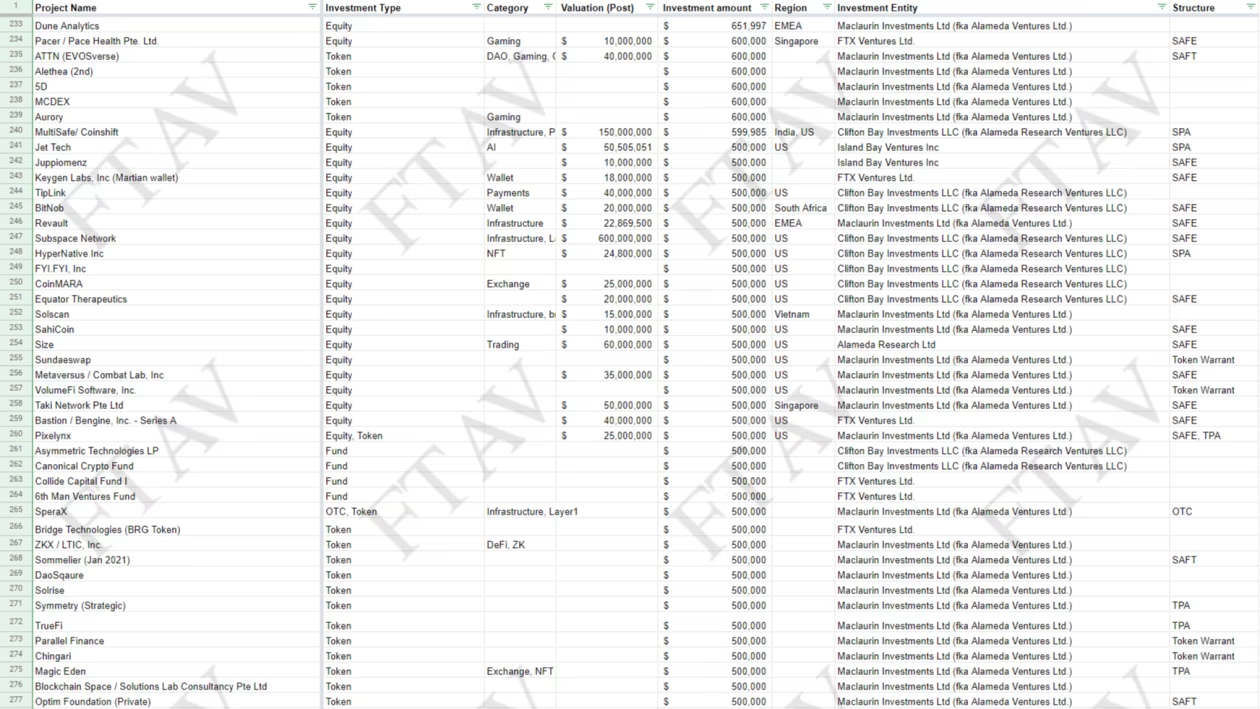
The VC division, in contrast to the rest of the FTX group, can now provide some insight into where some of the money went. Here’s where it went:

The screenshot above and all those below are taken from an Excel spreadsheet dated early November, when SBF was seeking rescue funding amid a run on FTX customer deposits. Mobile and app users are advised to click the magnifying glass below each image for more detail.

According to a person familiar with the rescue effort, the document shows an Alameda Research private equity portfolio — with some FTX bets mixed in — that was being offered as collateral in an attempt to secure a new credit line for the stricken group.

The disparate bundle of nearly 500 illiquid investments is split across 10 holding companies. The total investment value is given on the spreadsheet as in excess of $5.4bn.

As well as forming a central plank in efforts to maximise recoveries from FTX’s bankruptcy, the portfolio might offer regulators insight into whether the group’s trading and exchange businesses were ever operationally separate as claimed.

Bankman-Fried conceded in an interview with the Financial Times that he was involved in Alameda’s venture capital activities but has so far ducked questions around the misuse of FTX customer funds.

Going by the spreadsheet, boundaries between SBF’s companies were blurred. Two of Alameda’s biggest holdings, the crypto miner Genesis and the artificial intelligence research group Anthropic, are also listed on the draft FTX balance sheet published last month by FTAV. (Semafor subseqently reported that FTX had seized certain assets from Alameda after a margin call.)

As previously reported, the portfolio includes stakes in FTX backers Sequoia Capital and Anthony Scaramucci’s SkyBridge Capital, as well as in Elon Musk’s SpaceX and Boring Company projects through the investment in K5.

Of Alameda’s remaining investments, crypto and DeFi projects account for the majority. But the list also includes numerous start-up video game studios and betting platforms, online banks, publishers, a fertility clinic, a military drone maker and a vertical farming company,

Some entries have no clear link to an active business, suggesting they may be misspelt or mislabeled.

Note that FT Alphaville has excluded entries where an investment type is not given, which removes approximately a dozen names with a total stated investment of about $100mn. All other data are presented as they were shown to prospective FTX investors. The FT makes no claim as to the data’s accuracy or completeness.

When asked about why FTX used customer funds to prop up Alameda, SBF has repeatedly pleaded ignorance. The former FTX CEO said that to avoid conflicts of interest he chose not to get involved in Alameda’s trading and risk management, so before last month was not fully aware of its parlous state.

However, SBF told the FT that in early summer he had participated in conversations where Alameda’s financial health and borrowing were discussed. The venture capital investments Alameda had made were “effectively, some of them, on margin”, he added.

Alameda’s spreadsheet predates SBF’s current media blitz by a month, though it comes with all the same warnings about potentially selective recall and unreliable presentation, As the FT’s Joshua Oliver reports:

Bankman-Fried’s attempt to account for what went wrong was laced with caveats and references to his incomplete memory. He cited lack of “confidence” in his answers at least a dozen times, calling other responses “idle speculation” or “shitty answers”. At one point, he paused for half a minute with his head in his hands.

Caroline Ellison, former CEO of Alameda and SBF’s one-time romantic partner, could not be reached for comment.

Leituras Relacionadas

Foundation Steps Back, Ethlabs Steps Forward: Ethereum Undergoes Its Largest Restructuring in History

On June 23rd, the Ethereum ecosystem witnessed two major shifts, signaling a significant governance realignment. First, former Ethereum Foundation researchers established Ethlabs, a new independent non-profit. Backed by major ETH holders like Bitmine and SharpLink, Ethlabs aims to address practical needs for institutional adoption, including faster settlement, native asset issuance, cross-chain transactions, and mainnet scaling. Secondly, the Ethereum Foundation announced a major restructuring, laying off 54 employees (20% of its staff) to become a leaner entity focused on protocol governance and maintenance rather than being the primary builder. This move represents a pivotal correction. Criticisms had mounted over the Foundation's perceived slowness, lack of clear strategy, and over-reliance on Vitalik Buterin's influence. Ethlabs emerges as a more execution-oriented, "industrialized" layer focused on market adoption—bridging the gap between research and real-world use. Notably, Vitalik Buterin is absent from its list of supporters, interpreted as an intentional step to avoid excessive personal endorsement and allow the organization to build independent credibility. The Ethereum Foundation's downsizing and redefinition mark a retreat from its former central coordinating role. It now aims to share the "privilege of stewarding Ethereum" with other emerging groups like Ethlabs, the Ethereum Applications Guild, and The Ethereum Economic Zone. Analysts frame this dual shift as the Foundation ensuring Ethereum remains "correct" (credibly neutral), while Ethlabs must prove it remains "effective" (competitive and attractive for capital and adoption). This addresses community "shareholder-like anxiety" about ETH's market performance. While risks exist—such as concerns over shifting from Foundation centrality to large-holder influence—the consensus is that the greater risk for Ethereum was inaction, caught between technical idealism and organizational inertia. These steps aim to create a more multi-stakeholder, execution-driven future for the network.

链捕手Há 6h

Foundation Steps Back, Ethlabs Steps Forward: Ethereum Undergoes Its Largest Restructuring in History

链捕手Há 6h

Second Half of U.S. Crypto Policy: The Clarity Act Aims for 60 Votes, CFTC's "One-Person Commission" Becomes Biggest Variable

In a pivotal year for US crypto policy, the "CLARITY Act" is advancing in the Senate but faces a high hurdle, needing 60 votes to pass. Key challenges include bridging partisan divides on ethics and swaying undecided Republican senators within a tight legislative calendar of only about 40 working days. The policy "second half" involves intense negotiations on a broader framework for Web3 and DeFi, including crypto tax reforms and the Blockchain Regulatory Certainty Act. A significant uncertainty is the understaffed CFTC, operating with four commissioner vacancies, which complicates regulatory clarity. Meanwhile, the departure of key "crypto champions"—SEC Commissioner Hester Peirce and Senator Cynthia Lummis—will impact ongoing policy efforts. Industry experts are cautiously optimistic but realistic. Sara K. Weed notes that while progress is being made, CLARITY is unlikely to pass this Congress, pushing agencies like the SEC and CFTC to provide more guidance. Sulolit Mukherjee suggests meaningful crypto tax legislation is more likely to be attached to larger must-pass bills. Rashan Colbert discusses the jurisdictional debate over prediction markets, emphasizing the need for a regulatory framework that fosters their development as financial tools rather than treating them broadly as gambling. The clock is ticking, but opportunities remain for substantive progress through continued bipartisan dialogue and pragmatic efforts.

marsbitHá 9h

Second Half of U.S. Crypto Policy: The Clarity Act Aims for 60 Votes, CFTC's "One-Person Commission" Becomes Biggest Variable

marsbitHá 9h

Research Report Analysis: Morgan Stanley Details SanDisk SNDK, The Truth About Cloud Data Center Pricing Power and AI Inference Benefits

Morgan Stanley raised its price target for SanDisk (SNDK) from $1100 to $1750 on June 22, maintaining an Overweight rating. The upgrade is driven by AI inference demand reshaping the NAND market, particularly for KV Cache and context window storage in cloud data centers. These cloud clients exhibit price inelasticity and sign long-term contracts, granting SanDisk significant pricing power. SanDisk's New Business Model (NBM) agreements, covering over one-third of FY27 bit shipments with 3-5 year terms and fixed price/price collar structures, are crucial. They are projected to sustain gross margins around 80% even at floor prices, providing a buffer against cyclical downturns. Morgan Stanley forecasts gross margins to surge from 30.3% in FY25 to 86.7% in FY27e. With NAND supply expected to remain tight into 2026/2027 and cloud/data centers becoming the largest end-market, SanDisk holds supply-side pricing power. The company targets 15-19% bit growth via technology transitions, not capacity expansion. Revenue is projected to grow ~6.6x from FY25 to FY27, with EPS rising from $2.74 to $14.73, driven by high-margin cloud business. Key upside catalysts include faster enterprise SSD adoption and edge AI growth. Downside risks involve slower industry growth, competitor capex increases, market share loss, and competition from Chinese players like YMTC. The investment thesis rests on AI-driven structural demand, NBM's margin protection, and sustained supply tightness. The $1750 target implies ~28x FY27e P/E.

marsbitHá 10h

Research Report Analysis: Morgan Stanley Details SanDisk SNDK, The Truth About Cloud Data Center Pricing Power and AI Inference Benefits

marsbitHá 10h

Trading

Spot
Futuros
活动图片