Ethereum bears have the upper hand according to derivatives data, but for how long?

CointelegraphPublicado em 2022-11-23Última atualização em 2022-11-23

Resumo

ETH bears continue to suppress Ethereum price, but institutional traders’ buying activity and exchanges’ aiming to provide more transparency could improve investor sentiment.

Ether price experienced an 11.9% decline from Nov. 20 to Nov. 22, bottoming at $1,074 — the lowest level seen since July. Currently, investors have reason to be concerned after crypto lending company Genesis reportedly faced difficulties raising money, triggering rumors of insolvency on Nov. 21.

However, a spokesperson for Genesis told Cointelegraph that there were no plans for imminent bankruptcy because the company continues to hold discussions with its creditors.

Unease about the centralization of decentralized finance (DeFi) surfaced after Uniswap Labs changed the privacy policy on Nov. 17, revealing that it collects publicly-available blockchain data, users' browser information, operating systems data and interactions with its service providers.

Adding to the fracas, the hacker behind the FTX exchange theft of $447 million has been spotted moving their Ether funds. On Nov. 20, the attacker transferred 50,000 ETH to a separate wallet and converted it to Bitcoin using two renBTC bridges.

Traders fear that the hacker might be suppressing Ether's price to profit using leveraged short bets. The rumor was raised by @kundunsan on Nov. 15, even though the Twitter post did not gain exposure.
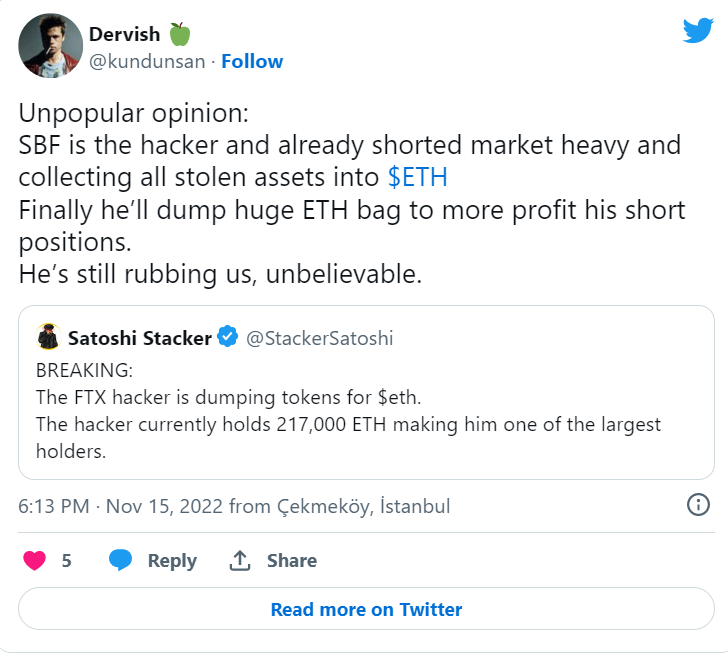
Let's look at Ether derivatives data to understand if the worsening market conditions have impacted crypto investors' sentiment.

Pro traders have been in panic mode since Nov. 10

Retail traders usually avoid quarterly futures due to their price difference from spot markets, but they are professional traders' preferred instruments because they prevent the fluctuation of funding rates that often occurs in a perpetual futures contract.
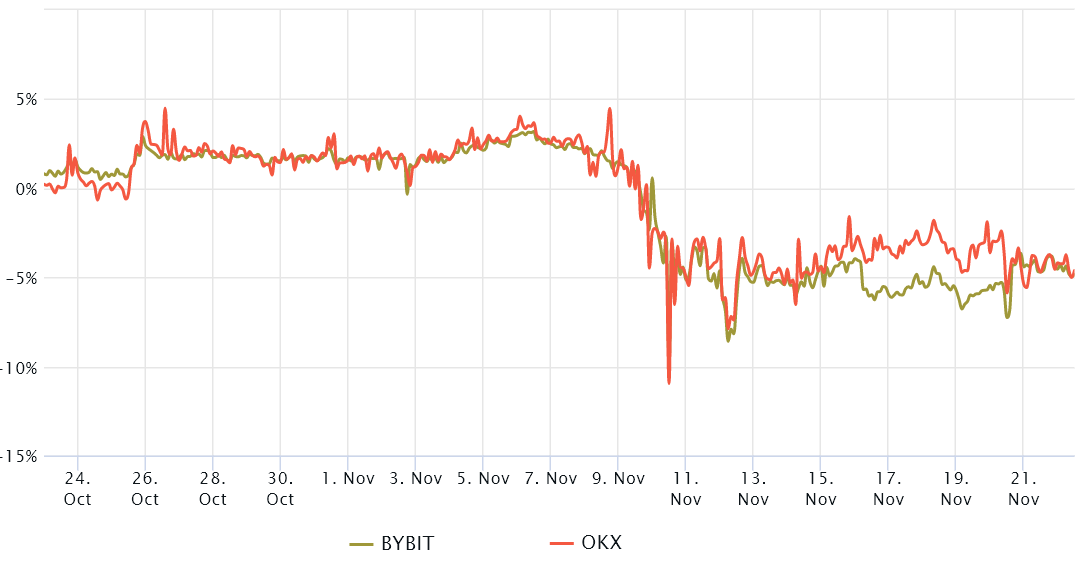
The three-month futures annualized premium should trade between +4% to +8% in healthy markets to cover costs and associated risks. The chart above shows that derivatives traders have been bearish since Nov. 10 since the Ether futures premium was negative.

Currently there is backwardation in the contracts and this situation is atypical and usually deemed bearish. The metric did not improve after ETH rallied 5% on Nov. 22, reflecting professional traders' unwillingness to add leveraged long (bull) positions.

Traders should also analyze Ether's options markets to exclude externalities specific to the futures instrument.

Options traders fear additional crashes

The 25% delta skew is a telling sign when market makers and arbitrage desks are overcharging for upside or downside protection.

In bear markets, options investors give higher odds for a price dump, causing the skew indicator to rise above 10%. On the other hand, bullish markets tend to drive the skew indicator below -10%, meaning the bearish put options are discounted.
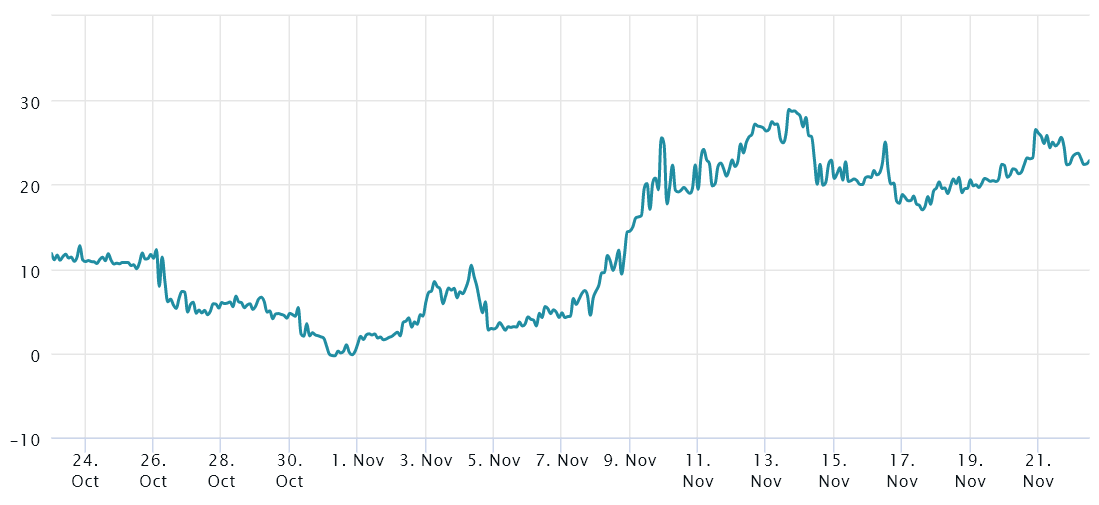
The delta skew has been above the 10% threshold since Nov. 9, signaling that options traders were less inclined to offer downside protection. The situation worsened over the following days as the delta skew indicator surged above 20%.

The 60-day delta skew currently stands at 23%, so whales and market makers are pricing higher odds of price dumps for Ether. Consequently, derivatives data shows low confidence right as Ether struggles to hold the $1,100 support.

According to the data, Ether bulls should not throw in the towel just yet because these metrics tend to be backward-looking. The panic that followed FTX's bankruptcy and the subsequent liquidity issues at Genesis might dissipate quickly if exchanges public proof of reserves and institutional investors addingBitcoin exposure during the dip are interpreted as positives by market participants.

With that said, at the moment Ether bears still have the upper hand according to ETH derivatives metrics.


Criptomoedas em alta

Leituras Relacionadas

The Disappearing Buy Button

"The Vanished 'Buy' Button" In June 2026, major Chinese online brokers Futu and Tiger were barred from allowing mainland Chinese users to purchase or deposit funds for US stocks, following a multi-department regulatory crackdown. This move, part of China's long-standing capital controls, aims to stem the outflow of domestic capital to support the development of local technology sectors, particularly in AI, where China perceives itself to be lagging. The restriction highlights a growing divergence between national economic strategy and individual investor needs. With slowing wage growth and a deflating property market, Chinese retail investors saw US tech stocks—which dominate global indices and capture a quarter of global economic growth—as a crucial avenue for wealth preservation. Domestically, the A-share market has only recently seen its technology sector surpass the long-dominant financial sector in index weight, reflecting a state-directed shift toward "new quality productive forces." The crackdown mirrors past actions against cryptocurrencies and tech deals, prioritizing financial stability and onshore control. It also aims to funnel liquidity and listings to Hong Kong and mainland exchanges to retain economic sovereignty. This regulatory gap creates an opportunity for decentralized finance. The emerging narrative shifts from "banking the unbanked" to "brokering the unbrokered"—using crypto and tokenized real-world assets (RWAs), like stocks, to provide global access to productive assets for those excluded by traditional finance, from Chinese散户 to users in other restricted markets. Simultaneously, the AI era is reshaping global capital flows. US tech giants act as "macro hedge funds," issuing cheap foreign-currency debt to fund expansion, leveraging their superior credit. However, non-US AI supply chain players (e.g., in semiconductors) are also rising. The competition for asset ownership and low-cost financing rights is intensifying, making access to capital a new societal divide as AI devalues routine intellectual labor. Finance remains in the "business of hope," but its gates are being redrawn.

marsbitHá 7m

The Disappearing Buy Button

marsbitHá 7m

According to Strategy, MSTR Has Delivered an Annual Return of 42% Since Adopting the 'Bitcoin Standard,' Even Though Its Treasury Is Underwater

According to Strategy (formerly MicroStrategy) Executive Chairman Michael Saylor, the company's stock MSTR has delivered a 42% annualized return since August 10, 2020, when it adopted its "Bitcoin standard" strategy. This performance surpasses that of Bitcoin itself, the "Magnificent Seven" tech stocks, and the S&P 500 over the same period. Saylor frequently highlights this to demonstrate the success of transforming the software firm into a leveraged Bitcoin investment vehicle. Despite this strong long-term stock performance, Strategy's core Bitcoin treasury position is currently at a loss. As of July 29, the company holds 843,775 BTC, purchased for an average of $75,476 per coin, implying an unrealized loss of approximately $11.4 billion. The disparity arises because MSTR stock acts as a leveraged proxy for Bitcoin, allowing for high annualized returns over a multi-year period even when recent purchases are underwater. To address its increasingly complex capital structure, which now includes multiple classes of preferred stock, Strategy introduced a new reporting framework on July 24. Key metrics include "Net BTC per Share," "$BTC Hurdle ARR" (the annual Bitcoin yield needed to cover financing costs), and "$BTC Floor ARR" (the minimum yield to maintain a sustainable leverage ratio). The company continues to accumulate Bitcoin and recently bolstered its dollar reserves by $525 million to strengthen coverage for preferred stock dividends.

cryptonews.ruHá 8m

According to Strategy, MSTR Has Delivered an Annual Return of 42% Since Adopting the 'Bitcoin Standard,' Even Though Its Treasury Is Underwater

cryptonews.ruHá 8m

Base Launches 'Human Verification', Is the Airdrop on the Agenda?

Base has launched "Base Verify Onchain," a new verification mechanism aimed at solving the problem of Sybil attacks and duplicate participation in on-chain activities like airdrops, rewards, voting, or minting. While blockchains can track wallet addresses, they cannot determine if multiple wallets belong to the same person. The system works by connecting off-chain identity verification with on-chain smart contract rules. Developers can set specific eligibility criteria in their contracts (e.g., requiring a verified X account or a Coinbase One membership). Users connect their wallet and sign a message, which is sent to Base Verify's off-chain service. This service checks if the user meets the pre-set conditions against verified credentials. If they do, it issues a short-lived cryptographic proof containing an identityHash. The application then submits this proof to the smart contract. The contract verifies the proof's validity, checks expiration, and crucially, uses the identityHash to ensure the same verified identity cannot participate more than once, even if using a different wallet address. This identityHash is unique per application contract, preventing cross-application tracking. Base Verify Onchain is positioned as a tool for reliably enforcing participation rules ("who" and "how many times") in specific on-chain scenarios. It is not a general identity system or KYC solution. Its announcement has sparked speculation about a potential future Base token airdrop, for which this tool could be used to prevent abuse. However, Base has previously stated that work on a network token is still in early exploration stages.

marsbitHá 23m

Base Launches 'Human Verification', Is the Airdrop on the Agenda?

marsbitHá 23m

Trading

Spot

Artigos em Destaque

Como comprar UNI

Bem-vindo à HTX.com!Tornámos a compra de Uniswap (UNI) simples e conveniente.Segue o nosso guia passo a passo para iniciar a tua jornada no mundo das criptos.Passo 1: cria a tua conta HTXUtiliza o teu e-mail ou número de telefone para te inscreveres numa conta gratuita na HTX.Desfruta de um processo de inscrição sem complicações e desbloqueia todas as funcionalidades.Obter a minha contaPasso 2: vai para Comprar Cripto e escolhe o teu método de pagamentoCartão de crédito/débito: usa o teu visa ou mastercard para comprar Uniswap (UNI) instantaneamente.Saldo: usa os fundos da tua conta HTX para transacionar sem problemas.Terceiros: adicionamos métodos de pagamento populares, como Google Pay e Apple Pay, para aumentar a conveniência.P2P: transaciona diretamente com outros utilizadores na HTX.Mercado de balcão (OTC): oferecemos serviços personalizados e taxas de câmbio competitivas para os traders.Passo 3: armazena teu Uniswap (UNI)Depois de comprar o teu Uniswap (UNI), armazena-o na tua conta HTX.Alternativamente, podes enviá-lo para outro lugar através de transferência blockchain ou usá-lo para transacionar outras criptomoedas.Passo 4: transaciona Uniswap (UNI)Transaciona facilmente Uniswap (UNI) no mercado à vista da HTX.Acede simplesmente à tua conta, seleciona o teu par de trading, executa as tuas transações e monitoriza em tempo real.Oferecemos uma experiência de fácil utilização tanto para principiantes como para traders experientes.

516 Visualizações TotaisPublicado em {updateTime}Atualizado em 2026.06.02

Como comprar UNI

Discussões

Bem-vindo à Comunidade HTX. Aqui, pode manter-se informado sobre os mais recentes desenvolvimentos da plataforma e obter acesso a análises profissionais de mercado. As opiniões dos utilizadores sobre o preço de UNI (UNI) são apresentadas abaixo.

活动图片