No one is set to lose more from FTX’s implosion than Sam Bankman-Fried, the crypto wunderkind who founded the exchange and then drove it into the ground this week. His net worth, once as high as $26.5 billion, has plummeted to less than a billion dollars–one of the fastest falls from the billionaires ranks ever. FTX users and employees may be in for big losses too, with Bankman-Fried now trying to cobble together emergency funding to cover a shortfall of up to $8 billion as customers demand their money back. “I can't make any promises,” he tweeted Thursday. “But I'm going to try.”
Then there are FTX’s investors.
As the crypto exchange ballooned in size, it became a huge draw for venture capitalists eager to get in on the Bitcoin boom. In June 2021, FTX raised $1 billion at an $18 billion valuation from venture investors such as Paradigm, SoftBank and Sequoia Capital. Three months later, FTX brought in a $421 million haul, pushing its valuation to $25 billion, from investors like Singapore-government owned investment firm Temasek, Tiger Global Management and the Ontario Teachers’ Pension Plan. By January of this year, crypto prices were on the decline, but FTX charged ahead. Investors, many of whom had also pumped money into the earlier rounds, put another $400 million into FTX–at a $32 billion valuation.
That $32 billion figure has gone up in smoke. So has the $1.8 billion-plus of capital that investors pumped into FTX over the course of three years: At least two major shareholders are marking their investment in FTX down to $0: venture capital firm Sequoia and, reportedly, crypto-focused firm Paradigm. Forbes did the same, dropping Bankman-Fried and cofounder Gary Wang from our billionaire’s list Wednesday, based on the collapse of both FTX and the pair’s trading firm, Alameda Research.
In a strict sense, FTX’s investors’ losses are limited to the $1.8 billion or so they put into the business. But their paper losses are much, much higher. If any of these investors had cashed out in January, when FTX peaked at the $32 billion valuation, they’d be tens or even hundreds of millions dollars richer. Instead, they could well end up with nothing.
Who will lose the most? Forbes has a list of FTX shareholders, sent to us by Sam Bankman-Fried in August during our reporting for The Forbes 400 list. Here are the venture capital firms, the pension plan–and two celebrity endorsers–who have a lot to lose if FTX can’t be saved.
(This analysis does not include shares of FTX U.S., the exchange’s American operations, which raised $400 million at an $8 billion valuation concurrent with FTX’s series C round in January. It remains unclear how the troubles facing FTX will impact the value of FTX U.S.. It’s possible that losses from FTX U.S. will push some investors’ total investment in Sam Bankman-Fried’s empire even higher.)
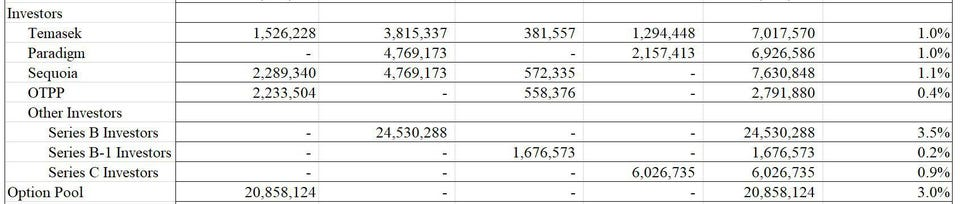
According to the capitalization table Sam Bankman-Fried sent Forbes in August, investors who stand to lose big if FTX goes to zero include employees, investment firms and Ontario teachers'' pensions.FORBES
SEQUOIA CAPITAL
Stake in FTX: 1.1%
Estimated amount invested (FTX only): $200 million
Value at January 2022 peak: $350 million
The Silicon Valley VC fund–famed for its investments in tech giants like Apple, Google and Airbnb–bought into FTX’s series B and B-1 rounds alongside Sequoia Capital Global Equities, a separate entity–to the tune of more than $200 million, according to a letter Sequoia shared on Twitter Wednesday. “FTX is the high-quality, global crypto exchange the world needs,” Sequoia partner Alfred Lin said in June 2021, after the series B round. “Sam is the perfect founder to build this business, and the team's execution is extraordinary.”
The warm feelings were mutual: According to a report published by The Information on Thursday, Alameda Research and Bankman-Fried-backed VC fund FTX Ventures committed “hundreds of millions of dollars” to funds run by Sequoia and two other firms.
The value of Sequoia’s investments in FTX peaked at $350 million earlier this year, marking what is the largest likely loss for an outside investor in the exchange. Sequoia said in its letter to its investors that its FTX stake represented less than 3% of the committed capital of one fund, and the fund’s $150 million loss is offset by about $7.5 billion in realized and unrealized gains.
TEMASEK
Stake in FTX: 1%
Est. amount invested: $205 million
Value at January 2022 peak: $320 million
An investment company owned by the government of Singapore, Temasek is the second-largest outside investor on the capitalization table, with 7 million shares. The $297 billion (assets) business, which owns big stakes in Singapore’s DBS Group and Singapore Airlines, invested in all three of FTX’s major funding rounds. With its $320 million stake on the brink of being worthless, a Temasek spokesperson told Reuters on Wednesday that they were “aware of the developments” and were “engaging FTX in our capacity as shareholder."
PARADIGM
Stake in FTX: 1%
Est. amount invested: $215 million
Value at January 2022 peak: $315 million
Paradigm, an investment firm “focused on supporting the crypto/Web3 companies and protocols of tomorrow,” invested in the exchange’s series B and C rounds and owned nearly 7 million shares of FTX as of August. “There's a bright future ahead for Sam and FTX,” Paradigm cofounder Matt Huang said in July 2021, “and Paradigm is excited to be a part of it."
According to The Information, Alameda Research also invested at least $20 million in Paradigm.
ONTARIO TEACHERS’ PENSION PLAN
Stake in FTX: 0.4%
Est. amount invested: $80 million
Value at January 2022 peak: $125 million
The Ontario Teachers' Pension Plan, which manages the retirement funds of 333,000 teachers in the Canadian province, invested a total of $95 million between FTX and FTX U.S. in late 2021 and early 2022. The FTX portion of that investment alone was worth an estimated $130 million following FTX’s series C round–before the crypto winter and current crisis. “While there is uncertainty about the future of FTX,” Ontario Teachers’ wrote in a statement, “any financial loss on this investment will have limited impact on the plan, given this investment represents less than 0.05% of our total net assets.”