Bitcoin price bottom takes shape as 'old coins' hit a record 78% of supply

CointelegraphPublicado em 2022-11-02Última atualização em 2022-11-02

Resumo

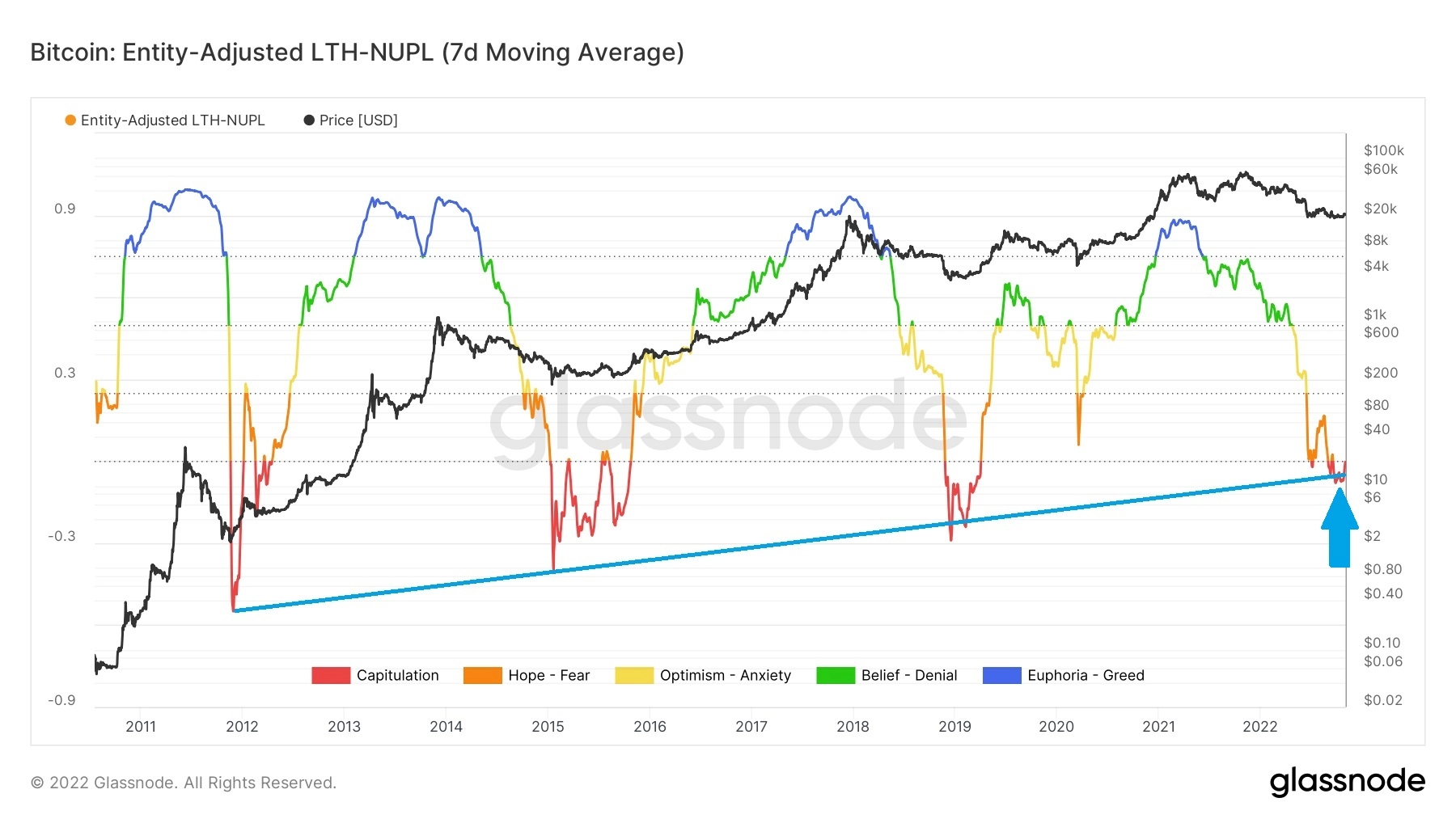
Bitcoin's long-term holders' NUPL metric has dropped to levels that coincided with market bottoms thrice since November 2011.

Bitcoin and the rest of the crypto market have been in a bear market for almost a year. The top cryptocurrency has seen its market valuation plummet by more than $900 billion in the said period, with macro fundamentals suggesting more pain ahead.

Another bear cycle produces more BTC hodlers

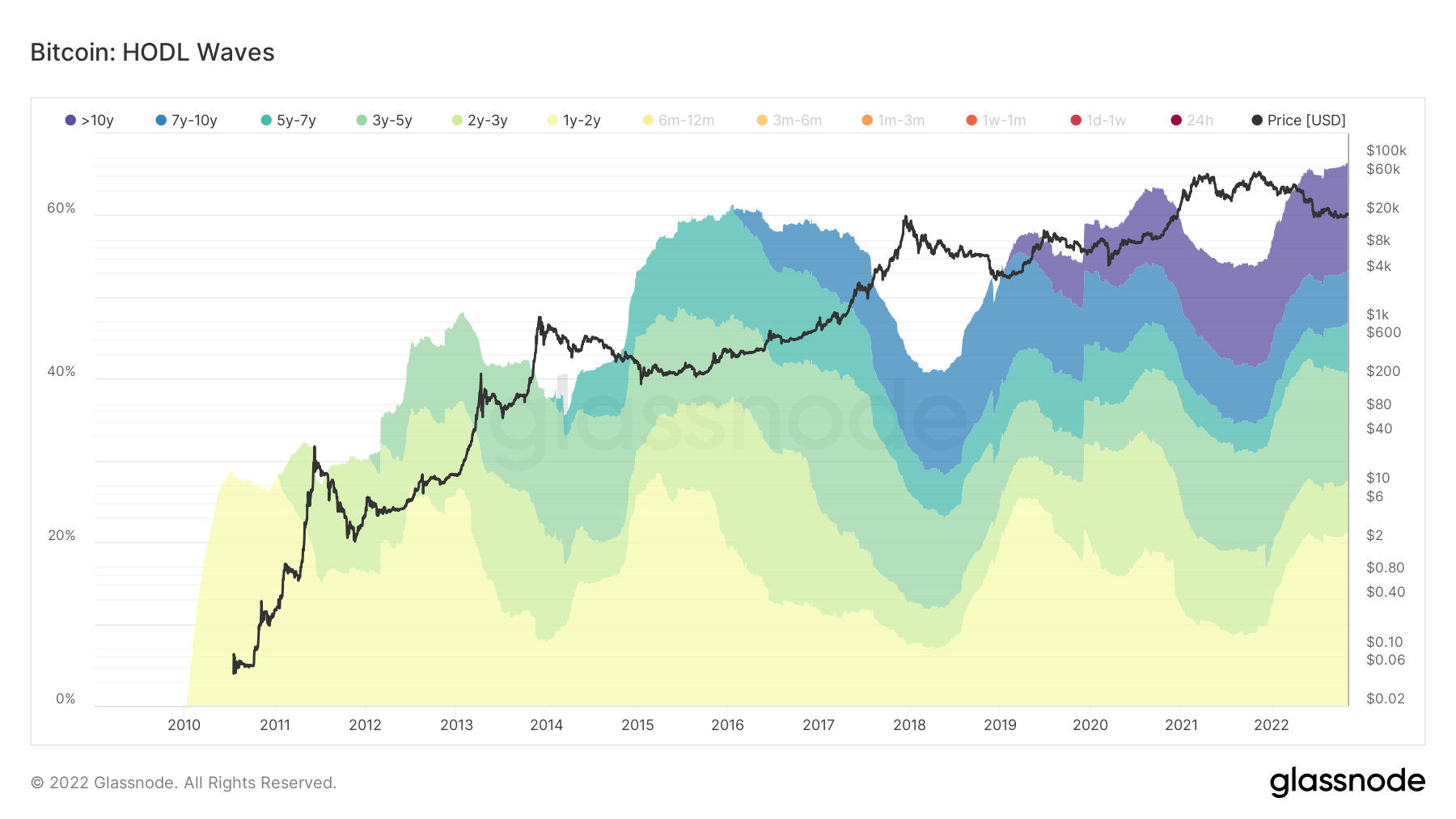
But the duration of Bitcoin's bear market has coincided with a substantial rise in the percentage of BTC's total supply held by investors for at least six months to one year.

Notably, the percentage of coins held for at least a year has risen from nearly 54% on Oct. 28, 2021, to a record high of 66% on Oct. 28, 2022, data shows.

Bitcoin HODL waves. Source: Glassnode

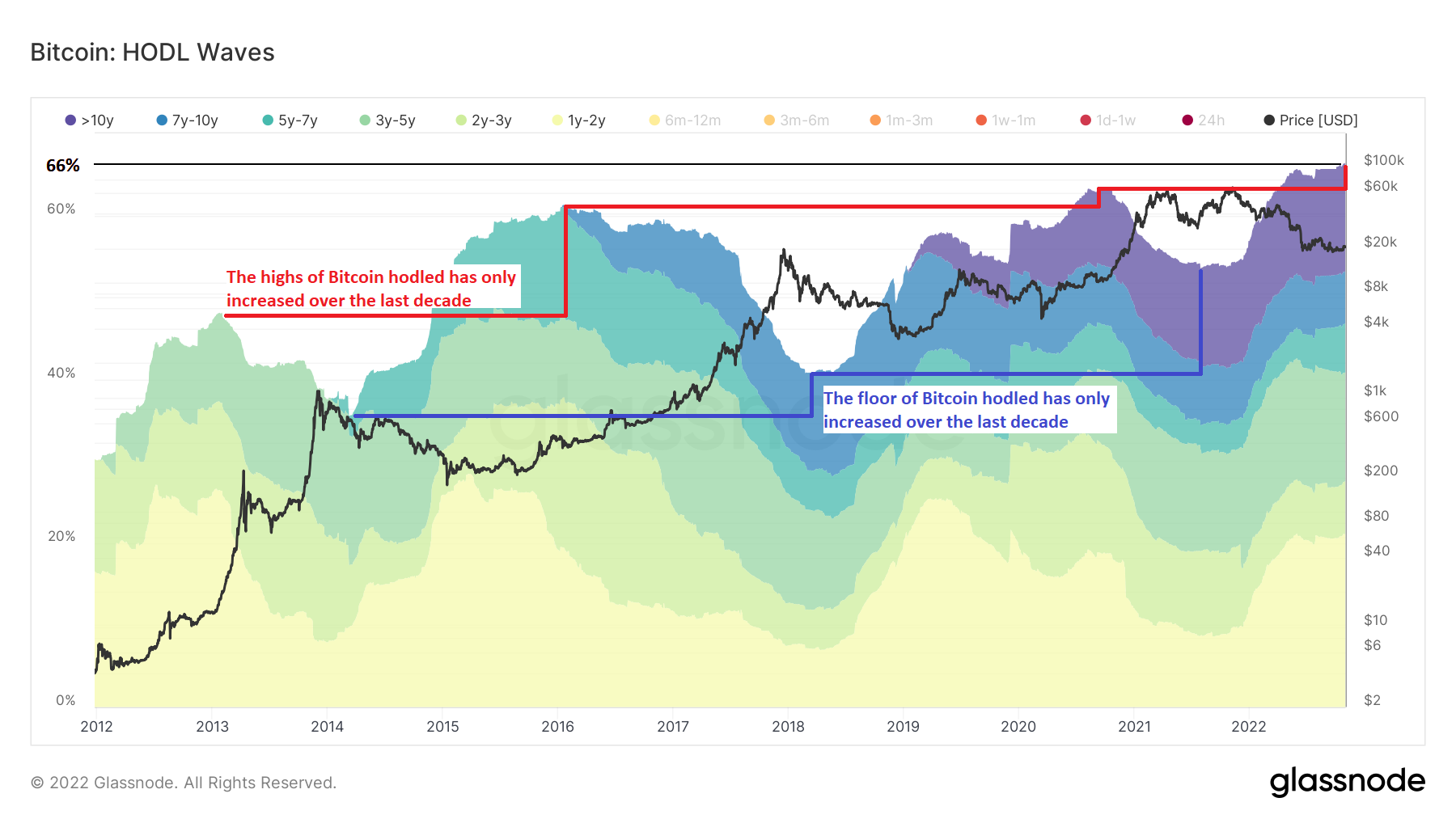
This evidence suggests that long-term investors are increasingly looking at Bitcoin as a store of value, asserts Charles Edwards, founder of digital asset fund Capriole Investments.

"Despite the worst year in stocks and bonds in centuries, Bitcoiners have never held on to more Bitcoin," the analyst noted while highlighting how the floor and ceiling in Bitcoin held for the long term has been increasing after each cycle.

Bitcoin HOLD waves featuring long-term BTC holding highs and floors. Source: Glassnode/Capriole Investments

Hodler data hints at Bitcoin price bottom

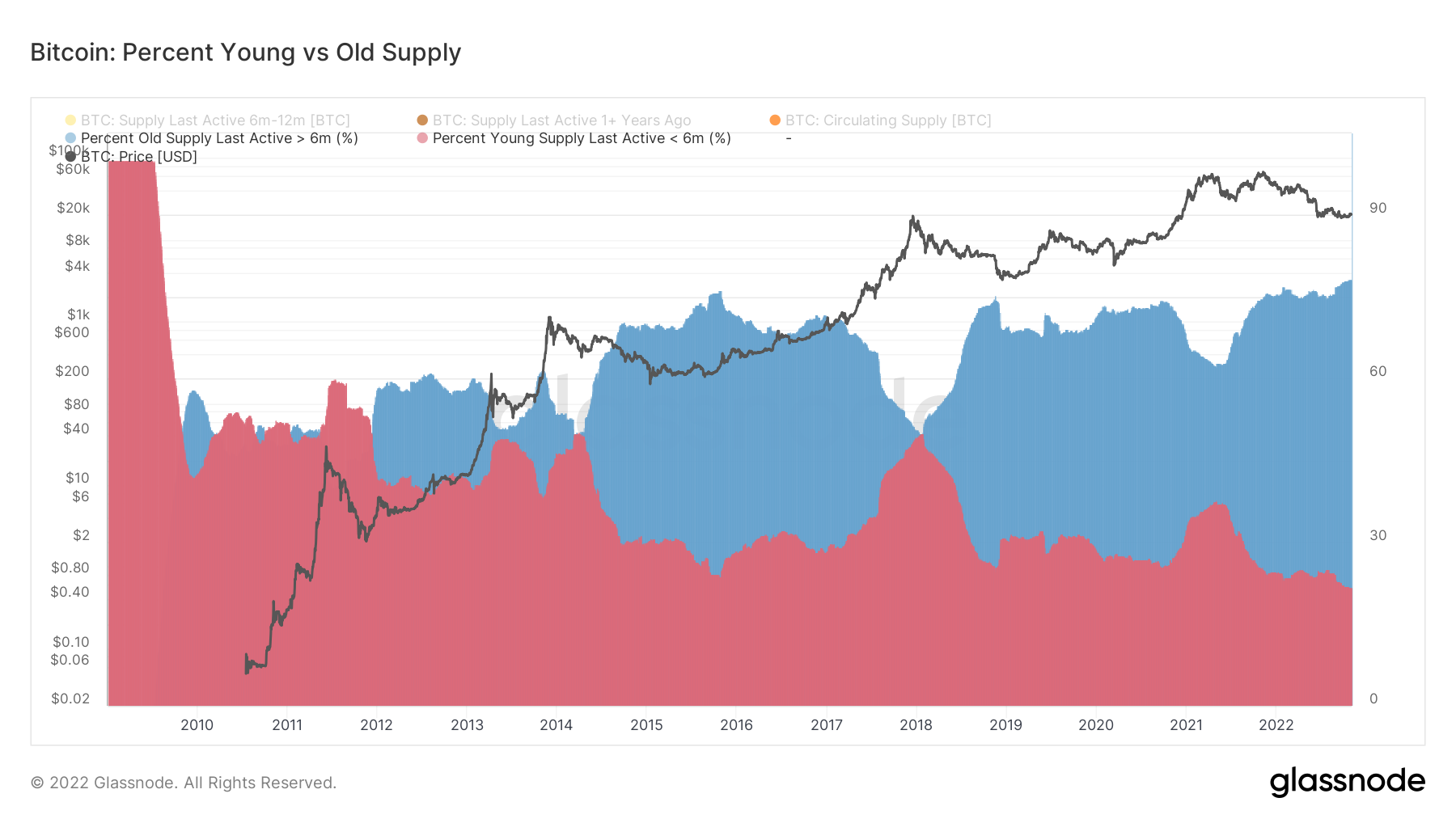
Additionally, Glassnode's research shows that the Bitcoin tokens held for at least 5-6 months are less likely to be sold. The number of these so-called "old coins" typically rises during bear markets, highlighting accumulation by the patient, long-term investors as short-term investors sell.

The behavioral difference is visible in the chart below, where the downtrend in Bitcoin price coincides with a persistent decline in the number of "younger coins" and an increase in the number of coins inactive for at least six months, or "old coins."

Bitcoin percent young (red) vs. old (blue) supply. Source: Glassnode

As of Oct. 31, the old coins comprise nearly 78% of the Bitcoin supply in circulation versus younger coins' 22%, thus reducing the likelihood of intense selloffs while forming a potential market bottom.

Moreover, on-chain data tracking Bitcoin's price and its long-term holders' (LTH) net unrealized profits and losses (NUPL) hints at a similar scenario.

Bitcoin entry-adjusted LTH-NUPL. Source: Glassnode

Notably, Bitcoin's entry-adjusted LTH-NUPL has entered the capitulation zone (red) that has coincided with the end of previous bear markets, as shown above. That includes the strong bullish reversals witnessed in November 2011, January 2015 and December 2018.

As Cointelegraph reported, Microstrategy, the world’s largest corporate holder of Bitcoin, has also reiterated its commitment to continue buying BTC for the long term.

"We have a long-term time horizon and the core business is not impacted by the near-term Bitcoin price fluctuations," explained CEO Phong Le.


Leituras Relacionadas

Report Interpretation: J.P. Morgan Details Micron's Pre-Earnings Sentiment, Current Hardware Sector Dynamics

Morgan Stanley analyst Joshua Meyers' report (June 21, 2026) highlights key trends in the hardware and semiconductor sector ahead of Micron's earnings. The core takeaways are: 1. **Micron & Memory:** Memory remains a high-conviction long theme, driven by strong AI demand and rising ASPs. However, investor focus is shifting to the sustainability of Micron's >80% gross margins and the specifics of potential new long-term supply agreements (SCAs). 2. **Hardware Supply Chain:** AI-related demand for servers, networking, and storage remains robust, but company performance is diverging. Celestica (CLS) shows improved margin confidence, Western Digital and Seagate benefit from pricing, Fabrinet (FN) sees predictable AI optics growth, and Teradyne (TER) anticipates a new Google customer. 3. **AI Capex & WFE Forecasts:** JPMorgan increased its Wafer Fab Equipment (WFE) market growth forecasts to 28% in 2026 and 29% in 2027. AI infrastructure financing is evolving, with higher project-level debt reducing constraints on capex expansion. The report signals that while the AI-driven hardware cycle is strong, the market is entering a phase focused on execution verification (e.g., Micron's SCA details, Fabrinet's ramp with Amazon) and valuation sustainability. Key near-term signals include Micron's guidance, Arista Networks' outlook, and the pace of demand normalization post potential tariff-related pull-ins.

marsbitHá 6h

Report Interpretation: J.P. Morgan Details Micron's Pre-Earnings Sentiment, Current Hardware Sector Dynamics

marsbitHá 6h

Research Report Analysis: The Fed's New Chair's Debut – New Leader, But Same Script?

Report Analysis: Federal Reserve's New Chair Debut – A New Captain, But the Same Script? Morgan Stanley's chief global economist Seth B. Carpenter analyzes the first FOMC meeting under new Fed Chair Kevin Warsh in a June 21 report. Warsh deliberately avoided providing forward guidance on interest rates, aligning with his philosophy. However, market expectations for a rate hike this year were reinforced. Key signals lie elsewhere: inflation may fall more than expected, and quantitative tightening (QT) could be more aggressive than anticipated. The FOMC's "dot plot" suggests only one rate hike in 2026. Carpenter argues that if inflation undershoots forecasts, the logic for even a single hike weakens, especially as projections indicate potential rate cuts in 2027. On QT, Warsh's stance is clear. Carpenter notes that measures like halving the Treasury's account balance could shrink the Fed's balance sheet by around $500 billion with minimal market impact. Combined with adjustments to reserve interest and liquidity rules, the ultimate QT scale may exceed expectations, though its market effect might be less disruptive unless the Fed actively sells Mortgage-Backed Securities (MBS). While Warsh initiated a review of the Fed's policy framework, the 2% inflation target remains intact for now. The report concludes that the market may be overestimating the significance of reduced forward guidance and the near-term rate hike risk, while potentially underestimating the scope and manageable nature of the coming balance sheet reduction. The key debates will hinge on upcoming core PCE data, the specifics of the QT path, and the framework review's findings.

marsbitHá 7h

Research Report Analysis: The Fed's New Chair's Debut – New Leader, But Same Script?

marsbitHá 7h

Critical Game Week: BTC Retracement Confirmation vs. HYPE Support Battle | Guest Analysis

This weekly analysis outlines a critical juncture for BTC and HYPE markets, focusing on key price level confirmations. **BTC Analysis:** BTC is at a pivotal point after a five-wave rally from the June 5th low of $59,100. The price has broken below a short-term rising channel's lower boundary, with the current move seen as a pullback to test this breakdown. Failure to reclaim this level could lead to a retest of the $59,000-$60,000 support zone. The core scenario hinges on this channel retest outcome. * **Key Levels:** Resistance at $64,500-$65,000 (channel boundary) and $69,500-$70,500. Support at $59,000-$60,000 and $55,000. * **Strategy:** A core bearish stance is maintained (20% short from last week), with short-term plans for tactical trades. Three detailed contingency plans (A/B/C) are provided for short positions on resistance tests or breakdowns, emphasizing strict stop-loss discipline. **HYPE Analysis:** HYPE shows strong momentum but is currently in a corrective phase after hitting a new high of $76.94. The price is retesting the crucial $64-$66 support area. * **Key Levels:** Resistance near $77 and $80-$82. Support at $64-$66 and $52-$54. * **Strategy:** The short-term approach is "buy on dips, avoid chasing rallies." A long position is considered only if clear stabilization signals appear at the $64-$66 or deeper $52-$54 support zones, with tight risk controls. **General Risk Management:** A standardized trailing stop-loss protocol is emphasized: set initial stop, breakeven at +1% profit, then trail stops upward to lock in gains. *Disclaimer: All analysis is presented as a personal trading framework, not investment advice. Market conditions are complex and require dynamic adjustment.*

marsbitHá 7h

Critical Game Week: BTC Retracement Confirmation vs. HYPE Support Battle | Guest Analysis

marsbitHá 7h

Trading

Spot
Futuros
活动图片