Убытки ФРС приведут к росту Bitcoin

VC.ruPublicado em 2022-10-26Última atualização em 2022-10-26

Resumo

Перекосы в монетарной политике ведут к росту неопределенности. Министр финансов США Джанет Йеллен предупреждает о рисках для финансовой стабильности, в это же время аналитики Bank of America называют Bitcoin потенциальным спасением от инфляции.

С чего все началось

ФРС является ведущей силой на мировом финансовом рынке, а доллар США занимает 59% долю в объеме международных резервов. Политика ФРС предопределяет действия остальных финансовых регуляторов и задает основные течения для международного капитала.

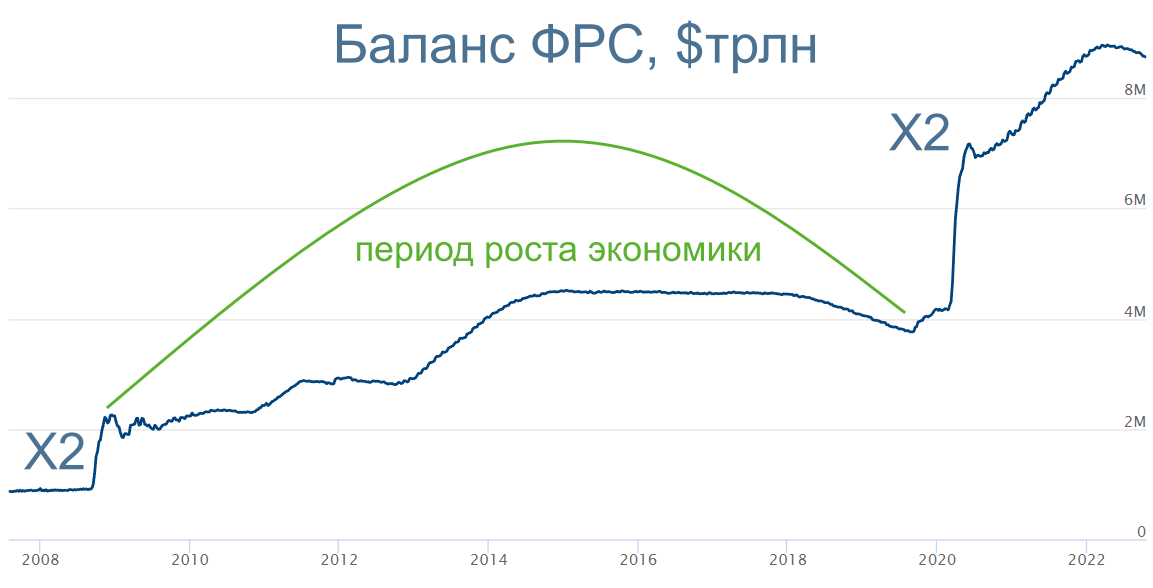
Во время мирового финансового кризиса 2008г. (начавшегося с ипотечного кризиса в США) ФРС для поддержки экономики более чем вдвое увеличила свой баланс, скупая активы и вливая деньги в экономику. В последующий период роста с 2010 по 2020гг. регулятор должен был его разгрузить, но не сделал этого.

С приходом пандемии в 2020 году ФРС вновь более чем в два раза нарастила баланс, а денежная масса доллара (М2) выросла на 35% за два с половиной года.

Источник изображения: federalreserve.gov

Последствия

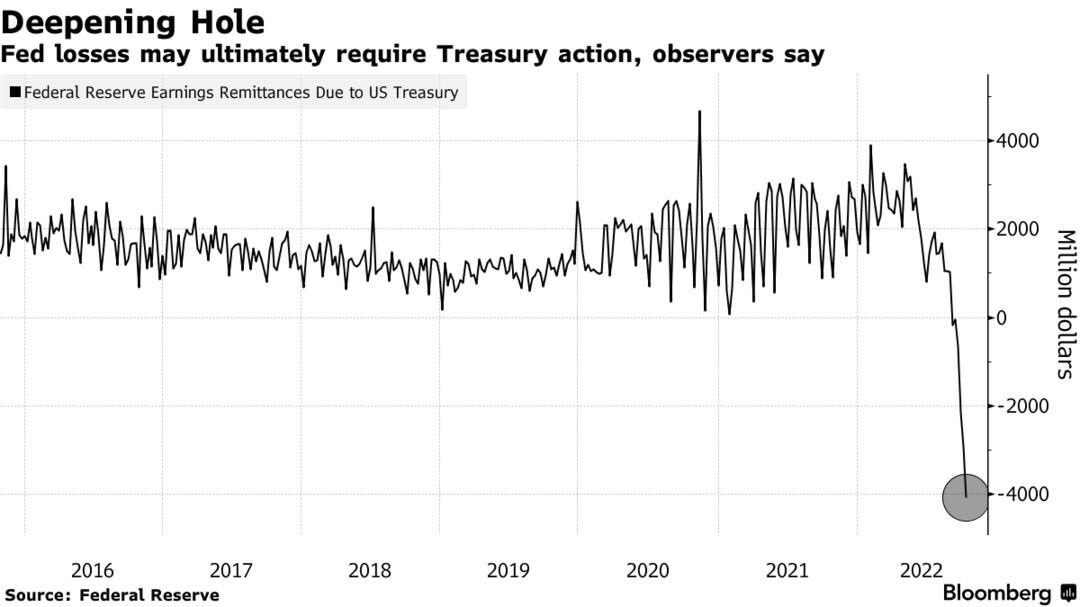
Последующая инфляция была не только естественным, но и неизбежным явлением в условиях чрезмерного финансового вливания. Для ее остановки ФРС использует повышение ключевой ставки, делая заимствования более дорогими. В результате в текущем году сама ФРС накопила долг перед Казначейством США в объеме $5,3 млрд.

Источник изображения: bloomberg.com

США имеют госдолг в размере $31 трлн, его обслуживание также становится более дорогим. Только с октября 2021г. по май 2022г. платежи по процентам выросли на 30% до $311 млрд. А в ближайшие 10 лет сумма выплат по прогнозам достигнет $8,1 трлн.

Ряд аналитиков справедливо полагают, что ФРС будет вынуждена ослабить хватку раньше времени и откажется от дальнейшего повышения ставки уже в начале следующего года. Если к этому времени инфляция не придет к целевой зоне в районе 2,0-2,5% (что маловероятно), для регулятора настанут по-настоящему тяжелые времена.

Смена настроений

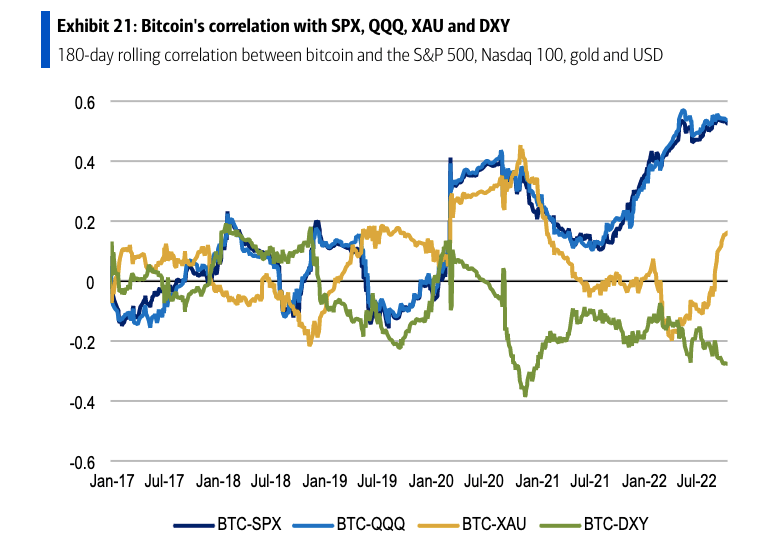
При проигрывании вышеозвученного сценария ряд аналитиков, включая Bank of America, ожидают ослабления роли доллара с ростом интереса к дефляционным активам. В этой связи они отмечают растущую корреляцию Bitcoin с золотом: «Bitcoin – это актив с ограниченным предложением, который в конечном итоге может стать средством защиты от инфляции».

Источник изображения: BofA Global Research

Сейчас ФРС пытается укротить инфляцию стремительным взвинчиванием ключевой ставки. Это уже привело к росту убытков регулятора, которые нужно будет погасить в будущем. Также рост ставки ведет к увеличению платежей по госдолгу, замедлению экономики, снижению конкурентоспособности американских товаров на международном рынке и ряду других негативных факторов. Это способно вынудить ФРС ослабить хватку раньше времени, но тогда инфляция укрепит позиции, а Bitcoin вернется к росту.

StormGain для vc.ru.

Leituras Relacionadas

The War Without a Unified Name: The Domestic Tech Giants' World Model Landscape

The article outlines the diverse and fragmented landscape of "World Models" in China's tech industry, where major players are pursuing similar goals under different names like world foundational models, physical AI, or integrated within autonomous driving and embodied intelligence systems. The core aim is to enable AI to create an internal, dynamic environment for simulation, reasoning, and learning, reducing reliance on infinite real-world data. This "data engine" allows for unlimited generation, experimentation, and iteration. The report categorizes the approaches of different companies: * **Internet Giants:** Alibaba is developing models for linguistic, virtual, and physical worlds (Qwen-AgentWorld, HappyOyster, Qwen-RobotWorld). Tencent's HY-World focuses on 3D, game, and social scenarios. ByteDance leverages its vast video data for a potential "digital twin" model. Huawei integrates its model into industrial applications like smart cars and robotics without separately branding it. Baidu embeds world model capabilities within its Apollo autonomous driving and Ernie systems. * **Automakers:** Companies like NIO, Li Auto, XPeng, and Geely are using world models as virtual "driving schools" and "testing grounds." They generate complex scenarios (e.g., rain, snow) to train and validate autonomous driving systems in simulation, aiming for more capable and safer AI drivers. * **Autonomous Driving Suppliers:** Firms such as Momenta, Horizon Robotics, Haomo.ai, and DeepRoute.ai are building the underlying "world engines." They focus on large-scale video generation for simulation, reinforcement learning, and enhancing end-to-end autonomous driving models, often integrating these capabilities into commercial products. While startups bring focus and innovation, they face challenges like limited data, compute resources, and deployment channels. Large companies possess these advantages and are rapidly transitioning world models from research projects into core business infrastructure powering products in vehicles, games, and industry. The conclusion is that world models represent an evolution and convergence of existing AI fields into crucial industrial infrastructure, moving the competition from simply building a model to effectively deploying it to understand and interact with the physical world.

marsbitHá 7m

The War Without a Unified Name: The Domestic Tech Giants' World Model Landscape

marsbitHá 7m

The Crypto Industry Enters the 'Show Me' Era: Vision Alone Is No Longer Enough

The crypto industry has entered a "Show Me" era, where grand visions and white papers are no longer sufficient to gain traction. This shift is driven by increased skepticism, high-profile bad actors, and notably, the serious entry of traditional finance (TradFi) institutions like BlackRock, Fidelity, and JPMorgan Chase, which are launching real, scaled products such as tokenized funds and blockchain-based settlement. This raises the bar for what constitutes a credible project. The communication dynamic has fundamentally changed. The focus is no longer on "what you are building" but on "what you have built and who is using it." Startups must now provide a "proof stack": verifiable data like mainnet transaction volume and active wallets, genuine partnerships with signed contracts, and evidence of organic product-market fit from real users, not just investors. Announcements must be backed by concrete, chain-verifiable evidence. For communication strategies, this means leading with proven facts and hard data—even if modest—rather than speculative narratives. A compelling story must be grounded in demonstrated results. While vision remains important, the balance has inverted from 80% vision/20% substance to the opposite. This higher threshold ultimately benefits builders with genuine traction, filtering out noise and allowing their real signals to stand out clearly. The "Show Me" era is a permanent maturation, demanding that communication strategies prove value, not just promise it.

链捕手Há 38m

The Crypto Industry Enters the 'Show Me' Era: Vision Alone Is No Longer Enough

链捕手Há 38m

Meta Follows the Trend into Prediction Markets: Can It Avoid Repeating the Failure of the Metaverse?

Meta, the tech giant behind Facebook, has reportedly formed a team to develop "Arena," a new application focused on prediction markets. Users would use platform points to place bets on outcomes in politics, sports, and global events. This move follows Meta's massive, nearly $900 billion, losses from its heavily-invested metaverse division, Reality Labs. The prediction market industry is already showing strong demand, with leading platforms like Kalshi and Polymarket facilitating hundreds of billions in annual volume. Meta, with its 3.56 billion daily active users across its apps, possesses the unprecedented scale to bring this niche activity to a mainstream audience, similar to its past success in cloning features like Stories and Reels. However, Arena faces significant hurdles. Meta plans to start with a points-based system to avoid strict financial regulations, but this may dilute the core incentive of accurate prediction that real-money markets provide. More critically, Meta enters the space with a major trust deficit stemming from its past regulatory battles, notably the failed Libra/Diem stablecoin project, and its controversial history with political content and misinformation. The prediction market sector itself is under increasing regulatory scrutiny, with recent CFTC actions including fines and the first-ever insider trading case. While Meta's vast user base offers a unique opportunity to expand the market, its success hinges on navigating complex regulations and rebuilding the credibility necessary for a platform dealing with sensitive topics like elections. The outcome could range from Meta dramatically growing the industry to Arena becoming a high-profile regulatory target before it can scale.

Foresight NewsHá 55m

Meta Follows the Trend into Prediction Markets: Can It Avoid Repeating the Failure of the Metaverse?

Foresight NewsHá 55m

Trading

Spot
Futuros
活动图片