The Risks in DeFi Stack

HACKERNOONPublicado em 2022-10-17Última atualização em 2022-10-17

Resumo

Decentralized Finance or DeFi is a form of blockchain-based finance that offers financial services without any central intermediaries.

Decentralized Finance or DeFi is a form of blockchain-based finance that offers financial services without any central intermediaries. What used to be a niche ecosystem with a TVL of less than $100 Million in the year 2017 grew to over $200 Billion at the peak of the last bull run in 2022.

TVL or Total Value Locked is the value of the crypto assets locked in a DeFi smart contract. - Source

The flip side of the tremendous growth is that it has become a honeypot for some of the most sophisticated hackers across the world. Billions of dollars have been lost to security vulnerabilities and economic failures.

If you are a crypto believer, you can’t ignore the movement of Decentralized Finance. While the ecosystem is too nascent for us to identify all potential risks, a look at the DeFi stack can help us understand the different ways things can break and thus inform how we can go about participating in the ecosystem.

None of what follows is financial advice. Neither will I claim to be an exhaustive list of risks in DeFi. Treat it more as a starting point and a framework for identifying different risks that may exist in a DeFi Investment Approach.

The DeFi Stack

We can look at the DeFi ecosystem as a combination of the following five layers.

Blockchain Networks - All DeFi protocols are deployed on a blockchain network. The blockchain network provides the computational platform for the execution of the smart contracts that power the DeFi service.

Crypto Tokens - The tokens are the underlying assets that are used by the protocol to deliver a service. A Lending Protocol might enable the lending and borrowing of a particular crypto token to be used by traders as a form of leverage. A Decentralized Exchange might have a pool that allows users to swap one token for another.

Protocol - DeFi Protocols are open-source computer programs that run on blockchain networks and provide financial services.

dApp Interface - These are the web interfaces that users use to interact with the DeFi Protocols. Some wallets such as Argent, Coinbase, and Brew Money offer in wallet integrations with Protocols too directly from the mobile.

Wallets - Cryptocurrency wallets hold the private keys that allow users to make payments, deploy and withdraw funds from defi protocols, and more.

Risks in Blockchain Network Layer

Unlike popular perception, blockchains are not infallible. Security vulnerabilities can allow malicious actors to siphon off funds or take over control of the network.

The 51% Attack

A 51% Attack on a Blockchain Network is a scenario where one single entity or group has control over 50% of the network hash rate. The implication of this is that the group can censor transactions, and reorder and rewrite blocks leading to double spending where a network participant can spend/utilize the same asset multiple times.

"Hashrate" refers to the total combined computational power that is being used to mine

and process transactions on a Proof-of-Work blockchain, such as Bitcoin. - Source

A 51% attack while complex and expensive to pull off is a risk that even mature blockchain networks such as Bitcoin have had to face at some point in time.

Bitcoin’s reckoning with 51% Attack

In 2014, ghash.io, a popular bitcoin mining pool for a brief duration of 24-48 hours had over 51% of Bitcoin’s hash rate. While GHash didn’t demonstrate any signs of malicious intent, it did raise debates on how bitcoin can avoid such scenarios of a pool or entity taking over 51% of the network’s hash rate. In this particular case, miners from the pool volunteered to move away from ghash. Moreover, ghash publicly vowed to limit its hash rate to 40% of the network’s hash rate.

A mining pool is the pooling of resources by miners, who share their processing power over a network, to split the reward equally, according to the amount of work they contributed to the probability of finding a block. - Source

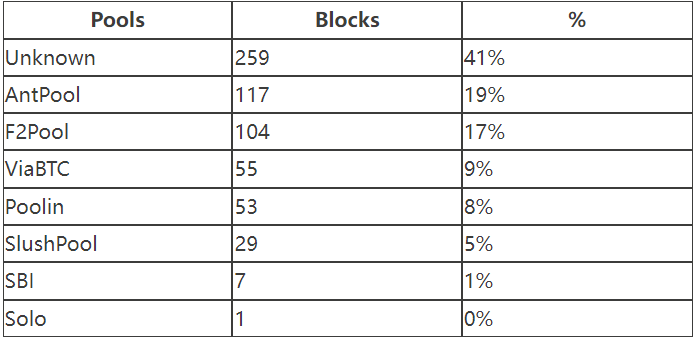
Bitcoin hash rate is more widely distributed today. For instance, the last days of data for blocks mined look like the following. The largest mining pool makes up for 19% of the network’s hashrate.
51% Attacks on Ethereum Classic

Ethereum Classic blockchain came into being after the infamous The DAO Hack. It has a market cap of over $4 Billion. In August 2020 Ethereum Classic was attacked three times and over $5 Million were siphoned off from the network through double-spending.

Vulnerabilities in Blockchain Network

Eventually, blockchain networks are powered by code and code can be buggy. In August 2010 an anonymous hacker was able to exploit a bug to create 184 Billion Bitcoin. Bitcoin supply is supposed to be capped at 21 Million. The anomaly was detected by the Bitcoin community soon. Satoshi Nakamoto coded up a fix for the issue and rolled it out within 5 hours that soft forked the network to state before the faulty block was mined.

In blockchain technology, a soft fork is a change to the software protocol where only previously valid transaction blocks are made invalid. Because old nodes will recognize the new blocks as valid, a soft fork is backwards-compatible. This kind of fork requires only a majority of the miners upgrading to enforce the new rules. - Source

In the recent past, Polygon, one of the leading scaling solutions for Ethereum and a sidechain, lost over 800K Matic worth $ 2 million to a hack. Two white hat hackers reported the vulnerability and Polygon rolled out a fix within 48 hours. Polygon Foundation covered the money lost and paid out a sum of $3.5 Million in bounty to the two white hat hackers.

The Volatility in Crypto Assets

Every asset class has inherent volatility. Crypto Assets more so. In stock markets, a 1% dip makes headlines and is reported as a crash. In crypto markets, it is fairly common to see such fluctuations in prices multiple times in a month.
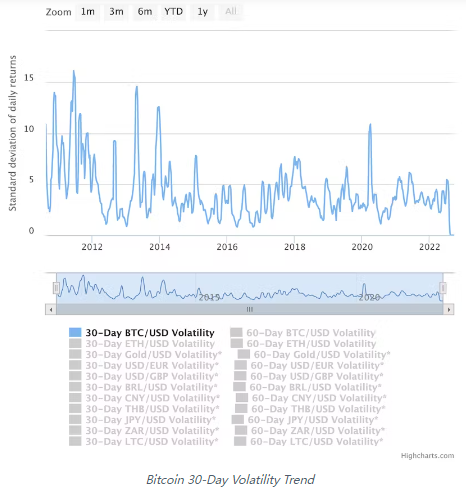
Bitcoin 30-Day Volatility Trend

The above graph shows the trend of Bitcoin price volatility over time. While it may seem that over the years, the volatility is reducing a bit, but still, 5% up and down swings are not that uncommon.

Volatility refers to the amount of uncertainty or risk related to the size of changes in a security's value. - Investopedia

30-Day Rolling Volatility = Standard Deviation of the last 30 percentage changes in Total Return Price * Square-root of number of trading days

Token prices are a function of market perception. The perception can be based on how the specific project is doing or it can be more macro as in where the overall market is headed.

For instance, the crypto market still has a very high correlation with bitcoin price. Whenever bitcoin price dips, we see people liquidating their other crypto assets bringing down the overall market. This is understandable considering even now bitcoin makes up almost 40% of the total crypto market.

Earlier this year, in May, 2022 a bank run on US Terra Stablecoin wiped off $ 40 Billion from the market. Anchor Protocol was one of the most popular lending protocols on Luna that offered ~20% APY on US Terra Stablecoin deposits. While the protocol itself worked as it was supposed to, a known economical weakness in Luna ecosystem led to US Terra losing its peg to US Dollar.

1 US Terra = 3 cents as of now

The Fault in the Protocols

Security breaches, code exploits, and flash loan attacks led to the loss of billions of dollars in DeFi. As per Chainanalysis, over $ 1.3 Billion were stolen in the first 3 months of 2022.

Security Breaches are instances when a hacker gains control of the private key or keys of wallets that have admin controls over the protocol. [The Ronin Hack](https://medium.com/uno-re/biggest-crypto-hack-of-all-time-a-breakdown-of-the-ronin-network-hack-ef8d9e25ba6b#:\~:text=The attacker discovered a backdoor,them using the stolen keys.) is one of the largest hacks in DeFi where allegedly a North Korean Hacking Group stole over $ 600 Million worth crypto tokens.

Ronin is an Ethereum Sidechain developed and operated by Sky Mavis to support their popular play-2-earn game, Axie Infinity.

Ronin Network has nine validators to process the transactions and as long as the majority of them approve a transaction it goes through. The catch was that the nine keys were controlled by just two entities. Sky Mavis had 4 keys and Axie DAO 5. However, Axie DAO had earlier provided Sky Mavis with access to sign transactions on its behalf for a short-term period. The access was never revoked. This miss allowed hackers to gain access to the majority of the keys and process the transactions.

Code Exploits are faults in smart contracts that allow a hacker to siphon off funds. The Polynetwork hack where $610 Million worth of crypto assets were hacked (and later returned) is one of the largest hacks that happened due to code exploits.

Polynetwork is a protocol that enables cross-chain assets transfer.

In this particular case, the hacker was able to figure out a way to invoke a restricted smart contract that enabled them to take control of the wallets that held assets managed by Polynetwork and transfer them to a wallet they controlled.

Frontend and DNS Exploits

Users interact with DeFi protocols by connecting their wallet to a protocol through a web interface. In May 2022 a hacker was able to leverage a vulnerability in the DNS to inject a malicious smart contract on the web interface for mm.finance, a leading DeFi protocol on Cronos chain, and diverted over $2 Million to their wallet.

The domain name system (i.e., “DNS”) is responsible for translating domain names into a specific IP address so that the initiating client can load the requested Internet resources. The domain name system works much like a phone book where users can search for a requested person and retrieve their phone number. - [Learn more](https://www.infoblox.com/glossary/domain-name-system-dns/#:~:text=The%20domain%20name%20system%20(i.e.,and%20retrieve%20their%20phone%20number.)

Losing Private keys or Seed Phrase

Cryptocurrency Wallets store the public key and the private key. The private key is used to access the fund and transfer them. The public key is your address. Private Keys or the more popular seed phrase where a 12 - 24 words phrase is used to generate the private keys.

If a hacker is able to access your seed phrase or your wallet’s private keys, they can take over your assets. Malicious software on your computer or mobile, or phishing attacks that trick users into sharing their seed phrase on a website are some of the common ways in which hackers gain access to their seed phrase and steal assets in your wallet.

In April 2022 an iPhone user lost crypto and NFTs in his wallet when a hacker pretending to be an Apple representative tricked the user to share a secure code that was sent to the user’s number and use that to hack into their iCloud Account. From there on, they were able to access the user’s wallet seed phrase

Navigating DeFi Safely

It is essential to practice caution when navigating DeFi considering the different risks that exist in the stack. As you delve into the DeFi Ecosystem, choosing the right platforms and ecosystems for your risk tolerance is a critical step. A few things to look for

Track record

How long has the blockchain or protocols been in existence? How have they performed in volatile market conditions?

What has been the TVL's growth over time?

What is the caliber of the core team working on the protocol or chain?

Independent Audits

Has it gone through independent security audits?

How robust are their processes? Here processes can range from their development activities, and security practices, to taking key decisions with community participation

Liquidity

How much liquidity the asset or the protocol has? This is especially critical in selecting an asset or protocol. Low liquidity can translate to higher risks.

How much AUM does the DAOs’Community’s treasury have?

A lot of products have emerged that help with such research. A few of them are DeFiLllama, DeFi Safety, and Exponential Finance. Beyond this, there are a few things you can do as a user that can ensure the safety of your funds

Maintain Wallet Hygiene

Don’t hold all your assets in a single wallet. Use a Hardware Wallet

Never share your seed phrase or private key online or offline

Maintain multiple backups of your seed phrase

Ensure safety in the devices where your wallets reside, desktop, mobile, or browser.

Be cautious about the dApps you’re interacting with and the kind of permissions you are allowing. Do a regular audit of the funds

Stay Informed - You can do all of these yet, if the dapp or protocol you interact with has been hacked, you can end up losing your funds. Stay aware of the happenings in the chain, assets, and protocols you use. You can use twitter for that.

Despite these risks, DeFi presents multiple opportunities for early adopters to not only grow their crypto assets but also get familiar with an emerging phenomenon that will reimagine how financial services are delivered in the coming years.


Criptomoedas em alta

Leituras Relacionadas

Why Does 'AGI Godfather' Ben Goertzel Believe the Future of AI Relies on Blockchain?

Ben Goertzel, known as the "AGI Godfather," argues that the future of Artificial General Intelligence (AGI) must be built on blockchain to prevent its control by a few corporations or venture capital firms. He believes the core AGI code should be free and open-source, but that this alone is insufficient without a decentralized infrastructure to run it affordably. His blockchain project, SingularityNET, and the broader Artificial Superintelligence Alliance aim to create a user-owned, decentralized network for hosting and deploying AGI, contrasting with the closed models of companies like OpenAI and Anthropic. Goertzel criticizes the shift of other labs from open to closed development. He argues that while a closed path is simpler, an open, decentralized model—akin to Linux and the internet—is both possible and ultimately better for humanity. He envisions an "Agent economy" where individuals orchestrate teams of AI agents to perform tasks, including transactions, on an open network rather than corporate clouds. While his current model relies on cryptocurrency, plans include offering paid AI services to businesses with the decentralized blockchain as the backend. Goertzel predicts human-level AGI could arrive by 2029 and warns that a gap in understanding and access to AGI could drastically worsen inequality. The first test of his decentralized approach will be the upcoming release of the Agent Omega Claw.

Foresight NewsHá 2m

Why Does 'AGI Godfather' Ben Goertzel Believe the Future of AI Relies on Blockchain?

Foresight NewsHá 2m

A Company Once on the Brink of Bankruptcy Just Surpassed Bitcoin in Market Cap

On June 22nd, driven by rising stock prices, SK Hynix’s market capitalization reached $1.35 trillion, surpassing Bitcoin's total market cap of approximately $1.29 trillion. This temporarily made it South Korea's highest-valued company. The core driver of this surge is HBM (High Bandwidth Memory), for which SK Hynix is the primary supplier to NVIDIA, holding over 60% market share. AI's demand for high memory bandwidth has translated into immense profitability, with SK Hynix reporting a 72% operating profit margin in Q1. The company's success follows a 13-year bet on HBM technology, beginning in 2009. It nearly failed after the 2001 dot-com bubble, was acquired by SK Group in 2012, and was subsequently recapitalized to continue its long-term HBM development. The article contrasts this with the Crypto AI narrative. Capital currently favors AI infrastructure players like SK Hynix due to "real orders, physical barriers, and quantifiable profit margins." In comparison, Crypto AI projects, promising decentralized compute and data markets, remain largely conceptual with limited tangible progress. Examples include Bittensor, whose core mechanisms are still under development, and Bitcoin miners transitioning to AI, who face significant funding gaps and execution challenges. The piece cites analysis suggesting the AI sector has absorbed nearly all new market liquidity since 2022, leaving little for crypto. It concludes that the current AI infrastructure红利 is captured by entities with proven technical barriers and supply capabilities, while crypto networks still need to define their concrete role in the value chain.

链捕手Há 43m

A Company Once on the Brink of Bankruptcy Just Surpassed Bitcoin in Market Cap

链捕手Há 43m

Bittensor Moves Towards Ultimate Decentralization: The Critical 18 Months for the TAO Ecosystem is Here?

Bittensor, a decentralized AI protocol, is accelerating its transition to full decentralization over the next 18 months, as outlined in a recent post by co-founder Const. The project currently operates in a "semi-decentralized" state: ownership and network participation are open and permissionless, with TAO distribution based on competitive contribution. However, protocol upgrades and governance have remained under core team control to enable rapid iteration in the fast-evolving AI sector. This strategic shift comes as the ecosystem matures, boasting 128 subnets and a large community. Const argues that continued centralization now poses risks, including single points of failure and regulatory scrutiny. The upcoming decentralization roadmap includes optimizing validator competition, opening liquidity pools, introducing governance rights for Alpha holders, and refining economic models. The move could fundamentally reshape TAO's value proposition, adding governance premiums to its existing valuation based on AI narrative and scarcity. It also signals a potential maturation of the AI crypto sector, where competition may shift from hype to sustainable protocol design and real economic activity. Bittensor positions itself not just as another AI token, but as foundational infrastructure aiming to decentralize intelligence production—analogous to Bitcoin's role in decentralizing money—with the goal of creating a resilient "Millennium Intelligence Federation."

marsbitHá 55m

Bittensor Moves Towards Ultimate Decentralization: The Critical 18 Months for the TAO Ecosystem is Here?

marsbitHá 55m

Japan's AI Dark Horse Emerges: How a 7B Small Model Challenges Fable and Mythos?

In June 2026, Sakana AI's new model Fugu caused a stir in the AI community. Its Fugu Ultra variant achieved scores of 73.7 on SWE-Bench Pro and 82.1 on TerminalBench 2.1, surpassing GPT-5.5 and Claude Opus 4.8, and was claimed to be comparable to export-restricted models like Fable 5 and Mythos Preview. Remarkably, the core of this high-performance system is not a massive model, but a small 7B-parameter RL Conductor model. Fugu operates as a multi-agent orchestrator: the 7B model acts as a "foreman," dynamically analyzing user tasks and delegating subtasks to a pool of top-tier global models (e.g., GPT-5, Gemini 3.1 Pro). It then synthesizes and verifies their outputs. This architecture represents a paradigm shift from monolithic models to an expert-team approach. It enhances performance in complex, multi-step engineering tasks like code review and security testing by enabling cross-validation from specialized models, improving long-session stability and token efficiency. However, Fugu's strengths come with trade-offs: it faces inherent latency due to multiple API calls, relies heavily on underlying US model APIs (creating dependency risks), and its benchmark comparisons with Fable/Mythos are based on reported scores, not head-to-head testing. For Japan's AI ecosystem, which lacks the massive compute and data resources of the US or China, Fugu exemplifies an "asymmetric breakthrough" strategy. Instead of competing directly in parameter scale, it focuses on intelligent orchestration of existing global models, offering a degree of AI sovereignty and resilience. While a significant system-level innovation, its ultimate capability is still bounded by the underlying models it coordinates.

marsbitHá 55m

Japan's AI Dark Horse Emerges: How a 7B Small Model Challenges Fable and Mythos?

marsbitHá 55m

Trading

Spot
Futuros

Artigos em Destaque

O que é BITCOIN

Compreender o HarryPotterObamaSonic10Inu (ERC-20) e a Sua Posição no Espaço Cripto Nos últimos anos, o mercado de criptomoedas assistiu a um aumento na popularidade das moedas meme, cativando não apenas os traders, mas também aqueles que procuram envolvimento comunitário e valor de entretenimento. Entre estes tokens únicos está o HarryPotterObamaSonic10Inu (ERC-20), um projeto intrigante que mistura referências culturais no tecido das criptomoedas. Este artigo explora os principais aspetos do HarryPotterObamaSonic10Inu, examinando os seus mecanismos, a sua ética orientada pela comunidade e o seu envolvimento com o vasto panorama cripto. O que é o HarryPotterObamaSonic10Inu (ERC-20)? Como o nome sugere, o HarryPotterObamaSonic10Inu é uma moeda meme construída na blockchain Ethereum, classificada sob o padrão ERC-20. Ao contrário das criptomoedas tradicionais, que podem enfatizar a utilidade prática ou o potencial de investimento, este token prospera no valor de entretenimento e na força da sua comunidade. O projeto visa promover um ambiente onde utilizadores envolvidos possam reunir-se, partilhar ideias e participar em atividades inspiradas por diversos fenómenos culturais. Uma característica notável do HarryPotterObamaSonic10Inu é a zero taxa sobre transações. Este elemento atraente visa encorajar a negociação e o envolvimento da comunidade, isento de encargos adicionais que podem desencorajar os traders de pequena escala. A oferta total da moeda está fixada em mil milhões de tokens, uma cifra que marca a sua intenção de manter uma circulação substancial dentro da comunidade. Criador do HarryPotterObamaSonic10Inu (ERC-20) As origens do HarryPotterObamaSonic10Inu estão um pouco envoltas em mistério; os detalhes sobre o criador permanecem desconhecidos. O desenvolvimento deste token carece de uma equipa identificável ou de um plano explícito, o que não é raro no setor das moedas meme. Em vez disso, o projeto surgiu de forma orgânica, com o seu progresso a depender fortemente do entusiasmo e da participação da sua comunidade. Investidores do HarryPotterObamaSonic10Inu (ERC-20) No que diz respeito a investimentos externos e apoios, o HarryPotterObamaSonic10Inu também permanece ambíguo. O token não lista quaisquer fundações de investimento conhecidas ou apoio organizacional significativo. Em vez disso, o “sangue vital” do projeto é a sua comunidade de base, que informa o seu crescimento e sustentabilidade através da ação coletiva e do envolvimento no espaço cripto. Como Funciona o HarryPotterObamaSonic10Inu (ERC-20)? Como uma moeda meme, o HarryPotterObamaSonic10Inu opera principalmente fora dos quadros tradicionais que muitas vezes governam o valor dos ativos. Existem vários aspetos distintivos que definem como o projeto funciona: Transações Sem Taxas: Sem taxas sobre transações, os utilizadores podem comprar e vender o token livremente, sem a preocupação de custos ocultos. Envolvimento da Comunidade: O projeto prospera na interação da comunidade, aproveitando plataformas de redes sociais para criar entusiasmo e facilitar a participação. Discussões, partilha de conteúdo e envolvimento são elementos cruciais que ajudam a expandir o seu alcance e a fomentar a lealdade entre os apoiantes. Sem Utilidade Prática: Deve ser notado que o HarryPotterObamaSonic10Inu não oferece utilidade concreta dentro do ecossistema financeiro. Em vez disso, é classificado como um token principalmente para entretenimento e atividades comunitárias. Referência Cultural: O token incorpora de forma inteligente elementos da cultura popular para atrair interesse, conectando-se tanto com entusiastas de memes como com seguidores de criptomoedas. HarryPotterObamaSonic10Inu exemplifica como as moedas meme operam de forma diferente de projetos de criptomoedas mais tradicionais, entrando no mercado como construções sociais inovadoras em vez de ativos utilitários. Linha do Tempo do HarryPotterObamaSonic10Inu (ERC-20) A história do HarryPotterObamaSonic10Inu é marcada por vários marcos notáveis: Criação: O token surgiu de um meme viral, capturando a imaginação de muitos entusiastas de criptomoedas. Datas específicas de criação não estão disponíveis, sublinhando a sua ascensão orgânica. Listagem em Exchanges: O HarryPotterObamaSonic10Inu conseguiu entrar em várias exchanges, permitindo um acesso e negociação mais fáceis pela comunidade. Iniciativas de Envolvimento da Comunidade: Atividades contínuas direcionadas a melhorar a interação comunitária, incluindo concursos, campanhas em redes sociais e geração de conteúdo por fãs e defensores. Planos de Expansão Futura: O roteiro do projeto inclui o lançamento de uma coleção de NFTs, mercadorias e um site de eCommerce relacionado aos seus temas culturais, envolvendo ainda mais a comunidade e tentando adicionar mais dimensões ao seu ecossistema. Pontos-Chave sobre o HarryPotterObamaSonic10Inu (ERC-20) Natureza Orientada pela Comunidade: O projeto prioriza a contribuição coletiva e a criatividade, assegurando que o envolvimento dos utilizadores está na vanguarda do seu desenvolvimento. Classificação como Moeda Meme: Representa o epítome da criptomoeda baseada em entretenimento, destacando-se dos veículos de investimento tradicionais. Sem Afiliação Direta com o Bitcoin: Apesar da semelhança no nome do ticker, o HarryPotterObamaSonic10Inu é distinto e não tem qualquer relação com o Bitcoin ou outras criptomoedas estabelecidas. Foco na Colaboração: O HarryPotterObamaSonic10Inu é projetado para criar um espaço de colaboração e partilha de histórias entre os seus detentores, proporcionando uma via para a criatividade e o fortalecimento da comunidade. Perspectivas Futuras: A ambição de expandir além da sua premissa inicial para NFTs e mercadorias delineia um caminho para o projeto potencialmente entrar em avenidas mais mainstream dentro da cultura digital. À medida que as moedas meme continuam a capturar a imaginação da comunidade cripto, HarryPotterObamaSonic10Inu (ERC-20) destaca-se devido aos seus laços culturais e abordagem centrada na comunidade. Embora possa não se encaixar no molde típico de um token orientado para utilidade, a sua essência reside na alegria e camaradagem fomentadas entre os seus apoiantes, destacando a natureza em evolução das criptomoedas em uma era cada vez mais digital. À medida que o projeto continua a desenvolver-se, será importante observar como as dinâmicas comunitárias influenciam a sua trajetória no panorama em constante mudança da tecnologia blockchain.

1.7k Visualizações TotaisPublicado em {updateTime}Atualizado em 2024.12.03

O que é BITCOIN

Como comprar BTC

Bem-vindo à HTX.com!Tornámos a compra de Bitcoin (BTC) simples e conveniente.Segue o nosso guia passo a passo para iniciar a tua jornada no mundo das criptos.Passo 1: cria a tua conta HTXUtiliza o teu e-mail ou número de telefone para te inscreveres numa conta gratuita na HTX.Desfruta de um processo de inscrição sem complicações e desbloqueia todas as funcionalidades.Obter a minha contaPasso 2: vai para Comprar Cripto e escolhe o teu método de pagamentoCartão de crédito/débito: usa o teu visa ou mastercard para comprar Bitcoin (BTC) instantaneamente.Saldo: usa os fundos da tua conta HTX para transacionar sem problemas.Terceiros: adicionamos métodos de pagamento populares, como Google Pay e Apple Pay, para aumentar a conveniência.P2P: transaciona diretamente com outros utilizadores na HTX.Mercado de balcão (OTC): oferecemos serviços personalizados e taxas de câmbio competitivas para os traders.Passo 3: armazena teu Bitcoin (BTC)Depois de comprar o teu Bitcoin (BTC), armazena-o na tua conta HTX.Alternativamente, podes enviá-lo para outro lugar através de transferência blockchain ou usá-lo para transacionar outras criptomoedas.Passo 4: transaciona Bitcoin (BTC)Transaciona facilmente Bitcoin (BTC) no mercado à vista da HTX.Acede simplesmente à tua conta, seleciona o teu par de trading, executa as tuas transações e monitoriza em tempo real.Oferecemos uma experiência de fácil utilização tanto para principiantes como para traders experientes.

4.2k Visualizações TotaisPublicado em {updateTime}Atualizado em 2026.06.02

Como comprar BTC

O que é $BITCOIN

OURO DIGITAL ($BITCOIN): Uma Análise Abrangente Introdução ao OURO DIGITAL ($BITCOIN) OURO DIGITAL ($BITCOIN) é um projeto baseado em blockchain que opera na rede Solana, com o objetivo de combinar as características dos metais preciosos tradicionais com a inovação das tecnologias descentralizadas. Embora partilhe um nome com o Bitcoin, frequentemente referido como “ouro digital” devido à sua percepção como uma reserva de valor, o OURO DIGITAL é um token separado projetado para criar um ecossistema único dentro da paisagem Web3. O seu objetivo é posicionar-se como um ativo digital alternativo viável, embora os detalhes sobre as suas aplicações e funcionalidades ainda estejam em desenvolvimento. O que é o OURO DIGITAL ($BITCOIN)? OURO DIGITAL ($BITCOIN) é um token de criptomoeda explicitamente projetado para uso na blockchain Solana. Em contraste com o Bitcoin, que fornece um papel amplamente reconhecido como armazenamento de valor, este token parece focar em aplicações e características mais amplas. Aspectos notáveis incluem: Infraestrutura Blockchain: O token é construído na blockchain Solana, conhecida pela sua capacidade de lidar com transações de alta velocidade e baixo custo. Dinâmicas de Oferta: O OURO DIGITAL tem um fornecimento máximo limitado a 100 quatrilhões de tokens (100P $BITCOIN), embora os detalhes sobre o seu fornecimento circulante ainda não tenham sido divulgados. Utilidade: Embora as funcionalidades precisas não estejam explicitamente delineadas, existem indicações de que o token poderia ser utilizado para várias aplicações, potencialmente envolvendo aplicações descentralizadas (dApps) ou estratégias de tokenização de ativos. Quem é o Criador do OURO DIGITAL ($BITCOIN)? Neste momento, a identidade dos criadores e da equipa de desenvolvimento por trás do OURO DIGITAL ($BITCOIN) permanece desconhecida. Esta situação é típica entre muitos projetos inovadores no espaço da blockchain, particularmente aqueles alinhados com finanças descentralizadas e fenómenos de moedas meme. Embora tal anonimato possa fomentar uma cultura orientada pela comunidade, intensifica as preocupações sobre governança e responsabilidade. Quem são os Investidores do OURO DIGITAL ($BITCOIN)? As informações disponíveis indicam que o OURO DIGITAL ($BITCOIN) não tem apoiantes institucionais conhecidos ou investimentos proeminentes de capital de risco. O projeto parece operar num modelo peer-to-peer focado no apoio e adoção da comunidade, em vez de rotas de financiamento tradicionais. A sua atividade e liquidez estão principalmente situadas em exchanges descentralizadas (DEXs), como a PumpSwap, em vez de plataformas de negociação centralizadas estabelecidas, destacando ainda mais a sua abordagem de base. Como Funciona o OURO DIGITAL ($BITCOIN) A mecânica operacional do OURO DIGITAL ($BITCOIN) pode ser elaborada com base no seu design de blockchain e nas características da rede: Mecanismo de Consenso: Ao aproveitar o exclusivo proof-of-history (PoH) da Solana combinado com um modelo de proof-of-stake (PoS), o projeto assegura uma validação eficiente das transações, contribuindo para o alto desempenho da rede. Tokenomics: Embora mecanismos deflacionários específicos não tenham sido extensivamente detalhados, o vasto fornecimento máximo de tokens implica que pode atender a microtransações ou casos de uso de nicho que ainda estão por definir. Interoperabilidade: Existe o potencial para integração com o ecossistema mais amplo da Solana, incluindo várias plataformas de finanças descentralizadas (DeFi). No entanto, os detalhes sobre integrações específicas permanecem não especificados. Cronologia de Eventos Chave Aqui está uma cronologia que destaca marcos significativos relacionados ao OURO DIGITAL ($BITCOIN): 2023: O lançamento inicial do token ocorre na blockchain Solana, marcado pelo seu endereço de contrato. 2024: O OURO DIGITAL ganha visibilidade ao tornar-se disponível para negociação em exchanges descentralizadas como a PumpSwap, permitindo que os utilizadores o negociem contra SOL. 2025: O projeto testemunha atividade de negociação esporádica e potencial interesse em envolvimentos liderados pela comunidade, embora não tenham sido documentadas parcerias ou avanços técnicos notáveis até ao momento. Análise Crítica Forças Escalabilidade: A infraestrutura subjacente da Solana suporta altos volumes de transações, o que pode aumentar a utilidade do $BITCOIN em vários cenários de transação. Acessibilidade: O potencial preço de negociação baixo por token pode atrair investidores de retalho, facilitando uma participação mais ampla devido a oportunidades de propriedade fracionada. Riscos Falta de Transparência: A ausência de apoiantes, desenvolvedores ou um processo de auditoria publicamente conhecidos pode gerar ceticismo em relação à sustentabilidade e confiabilidade do projeto. Volatilidade do Mercado: A atividade de negociação depende fortemente do comportamento especulativo, o que pode resultar em volatilidade significativa dos preços e incerteza para os investidores. Conclusão O OURO DIGITAL ($BITCOIN) surge como um projeto intrigante, mas ambíguo, dentro do ecossistema em rápida evolução da Solana. Embora tente aproveitar a narrativa do “ouro digital”, a sua divergência do papel estabelecido do Bitcoin como reserva de valor sublinha a necessidade de uma diferenciação mais clara da sua utilidade pretendida e estrutura de governança. A aceitação e adoção futuras dependerão provavelmente da abordagem da atual opacidade e da definição mais explícita das suas estratégias operacionais e económicas. Nota: Este relatório abrange informações sintetizadas disponíveis até outubro de 2023, e desenvolvimentos podem ter ocorrido além do período de pesquisa.

97 Visualizações TotaisPublicado em {updateTime}Atualizado em 2025.05.13

O que é $BITCOIN

Discussões

Bem-vindo à Comunidade HTX. Aqui, pode manter-se informado sobre os mais recentes desenvolvimentos da plataforma e obter acesso a análises profissionais de mercado. As opiniões dos utilizadores sobre o preço de BTC (BTC) são apresentadas abaixo.

活动图片