XRP social activity soars to 3-month high as daily price rises 13%

FinboldPublicado em 2022-09-30Última atualização em 2022-10-01

Resumo

The cryptocurrency market seems to be gaining steam again.

XRP social activity soars to 3-month high as daily price rises 13%

The cryptocurrency market seems to be gaining steam again, as most of its assets are back to trading in the green zone, including XRP, which has recorded gains in more than one area – social activity and price increase.

Specifically, XRP’s three-month social activity is on the rise, recording 1.95 billion social engagements from 9,424 social contributors as of September 29, 2022, according to the data and chart posted by crypto and stock market social intelligence platform LunarCrush.
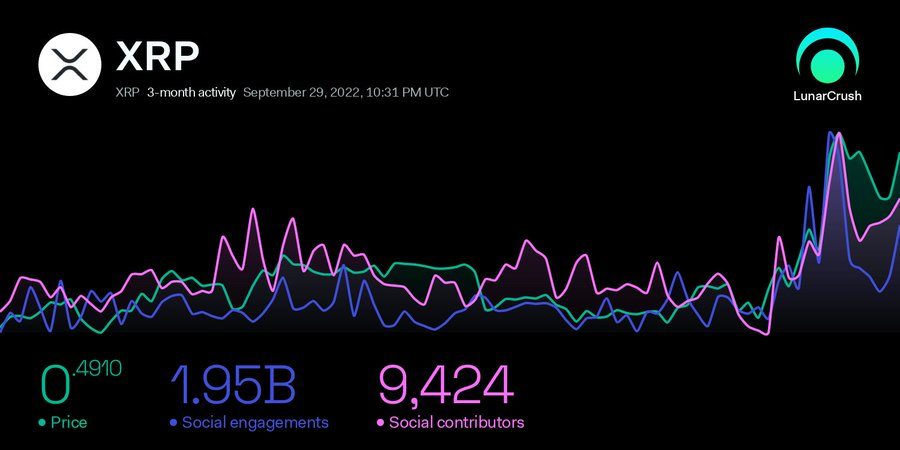
XRP 3-month activity. Source: LunarCrush As explained in the tweet, these figures represent an increase of 38% in social engagements and 8% in the number of social contributors over the period of three months. 
Major growth in three months and on the day
At the same time, the price of XRP has recorded significant increases as well, growing by nearly 59% over the three months leading up to September 30, according to data retrieved from CoinMarketCap. 
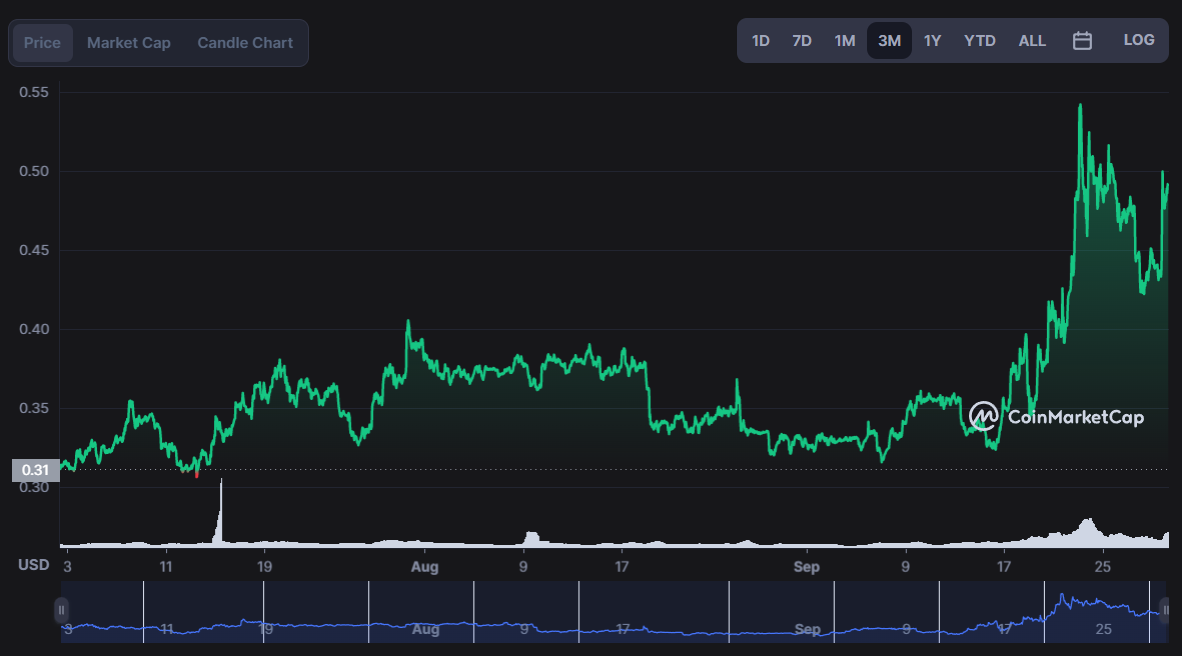
XRP 3-month price chart. Source: CoinMarketCap

As things stand, the price of XRP is currently $0.4926, which represents a 12.84% increase on the day, although still a decline of 7.9% across the previous week. Its market cap now amounts to $24.42 billion, making XRP the sixth-largest crypto by this indicator.
That said, the crypto community over at CoinMarketCap is bearish on the token’s near future, with votes estimating that the decentralized finance (DeFi) token would trade at $0.4166 by October 31, 2022, as Finbold reported.
XRP – a security or not?
Meanwhile, XRP is entangled in a widely publicized lawsuit that the United States Securities and Exchange Commission (SEC) launched against the token’s issuer, Ripple Labs, accusing it of illegally selling the crypto that the regulator considers a security.
Recently, Ripple’s defense team introduced an argument that the XRP tokens cannot be securities as there were no “investment contracts” involved in their issuance, which would give investors rights and force the issuer to act in their interest.
Court updates reflecting on the price
One of the reasons for the surge in the price of XRP could be the news of both sides requesting a summary judgment in the case, which would allow them to skip the trial phase and allow the judge to make a ruling.
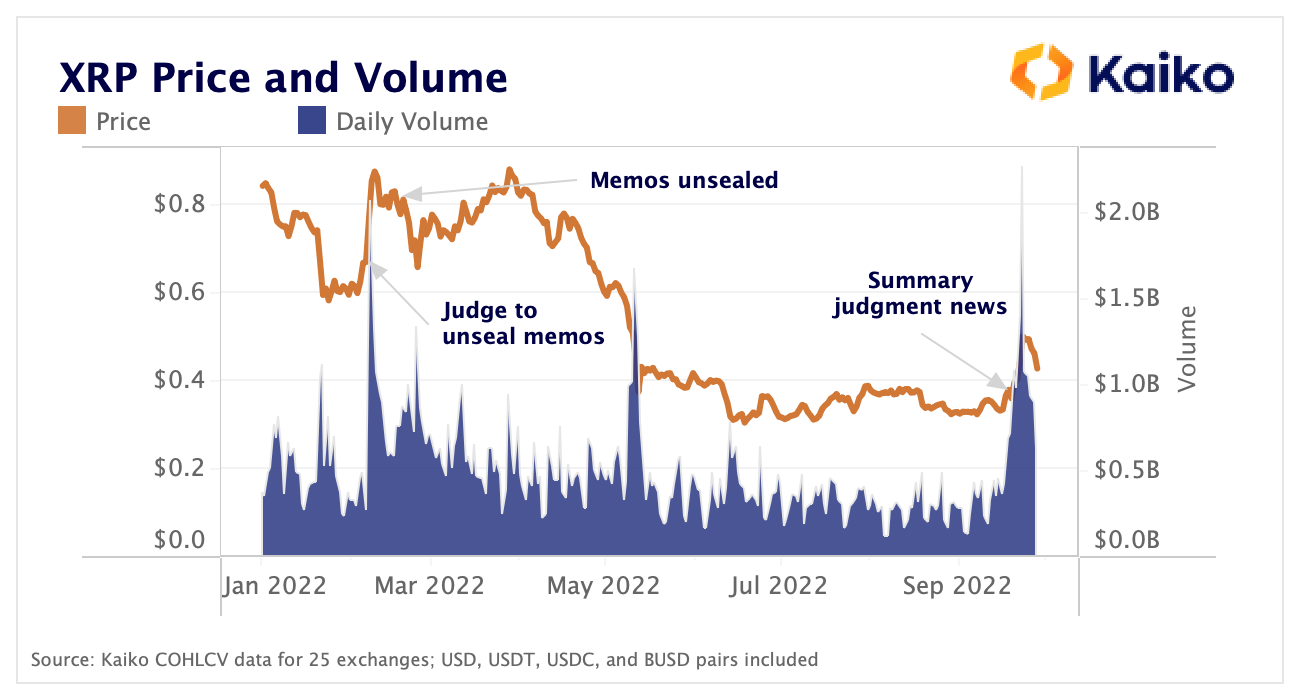
Effect Ripple v. SEC legal updates on XRP price and volume. Source: Kaiko Research Historically, the court updates on this case had a significant impact on the price of XRP, as well as its volume, according to the data shared with Finbold by the financial analytics platform Kaiko Research on September 29.

Leituras Relacionadas

OpenAI's "Most Open" Move: Codex No Longer Exclusively Favors GPT

OpenAI has significantly opened up its Codex programming agent by introducing a "model provider" configuration layer that allows users to connect it with various open-source models, not just its proprietary GPT. Through a configuration file or a simple `--oss` command-line flag, Codex can now route requests to local services like Ollama or LM Studio, or to third-party APIs such as Mistral or DeepSeek. This move is seen as one of OpenAI's most "open" steps, potentially lowering costs and enhancing privacy for developers who can run code generation offline. However, integration isn't seamless for all models. Codex primarily uses OpenAI's newer Responses API, while many open-source models rely on the older Chat Completions interface. This creates compatibility issues, especially for advanced features like function calling. The developer community is already building "routing" or adapter layers (e.g., CC Switch, LiteLLM) to translate between these protocols, enabling hybrid setups where GPT handles planning and open-source models handle execution. Analysts interpret this as a strategic shift for OpenAI: from competing solely on model superiority to controlling the platform and interface standards. By making Codex a flexible, pluggable entry point for AI-assisted programming, OpenAI aims to become the central hub in the developer toolchain ecosystem, even as users gain the freedom to switch underlying models.

marsbitHá 41m

OpenAI's "Most Open" Move: Codex No Longer Exclusively Favors GPT

marsbitHá 41m

When 500 Million People Abandon ChatGPT

ChatGPT's Global AI Assistant Market Share Drops Below 50% Three and a half years after its groundbreaking launch, ChatGPT faces a pivotal moment. While it remains the largest AI assistant globally, its market share has fallen below 50% for the first time, reaching 46.4% as of May, according to Sensor Tower's 2026 AI landscape report. Google's Gemini (27.7%) and Anthropic's Claude (10.3%) are now its main competitors, with Grok, Perplexity, and others also gaining ground. The market has evolved from awe and initial adoption into a phase of product comparison, ecosystem integration, and commercialization. User behavior has matured significantly. Loyalty is low; users readily switch between assistants for specific tasks. Gemini benefits from deep integration within Google's ecosystem (Search, Gmail, Android), while Claude has carved a niche among productivity-focused users with strong retention, nearly matching ChatGPT's. User choice is now influenced by a complex mix of capability, ecosystem, price, use case, and even brand trust. Commercialization is accelerating. AI app downloads continue but growth is slowing, while user spending is rising. Over $4.2 billion was spent in-app during H1 2026. Claude leads in premium subscription conversion rates (13%). OpenAI is expanding its revenue streams, testing ads shown to 17% of ChatGPT users daily by May. This shift highlights the immense financial pressure of model training and inference costs. Despite revenue growth, OpenAI's cash burn is intense, reaching $3.7 billion in Q1 2026. The company projects this could rise to $25-57 billion in the coming years, underscoring the industry-wide challenge of scaling profitably. The symbolism is clear: ChatGPT no longer defines the AI assistant market alone. The era of a single dominant product is over. Gemini, Claude, and specialized tools are collectively shaping user habits and business models. As AI assistants move from novelty to utility—judged on accuracy, efficiency, and value—they are becoming embedded in everyday digital life. ChatGPT may have lost its majority, but AI as a whole is winning, entering a mature, competitive, and diverse new phase.

marsbitHá 43m

When 500 Million People Abandon ChatGPT

marsbitHá 43m

Trading

Spot
Futuros
活动图片