Abstract
This week, we focus on the following events: 1) Fed Hikes Rates to Their Highest Since 2007; Bitcoin Slides Toward US$19,000; 2) Crypto Exchange FTX in Discussions for Up to US$1 Billion Capital Raise at US $32B Billion Valuation; 3) California 'BitLicense' Bill Vetoed by Governor Gavin Newsom.
Project Analysis: The ETH 2.0 merge was officially completed on September 15th, and ETH entered the POS era. For now, ETHW and ETF are the two major hard fork tokens post merge. We analyze the two from several aspects.
Table of Contents
1. Industry overview 3
I. Overall market trend 3
II.NFT 5
III.DeFi 7
IV.Layer 2 8
2. Market news (Source: Coindesk, Odaily) 9
I. Industry news 9
II. Investment and Financing 10
III. Supervision 11
3. Project Analysis 12
I. Introduction 12
II. ETH Hard Fork History 12
III. About ETHW 13
IV. About ETF 15
V. Risks and Opportunities 17
1. Industry overview
I. Overall market trend
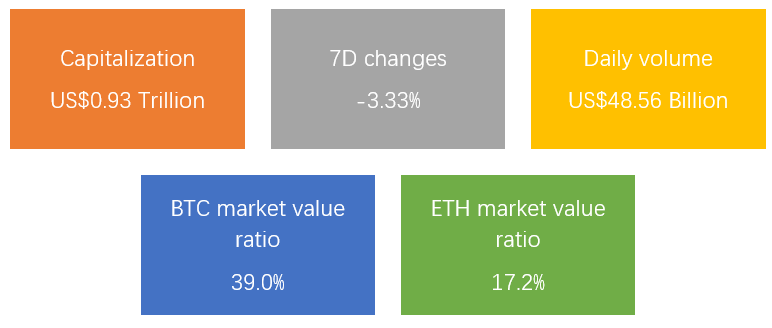
Figure 1. Overall market data
Source: CoinMarketCap
The global cryptocurrency market’s market cap this week saw some changes as a follow-up to the ETH Merge. Bitcoin is currently trading at US$18,986, one of its lowest points over the past few weeks, and some analysts have even called it a "discounted” price. Meanwhile, Ethereum, the second largest cryptocurrency, is currently trading at US$1,311, even lower than its low point from last week. EthereumPOW, the forked token after the Merge, saw a significant increase of 87.76% last week. XRP observed an increase of 29.57% last week. Most of the other top 10 tokens saw a change of less than 10%, but most decreased.
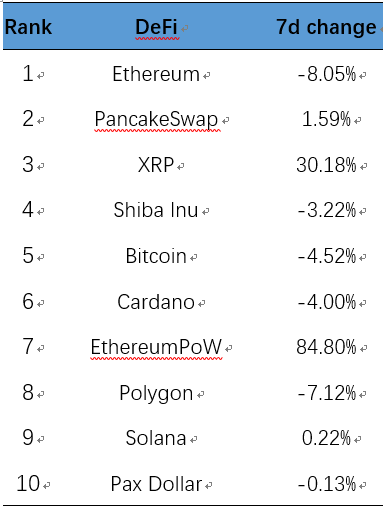
Table 1. Last week's hot currencies
Source: CoinMarketCap
II.NFT
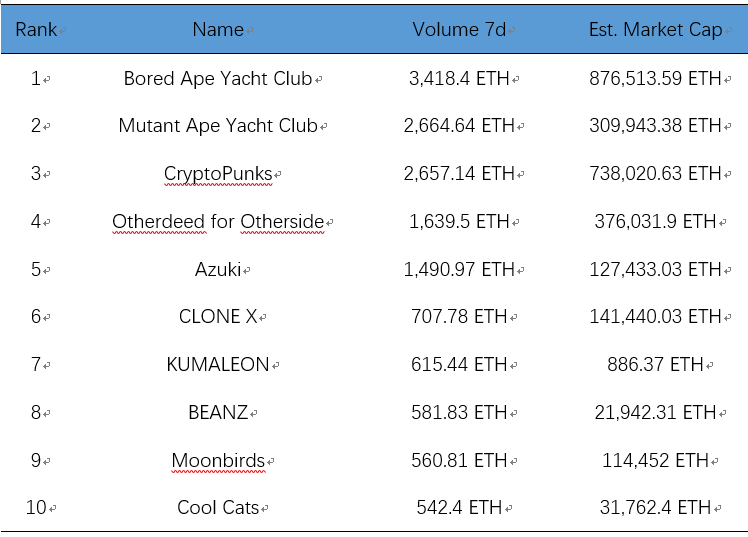
Table 2. NFT Collections Listed By Sales Volume (7d)
Source: CoinMarketCap
The NFT market last week saw a decrease of 22.56%, with a market cap of US$2,340,880,186.04 this week. The 7-day sales volume changed by 6.54% to US$32,766,920.25 and total sales did not change very much at 4.29%, to 58,815. Overall, the NFT market did not see many fluctuations this week, with the brand BAYC back among the top 10 NFT brands this week, while the majority of the other top 10 are familiar brands. Apart from a new brand called BEANZ, all the other brands saw a volume change of less than 0.1%, with BEANZ changing by 0.11%. KUMALEON made it to the top 10 for the first time.
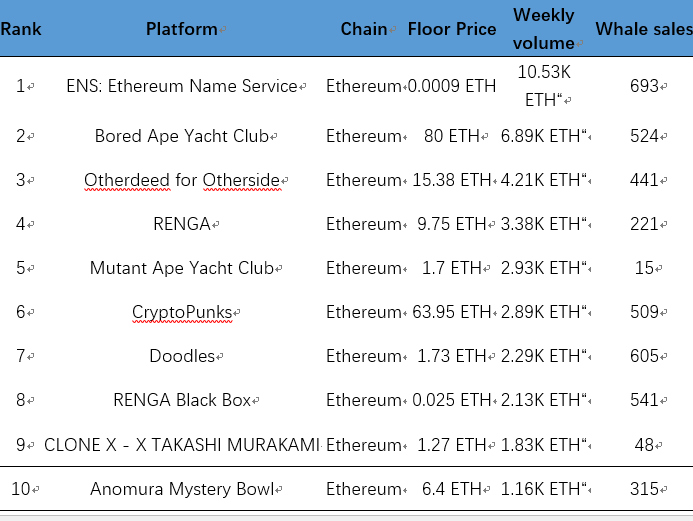
Table 3. Top trending collections on NFTGO (by daily volume)
Source: NFTGO
III.DeFi
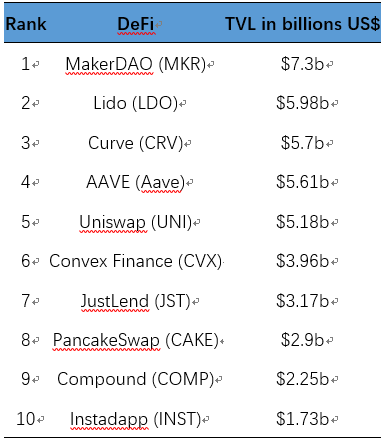
Table 4. DeFi market TVL ranking
Source: DefiLlama
IV.Layer 2
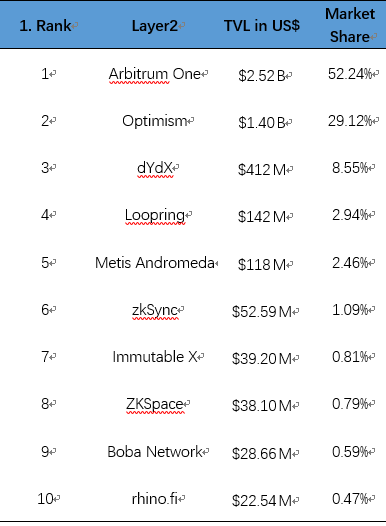
Table 5. Layer2 protocols ranking and market share
Source: l2beat
2. Market news (Source: Coindesk, Odaily)
I. Industry news
Fed Hikes Rates to Highest Since 2007; Bitcoin Slides Toward US$19,000
In a widely anticipated move, the Federal Reserve on Wednesday raised interest rates by 75 basis points (0.75 percentage point), marking the third consecutive time this year that central bankers decided on a hike of that magnitude – and stiffening headwinds in the Bitcoin market.
The federal funds rate will rise to a range of between 3% to 3.25%, the highest since late 2007. The rate had stayed near zero for more than two years. Traders are currently betting that the federal funds rate will go above 4.25% before central bankers pause the campaign.
Once the terminal rate – still a matter of disagreement among central bankers – is reached, some economists project it will likely stay at that level until inflation comes down significantly, possibly to the Fed’s target rate of 2%. Yet, projections by the Federal Reserve's own top officials are estimating rate increases through 2023.
Celsius Network Might Be Planning to Turn Its Debt Into Crypto ‘IOU’ Tokens
Bankrupt crypto lender Celsius Network appears to be considering a plan to turn its debt into crypto “IOU” (“I Owe You”) tokens.
Celsius filed for Chapter 11 bankruptcy protection in July, a month after halting withdrawals because of a liquidity crisis it blamed on “extreme market conditions.” Subsequent bankruptcy proceedings in the Southern District of New York have revealed the depths of Celsius’ financial troubles: The lender owes 500,000 creditors nearly US$5 billion.
Even if Celsius sold all of its assets – including its mysterious, half-finished mining subsidiary, Celsius Mining that Celsius’ executives and bankruptcy lawyers have pinned their hopes on to get out of debt – it would still be left with a US$1.2 billion hole in its balance sheet.
II. Investment and Financing
Crypto Exchange FTX in Discussions for Up to $1B Capital Raise at $32 Billion Valuation
Crypto exchange giant FTX is in discussions with investors for up to US$1 billion in fresh funding at a valuation of about US$32 billion, CNBC reported Wednesday, citing people with knowledge of the talks.
CoinDesk reported last week that FTX was seeking to raise money in parallel with evaluating acquisitions, adding that FTX was also looking to have itself valued at the same US$32 billion valuation it won this year in an earlier funding round.
Crypto Exchanges Binance and FTX Have Both Bid Roughly US$50 Million for Voyager’s Assets
Binance and FTX have made the top bids of roughly US$50 million for the assets of insolvent crypto lender Voyager Digital, according to people familiar with the matter who spoke to the Wall Street Journal. Neither offer has been accepted yet, according to the report.
Binance’s current bid is purportedly slightly higher than FTX’s.
CoinDesk previously reported that FTX and Binance were on the hunt to acquire Voyager's assets in the bankruptcy auction, which was held last week in New York. Final results of the auction are expected to be announced on Sept. 29, although an announcement could come earlier.
Alameda Research, Jump Crypto Lead US$37 Million Funding for 3Commas Automated Crypto Trading Platform
3Commas, an automated crypto trading bot platform, has raised US$37 million in a Series B funding round led by investment firms Target Global, Alameda Research and Jump Crypto, as well as Dmitry Tokarev, founder and CEO of crypto custodian Copper. The funding will be used to advance bot technology, expand the trading ecosystem and enhance developer tools for creating apps for the 3Commas ecosystem, according to a press release.
3Commas raised US$3 million in a November 2020 seed round that included Alameda Research, which was founded by FTX founder Sam Bankman-Fried.
3Commas is a product ecosystem offering trading tools and automated strategies managed by machine learning-driven trading bots that use historical data to help investors utilize different crypto trading strategies. The startup recently launched the DeCommas subsidiary to provide users with easier access to trade automation in decentralized finance.
III. Supervision
California 'BitLicense' Bill Vetoed by Governor Gavin Newsom
California Governor Gavin Newsom (D) vetoed a crypto licensing and regulation Bill seen as a possible West Coast version of New York's "BitLicense" on Friday.
Assembly Bill 2269, sponsored by Assemblymember Tim Grayson (D), would have created a licensing regime for anyone hoping to facilitate crypto transactions, likening it to how money transmissions are currently overseen by the Money Transmission Act. It was one of eight bills Newsom vetoed Friday, He signed 21 other bills, addressing issues ranging from crossing signals to cybersecurity to infrastructure concerns.
"On May 4, 2022, I issued Executive Order N-9-22 to position California as the first state to establish a transparent regulatory environment that both fosters responsible innovation, and protects consumers who use digital asset financial services and products – all within the context of a rapidly evolving federal regulatory picture," Newsom wrote in a message explaining his veto. "Over the last several months, my Administration has conducted extensive research and outreach to gather input on approaches that balance the benefits and risk to consumers, harmonize with federal rules, and incorporate California values such as equity, inclusivity, and environmental protection."
CFTC Penalizes Blockchain Protocol US$250,000, Files Action Against Successor DAO
The Commodity Futures Trading Commission has issued an order filing and settling charges against blockchain software protocol bZeroX and its founders, the CFTC announced in a press release Thursday.
The order penalizes the protocol and its founders Tom Bean and Kyle Kistner US$250,000 for offering illegal, off-exchange trading of digital assets, registration violations and neglecting to adopt a customer ID program required by the Bank Secrecy Act compliance program.
The CFTC has simultaneously filed a civil enforcement action charging the Ooki DAO, the successor to bZeroX, with violating the same laws as bZeroX. It seeks restitution, disgorgement, civil monetary penalties, trading and registration bans and injunctions against further violations.
3. Project Analysis
I. Introduction
The ETH 2.0 merge was officially completed on September 15th, and ETH entered the POS era. The Merge project, backed by the Ethereum Foundation, has always laid claim to a strong community consensus, and hard fork supporters have been seen as an unpopular minority. Vitalik also re-emphasized his opposition to hard forks during the Korea Blockchain Week event, saying that people who push Ethereum hard forks to keep PoW are “outsiders” who “just want to make a quick buck”. Even so, as the merge approached, the more heated the discussions about the hard fork have grown. As for now, ETHW and ETF are the two famous hard fork tokens after ETH merge. We analyze them from several aspects.
II. ETH Hard Fork History
Since its inception in 2015, Ethereum has experienced many hard forks:
●ETC
ETC is the result of the first hard fork in Ethereum’s history as a result of an incident that occurred in 2016. The contract bugs in the DAO led to funds being stolen by hackers. Groups that disagreed with the hard fork continued to support the old blockchain, i.e., admitting to the loss of funds. ETC is the most controversial fork, with the market cap currently ranking 19th on CoinMarketCap.
●ETZ
ETZ was launched by a group of technology enthusiasts in 2018 to create a better decentralized application platform. But it has few supporters — the dApps have not been developed, and its token price is almost zero.
●Hard forks to reset Ethereum difficulty bomb
The difficulty bomb aims to encourage Ethereum’s smooth transition from a PoW chain to a Proof of Stake (PoS) chain. Artificially increasing block difficulty, so miners cannot continue to produce blocks and obtain rewards, would serve to discourage the coexistence of the new chain and old chain. However, due to the technical progress of ETH2.0, the difficulty bomb has been repeatedly delayed and reset six times, resulting in six hard forks. These hard forks brought no controversy or any new forks.
ETC, backed by big miners, is a successful example of an Ethereum hard fork. Unlike current times, people in the industry at that point in time had very distinct conceptions of what decentralization meant. The technical implementation for the hard fork was relatively easier, and there was no need to consider the smart contracts or their tokens. For ETH 2.0, a hard fork would need to retain the functions capable of executing smart contracts on Ethereum, completing historical data and current user status. That is to say, the new PoW chain has to record all accounts, their respective balances, and all smart contracts which were deployed and run in the EVM. At this point, the same applies to the forks. Both the original chain and the forked chain before the fork time point have the same blocks. But after the fork, miners who support the PoW forked chain will continue to generate blocks and ledgers while following the new rules. It is possible that this rule removes the difficulty bomb or EIP-1559, making block rewards higher and resulting in more profitability for miners. The setting of the new rules means that the PoW fork chain needs to develop new node clients, browsers and wallets. The fork also needs to be supported by exchanges and custodians.
III. About ETHW
What is ETHW?
The EthereumPoW network is a fork of the Ethereum network. The native token for the EthereumPoW network is ETHW. In simple terms, a fork changes the functionality of the blockchain network drastically. EthereumPoW was born because a small but vocal group in the crypto community believes that the network should stick to the PoW consensus mechanism. Many of these are miners, who wish to hold onto their revenue as Ethereum switched to the PoS mechanism on September 15. In recent months, prominent crypto miner Chandler Guo and others have campaigned for ETHW, claiming Ethereum 2.0 will drive crypto miners out of work. Since the launch, there have been over 1.7 billion transactions. The total number of addresses holding ETHW now stands at over 254 million.
As Chandler Guo said in a YoutTube video, ETHW is essentially a DAO. The Ethereum Foundation abandoned miners, and the original intention of this DAO is to serve as a platform for miners and developers who wish to support miners.
Supporting Exchanges: Huobi, FTX, Gate, Kraken, Poloniex, OKX, MEXC, Bybit.
ETHW Price
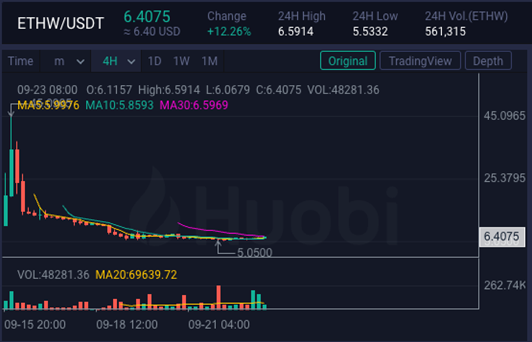
Figure 2: ETHW Price on Huobi
Source: https://www.huobi.com/en-us/exchange/ethw_usdt/
ETHW Hashrate
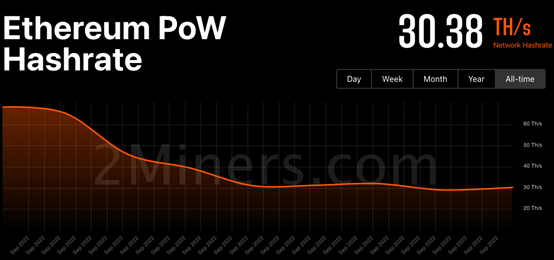
Figure 3: ETHW Hashrate
Source: https://2miners.com/ethw-network-hashrate
IV. About ETF
What is ETF (Ethereum Fair)?
EhereumFair is an Ethereum fork token. It keeps the PoW mechanism, and anyone can participate without restrictions. As the public facing allocation arm of the EthereumFair Foundation, ETF provides funding and other forms of support to eligible projects working to improve EthereumFair. It focuses on work that strengthens EthereumFair’s foundations and enables future builders, such as open source tooling, building blocks and libraries, research, community building, educational resources, open standards, infrastructure and protocol improvements.
ETF support is generally directed toward enabling builders rather than end-users: strengthening EthereumFair’s infrastructure, expanding the range of tools available to those building on EthereumFair, gaining a deeper understanding of cryptographic primitives, and growing the builder ecosystem through education and community development. It claims to be open to supporting work from people and teams of all kinds.
There is little information on the ETF on the Internet, and its official website contains a scant amount of data.
Supporting Exchanges: Huobi, Poloniex, etc.
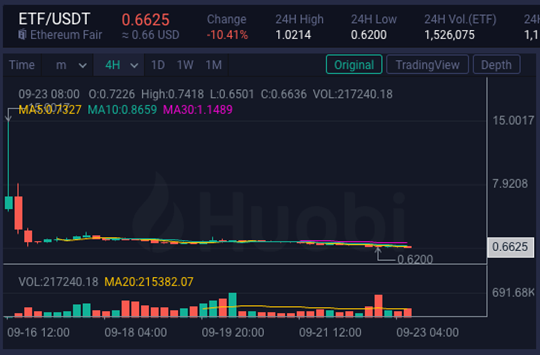
ETF Price
Figure 4: ETF Price
Source: https://www.huobi.com/en-us/exchange/etf_usdt/
ETF Hashrate
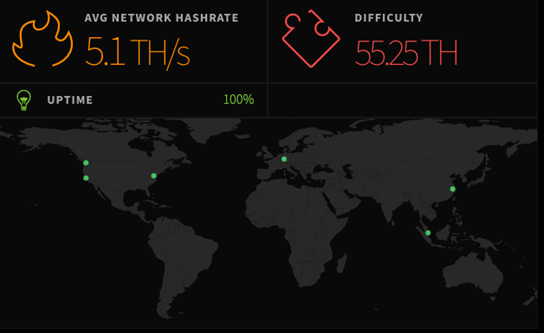
Figure 5: ETF Hashrate
Source: https://state.etherfair.org/
V. Risks and Opportunities
Because of the reliability and authority of the Ethereum Foundation, the vast majority of protocols, NFTs and companies have chosen chains that only support ETH. Forks such as ETF and ETHW is not supported by mainstream oracles, companies and protocols. This also directly caused the smart contracts on the chain to fail to function normally for a period of time after the fork. Stablecoins are even more crucial because stablecoins are backed by companies. If one wishes to re-establish the ecology and applications on the chain, one would need a large number of developers and users to support the new chain. However, Chandler Guo recently said that the most important function of ETHW is to back up ETH to prevent irreversible errors in the operation of the new mechanism.
Right now, the most beneficial factors in support of Ethereum forks are miners and exchanges. Exchanges who seize this opportunity can gain a large number of users to pledge and trade. For miners, the ETH chain has abandoned them, and a large amount of hashrate is idle. It is necessary to find a high-yield POW chain for mining. ETHW and ETF may not be able to amass relatively considerable income, but it is also a direction that can be promoted.
Caution needs to be exercised for ordinary users buying such assets. ETHW and ETF look to be very unstable assets in the near future. From the perspective of hashrate, they are only supported by a small number of miners, and there is a high possibility of the chain being attacked.
About Huobi Research Institute
Huobi Blockchain Application Research Institute (referred to as "Huobi Research Institute") was established in April 2016. Since March 2018, it has been committed to comprehensively expanding the research and exploration of various fields of blockchain. As the research object, the research goal is to accelerate the research and development of blockchain technology, promote the application of the blockchain industry, and promote the ecological optimization of the blockchain industry. The main research content includes industry trends, technology paths, application innovations in the blockchain field, Model exploration, etc. Based on the principles of public welfare, rigor and innovation, Huobi Research Institute will carry out extensive and in-depth cooperation with governments, enterprises, universities and other institutions through various forms to build a research platform covering the complete industrial chain of the blockchain. Industry professionals provide a solid theoretical basis and trend judgments to promote the healthy and sustainable development of the entire blockchain industry.
Contact us:
Website: http://research.huobi.com
Email: research@huobi.com
Twitter https://twitter.com/Huobi_Research
Telegram: https://t.me/HuobiResearchOfficial
Medium: https://medium.com/huobi-research
Disclaimer
1. The author of this report and his organization do not have any relationship that affects the objectivity, independence, and fairness of the report with other third parties involved in this report.
2. The information and data cited in this report are from compliance channels. The sources of the information and data are considered reliable by the author, and necessary verifications have been made for their authenticity, accuracy and completeness, but the author makes no guarantee for their authenticity, accuracy or completeness.
3. The content of the report is for reference only, and the facts and opinions in the report do not constitute business, investment and other related recommendations. The author does not assume any responsibility for the losses caused by the use of the contents of this report, unless clearly stipulated by laws and regulations. Readers should not only make business and investment decisions based on this report, nor should they lose their ability to make independent judgments based on this report.
4. The information, opinions and inferences contained in this report only reflect the judgments of the researchers on the date of finalizing this report. In the future, based on industry changes and data and information updates, there is the possibility of updates of opinions and judgments.
5. The copyright of this report is only owned by Huobi Blockchain Research Institute. If you need to quote the content of this report, please indicate the source. If you need a large amount of references, please inform in advance (see "About Huobi Blockchain Research Institute" for contact information) and use it within the allowed scope. Under no circumstances shall this report be quoted, deleted or modified contrary to the original intent.